• About
  • Brand Building
  • Film & Drama
  • Writing: Arts & Lifestyle
  • Writing: Interviews
  • Writing: Luxury Brands
  • Writing: Travel

sitanshi talati-parikh

sitanshi talati-parikh

Category Archives: Interviews: Cinema

Priyanka Chopra: Unstoppable Priyanka!

20 Thursday Nov 2008

Posted by sitanshi talati-parikh in Interviews (All), Interviews: Cinema, Interviews: Cover Stories, Publication: Verve Magazine

≈ Leave a comment

Tags

Bollywood, Dostana, indiancinema, Interview, priyankachopra

Published: Verve Magazine, Cover Story, November 2008
Photograph by Atul Kasbekar

From Bareilly to Boston and Manhattan to Mumbai, the cover girl many times over, is leading a fairy-tale life. Firmly entrenched in Bollywood, Priyanka Chopra will have a record six releases this year. Dostana, where she plays an editor at Verve, releases this month and promises to be a rollicking watch. Sitanshi Talati-Parikh finds the vivacious actress full of soul, spirit and spunk

Priyanka01

It is an ordinary Thursday. What makes it extraordinary is the glitter of star power that suffuses the morning with a powerful glow. The lithe, dusky beauty saunters into the make-up van, face barely visible under her enormous shades, dressed in “comfort clothes” – leggings and a long spandex top in her favourite colour, black – after a late shoot the previous night. We look up with trepidation, as she emerges a considerable while later, our allotted time ticking ominously away. Flashing dazzling smiles at everyone, Priyanka Chopra faces the camera, barely wincing in the painfully high Dior heels, which are at least a size too big for her – by her own confession, she was “born in heels”. Ace photographer, Atul Kasbekar, coaxes fluid motion from the svelte actress. She immediately picks up the beat of the music pulsating in the tiny studio and twirls, twists at her slender waist, gracefully cuts the air with the circular motion of her lean arms, flips her hair and throws herself into the scheme of things, with ferocious enthusiasm and buoyancy. It’s a perfect first shot. As the music suddenly stops, and her personal iPod is hastily summoned, with barely noticeable displeasure, she confides, “I can’t think or function without music. My van, my room, my car are always blasting music, so the five minutes I get, become my chill out zone. And besides my family, that’s the one thing I find time for.”

With the kind of schedule she keeps – 25 films in less than five years, not a single holiday or vacation since, working literally 20 hours a day – she is playing a serious juggling act with work and family. “I really don’t find time for my family – I take it for granted that they will come and hang out with me.” Being the first-born to parents who left a flourishing medical practice to ensure that her career took off, it is evident that Priyanka has done them proud. The senior Chopras unobtrusively watch their daughter’s shoot, the mother with a slight smile as she notes the near-perfect shots being reflected on the computer screen, and the father sits back quietly and takes in the confidence of his offspring with teary-eyed pride. Rarely present while his daughter is shooting, the Verve shoot takes Dr. Ashok Chopra back in time. He recalls his 12-year-old girl flouncing in front of a full-length mirror (her only demand from her parents) singing ‘Mere khwaabon mein jo aaye…’ from Dilwale Dulhaniya Le Jayenge – Priyanka’s absolute favourite film of all time. Even now, she recalls in the blink of an eye the same sparkle, head toss and look of romantic fervour.

“Today my dad is home, living his life to the fullest – I am so grateful for that.” She went through a rough patch – possibly the only glitch in an ostensibly dream-like life – when she watched her father go through a serious illness that took him two years to recover from. She was, at the time, shooting for one of the most important movies of her career, Krrish and wrapping up Bluffmaster. “Your father is always your invincible superhero, to whom nothing can ever happen, because he is the one who protects you – and then suddenly tables turn and you have to protect him. I felt so helpless and lost. I didn’t know how to deal with it.” But deal with it, she did. She would spend nights between shoots at the hospital, thankful that this happened at a time in her career when she could provide the best possible treatment that money could buy, without compromising on her work. A year earlier, it would not have been possible.

The July-born Cancerian’s amiable personality and warmth bubble to the surface as she reminisces about the people close to her heart. Her younger brother, Siddharth, is very proud of having a ‘hot’ older sister. She admits, “I am a self-confessed bully. I used to make him do all my work and I even used to dress him up as a girl! For seven years I was the only child and my parents’ most prized possession. And then he came – I used to pinch him and make him cry. My dad would come in and I would quickly pretend that I was holding and pacifying him!” She laughs unselfconsciously. “I love him – he is my greatest weakness. I spoil him, like he is my child.”

Friendships have their own familial bonds. Hailing from an army family, spending most of her childhood on the move, from Bareilly to Jamshedpur, and Iowa, New York and Boston, Priyanka has still managed to cultivate some lasting friendships – her childhood friend, Tamanna, for instance, who flies down from Delhi to meet her on her birthday. “I’m very close to my friends. If you have even two or three ‘4 a.m. friends’ who you can depend on for your life – and you know if you were kidnapped and someone asked you who would vouch for your life, it would be those people – then you’re very lucky. Though all your colleagues are your friends, there are only a few people whom you consider family.”

That’s what Dostana is about – three friends who consider each other family – and how a relationship between great friends is formed and broken. Priyanka, who loves the outdoors, admits that the movie had the best outdoor shoot she has ever experienced. Two months on location in Miami, she found herself gleefully entertaining her “khandaan” from America. Relatives were “crawling out of every room, closet and bathroom” in her three-bedroom apartment. Priyanka dressed for the shoot every morning with people passed out on the couch. Her family was on holiday and would come and hang out on the set. The euphoria was catchy. It is easy to visualise the massive on-location party, including malls and beaches (think fabulous South Beach), with a variety of restaurants and live music bars – all pulsating with energy that Priyanka feels will translate positively on screen.

In a film about friendships, what were the off-set relationships like? “I never thought I would bond with Tarun (Mansukhani) as much as I did. Initially, I didn’t know him very well and I didn’t think I would, either. He seemed like a really serious guy – we fought like cats and dogs, and made up instantly. I keep telling his wife, Karuna, that I play his on-set wife because we are constantly fighting like a married couple! But he has so much clarity as a director.” Karan Johar popped in for a bit and Hiroo Johar was officially the “big mother hen”. Abhishek Bachchan and John Abraham, her co-stars in the film, who pretend to be a gay couple to get an apartment to live in, spent all their off-screen time together, leading Priyanka to quip that they took their roles quite seriously!

John Abraham was the self-proclaimed fitness guru on the set, training everyone – the make-up maestro Mickey Contractor, included. Every day, after the shoot, everyone would land up at the gym. Priyanka studiously followed the regime – despite the fact that she generally doesn’t work out at all – to ensure that she looked prime for her swimsuit scene in the movie. Admiring her trim body – slimmer than she has ever been – It is hard to believe that she doesn’t work out or diet, after seeing how even the ramp-size Dior outfits at the Verve shoot are too large for her. She leans forward with a conspiratorial whisper, “being overworked and underpaid is the mantra for losing weight”.

Priyanka’s character in Dostana is an editor at Verve, and is dressed in accordance to the location. “In Miami, anything’s possible. I wore shorts, high heels and a shirt to work – and I was over-dressed!” Priyanka hopes the fashion critics will find it equally appealing. “If you try to please the critics, making films trying to keep in mind what the fashion industry is going to say, then you’ll never be able to experiment.”

The actress, who has had no mentor or any formal training in acting, has found herself experimenting through her film career. High on the popularity chart, Priyanka has had her share of missable films and reigned supreme in spite of them. The laugh lines smear away and she quickly retorts, “But that’s normal, right? Nobody can get a track record of 100 per cent. It is against the law of averages.” Have the decisions been based on script alone? “It is not just the script. At every point in my career, each film I did was for a certain reason. It may not have done well, but at that point doing that film or finding that film was very important.” Andaaz and Hero gave her small, but important parts; Kismat was her first solo heroine film; Plan with Sanjay Dutt, made by Sanjay Gupta and Asambhav with Rajiv Rai, were a step up in that ladder. “I never expect anything from any film. I feel when you have expectations, somewhere you are let down.” With a sudden flash of her 100-watt smile she confides, “But I can’t help expecting from these three – Drona, Dostana and Fashion. I’ve worked really hard on each one of them and they are very special to me, whatever the fate of the film may be.”

Suddenly retrospective and a tad philosophical, Priyanka appears wiser than her 26 years. Clichés appear truisms as she applies them to her life – she speaks without any affectation, if a shade reminiscent of her articulate Miss World persona. “It is never the end that matters. It is also the journey – we may think of it as a proverb, but that’s how I have led my life, and it works for me. At this point of time, what I do is very important. What happens in the future will be part of what destiny has in store. The decisions I take now must be with courage of conviction.”

Courage of conviction has definitely got her where she is – able to pick and choose, and have more work on her hands than she has time for. “I’ve always believed that I am destiny’s favourite child.” Not even in her wildest dreams did the naturally talented actress, who was considering a career in aeronautical engineering (“making planes and going to NASA”) ever think she would be a part of show biz. “It still feels so surreal.” Neither she nor her family have had the time to retrospect. A mere 17-year-old schoolgirl when she participated in the Miss India beauty pageant – on an entry sent in as a lark by her family – she had just finished school when she became Miss World. “I had to grow up in a month!” She had to reconcile herself from a teenager in sneakers riding a bicycle to a young woman in a sari gracefully balancing a tiara on her head. “They say that the head that wears the crown rules the world. It’s not easy and it wasn’t. I still don’t remember how I did it – I only followed instructions – I was almost robotic in what I did. I only remember being myself since the last few years – since I was 22 or 23. Before that I was always so withdrawn, wary of being in this industry, not knowing anyone, wanting to protect myself and my family. Everything just happened to me. I feel somebody up there is holding onto my little finger, guiding me through life, which is why I never question what’s happening. I know if something bad is happening, this too shall pass, because there is a reason why I am here.” And what about ideals of changing the world that beauty pageants inspire? “I never had aspirations to conquer or change the world. I’m just playing my little part in the bigger picture and am happy that I am able to contribute.”

The strong girl is also incredibly soft-hearted and considerate. Very fond of children, she swings into the shoot in her gold Dior dress with her spot-boy’s son on her arm, smiles and poses for multiple pictures with their family. Later, while giving bytes to a news channel, she notes with the corner of her eye a man bent double with heavy equipment standing behind waiting for her to finish, and she immediately stops and gives way. A self-confessed “mush-pot”, she has a major weakness for romantic comedies, though she can watch creepy horror films with equal fascination. She would often get inspired and write poetry on little paper napkins – being a fan of prose, shayaris and Urdu – though she hasn’t done that in a long time. With a sudden twinkle she reveals that she would love to be serenaded – but with originality and spontaneity. “Buying red roses and sending them is so thoughtless! I prefer thoughtful gifts. A hand-written note would mean so much more to me than diamonds. Actually, a hand-written note with diamonds would mean a lot more,” she rounds up with a chuckle.

The voracious reader (biographies, chick lit, travelogues) hasn’t even had time to read a script that has been lying with her since the last twenty days. Sleeping four-five hours a day, she only manages to unwind in her white Mercedes, which she calls home. “I have worked every single day in the past few years and there isn’t one day that I regret it. I know the day I wake up in the morning feeling that I am too tired to shoot today, I will retire. Very few people are fortunate enough to love what they do. I really, truly love what I do.” That obviously keeps her steamrolling on. As I step out of her car, I watch her walk to the next shoot with a bounce in her step – despite the fact that she missed lunch entirely while talking to me.
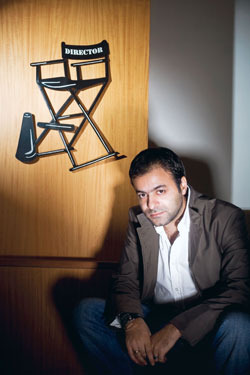
Tarun Mansukhani: Picture Perfect

20 Monday Oct 2008

Posted by sitanshi talati-parikh in Interviews (All), Interviews: Cinema, Publication: Verve Magazine

≈ Leave a comment

Tags

Bollywood, Dostana, indiancinema, Interview, Karan Johar, Tarun Mansukhani

Published: Verve Magazine, Features, October 2008
Photograph by Ritam Banerjee

After assisting with six films, and 10 years in the industry, Tarun Mansukhani debuts as a director with Dostana, releasing next month under the Dharma Productions banner. Sitanshi Talati-Parikh finds him full of steely determination, anticipation and solid allegiance to his mentor, Karan Johar

Director

The sharp, dapper man, just a shade over 30, seems more suited to the corporate world than Bollywood. With crispness of speech and meticulous attention to time, Tarun Mansukhani appears like a tightly wound elastic band – afraid to let go. It makes me ask him a number of times if he is nervous about his big release. “I haven’t thought about it, because I would’ve crumbled under that pressure. It is easier to think of it as just another film.”

Experience has made Mansukhani smarter. He quips, “I tell all my assistant directors that they can’t lie to me – I know all the tricks of the trade, I’ve played them all with Karan!” Waxing eloquent on a superb equation he shares with Karan Johar, the debut director paints a rosy picture. “Karan is the only producer in the world, who when you are hitting a deadline, tells you to relax and take your time. When you go over budget, he asks if it is justified, and if so, says, ‘No problem!’ It makes me want to ask him, ‘Are you sure?’”

Dostana, a romantic love triangle, starring Abhishek Bachchan, John Abraham and Priyanka Chopra, has been shot in Miami. During the shoot, Mansukhani recounts, Johar came to Miami for two weeks, and finally announced, ‘Look, I am really unemployed – I come, I shop and I eat. So I am going back to Mumbai to do more constructive work.’ And he left, not returning until the end of the film. The creative freedom, faith and trust provided by Johar, leaves the former singing praises of a perfect boss and perfect job. And yet, says Mansukhani, “I do not try to stay within Karan’s auteur. In fact, my deliberate decision is to combat what I have learnt – to break the school that we have developed for ourselves.”

While working on the story he has made a conscious effort to use everyday language, even if it is pedestrian language or Hinglish. While the film is youth-centric, it is not just the youth they want to appeal to. “There is an emotion that appeals to all age groups. It is not in its film-making or in its technicality or dialogues. We all have friends, our parents have had friends and our kids have friends. It may not be the dialogue that they might have spoken, or the language; but what is important is that they remember those friendships.”

Dostana is predominantly about the bond of friendship. Mansukhani, who studied in a boarding school, experienced deep friendships, giving him the idea for his first film. He brought in the premise of two men pretending to be gay to stay in an apartment, to make the story interesting. “It was a very conscious effort to not make fun of the gay community. You are not ribbing jokes about them or using them as a ploy.” A mother, who very subtly and with humour shows her acceptance of their sexual preference, adds a progressive element. So, another masala film with a social message? “We can all make art films at the end of the day, but there is a certain reach. Today this is what I would like to make. In the future, I may want to make an extremely gritty film, like Black Friday for instance.”

Talking about friendships, Johar and Mansukhani go back a long way. Johar went to school with Mansukhani’s sister, and when he was looking for an assistant for Kuch Kuch Hota Hai, he thought of him, who at the time was assisting television producer Anand Mahendroo. Mansukhani was not certain he wanted to be a part of commercial cinema – “I was just a Breach Candy boy who didn’t understand Shah Rukh and Kajol. Dilwale Dulhaniyan Le Jayenge was just another film for me.” When he took the FTII exam, confronted by questions on the direction of Swami Vivekanda Part II, he decided to work for Johar instead. The rest is history. The young director sees the future as very promising – making more films for Dharma, and eventually becoming a producer, financed by Dharma. “I don’t see myself breaking away from this family in any form. It is the only family I have known.”

Contrary to expectations, Mansukhani is not a die-hard cinema fan. Having studiously managed to avoid the classics, despite Johar’s repeated suggestions, he remarks unselfconsciously, “I stand clueless at a party when someone talks of classics like Guru Dutt and Satyajit Ray, and glibly put in my two bits, without knowing what they are talking about!” He prefers Sholay, Gadar or the more recent – admittedly candyfloss – films like Dilwale Dulhaniyan Le Jayenge and Kuch Kuch Hota Hai. Quick to laugh at himself, he confides, “The only reason I go to the cinema is because my wife wants to watch a film. While I critique every other film aloud, I am silently taking notes – though no one knows that!”

The resilient director doesn’t give himself even a moment to take a break. Starting work soon with Johar on My Name Is Khan, due for release next year, he is matter of fact about his breakneck schedule. “We are addicted to films – we are not good at anything else. This is our only world.”

And juggling that attitude with a family life? He is quick to compliment his spouse – with whom he has been in a relationship for 12 years and married for three – on being the most understanding person in the world, especially after admitting he hasn’t been to family dinners, and hasn’t met most of her family! He even missed his sister’s wedding when he was busy with a shoot. “I hope that these sacrifices made will accomplish something – at the end of the day, these opportunities may not come to me later. This is what I need to do to make life happen.”

Farhan Akhtar: Rocking Star

20 Monday Oct 2008

Posted by sitanshi talati-parikh in Interviews (All), Interviews: Cinema, Publication: Verve Magazine

≈ Leave a comment

Tags

Aamir Khan, Bollywood, Dil Chahta Hai, Don, Farhan Akhtar, indiancinema, Interview, Javed Akhtar, Lakshya, Luck By Chance, Rock On, Zoya Akhtar

Published: Verve Magazine, Verve Man, October 2008

Heady from the unprecedented success of Rock On!! Bollywood’s latest poster child of youth cinema, Farhan Akhtar talks to Sitanshi Talati-Parikh about his kind of movies, juggling family life with work and how genes make a difference

Superb actor, director, script-writer and now also a good singer (in a raspy sort of way), Farhan Akhtar steals the show with his overwhelming energy and passion on screen. Slipping into the skin of the protagonist, you feel him come alive and half expect him to jump out of the screen. How is it possible to be the master of all trades? Akhtar believes it’s just about applying yourself a 100 per cent in what you have chosen to do. Then there’s his excellent lineage. “I would agree that genetics must play a part in creating a natural leaning towards something that has been so dominant in past generations. But eventually, it cannot make you a good director or actor. That you will have to do yourself,” says the artiste, who keeps pace with a marathon schedule, and is known to never sit idle – not even for a moment.

Powered on by the desire to tell stories, Akhtar believes film-making is a collaborative art form which makes choices about script, crew and cast (among others) very crucial. He takes his time to decide on all these things before getting into a project. “I don’t know what motivates people to make the choices they do – I would hope that my work and its appreciation would serve as a catalyst for other people to do more original work and benefit from it – creatively and at the box office.”

Why, then a sequel to Don? “I found myself obsessed with the title character and the background score. I had to get it out of me. Luckily, I found many people who were as obsessed with the film as I was.” Akhtar has created a cult genre with his youth-centric films. Dil Chahta Hai became the film that revisited Bollywood norms and resonated with a huge college-going audience. That set the pace for Akhtar to continue down a road that told stories that he understood, that he wanted to tell, and which upgraded the passé films into a slicker, smoother and more identifiable medium. At the end of the day, as the film-maker puts it, “it is important to have something to say in an entertaining, engrossing manner.”

Akhtar was not consciously trying to set a social trend. He is clear in stating that, “It is not advisable to design a film keeping in mind its social impact. The design will show if that is the approach. Stay true to the story and do it because you believe in it. If the audience recognises your heart in it, everything else will follow — Rock On!! is being appreciated by an audience of 10 to 60 years of age. If the story has a universal emotional core, then it should be able to connect with all generations.”

And yet, each time it is a different story. Akhtar confesses he is a fan of all genres of movies. Lakshya didn’t do as well in the box office, but it was another story that had to be told. And then came Rock On!! – a simple story, a story you would have heard before, but one that rocked. It was the perfect blend of cinematography, acting, concept, style and above all (as with most of Akhtar’s work) dialogues that work. That are not stilted or refurbished like many of the others are.

There is actually a club of like-minded film-makers, where constructive criticism is an option, of which Farhan Akhtar, Kunal Kohli, Madhur Bhandarkar, Rakeysh (Omprakash) Mehra, Ashutosh Gowariker, Raju Hirani and Vipul Shah are a part. While Akhtar shares a great rapport with Gowariker, to the extent that they “discuss each other’s work candidly, knowing that all views are coming from a space of respect and admiration;” Akhtar’s film-making style is reminiscent of that of Aamir Khan – in that they are both gifted with supreme originality of outlook. And above all, a great sense of characterisation. Both have impeccable tastes in casting – and making an ensemble cast work is often what it takes.

Akhtar is constantly on the look out for talent – whether young or old. The website of Rock On!! actually has a talent hunt for upcoming stars. When questioned whether it was to increase the buzz on the site, he states that it is to find talent, young or old. “A good actor can be hidden inside any person of a age or gender.” That is surprising, considering that Akhtar, like Sanjay Leela Bhansali or Karan Johar, has chosen to work with established actors in his initial films. Akhtar doesn’t attribute this to stalwarts being a safer choice. He is noncommittal in his response. “I have been fortunate to have worked with some big names and talent in my films. That was the need of the script and character. Rock On!! allowed us to work with new talent as it suited the nature of the story. For me, cast is determined by character, not the other way around.”

The film-maker, who considers it a privilege to hail from a legendary family of parents — Javed Akhtar and Honey Irani, and Shabana Azmi – is very firm on the subject of credit. Where once Honey Irani had lost out on credit for her work on Dilwale Dulhaniya Le Jayenge, leading to relations being soured between the two film families, Akthar believes that, “credit is as, if not more, valuable than your fee. The money will come and go but your name will be up there forever. No one can take that away. We are very careful to make sure every single person involved on our films is given their due credit.”

A Martin Scorcese and Woody Allen fan, Akhtar admires their ability to keep reinventing themselves. It appears that he is modelling himself after them, waiting for more hidden talents to surface. Coming up soon is his sister Zoya Akhtar’s film Luck By Chance, in which he is acting. His next directorial venture is slated for 2009. Akhtar prefers not being bottled into acting or directing. “They are both a part of who I am and I hope to keep exploring and learning new things about the art and craft.”

Is his life easy? “I love doing what I do, so it’s not about easy or difficult for me. I try my best.” Married and father of two young daughters Shakya and Akira, Akhtar is constantly playing a juggling act. “I do take my children to set with me when it is possible because it is important that they know where I go and what I do. They should not feel I am disappearing for periods of time without reason.” Known to be exacting, is Akhtar an easy person to get along with? With a light chuckle, he responds, “I get along with myself just fine!”

Sameera Reddy: Girl Transformed!

20 Tuesday Nov 2007

Posted by sitanshi talati-parikh in Interviews (All), Interviews: Cinema, Interviews: Cover Stories, Publication: Verve Magazine

≈ Leave a comment

Tags

Bollywood, indiancinema, Interview, Sameera Reddy

Published: Verve Magazine, Cover Story, November 2007
Photograph: Joy Datta

Bollywood siren Sameera Reddy has stepped out from the shadow of her model siblings into the sizzling world of the big screen. Recently seen schmoozing with the likes of Shakira and George Clooney at the Toronto Film Festival which showcased two of her films, the sultry star, who was also in the news for battling to save an orphanage, reveals to SITANSHI TALATI-PARIKH, that under all that glamour, she is just a simple girl with simple desires

Sameera03

“Being glamorous doesn’t turn my head, because I have been on the receiving end of never being looked at, of never getting a rose on Rose Day in college, of being alone. I am now more wary of superficiality.”

“It was a painful time when nobody even knew I existed – that there were just two Reddy sisters who were models, Sushma and Meghana.”

“We are so opinionated and headstrong, all with ideas about what’s best for the other! Now, when my sisters and I spend precious moments together, it is a riot.”

“Being sexy is just a facet, not the whole. I didn’t start out being a sex symbol, or think that I would be an actress. It was almost like an overnight change.”

“It isn’t fair to be under constant pressure of having to wake up every morning, roll out of bed and come down looking as if you have just stepped out of a Yash Chopra film! But it is a part of who we are and what we are expected to do.”

“I go with the flow, from bubble-headed bizarre roles in Telugu films, to serious acting in Bengali cinema, to masala parts in Bollywood.”

“I am meticulous about learning all the languages in which I act and I understand the meaning of every word that I speak.”

“Being an actor makes you an extrovert. It throws you into the water and forces you to learn to swim. The image is just an extension of what I am supposed to be – but it is really not who I am.”

“The adulation is fantastic – it is what makes all the baniyawalas and rikshawalas recognise me. But, one day it’s going to go away. The day most actors dread, is the day I feel I will be set free….”

“The turning point of my career was being a part of Buddhadeb Dasgupta’s film, Kalpurush. You can’t hide in Buddhadeb’s cinema, it is just you and your character and it is the true test of real acting.”

“I got a renewed sense of confidence when Buddhadeb chose to cast someone like me, when everyone else dismissed me as just a glamour doll.”

“Toronto was a crazy picnic. I went to the Festival with no expectations and ended up meeting all these international celebrities who are so unbelievably down to earth. Having dinner with them seemed like the most normal thing to do!”

“The Indian sari is the sexiest outfit in the world. Why wear Versace and Armani to International festivals?”

“I am mad about travel and I love places with history and culture, like Turkey. I like backpacking; I have spent a month in Thailand, where I learnt how to ride a bike.”

“I am a loner and an introvert. I love sitting by the poolside reading and writing in my diary – which would probably make a fantastic best-seller! I also enjoy knitting.
I shock myself. I can be unpredictable, because I am very impulsive. I follow a strict fitness and diet regime; yet one day I can wake up and decide to eat pani puri off the road, or fly to Paris, and actually do it!”

“I can say something, and then do something completely different.”

“I would never reveal my inner self to anybody.”

“My portable PlayStation is always with me. I love Need For Speed and car racing games. Sam’s Mission, a video game revolving around me, is a great kick, pun intended!
My love life suffers because guys are really intimidated by my image. At the end of the day, I am just a girl, who wants a simple guy she can come home to, not a model, actor or cricketer!”

“My role model is my mother, a part of my dad’s business, a social worker and a constant learner, whose energy even at the age of 61 makes me want to better myself.
In a world full of superficiality, taking care of orphan kids has been a reality check. The plasma TV, the diamond ring, every big thing became so redundant.”

“I emotionally blackmailed all my friends, found out what fancy new thing they were about to buy and made them put the money into the orphanage instead. I’m proud of them for coming through for me.”

“I am not a party animal. I like simplicity. My favourite thing in the world is plopping down with a big bag of popcorn and watching a movie. What really gives me pleasure is coming home to safety and comfort after a hard day’s work.”

“It is a tight slap in the face if you think that when you win the Filmfare Award you will be happy, or when you find the perfect man or lose weight you will feel good. None of that matters – happiness should begin right at this moment with no end goal in sight.”

Lillete Dubey: The Performer

20 Friday Jul 2007

Posted by sitanshi talati-parikh in Art, Literature & Culture, Interviews (All), Interviews: Cinema, Interviews: The Arts, Publication: Verve Magazine

≈ Leave a comment

Tags

Bollywood, indiancinema, Interview, Lillete Dubey, vervemagazine

Published: Verve Magazine, Features – Multiplex cinema, July 2007
Photograph by Kunaal Roy Kapur

She calls herself ‘an accidental film actress’. Lillete Dubey has made a mark for herself as an acclaimed character actor in films like Monsoon Wedding, My Brother Nikhil and the soon-to-be-released Bow Barracks Forever. In a freewheeling chat with Sitanshi Talati-Parikh, she describes how small-budget films have given rise to an independent, alternative voice in Indian cinema

Lillete

As I wait for the husky-voiced, charming character actor of substance, I potter around her intimate boudoir with its coffee-table tomes, old family photographs and bright silk cushions. Finally I meet the “died-in-the-wool theatre person”, who insists on calling herself an “accidental film actress,” whilst she is getting primed for the Verve shoot. Over lemonade and cheese toast, the intuitive, friendly and very “non-filmy” Lillete Dubey, jumps right into the topic at hand.

When I ask her whether alternative cinema began getting a decent showing after the mushrooming of multiplexes, she begs to differ. Dubey strongly believes it is the changing expectations of the audience that has given rise to a different kind of cinema. Multiplexes have given a platform, an alternative to mainstream, commercial cinema; but it was something that was coming – people were getting tired of having no choice. Everything, she believes, is a by-product of audience tastes.

Lighting a cigarette, Dubey explains that in her younger days, the audience did not have the choice to see anything besides Doordarshan. Today, due to the sudden advent of cable TV, media exposure and foreign films, there is a much more sophisticated audience. Their demands and expectations are different. The new discerning audience is not happy with the “seven-dances-in-Switzerland” kind of cinema. A synergy between all these elements, including the rise of multiplexes, led to the creation of what she calls, the “small-budget film”. “There isn’t ‘art’ or ‘offbeat’ cinema, simply “big-budget” and “small-budget” cinema.”

Small-budget films have given rise to an independent, alternative voice in Indian cinema, the likes of My Brother Nikhil, Bheja Fry and Monsoon Wedding. Here, the story and performances drive the film. Dubey believes this is what differentiates the two kinds of cinema and why so many movies with huge stars and hype are not hits. This is the reason why a ‘multiplex’ film, made well and within a tight budget, has very high chances of doing well, whilst the risks of a big-budget movie are commercially much higher.

Dubey rues the dearth of good character roles, especially for women, in Indian cinema, a fact that is slowly changing with the advent of smaller, independent films. The talented actress, whose upcoming ‘multiplex’ movie is the ensemble English film, Bow Barracks Forever, about Anglo-Indians in Kolkata, says thoughtfully, “Most actors (including me) would say, ‘I’ve never got the role that does me justice.’ That may sound presumptuous, but it is the remark of someone who is still striving to better than what they’ve always done. Any intelligent actor will always hanker for something richer, better, more complex, more difficult and more challenging. That’s the nature of the animal.”

Dubey agrees that a film-maker should keep trends, profiles and tastes of audiences, economics and universal appeal in mind when making a film. However, she strongly believes that if a film is made from the heart, with a good story, it will work better than a movie contrived with too much agenda. “In the end,” she smiles, “good cinema or any creative art is simply about illuminating the life we live.”

Newer posts →

|  Filling the gaps between words.  |

Writing By Category

  • Art, Literature & Culture
  • Brand Builidng
  • Brand Watch
  • Fashion & Style
  • Features & Trends
  • Fiction
  • Food
  • Humour
  • In The Media
  • Interviews (All)
  • Interviews: Business
  • Interviews: Cinema
  • Interviews: Cover Stories
  • Interviews: Lifestyle
  • Interviews: Luxury Brands
  • Interviews: The Arts
  • Interviews: Travel
  • Musings
  • Parenting
  • Publication: Conde Nast
  • Publication: Elle
  • Publication: Mint Lounge
  • Publication: Mother's World
  • Publication: Taj Magazine
  • Publication: The Swaddle
  • Publication: The Voice of Fashion
  • Publication: Verve Magazine
  • Social Chronicles
  • Sustainability
  • Travel Stories

Reach out:
sitanshi.t.parikh@gmail.com

© Sitanshi Talati-Parikh 2018.
All Rights Reserved.

Website Powered by WordPress.com.

  • Subscribe Subscribed
    • sitanshi talati-parikh
    • Join 51 other subscribers
    • Already have a WordPress.com account? Log in now.
    • sitanshi talati-parikh
    • Subscribe Subscribed
    • Sign up
    • Log in
    • Report this content
    • View site in Reader
    • Manage subscriptions
    • Collapse this bar