• About
  • Brand Building
  • Film & Drama
  • Writing: Arts & Lifestyle
  • Writing: Interviews
  • Writing: Luxury Brands
  • Writing: Travel

sitanshi talati-parikh

sitanshi talati-parikh

Category Archives: Travel Stories

Xi’an’s Treasure Trove

23 Tuesday Jan 2007

Posted by sitanshi talati-parikh in Publication: Verve Magazine, Travel Stories

≈ Leave a comment

Tags

China, Interviews: Travel, Terracotta Warriors, Verve Magazine, Xi'an

Published: Verve Magazine, January 2007

Sitanshi Talati-Parikh watches an eighth wonder of the world unfold before her eyes

Wonder01

They were like worker bees or ants, methodical, diligent and hard working. They are all lined up before me, steadfast and eager to rise in the ranks or in the world. Commanding attention, whilst also at attention, ready to take off at a moment’s shot. I could be talking as much about the Chinese army as the recently discovered – and generally considered – eighth wonder of the world, the life-size terra-cotta warriors of Xi’an. On October 1, 1979 Emperor QinShihuang’s Terracotta Museum was opened to the public. Over 1,000 restored terracotta warriors and horses were displayed and the formerly sleepy XiYang village is now world-renowned.

At first dig, a hand came up along with the mud. Soon after, a weapon, followed by a broken face smeared with burn marks. The call of alert given by a local farmer, quickly brought in the archaeological team, which began their explorations and excavations. Famous for his discovery, the wisened old man is alive to this date, signing many autographs and pictures in the archaic museum.

The history of the Qin Dynasty has now unfolded before the people. Emperor Qin spent nearly 40 years (247 BC to 208 BC) constructing his underground mausoleum, around which the life-size terra-cotta warriors stood guard, like faithful soldiers. The emperor believed that life under the ground was a continuation of life on earth. Even when it appeared as if they had reached rock bottom, these workers, under the order of the emperor, kept going. Despite the aggressive and extensive efforts, Emperor Qin died at the age of 50, unable to see the completion of his tomb. Many of the tomb builders were also buried alive, along with thousands of officials, in order to keep the tomb secret.

Emperor Qin Shihuang’s search for immortality lives to this day in his mausoleum, which was actually an underground treasure trove. The tomb was a subterranean palace with a protective outer wall 6,210 metres in perimeter on the ground level. Within this area was an inner wall that surrounded the burial mound. Both the walls had watchtowers and gates. The burial mound was 115 metres high over 2,000 years ago. With the passage of time, it has been reduced to two-third of its original size. It was later learnt (since the original discovery in 1974) that three underground pits, traversing an area of 22,000 square metres, contain an estimated 8,000 life-size ceramic warriors and horses.

As I tour the factory that describes the restoration process, I learn that all the terracotta figures were fashioned from local clay, weighing anything from 110 to 300 kilos each, with an average height of 1.8 metres. In the pits, the terracotta warriors and horses are arrayed in a practical battle formation, with different ranks of the army, ready to protect and serve. Their distinctive dress, demeanour, size and weapons display their ranking, ranging from generals, officers, soldiers, charioteers, cavalrymen, kneeling and standing archers, with bronze birds and implements accompanying them.

The interactive movie brought the period alive, where according to reports, XiangYu, a rebel in the Qin Dynasty, burnt Emperor Qin’s palace and mausoleum in 206 BC. The fire damaged the pits and the buckled roof pressed the terracotta warriors and horses into ruin. When uncovered, fragments and broken remains were all that remained, which created a mammoth task of restoration for the archaeologists, with each statue often taking months to be mended and restored. The story of this world wonder parallels that of the People’s Republic of China, reminding one that history does repeat itself, often in strange ways. The country is being pushed by its current president for a different kind of immortality – that of a nation’s supremacy over the world, where the ability of the common man to join together and work in cohesion for something greater, will serve as a landmark reminder of a wonder yet to come. One only hopes that nothing gets burnt along the way.

Travel blog: The Forbidden City of the Dragon Lady (Beijing, China)

23 Tuesday Jan 2007

Posted by sitanshi talati-parikh in Publication: Verve Magazine, Travel Stories

≈ Leave a comment

Tags

Beijing, China, Food, Great Wall of China, Interviews: Travel, Tian'anmen Square, Verve Magazine

Published: Verve Magazine, Travel, January 2007

Meandering through the oriental imperial gardens at the Summer Palace, digging into spicy Sichuan-style cuisine and watching an emotional tableau at the Red Theatre, in Beijing, Sitanshi Talati-Parikh finds herself riveted by the magnificent historical aura of the Chinese capital

Travel01

The subdued historic capital of the People’s Republic of China is coloured bright with the anticipation of hosting the Games of the XXIX Olympiad in 2008. Steeped in history, this city hasn’t shed its old-world charm, whilst donning the garb of modernism. With memories of the past lurking in every corner and tourist site, Beijing is exciting for its strange and unsettling tenor of an ardent hold on the past and an unequivocal desire to be a forerunner of the future. I could feel this fill up my senses as I walked through the X-O line that divides it from east to west and is the heart of the city, on which lies its history….

DAY 1
8 a.m. TIAN’ANMEN SQUARE
In the light of the early morning sun, the Square, which is usually crowded with jostling tourists and insistent peddlers, is serene at this hour. I am lucky enough to catch the ritual national flag-raising ceremony at daybreak, where the largest square on earth celebrates the dawn of a new day and the beginning of an era. On October 1, 1949, the founding of the People’s Republic of China was solemnly proclaimed here and since then it has become the symbol of China and its capital, Beijing. Symbolism is prevalent in every aspect of this city, as I discover in my first lesson. My well-informed guide announces that the national flag is red in colour, as a reminder of the bloodshed that took place here and the yellow stars signify peace, harmony and freedom.

9 a.m. FORBIDDEN CITY
The fact that the name makes it sound mysterious and exciting adds to the fact that this metropolis has indeed seen a lot in its time. It was the imperial palace during the Ming and Qing dynasties. Over a span of more than 560 years, 24 emperors called this home. It is the largest and the most complete complex of ancient palatial structures in existence, covering 7,20,000 square metres. Walking the X-O from Tian’anmen you reach the Forbidden City. With only one entrance and one exit, anyone who enters must complete the journey in order to leave! I learn that it was decree that to maintain the power of the imperial palace, no bright colours were to be used in its vicinity. Royal colours were only meant for the area inside the Forbidden City. It makes me wonder, whether the life inside the imperial palace was as rosy as its colouring, whilst the life outside remained as dull as its grey exterior.

11 a.m. SUMMER PALACE
The place slowly opened up to me. Situated at the foot of Xishan Mountain in Beijing, the Summer Palace, originally called the Garden of Clear Ripples, began to be built in 1750. Covering an area of 2.9 million square metres, it is chiefly formed by the Longevity Hall and the Kunming Lake. There is also the Suzhou Street, Garden of Harmonious Interests and the Longest Corridor in the world. Whilst embodying the style of oriental imperial gardens, is also an artificial lake. The Chinese believed that the beauty of a place should not appear immediately, but should unfold slowly, like the chapter of a book or a beautiful poem. The majesty of the place lies in its spacious exteriors and intricate interiors. The emperor was so moved by the landscape of Southern China, that he painted thousands of murals of this scenery in the Summer Palace. Moving through time, you slowly begin to imagine living here and the past begins to come alive. The story of the Dragon Lady unfolds: the queen who wielded command over the people for 48 years through two young emperors (her son and subsequently her nephew). When the nephew rebelled, he was imprisoned in the imperial palace and that is from where the prison derived its name. I surveyed the grounds through the lookout areas in the corridors, restored to its past elegance, where women, who couldn’t walk around openly would find a place to view the outside world. In a time when women were restricted, the Dragon Lady had found the ability to create an imperial prison for a prince!

1 p.m. IN A SOUP
In the moment of truth – the first lunch in the middle of the city, in a country of ten thousand cuisines, that is rumoured to be the bane of Indian vegetarians, I looked for sustenance. From a choice of noodle or dumpling restaurants, I managed to pull out a Sichuan-style meal, which to my astonishment, was not only palatable but also delicious. From then on, the food mantra was “Sichuan,” which meant food from the Sichuan province – hot and spicy!

2 p.m. TEMPLE OF HEAVEN
Rejuvenated, I thought I had had my fill of history, as I trudged up the long walkway and enormous flight of stairs with aching feet. Everything in this megapolis was generously laid out. As I looked at the well-kept pastures surrounding the walkway, I asked my guide what these beautiful grounds had been used for. I was shocked at her unflinching reply, “breeding ground for sacrificial cattle!” Emperors would sacrifice an animal to please the gods in this Temple of Heaven. As I climbed up to the top, I surveyed the serene country before me, one that had seen bloodshed of many sorts, to one that now had camera-clicking tourists scampering around for a piece of history and a part of heaven.

4 p.m. SHOPPING FOR 2007
In this buzzing metropolis, I discovered that there are ample places to shop. I scouted the Silk Street, Panjiyuan Market and Hongqiao Pearl Market amongst others for hidden treasures. Easily diverted by the ‘magic trick’ peddlers, I am now the proud owner of curios of a bygone era.

8 p.m. PEKING ROAST DUCK
A die-hard vegetarian, this is one thing I left untried and accepted the verdict from my husband. Eating Peking Roast Duck is considered as much a must-do, as climbing the Great Wall! Immersed in condiments, roasted over an open flame, it is served with Chinese onions and a special plum sauce.

10 p.m. SINGING FOR THE MONEY
As night-time arrives, for music lovers, Beijing is the prize catch with the capital’s very own international festival with musicians and performances from Chinese to Russian and from BBC Symphonies to Mozart. The renowned Peking Opera is my choice for an authentic Oriental experience: a breathtaking performance of song, spoken dialogue and movements. For those who miss the 7 p.m. show, let your hair down on the Bar Street to the tune of worldwide music including rock, jazz, blues, country, pop and folk.

DAY 2
9 a.m. BEIJING BREAKFAST
If the sumptuous hotel buffets don’t do it for you, then grab the popular local snack off the streets. Sold by vendors, this pancake, into which an omelette of vegetables, sauces and spices is folded, is a quick and easy meal on the way to greater heights.

10 a.m. MING TOMBS
Quite missable except for the beauty of the walk and the view from the top!

12 p.m. THE JOY OF PORCELAIN
I was amazed at the intricacy and delicacy of the work involved in making the famed Chinese porcelain. It was not possible to resist buying, buying and buying…!

2 p.m. THE GREAT WALL OF CHINA
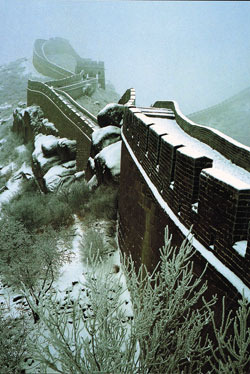
Autumn is considered one of the best times to visit the Great Wall, to view the change in foliage, but this wonder of human civilisation remains breathtaking all year round. Its construction began in the seventh and eighth centuries B.C. During the period of over 2,000 years, more than 20 dukes or princes and feudal dynasties contributed to the building of the Great Wall. Stretching 3,950 miles, the huge monument was built as a defensive structure.
The most well maintained and popular section is at Badaling, 50 miles north of Beijing and over 2,625 feet above sea level, but its magnitude and beauty can also be seen from more remote locations like Jinshanling, Mutianyu and Simatai. At any spot, however, climbing the wall is worth it, just to view the beautiful landscape that is China and a way to marvel at the feat that took thousands of years and millions of people to complete.

5 p.m. WHERE THE ROADS MEET
The Chinese capital consists of an eclectic mix of old and new styles of architecture. These contrasting designs can be noticed at the Dashanzi Art District. The city holds everything from dull grey monotonous buildings and beautiful ancient structures to modern skyscrapers. For the most upmarket address, drive down the Avenue of Eternal Peace and check out the luxurious hotels and buildings.

7 p.m. PAINTING THE TOWN RED
As if the wonders of the world were not enough, I am once more bowled over: this time by the brilliant Kung Fu show at the Red Theatre. The story describes the process of becoming a monk, training from childhood, the trials and tribulations and then passing the test of a warrior monk, brought to life with excellent live performances, brilliant lighting and stage effects.

11 p.m. BEIJING REFLECTIONS
As I prepared to say goodbye, I felt a sense of completeness, as if I had experienced the past and been shuttled back to the present. I peered down at the busy streets and reflected that here was a city where history had been made and one in which the glory of its heydays had not dimmed in the light of its future accomplishments.

The Main Course is French! (Shanghai, China)

23 Saturday Dec 2006

Posted by sitanshi talati-parikh in Publication: Verve Magazine, Travel Stories

≈ Leave a comment

Tags

China, Interviews: Travel, Shanghai, Verve Magazine

Published: Verve Magazine, Rambling Reporter, December 2006

A smattering of ramshackle buildings amidst the gleaming skyscrapers in Shanghai makes Sitanshi Talati-Parikh wonder how the city grew from ugly and dwarfed to tall, splendid and oh, so cosmopolitan, in just over a decade

Rambling01

As I landed in the city that is the poster child of the modern world, I held my breath until I could espy the snaking highways and the splendid buildings. I recalled seeing a row of symmetric buildings read: boring) from the plane, and a few dilapidated structures whilst being stuck in the traffic on the highway… and the tension gnawed at my insides. All along, this place, this city, is what I had been waiting for, with an innate knowledge that it would be simply outstanding. They all told me it would. I couldn’t be so sorely let down?

Secretly though, I wasn’t sure if I was happy or sorry to be unfazed by this city. It didn’t look like much – and I had given it all of 15 minutes! I refused to believe that any city held together by socialist-communism could offer a better way of life than a democratic one. My views were challenged every minute that I spent in unarguably the most modern city of the world. As I held onto my possibly jaded view, I saw the New World Order.

The city sneaked up on me. Slowly but surely it began to grow, like hunger or a snake uncoiling itself. It began to get bigger, bigger than I had ever imagined, and better, better than I had ever seen before. I tried to run away from it, afraid it would engulf me, but it towered over me at every opportunity. Even standing atop the tallest Asian TV Tower (Orient Pearl), looking down upon the city didn’t make it any less overpowering….

As my father raved about the city at every opportune moment, I would respond with a diatribe – the highways were excellent, but the traffic was still too much; the people were hardworking and intelligent, but they couldn’t piece a word of English together and the locals were a rowdy and uncultured lot. The government wants the city to grow, the country to prosper and the people to be well cared for, but it’s communist!

And suddenly it just didn’t seem so bad to me. Could all of this be so miserable? I recall the hungry eyes of the children on the streets of my hometown, and I compare it to the satisfied gleam on the faces of the youth of China. What had my so-called democracy done that was better than this? Our freedom of speech was not feeding the poor and making them happier! As the per capita income rose, the people in Shanghai grew wealthier. They were well provided and cared for.

Our hotel was plush and luxurious, and it was one amongst the many luxury hotels that vied for attention. It reeked of comfort and wealth, as did the fabulous multi-cuisine restaurants that you could choose from. From Italian wine and Mexican margaritas to Spanish tapas, Japanese sushi and French main courses, Indian dessert and Chinese tea, you could pick a cuisine from a myriad places on the globe. If the tastes were simpler and more local, you could just walk down on one of the smaller streets and pick up some dumplings or skewers.

Finishing a long drawn out meal at Giovanni’s, on the 27th floor of the Sheraton Grand, my father wistfully pointed out the glittering lights below. “Doesn’t that remind you of the Queen’s necklace?” Instinctively, I reacted with a, Yeah, right! It seemed like a role reversal. I was, in barely a few days, intensely cynical of the town that brought me up, and in awe of this city of lights.

Somehow, celebrating Diwali on the Shanghai-by-night river cruise, alive with sparkle, flavour and culture, didn’t seem out of place. This was a city totally livable – by anyone. As if to prove a point, little boats chugged by all day, on Shanghai’s Huangpu River, with enormous TV screens flashing a new lifestyle.

The city is truly cosmopolitan, in its own right. America has hit Shanghai (and China for that matter) pretty hard. Even obscure American franchises dotted the Eastern landscape; Chinese fashions were a culmination of Western haute couture with an extra zing and smaller sizes! That was very evident by the upcoming Shanghai Fashion Week that I happened to be right in time for. (Must-buy from China’s first upscale global brand, Shanghai Tang).

There is Halloween around, and the locals groove to Western pop music without understanding a word of the songs! It’s surprising to see a Starbucks inside a traditional Qing-dynasty architectural structure. Has America arrived in China, or is it the other way around? In a city where the subway system was yet to be integrated in whole, the roads were packed with cars from every country imaginable. Was I in New York or Shanghai? Subtitle the hoardings, pump up the highways, de-slant the eyes and you wouldn’t know the difference.

For a city that opened to the world after the Opium War, where foreign adventurers set up trading firms and mansions on the Bund (still the happening spot in town) from the proceeds of Opium trafficking, today, the skyscrapers in the city house the well-off middle class, while the rich live in plush villas in the suburbs, along with the poor. Whether walking on the Bund and the beautiful riverside promenade or on the streets of old Shanghai, with the Yu Gardens, Jade Buddha Temple and teahouses, one can marvel at how far this city has come.

I was incredulous as I saw the smattering of ramshackle buildings amidst the gleaming skyscrapers. I asked our tour guide – how in the world does the city go from ugly and dwarfed to tall and splendid in a span of just over a decade? The answer seemed unbelievably systematic – the government provided the residents of the buildings (that were to be razed down) with alternate housing, and replaced the old buildings with better ones! Easier said than done? Not quite! Rules and regulations were accepted, as a way of life, not something to be troubled by. The city reminded me of the brilliant Chinese acrobatic show I saw that evening – balanced gingerly on a pole of socialist-communism, but landing upright every time, not wavering even once.

Despite the cocoon of luxury, any tourist to Shanghai only wants one thing. A bargain, or many of them! The renowned Shanghai flea market is what we wanted, with a burning sense of need and urgency. The itch to bargain hit us like we’d been forewarned, like never before, not even on Mumbai’s ‘Fashion Street’. It didn’t take but a few seconds for that desire to be blown apart, when we were sorely informed that the ‘fakes’ had been taken off the roads. The flea market was eradicated in June. But we were welcome to shop at the government authorised malls. Malls? Why in the world would one go to malls in China? Malls, which were better than those in America…. Buzzing glass elevators that climbed like purring felines, shops that held one in awe, the sizes of which simply extended to the end of the earth.

To our enormous relief, Nanjing Road (the walking street, where one can take a little tourist motor train, but not any other form of vehicle) gave us local shops and boutiques… and hawkers. The hawkers that were like the plague; they ensnared us and led us into shady little alleys where following a dizzying ride up rickety stairs and hidden closets, you discovered that the fake hadn’t quite deserted Shanghai – it was just concealed from the naked eye. Polo, Abercrombie, Burberry, Gucci and the lot still flourished here, originally fake.

This made me wonder…. Maybe it was my purely democratic fantasy that refused to let me accept otherwise. Just as the fake Gucci was hidden, was the other side of life in this mystical country hidden from us too? We, the wide-eyed tourists, who came with a desire to see the People’s Republic of China in action, saw one side of the proverbial coin. Was the coin transparent or were we seeing exactly what they wanted us to see?

Sleepless in Seattle

23 Sunday Apr 2006

Posted by sitanshi talati-parikh in Publication: Verve Magazine, Travel Stories

≈ Leave a comment

Tags

Interviews: Travel, Seattle, USA, Verve Magazine

Published: Verve Magazine, Travel, March-April 2006

Home to Microsoft, Boeing and those fabulous Starbucks frappuccinos, Seattle, the vivacious city on the ‘upper-west’ side of America, is a ski-jump away from Vancouver. As it always does at this stage – when flying for business takes precedence over flying for pleasure – SITANSHI TALATI-PARIKH’S rendezvous with the Emerald City began with a business seminar…

Seattle

A typical East Coast sentiment kicks off with a nasty red-eye leaving me with a whopping two hours of sleep that night. Straggled and disconcerted, I peer out at the city through heavy-lidded eyes and get accosted with a whiff of the sharp ready-to-rain-anytime air that chills and warms you at the same time. I happen to have the day free before I start spending quality time indoors at the seminar, and I quietly contemplate the best use of my precious hours of freedom. Many, many hours behind on sleep, I crave the much-advertised soft beds of my hotel. As I swing into Downtown, however, my eyes pop open and my body surges with adrenaline.

The adrenaline didn’t abate until I got on that flight back home, and even at this moment, I can still recall that heady feeling. I knew the moment my cab snaked its way into the city that this would be one memorable trip. With fatigue threatening to take charge, I could sleep in or check out the city. The choice was easy. For that one day, I shed the business suit and became the camera-clicking tourist – backpack and all.

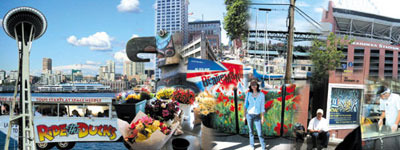
The hilly roads that can get steep without a moment’s notice all lead to the most fun place of all – Pike Place Market. A cut above the designer stores in their typical city décor, this market is just downright homely, with ‘fresh’ being the operative word. Miles and miles of the most beautiful and fresh flowers lay spread out before me, of every hue imaginable. I purchase some of the fresh farm fruits from those ever-smiling vendors, surreptitiously sample some of the homemade honey and gourmet chocolates, and join the onlookers watching cheese being churned by hand. Guiltily, I purchase a Seattle shot glass for my collection, a Chinese wall hanging and a sketch of Starbucks. The joy of strange little souvenirs. Compare the inviting little café-style restaurants with tantalising aromas and cuisines for every palate, to the airline’s ‘generous’ serving of pretzels.

My personal favorite remains the scrumptious Mediter-ranean sandwiches at the Sister’s European Café. I went there every day in lieu of the seminar lunches. They are just that good.

A local market singer strikes up a song about my T-shirt, and I realise a bit too late. As I begin to draw undue attention from the crowd, I look down aghast, at the words: ‘Guys make nice pets!’ Somehow, the Abercrombie & Fitch T-shirt didn’t seem like such a big deal when I actually bought it! A trifle nonplussed, I decide it’s about time I scram and I quickly clamber onto the nearest vehicle heading out. Turns out to be a bus going to the Seattle Space Center. Checking out the area, I also discover a Science Fiction Museum and something called the Experience Music Project. And then, my eyes catch a sign for ‘Ride the Ducks of Seattle.’ I was intrigued.

Could anything be more fun? The vehicles used are actually World War II relics and they go on land and water, giving a 90-minute tour of the city! I was in it for the ride.

We learn the duck sound and the tour guide-cum-driver is just brimming with jokes. Every age group is present and the racket we make is quite extraordinary. The people in this city are so friendly, even the harried business sorts (I’m not one of them today) actually stop by to wave and some even do the duck waggle! We do a by-land and by-water tour of the city and its skyline, check out the Art Museum (there is a Van Gogh Exhibit this week), the Seahawks Stadium, and an ancient refinery….

The most interesting part about this city is the diversity from one part to another. The Belltown District where the Space Needle is located is only alive when there are tourists around. The Space Needle (surprisingly) originated as a science project by some students and is now a famous Seattle landmark.

After a steaming cuppa’ at the Space Café, I ride to the top of the Space Needle to check out the real-time web cams. Zooming into the city, I can almost spy my husband, Sahil, sneaking furtively into a Banana Republic when he should be busy taking some business away from Microsoft!

The next stop was the Pioneer District that is actually underground. When that part of town was rebuilt, the roads ended up covering the first floor of a number of buildings.

Glowering totem poles stare watchfully at me, daring anyone to make a comment on this strange part of town. It feels like something out of Alice in Wonderland, where life exists at a subterranean level, very separate from its sunny counterpart. Taking an Underground Tour brings to light a dark sort of existence.

The Fremont is the artsy area, what with naked bicyclists, alternative and grunge music. Downtown has classy shops and restaurants, the theatre and Pike Place Market. The harbour area is always busy, and catching a ferry or a cruise to a nearby island is a piece of cake.

Taking a short ferry ride to the closest island, Bainbridge, is fun. The Island is small and cosy – I really feel it’s quite possible to walk from one end to the other! Leaning against a colourful mural in front of a little art gallery, it all looks very serene. The painting comes to life and the fields seem to extend endlessly behind me. After a quiet lunch, the ferry ride back is invigorating. The wind whips past my face, as I take in the Seattle cityscape in sharp relief against the clear blue sky. I sigh contentedly as Seattle has generously kept her ubiquitous rain clouds away from my weekend trip.

After such a memorable few hours, I can’t imagine a day spent indoors. There are lunch breaks though, I console myself, with much the same I’m-so-busy-but-oh-so-mournful look sported by the business sorts. And after 5pm, strolling down the streets of Downtown is something to look forward to. Incredibly fabulous Italian restaurants like the Palomino and Vivanda are at an appetite’s length; I noticed Fox’s Sports Bar earlier and some interesting breweries. Or I could catch a musical nearby. It’s not like there’s a lack of entertainment, just a lack of time.

The seminar paled in comparison to the mysteries of the city. I can think of a dozen more things I would have liked to do whilst there, but isn’t that the case with any new place? These are the moments when mixing business with pleasure comes to life….

Newer posts →

|  Filling the gaps between words.  |

Writing By Category

  • Art, Literature & Culture
  • Brand Builidng
  • Brand Watch
  • Fashion & Style
  • Features & Trends
  • Fiction
  • Food
  • Humour
  • In The Media
  • Interviews (All)
  • Interviews: Business
  • Interviews: Cinema
  • Interviews: Cover Stories
  • Interviews: Lifestyle
  • Interviews: Luxury Brands
  • Interviews: The Arts
  • Interviews: Travel
  • Musings
  • Parenting
  • Publication: Conde Nast
  • Publication: Elle
  • Publication: Mint Lounge
  • Publication: Mother's World
  • Publication: Taj Magazine
  • Publication: The Swaddle
  • Publication: The Voice of Fashion
  • Publication: Verve Magazine
  • Social Chronicles
  • Sustainability
  • Travel Stories

Reach out:
sitanshi.t.parikh@gmail.com

© Sitanshi Talati-Parikh 2018.
All Rights Reserved.

Website Powered by WordPress.com.

  • Subscribe Subscribed
    • sitanshi talati-parikh
    • Join 51 other subscribers
    • Already have a WordPress.com account? Log in now.
    • sitanshi talati-parikh
    • Subscribe Subscribed
    • Sign up
    • Log in
    • Report this content
    • View site in Reader
    • Manage subscriptions
    • Collapse this bar