
Tags
Published: Verve Magazine, In Memoriam, January 2009
Photograph: Ritam Banerjee
Despite the many bodies and minds that go behind giving viewers live news coverage from an area of conflict, it is the face that confronts the camera and speaks to us that leaves a lasting impression. The placid, immovable expression that barely flinches when gunfire erupts stands for courage, conviction, and a strong sense of responsibility. Under the endless barrage, especially on the first night, millions were glued to the television channels, in lieu of any print publication being available at the time. With minute-by-minute updates, we watched the newscasters broadcast live, without any perceptible fear. Sitanshi Talati-Parikh meets three representative young women newscasters, who are not crime reporters but ended up spending many long hours on the field. Mahrukh Inayet, the light-eyed Kashmiri with an insane work schedule that made it nearly impossible to meet her, Miloni Bhatt, the true-blue Mumbaikar, and Yogita Limaye, the youngest of the lot, composed and collected beyond her years – all of whom are self-assured, determined and ironically, camera shy

MAHRUKH INAYET
Deputy News Editor, Times Now
Age : 31
Beat : Nothing specific – everything.
“Gunshots are not new to me.”
Mahrukh has been born and brought up in Kashmir, where her parents currently live. “I have seen so many encounters. During the start of militancy there would be firing outside our house and I could hear bullets hitting our tin roof, going ‘tuk-tuk-tuk’ and I would lie flat on the ground. It was very tough growing up like that. You get desensitised to it at a certain level. It is a very artificial way of living. I always felt that it had to end, I feel very strongly about what is happening there, in the sense that somehow, peace must be restored.”
“I always wanted to live in India.”
With a Masters in journalism from American University, USA, she started her programme at the same time as 9/11 and began her journalism assignments by interviewing people in the Pentagon. She worked with National Geographic (USA) for nine months, Headlines Today, Delhi for three years and has been in Mumbai with Times Now ever since, totalling over six years of work experience, including about 15-20 assignments from Kashmir”
“It was like something out of a movie set – I couldn’t believe it”
“The Taj is a symbol of so many things – our pre and post colonial legacy, our development, a space that stands and welcomes anything that comes into India. They are trying to hit everything that this country stands for: development, economy, the grandeur, the legacy, the tradition, the history, everything.”
“On TV you just get to see one face, but there are so many people who are involved, collating all the information.”
Mahrukh spent nearly 62 hours on the field during this tragedy. She worked in shifts with colleague and Mumbai bureau chief Deepti Menon, taking a three-four hour break – sleeping in the car or going home to change.
“The cameras were on most of the time, and you were in front of them…”
“You know that you have the ability to create panic in such a situation and you can’t be hysterical or show your emotions because others are watching you and might get affected by it. It is a very delicate balance to maintain. You couldn’t hide your feelings and expressions, despite there being bomb blasts and firing in the background.”
“You shouldn’t get into changing public opinion.”
“You should just report – as truthfully, as honestly as compassionately, in as composed and as calm a manner as possible. Opinions, editorialising information is left to editors, opinion-makers, and to the viewer.”
“We cannot afford to have a repeat of something like this.”
“Whether it is the government that needs to realise it or whether as citizens we need to be more active. While questioning politics, it is important for us to exercise our right to vote in a more effective manner and be more politically aware. It is a dichotomy that we live in and it is a two-way street.”
“Somewhere there needs to be a sense of closure.”
“I couldn’t switch off at all in the middle of it. I was in fact obsessed with the news. I just want to keep reading about it, going through the same pictures. It has happened to me for the first time. I don’t know what is going to bring it, but I need a sense of closure.”
“I enjoyed writing and I enjoyed telling a story.”
She didn’t always want to be a journalist. She thought about becoming a doctor – either a psychiatrist or a paediatrician. “I don’t think the situation in Kashmir per se moved me towards becoming a journalist. But, once I decided on it, I realised that it was one situation I wanted to report on.”
“It is easier being a woman reporter.”
“It is kind of unfair, because otherwise you believe in equal rights, but you never say no when you get easier access compared to the men. More government officers, politicians are nicer to women than men; even the women are nicer to women – more encouraging.”
“If I have any calmness and composure, I get it from my mother.”
“My mother is a very emancipated woman, very broad minded, and has taught me very basic values.”
“In my very little free time…”
“I like going out, watching movies, reading, travelling, and photography.”
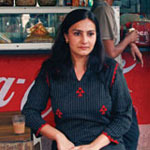
MILONI BHATT
Senior Special Correspondent, NDTV India
Age : 31
Beat : Economy and aviation
“I am a Mumbaikar”
Miloni was born, raised, fell in love, and got married in Mumbai. She has eight years of experience on the field, and has been with NDTV for five years.
“We came out of the emergency because of the print media that stuck its neck out.”
I didn’t always want to be a journalist. I was in the Democratic Republic of Congo, and Nigeria, visiting my father who was employed there, when I was absolutely appalled to discover that the people who were labourers were all highly educated. The gardener had a double degree. Nigeria and India got independence around the same time, and I couldn’t believe that one country ended up like this and the other so differently. One of the reasons was democracy and free press – the access to information, knowledge, to a world-view. I was very clear that I wanted to do TV because I was very influenced by the reporting BBC did in Africa.”
“I’ve covered crime before, but one can’t compare a terror attack to any kind of crime story.”
“It is of a different magnitude – the scale, the violence, the people, the victims. The train blasts, the bombings at the Gateway, at Zaveri Bazaar, explosions at Ghatkopar – I don’t think I will ever forget any of it.”
“My family is reconciled to the fact that I will be in situations like that.”
“I couldn’t take my family’s calls as I was in the midst of live reporting. I could see the phone blinking and I was thinking, ‘I can’t talk to you guys right now, just watch me on TV, if you are so desperate!’”
“I don’t think anyone can continuously report on terror.”
“It will get to you at some point. The important thing is that you get training to report and de-link yourself from that situation. Talking to your colleagues, putting things in perspective also help – I can’t talk to anybody on the outside – it’s too much for them to take.”
“We are not meant to editorialise.”
We are field reporters – what you see is what you talk about. Everyone has an opinion, but my job doesn’t allow me to express it. Reporters don’t fall in and out of personalities. Yes, we are angry. Yes, we feel like every other common man. But we also have a wide-angled perspective – because we are seeing many things happening simultaneously, understanding the reason and cause.
“This is my job.”
“Like security agents protect people – it is my job to report and if my job entails reporting on terror attacks then that’s what I will do. At the end of the day, as a journalist, you are compelled – you cannot sit in a newsroom when there is a big story unfolding. You just want to go there and be a part of it. At the end of the day, you are documenting history.”
“Mistakes do happen, with breaking news and developing a story over several days.”
“This is not a situation that anyone has ever reported on. The media doesn’t have a benchmark to go by. I’m sure we have made mistakes, and we regret those mistakes. I can imagine that the viewer’s point of view is also valid, but I’d rather do my job than worry about what xyz is saying. We can’t give in to our anger, sense of loss and rage like them.”
“I am amazed at the kind of response we have got…”
“People have said, ‘Wow you were there, thanks for bringing us the news.’ I don’t see novelty. Journalism is not about reporting only during normal times, it is about reporting in times of crises. We are trained to play the most responsible role possible. We report what we see and not give in to panic or rumours.”
“I have never thought about being a female journalist.”
“More than half of NDTV is women. Does that kind of discrimination exist? In eight years I have not faced it. It might have worked in my favour, maybe, but it hasn’t worked against me – and that’s a good thing.”
“I don’t have an icon.”
“I am a sucker for hard news. I love it – it gets me. It can be anywhere in the world….”
When not working…
“I just go home and sleep, because I am sleep deprived. Go out, meet friends. I catch up on life.”

YOGITA LIMAYE
Senior Correspondent – Anchor, CNN-IBN
Age : 25
Beat : Mostly education and civic issues
“We could hear people screaming for help….”
“The first night, we were very close to the Taj and we could see people in the front of the hotel, facing the Gateway, holding white hankies, somebody was trying to send out a morse code with a flashlight.
“It is impossible to not react.”
“There are some people who can separate their professional life and their personal life – but you can’t break away from it. Seeing it burning, we all got emotional, whether we would like to admit it or not.”
“The next day, interviewing people, I didn’t try to be a professional journalist.”
“I put a little bit of emotion in it, because that is what you are naturally feeling. As long as you are not sensationalising it, it is okay. People want to hear and know what it felt like.”
“I also got smses from old friends, strangers….”
“I haven’t been able to reply to everyone, but each one added that energy saying you can go on. This is nothing compared to those who were inside and came out shaken up, went through. When you see that, you think at least I or my family isn’t in that situation, and I am just doing my job here.”
“It was the first time I had heard gunfire in my life.”
“For someone in South Bombay it is unheard of to hear shootings! And even ones who cover the crime beat are not people who work in Jammu and Kashmir or the north-east where things like this happen more regularly. I have never reported from a conflict area.”
“There was no fear at the time.”
“I was merely reporting what I was seeing on the ground. Fear hit me only at one instance that night. After the VT shooting, we were sitting in our car at the Metro junction, when we suddenly heard grenade explosions coming behind. Till date I have not been able to verify their location – but that’s when I wondered, what if they had also planted bombs all over the city.”
“You can be heroic and say you don’t feel like eating and don’t need rest, but the fact of the matter is, that you do.”
“I didn’t even think of bathroom breaks – you feel thirsty so you keep drinking, but we didn’t have a desire to eat. When I would go for four-five hours in the middle of the day to take a break, I made sure I had a bath, a strong cup of chai, and forced myself to eat. You are working as a team. When one person’s energy is running low, it is important for the next person to come back charged up. These are the days for which many of us become journalists – so you want to be there through the thick of the action.”
“Even now my mother hasn’t told me how scared they were.”
“My sister, from Bangalore, kept telling me, ‘Don’t do anything stupid, don’t be extra brave and try and get those shots’. While I wanted to get my work done, I realised it doesn’t make sense putting your life on line for something.”
“All of us are not in depression, but are tuning out.”
“I try to indulge in retail therapy, watch a film at home. While many of us are mentally tired, perhaps getting back to city stories – we know the action will die out soon enough. For a while it will seem like that adrenalin rush is missing….”
“The tsunami of December 2004 made me want to do this really badly.”
“I am qualified to be an engineer. I had always wanted to be a journalist, but the safer side of me prevailed. I was thoroughly bored with software though, and joined CNN-IBN as someone on the desk, instead. I worked my way up in a year to reporting and to Mumbai. I never considered my back-up option. This gives me a lot more satisfaction, it is never boring and I love it.”
“Gender doesn’t make a difference in this profession – if at all, it might make things easier!”
“After two nights, I began thinking, when will I go home and sleep in my own bed?”
“I hope to have the abundance of energy, which is what I notice in tireless people like CNN-IBN’s editor-in-chief Rajdeep Sardesai or Shah Rukh Khan – I see it in everyone at the top. The ability to go on and on and on like a Duracell bunny almost, it something that amazes me, and that I look up to.”
“There’s nothing like a disaster to give you recognition.”
“This has been my most important reporting assignment so far. Ironically, disasters are what journalists live for.”
 sitanshi talati-parikh