• About
  • Brand Building
  • Film & Drama
  • Writing: Arts & Lifestyle
  • Writing: Interviews
  • Writing: Luxury Brands
  • Writing: Travel

sitanshi talati-parikh

sitanshi talati-parikh

Tag Archives: Aamir Khan

Vidya Balan: The Next Aamir Khan?

02 Monday Jan 2012

Posted by sitanshi talati-parikh in Musings

≈ Leave a comment

Tags

Aamir Khan, Bollywood, indiancinema, vidyabalan

Why Vidya Balan is all set to be the female version of Aamir Khan in Bollywood….

Many actresses have looks and talents and a few have both. But what sets a handful apart is when audiences wait for their next as unique and different, as unsual choices, and worth watching. Post her initial success, Balan, like Khan floundered in a couple of commercial films that did her talent no merit. But quickly, she found her ground and stood it. She is treading the fine line between off-beat and commercially successful that possibly only Rekha could before here, where her films now make for coffee-table discussions.

What works for Balan is her sheer versatility. She can morph herself into the character, much like Khan, so that there isn’t a trace of her real-life persona visible, besides her voice and features. No mannerisms, no particular nuances that one attributes to a person. She doesn’t bring herself on screen, she only brings a character, and that too a finely-drawn, deeply nuanced character.

That is possibly the difference between a fine actor and a movie star. A movie star can’t let go of their own persona, even momentarily on screen – think Shah Rukh Khan, Salman Khan and Kareena Kapoor – while a fine actor becomes whom he/she requires to be on screen. Many actors can don this persona for a specific kind of role – Ajay Devgn for gansta films, Abhishek Bachchan for Guru, Saif Ali Khan for Omkara, or Anil Kapoor for humorous, slimy characters like the one in Slumdog and MI4. And some like Saif Ali Khan and Anil Kapoor can even show a breadth of talent across the board. The others not listed here, like Ranbir Kapoor, are all extremely watchable, entertaining and even powerful in their screen presence, but they can’t let you forget who it is on screen that’s playing that role. Their personal presence often or momentarily overpowers their character.

To become another person on screen, and remain so through the entire film, over and over again through a wide range of films is possibly the mastery of only two actors at the moment in Hindi cinema – Aamir Khan and Vidya Balan. Their choices will always be followed, their movies will always have a definite audience, and their fans will remain discerning. That is not to say that there isn’t a place for other actors and movie stars, but it is to point out that Khan and Balan will remain a class apart in their profession of choice – acting. They will remain actors before they become superstars or moviestars.

Movie references:

Vidya: Ishqiya, No One Killed Jessica, The Dirty Picture, Paa, Parineeta, Guru, Salaam-e-ishq

Aamir: All his films since he began doing a single film a year! (mid 90s), particularly the ones in the last decade.

Why @delhibellymovie makes for a marketing study

29 Wednesday Jun 2011

Posted by sitanshi talati-parikh in Musings

≈ Leave a comment

Tags

Aamir Khan, Bollywood, Delhi Belly, imrankhan, indiancinema, Vir Das

Any movie that has a tagline “Sh!t Happens” is doing two things very knowingly: alienating a section of people, and getting another section of people curious. Possibly only a gamble Aamir Khan is willing to take: selling a movie about potty stuff and a stomach condition. There will be those who will consider him not quite off the rocker, and those who will grudgingly drag themselves into the cinemas next weekend to see what’s up. Or down.

Aamir’s movies would make for a brilliant marketing study in themselves. They use elements of the films very carefully, carving a niche audience even before the release – in this case, possibly queasy college kids – and are always unique. He never tends to repeat himself, and what is fabulous: he never openly sells himself. He sells his intellect, which people have seen and appreciated over the years; he sells his choices, which people have grown to trust; he sells tenets of the movie that may not be obviously saleable and he, ingeniously, makes them saleable.

He waited many years to release this film, even queuing it behind his production house’s other releases, so much so that people got tired waiting for it to release, rumours began spreading about tension brewing between the director and the producers. When he finally decided to release the film, which is a short English-language film (also being dubbed in local languages) without an interval and with no songs (besides background music), he worked in an alternative promotional strategy.

1. Imran Khan, now a household name, is selling sex in the movie. Crushing the ‘nice kid – now married and settled’ image, Imran gets down and dirty in the movie.

2. There are a good number of expletives used – particularly in the song which has been touted as a cult classic ‘Bhaagbhaagdkbose’. The ‘good kids’ of the film, claim to not know these words and their meanings. Aamir suggests an ‘A’ rating. The censor boards get into overdrive. See video of the song (my personal favourite): http://youtu.be/8OVGbdOG7dA

Also: Selling reverse psychology. Telling people not to watch something is like a sure fire way to get the people to come see what they are told not to watch. Snap.

3. The actors remain straight-faced and yet severely dry and mocking in their humour when being interviewed. (See @thevirdas’ tweets about conversations with a journalist)

4. The songs. THE SONGS. For a movie that has no songs, the songs are a raging hit.  Shot recently, they are cleverly envisioned – each one a distinct and innovative study in youth culture, popular lingo, satire and clever misconceptions. Music and lyrics, bang on. Cult classics in the making.

5. Soft selling. What does the youth who will be coerced to watching this movie want? T-shirts. Funky, irreverent t-shirts, selling the Delhi Belly brand. Imran and the others are busy doing that.

6. Food: Delhi Belly refers to a stomach condition. You find the Delhi Belly trio, ironically being photographed at gourmet and fine dining places – presumably to now avoid getting a ‘delhi belly’?

7. Irreverence. Therein lies the foundation on which this film is built. Three kids go through sh*t. And hopefully come out of it alive. With the name, the songs, the attitude and the overall marketing, Delhi Belly is selling a good degree of irreverence.

8. Item Number: Aamir, is for once, selling himself. An item number done 70s disco style. #MAJORWin. See video: http://youtu.be/IGYA_P7ZHcw

9. I like a movie that sells it’s men rather than it’s women. A gratifying change. However ‘shitty’ it might be.

Now it’s just up to the target audience to lap it up.

Aamir has a way of making films and concepts iconic and into a brand. His auteur, unlike other directors, isn’t a kind of film, it’s merely good cinema – path-breaking, unique, and never cut from the common cloth. The success of his films has enough to do with his marketing brainwaves, experience and perfection at the editing table as it does with the film itself. SO much nicer than cheap marketing pot shots that many other films are reduced to.


Barenaked Ladies’ Men

18 Wednesday Nov 2009

Posted by sitanshi talati-parikh in Humour, Publication: Verve Magazine

≈ Leave a comment

Tags

Aamir Khan, Abhay Deol, Akshay Kumar, Bollywood, comment, Farhan Akhtar, hrithikroshan, imrankhan, indiancinema, John Abraham, Neil Nitin Mukesh, Ranbir Kapoor, Saif Ali Khan, Salman Khan, Shah Rukh Khan, Shahid Kapoor, Thoughts, Trend, vervemagazine

Published: Verve Magazine, Verve Man Supplement, October 2009

Salman Khan, the trailblazer of toplessness in Hindi cinema, transformed from an endearingly lean romantic hero into a full-blown male with an explosion of warrior-like muscles. The others grudgingly followed suit(less). Tongue firmly in cheek, SITANSHI TALATI-PARIKH disclaims all puns as truly intentional as she traces the shirtless journey

Ranbir01

WE LOVE THEM, WE LOVE TO hate them, and now we’ve got them by the balls. For years, Choli ke peeche remained a resounding metaphor for desi mankind, as women heaved with cleavages bared and shimmied their naked bellies. It’s time for retribution. Men have now to convince us of their physical worthiness. No, I’m not a feminist. I truly love men, but this is honourably judicious and just sound philosophy. No woman or gay man worth her/ his salt will settle for less than that.

So began the era of the shirtless man – and the ball was set rolling by Prem-boy. Boy, do I miss Prem from Maine Pyar Kiya. I’d be his friend any day! Ignoring the fact that his first commercial success may have had something to do with his lean frame and boyish charm, Salman Khan instead fixated upon the name as a lucky charm and decided to henceforth fill the screen with his presence, literally. Prem from Partner and No Entry are not exactly more prem-worthy simply because there is more of him to love. Characteristically, Salman Khan’s beefy frame became more ‘wanted’ than his histrionic abilities as he cleverly diverted our attention to his torso, with frequent fluid and well-practised moments of sudden shirtlessness. The swollen muscles oozed charm and the girls swooned. And the men followed suit. Swooning, I mean. They began hyperventilating – they realised that to be taken seriously, as true romantic lovers, with fire in their loins and sincerity in their hearts, they would have to bare all. Truth be damned, the shirt must come off. And so began that waxing of the bodies and the waning of the clothes, as the actors worked themselves into a deep sweat for the roles that demanded an idolisation of their bodies. The Khan gym became the harvest ground for the upcoming lean, mean male machines.

Shah Rukh Khan decided that the best way to circumvent this phenomenon was to do exactly the opposite – keep his shirt on. Tantalising and teasing, he wore skin-tight ensembles, T-shirts that promised a well-toned torso when peeled off, to which only those near and dear would be privy. For the not-so-lucky others, it was left to the fertile imagination and Chinese whispers. And then, someone near and dear to him decided that enough was enough. Such magnificence must not be left inside the closet, but must be shared with the populace at large. So, amid quite a splash, all multiple packs of SRK’s un-really flat belly were exposed in Farah Khan’s Om Shanti Om. The women (and men) responded with sincere gratitude – so much money was spent in a genuine quest for sensual pleasure that the two Khans (one with a flat stomach and one generously pregnant) sang their title track all the way from the box office to the bank.

Aamir Khan watched in stoic silence. He knew his work was cut out for him. Baring his chest as a farmer would only get the spade card – he needed a clever way to up the shirtless quotient into an ace of hearts. He decided that the only way to make women scream with orgasmic satisfaction was to go down south. That’s when he decided to recreate Ghajini in Hindi. His blown up torso filled the screen with its angst, the veins on his muscular arms popped out with fury – that seemed to glower with an incinerating question – Prem, Rahul or Me? After all, if anyone came after his girl with a hatchet, whether she lived to tell the tale or not, he would make sure justice was achieved. Even if it killed him to remember to do so.

While the cream Khans were running around scheming pure nudity, at the Kumars’ there was much debate about the best course of action. How could the great body transform from toned-stuntman-entertainer into sizzling garam masala? That is when they decided to take the high road – with the wife unbuttoning khiladi husband’s pants in a public display of affection. Truly hedonistic. Meanwhile, his old counterpart Saif Ali Khan was not to be left an anari any longer. He figured a hot new avatar was in order and in Salaam Namaste, in a mad Race, with a lot of Tashan, he showed the world that what he was made of. We know at least one girl who fell hard for it and requested a more detailed inspection. While playing onscreen gangster roles to vindicate his offscreen ones, Sanju baba (Sanjay Dutt for the uninitiated) decided that he couldn’t be forgotten – after all, he was in his hey days, the proud bearer of a hot bod, too! So he joined the ranks of the younger lot – the likes of Arjun (Rampal), Zayed (Khan), Upen (Patel) and Dino (Morea) who were flashing well-toned bodies and not much wit.

When you talk of the real current guard of male hotness, Hrithik Roshan and John Abraham immediately spring to mind. I recall a young Hrithik Roshan out on a romantic date with then-girlfriend Sussanne, looking dangerously attractive. He wasn’t buffed up – he was lean and lanky. And then out of the blue, Kaho Na Pyaar Hai threw up an overnight sensation – a new dancing superstar with rippling muscles and a body that seemed like it would burst out of the sheathed vests. The girls nearly jumped out of their seats with uncontrollable hysteria. I can only imagine that Roshan, a shy, ambitious youngster (the industry is full of such oxymorons) was overwhelmed with the response, scared even, so afraid for his life that he decided it was better to keep the clothes all on – at least until he was well armed. The Greek-god-superhero protected us in Krrish, battled his suitors in Jodhaa Akbar and matched wits with his counterpart in Dhoom 2, all suitably unclothed, leaving women severely asthmatic with increased bouts of breathlessness. As if that is not enough, to drive the point home hard, Roshan (with full aashirwad from Roshan senior) has decided to shipwreck our hearts even more with his upcoming super-sensual Kites, where it is all about baring more, not Barbara Mori.

John Abraham had it easy or hard depending on who’s judging. He could have been written off as a piece of rugged meat: good to bite, but tough to chew. He met all the traditional bad-boy expectations: hard, chiselled body, a driving desire for bikes and the rough road to success; and to the disappointment of many a woman, a hot babe to go with the hot body on the hot wheels. The slightly crooked, dimpled smile and the wayward earnest expression belie the fact that he has an MBA tucked up his sleeveless arm. Going straight into no-nonsense territory, steamy Jism proved early on that he had no qualms about using his body to the best advantage, Dhoom sent pulses racing faster than his bike and Dostana captured the juicy dimples in all his cheeks. After his serious nudity in New York, we may grudgingly agree with the bootylicious actor when he asserts, ‘You may know me for my body, you may think I am sexy, but you will respect me as an actor.’

And just around the corner, the boy next door has come a long way from being a performer in Shaimak Davar’s dance troupe, better known for his flamboyant relationship with Kareena Kapoor. And now he is playing the role of one of the most eligible bachelors, playing the field by playing his current relationship(s) close to his chest. Always sporting a well-expanded torso, ‘F’hahid Kapoor is riding a high horse, with hair askew, grim determination and a lean, shirtless body steering him very close to the winning line, making him the industry’s latest poster child of toplessness. Rather than well-clothed charm and boyish appeal, it is the (unnecessarily) bare-chested appeal of kamina Charlie that seems to tug at female (and box office) heartstrings.

When we speak of male nudity, there is a young debonair rake who will possibly never live down the unexpected sensation of a particular homoerotic towel scene in his debut movie, one that will be etched into memories of an unforgiving and salivating audience for years to come. He may hide behind his beard (Rocket Singh), wear khadi (Rajneeti), sleep in (Wake Up Sid) and disappear from the media, but Ranbir Kapoor will forever remain the iconic just-showered Ranbir Raj from Saawariya – all infamously fair and handsome.

Proving their own worth in the meatpacking business is the young crop of ‘thinking actors’ who are in various stages of undressing. Neil Nitin Mukesh, who has a predilection towards dark roles, has seriously gone the full monty for his upcoming film Jail. Farhan Akhtar gave us a splashy preview in Rock On!! and Abhay Deol was darkly interesting in his lazy, rather hairy topless state in Dev.D. Imran Khan has yet to show us what he’s made of, and he can kidnap us anytime to do so!

Imran Khan: An Actor and a Gentleman

20 Monday Apr 2009

Posted by sitanshi talati-parikh in Interviews (All), Interviews: Cinema, Publication: Verve Magazine

≈ 1 Comment

Tags

Aamir Khan, Avantika Malik, Bollywood, Delhi Belly, imrankhan, indiancinema, Interview, Jaane Tu Ya Jaane Na, Kidnap, Luck, vervemagazine

Published: Verve Magazine, Verve Man, Features, April 2009
Photograph by Colston Julian

Affable yet reticent, blunt yet polite, serious yet funny, unemotional yet moody, Bollywood’s latest poster boy seems to be a contradiction of sorts. Aamir Khan’s nephew and Nasir Husain’s grandson, 26-year-old Imran Khan is two films down with two new releases, Delhi Belly and Luck coming up this year. Sitanshi Talati-Parikh draws the suave and restrained actor out, even if just for a little bit

Imran02

The brows are furrowed in intense concentration. The facial expression is blank. The eyes are reflective. The humour is deadpan. No smirk, no smile, not even a laugh line. And yet we all titter. What is it about this new kid on the block that sends hearts fluttering and makes you yearn to know more? As I watch Imran Khan step self-consciously in front of the camera, taking shot after shot effortlessly, I can’t help but notice his face has character. Whether it emanates from the well-crafted jawline or the intensely expressive eyes, it’s unmistakable. After every shot, Imran lithely hops over for a critical assessment. He is his own worst (or best) critic. As he discusses camera angles with photographer Colston Julian, I learn that he is a self-taught actor (or more accurately, natural), while he has been formally trained in writing, cinematography and direction at New York Film Academy, Los Angeles.

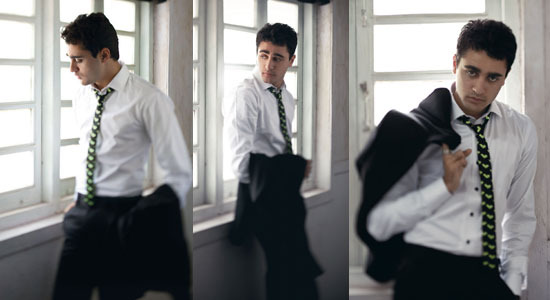
In a crisp white shirt and black trousers with a funky Batman tie (he is a huge fan), Imran sits cross-legged before me on a chair with an expectant look on his face. Why would someone who looks as good as him not attempt to give acting a shot and head straight for direction? As a child he picked up the camera, playing with genres like sci-fi (on the lines of Alien), Agatha Christiesque murder mysteries and spoofs. Post-school, he stumbled from market research into advertising (including ad films). At this point he realised films are what he understands best. After all, the mere smell of celluloid gives him butterflies in his stomach.

Acting was never his intention. A sequence of events – or fate – combined with Abbas Tyrewala’s faith in him led to Imran being cast as the lead in Jaane Tu…Ya Jaane Na (2008), the film that made him an overnight star. Despite having played a young Aamir Khan in Qayamat Se Qayamat Tak (1988) and Jo Jeeta Wohi Sikandar (1992), he says matter-of-factly, “I never thought of myself as being a very good looking guy and figured there was no place for me in the Hindi film industry. Hrithik Roshan set the bar. He is a complete package. I’m not built like him, I can’t dance even a quarter as well as he can – that’s something I aspire to.”

Noticing my imperceptible shiver with the blast from the air conditioner, he solicitously jumps to his sock-covered feet and props himself up on his toes to tone down the room temperature. Then in a flash he is back in interrogation mode. Born in Wisconsin, America, to Nuzhat Khan (director Mansoor Khan’s sister) and Anil Pal, he moved to Mumbai with his mother after his parents’ divorce. He was a year and a half at the time. In all the schools he went to – including Bombay Scottish (Mumbai), two schools in Ooty, a nature-based gurukul in the Nilgiris, Bangalore and Fremont high school in Sunnyvale, California, he was always the new kid in school. “It was really tough. I didn’t grow up being considered cool or dating a lot of girls. I was into science and books and not into sports. I was always the odd one out at parties, sitting in the corner, knowing barely two or three people.”

Imran admits that constantly moving from school to school made him more independent but also a bit of a loner. “I don’t socialise a lot and like silence. I can’t be on all the time – I need occasions when I am with absolutely no one so I can reset, recharge, rejuvenate and then come back out.” He has only just started to make friends in the industry – think Ranbir Kapoor – since he grew up not knowing anyone. Though fond of listening to music, he can’t abide television. He actually doesn’t own a TV or a cable connection. Surprising, considering that he is an obsessive movie buff and watches three to five movies a day (on his computer) and is happiest when at a movie theatre.

As we get to the much-publicised fact that girls are extremely “well-behaved” around him – “very calm and composed – no crazy stuff,” I discover he is also the guy who likes to be in the background and tries not to get noticed. “I roam around town (getting a roll at Candies, Bandra) practically invisible. It’s like an internal switch I can turn on and off. I can walk into a room and make everyone turn around and notice me, or I can walk across a room and no one will ever realise that I am there.”

Imran04

He can be brutally blunt without any perceptible intention of causing discord. “I can’t make stuff up or say anything that isn’t exactly as it is. I live my life by fact and follow reason and logic. I find emotion and irrationality hard to deal with.” Does that make relationships complicated? He swiftly attributes his personal growth to his relationship with girlfriend Avantika Malik, whom he has been seeing for over six years. “I have learned a lot about myself and become a more balanced person. I was 19 when I started seeing Avantika, at a point where I couldn’t express my thoughts and feelings. I’m still not very good at that but have become more comfortable with my own emotions.” The young actor doesn’t see any danger in tagging himself as ‘unavailable’ – “People trust you more if you are open about your relationships.”

Post film school in LA, he could have tried his hand at Hollywood movies. He attributes his return to India to finding it offensive that elite Indians can be so disdainful of Hindi films. “I understand that these movies have shortcomings, but I want to make it better!” He explains earnestly, “I have never lacked anything in life. Everything that I have today comes from the film industry. My grandfather started with nothing – his family threw him out when they found out that he wanted to work in the film industry. He has built it all up, and for me to run away from that is impossible.” I can quite believe him when he says his strongest point is his integrity. “If it is not right or not honourable, I won’t do it – like taking money for things I don’t believe in. It may be an old-fashioned concept, but it counts for something, right?”

Right. And victory follows the honourable? According to the Capricornian, “Success is having the freedom to choose to do only what you really want to do.” By his own definition, Imran is very successful. While scripts are lined up at home, he can’t seem to find one that excites him. “I feel bored and stagnated if I am doing the same thing over and over – that’s part of the reason I am not a banker!” It explains why he jumped from playing a romantic hero to a villain. Ironically, while serious roles are easier for him than light, fun, “torturous” scenes, Imran suffered a lot emotionally, playing the negative role in Kidnap (2008). He couldn’t sleep, would suddenly start crying, and even threw up, dealing with the violence of the character. I ask him if it is worth it. Pensively he says, “I have come out of that stronger as an actor. It’s like scar tissue – when it heals, it heals back tougher.”

In his upcoming comic caper Delhi Belly, directed by Abhinay Deo and from the Aamir Khan Productions banner, Imran sports a new look. He loses the beefed-up frame of Luck, a forthcoming action-thriller directed by Soham Shah and turns into a long-haired, scrawny guy. “Everyone knows how much your physical appearance affects you personally. Women think that way about being fat while guys worry about being skinny.” He straightens his body and puffs his shoulders to demonstrate. “Physicality means a lot – for better or for worse. That’s how we are!”

He is precise and involved about his look to the extent of admitted eccentricity. The idiosyncrasy is tinged with moodiness – he shuffles simultaneously through multiple books and movies entirely dependent on his frame of mind. Imran, who coined, “I like humanity in principle but not in practice,” doesn’t wear his heart on his sleeve. “The people who matter know and understand me. I don’t feel everyone needs to like me beyond a superficial level.” And yet this intensely private person is also incredibly sentimental. The quirky tie collector fondly treasures his grandfather’s blue tie; and the green-and-yellow striped tie worn by Aamir in Jo Jeeta Wohi Sikandar is sported by the nephew in the publicity stills of Jaane Tu…. I inadvertently stumble upon a pair of bright-hued Converse shoes (another fetish) gifted to him by a friend on his birthday, that he doggedly wears despite their being a size too small.

He puts the shoes down and looks up expectantly. My first and last memory of him is his intense concentration. He doesn’t get distracted easily as people move, doors open, phones ring, bugs fly; he remains completely tuned into the task at hand. For about an hour the deep brown eyes are trained onto me and the very second, the conversation (as he prefers to term it) is over, the eyes have clicked out and the focus has shifted to the next task at hand. The bright young Khan – who refuses to tint his car or wear sunglasses because they hide the eyes and mask the face – has withdrawn into his shell, the inscrutable mask back in place.

Farhan Akhtar: Rocking Star

20 Monday Oct 2008

Posted by sitanshi talati-parikh in Interviews (All), Interviews: Cinema, Publication: Verve Magazine

≈ Leave a comment

Tags

Aamir Khan, Bollywood, Dil Chahta Hai, Don, Farhan Akhtar, indiancinema, Interview, Javed Akhtar, Lakshya, Luck By Chance, Rock On, Zoya Akhtar

Published: Verve Magazine, Verve Man, October 2008

Heady from the unprecedented success of Rock On!! Bollywood’s latest poster child of youth cinema, Farhan Akhtar talks to Sitanshi Talati-Parikh about his kind of movies, juggling family life with work and how genes make a difference

Superb actor, director, script-writer and now also a good singer (in a raspy sort of way), Farhan Akhtar steals the show with his overwhelming energy and passion on screen. Slipping into the skin of the protagonist, you feel him come alive and half expect him to jump out of the screen. How is it possible to be the master of all trades? Akhtar believes it’s just about applying yourself a 100 per cent in what you have chosen to do. Then there’s his excellent lineage. “I would agree that genetics must play a part in creating a natural leaning towards something that has been so dominant in past generations. But eventually, it cannot make you a good director or actor. That you will have to do yourself,” says the artiste, who keeps pace with a marathon schedule, and is known to never sit idle – not even for a moment.

Powered on by the desire to tell stories, Akhtar believes film-making is a collaborative art form which makes choices about script, crew and cast (among others) very crucial. He takes his time to decide on all these things before getting into a project. “I don’t know what motivates people to make the choices they do – I would hope that my work and its appreciation would serve as a catalyst for other people to do more original work and benefit from it – creatively and at the box office.”

Why, then a sequel to Don? “I found myself obsessed with the title character and the background score. I had to get it out of me. Luckily, I found many people who were as obsessed with the film as I was.” Akhtar has created a cult genre with his youth-centric films. Dil Chahta Hai became the film that revisited Bollywood norms and resonated with a huge college-going audience. That set the pace for Akhtar to continue down a road that told stories that he understood, that he wanted to tell, and which upgraded the passé films into a slicker, smoother and more identifiable medium. At the end of the day, as the film-maker puts it, “it is important to have something to say in an entertaining, engrossing manner.”

Akhtar was not consciously trying to set a social trend. He is clear in stating that, “It is not advisable to design a film keeping in mind its social impact. The design will show if that is the approach. Stay true to the story and do it because you believe in it. If the audience recognises your heart in it, everything else will follow — Rock On!! is being appreciated by an audience of 10 to 60 years of age. If the story has a universal emotional core, then it should be able to connect with all generations.”

And yet, each time it is a different story. Akhtar confesses he is a fan of all genres of movies. Lakshya didn’t do as well in the box office, but it was another story that had to be told. And then came Rock On!! – a simple story, a story you would have heard before, but one that rocked. It was the perfect blend of cinematography, acting, concept, style and above all (as with most of Akhtar’s work) dialogues that work. That are not stilted or refurbished like many of the others are.

There is actually a club of like-minded film-makers, where constructive criticism is an option, of which Farhan Akhtar, Kunal Kohli, Madhur Bhandarkar, Rakeysh (Omprakash) Mehra, Ashutosh Gowariker, Raju Hirani and Vipul Shah are a part. While Akhtar shares a great rapport with Gowariker, to the extent that they “discuss each other’s work candidly, knowing that all views are coming from a space of respect and admiration;” Akhtar’s film-making style is reminiscent of that of Aamir Khan – in that they are both gifted with supreme originality of outlook. And above all, a great sense of characterisation. Both have impeccable tastes in casting – and making an ensemble cast work is often what it takes.

Akhtar is constantly on the look out for talent – whether young or old. The website of Rock On!! actually has a talent hunt for upcoming stars. When questioned whether it was to increase the buzz on the site, he states that it is to find talent, young or old. “A good actor can be hidden inside any person of a age or gender.” That is surprising, considering that Akhtar, like Sanjay Leela Bhansali or Karan Johar, has chosen to work with established actors in his initial films. Akhtar doesn’t attribute this to stalwarts being a safer choice. He is noncommittal in his response. “I have been fortunate to have worked with some big names and talent in my films. That was the need of the script and character. Rock On!! allowed us to work with new talent as it suited the nature of the story. For me, cast is determined by character, not the other way around.”

The film-maker, who considers it a privilege to hail from a legendary family of parents — Javed Akhtar and Honey Irani, and Shabana Azmi – is very firm on the subject of credit. Where once Honey Irani had lost out on credit for her work on Dilwale Dulhaniya Le Jayenge, leading to relations being soured between the two film families, Akthar believes that, “credit is as, if not more, valuable than your fee. The money will come and go but your name will be up there forever. No one can take that away. We are very careful to make sure every single person involved on our films is given their due credit.”

A Martin Scorcese and Woody Allen fan, Akhtar admires their ability to keep reinventing themselves. It appears that he is modelling himself after them, waiting for more hidden talents to surface. Coming up soon is his sister Zoya Akhtar’s film Luck By Chance, in which he is acting. His next directorial venture is slated for 2009. Akhtar prefers not being bottled into acting or directing. “They are both a part of who I am and I hope to keep exploring and learning new things about the art and craft.”

Is his life easy? “I love doing what I do, so it’s not about easy or difficult for me. I try my best.” Married and father of two young daughters Shakya and Akira, Akhtar is constantly playing a juggling act. “I do take my children to set with me when it is possible because it is important that they know where I go and what I do. They should not feel I am disappearing for periods of time without reason.” Known to be exacting, is Akhtar an easy person to get along with? With a light chuckle, he responds, “I get along with myself just fine!”

|  Filling the gaps between words.  |

Writing By Category

  • Art, Literature & Culture
  • Brand Builidng
  • Brand Watch
  • Fashion & Style
  • Features & Trends
  • Fiction
  • Food
  • Humour
  • In The Media
  • Interviews (All)
  • Interviews: Business
  • Interviews: Cinema
  • Interviews: Cover Stories
  • Interviews: Lifestyle
  • Interviews: Luxury Brands
  • Interviews: The Arts
  • Interviews: Travel
  • Musings
  • Parenting
  • Publication: Conde Nast
  • Publication: Elle
  • Publication: Mint Lounge
  • Publication: Mother's World
  • Publication: Taj Magazine
  • Publication: The Swaddle
  • Publication: The Voice of Fashion
  • Publication: Verve Magazine
  • Social Chronicles
  • Sustainability
  • Travel Stories

Reach out:
sitanshi.t.parikh@gmail.com

© Sitanshi Talati-Parikh 2018.
All Rights Reserved.

Website Powered by WordPress.com.

  • Subscribe Subscribed
    • sitanshi talati-parikh
    • Join 51 other subscribers
    • Already have a WordPress.com account? Log in now.
    • sitanshi talati-parikh
    • Subscribe Subscribed
    • Sign up
    • Log in
    • Report this content
    • View site in Reader
    • Manage subscriptions
    • Collapse this bar