• About
  • Brand Building
  • Film & Drama
  • Writing: Arts & Lifestyle
  • Writing: Interviews
  • Writing: Luxury Brands
  • Writing: Travel

sitanshi talati-parikh

sitanshi talati-parikh

Tag Archives: Interviews: Cinema

Gypsy Queen: Anushka Sharma

01 Monday Jun 2015

Posted by sitanshi talati-parikh in Interviews (All), Interviews: Cinema, Interviews: Cover Stories, Publication: Verve Magazine

≈ Leave a comment

Tags

Anushka Sharma, Bollywood, Interview, Interviews: Cinema, Verve Magazine

Published Verve Magazine (Cover story) April 2015 and on vervemagazine.in
Photographs by Prasad Naik

Anushka Sharma for Verve Magazine April 2015 cover

“I don’t think I have ever felt like I have belonged to any place.” Coming from an army background, she has spent her youth travelling around the country. Even Bengaluru, where she spent most of her time, wasn’t really home. Anushka Sharma moved to Mumbai over eight years ago with no connections, accompanied by just her mother and brother. “The beauty of my childhood, the lovely experiences I had…all came into focus when I didn’t have them anymore.”

The arrival into the city, into the civilian world, made her appreciate the sheltered and contained life she had lived before. “That’s what your journey is about — when you are living it you don’t know what it is, you are only experiencing emotions. In the army background you are prepped to live in order; when you come out of it, you experience chaos. You live and you continue the motions to cope with it. You ride the tide. You can’t stop and think; you go with the flow.”

In her new, comfortably appointed home in Versova, she tucks herself into a nook of her massive sofa and bites into an extra-large samosa with relish. This particular house has been a labour of love; with an entire floor (over 6000 square feet) devoted to private spaces for her parents, her brother and herself. Bright vases, patterned wallpaper, large mirrors, distressed furniture all radiate a happy, lived-in vibe. After the success of the Aamir Khan-starrer, PK, she’s shooting nights, and also juggling the launch of her maiden production venture, NH10 while awaiting the release of Anurag Kashyap’s Bombay Velvet with Ranbir Kapoor. She doesn’t have the jaded eye of a seasoned traveller or the wide-eyed wonder of a newbie. She’s free from poetry but she finds the silent music that calls out to her when she moves to her own rhythm. Over cups of cappuccino made with freshly crushed coffee beans and topped with smileys patterned in the foam, we discover the girl behind the gypsy.

“Mumbai made me grow up.”
“I was 17 or 18 when I came to Mumbai. I didn’t have any friends when I came here. My brother (older by four years) accompanied me…we got even closer. You learn so much about yourself. For an outsider, the city doesn’t have a residential vibe, unlike Bengaluru and Delhi. Here, every area is a mix of workplaces and homes. You are constantly surrounded by a rapid pace and energy. You find it daunting, you get involved in it, you get sucked into it and finally find your calm in the city.”

“Mumbai is an extremely professional city.”
“I have gotten a lot from it and I have grown to respect the place. There is a vein in which people who live here function, especially those who have come from outside to work. People are hard-working — constantly on the move, constantly trying to make something out of their lives.”

“Although you are a part of this huge population, you are constantly alone.”
“People say Mumbai is a lonely city. Everyone’s moving in a hurry. No one casually chats with anyone. In a train filled with people, no one is having a conversation. Everyone is in his or her own zone. And you want that, you are looking for this time to yourself.”

“I just want to be left alone when I am travelling.”
“Even when nobody knew who I was, I would explore places as if I were lost in my own world. That’s the time you enjoy your privacy. In India I can only see places when I am shooting, because they are cordoned off. It’s only abroad that I can experience something as normal as getting out of the hotel and walking on the street rather than getting into a car and going somewhere….”

“I’m not interested in sightseeing.”
“As actors we travel a lot. We live in places for 15 days to a month and a half. A film crew is always interested in the sights. For me, it’s all about the experience. I want to go to a restaurant; I want to walk on the streets and eat in the quaint places, experiencing the local flavour of the place. That’s exciting.”

“I always end up talking to strangers.”
“While growing up I used to watch a lot of travel shows. The one thing that connects people and places is food. There are so many stories you hear when you go to a restaurant or to a bar, meeting local people, talking to them. That discovery is very important, which is why I don’t like going to touristy places. If my friends want to go to Goa, I won’t take them to Baga. It will be to a place that I have discovered after several visits to Goa.”

“I’ve always been open to new experiences.”
“Travel is anything that enables you to have a different perspective on things, which could be 50 or 5000 kilometres away. I constantly want to see and know more. I don’t have a wish list, because when you really want to connect to places you keep your horizons wide and open.”

“I find it difficult to connect to European countries.”
“I find that language is a barrier — as much as I love Europe and its unique culture — I don’t think about living or having a house there.”

“I bring back fridge magnets from every place I go to.”
“I also always pick up one for a friend. Unfortunately, in this (new) home, I am unable to put up the magnets on the modular kitchen fridge, so now I just keep them or give them to people….”

“My home is very personal.”
“I didn’t want someone to just do my house. I didn’t want an opulent looking place with chandeliers and velvet or the colour red. I find it impersonal. I wanted a space that would be an extension of my own personality. I’m a little rough around the edges, I’m not very proper; so the elements in the house are close to that.”

“The moment in my life that I felt extremely proud was the day I moved into my house.”
“People in the industry who come from an affluent background, may feel it’s just buying a house…but for me, it’s a milestone. When you come from a middle class background, it’s the biggest achievement. I’ve lived in government lodgings all my life. My father had taken many loans for our house in Bengaluru. I’m very close to my family and always wanted to live with them. When I moved into this house, my father looked very happy — and for the first time I felt proud of myself. Though I had an apartment before, this was the ‘big’ house we all wanted. ‘Achievement’ is a personal term. For the world achievements may be fame and money, but just the fact that we had made a home, meant the world to me.”

Anushka Sharma for Verve Magazine April 2015 cover

Places with connect

St Ives, England
“I had the most amazing mussels here. (I am now a vegetarian). I could see seagulls near the ocean, hear the sound of the birds, the weather was beautiful; I was with my closest friends and the mussels were so fresh….”

Galibore, Karnataka
“I went to a fishing camp with two friends. The Kaveri River flows by there. It wasn’t the fishing season; bits of the riverbed were exposed. We didn’t fish, but we would go on boat rides. We stayed in a camping site that included tents and barbeques, no resorts!”

Australia
“Even though I’ve only been there once, I really liked it.”

Café Y, New York City
“It’s an underground café in the Village. I heard the most beautiful music here. It was commercial music, but done so differently.”

North-east India
“The north-east is the loveliest part of our country. When I was six or seven years old my father was posted in Arunachal Pradesh and Assam. I used to travel to places people hadn’t even heard of. It was a completely different world.”

London, United Kingdom
“I could have a house in London. I’ve been there the most number of times; I know the place really well.”

Anushka Sharma for Verve Magazine April 2015 cover

Right Here, Right Now with Anushka Sharma:

On my iPod “Take Me To Church by Hozier.”

In (On) my fridge “No fridge magnets!” (There’s a story behind this. Read more here.)

In my bag
 “Wallet, Lip Balm, House Keys.”

On my blacklist
“Complicated people, drama, lies, dishonesty.”

In my wallet
 “Money, credit cards, identity card.”

In my bedroom “I like it clean. I don’t like hoarding things. Just my bed, TV and books.”

On my bookshelf  “Lots and lots of books. A favourite, JD Salinger’s The Catcher in the Rye.”

On my phone “Phone calls, music, e-mails.”

On my wall “Two pictures of a ballet school, showing the feet of ballerinas. It describes all the things your body can’t naturally do, that you train your body to do – it shows strength and hard work; it is beautiful and creative.”

In my car’s glove compartment “Tissues.”

In my wardrobe “Clothes waiting to be colour coded! I have no OCDs but my wardrobe is chaotic. It’s a walk-in wardrobe where I just leave things. I can’t find clothes. So I keep saying I need more clothes.”

On my bucket list “To travel, to grow, to learn.”

In my beauty bag “Lip balm, mascara, under-eye cream.”

In my bathroom “I’m obsessed with bath products! I have lots of shower gels and multiple body lotions. My nose is sensitive and when I wake up and go to have a shower, I like to surround myself with lovely fragrances.”

On my skin “Moisturiser. I have asked all the women whom I have met who have great skin, if they moisturised a lot when they were younger, and they said yes. However late I may return from a shoot or however tired I may be, I make sure I moisturise everyday.”

In my life “Family, work, love.”
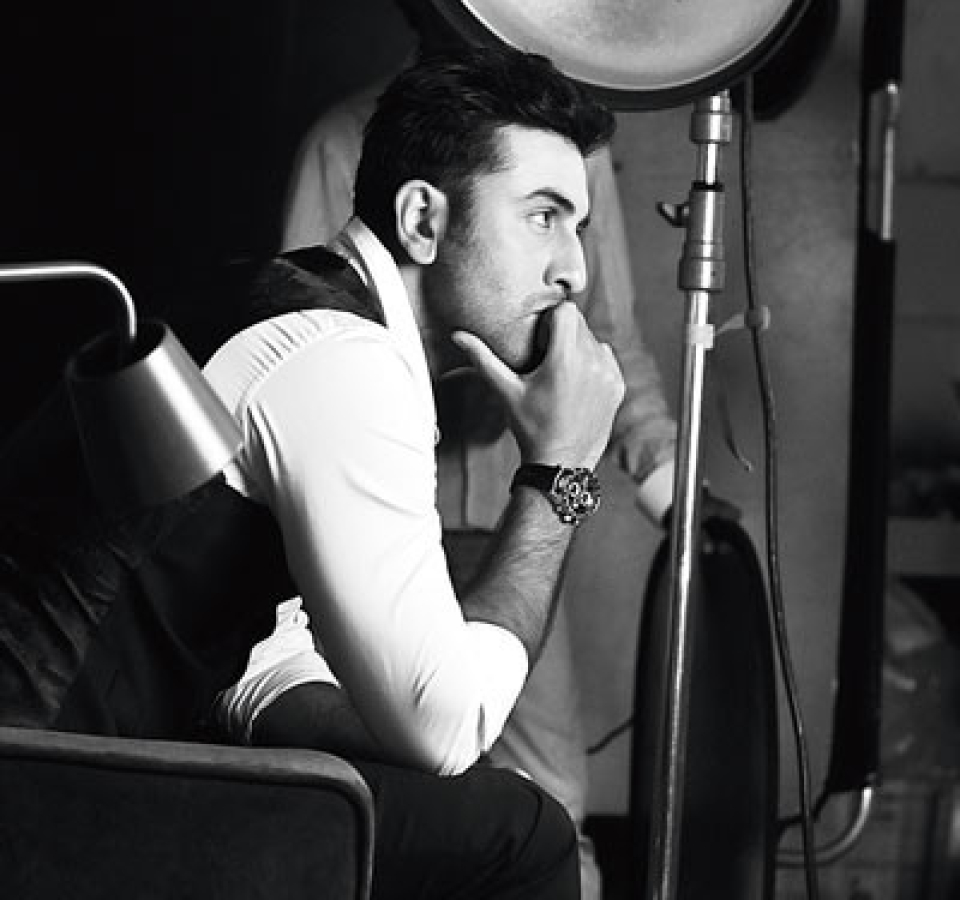
Ranbir Kapoor: Fatal Attraction

01 Saturday Nov 2014

Posted by sitanshi talati-parikh in Interviews (All), Interviews: Cinema, Publication: Verve Magazine

≈ Leave a comment

Tags

Bollywood, Interviews: Cinema, Ranbir Kapoor, Rockstar, Saawariya

Published Verve Magazine, Verve Man supplement, cover story, October 2014
Photographs by Dabboo Ratnani

Ranbir Kapoor for TAG Heuer and Verve, shot by Dabboo Ratnani Ranbir-Kapoor-5-960x900_c

In 2007, with Saawariya, a fresh-faced actor emerged, with the promise of cinematic style. He was eminently watchable and easy on the eyes. The very fact that he could drop his towel without any inhibitions in his first film showed that he had no awkward reservations and could go the distance. Through the films after, he proved himself to be a commercially viable Bollywood star, dancing like a pro and displayed clever histrionics that can only come from a place that has nothing to do with training, observation, knowledge or practice. It’s inherent, it’s intrinsic and it’s something that makes him the poster child for royal DNA.

Suave and personable, there is a boyish charm that makes it easy for people to get drawn to him. I met him socially, just before the release of Saawariya, and when he discovered that I was involved in the film in a small way, he immediately asked my opinion of the film with tremulous anticipation. It was the launch pad to his dream career, after all. Even then, his soft-spoken voice and sincere doe-eyes made you want to believe.

Rockstar director, Imtiaz Ali, is all praise for the Kapoor: “As an actor, Ranbir keeps his craft craftless. He manages not to impose his personality on the character. That is almost impossible to achieve. He is truly deeply madly passionate about cinema. Anyone would be lucky to work with him.” And his repertoire of varied roles underlines this fact. Rocket Singh (2009) proved that Ranbir Kapoor could take a staid role devoid of glamour and turn it into one of his most memorable performances. Rockstar (2011) displayed the zeal, the aesthetic heights that he could be driven to for a role. Barfi! (2012) established that Ranbir could be given any role, with any disability and he could rip the screen with the sheer power of his performance. It’s that easy for him. It’s that exciting for us as viewers. It is without a shred of doubt that the elusive superstar that people await for decades, even generations, has been delivered in the form of Raj Kapoor’s grandson.

But somewhere along the lines, cracks began to appear on the chiselled persona. He’s the rock star of our dreams and the Hyde of our nightmares. He’s the debonair rakish Willoughby that every ‘good’ girl gets her knickers in a twist for, in a futile attempt to tame. He’s young, at the prime of his game and he must sow his wild oats. Do his personal choices make a difference to his onscreen abilities? Only when he chooses to play the field onscreen, you want to save the haseenas from his grasp.

Fortunately for him, the chinks that appear in the amour are only personal ones, never professional. And after a tumultuous break-up he can continue to woo his ex-girlfriend on screen with as much finesse as he would his latest lady love, as is evident by the massive success of last year’s rom-com entirely lacking in nuances,Yeh Jawaani Hai Deewani.

But, his ability to sustain lasting relationships with the same ease he brings to the screen is the question. Is it possible, or fair to expect him to have it all? He promised us a screen hero and never fails to deliver. Must he also give us a persona that we can look up to and admire in real life? It is so rare to find a combination of a brilliant actor and a movie star – one that the masses and critics applaud with equal spirit. May that be enough for us, and may we only hope that the women in his life find peace in being a part of something greater than a person – being witness to Talent.

Ranbir Speak

“My own search for who I am and to make my parents proud, is what drives me. I am very passionate about Indian cinema, acting, directing and producing films. I get to do what I love…it becomes the biggest driving force in life.”

“I don’t think I have ever felt pressure. I felt a responsibility – my family has been contributing to Indian cinema for 80 years and now I have to take that legacy forward, in my own individual way with my own notions, thoughts and choices. Pressure is always used in a negative way; it has positive attributes. So for me it was a responsibility and I had to prove myself within my family.”

“I don’t take tags like ‘desirable’, ‘good-looking’ or ‘bad looking’ too seriously. I always believe that handsome is what handsome really does. If your work is good, everything seems good. I hope to continue doing good work, work with interesting people and constantly surprise myself.”

“You go to work, you come back home, and you switch off and spend time with family, your wife, your girlfriend and your siblings. Family and close friends are really important, that’s what grounds you. The film industry transports you to a place that is not real, so it is really important to get back to your bearings.”

Living Her Dreams

30 Wednesday Apr 2014

Posted by sitanshi talati-parikh in Interviews (All), Interviews: Business, Publication: Verve Magazine

≈ Leave a comment

Tags

Bollywood, Interviews: Cinema, Perizaad Zorabian, The Rose Code, Theatre, Verve Magazine

Published: Verve Magazine, April 2014
Photograph by Toranj Kavyon

Indian cinema and theatre actress, mother and brand builder of her family business; Perizaad Zorabian-Irani is effortlessly easy-goIng, exuberant and full of life

Perizaad Zorabian for Verve Magazine

I don’t have a single lazy, chilled out moment! My life moves at a crazy pace…but that’s the only way I know how to be.”

Dinner With Friends, the Pulitzer Prize-winning play directed by Feroz Abbas Khan that she’s been working in, has been running for three years and seen a 100 shows worldwide. Simultaneously, Perizaad Zorabian-Irani has looked after specific food ranges as her family business, Zorabian Chicken, started its journey into the retail space. And if that’s not enough, she’s mother to six-year-old Zaha and four-year-old Zayaan.

Juggling things isn’t new to her. The 40-year-old describes how she managed to be in the top 10 of her class in school while training for 12 years to be a ballerina – one whom in her teacher’s words was ‘born to be on stage because of the immense joy she brings to her performance’. Later, while modelling and being a part of fashion shows and dramatics, she graduated with a gold medal in management from Mumbai University. She followed it with her education in New York City, where, in addition to her MBA, she also attended the Lee Strasberg Theatre and Film Institute. “All throughout, I have been inclined towards academics and the arts; I feel passionately about both!”

Building the Zorabian brand in the retail space with a limited marketing spend has been extremely challenging. “All I had when we started building our brand was quality – an outstanding product to offer the Indian consumer. Convincing our storekeepers and retailers to give Zorabian shelf space when we first started off was tough, but today when people stop me to tell me how much they love our product, I feel like I have conquered the world and it makes me believe even more in the power of doing things right.”

She’s been nominated for a best debut award for Bollywood Calling (2003), and won a best actor award for Joggers Park (2003) at the Bollywood Awards in New York. She’s acted in more movies since, including essaying the role of Indira Gandhi in a Chinese film, Badung Sonata, and looks forward to exploring that profession further. “Zorabian Chicken gives me an adrenaline rush; being an actor is my moment of nirvana – I need both to complete me.”

She’s been trained early to manage her time effectively and she’s grounded with a strong sense of discipline with the ability to prioritise; which all form key aspects of the balancing act. She admits that it’s not easy to do all of it together, especially when one has young children, but, “if you really want to do something, the whole world conspires to make it possible!”

Perizaad got married in 2006 and believes her husband, businessman Boman Rustom Irani, is the ‘wind beneath her wings’. “In spite of being hugely successful in his own right he has never undermined my need to excel – he has always respected and encouraged it.”

She describes her style quotient as minimalistic, understated, classic and feminine; and her most treasured possession is her engagement ring, which she absolutely can’t take off, even after seven years. While passionate, committed and hard- working are all what she’s about, Perizaad Zorabian-Irani believes success is merely “living life on your own terms. Being able to chase the dreams you want to; being free!”

Cool Crusader

10 Thursday Apr 2014

Posted by sitanshi talati-parikh in Interviews (All), Interviews: Cinema, Publication: Verve Magazine

≈ Leave a comment

Tags

Bollywood, Interviews: Cinema, Nirbhaya, Poorna Jagannathan, The Rose Code, Theatre, Verve Magazine

Published: Verve Magazine, March 2014
Photograph by Toranj Kavyon

Theatre personality, Bollywood actress and American television star Poorna Jagannathan is passionate, driven and well on her way to achieving her own definition of success

Poorna Jagannathan for Verve Magazine

“I’m sick of hearing myself talk about things I’d love to do. I’m trying to just shut up and actually do them.”

And she has gone ahead and done exactly that. Poorna Jagannathan, 41, best known locally for her irreverent role in Delhi Belly (2011) and her character role in last year’s Yeh Jawaani Hai Deewani, juggles working in America and India while also being a mother to her seven-year-old son. “Straddling two continents and living a gypsy lifestyle isn’t easy, but I am drawn to excellent writing and for now, it’s still coming out of the States for me. And raising a child when both parents are working is like a dance where everyone has two left feet!”

Jagannathan was born in Tunisia, grew up in various parts of the world, before calling America home. The American television and film actor begins shooting for HBO’s new series, Criminal Justice, opposite Robert De Niro this summer. But closest to her heart is the critically acclaimed human-rights-theatre-project Nirbhaya, which is a play she has initiated, produced and is acting in. The gang rape in Delhi left her with an unnerving feeling of complicity – reminding her about the times she remained silent about the sexual violence she had dealt with. She felt it is silence that sustains a culture of violence and unaccountability.

Five women (including Jagannathan) come forward to talk about their own personal experience with sexual violence. The hope is that by them breaking their silence, the audience members will too. The play premiered abroad where it won the 2013 Amnesty International award, including several others. It was also listed by The Guardian’s critics as one of the ‘best plays of 2013’. Leaning on crowd funding for their India run, Nirbhaya tours Mumbai (Tata Theatre, 17-20), Delhi (FICCI Auditorium, 22-25) and Bengaluru (Rangshankara, 26-30) this month. “Producing Nirbhaya was a complete paradigm shift. I stopped waiting for something or someone to come along and change things. It’s also when I stopped talking about wanting to do something and actually did it – that was hugely liberating.”

She’s constantly looking to be the voice of dissent. Jagannathan has added a new dimension to the Bollywood red carpet look, and that’s because she likes character in everything that she wears or does. She treasures her wedding ring, which is her mother’s old, traditional South Indian, U-shaped ring. Her sense of humour serves her well as she navigates the Indian film industry, and she admires people who play the ‘David vs. Goliath’ game. “It takes a lot to go up against the system here.”

The Barracks and the Beautiful

01 Tuesday Apr 2014

Posted by sitanshi talati-parikh in Features & Trends, Interviews (All), Publication: Verve Magazine

≈ Leave a comment

Tags

Anuja Chauhan, Anushka Sharma, Army Background, Bollywood, Gul Panag, Interviews: Cinema, Milkha Singh, Neha Dhupia, Nimrat Kaur, Priyanka Chopra, Tarun Tahiliani, Verve Magazine

Published Verve Magazine, March 2014

These driven professionals have solid grounding even if they have lived a nomadic existence. Discipline, endurance, strong commitment to fitness, confidence and the ability to fit in anywhere are defining qualities of army brats. We find that their background is a strong player in their success

“In the services one defined themselves by what one did and stood for, and that does someone more good than being dependent on possessions, especially those handed down to you. Our self- confidence came from ourselves, it was partially a nomadic life, thinking was the best way to travel, movies could be watched under umbrellas in the rain, and one was inculcated with a sense of pride”. – Tarun Tahiliani, designer

Were you aware that the celebrated designer and his sister, Tina, who runs the country’s foremost multi-brand designer store, Ensemble, both hail from a defence background? Their father, Admiral Radhakrishna Hariram Tahiliani, served as the Chief of the Naval Staff of the Indian Navy and as the Governor of Sikkim. Far more than you may realise, the great names of art and culture, fashion and television, corporate anchors and CEOs owe their allegiance to a background of serving the country. (See box for Bollywood’s army kids)

When you observe the way in which these young men and women deal with the pressures of public life, the way in which they remain calm under crisis or criticism, and have the patience and wherewithal to continue on a chosen trajectory, is seems to have a direct bearing on their powerful upbringing. Indian cinema actor, Anushka Sharma’s ability to respond with grace and restraint over the recent public scrutiny or Priyanka Chopra’s strong-willed endurance could be attributed to their upbringing. Former Miss India and Indian cinema actress, who once considered becoming an IAS officer, Neha Dhupia, is strong-willed and not easily moved. “I’m very stable as a person: when my head packs up my body takes over and when my body packs up my mind takes over. My Mom always says, ‘If it doesn’t kill you it only makes you stronger.’ My Dad always says, ‘Don’t sweat the small stuff.’ My parents are humble, educated and unaffected by their surroundings. Being indecisive about things in life isn’t appreciated; it’s almost a sign of being foolish. It’s important to try – winning or losing isn’t important.”

The lifestyle, bordering on nomadic – as Tahiliani describes it – is bound to have repercussions – for most of them, the ability to make friends anywhere, to pick up and move on and remain disconnected from the trappings of setting roots, and treating it like an “adventure”, as stellar novelist, and Rajput army kid, Anuja Chauhan, puts it. It serves them well when dealing with fame, ephemeral industries, transitory jobs and new people. Indian cinema actress, Nimrat Kaur, who shot to fame recently with The Lunchbox, says “We never stayed in one place for more than two to three years. It keeps challenging your comfort zone. You need to make new friends and start afresh; you don’t have an identity you carry with you for years together.” Actor and activist, Gul Panag counts that she has been to 13 schools: “I’m still in touch with these friends. Having travelled so much, I do find it easier to view life as a wide canvas.” While Chauhan admits that “you get better at socialising, taking a deep breath, walking into a roomful of strangers and making friends with them”, she believes that not sticking around in one school impacts the chance of having deep friendships.

There is also a tolerance towards and the ability to deal with people, while fostering an innate sense of confidence and approachability. Says Kaur, whose father was a farmer’s son and didn’t have money for school: “The environment is extremely eclectic – people from all walks of life come in to the army to become officers. You are exposed to values from different cultures. Everyone has the same resources and furniture, is at the same level – it makes a difference to your worldview. As a girl I was never treated differently from the boys, you have the same responsibilities.” And they are definitely not shy talking to people. Chauhan agrees, “Army brats strut around a safe cantonment environment, and so they’re more confident – and more patriotic!”

Great mental strength and the ability to deal with situations bristling with tension give them staying power in industries that are cutthroat yet riddled with fragile and tenuous relationships. Gul Panag, whose father, H S Panag, is a general (retired) in the Indian Army, admits that having to deal with the fact that one of your family members may be posted to an area that is fraught with immense danger and dealing with the uncertainty that it creates, makes you mentally very tough. “The whole focus of putting country before self also creates a deeper sense of purpose and strength that is then evident in other areas of life as well – you are willing to take more risks, live life fuller and, of course, are also more grounded.” Perhaps this thinking gives Panag the ability to be outspoken on a public platform, the confidence to become an activist for social causes.

And along with that comes the actual physical strength – the training to keep going for long hours and withstand immense physical pressure. Army brats are all very outdoorsy, learning to swim and horse-ride at an early age, are automatically exposed to a wide range of sports and tend towards natural athleticism, even if all can’t eventually be the famous runner Milkha Singh or his golfer son, Jeev Milkha Singh. Or stunt star Akshay Kumar, for that matter! Panag started running when she was 16, inspired by her father’s passion for fitness. “He would often make an example of me to his unfit officers, comparing the fact that a 16-year-old girl could outrun them! The focus on fitness was certainly a way of life growing up, and it’s stayed with me always.” Kaur also stresses on the discipline that comes as a part of the culture, along with being physically fit – being physically on time! “My father was one of the fittest people I had known. It (the movie industry) is a physically exhausting field and being delicate takes that much longer to adapt to things.” Neha Dhupia is a regular in the Mumbai Marathon. “I never start or end my day without a run, even when I am travelling. Being in the (movie) industry you want to get away, to clear and relax your mind, not have it ticking like a time bomb.” Chauhan, who easily romanticises the cantonment life says, “I think the whole club-swimming pool-golf-course- embroidery classes-May Queen Ball culture is one of the best one could have those days.”

The regular social events in the barracks, which include participation in initial-level beauty contests such as the Navy Queen held at the Navy Ball, naturally prep the girls for thinking of pageants as a future option on a bigger scale. Dhupia changed her mind about becoming an IAS officer when an uncle suggested her entering her name in the Miss India beauty pageant. There was no looking back. From Sushmita Sen and Lara Dutta to Pooja Batra, there are a number of army offspring who have shone in beauty pageants and eventually gone on to become actresses. Panag admits, “I think every little girl dreams of being Miss India one day. I don’t know if it’s an army-specific thing. But certainly the outlook in the defence forces is forward looking and allows girls that freedom to dream and do.” But Kaur is quite vociferous in her anti-view, “My mother was never inclined towards beauty contests. I don’t subscribe to them personally. They are an easy way of making a mark. When Sushmita Sen won Miss Universe, or Aishwarya Rai won Miss World, everyone rejoiced. The novelty may have got diluted today – now there are other ways of being noticed.”

Being associated with a defence family also means dealing with the loss of life and coming to terms with insecurity about your loved ones. It also tends to make you value life more. Kaur, whose father was in the Indian Army and lost his life in a terrorist attack in Kashmir, has deep feelings about it. “Having seen death up close keeps your core strong. My inner strength or core comes from an upbringing I have seen – you can take everything away from me, but you cannot take away the upbringing. I have these values and they remain with me. I have seen extremely drastic times with losing my father on the field in Kashmir. I don’t know if being in any other profession would have changed things. Life is more fragile and you have experienced more dangerous situations. You don’t take things for granted; you value life and people. Things change without your control so rapidly. All you have is your conduct and how you treated people, and your goodwill.”

Without going deep into Francis Galton’s nature and nurture debate, and accepting that the ‘tabula rasa’ theory cannot be viewed in isolation, one must admit that one’s upbringing and surroundings have a strong and dynamic impact on our choices, thinking and personality. It defines whom you eventually go on to become and defines how you deal with circumstances. Army brats are given a solid foundation upon which they manage to make something of themselves – as so many people in diverse fields have proven. Galton’s half- cousin Charles Darwin’s ‘survival of the fittest’ is not too far from the truth when it comes to defining the success of these individuals from defence backgrounds. They are fit, determined and they often show us how it’s done.

BOLLYWOOD’S ARMY BRATS

  • Akshay Kumar
  • Anushka Sharma
  • Arjun Rampal
  • Celina Jaitley
  • Chitrangada Singh
  • Gauri Khan
  • Lara Dutta
  • Mohnish Behl
  • Pooja Batra
  • Preity Zinta
  • Priyanka Chopra
  • Sushmita Sen

To The Manner Born: Sonakshi Sinha

05 Monday Aug 2013

Posted by sitanshi talati-parikh in Interviews (All), Interviews: Cinema, Interviews: Cover Stories, Publication: Verve Magazine

≈ Leave a comment

Tags

Bollywood, Imran Khan, India, Interview, Interviews: Cinema, Sonakshi Sinha, Verve Magazine, Vikramaditya Motwane

Published: Verve Magazine, Cover Story, August 2013

Sanskaar is a word often associated with her, she says. Sonakshi Sinha is unabashedly confident, reclusively shy and riding a wave of professional good fortune. The homegrown actor is uncomplicated and easy-going…and quintessentially Indian…

Image

She is always excruciatingly punctual. Apparently, on set she’s the first one in – ready before even the lighting guys have set up. At magazine shoots, she’s there with at least a couple of minutes to spare. Sonakshi Sinha crashes on the bed of the hotel suite we are shooting in and experiences a ‘lazy’ moment. Indigo skinny jeans, fitted tee and a smart cropped black leather jacket, a faint hint of lipstick and reflector shades complete the biker-chic look.

We chat lightly. Her grilled cheese sandwich and fries are on their way. While she agrees that an Indian woman is meant to be traditionally curvy and voluptuous, you find that she looks surprisingly slimmer in person than she did recently on screen, and her stomach is enviably flat – but her face is as captivating when she breaks into a smile. That smile reaches her large, expressive coffee-brown eyes that are immersive and can sparkle with a mood of their own. When her lip curls in dissatisfaction, it takes you back to her recent role of Pakhi from Vikramaditya Motwane’s Lootera, seared in our memory, as she transcends the elongated scenes in the movie with her emotiveness. She speaks easily, points out that she keeps getting asked certain questions – answers to which she’s “rattoed” (memorised by rote) and admits she enjoyed our little conversation.

The largely well-received Lootera was a “once-in-a-lifetime opportunity. I felt it was written for me”. People kept telling her not to do the film, that it was meant for a more mature actress, but she figured it was a dream role. And, she admits, the very fact that people were advising her against it goaded her to go for it. While she makes no pretense to high cinema, the 26-year-old girl, who’s taken on masala blockbuster movies head-on and won the heart of the hinterlands, feels that a slow, period romance like Lootera has given her recognition as an actor.

She comes on the set, gets ready with her lines and awaits the director’s instruction. Opening each day with a clean slate, she prefers to be moulded according to the director’s vision, believing that no one understands the character better. In her upcoming release this month, the Akshay Kumar-Imran Khan starrer, Once Upon A Time In Mumbai Dobaara, she plays a girl who makes the move from Kashmir to Mumbai to act. The first Milan Luthria film was a gangster thriller; the sequel has a stronger love angle, requiring a different chemistry for each character (Akshay and Imran), and balancing that became a challenge for her. “I was never a movie buff – I watched very few movies. I like to observe people and their nuances. I meet so many people every day – there is so much variety.”

“Sonakshi is professional, dedicated, fearless and magical. She has a wonderful presence – if she chooses her roles well over the next few years she could be one of the all-time greats.”
– Vikramaditya Motwane, director

Standing tall at five feet and eight inches, she’s comfortable in her own skin, but remains a quiet person. “I am a Gemini – two sides of a coin. I’m a shy person; I like to be by myself sometimes. I don’t overindulge in conversations with people I wouldn’t know.” She knows she’s here to do a certain job and that’s all that matters. “Some people are just meant to do what they are meant to do. I’ve inherited it from my father (actor-politician, Shatrughan Sinha) – he’s a very confident person. Besides, I don’t have anything not to be confident about – I’m very happy, I’m doing well; I’m working hard.” But it’s an industry of insecurities. “That’s what a lot of people tell me. I don’t know. I don’t want to be the centre of attention, I’m not insecure, I’m very comfortable with who I am, with what I’m doing, I don’t poke my nose into other people’s business. I guess that makes me a misfit!”

Sonakshi has her life cleanly compartmentalised. “I switch on and switch off with the camera. I don’t like to take my work home, I don’t like to talk about it; at home it’s a completely different life.”

Preferring to hang out with her school and college friends rather than fraternising with industry people, she says, “Going out for events and promotions, crowds of people yelling and shouting your name – that’s where it ends. At home I’m not a star, I’m my parents’ daughter and my brothers’ sister. If I do something wrong I’m reprimanded for it.” Having lived an unabashedly sheltered life while growing up (not being allowed to go abroad to study or to join her brothers at Kodai International boarding school), she admits, “I still have to be home at 1.30 a.m. when I go out! I have a deadline…it’s always been like that.”

Her mother used to be by her side all the time when Sonakshi had just started her movie career, but now she leaves her to figure things out for herself. “While she knows we are always there for her, workspaces have changed today. She’s grown up now, she understands her limits,” says erstwhile actress, Poonam Sinha who recalls how her daughter has always been sure of herself, quick to take a decision, with no qualms after. “She used to sketch much before she knew she wanted a career in fashion design. She would throw the sheets away, but I used to collect her sketches. Even her foray into films – she entered without any formal training in acting, dance or dialogue delivery. But she was confident from day one. I remember Salman Khan saying to her, ‘Wow, you are a one-take artist!’ She also has a strong gut instinct – she had a feeling about Pakhi (Lootera), that no one but she could play that role. She didn’t think twice.”

Sonakshi has wriggled into a very specific niche in Hindi cinema, quietly making it her own. Somehow, that garners the most queries from viewers who are now accustomed to bare-all-wear-nothing heroines. “It’s ironic that people keep asking me why I keep doing traditional roles as opposed to glamorous ones and no one asks any other Hindi cinema actress why she doesn’t do traditional roles as opposed to glamorous ones! We are talking about India, aren’t we,” she snips back with a smile. Playing a UP girl in Dabangg, a Bihari in Rowdy Rathore, a Punjabi kudi in Son of Sardaar, a Bengali in Lootera and now a Kashmiri girl in Once Upon a Time…she’s been captivated by the places she’s shot in. “I’ve covered most parts of India and found the interiors of the country fascinating. While sitting in the city (Mumbai) we tend to plan vacations abroad, and shooting in these locales has been an eye-opener…they are beautiful! And, I love Mumbai. However much we may crib about the mess and the roads, there’s just something about being home – about this being home,” she says with a broad sweep of her hands, encompassing the rain-tossed waves and palm fronds of Juhu beach outside the windows.

You don’t think she’ll hop off to perform a puja anytime soon, but you do think that she’s been raised to be careful of her screen presence and of her public persona. To be mindful of the way her actions would reflect upon her family. “The world has moved on, children live in a freer world, inspired by the West, but we are a very conventional family. She knew her dos and don’ts. Her father comes from that part of India, is a politician…she’s had to understand her responsibility,” says Poonam Sinha. Sonakshi adds, “There has never been any pressure from their side to do any of it – it’s just the way I have been brought up. I am a certain way, I don’t wear certain kinds of clothes, and we are a conservative family. It’s a part of my value system. My upbringing has everything to do with my rootedness and morals. It’s instinctive. Today wherever I go, when I meet somebody senior, actors or technicians, they give a direct compliment to my parents by saying, ‘I want my daughter to be just like you,’ and they use the words sanskaar a lot.”

“She’s got the swagger and attitude of Salman Khan and Akshay Kumar, and what makes them attractive is what makes her attractive: her inherent confidence and security. She’s simple, straightforward and uncomplicated.”
– Imran Khan, actor and co-star

So she sinks easily into her onscreen traditional avatar. She dons the saris and bindis and smiles beatifically into the camera. She’s mastered the art of holding her face at an angle just right, so that her sharp profile can be seen at its best advantage – she knows she can charm the audience with her warm smile and demure flicker of her eyelashes. And when I relate what her co-star and director have to say about her for this interview, you can’t miss the faint blush creeping up. She’s bashful; she’s smiling, she’s unable to look up. “The overall perception is that the youth is getting immoral – but that is a generalisation. I think India remains a rooted country, a country bound by values. That’s the basic story.”

The World According to Aishwarya Rai Bachchan

19 Saturday Mar 2011

Posted by sitanshi talati-parikh in Interviews (All), Interviews: Cinema, Interviews: Cover Stories, Publication: Verve Magazine

≈ Leave a comment

Tags

Aishwarya Rai Bachchan, Bollywood, Interview, Interviews: Cinema, Interviews: Travel, Verve Magazine

Published: Verve Magazine, Cover Story, March 2011
Photographs by Mike Ruiz

Aishwarya Rai Bachchan’s natural precociousness springs up at every twist in the traveller’s tale. Sitanshi Talati-Parikh watches the ex-Miss World-turned-moviestar-and-homemaker switch from child to Inca queen, Bollywood dramatist to casual honeymooner, lost tourist to Disneyworld explorer, through loud giggles, flashing smiles, dramatic enunciations and passionate inflections, exploring a few of her many memorable journeys


Ash04

A little girl sets sail for the world in an “enormous ship”. The romantic notion of travel becomes a kaleidoscopic reality, possibly even a way of life, with her “shippie” dad and family. It is the mid ’80s when Japan is “very disciplined” and China is yet to come into its own. Around a decade later, winning the Miss World pageant makes her “a cultural ambassador of India” in places unpronounceable. And through it all, Aishwarya Rai Bachchan has felt the power of being Indian, of coming from “a world within the world”.


Since then, there have been movie shoots in exotic locales: from a desert full of water bodies in Latin America to remote towns in India, brand endorsements in cobble-stoned Europe, and the world becoming a stage, literally, with performances like the Unforgettable World Tour. “I will go out and experience a place, I won’t live in an ivory tower, while gauging it and being responsible. Ever since Miss World, people have given me a lot of love – whether you call it recognition or adulation, they have always been expressive in their connectivity with me. When they saw me on the streets, it wasn’t like ‘Ay, Aishwarya!’ – women would come forward blessing and embracing me.”


Always politically correct, her carefully polished voice modulating with occasional bursts of enthusiasm, the intrepid traveller sits easy, knowing that the subject of the day is one she can be naturally passionate about. She points out that while the world advanced technologically, becoming a “smaller place”, her life mirrored the advancement: “Everything became from a 14-hour or 18-hour flight to ‘just an overnighter’, because you started doing it so often. Abhishek (Bachchan) and I love flights – we’re psychotic that way.” And, as she inevitably spends an exorbitant amount of time in transit, the covert people watcher admits “feeling a lot for elderly Indian passengers who walk around staring at monitors. Airports can be overwhelming – with the distances, pace, people and security checks; and while they have become second nature to me, I can still relate to how the experience can be for the uninitiated.”


South Africa: “I had a funny feeling inside me – looking outside the airplane window – a sense of going away.”
There are three times that Aishwarya Rai Bachchan recalls feeling this way, with a distinct sense of poignancy. It began with the flight to South Africa as she left to compete for, and win, the Miss World pageant title in 1994. “I suddenly felt that I would be away from everyone and alone for a month. And the thought of being with a whole lot of people foreign to you; but when you get there, you just fit in. I don’t know if it was a premonition or not, but I sensed that life was changing.”


London: “When you land there in winter, you barely wake up from the jetlag and feel that it is dark, like night again.”
In London, where she was to spend a year as the reigning Miss World, she had the option to have her own apartment or to live with a family in their house. “And I, being the responsible one, chose to stay in a house with a very sweet elderly couple rather than alone in an apartment, knowing my family would feel more secure. It’s a very Indian thing.” It was the first time she was living on her own: “For further studies I never went outside of Mumbai, because my father was a marine engineer, and it was just my brother, mum and I living together; I would feel for my mother and didn’t want to leave her and go away.”


Shanghai: “Suddenly Shanghai was an absolutely different city, and the world was beginning to talk about the change in China.”
It was a very different China during her repeat journey in 1994, when she went as a model with Hemant Trevedi. “Shanghai was a symbol of that change – the modernisation and globalisation, like the US on this side of the world. This was a new culture, very much in keeping with the times or ahead of the time. Very interested in India and Indian fashion and it was almost a privilege to be there with our fashion and our designers.”


China: “This time I was shooting a song on the Great Wall doing a little jig!”
In 1994, she had walked up to the fifth gate of the Great Wall, with a “more grown-up taking away, recognising the passion of generations working on building this incredible wonder that we live with on our planet”. She was back on the Great Wall as an actor, shooting the song Poovukkul, which showcased the Seven Wonders of the World, for Shankar’s Jeans. “You never know when you are going to revisit a certain part of the world. As a kid, when I was there in the ’80s, they took us to a uniquely Chinese opera, and sang some of our Hindi songs, with all the Chinese in the audience looking at us because we were the one Indian family sitting there. You’ve heard of people in China and Russia listening to our music, our film songs, and then to think, on my third visit there, I was shooting a song, with a live audience of people fascinated by our cinema and the song culture of our movies.”


Times Square and historic sites: “I am an actor – it means you have to do everything!”
Dancing atop the Great Wall – did it feel ridiculous at all? “Interestingly enough, never,” Aishwarya answers decisively. “From the beginning, I never felt odd. When shooting for Aur Pyar Ho Gaya, I remember Bobby (Deol), even though he belongs to an actor-family, feeling a bit odd when we had to do ridiculous things in public arenas, like jump on a car, or run on the street with a toothbrush in our hand and toothpaste on our face.” Or the time when she was in New York City shooting for Aa Ab Laut Chalein in Times Square wearing a fuschia pink gown with a bow, big earrings and a flower in her hair. “I had no inhibitions. You’ve grown up watching it, song and dance is so much a part of our cinema that you don’t feel silly doing it.”


Disneyland: “We both were like excited kids – free, happy and wonderfully reliving our childhood.”
A youthful exuberance springs up as she recalls memories of the past. “That family trip (’80s) that started with Japan ended with Disneyland, and Abhishek and I ended our honeymoon – after Bora Bora’s ‘drop in the ocean’ experience – in Disneyland. It wasn’t planned, but worked out beautifully into a great circle.”


Tunisia: “In my interviews, when I say ‘Every day I feel like a newcomer, or every day is like the first time’ there are those special moments when I actually feel that, very, very strongly.”
The third time she felt “the pit of the stomach feeling” was when she took off to shoot for “one of the best film experiences”, The Last Legion in Tunisia and Slovakia. “Not only did I have no one from my nationality on the crew, it was a guy flick – everybody was a dude! I was going to be a warrior, this action character. I was feeling it again: going away for a very long period, and I had to step away from very interesting work that was happening here. I had gone through that predicament too many times in my life and career: ‘Heck, all good things happening, do I have to choose?’” Without any idea of the geography of Tunisia, she was bowled over by the spectacular beauty of the country. She arrived three days before the shoot, without rehearsal. “Everyone was in panic mode, but my dancing helped me, I embraced action instantly. Beautiful Mediterranean water, very hot and warm…a bit much in the costumes, with all that armour! The places were so quaint and simple that we all became that much closer as a group.”


Slovakia: “These guys are HUGE. When you sit on these buggers, you don’t walk straight for two days after.”
Slovakia was familiar because she had been to Prague. She found the “cold (weather) and green” country replete with beautiful castles. “We were all like kids. We had so much fun working together, and such incredible discipline – whether it was Colin (Firth) or Sir Ben (Kingsley) – we were like children in a giant videogame.” And the most remarkable experience was spending time on horseback. She emits a loud, expressive laugh: “The horses in Tunisia are one size and then you get to Slovakia and you realise that the horses there are different. These guys are HUGE. When you sit on these buggers, you don’t walk straight for two days after!”


Budapest: “Ajay kept telling Sanjay (Leela Bhansali) that the two things he dreaded the most, dancing and singing, were what Sanjay made him do in the film.”
Budapest was special because Hum Dil De Chuke Sanam was shot there, for which she got her first Best Actress award. She recalls with a smile, the dance sequence with a rather nervous Ajay Devgn. “It was exceptional because it was an insight into their culture – the music and dance sequence was local to the place. So you actually experienced something unique, apart from the magnificence of being by the river and bridge. Also, we saw very few children in the country, and then we realised that they were encouraging people to have more children because of the mortality rate. Apart from the cuisines, it is always interesting to come away with an insight into the place. For me, it is not about hitting the shops; it is about getting to know a place.”


Brazil: “I was reliving my college days, being vicariously part of a gang of childhood friends.”
After Columbia during her Miss World reign, she was back in South America much later, when shooting for Dhoom 2. “The genre of the film we were working on made us relive our college days. I was privy to a close unit of kids (Abhishek, ‘Duggu’ Hrithik Roshan and Uday Chopra) who are childhood friends, and felt that I was vicariously part of the gang. Brazil offers that kind of spirit, the film gave that kind of energy.” Her eyes take on a faraway look as she recalls a surreal moment towards the end of the Dhoom 2 shooting schedule. They lay sprawled below the “magnificent” Christo, in the wee hours of the morning, before Hrithik Roshan was returning to his son being born. “We were in that woozy state of mind, because we had stayed awake the previous day and night and were watching the sun rise. It was a very quiet time, the early morning hour before the tourists arrived. We had had such a noisy schedule, all of us buzzing throughout, that it was the best silence we all shared. As we lay on the ground, we felt that Christ was looking at us from the skies. You hear terms like, ‘listening to the sound of silence’, but we experienced it then.”


Machu Picchu: “In my little bling feathered costume, I looked like one of the Inca queens.”
Shankar’s Robot took her once again to “the other side of the world”. She had taken a break from her career for the first time in her life. “I was facing the camera after an unexpected eight months all the way in Machu Picchu (Peru).” It was the longest journey they had made – counting the kind of flights, number of flights and locations. Upon reaching the place, a tiny township, after a train journey, they all walked from the railway station dragging their bags on the road. “As we trekked along, we suddenly passed a marketplace. My staff was exhausted, but I was thinking, ‘What an adventure!’ I love walking, because we don’t do that enough, and you actually get to feel the pulse of the place, get in contact with the people and culture, otherwise it could well be structure to car, car to airport, airport to plane, plane to car, car to hotel.”


Mexico City airport: “I was the pride of India and all that – and I didn’t have my passport. This was the worst moment for me.”
With her valet in tow, and running a fever, Aishwarya was connecting via Mexico City en route to Melbourne, Australia, representing India in a performance at the Commonwealth Games. Special Services, who had come to help them with the language barrier, disappeared with their passports. “It was bizarre. People there would smile a lot and look blank, because they didn’t speak the language.” She was taken to a private room that was empty save for two people who could be guards eating a home-cooked meal. “It was like the movies – being in a prison cell and these guys going at their meat sauce and bread. They would say something to each other and keep smiling at me. My valet has piercing eyes, so I would keep telling him to smile and keep his face easy. I suddenly felt I had to be protective and get us out of here. I had never felt that before. I wasn’t getting through on the phone to anyone and at one point I felt myself go a bit cold. I had wanted to visit Mexico, but this was not the adventure I was looking for!” After an encounter with a man who spoke perfectly-accented English and suddenly refused to speak any, to a bunch of “strong-looking women” who used the word “off-loaded”, Aishwarya nearly gave up. And then suddenly, in the crowd she spied the person who had disappeared with their passports and chased him down. “He was carrying our passports in his hand, and till date I have no idea why.”


Los Angeles: “With time, travel, age and experiences, you begin to like the easier, more social pace of LA.”
After boarding the flight from an eventful Mexico City, she was transiting through LA to catch her Melbourne connection, hoping to make it in time to perform. “I reached LA and suddenly life was beyond fabulous. It was the one time I cherished being who I am, in terms of the celebrity life. Suddenly, it was beyond comfort, think all superlatives. I always say that once in a while, if it gets too comfortable, God just does a little schickt (demonstrates a click with her fingers like playing carom). He’s watching his own little rom-com, thinking, ‘I want to have fun with you’. So I think, ‘Enjoy it, and turn it when you want to.’”


New Zealand: “The life that we lead, we are like gypsies, nomads, and I’m very quick to feel at home in any place in the world.”
She’s spoken a marathon, and yet looks like she can go on. I’m right; this would make a coffee-table book. “We don’t realise how quickly time flies and because a part of our life gets captured on celluloid forever, I feel as actors we live lifetimes within our lifetime.” She is off to join Abhishek in time for his birthday, in New Zealand where he is shooting, in a place she has never been before. Some people are meant to be children of the world, explorers in their own right. “And yet, when one travels so much, there will always be something unique to being home. It is your family that makes home what it is – it’s not the physical structure even if you say bed and all of that. I live a very homely life in the places that I go to. Besides, as Abhishek rightly puts it, one in six is an Indian: you can go to the farthest of places and we (Indians) will be there, saying, ‘Hello, you want home-cooked food?’ That’s the best part about Indians – they are there to feed you. You are at home anywhere in the world.”

There is no “I” in Teamwork…

25 Monday Oct 2010

Posted by sitanshi talati-parikh in Musings

≈ Leave a comment

Tags

Chak De, Imran Khan, India, Interviews: Cinema, Politics, Raajneeti, Teamwork, Thoughts

It’s an observation I picked up from Twitter – that teamwork doesn’t have an “i”. And while that’s simple to understand, it means the making or breaking of a country. Sounds monumental? It is. Let’s start with what triggered this thought. Actor Imran Khan’s column in HT today (see excerpt below) on teamwork in movies and my catching Raajneeti on TV last night.

Imran Khan talks about how movies are made by teams, even if they are temporary, they are loyal:
“I wanted to talk about how we all come together for a few months, work till we fall down from exhaustion and then go our separate ways. You see, most people never realise just how much teamwork plays a part in what we do. An actor could be giving the performance of a lifetime, but if the cameraman doesn’t capture it correctly, nobody will ever see it. Each and every shot depends upon each and every person from each and every department doing exactly the right thing at exactly the right moment. It’s stressful and demanding… but it also creates a kind of bond that few other things can. For example, as I sit and write this, there is a game of cricket underway. The actors, director, ADs and light boys are all taking turns batting and bowling, and there is no hierarchy. Or, when we’ve been shooting for hours and it’s past lunch time, no one complains, because we’re all in it together. Nobody starts eating until everyone has broken for lunch.

The fate of a film can never be predicted; it may do well, it may disappear without a trace. I’ve seen both happen. But that can’t change the way we approach our work. We still have to give it everything we have, and we still have to come together and work as a team. And that’s reflected in the term for an entire cast and crew of a film; it’s called a unit.” (Full column here.)

On the other hand, there is politics, where there are teams and more teams and even more teams that spend their time bickering, playing games, manipulating and buying each other out. While some people thought Raajneeti was a bit extreme, I find it quite a relevant movie of the time – where politics today is not what the Greeks intended it to be when they coined the term.

Ref: Wikipedia: “Politics (from Greek πολιτικος, [politikós]: «citizen», «civilian»), is a process by which groups of people make collective decisions. The term is generally applied to behavior within civil governments, but politics has been observed in other group interactions, including corporate, academic, and religious institutions. It consists of ‘social relations involving authority or power’ and refers to the regulation of a political unit, and to the methods and tactics used to formulate and apply policy.”

What is the problem with our country, or many other countries today? Is it really what we learnt in civics and political science and sociology, the things we rattle off, the terms that NRIs sit back in their la-z-boys and shake their heads over while munching betel nuts? Corruption, over-population, illiteracy…these are the buzz words. Yes, these problem exist, and yes, there are important issues that need to be solved for our country to move forward. But is this the real problem at the very foundation of our issues? I think not, I think it is a genuine lack of team spirit. We don’t think like one nation, one people. Whether it is because of religion, caste, money, social structure or an age-old belief in hierarchy…or even just survival of the fittest (because we’ve had to survive to make it here – fight to get anywhere), it has made us individualistic. At the very most, we may include our family in our concerns, but that is also getting few and far between and we find ourselves largely driven by selfish concerns. Some of our wealthiest people do not contribute to charity, rather build towering monuments to denote their status. Recently, while visiting the Jai Vakeel school for the mentally challenged, I learned that the government hasn’t paid salaries there in four months. So even when something good is being done, they can’t simply cough up the change to keep it going, but they can pocket the change from CWG and other big projects. While lining one’s pockets, can’t one at the very least ensure that some good comes of some of the tax payers’ money?

Another quote popularised on Twitter, “Indians are privately smart and publicly dumb” – is exactly the same thing, we don’t believe in treating our country like our own. The streets are not ours, we can trash them. The public loos are not in our house, we can leave them filthy. The movie theatre isn’t our own, we can mess it up with food and drink. Publicly, we notoriously behave like pigs in a pigsty, and yet, we follow stringent hygiene and cleaning rules in our homes – remove your shoes before coming in, they will track germs from the outside in! Is it that we believe that someone else will take care of our mess? Is it simply because we don’t care enough about anyone else that it doesn’t matter?

The reason we admire sports so much is that as humans we crave bonding and togetherness – and there are very few places that show mutual respect and warmth for other humans than in teams that come together for a common cause. I admire the film industry – despite their bickering and issues and camps, a group of people come together and work hard to make a film – even if they never see each other again once it’s complete, they gave it their unselfish best when required. In fact, the movie Chak De is a metaphor for Indian society – we are too mentally segregated to think like one, and when we do, we can possibly reach heights we have never considered possible.

Why can’t we as social citizens do that? Why must we treat other people as “others” and not a part of our own team, own country, own race? Why can’t we think like “we” rather than “I”? If we were to, everything would be very different. A simple shift in perspective would make a huge difference in thought and a huge difference in where we are as a race or nation.

Short-sightedness – where we can’t see beyond our own noses and houses, is what makes us an ultimately selfish race. And this is the root of the trouble – global warming, social evils, unhappiness all boils down to being able to think as a bigger identity than oneself. Can we be bigger than we think we want to be?


|  Filling the gaps between words.  |

Writing By Category

  • Art, Literature & Culture
  • Brand Builidng
  • Brand Watch
  • Fashion & Style
  • Features & Trends
  • Fiction
  • Food
  • Humour
  • In The Media
  • Interviews (All)
  • Interviews: Business
  • Interviews: Cinema
  • Interviews: Cover Stories
  • Interviews: Lifestyle
  • Interviews: Luxury Brands
  • Interviews: The Arts
  • Interviews: Travel
  • Musings
  • Parenting
  • Publication: Conde Nast
  • Publication: Elle
  • Publication: Mint Lounge
  • Publication: Mother's World
  • Publication: Taj Magazine
  • Publication: The Swaddle
  • Publication: The Voice of Fashion
  • Publication: Verve Magazine
  • Social Chronicles
  • Sustainability
  • Travel Stories

Reach out:
sitanshi.t.parikh@gmail.com

© Sitanshi Talati-Parikh 2018.
All Rights Reserved.

Website Powered by WordPress.com.

  • Subscribe Subscribed
    • sitanshi talati-parikh
    • Join 51 other subscribers
    • Already have a WordPress.com account? Log in now.
    • sitanshi talati-parikh
    • Subscribe Subscribed
    • Sign up
    • Log in
    • Report this content
    • View site in Reader
    • Manage subscriptions
    • Collapse this bar
 

Loading Comments...