
• About
  • Brand Building
  • Film & Drama
  • Writing: Arts & Lifestyle
  • Writing: Interviews
  • Writing: Luxury Brands
  • Writing: Travel

sitanshi talati-parikh

sitanshi talati-parikh

Tag Archives: Pakistani Arts & Literature

The Present Past

27 Sunday Jun 2010

Posted by sitanshi talati-parikh in Art, Literature & Culture, Interviews (All), Interviews: The Arts, Publication: Verve Magazine

≈ Leave a comment

Tags

Art and Design, Pakistani Arts & Literature, vervemagazine

Published: Verve Magazine, Nerve, June 2010

Risham Syed is an artist who understands the influence of history in contemporary life, and expresses it through her often ironic and provoking tableaux. Sitanshi Talati-Parikh explores her intent and thought
Art02
Art03
Art01
See the full gallery on Posterous

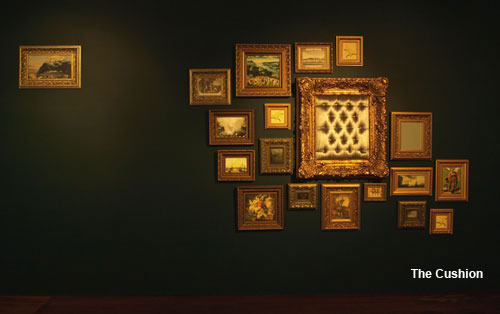
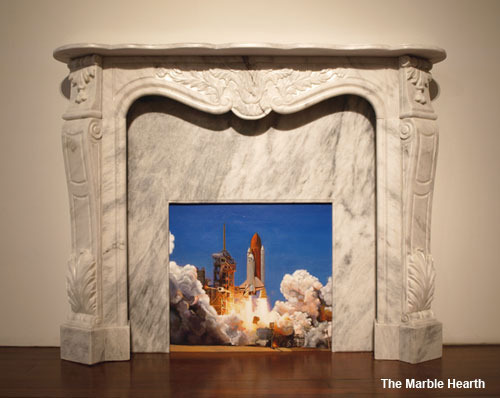
Lahore-based Risham Syed stages provocative set pieces by juxtaposing the power of the past with symbols of contemporary Pakistani society. She paints art, historical images or even photographic images in acrylic, which is essentially plastic. Paintings are turned into objects and ‘conceptual pieces’. There is a very strong influence of power play in the mise-en-scene of installation art and the placement of objects. Domestic objects are used to talk about her experience of living in a society “which imposes certain roles on (men and) women who in turn assume these roles most of the time without challenging/questioning them. This is a take on that, but then these objects engage in a dialogue with the larger social/political picture.” She chooses objects that carry a particular historical/cultural context. For example, the white marble mantelpiece is very Victorian with Indian elements. Along with representing the family unit or the institution of it, it represents a certain class. The wall lamp pretends to be ‘Victorian’ but is a very cheap Chinese version of it. The vestiges of cultural inheritance are observed to suggest an origin and it’s very perceived authenticity.


Art04

In conversation with the artist:

What inspires your works?
I collect photographs from newspapers, magazines, life around in general on a daily basis. I also collect old photographs that inherently carry a particular context with them. I am interested in history and how it connects itself with the present moment.

What draws you towards historical power play?
I connect history with the present. It is also a way of looking within and outside and I like this recurring dialogue. The way I construct this connection, I feel it remains open and every time a new narrative can appear, depending on the sequence of the connection.

Are you using space as a metaphor?
The most apparent thing is a domestic space that comes through from these constructions. It’s a metaphor for roles, personas, pretences, power play, control, etc. Domesticity is a tool that I use to connect various issues with the larger picture. You see a quiet wall lamp with a small painting under it but on close inspection the painting is of disturbance or violence. In this way within the quiet, apparently pretty domestic spaces, there is another space within the painted surface which again is a metaphor for the space outside of us which is alien yet it’s the space within us.

What does power mean to you?
The idea of power or ego is within us and it manifests itself in various dislocated channels resulting in destruction. There is power play from within the basic family unit structure of the society to the larger global picture. It’s the base of the economic structure and that becomes the driving force. It is connected with identities, images, personas, relationships and attitudes.

Influencing artists Zahoor-ul Akhlaq, Salima Hashmi, Quddus Mirza (her teachers at National College of Arts, Lahore). Indian artists like Amrita Sher Gill, Arpita Singh, Bhupen Khakar, the Warhli tribes.

Love looking at: Rembrandt, Leonardo, Vermeer, Gauguin, Van Gough, Magaritte, Joseph Cornell, Frida Kahlo, Chagall, Rothko, Rauschenburg, Richter, Peter Blake, Hockney, O’Keefe, Cartier Bresson….
Literature: Window to Pakistan

26 Friday Dec 2008

Posted by sitanshi talati-parikh in Publication: Verve Magazine

≈ Leave a comment

Tags

Chick Lit, Interview, Literature, Moni Mohsin, Pakistani Arts & Literature, vervemagazine

Published: Verve Magazine, Speaking Volumes, December 2008

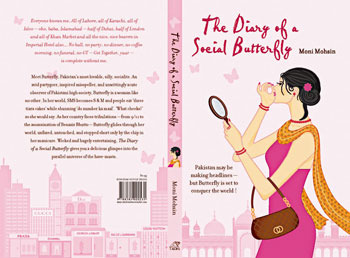
The Dairy of a Social Butterfly flits through Pakistani social life and lands smack in London. Droll and full of localised accents, the recently published book is a collection of London-based Pakistani writer Moni Mohsin’s columns over the past few years. Sitanshi Talati-Parikh catches up with the earnest writer to exchange a few words on the tenuous nature of relationships in the subcontinent, the role a writer plays and the sentimentalisation of literature

Spvol01

Dignified, self-assured and a tad bit scep-tical – I notice an imperceptible raise of the eyebrow denoting the discontentment at the way at which the talk on globalisation of language is conducted – in much the manner of a disapproving school marm. Originally from Pakistan, Moni Mohsin, lives in London with her family, and has been writing a delectably funny column for the Pakistani The Friday Times since the early 90s.

While her first book, The End of Innocence (2006) proved to be a promising debut novel, upon increasing interest in her columns, she shelved her plans for a second novel based in London, and went ahead with compiling her columns into a book. Launched particularly for the Indian sub-continent, seeing how the columns (which are also syndicated in India) drew a lot of interest during the Jaipur Kitab festival, Mohsin feels that she had found an audience for the book. Starting from 2001, the year of 9/11 and rounding up in 2007 with Benazir Bhutto’s assassination, The Dairy of a Social Butterfly is a witty and sardonic comment on the ‘social butterflies’ of Pakistan, especially the ones who find a summer home in London. With parallel events running in her book, for instance: ‘US concerned about Afghan border security, Butterfly concerned about her missing bike,’ the readers have enough to scoff at with the protagonist’s heavily accented language, lack of general unconcern and unintentional innuendos. The columns respond to events that take place in Pakistan: political and social events, big weddings et cetera. All of this is sourced through the news, Pakistani television and the social scandals discussed with Mohsin’s sister over the phone. “I go once or twice a year to Pakistan. I have children, so I am constrained by their school calendar,” says Mohsin with regret – as evidenced by the essay she has written exclusively for Verve.

Most writers of the diaspora tend to sentimentalise their country when they write about it. Mohsin reacts immediately with a very vociferous denial. Asking me, quite rhetorically if I thought Butterfly was sentimental, she races breathlessly on and lists Pakistani writers who are not in the least sentimental. Think Mohsin Hamid and The Reluctant Fundamentalist, Mohammed Hanif and A Case of Exploding Mangoes, or Nadeem Aslam. “In my novel, The End of Innocence, I talk about the honour killings in Pakistan and how horrible they are. We are not sentimentalising our country. You write about the smell of the earth after the rain, or the smell of freshly sliced fruit that fills a room because it is very particular to the subcontinent. If you live abroad, you realise that there are a lot of things you take for granted about the subcontinent. I always write about how when walking down a street in London, you know you are passing an Asian house, because of the smells that emanate – frying garlic and haldi. I don’t know if I am sentimentalising it, but it is there. Sometimes to avoid it would also be silly, because it exists. The challenge is not to romanticise it and to write about it with honesty and affection.”

Why not a novel about London where she lives, and why Pakistan, a place that she visits infrequently? “I thought I had to really know society before being able to comment on it. I have been hijacked by events, but my next book will be set in London. I am so involved with Pakistani society – so much is happening there, there is so much to be said. It is so vivid and new. The rest of the world is also interested in new societies and how they are shaping up.” Mohsin takes me back to a recent seminar in London, organised by Tehelka, in which they were trying to set up a dialogue between Pakistani writers and Indian writers and journalists and other cultural and political figures. A well-known film-maker said that there is recent interest in Muslims, ‘Muslims ka kaam karein’. “While he felt it was more of a trend, I don’t know. Generally in the subcontinent, interesting things are happening; people are producing interesting work and films. For such a long time, we in the subcontinent have been looking to the West and ignoring what is happening within ourselves and it is almost ‘declassing’ ourselves or ‘putting ourselves down’. Suddenly you feel you don’t have to. Pakistani and Indian writers and artists are making such waves abroad – you don’t have to look beyond our own backyard.”

While the interest is intense, is there openness for dialogue and understanding that extends beyond the arts? Mohsin firmly believes that Indians are less informed about Pakistan than the other way around – probably because Pakistanis have been exposed to Indian films for a long time and a greater percentage of Pakistanis travel to India. “Indians are possibly more naïve in that sense, and therefore readily believe everything they read about Pakistan. I think there is room on both sides for massive person-to-person contact; it is very important.” Mohsin, who also writes a column for a leading Indian daily describes how she is moved by the fluid dialogue between Malaysians and Indonesians. “They seemed to know each other, their works and their countries so well! Malaysians have houses in Indonesia, Indo–nesians work in Malaysia and such a free-flowing contact exists between them, that I thought what a pity that we don’t have that in the sub-continent.” I wonder why this is so, and Mohsin is quick to reply to my suggestive question, “I don’t think Pakistan is a closed society. It is very welcoming. Most people, Indians in particular when they come to Pakistan feel that hugely. What they are led to believe is so different from the actuality.”

Pakistani writers then shoulder a good deal of responsibility in setting the matter straight. “I don’t think I am playing a role in being an ambassador for my country – remember these articles were written for Pakistanis, they were not written for others, in fact, I thought they wouldn’t have a market outside. I’m just portraying what I see. And as a writer, your first duty is to tell the truth. It is not about me projecting my country abroad, it is just me commenting on my country. A writer’s job is to show a mirror to society, and I think all writers are trying to do that.”

|  Filling the gaps between words.  |

Writing By Category

  • Art, Literature & Culture
  • Brand Builidng
  • Brand Watch
  • Fashion & Style
  • Features & Trends
  • Fiction
  • Food
  • Humour
  • In The Media
  • Interviews (All)
  • Interviews: Business
  • Interviews: Cinema
  • Interviews: Cover Stories
  • Interviews: Lifestyle
  • Interviews: Luxury Brands
  • Interviews: The Arts
  • Interviews: Travel
  • Musings
  • Parenting
  • Publication: Conde Nast
  • Publication: Elle
  • Publication: Mint Lounge
  • Publication: Mother's World
  • Publication: Taj Magazine
  • Publication: The Swaddle
  • Publication: The Voice of Fashion
  • Publication: Verve Magazine
  • Social Chronicles
  • Sustainability
  • Travel Stories

Reach out:
sitanshi.t.parikh@gmail.com

© Sitanshi Talati-Parikh 2018.
All Rights Reserved.

Website Powered by WordPress.com.

  • Subscribe Subscribed
    • sitanshi talati-parikh
    • Join 51 other subscribers
    • Already have a WordPress.com account? Log in now.
    • sitanshi talati-parikh
    • Subscribe Subscribed
    • Sign up
    • Log in
    • Report this content
    • View site in Reader
    • Manage subscriptions
    • Collapse this bar