• About
  • Brand Building
  • Film & Drama
  • Writing: Arts & Lifestyle
  • Writing: Interviews
  • Writing: Luxury Brands
  • Writing: Travel

sitanshi talati-parikh

sitanshi talati-parikh

Tag Archives: Wine

The Curious Colours of Colmar

30 Friday Sep 2016

Posted by sitanshi talati-parikh in Publication: Verve Magazine, Travel Stories

≈ Leave a comment

Tags

Alsace, Colmar, France, Interviews: Travel, Wine

Published in Verve Magazine, September 2016
Photographs by Falguni Kapadia

At the heart of the Alsace region in France lies a beautiful town that makes your heart sing. Colmar is the spot that makes you fall head over heels in love
Screen Shot 2017-07-24 at 1.08.06 PM


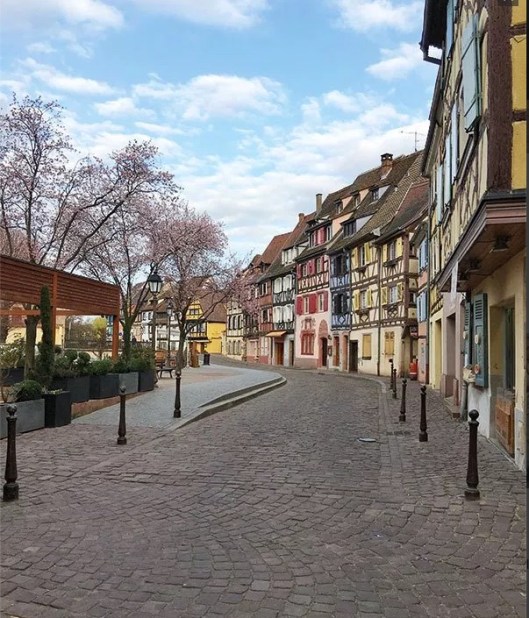
Brilliant splashes of colour on half-timbered houses is what makes Colmar breathe life into the cliche ‘picture-perfect’. But it’s the quaint lanes, stuffed with local shops and delicacies, the warmth of the Alsatian-speaking people and the stunning calmness that pervades the town that makes it other-worldly. A medieval setting, but without the drama of gnomes, toadstools and fairy dust, something Enid Blyton would use as inspiration for a magical novel series, perhaps. And yet, Colmar has lived in the time of practicality and realism of taxes and war and not of imaginative children’s tales. Ironically encouraging the toadstool shapes, the town tax at one moment in history was as per the surface area of the house on the ground; so the residents built homes narrower from the bottom and wider from the top.
Screen Shot 2017-07-24 at 1.08.27 PM

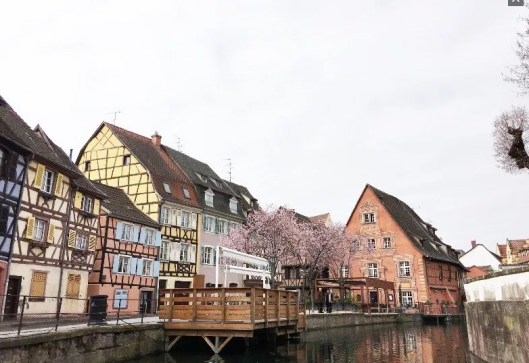
As you walk through the lanes, you are privy to some of the most eclectic structures; also, the timber inside is protected and cannot be removed or cut down. Christina Perri’s song pops into my head — Darling, don’t be afraid, I have loved you for a thousand years. I’ll love you for a thousand more — when I face centuries of European history in the bright vision that is Colmar.

Screen Shot 2017-07-24 at 1.08.40 PM

Johann, our river guide, is beaming from ear-to-ear, with a sense of pride in the beauty of his hometown. As he guides us through Little Venice, down the serene ‘green area’ on the river (with a silent zone) and under tiny bridges so low that you need to bend triple, you can’t help but find his exuberance for the surrounding infectious. While he tries to nudge information out about your city, he knows nothing can match up to his. When you buy a house on the embankment (and they cost a pretty penny), you buy a part of the river, which keeps the tiny water body private. It flows through the garden district of the town, and was once used to transport produce. Tax seems to have been quite an evasive issue, because the boats in the town are also flat — there was a tax on the part of the boat submerged in the water, so they were designed just deep enough to bring back vegetables. And as a protective gesture, the precinct of the old town once had a railing to prevent boats from entering the town at night, a worthy safeguard, perhaps as someone entering this lush space may fall promptly in love and set roots forever?

Screen Shot 2017-07-24 at 1.09.36 PM

The Rhine, which is now a partition between Germany and France, once formed a link between the two countries. Colmar, in the heart of the upper Rhine valley, turned French in the 17th century and changed nationality five times! In 1939, it was the first bit to be invaded by the Nazis and was the last important town to be freed in 1945, with practically no damage to boot. The town is a curious mix — though a happy one — of French and German culture, and the influences are evident everywhere. The ‘fashion street’ of the past has the motif carved in metal of the draper holding a stick to measure material. As you walk along, you can’t miss those of a lady holding a goose or a pig, with foie gras and sausage being popular products from the area. The latter can be tasted at a number of the local restaurants, including the multi-floor one, which has graphic art on the walls and is happily positioned in the city centre, called Le Fer Rouge. The Alsace region is the birthplace of foie gras, and the town is peppered with Michelin-starred restaurants, each rubbing shoulders with the other.

Screen Shot 2017-07-24 at 1.09.09 PM
Screen Shot 2017-07-24 at 1.09.19 PM

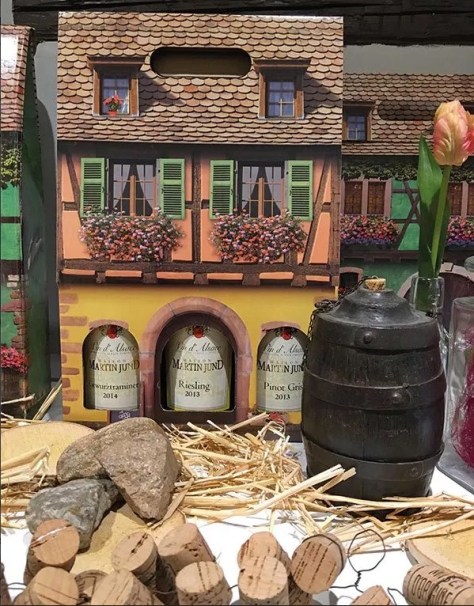
The favourite local son, Bartholdi, the famous creator of the Statue of Liberty in New York, has his mark everywhere, including a smaller replica in the city! Besides a museum dedicated to him, there is also a Bartholdi fountain where he is holding grapes, because he is supposed to have brought back grapes from Hungary for the local Pinot Gris. Wine, not surprisingly, is like water in Colmar, which has been the wine capital of the Alsace region since the Middle Ages, when it used to export to Switzerland. Large quantities of local produce were shipped along the river to Strasbourg, and then onwards along the Rhine to the Netherlands, moving on to England, Scandinavia and the Baltic coast. For the Domaine Martin Jund winery, Sebastian Jund, a fourth-generation viticulturist, shows us his cellar and takes us through the various in-house specialities. “Local wine represents the culture and people of the area.” Producing off 80 hectares of land, without pesticides and chemical products, they work with seven different grapes. White wine is the popular local drink of choice, we discover, and the hand-pressed grapes, stored in their own cellar, are sold mostly locally at around 50,000 bottles a year. We tasted four wines: the fruity Muscat sugarless, the spicy grape Gewurztraminer, the Sylvaner and a dry Riesling. As we swirl the home-grown liquid around in our glasses, we learn that they never drink alone, always with family. As Jund says, “With wine, it’s not about the right word or right place; it’s about having a good time and comforting your personality.”
Screen Shot 2017-07-24 at 1.09.48 PM

That’s what the town is about — local character with a ‘country’ atmosphere. For instance, the tale associated with the watchtower in the iconic Gothic monument with a striking coloured tile roof, the Église Saint-Martin church. As legend goes, a watchman was required to stay in the tower for one year at a time and not come down. But as a lot is required to keep a man busy, besides keeping a lookout, he was also a shoe repairman…and footwear was sent up to be fixed via a pulley system! Stories and folklore abound, the town swells with the high notes of history. And as we wind down with dinner at La Maison des Têtes, we are surrounded by tables that reverberate with a sense of the familiar, and we can’t help but feel the beat of the infectious camaraderie that suggests lasting friendships.

Screen Shot 2017-07-24 at 1.10.02 PM

La Maison des Têtes (House of Heads), a fine example of Renaissance architecture in the centre of Colmar, is actually built from the stones of the first wall in the town in the early 13th century. It is possibly the most famous local house, with intricate sculptural adornment — decorated as it is with 106 grimacing heads. The building that conveys ‘an idea of the wealth of the merchant class’ was restored in 2012. While many remains from the prehistoric town are around, you are not likely to find them in Colmar, probably because of the river that would have washed away the pieces. The facade of La Maison des Têtes was built in the early 17th century and one part was used for praying. Today, it opens into a charming hotel with sumptuous-sized rooms and a fine-dining restaurant. With history surrounding you, you find yourself at peace in this abode, a perfect place for a romantic sojourn, to dwell amid the thoughts of the past and the mystery of the present, to the sounds of classical and jazz music flooding the town during festival time and the sweetness of the jam made from the fruit of the wild rose tree.


Travel blog: California Dreamin’ – Napa Notes

22 Friday Aug 2008

Posted by sitanshi talati-parikh in Publication: Verve Magazine, Travel Stories

≈ Leave a comment

Tags

California, Interviews: Travel, Napa valley, USA, Verve Magazine, vervemagazine, Wine, wine tasting

Published: Verve Magazine, Travel, August 2008

Jazz evenings, vines dripping fruit, cheese on a platter. Verve goes on two languorous road trips

Travel01

As sleepy as a cat curled up on a furry rug by a crackling fire, as mobile as fresh wine that slowly slithers down a crystal glass, Santa Rosa is a town that is just barely half-awake. Eating an authentic Mexican meal at a local restaurant, the town reminds me of something out of an old Western film. We had just arrived here, driving up from the foggy centre of San Francisco into the hazy dustiness of Santa Rosa, which is the perfect spot from which to navigate wine country, the sprawling wilderness that is absolutely enchanting and completely at one with nature. We start off on the drive with my friend’s Ecuadorian fiancé, our designated driver.

My mind drifting away, I recall Mr. Big from Sex and the City, who randomly buys a vineyard in Napa and leaves NYC to set up shop in sunny California. Or maybe I am thinking of Sideways, the Alexander Payne movie about two middle-aged men who take off on a trip through wine country – drinking a lot of wine and trying to get lucky with the ladies. Wine country has a dramatically different meaning for anyone who has been there, or wants to go there – it stands for a mystical sense of escapism – an alternative to beaches and hills. Expansive flatland stretching longer than the eyes can see, winding roads through vines dripping with fruit that lead to a manufacturing unit for eternal intoxication.

I wonder if it is the lazy meandering or the breathless anticipation for that new flavourful taste that attacks your palate, or the simple desire to unwind in a lengthy road trip that gives wine country a charm that raises eyebrows and nods of approval. Exploring wine country however, takes more than one sunny afternoon. It is possible to consider days, even weeks of enchantment, drifting languorously from one vineyard to another, from one valley to another, polishing off the best cheeses and dining at some of the finest restaurants. Think Napa, Sonoma and Mendocino counties.

With sultry sounds of Simon and Garfunkel to take us back to an era beyond the electronica of today, the car rolls smoothly on, zipping past the dusty vineyards, as we sit armed with a map, chocolate-covered pretzels and excited gossip galore. Turning into our first stop we pour out like excited teenagers, dying to get a first look at a real-life winery. Where entertaining visitors and tourists is as much a business as is producing the famous wines.

Our introduction to the art of tasting starts with the Robert Mondavi winery. Opening a ‘fresh’ bottle of Reserve wine, we let the wine breathe to absorb the natural flavours from its first breath of fresh air. As we watch the ruby red liquid slide down the wide-bottom glass, the server, with an artful twist of his wrist, explains the clarity and quality of the wine. Observing it is like knowing the difference between a crystal and diamond – the different grades and the uniqueness of the one with crystal-clear clarity. With a degree of reverence, the glass is held before us, with its splash of precious nectar and we are encouraged to take in its flavours. Is it woody or musky? Cherry or Meaty? Do we sense a dash of burgundy? As our inexperienced noses start to give up and get confused, the knowing demonstrator quickly picks up a petri dish of fresh coffee beans and swishes it before our twitching nostrils. That will break the sense of smell and once we go back to smelling the wine, the aromas start to become sharp and more distinct.

Barely have we reached the starting phase of sensing aromas and mentally tuning into flavours that would hit our senses, is it time to take that first sip. Tentatively, we stand queued up ready for the hit. Holding the first sip while swirling it about with our tongues and breathing in the aromas, we close our eyes to experience the multitude of flavours that flood our palate. It is then that we can actually realise how numb our taste buds are with the daily overdose of packaged foods, condiments and spices that we have forgotten to really appreciate basic tastes.

Back in the car, heady with the rush of excitement with a new sense of awakening, we plot our journey. While the other wineries along the way are more of jolly experiences and a great way to experiment with the crash course on wine tasting, it is the rustic beauty of Rubicon Estate that really takes our breath away. On the way to Rubicon, we encounter the cozy groves of Ravenswood in Sonoma County, where we are encouraged to be bolder – not surprising given their motto of ‘No wimpy wines!’ We come face-to-face with Zinfandels, surrendering to a rich, full-bodied and intense experience, that I don’t think we are ready for, yet!

Ready for the lunch break though, we stop at the family-owned V. Sattui winery, known for their gourmet deli and cheese platters. Refuelling, we decide to take a turn through the gift shop and museum (I succumb to buying a wine country poster) and the chilly barrel aging cellars, getting a taste of the actual process. Italian winemaker Vittorio Sattui arrived in San Francisco in 1882 with his new bride, Kattarina, to begin their life in America. A trade baker, making wine in his spare time, Vittorio’s reputation grew until Prohibition. Daryl Sattui took his great-grandfather’s passion to fruition, and in the late 1900s V. Sattui Winery became a beautiful stone structure amid the venerable 250 year-old oaks, reminiscent of the late 19th century wineries in Italy and France. The walk back in time filled me with a sense of warmth that no amount of wine could.

From the Italian rustic story, we reached that glamourous Italian connection – the Coppola family. Francis Ford Coppola has spent nearly as much time making wines at his Niebaum-Coppola Estate Winery (now called the Rubicon Estate) in the Napa Valley as he has making movies. As we walk into the grand estate with creepers and moss-covered stone, we are overwhelmed with a sense of something larger-than-life. Just dropping the name Coppola, leads one to feel in the presence of power, something very different from the quaint homeliness of V. Sattui. As if it is not enough to feel this power, we are thrown amidst a deeper significance of this estate – something that makes this less about wine and more about a marking of history and experiences – a part of a greater sociological significance – about two immigrant families (Gustave Niebaum and the Coppolas) who came together to ‘establish a wine estate rivalling those in France’. As the Godfather of filmmaking put it, he was a part of the two great art forms key to the development of California. The hoity-toity demeanour of the estate’s caretakers make us want to scurry back out into bright sunshine and the reality of everyday life – where crystal chandeliers and grand staircases are left to the reel life rather than real life.

As the hours and the wineries roll by in hazy delirium, we decide that it is about time to turn back to the foggy bay area, where strolling down Fisherman’s Wharf, watching the sun set, we could sit back at a little Italian bistro, replay the day’s escapades over a glass to wine that we have just learnt to appreciate. After all, I think, as the Golden Gate Bridge appears in the horizon, the experience does make one thirsty for more.

|  Filling the gaps between words.  |

Writing By Category

  • Art, Literature & Culture
  • Brand Builidng
  • Brand Watch
  • Fashion & Style
  • Features & Trends
  • Fiction
  • Food
  • Humour
  • In The Media
  • Interviews (All)
  • Interviews: Business
  • Interviews: Cinema
  • Interviews: Cover Stories
  • Interviews: Lifestyle
  • Interviews: Luxury Brands
  • Interviews: The Arts
  • Interviews: Travel
  • Musings
  • Parenting
  • Publication: Conde Nast
  • Publication: Elle
  • Publication: Mint Lounge
  • Publication: Mother's World
  • Publication: Taj Magazine
  • Publication: The Swaddle
  • Publication: The Voice of Fashion
  • Publication: Verve Magazine
  • Social Chronicles
  • Sustainability
  • Travel Stories

Reach out:
sitanshi.t.parikh@gmail.com

© Sitanshi Talati-Parikh 2018.
All Rights Reserved.

Website Powered by WordPress.com.

  • Subscribe Subscribed
    • sitanshi talati-parikh
    • Join 51 other subscribers
    • Already have a WordPress.com account? Log in now.
    • sitanshi talati-parikh
    • Subscribe Subscribed
    • Sign up
    • Log in
    • Report this content
    • View site in Reader
    • Manage subscriptions
    • Collapse this bar
 

Loading Comments...