Crafting with Purpose: Her Story

Tags

, , , , , , ,

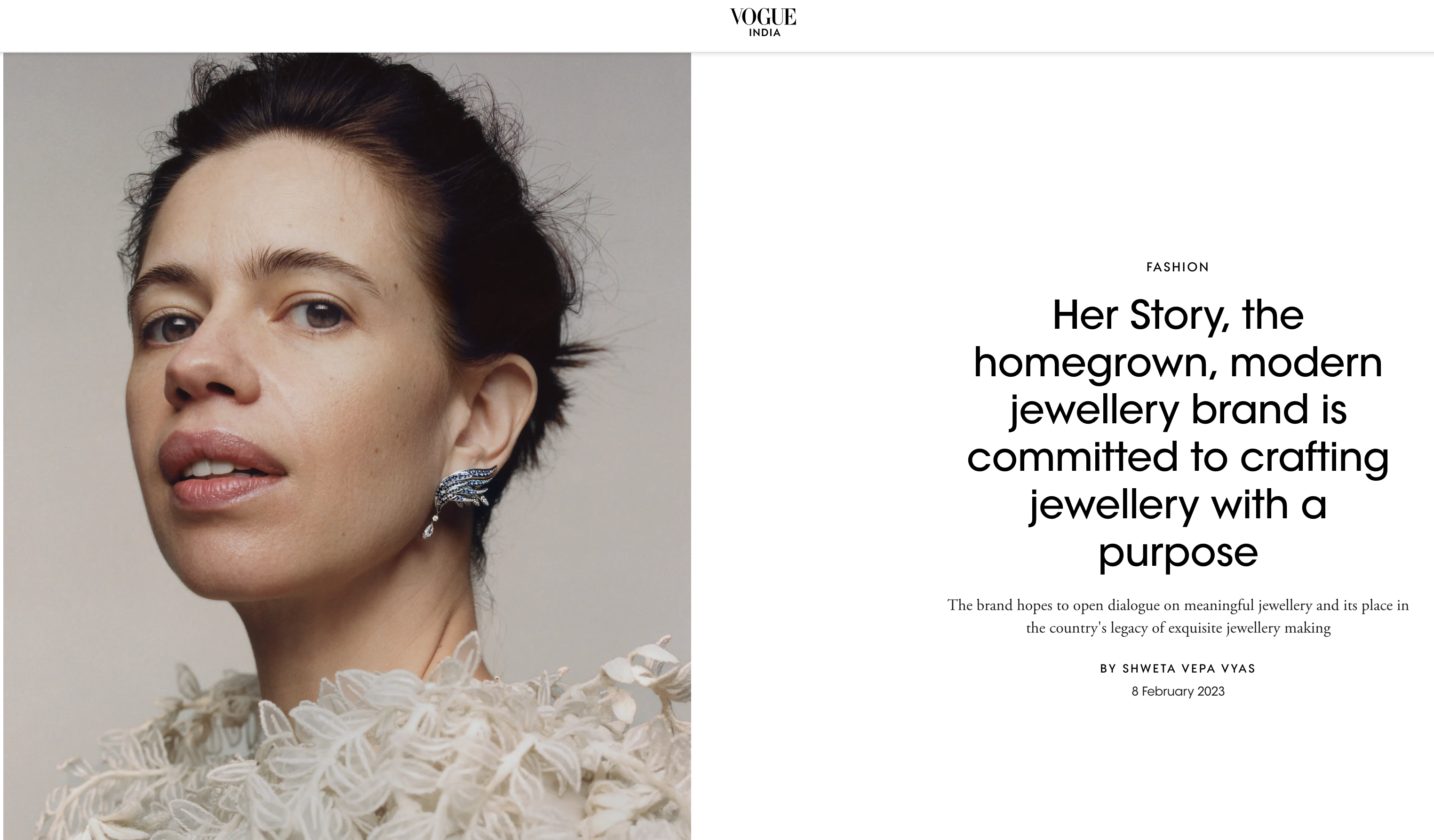
In the Media: Vogue India | February 8, 2023

What do women want? […] The answer is what led to the creation of Her Story—a contemporary jewellery brand founded to add meaning to jewellery purchases. Shedding light on these learnings is Sitanshi Talati-Parikh, Creative Director, Her Story: “We found that meaningful purchases are more relevant today than ever before for the modern woman, versus those that are purely acquisitional.” For instance, a client wrote to the brand during the pandemic about a Her Story jewel her partner had given her based on a poem that described her personality. “It gave her the strength to hold on through difficult times, because it represented her partner’s love and presence while they physically couldn’t be together,” she says. 

In Talati-Parikh’s words, these learnings built a ‘library of emotions’ based on which the brand opened its doors—first as a pop-up boutique in Mumbai’s Altamount Road in 2019 and then as a brick-and-mortar in Mumbai’s art capital, Kala Ghoda in 2022. We delve a bit deeper into these perspectives that the team gleaned from real experiences of women and deep-diving into biographies of women achievers, global feminist writing and literature together with live consumer research with women of varied ages and profiles. For instance, some women are motivated by the idea of ambition and drive. This idea formed the basis of Her Story’s very first collection, ‘Limitless.’ “Smriti Madhana, the opening bats person for the Indian women’s cricket team and the campaign face of this collection, speaks of growing up as a woman in the world of cricket in India. She shares what it means for her to represent the country in the sport and how she feels ‘limitless’ on the 22-yard wicket,” says Talati Parikh

So how do these learnings translate into an actual design process? “It takes 9-12 months to build a collection from start to finish, including consumer feedback and research at key stages. Once the essence of a story is captured, the design team interprets it through a deep creative exploration, to find evocative metaphors and create relatable symbolism inspired by art, architecture and nature. Master artisans then carefully handcraft every piece,” she further adds. 

The pieces are brought to life using best-in-class diamonds with special cuts along with gemstones that are all set in 18K gold. Each of the diamond pieces are layered with meaning. “Perspectives of modernity is our starting point for each collection, and the materials are chosen based on how they support the idea of the collection and the metaphor it is based on,” elaborates the creative director.  So, for instance, triangle-shaped diamonds have been used in a vertical pattern in the Limitless collection because “they aptly represent the idea of verticality, height and a skyline that speaks of limitless possibilities,” as Talati Parikh tells us. On the other hand, tulip-shaped, rose-cut and pear-shaped diamonds have been used in the style of Chantilly lace in the C’est L’Amour collection to convey the strength of love. […]

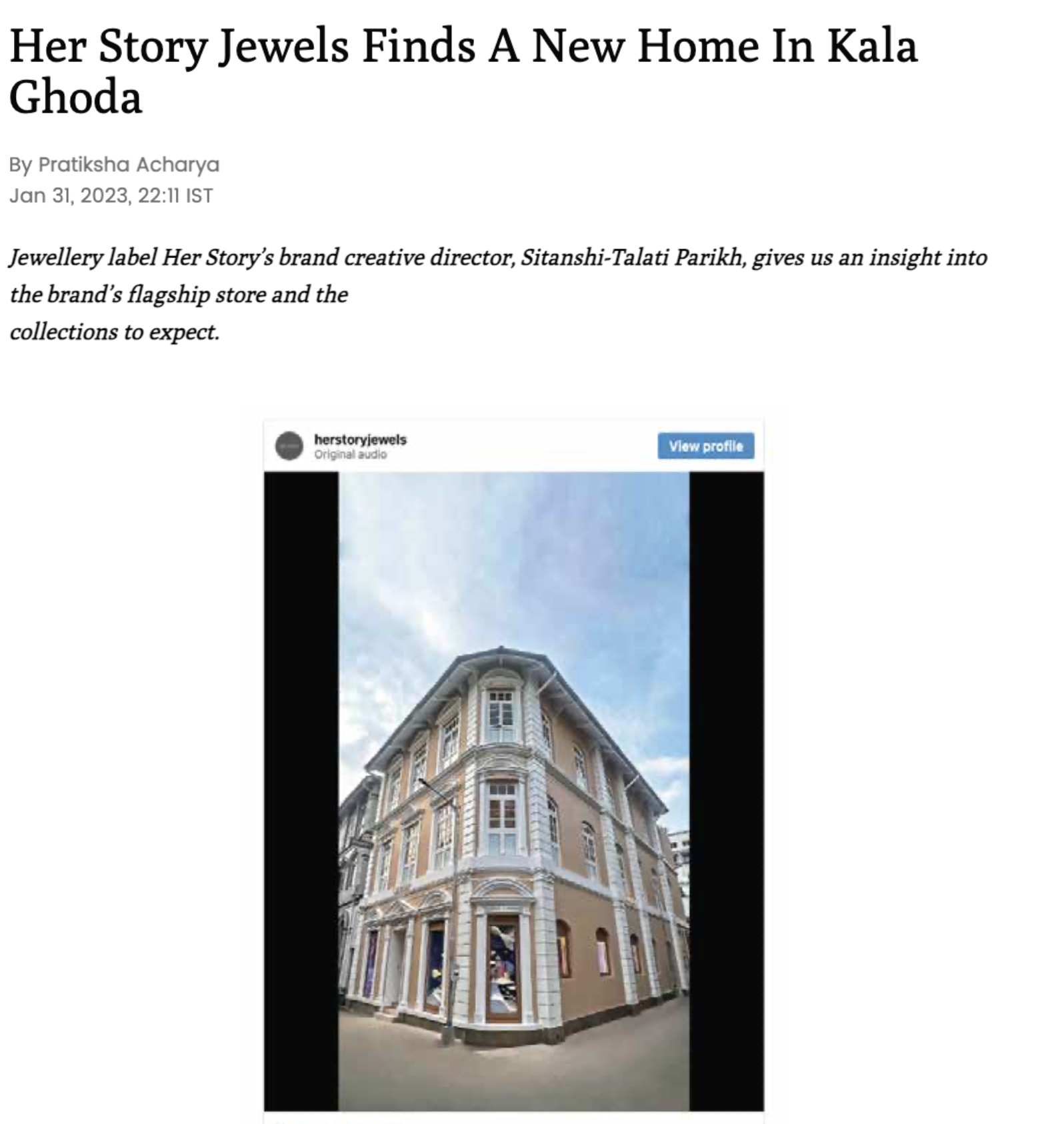
Her Story finds a new home…

Tags

, , , , , , , ,

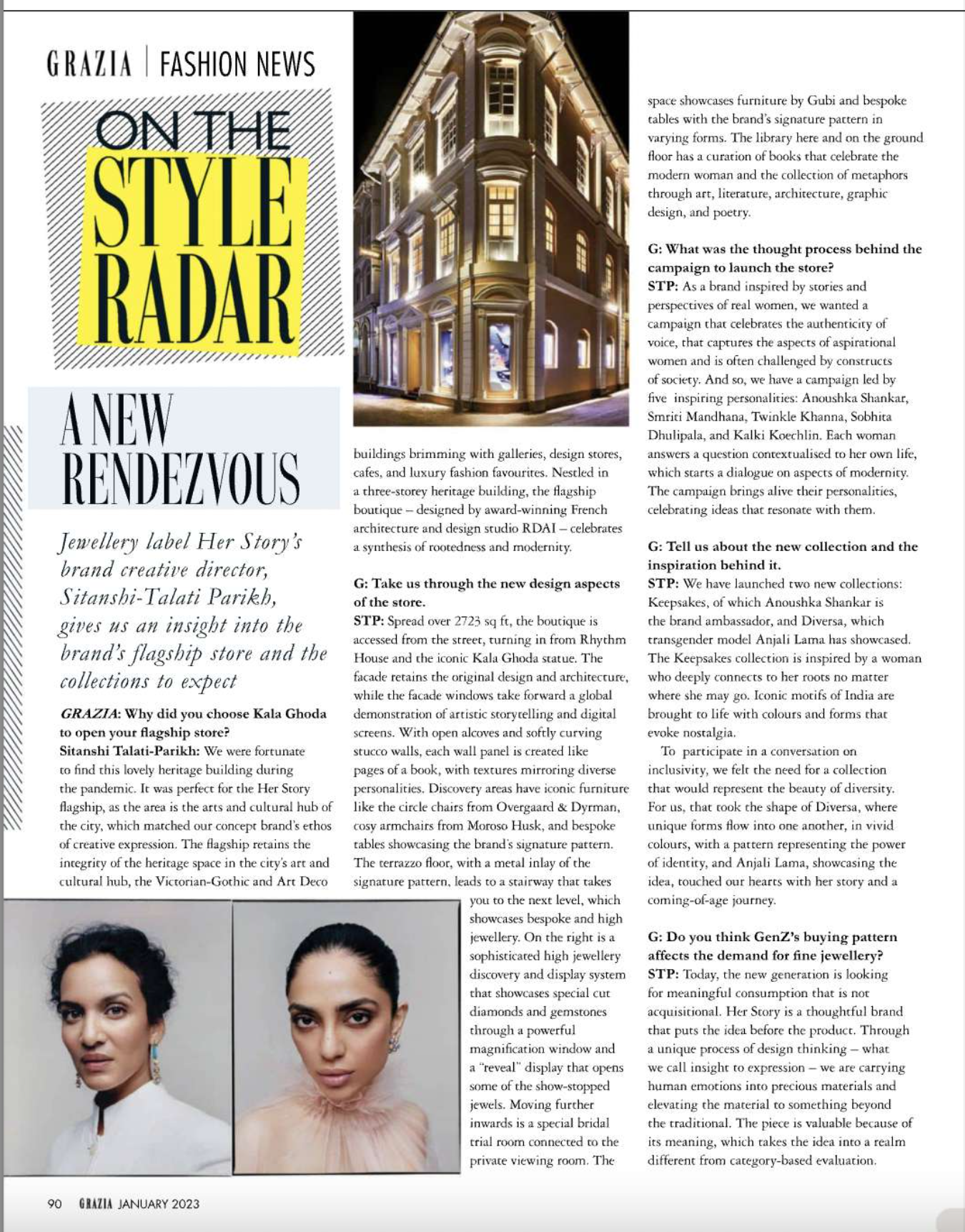
In the Media: Grazia | Jan 31, 2023

G: What was the thought process behind the campaign to launch the store?

STP: As a brand inspired by stories and perspectives of real women, we wanted a campaign that celebrates the authenticity of voice, that captures the aspects of aspirational women and is often challenged by constructs of society. And so, we have a campaign led by five inspiring personalities: Anoushka Shankar, Smriti Mandhana, Twinkle Khanna, Sobhita Dhulipala, and Kalki Koechlin. Each woman answers a question contextualised to her own life, which starts a dialogue on aspects of modernity. The campaign brings alive their personalities, celebrating ideas that resonate with them. 

G: Tell us about the new collection and the inspiration behind it.

STP: We have launched two new collections: Keepsakes, of which Anoushka Shankar is the brand ambassador, and Diversa, which transgender model Anjali Lama has showcased. The Keepsakes collection is inspired by a woman who deeply connects to her roots no matter where she may go. Iconic motifs of India are brought to life with colours and forms that evoke nostalgia. To participate in a conversation on inclusivity, we felt the need for a collection that would represent the beauty of diversity. For us, that took the shape of Diversa, where unique forms flow into one another, in vivid colours, with a pattern representing the power of identity, and Anjali Lama, showcasing the idea, touched our hearts with her story and a coming-of-age journey. 

G: Do you think GenZ’s buying pattern affects the demand for fine jewellery?

STP: Today, the new generation is looking for meaningful consumption that is not acquisitional. Her Story is a thoughtful brand that puts the idea before the product. Through a unique process of design thinking – what we call insight to expression – we are carrying human emotions into precious materials and elevating the material to something beyond the traditional. The piece is valuable because of its meaning, which takes the idea into a realm different from category-based evaluation.

Insight to Expression: Her Story

Tags

, , , , , , , ,

In the Media: Elle Decor | Jan 18, 2023

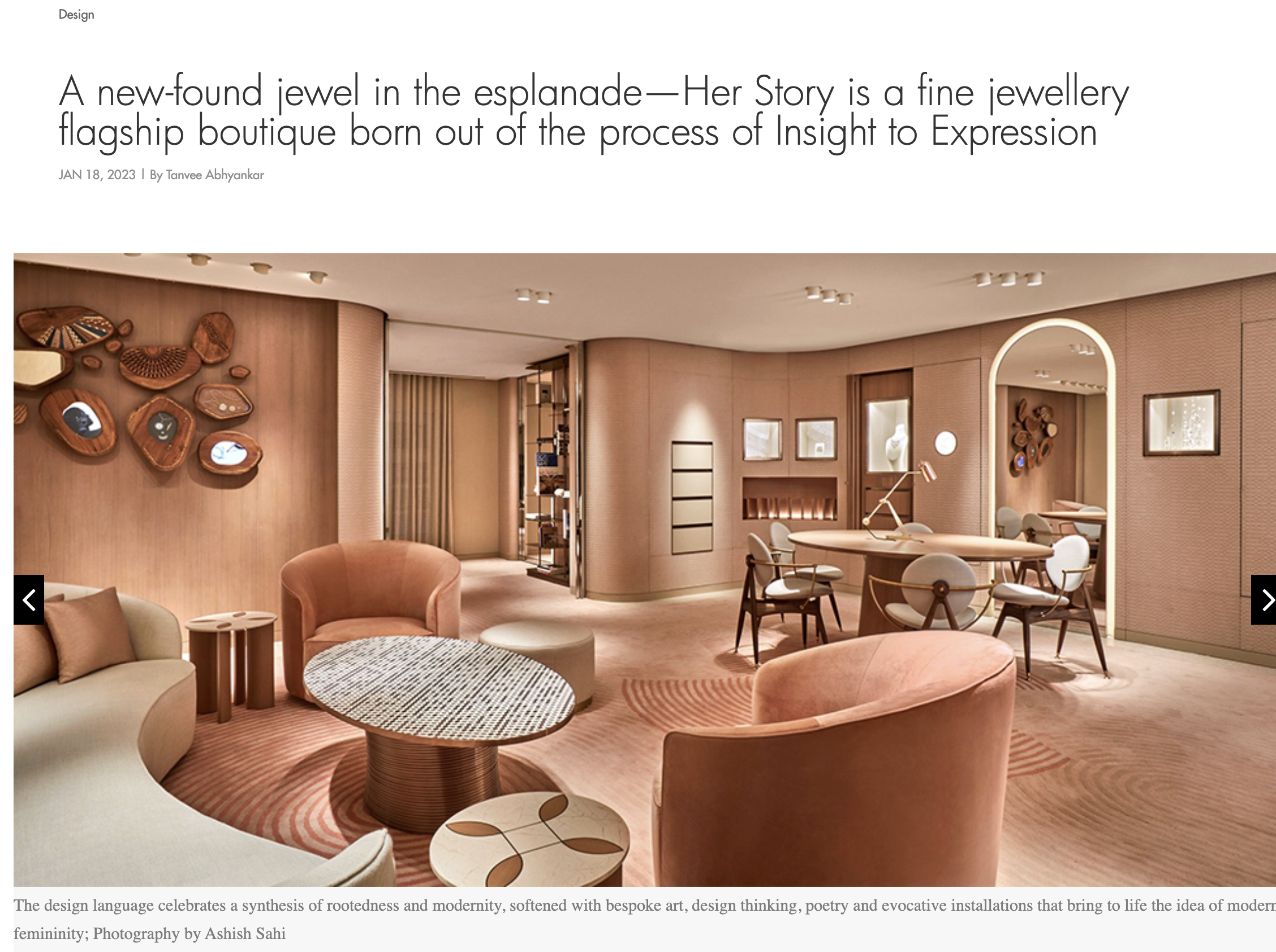
A boutique that I creatively led with award-winning French space design firm, RDAI, covered in the media…

[…] The award-winning French architecture and design studio RDAI, known for its experience in retail design and their work with some iconic luxury brands globally, was chosen. […] “Our brief to the designers was to celebrate the facets of the modern woman, with depth and creativity. It was important that they maintain the integrity and aesthetic feel of the heritage space, while delivering the brand concept in a manner that is tasteful and with subtle sophistication,” says Sitanshi Talati-Parikh, Brand Creative Director when asked about the brainstorming that went in ideating the store. […]

Gallery of Moods: Her Story

Tags

, , , , ,

In the Media: Architectual Digest | December 2022

A boutique that I creatively led with award-winning French space design firm, RDAI, covered in the media…

[…] As it opens doors to a spanking new flagship store in Mumbai’s Kala Ghoda arts district, Her Story is all set to redefine how Indians buy jewellery. As a rule, Her Story forgoes traditional jewellery sets in favour of design collections, each of which represents an idea or emotion relating to the persona of the modern woman. “We begin and end with the consumer, and the product is only a part of their journey,” says Her Story brand’s creative director Sitanshi Talati-Parikh, “The collection, not the product, is the hero of the space.” […]

As a final artistic flourish, RDAI converted Her Story’s brand identity poem into a binary pattern, inspired by the traditional art of Kolam. The poem weaves through the very fabric of the store’s architecture: sometimes embroidered, other times engraved or inlaid. “This has become the Her Story motif,” says Talati-Parikh, “It has become integral to the brand ethos; it speaks of identity of our muse—the modern woman, while simultaneously being a part of the brand DNA.” […]

Indeed, the poem itself is a reflection of the spirit of the Indian woman; the Kolam design is a celebration of the brand’s roots in Indian tradition; the binary replication is symbolic of Her Story’s eye towards the future. “The industry has slowly but surely been moving towards an expressiveness of individuality and personality rather than a societal ideal or family legacy,” muses Talati-Parikh. “You fall in love with something because it expresses something for you, whether it is your personal sense of style, who you are or how you wish to be perceived. So we have a different definition for what is precious–something is precious because it is meaningful to you.”

WFH Journal: To Dress or Not to Dress

Tags

, , , ,

Published: The Voice of Fashion, March 24, 2020

Remote working, often used by creative folks and freelancers, should have a defined code of dress conduct. Or perhaps not 

Screen Shot 2020-03-25 at 1.34.56 PM

The last thing you want to read is another COVID-19 story. While everyone who can is currently working from home, this is the journey of an independent writer and consultant, who often needs to be more productive than her full-time colleagues to ensure that people respect her efficiency, time-management and trust her dedication. If women still need to prove themselves in the workplace, women working from home need to flip over and do cartwheels while juggling and breathing fire.

Having run a tech startup in the US from a home office (2002-2005), and then the last decade partially working from home, rolling out of bed, showering and hitting the desk on days I am not walking out of the door has become routine for me.

The early 2000s were different: video conferencing hadn’t become mainstream and what you wore as you sat in front of your screen didn’t matter. You could paint your toenails while you were on a client call or eat a 12-inch sub, with sauce threatening to smear your face like a bad impression of the Joker. You could wear nothing, if that worked for you (it never did for me), or even your ratty PJs.

From the early days, I felt the power of routine and specificity. Even more so because I have always opted for a dedicated workstation over a lie-in-bed-with-a-laptop scenario. Perhaps today I may be considered old-school, but if you dress for it, your mind is automatically geared for it. The couch never beckons if your PJs are discarded first thing in the morning. Does that mean I would hop into a power suit? Unlikely. Crisp, freshly-laundered clothes, that are functional and comfortable, work for me. While I mostly wear dresses to work and meetings, separates like shorts, denim capris or anti-fit culottes and a tee or linen shirt generally become the go-to garments of choice when I am working from home. You feel ready, but without the bedhead or the stiff upper lip.

Zoom, the US-based video conferencing service (whose market value has sky-rocketed in recent COVID-times), has changed a lot of how we function. While being privy to endless video calls over the last couple of years, I have seen folks sport everything from PJs to formal attire. It doesn’t bother me what others wear — and I have had my share of bad hair days — but how you appear on a video call is more a function of vanity over productiveness. Have I given it a thought if I know I have a day filled with video calls? Sure. Do I make an extra effort to fix my look? Absolutely not.

And perhaps, even if it isn’t ideal, what you wear is intrinsically linked to how you feel — about yourself and your work. It is the subconscious codes we have gotten used to associating with workplaces and productivity. It is about who you are, how you wish to be perceived, and that inadvertently affects how you perform. I am not so easy-going that PJs can drive my work day, nor am I sufficiently driven by social codes to need formal attire and makeup to feel productive. I fall somewhere in the middle — a space of easy comfort and a freshly-scrubbed face that allows you to open your eyes and mind, and begin a new day.

WFH (work from home) Journal on The Voice of Fashion is a series of personal, reflective stories on what it means to work from home, and the importance—or lack of it—of dressing up for it.

The Price of Sustainability

Tags

, , , , , ,

Published: The Voice of Fashion, June 13, 2019

Working for the sustainability industry may be a noble choice but it is an ongoing struggle for those who must also make it commercially viable

Screen Shot 2019-06-14 at 3.35.42 PM

A label or company that offers sustainable products or services has many challenges in a consumer world that is still unclear about the need for sustainability. These include agreeable pricing, finding suitable collaborators, marrying retail expectations with sustainable production cycles, raising awareness, and through it all, making ends meet.

Here Mumbai-based founders of Chindi, Nadiya Paar and Verandah, who are trying to make a difference with their entrepreneurial ventures on how they negotiate the odds.


Chindi

The Pricing Bubble

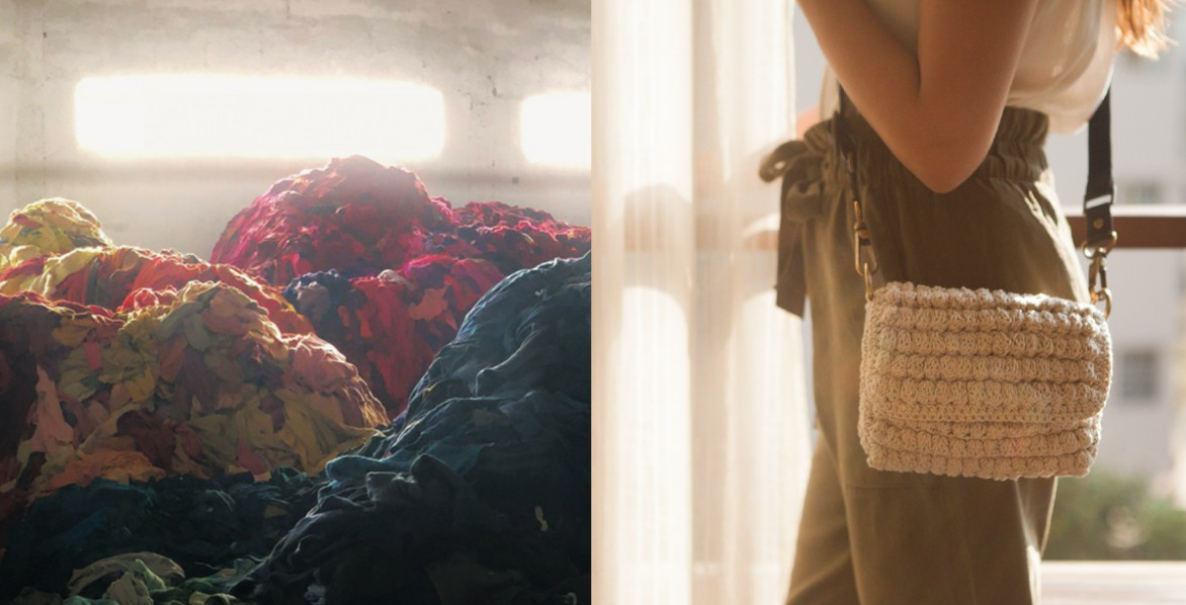
An enterprise driven by sustainability has to deal with the lack of awareness about what goes into creating a sustainable product, and consequently, the rationale behind its higher price point. Chindi, a social enterprise that recycles textile waste into luxury accessories handmade by low-income craftswomen in India, finds that sustainability is still a niche space. Says founder Tanushri Shukla, “It’s also difficult to compete with fast fashion brands who have changed customers’ perception of how much products should rightfully cost.” This renders the retail of sustainable products difficult, with the consumer unwilling to absorb the cost.

Therefore, such an enterprise may not always be profitable—and seeing this prevents other entrepreneurs from taking the leap. Also, there is no benefit from a funding standpoint—as Shukla points out, with social enterprises not being legal entities in India, they do not get the same benefits available to non-profit organisations.

On the other hand, Anjali Patel-Mehta, founder of resort label Verandah, finds that while the concept of a sustainably-made garment is not understood by many, it is being used as a marketing device. Thus, there is a blurring in the minds of a consumer.

Patel-Mehta struggles to replace her luxury staples like cotton and silk with more sustainable fabric alternatives which have the same texture but are not as taxing on the environment (cotton, for example, requires a great deal of water in its production). She also stresses the need for industry-certified sustainable vendors.

One of the biggest challenges faced by conscious designers is the slow and limited production cycles. Says Megha Kanera of Nadiya Paar, that specialises in handloom saris, “A big challenge is the pace of the ethical industry versus fashion cycles. A piece takes a great deal of effort to produce and stores want new products every four-six months.”


Verandah

The Impact of Change

Shukla feels that change doesn’t have to come from the customers as much as from non-sustainable brands making their money by flogging cheap products that exploit their labour force. She says, “They are the ones who have conditioned customers and their voice is loud—so that should be the first point of change. Customers, on their part, would benefit from building a sense of empathy and awareness about what goes into making and selling handmade, sustainable products.”

But as awareness slowly rises about the searing need for a sustainability conversation, more brands begin to buy into the philosophy, automatically increasing the scale, acceptance, and viability of the sustainability dialogue. For example, Verandah didn’t start out as a conscious label. Patel-Mehta says, “Initially we didn’t stress on sustainable textiles. As our awareness grew about the ‘true cost’ of fashion, we felt it imperative to have sustainable practices.” Today, Verandah’s RTW (ready-to-wear) lines speak the language of upcycling, azo-free dyes and mindful fabrics, while their eco-friendly swimwear line, launched this summer, mostly uses ECONYL® yarn, regenerated from waste materials.


Nadiya Paar

Making Sustainability Work

Shukla started Chindi in response to witnessing first-hand the vast quantities of tailoring waste dumped in Deonar (Mumbai), Asia’s largest landfill. Says Shukla on the motivation to keep going, “It is all on the belief that the work is making an impact. The word ‘chindi’ (which means thrift), which was once considered a negative thing, has now entered the daily parlance of designers.

She also points out that, “As social entrepreneurs, we cannot always measure our success in the same terms that a commercial entrepreneur does. Money may not always flow in, but the impact goes beyond money. We need to pay attention to our stories of change as much as our bank balances.”

Patel-Mehta, who believes she still has a long way to go, says, “I think success is in the efforts and goal-based approach by setting small metrics for your personal philosophy. There is no finish line.”

At the end of the day, the strongest impact is in building a mindful community. Kanera, who shares best practices—like the brand’s seed tags—with her fellow designers, puts it best when she says, “We share vendor or material detail with other labels who now use a similar concept. I also travel with fellow designers to craft hubs so we can give combined bigger orders to weavers to make it viable for them. We do not treat anyone as competition, rather as people working and walking in the same direction.”

The Myth and Reality of Sustainable Diamonds

Tags

, , , , , , , ,

Published: The Voice of Fashion, June 5, 2019, World Environment Day
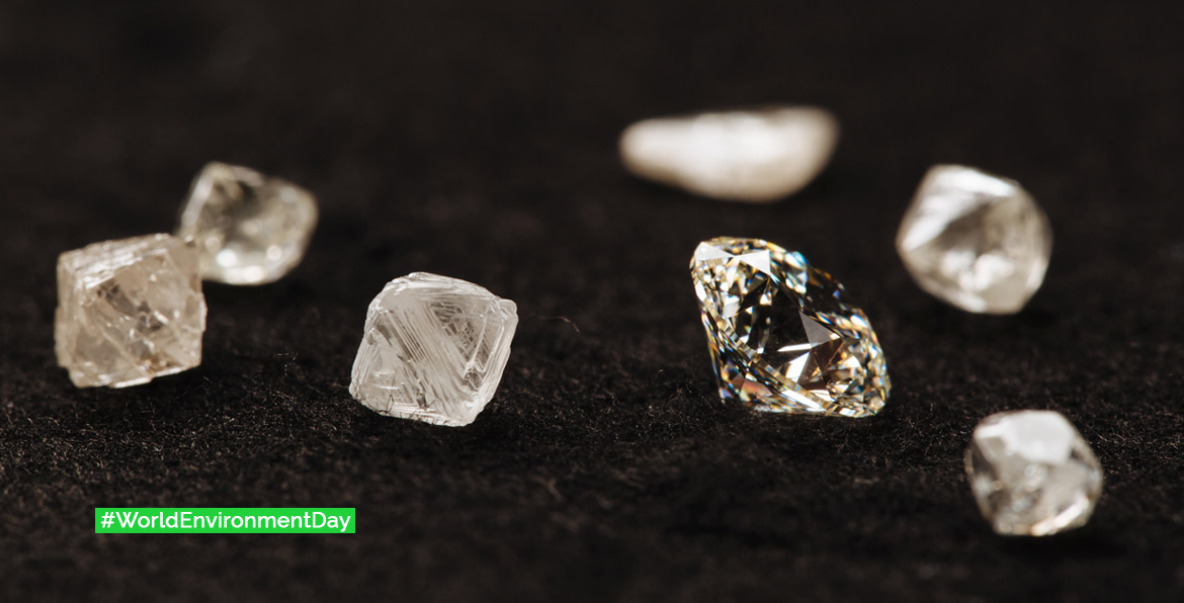
Images courtesy DPA and Diamond Foundry.
Screen Shot 2019-06-06 at 5.52.59 PM

Exactly 20 years ago, Advertising Age (global media brand now called Ad Age) proclaimed the 1948 “Diamond Is Forever” De Beers (diamond mining company) advertisement as the slogan of the (last) century. This remains a testimony to the successful positioning of the diamond as a sparkling beacon of romantic love. But perhaps it is time to review the price we may be paying for it ecologically.

India is one of the largest markets globally in the purchase and manufacture of diamond jewellery, showing steady growth in popularity vis-à-vis traditional gold jewellery. And yet, there is a remarkable disinterest in the environmental effects of the diamond industry—perhaps due to lack of genuine information, inadequate media coverage and strong marketing by big diamond houses towards keeping the romance of diamonds alive.

The Impact of Diamond Mining

At the most basic level, traditional mining creates displacement of wildlife and vegetation. Often this leads to irreversible ecological damage, industrial and chemical waste, heavy water consumption, greenhouse gas emissions and consumption of fossil fuels.

Globally, with the increasing popularity of ‘eco-friendly’ lab-grown diamonds, there has been a renewed interest in the sustainability of mining. Perhaps in response to that, on May 2, 2019, the Diamond Producers Association (DPA) released a commissioned report, ‘Total Clarity’, to evaluate the benefits of the mining industry. But can that be taken at face value? The DPA, formed in 2016, comprises seven companies including the De Beers Group, representing approximately 75per cent of the world’s rough diamond production.

Jean-Marc Lieberherr, the chief executive officer of the DPA admits, “On the environmental front, the impact is globally negative, like for any large-scale industrial activity. Today, 100per cent of the irreversible environmental costs associated with large-scale diamond mining by DPA members are linked to greenhouse gas emissions, which is equivalent to 160kg per polished carat.” The DPA report speaks of renewable energy, biodiversity programs, and land being reclaimed at the end of the mining cycle. But it is not as simple as putting the earth back into the ground—closure can take many years and several hundred million dollars.

Meanwhile, sustainability has to take environmental as well as socio-economic factors into consideration—after all, the $82 billion industry provides a livelihood for 10 million people worldwide (De Beers Group insight data 2017).
Screen Shot 2019-06-06 at 5.57.31 PM

Is Your Diamond Conflict-Free?

In a 2015 Time magazine (American weekly magazine) cover story, 34-year-old Max Rodriguez says, “I don’t want a symbol of our union to also be associated with chaos and controversy and pain.”

Diamonds bought or sourced from big brands like Forevermark and De Beers come through structured channels. But 20 per cent of world diamond production by volume (Diamond Development Initiative or DDI data), is from the Artisanal and Small Scale Mining (ASM) of diamonds, 90 per cent of which operates informally and with little oversight.

Besides the endemic environmental damage, miners face difficult and occasionally hazardous working conditions, lack of access to fair market prices, and the use of diamonds as potential “currency” to finance rebel armies (Total Clarity report).

Decades after the 2006 political war thriller, Blood Diamond, which described the grim connection between diamond mining and the financing of conflicts, most believe that diamond mining has come a long way with the Kimberley Process, an international diamond certification system set up in 2003. And yet, as reports suggest, not only is the Kimberly process riddled with loopholes, it also doesn’t guard against human-rights abuses, unfair labour practices or unsafe mining conditions.

Innovations to Create Accountability

De Beers, in partnership with the DDI (that works to effect change in the ASM sector) launched GemFair in a pilot program last year in Sierra Leone (West Africa). It includes a digital app to track diamonds recovered by artisanal miners through the supply chain. Ian Smillie, chair of the DDI and founding participant in the creation of the Kimberley Process says, “GemFair undertakes to make an offer on all diamonds produced by these groups at fair market prices. It has shortened the pipeline and created a strong traceability mechanism.”

And after several years of trial and error, last month the DDI formally launched an innovative certification system, the Maendeleo Diamond Standards.

The Alternative To Mined Diamonds

Last year in November, a manmade diamond ring by San-Francisco (the US)-based Diamond Foundry and co-designed by Sir Jony Ive, Apple’s chief design officer, was auctioned for $461,250 at Sotheby’s (New-York-based auction house).

Screen Shot 2019-06-06 at 5.56.16 PMDiamond Foundry ring

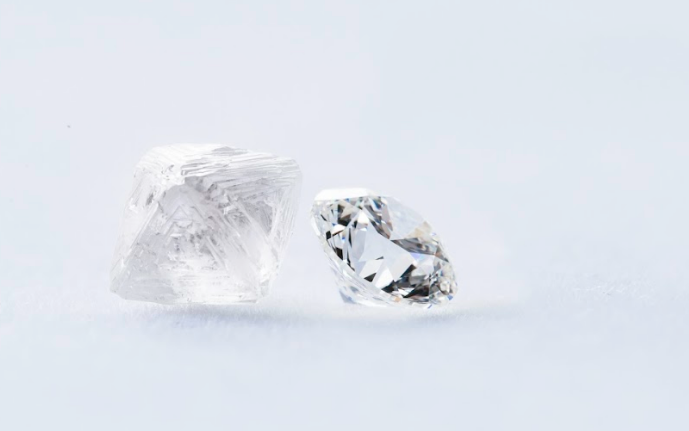
The industry and the consumers may be polarised on manmade versus mined diamonds, but technology offers a choice. A diamond can be made in a lab, by replicating the same conditions that it takes to make a diamond over many years below the earth’s surface (HPTP—high pressure, high temperature) or by chemical vapour deposition (CVD). Today, it is possible to easily create a Type IIA diamond, which is like the ‘Koh-i-Noor’ (one of the largest cut diamonds in the world)—rare among mined diamonds.

A lab-grown diamond also needs to be responsible for labour practices and particularly, high levels of energy consumption, due to the extreme temperatures required to produce a diamond. Diamond Foundry, for instance, has been certified carbon neutral and their zero net carbon footprint includes their employees commuting to work.

Screen Shot 2019-06-06 at 6.01.12 PM

Bringing a Diamond Back

Recycling diamonds makes a diamond’s journey last longer by resetting a stone in a modern design. Rough Polished (analytics firm) reports that an estimated $1 trillion worth of ‘used diamonds’ are locked away in private hands. The diamond industry, by virtue of the marketed emotions attached, thwarts the potential recycling of diamonds.

“Many of today’s younger consumers aren’t only open to alternatives, they are willing to pay a premium for products that have a low environmental impact or are socially responsible,” states a Morgan Stanley 2016 research report.

Lieberherr points out, “We are not perfect, no industry is—but we are working to be better.” As in most cases, blaming an industry is not the answer; rather it is in holding the stakeholders accountable. And as a consumer, demanding specifics to make informed decisions. After all, the critical step, as in all sustainability conversations, is to create a truly transparent supply chain.

 

Sustainable Indian Weddings. Really?

Tags

, , , , ,

Published: The Voice of Fashion, May 9, 2019, Opinion piece

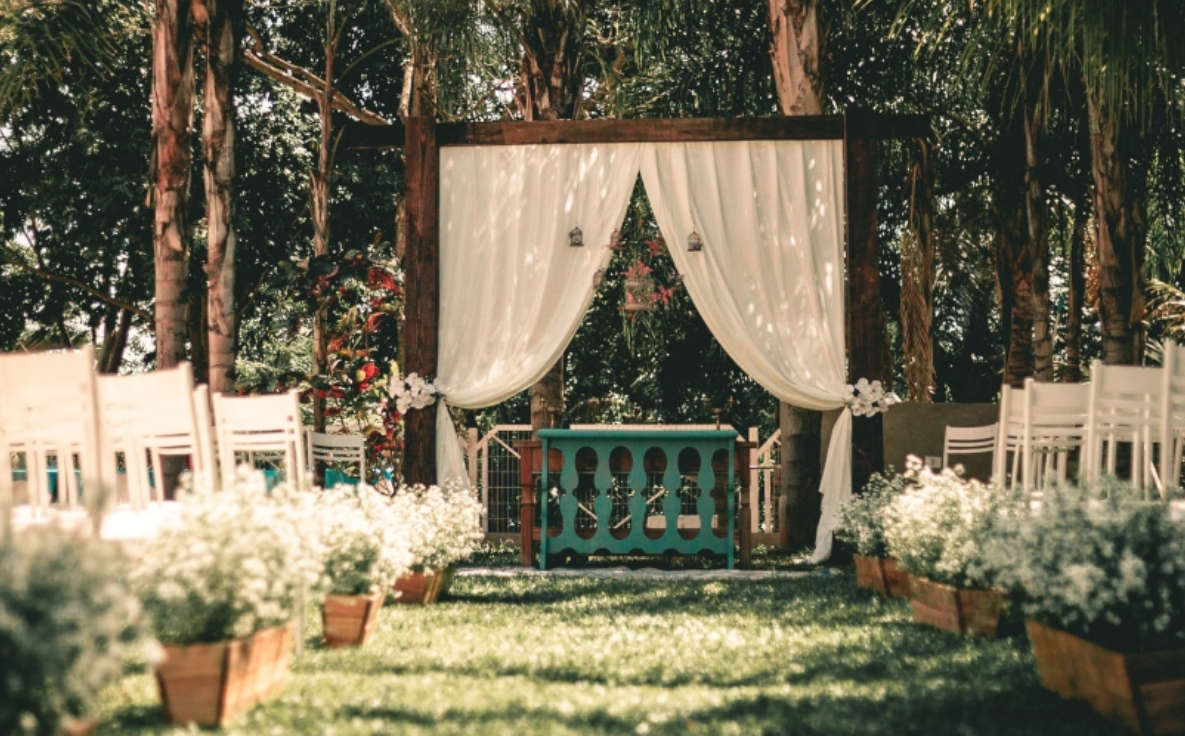
More than 10 million weddings take place in India each year, but how many of them would ever be eco-friendly?

Screen Shot 2019-06-06 at 5.43.54 PM

Have you ever heard of a muted desi (local) celebration? Or, the words: “I am getting married, but it’s not really a big deal.” That’s not the way India rolls. The grand cinema of weddings is a metaphor for life. It tells the world that this is so big, that it cannot, will not, and should not fail. In this ode to matrimony lies the foreplay of the bride and bridegroom. They are made to feel so special—nothing is bigger than them at this moment, nothing can trump this card. Certainly not environmental concerns.

The Indian wedding market is estimated at approximately ₹33,000 crores, the world’s second-largest, after the US market; while growing at an estimated 20 per cent a year, the Hindu Business Line reported in 2017. The same article reports that an average Indian spends an estimated one-fifth of their wealth accumulated in a lifetime on weddings.

Weddings are largely—like most luxury purchases—what you want to communicate to the world about yourself. And as the Amazon Prime series Made in Heaven (2019) suggests, weddings are a societal farce, a suggestive discourse on tradition and morality that lends itself to deep hypocrisy. As the video documenter of these weddings, Kabir Basrai (played by Shashank Arora), asks in the show—why is this the biggest moment of a woman’s life? As if everything she is and has done leads up to this point? It’s who you are, as a person, sure, but particularly, it is your standing in society. Royal, regal, rich and very unsustainable.

According to a 2016 story published by Fashion United, a UK-based fashion industry network site, as per industry estimates, in the top 15 Indian cities people usually spend between two to 20 million rupees for three to five days of extensive celebrations, from mehendi, sangeet, haldi, baraat and pheras to bidai. The immense cost to the environment to generate the orchestra of the grand wedding, including but not limited to the intricate invitations, wasted food, elaborate décor including fountains, stages and mandaps, services flown down from various parts of the world, heavy use of non-biodegradable products including plastic (think of the many barely-consumed bottles of water) and fabric (synthetic and otherwise) drown sense and sensibility.

A great start would be for Indian parents to forget the number of weddings they may have attended and curate a guest list comprising a select few, while simultaneously restricting the affair to a single event. And in a fell sweep, reducing the burden of ‘the biggest party they would ever throw’.

If a host would dare to change the mindset that organic is not skimping on the finery, then sourcing local, bio-degradable elements or going au naturel and keeping it minimalistic would be de rigueur. Couples in America have been reported to be open to second-hand garments and opting for no-paper-or-plastic and zero-waste catering. For the invitations, choosing recycled or seed paper, or sending e-vites. Perhaps one could give up gold-silver-and-bone-china gifts in favour of an eco-friendly registry (or accept donations to a charitable or sustainable organisation) and mindful favours.

The Fashion United article also suggested that the average clothing budget for an Indian wedding is $375,500 (₹26,257,197) and up to 80per cent of a designer’s business comes from bridal couture. In 2017 The Economic Times, a business daily, reported that weddings could save costs by renting outfits and jewellery. The most ethical and sustainable option for jewellery is vintage or heirloom, even if redesigned and updated in style. After all, ethically-made jewellery from lab-grown diamonds and recycled metal are better alternatives than new jewels, which bear the burden of mining.

Perhaps wearing a sari that is not brand new to even your own offspring’s wedding would make a statement—that the environment and their future on this planet matter.

While the lack of knowledge about the heavy carbon footprint of celebrations plays a role in choices being made, one could argue that in India particularly, the environment would not be a factor in the decisions. Also, as suggested by Viswanathan Raghunathan in Games Indians Play: Why We Are the Way We Are, socially, Indians are not primed to think about the greater good versus the private need. Savings, loans and investments are considered for education, marriage and health, and among certain income groups, marriage trumps all the others. If only marriage could be evaluated as a meaningful relationship with a person and the environment we live in—low-key, natural and organic, subtle and meaningful, like life and love should be—perhaps we could visualise an eco-friendly wedding in India. Until then, the industry just grows in the most unsustainable fashion.