Literature: Eat Recycle Save (Tristram Stuart)

Tags

, , , ,

Published: Verve Magazine, Nerve, September 2009

The writer of The Bloodless Revolution, Tristram Stuart, is back with another sit-up-and-take-notice book, Waste, about how tackling the problem of waste is one of the simplest ways of reducing pressure on the environment and on global food supplies. The UK (Sussex)-based author tells Sitanshi Talati-Parikh what’s working and what’s not in India

Tristram02

What are we doing right?
In India the recycling tradition has always thrived – kabari-wallahs collect unwanted trash for recycling and food waste is left for animals to graze on, turning it back into meat, milk and manure. As a result, India produces meat and dairy products much more efficiently than Europe and the United States. Also Indians eat more vegetarian food and less meat than other nations, and this is a much more efficient way of feeding people than the meaty diets of the West and of China.

What should we keep in mind as we embrace a more consumerist culture?
Growing food uses land and water, so reducing food waste can help to reduce water depletion, deforestation and global warming.
Nearly one billion people are malnourished in today’s world: we can help alleviate their hunger simply by wasting less food. It means the food will stay on the market where people can buy it to feed their families, instead of the food ending up in our rubbish bins.
We have to keep an eye on food companies, who often waste thousands of tonnes of food for no good reason. When supermarkets get too powerful, they make farmers grow food that they then decide not to stock, causing harm to the land and to the farmers.
The government should help farmers keep their food fresh so it doesn’t rot before it reaches the market. Simple things like fruit crates, cool storage in markets and on farms can help a lot.
Food storage in the home is really important: keep it cool, and use up leftovers – don’t let them go to waste.
Just remember: Buy what you need and eat what you buy!

Theatre: Burning Bright (Mahesh Dattani & Lilette Dubey)

Tags

, , , ,

Published: Verve Magazine, Nerve, September 2009

After a long hiatus, Mahesh Dattani returns with Brief Candle, a tragi-comedy about love, life and death, situated in a hospital for the terminally ill. Post the first opening last month, Sitanshi Talati-Parikh takes a theatrical turn with director, Lillete Dubey and the playwright

What should one expect from this Dattani play?
Mahesh Dattani (MD): I don’t know! It is a piece of drama like my other plays except it plays with theatrical conventions. [On another note] I do seem more motivated when a director is willing to commit herself to a production of my play. Lillete announced the play even before I had written it!
Lillete Dubey (LD): Mahesh’s hallmark ability to tackle difficult subjects with humanity, humour and deep insight.

You have had a very successful working relationship with each other….
MD: Lillete and I make a great team as our creative thoughts have common ground and yet we are two very different people. It is this synergy that creates an exciting creative environment at rehearsals and even in our personal interactions.
LD: Mahesh and I both enjoy stretching ourselves down a road less travelled – both in terms of theme and structure – and we try to create pieces that push people to re-examine their lives and the world around them.

What brought about this particular story?
MD: Well, the first thought came to me after a personal loss in my family. The concept of relationships that get defined only at the time of closure seemed to grow in me. While the play is not autobiographical it has sprung from personal loss. A lot of what my mother went through, although she did not suffer from cancer, found its way into characters like Shanti, a survivor of breast cancer.

Do you believe a topic like this can be handled with humour and without a deep sense of loss?
MD: There is a very fine line between comedy and tragedy. Both stem from a sense of loss but with comedy, that loss is viewed from a great distance. I have attempted to show characters who are going through a grave sense of loss but would like to distance themselves from it.
LD: That’s the challenge – to pick a subject like mortality and see how one can fashion something moving, meaningful, affirmative and even comic out of it!

the pen or the star?

Tags

, , , ,

just saw an old interview with aamir khan and imran khan on youtube where aamir made a very interesting observation. He said: when he had a debut film QSQT, there was only one channel and not much film coverage in major newspapers (basically no tabloids and gossip rags). A PR person tried to get some journalists interested in interviewing the new stars, but were not very successful. (Little did they know who they would have had the first digs on had they taken the bait!)

Ironically, today, with so many channels, publications and not to forget online media, there is a desperate quest for news – good, bad or ugly. Good journalism has been left far behind, now anybody’s uncle’s sister’s second cousin’s daughter … (u get my drift) is hot news. A starlet with a buxom bust is the hottest thing in town, before she has even done anything to prove herself. Not only are people looking for space-fillers, quantity has overtaken quality.

Reality TV has added another dimension: your next-door neighbour could be the next reality TV star and from then on the next bollywood king. While the playing field has been levelled, there is no sifting to find who is really worthy of the time and attention.

Coming back to the stars, the biggest problem, is the PR machinery. While PR is supposed to signify a public relations team/ person, facilitating a smooth interaction with the person they represent, instead they end up being a method to put up a wall of falsehood around the star. The PR person is either a mouthpiece for the star’s inane demands (which they cannot ask for directly) or is a filter through which the star is approached – with the normal problems of Chinese whispers, inaccurate depiction and ego hassles. You have to first pander to the PR person’s ego and then pander to that of the star. But before that, you need to be able to access the PR person. In most cases, the PR person is so busy (either taking up too many stars are one time or simply pretending to ignore calls that they are just not up to taking) that you need to go through hell to get one simple ‘yes’ or ‘no’ out of them. If the process involves getting approvals/ agreement from the star, one can just forget it ever happening. The PR people can be vindictive, rude, dishonest, unavailable and deeply inefficient. It is possible the stars would never know that their PR people are actually giving them a bad rep and dissing them to the media. Or maybe, the stars know, because that’s exactly who they are?

The tables have truly turned. At one point of time, the stars needed the media, and made themselves available to them. Now, apparently, the media needs the stars, and they have to cater to their every inane demand to get a story. Every little wannabe actor, one-movie-old or debuting wants to be on magazine covers. But no one stops to ask themselves – ‘what have I done to merit it?’ And where is the sanctity of true media and journalism, if the media is willing to stoop to all levels to cater to them? Is the pen mightier than the star, or the other way around?

Here’s a another twist in the saga. Stars have now begun to talk to their fans directly. The media and the PR person have been thus circumvented with blogs and twitter. Fans know exactly what their star is doing at any time of the day, what they are thinking/ feeling. What value can media add to a person who is already baring all? The mystery, the art of conversation – taking the time to get to know the reclusive star and drawing them out to bare all, may just fade into oblivion. The changes that we are witnessing show the death of old fashioned celebrity interviews, democracy and independence of the media; and transparency and honesty of the PR person.

Travel blog: Fine Lace and Liquid Chocolate (Bruges, Belgium)

Tags

, , , , ,

Published: Verve Magazine, Travel, September 2009

Its charming canals lined with low-hanging trees, moss-covered stone houses with flame-coloured roofs and sleepy cobble-stoned pathways make for a great honeymoon destination, far from the madding crowd. Sitanshi Talati-Parikh pays a visit to the world’s chocolate capital, a UNESCO world heritage city, and the once-cultural capital of Europe, Bruges, in Belgium

Burges02

I found romance where I least expected it. Bruges shattered my impression that palatial beach villas are the mise en scène for a passionate interlude. Tucked away into the heart of northern Belgium, in the Flanders district, lies a egg-shaped fairy-tale town that weaves a tale of charm like it would into the fabric of its famous handmade lace. It is where the legends of knighthood and the mystery of goblins live in the gothic, baroque pieces anchored to the old world. I can imagine the peaceful spirits from Harry Potter prowling the aged alleys of Bruges. Not surprisingly, the first book in English ever printed was published in Bruges by William Caxton and much fiction and numerous movies (think In Bruges) have been inspired by the city. The gothic spires breathe out folklore that can only be confirmed by venturing into the aged great stone doorways, by standing in the centre of the courtyard and being enveloped by the sounds of the past.

Turn back the clock to the 15th century, a truly luxurious time for Bruges. The Duke of Burgundy holding court, many a fabulous soirée in the palaces rich with Flemish oil paintings (recall Jan van Eyck) and aglow with carpets spun with real silver and gold threads, glittering in the evening candlelight. It must have induced a stupor so deep that between 1600-1800 Bruges ‘fell asleep’ and it was only in 1892 that it experienced an awakening. At this time Bruges-la-Morte, a short novel by Belgian author Georges Rodenbach describes the city as dark, poor and ugly. While the locals were not thrilled, the tourists flooded the place scoping out the romance in it. Bruges’ romance lurks in the alleyways, where the past seems to want to speak to you, but the stone buildings stand quiet.

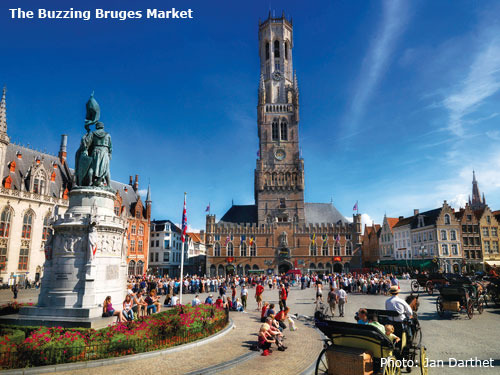
‘Belgians have a brick in their stomach,’ goes an old saying – ‘they want to build or own a great house to impress’, says our tour guide, Pol Verschuere, a wizened gentleman who speaks with a thick Flemish accent, muffling and rolling his words and missing syllables. It is a soft, fluffy language, of another world. Leaning on his umbrella, he points out to the gothic architecture, which was later changed to baroque, and to the rococo houses. Even the foundations are old world: the brick houses ‘decorated’ with natural sandstone are held together with non-corrosive bones of sheep. Three stately spires represent the Bruges skyline, one of which is the 13th century Belfry, housing a municipal carillon of 47 silver-toned bells. Climbing the steep and narrow 366 steps up the 83-metre tower (which tilts to one metre to the east) is a tourist must-do, if only for the spectacular panoramic view of the city below.

Burges06

After the climb, we took sustenance from one of the two fries’ stands below the Belfry (they have been competing since 1896). Their fame precedes them – the famous hot fries topped with cheese were overrated, and in true Belgian-style hospitality, we found ourselves shelling out extra euros for ketchup and any other accessory that may traditionally accompany the humble fry. Once revived, we moved onto the Church of Our Lady with a 122m brick spire, which houses the sculpture Madonna and Child, believed to be Michelangelo’s only sculpture to have left Italy within his lifetime. Our candle deferentially joined the others flickering in the hallowed interiors, glowing with a sense of awe at standing before the work of one of the world’s greatest artists.

Burges05

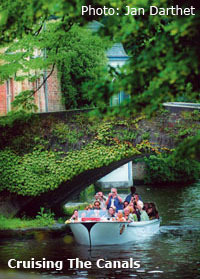
With the same sense of inner quietness, we cruised down the canals of Bruges, ‘the city’s arteries’ as tucked-away gardens, picturesque bridges and quaint – and often oddly shaped – stone homes unfolded before us. While the boatmen are not Venetian and probably not of musical inclination, the romance of the little waterways lies in the stillness around. Notwithstanding the loud warnings to duck as an impossibly low-hanging bridge would appear; and as one, the entire boat-full of tourists would bend over double as we passed under a dark, mossy alcove. Our boat slid quietly past a very important meeting of birds, past a troop of school kids who stopped to wave and turned into a little nook where a little beer bar and its nondescript customers were abruptly exposed.

Bruges is a great thirst quencher with its local beers such as the Brugse Zot and Brugse Straffe Hendrik, which are still brewed in the city itself, in the only remaining brewery, Halve Maan Brewery (1856), of which you can take a guided tour. At night, we strolled down to the Cathedraat, one of the stonewalled pubs, with outside seating, facing the courtyard. Here, my husband and I felt a sense of quiet companionship as we sipped away and watched the world go by: the late dinner seekers standing before the pubs checking out their daily specials and moving on indecisively. In sharp contrast, inside the bars, we felt like we were thrown into an American frat house or a British pub – with the heady combination of testosterone, beer and enthusiastic sports viewing.

While walking around the lively market place (central square), hunger pangs led us to make the mistake of eating at a commercial restaurant like De Carre (studiously avoided by locals and well-informed tourists alike), which left a bad taste in our mouth. The soft, fresh Belgian waffles off the street corners sweetened our palate – they were in a word, spectacular. If you like living life on the wild cocoa side, try the liquid chocolate, tobacco chocolate, chocolate lipstick or a chocolate sniff box (first ordered by the Rolling Stones) at Chocolate Line. Or the 44 kinds of hot chocolate (think banana and ginger – or not!) at Bar Choc. If that’s not enough, you can really get adventurous with their stewed meat in beer-and-chocolate sauce, with baked potatoes. I confess I didn’t!

As we spent a couple of days absorbing the lifestyle of the local taverns, intermittently sneaking out for some excellent takeout Chinese right next to the Kempinski Hotel Duke’s Palace, we were more than ready spend a sophisticated night out on our last evening in Bruges. Dressing up and calling a car to take us to the Michelin-starred De Karmeliet, we spent hours with much local wine, an extensive cheese platter and Chef Geert van Hecke’s fine dining experience of French with Flemish twists. (Interesting choice of cuisine when you recall that in the 1302 battle between the two countries, a whole regiment of French soldiers were murdered in their sleep!) While whispering such sweet nothings into each other’s ears, we found ourselves rubbing shoulders with the most exclusive patrons, all of whom engaged in muted conversations that floated like a whisper in the many alcove-like ‘dining rooms’ spilling into each other.

Bruges left us with a heightened sense of ‘other world’, where crass meets sophistication, where the old world meets the new, where charm lies in the stony street corners, where lovely boutiques are manned by surly Belgians, where exquisite tastes linger, take a hold and draw you back for more. Having been home to freedom fighters, rulers, mathematicians, engineers, theologians, poets, scholars, painters, writers and diplomats; whether it is a day or a weekend spent here, the city brings the past forward into the present.

IN BRUGES

In 1277, the first merchant fleet from Genoa appeared in the port of Bruges, making it the main link to the trade of the Mediterranean.
Diamond cutting actually originated in Bruges, before gaining a stronghold in Antwerp.
French fries are a Belgian invention. It is believed that because the Belgian commanders during World War I spoke French when they baked their fries, their allied commanders tagged them as ‘French Fries’.

It is a Museum Haven! Fries Museum (History of the Potato Fry), Diamond Museum, Lace Center, Lamp Museum (History of interior lighting, with the world’s largest lamp collection), Chocolate Museum, Groeninge Museum for the Flemish Masters and Folklore Museum…among others.

FAR AND AWAY

Getting There Bruges is connected to all major European cities by train, ferry and motorway. Flights get into Brussels airport, from where there is a transfer to Bruges by train.
Take Aways Genuine Belgian lace is rare and very expensive. The market is flooded with many cheap replicas. Belgian chocolate of all kinds is a must, especially truffles. Maybe an original Flemish oil painting or two?

Imtiaz Ali: The Chemistry In The Script

Tags

, , , , , , , ,

Published: Verve Magazine, Features, September 2009

Photograph: Ankur Chaturvedi

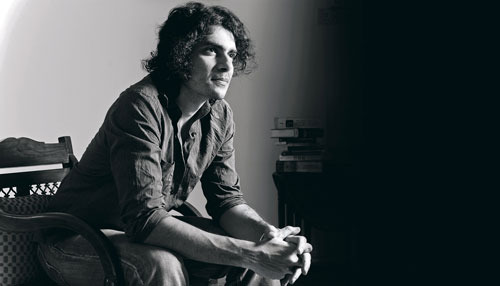
He’s smart, casual, with unruly locks that women want to tame and is completely unmoved by his own success. Kareena Kapoor believes he redefined her career with the role of Geet in Jab We Met. Award-winning writer-director Imtiaz Ali speaks to Sitanshi Talati-Parikh about his disinterest in love stories and not being a good writer, hot on the heels of his latest film Love Aaj Kal

Imtiazali

I think women are much smarter than men.” Pat comes his reply when I suggest that while women loved his latest romantic story Love Aaj Kal (LAK) starring Saif Ali Khan and Deepika Padukone, most men were not visibly impressed. Despite how it sounds, Imtiaz Ali is extremely self-effacing, to a point where he appears not to believe in his own success. It seems to be a mere accident that he can be considered a film-maker of distinction, in a space of the simple love story.


Ali, contrary to expectations, doesn’t like watching love stories. “I prefer relationships like those in Wong Kar-Wai’s Chungking Express (1994). There will always be a man-woman relationship in my films – I am old enough to admit that I like women.” That would explain one of the strongest elements of his cinema – his deep characterisation that surpasses the situation, story or script. The 38-year-old believes that fire is not born on screen alone – that chemistry exists first in the script; and particularly if the actors are suited to the characters. And he has a bias towards actors who haven’t done much work together: “If there is a kissing scene between a couple that is kissing all the time, there is no big deal – it is almost brotherly.” While Ali’s films display the maturing of a love story, happy endings are not a prerequisite. LAK was actually supposed to end unhappily, before he realised (with some insight from director-friend Anurag Kashyap) that it would not be very profound to start and end with a break-up.


The Jamshedpur-born film-maker’s stories are not set in the midst of tamasha and great social disturbance. Rather, they examine the turbulence of the relationship itself, often caused by distinctive character traits. About his choice of genre he simply states, “I’m not very cinema-literate and not really a movie buff. I don’t know what genre I belong to or am creating, and I am not going to fight that. I am selfish enough to do stories that I enjoy most at that point of time.” At the same time, he admits to having to think practically about the film he wants to make. “There are multi-crores riding on the film, it is a very expensive medium and I am from a very middle-class family – I don’t want to take the tension of squandering away anyone’s money.”


Reports suggest that LAK grossed Rs 62 crores worldwide in the opening weekend. “I didn’t have numbers in mind. It is overwhelming, the response, but my expectation from myself is not very much.” Whether he is out to impress or not, people are more than willing to place their bets on him. “People’s faith is a double-edged sword. You get the chance of doing what you want to do, but you also lose some of the filter for your work – finding people who will be direct with you!”


While it is the crisp attention to contemporary dialogue and situations that is the hallmark of an Imtiaz Ali film, there were some murmurs about conversation over-kill in LAK. He looks piercingly back, appearing unfazed. “I am not a very good writer. I’m a director who manages to put his thoughts on paper. A writer would have more precision, more imagination in terms of dialogue. Don’t get me wrong – I’m not saying it doesn’t work. But, sometimes I feel that what I am writing is merely a code for the director [myself] to understand at the time of the shoot.” Writing the scripts for his previous films was a matter of circumstance, not choice. And yet, starting from school skits, the work that he enjoyed doing the most was that which was organic, home-grown and self-written. Regardless of his personal opinion, after winning accolades for Jab We Met (2007) – which he is dismissively appreciative of – Ali can’t escape his own writing.


Doing theatre in Delhi, an advertising course in Mumbai and becoming a “tape-delivery boy for Zee TV” finally brought Ali to television (think Purushetra and Imtihaan), where he spent many years struggling to find a balance between his two-hour stories and their long-term serials. “It was my mistake – TV is not looking at completion, it is looking at longevity.” Then Socha Na Tha (2005) happened, over a period of three years, “where all hell broke loose”. After Socha’s unsuccessful stint at the box office, Ali found himself floundering. “I’ve been a little irresponsible with the practical aspects of life. I don’t know how I have survived up until now. It’s a miracle. I have been broke, I am still broke, but I have got money whenever I needed it. And yet, that didn’t pressurise me to do a film that I didn’t want to, even if it looked like the most attractive proposition on earth. And then Jab We Met happened.”


Today he sits back casually, with no particular story that he plans to start work on soon. “There are stray bits floating in my mind – I don’t know which will materialise into a story. Some of them are so scary I want to forget them! The slate is clean – it gives you insecurity; but right now I have nothing. Usually I wait for myself to lose interest in my old stories. If I lose interest, I feel relieved that I don’t have to waste another year convincing people to invest in it! The best thing to do with a story is not make it. But, if it is compulsive, you have no other option – it is like a ghost you have to exorcise.” He stops to catch his breath. Does he actually enjoy making films? He chuckles, with a flash of the Imtiaz Ali charm. “A lot actually. More than anything else. It is a little compulsive-obsessive rather than a work of creative art that you enjoy with a cup of tea (he’s just finished two cups) and good music.”

The Sounds of Silence

Tags

, , ,

Published: Verve Magazine, Features, August 2009

Giving up a neurotic SoBo life to spend time at a yoga and meditation camp for 10 days may not be as difficult as it sounds, and could be a process of self-discovery finds Sitanshi Talati-Parikh

In our jet lagged, jet setting, jet spreeing and jet skiing lifestyle, is anything worth the effort of waking our numbed consciousness into a half-awake stupor, struggling to comprehend the deeper meaning of life, whilst a cock crows its loudest best? I struggled with these, and a million other questions, as my Loved One held our destiny for the next ten days at ransom, to a Presumptuous Class that claimed to ‘bring clarity to one’s life’. It was so passé, so trite and so cliché. But at 5 a.m., as Loved One, quite matter-of-factly dragged me out of bed, I realised that this was one dawn that I would have to see, with my eyes wide open.

As we sped down the clear morning roads – I gasped. The Arabian Sea was a colour that I can only describe as cobalt blue – a hue I had never before seen in our often-murky seas. My cranky desire to hold back, to not like Presumptuous Class and to prove to Loved One that I had given it a shot, but it wasn’t working for me suddenly seemed very inconsequential. I reached the location and stood grudgingly, waiting for something groundbreaking to happen.

And then, Aura walked in. I can only describe her as Aura – because she simply had a powerful presence, a persona that seemed to float above the ground, which seemed rooted in reality – one who could joke, smile, look grim, shed tears, and yet was beyond it all. She, of the fair face and lustrous hair, made us work on our ‘inner self’ – from within to without; through meditative exercises, emotional workshops, and spiritual discourses. She took me to a point where my heart bled, and I realised that we often live our lives in non-experiential non-existence. When the myriad emotions and emotional baggage that we subconsciously or unconsciously carry around with us get a chance to find a way out, it creates a clean slate: accepting the things that weigh us down, exploring them and then letting go of them. It is a catharsis for the soul. Aura was serene, as serene as I would want to be from the inside – the quietness that I often miss, and then forget how it feels in the noise of our lives – emanated from Aura, and her wispy fingers touched my soul, reminding me what it meant to be quiet, free, and happy.

Aura ran a tight ship and a strict regime – no latecomers allowed (and she was picky down to the second), a raw food diet, meals only when designated. And, in our boob-tube lifestyle, Aura had the gumption to suggest discarding television, newspapers, magazines, tea, coffee, smoking, inebriation and what-not-else, from our ‘sensational’ existence. Sigh…I could taste the fondue, bite the chocolate, relish the pizza, and devour the curry, but all only in my fertile imagination. Mohammed was going to the mountain, and the climb was exhaustingly uphill.

The next week was a roller coaster for my mind and body. Every morning, ritualistically, I would struggle out of bed and speed down the snaking road, by the cobalt blue seas, towards Aura. Every morning, Aura would batter my mind and soul, pervading my Intelligence, Emotional, and Spiritual Quotient. I felt myself simmer down into a willing and subdued silence, whilst another part of me jumped up with questions to the statements and answers to the questions.

Pranayama began our mornings, as we eased the art of holistic yoga into our lives and spirits. They claimed that at the end of the week, I would be a happier, jumpier and more exuberant person, completely revitalised. The cleansing process had begun. As I sat back on the threadbare mat in vajrasana, biting back a feeling of discomfort, I pondered about the luxury we leave behind, making the superhuman effort to accept this simple lifestyle. With breaks for herbal tea, fresh juices or light uncooked meals (ashgourd raita, anyone?), I realised that the only valuable allowed here was an open mind.

The days were now longer, and yet not as stressful. I could go on for longer hours without having to compromise on time or work. I was beginning to feel lighter. I could now understand, how, living years like this, I could become like Aura. But could I live like this for years? Already, friends howled and tormented Loved One and I, since we had absconded into yogic delights, leaving behind the neighbourhood of the blissfully alcoholic and the late night seekers. I was now living at a plane, where I never saw the people I used to see, and felt removed from it all. It was a distant memory that seemed to fade and hover in the sky like a lazy cloud, unwilling to move, but ready to pour down on me at any moment. I knew my weightlessness and enlightening of spirit would be washed away in that downpour.

What hovered at even more dangerous proximity was the Silent Retreat: two entire days of yoga, meditation, raw food, discourses, oneness with nature, and above all, silence. There was a strict regulation on not speaking or communicating with anyone during those two days. As a part of our ‘learning exercises’ we wandered blindfolded on the barbed-wire hills, entrusting our fate into the hands of a person who was a stranger before this camp. As we remained abandoned in the rainy woods, hungry, tired and unwashed, finding that what we take for granted is the most beautiful thing of all; as we spoke our minds, shared our thoughts and opened up our emotions to strangers, I realised that it is easy to just be.

Silence is often considered evil, something dreaded as akin to loneliness, and it is easy to succumb to the anxiety that the thought of silence breeds. Left adrift in our own thoughts, in quiet environs, I suddenly found that my mind and its monumental and continuous thoughts often drowned out the greatest sounds of all – the sounds of nature, the sounds of stillness. And shockingly, in these sounds of stillness and nature, my own normal thoughts came rushing back with renewed clarity and vision, crystal clear. We often want to say so many things, that we really need not say….

Back in the midst of commotion and chaos, I realise that the life I have carved for myself forces me to break free from the shackles to regain sanity. And yet, we live in this reality. As soon as I was back, into the world I loved and yet was often exhausted by, and into the never-ending partying circuit, I realised over cocktails and conversation that my newfound enlightenment could only be applied bit-by-bit to every moment of my day in this insanely chaotic world – and it would automatically unfold into a fabulous coherence. In the very end, it all boils down to who we want to be, or not be.

The author attended a corporate Siddh Samadhi Yoga course taught by Najoo and Manoj held in Mumbai with an accompanying Silent Retreat in Manor.
One Fine Day

Published: Verve Magazine, Art Mart August 2009

The idea was formulated on the back of an airline airsickness bag. The annual India Art Summit, started last year by 10 people, has steamrolled into an event of international significance. International galleries now make India their holiday destination spot for the summer. Sitanshi Talati-Parikh gets the organisers to recount what it takes to put together an event of some consequence

New Delhi-based associate director of the India Art Summit, Neha Kirpal, describes a ‘normal’ day

7:30 a.m. Woken up by Gayatri Sinha (art curator) to discuss one of the billion aspects of the project. P.S. I am not a morning person.
8:00 a.m. Getting ready for work while on a conference call with NGMA director Rajeev Lochan; a media interview about the state of the economy and the art scene with IANS; a quick bite in the car while looking over a press release announcing our 34 global media partners (the office is a five-minute-ride from home so that’s the time I have).
9:30 a.m. On the phone talking to people in the East: important fair directors, museum representatives and galleries in Hong Kong, Phillipines, China, Korea, Tokyo.
9:45 a.m. Make a checklist for the day averaging about 70-80 tasks a day.
10:00 a.m. Meeting a potential sponsor for the seminar programme.
10:45 a.m. Call a team meeting for advertising and publicity plans: send off teams all over the city to put up posters, negotiate with magazines for ads, blogs online, update Twitter, leave a note on Facebook….

12:00 p.m. Negotiating with an art gallery owner about how it is difficult to accommodate a 10 x 10 work in a 8 x 8 area.
12:30 p.m. Meeting Renu Modi at Gallery Espace, to discuss…well, the state of the market, selling price points, artworks being shown by them….
1:30 p.m. w It is 48 degrees and 20 people are working in a pool of sweat. Also on site is a big discussion with the Subodh Gupta about where his gigantic piece of art can be placed.
3:00 p.m. Running back to the office, looking at the show catalogue. Pagination, page sequence, printer screw-ups, re-doing samples.
4:30 p.m. Meeting with our projects’ curator to discuss lighting in the sculpture park.
5:30 p.m. Conference call with Sotheby’s; collectors; VIP programme.
6:00 p.m. Meet Peter Nagy for coffee to discuss Nature Morte’s show at the Summit.

6:45 p.m. Badges! 300 exhibitors badges, 60 speakers badges, 800 VIP badges, 15,000 general visitors, 200 press badges….
7:15 p.m. Picking a shade of silver for the show catalogue. How many shades of silver are there?!
7:30 p.m. A conference call with Art Tactic in the UK – working on a daily art newspaper for the Art Summit.
8:00 p.m. Invitations, artist queries, reviewing contracts with art publications, collaborations with art organisations like Art Asia Archive for the dream museum project, thank-you notes and issues to do with venue security.
8: 30 p.m. Review the Video Art programme proposed for the video lounge. There are over 100 video artists being shown in three days!
9:30 p.m. Talk to people in the West – it is their time of the day now.
10:00 p.m. Next day’s checklist, and read assorted media articles on the art world (we’ve got a company that tracks art news on a daily basis nationally).
10:30 p.m. Just the beginning of a long night ahead, preparing for another long day. Wait, I hear the phone ring….

The India Art Summit will take place between August 19 and 22 at Pragati Maidan, New Delhi. Events include an international speaker’s forum, a sculpture park, installations at The Purple Wall Project, a video lounge and other satellite events across the city. For more details visit www.indiaartsummit.com.

FIGURE THIS
Some numbers that are a part of the India Art Summit 2009

22,000 man hours
   
600 litres of white paint
11 countries
   
56 speakers
   
500 artists
4,210 sq m of concrete flooring
   
500 artists
2000 art works
   
400 kilo watts of electricity
55 galleries
   
20s is the age-group of the core team
37 world-wide media publications

For Art’s Sake

Managing director of The India Art Summit, Sunil Gautam (of Hanmer MS&L Communications), answers two questions

Why art?
Art is stimulating. It’s something that brings out creative energies; it’s engrossing and captivating. This is also a field which has little in terms of organisation and structure, so it was a very challenging space to enter. And I like challenges!

Why Delhi?
We’re working very hard to promote Delhi as a cultural capital in the Asian region. Around the world, this is being seen as India’s official art fair, so it’s obvious to consider the national city. Plus, Delhi’s got a very vibrant art market!

INDIA ABROAD

Verve points out another heavy-weight show worth checking out this month

India Xianzai
Take India to China and you can create a great artistic bridge – think the exploration of issues related to cultural assimilation. If you happen to be in Shanghai before August 30, you can proudly check out the likes of Anju Dodiya, Chitra Ganesh, Hema Upadhyay, Jagannath Panda, Jitish Kallat, Justin Ponmany, Mithu Sen, Reena Saini Kallat, Riyas Komu, Subodh Gupta, Thukral and Tagra and Santhosh TV at The Museum of Contemporary Art, People’s Park, 231 Nanjing West Road, Shanghai (www.mocashanghai.org).

the wired generation

Tags

so as Sahil observed this morning, the generation next is truly a wired generation. if we are able to finish a task in seconds, when earlier it would take hours, that should automatically make our lives much simpler, easier and give us more free time, right? Wrong. We pack more into a day, multi-tasking faster and often remain connected outside work, just because we can. That means our mind is constantly switched on and churning data. Instead of making our lives simpler and easier, technology has obviously made our lives more complicated. Can’t live with, can’t live without?

generation gap

Tags

,

So in conversation at lunch today, I discovered that it’s very easy to map a sociological downturn to a more materialistic and individualistic state that we are in today (obviously generalising):

1. Independence Generation: All they wanted was self-respect and freedom to be themselves. Their desire extends to the entire nation and community. There is no sense of Self and a deeply ingrained sense of values and responsibility towards a greater good.

2. Post-independence Generation: It was all about the simple things in life: roti, kapda aur makaan. There is a greater thought towards family and society, with a continuance of the value-system of the past. There is a negative qualification for those who are willing to drop this value-system to move forward into a materialistic route.

3. Industrial Generation: It was a time to sow the seeds to prosperity – work hard, save really hard, dream of that one vacation of a lifetime and a good retirement. It was an itch towards a comfortable life. Their desire is just for a better life for their family, with a great deal of dependence on the extended family, social groups and other social circles of influence. Values remain, but they are beginning to get diluted by the pressure of responsibility to provide for those around.

4. The Wealth-creator Generation: They thought about true wealth generation for the future generations. They also worked hard, but began to indulge – in the little luxuries that they had so far not been privy to. They are the last pure-breed example of stoic ‘follow-in-the-footsteps-of-your-father’ generation. Their circle of influence extends to the extended family and friends, with the beginnings of the Self philosophy. Values have begun to lose meaning in business and they are kept merely for personal life: where virtuosity is still in demand.

5. The Wealthy Generation: They are born into a comfortable life. They are the ones who studied abroad and began to realise the fact that they have career choices. They are the go-getters. Those that are not born into comfort, choose it as a career option with pvt sector jobs that give them more money than their grandfathers had in a lifetime. More choices and the drive to succeed very quickly create more anxiety and stress. There are two kinds of people here – the people who live off the forefathers’ sucesses and those who take different career options to create/build the next big thing. They work hard, party hard and look for a perfect work-personal life balance. For them it is about the self, immediate family and close friends. The extended family and society are not of particular consequence. Values are also a matter of choice and convenience.

6. Generation Next: This is a very exacting generation. It is a generation that spends money faster than it can be made, and looks for shortcuts to success. They have seen great wealth, and are familar with deep materialism. Everything can be quanitfied in terms of money or social markers and values are not of great/any consequence. It is a generation that expects instant gratification, without having to work hard for it. It is all about the Self and there is no sense of apology. There is no desire to think or consider anyone else. There is complete loss of value-systems and there is no desire to put up a front to prove anything.

writer’s blog

Tags

,

I mean writer’s block – can’t you see? what can be worse than having a deadline and having writer’s block at the same time? Try as I might I can’t make it sound any better than it does right now, and right now it’s shitty. It isn’t what I intended, it isn’t what I wanted and it isn’t worth reading. And someone else could’ve done it better. It’s a fix I can;t get out of, it’s a place I am in, and it’s a situation that just gets succeddingly worse. And it;s in my head. The question is, how does one get it onto paper?