• About
  • Brand Building
  • Film & Drama
  • Writing: Arts & Lifestyle
  • Writing: Interviews
  • Writing: Luxury Brands
  • Writing: Travel

sitanshi talati-parikh

sitanshi talati-parikh

Tag Archives: Karan Johar

Verve Man: The mysterious appeal of these men…

16 Tuesday Oct 2012

Posted by sitanshi talati-parikh in Features & Trends, Publication: Verve Magazine

≈ 2 Comments

Tags

Bollywood, indiancinema, Karan Johar, Men, Politics, Salman Khan, vervemagazine

Published: Verve Magazine, October 2012, Verve Man supplement

The Mysterious Appeal of These Men: Salman, Chetan, Rahul, Karan and Sachin. (Admit it – you knew their last names as you read it.)
In a perfect world, we want to see people who are famous because they know their craft exceedingly well – the ones who are untouchable because you can’t surpass their talent. It puts them on a pedestal of excellence and it silences detractors. Sometimes there are those who may or may not have talent, but have an x-factor, which makes them incredibly appealing to a large number of people. Sitanshi Talati-Parikh decodes the controversial appeal of five successful men across industries


Salman Khan, actor
In a recent TV interview, Salman Khan said something that sounded ridiculously ostentatious. But if you take it in context of who he is as a person – simple and direct – you would understand that he was just stating the obvious. Ek Tha Tiger’s release and people’s reaction to that movie and others before it, Dabangg and Bodyguard in particular, lend complete strength to the fact that Salman Khan exists in the industry for his fans. (And he has many of them.) As he points out, if you need an actor to play a role, there are many people to choose from. A director and producer will think of Salman Khan, only when they want the full Salman-Khan-ness in a particular film. He’s unapologetic about who he is or what makes him popular among the masses. He’s also matter-of-fact about his popularity, without being self-propagandizing. It doesn’t matter whether the movie has a story, or whether the film is completely OTT, or even that the character does the strangest things – like manage to pop the buttons of his shirt as he struts. His style of dancing – not updated over the years, but true to form with certain pelvic thrusts or iconic hand gestures; his action sequences, where he isn’t a hero, he is a super hero; his romancing – which is stilted and subdued; are all aspects of the Salman Khan phenomena that his viewers expect. It’s suggested that he dresses like James Dean and picks nuances from Dharmendra; two actors he believes should be closely watched. And in his smile, lies his resemblance to Dean, though he doesn’t smile enough – off screen and on it. While his cinema may be regressive in it’s form, it’s appeal – rather his appeal – remains eternal. He has consciously chosen to be a performer and entertainer, and removed himself from being an actor. And yet, maybe it was his cleverest move, the secret formula to being one of the biggest movie stars of the Indian film industry. Behind his rather simplistic appeal, quotes and choices, lies a sharp brain that has managed to find a bankable spot in the industry. He has, very possibly gauged his strengths and weaknesses, and put his money in just the right place.


Chetan Bhagat, writer
Some time ago, on an episode of Love2HateU, the celebrity guest was Chetan Bhagat. The poor girl – the ‘hater’ – stood no chance against Bhagat’s generous Gandhi-ism, so beatifically patronizing and condescending. But that’s Chetan Bhagat – a huge icon and idol to some and an even huger eyebrow raiser to others. Bhagat’s success – and he is astonishingly successful – is because he has crawled through the cracks and found his target audience. And what a target audience that is. The non-readers. Instead of churning out a highbrow book filled with beautiful metaphors and aiming for the Booker-reading intellectuals, Bhagat does what he does best – appeal to those that have admittedly never read a book before. And therein lies his claim to fame. Bhagat has automatically found his safety in numbers. While Bhagat makes no pretentions about his literary aspirations, he basks in his own stupendous success, often lying on a raft of self-appreciation. And what irks people is that his raft never, ever capsizes. Top models can have a bad hair day, brilliant directors can have a box office flop, the Sensex can crash, but Chetan Bhagat only goes from strength to strength. As he smugly states, ‘I’m happy to be on this show (Love2HateU) because my new book has just released and I want to know that there are people who don’t like what I do, not just people who enjoy my books.’


Rahul Gandhi, politician
Is it possible to bank a country’s future, its political aspirations on a set of irrepressible dimples? While our democracy is far more discerning than that (we hope) it is true that as the younger Gandhi scion grew up, a great deal of hope was vested on his future. He had the political pedigree, and most importantly he looked the part. It didn’t really matter what he said – or didn’t say – he was just so easy on the eye. Every woman could imagine him at the helm of India, attending the topmost international discussions and global summit roundtables looking stupendous representing India. And yet, that hasn’t really played out well for him – while remaining a member of Parliament, he hasn’t proven himself as a strong candidate for the topmost office of the country – despite the looks. Whether he manages to get any further, we can only wait and watch, and hope that there is more depth to him than his dimples, or India may end up having her own frat-boy-politician in the making, served up American style.


Karan Johar, director
You watch Dilwale Dulhaniya Le Jayenge and you see that plump friend of the hero, put there so that the hero can shine. A school misfit, no one would have guessed that Karan Johar would become a phenomenon. Johar has lived his high school misses through his films – creating the candy-floss make-believe world that he would have liked to be a part of, making his protagonist (more often than not played by his buddy Shah Rukh Khan) the popular kid in school. The kid Johar should have been, going by his current personality. What he may have been unable to achieve in his school years, he’s more than managed in his adult life. He is the force behind one of the biggest production houses in Hindi cinema, Dharma Productions, his movies do record business, he can make or break an actor or director, and often can control the future of a movie star, as evidenced by his power over the future of one top actress who wound up in his bad books. His talk show became an iconic talking point at every Koffee-table conversation. His rapid-fire questions allowed for his sharp wit, humour and personality to shine through, even if he did demonstrate that he lives happily in his own industry bubble. Only on Simi Garewal’s show did any of his vulnerability come to the fore. Johar is a complex animal, but his success is because of these complexities and layers to his personality. With Student of the Year in the offing, we wish we would move beyond the chasm of his youth to the brilliant success of his grown-up years in his directorial offerings. But would that be a cathartic story worth telling?


Sachin Tendulkar, sportsman
The Master Blaster. Anything said against him is akin to blasphemy. How did a supremely talented teenage kid manage to bear the weight of a nation’s hopes on his young shoulders? One who should just concentrate on the game is made to feel like the savior of the country. Every poor man’s hopes, every rich man’s dreams are with Sachin Tendulkar as he takes strike after strike. As if that were not enough, he had to attempt captaining the Indian cricket team. It’s a wonder he didn’t retire early, just to find inner peace. He has dealt with it all with equanimity – reminiscent of great players like Roger Federer in tennis – where nothing sways him. Victory brings a smile
, and when he’s down, he’s generally outwardly calm. Children are named after him in quick succession, he is revered to the point of blind faith, and he can do no wrong. Even if he gets out in duck thrice in a row, it’s okay because he has given us many centuries before. People cannot be logical around Tendulkar, he is more than human, he is God. With anyone else it would be dangerous, this blind idolization. As Wright Thompson in an insightful study on his charisma pointed out – Tendulkar’s meteoric rise took place in parallel to India as a country and economy opening up. He symbolizes everything we dream and wish for, all that is balanced and good. He steadies our racing hearts; he lives our greatest hopes. And he does it all with a clean chit. He makes people feel good – about themselves and their country, and he gives people a sense that we can be better, that we can be the best. And he forms the bridge – between the insecurity of the past and the brash confidence of the future.

Why Bollywood Talk Show Hosts Should Host Less

23 Thursday Jun 2011

Posted by sitanshi talati-parikh in Musings

≈ Leave a comment

Tags

Bollywood, Deepika Padukone, Karan Johar, Koffee With Karan, Ranbir Kapoor, Simi Garewal

Recently two celebrity talk shows that once reigned supreme have returned to television in a brand new avatar. Simpering, buttering and at best cajoling their guests into letting go of certain inhibitions to guarantee TRPs.

Lately, Simi Garewal – famous for her Rendezvouz With Simi show, where she played agony aunt to all her celebrity guests – got them to cry on her shoulder, laugh and reminisce all while holding their hands, giving them a chance to open up their lives, loves and unhappiness in front of the entire nation, is back with Simi selects India’s Most Desirable. This time, she uses the show to reestablish her iconic status and that of her guests. She repeats frequently in the show why she considers her guests ‘India’s most desirable.’ I think we would know why a handful of top Bollywood stars are desirable. Do give the audience some credit. She uses the show to suggest how Ranbir Kapoor, whom she is obviously incredibly fond of, possibly even charmed by, is actually really a sweet little Mama’s boy, very acceptably interested in women. What’s amusing is how Ranbir manages to charm her and keep her charmed throughout. And we shouldn’t even get to the part where Mama actually comes in with her endearments for Son. Simi’s botoxed and sugar-coated avatar give the audience less of a chance to see the real person, and more of a chance to see the avatar she wishes to – or has promised her guests to – unfold before the audience. Add a reassuring tarot card reader, a live audience that is highly impressionable and possibly enamoured by star power, and you have a celebrity I’m-so-famous-that-it-hurts show.

Karan Johar’s Koffee With Karan was funny, irreverent and iconic in that he managed to make a chat show into a gossip session that allowed his guests a ‘get out of jail free’ card to be as bitchy and frank as they liked when they did their rapid fire round. This time around, KWK is like a badly made cup of weak Koffee – quoted from my earlier post Decaffeinated Koffee With Karan:

“After a long hiatus, Johar is back with season 3 of KWK, and despite being much awaited, it fails to satisfy. It is disappointing, just like his movies: dramatic without meat, one-sided and microcosmic. Where you look for incisive questions, probing analysis and incurable wit, you realize that the show now balances on Johar’s relationship with his guests – so he treads on eggshells, pleases them, praises them and it becomes a mutual back-scratching hour. The questions are boring, dull and jaded – do we really care how some actors rate other actors? Do we want to know about only 5 actors – the Khans and Akshay Kumar? With only the bitchiness or sharp wit, straight-faced untruths and simpering (respectively) of Kareena, Saif, Ranbir and Priyanka provide some entertainment or relief, the show falls completely flat for the same reasons his movies fail to excite: they remain relevant to an older time, they assume only 5 people of either sex exist in the industry or Karan’s world, the format hasn’t got updated with anything but blatant in-show marketing of advertisers and sponsors.”

Note: Deepika comes into Simi’s show advertising blatantly for Neutrogena. She goes to Karan’s show taking Nescafe breaks – another one of her brands. Simi and Karan openly advertise these brands on their show. Maybe the hosts/ channels are afraid they won’t make the TRPs or the advertising revenue the normal way, so need to add this extra marketing to the mix?

What is it about these smart, savvy and experienced talk show hosts that they find themselves sinking into mediocre hosting? Pressure from that fact that they are a part of the same industry? Wouldn’t it be far more interesting if an outsider quizzed these people, without having to worry about having to make movies with them in the future? Or to not have to face that odd, cringing feeling when the guests have to choose from a list of tired-and-famous directors, and when the talk show host puts himself on that list. In a spectacular display of self-preoccupation. So the hosts are full of themselves, the guests are full of themselves, the hosts are insisting on the popularity of their guests with audience clips, accolades and praises – and in all of that, the viewer is left feeling…very-taken-for-a-starry-ride-to-nowehere-ish. Oh snap.


Decaffienated Koffee With Karan

22 Wednesday Dec 2010

Posted by sitanshi talati-parikh in Musings

≈ Leave a comment

Tags

Bollywood, Karan Johar, kareenakapoor, Koffee With Karan, movies, priyankachopra, Ranbir Kapoor

After a long hiatus, Johar is back with season 3 of KWK, and despite being much awaited, it fails to satisfy. It is disappointing, just like his movies: dramatic without meat, one-sided and microcosmic. Where you look for incisive questions, probing analysis and incurable wit, you realize that the show now balances on Johar’s relationship with his guests – so he treads on eggshells, pleases them, praises them and it becomes a mutual back-scratching hour. The questions are boring, dull and jaded – do we really care how some actors rate other actors? Do we want to know about only 5 actors – the Khans and Akshay Kumar? With only the bitchiness or sharp wit, straight-faced untruths and simpering (respectively) of Kareena, Saif, Ranbir and Priyanka provide some entertainment or relief, the show falls completely flat for the same reasons his movies fail to excite: they remain relevant to an older time, they assume only 5 people of either sex exist in the industry or Karan’s world, the format hasn’t got updated with anything but blatant in-show marketing of advertisers and sponsors. Tsk, I’d rather watch KBC or Masterchef than my old favourite KWK. Koffee makes me yawn.

Cinema in Transition – Dinosaurs in the Park

27 Saturday Feb 2010

Posted by sitanshi talati-parikh in Musings

≈ Leave a comment

Tags

Bollywood, indiancinema, Karan Johar, My Name Is Khan, Reviews, Thoughts

I told myself that another review would be pointless, especially after I’d seen the movie so late. After all, I’m not surprised that I am disappointed with the film. Inauthenticity (especially to the syndrome), over-the-top performances, over-dramatization, continuity errors and inconsistency are all a part of this so-called “Bollywood cinema” that we make exceptions for. We make those exceptions because they entertain us, because they star the larger-than-life actors and because they work so marvelously with cinematography, locations and dream-scapes, that we succumb to them. All along understanding that nothing can be 100%, nothing can be perfect. Nothing that is real will translate well on screen and will make us feel good about ourselves, or send us back truly entertained. That’s because ‘realistic’ cinema at a point of time was grimy, gritty and dark. Barjatya, Johar and others of their ilk brought a slice-of-life drama from an ordinary life and made it extraordinary with heightened emotions and colourful scapes. And there was a time when this really worked. I’ve seen Hum Aapke Hain Kaun, Dilwale Dulhaniya…, Kuch Kuch Hota Hai etc an umpteen number of times. Barjatya slowly realised that his kind of cinema had become a dinosaur – it was too sweet to digest, and in its inherent unreality (there may be very few families actually like the ones he portrayed), in his inherent moralising and ethical trip, he was alienating an audience that once loved him. That’s because too much of a good thing can be bad, especially if your pulse remains on what you want to say, and not on what your audience wants to hear. Karan Johar brought a younger sensibility to Barjatya’s cinema – a youthful exuberance, the pain of love all candy-flossed into “happy times”. And he succeeded – his movies evolving with his own evolving thoughts and sensibilities, and his courage to be bolder with his themes on screen. But while his themes are generally relevant to the time and often have an important message to deliver, his films are still packaged in unreality.


But Johar remained true to what he wanted to say – that one man can be larger than life. And that man, for most part was Shah Rukh Khan. What  makes it difficult, is that Shah Rukh, himself, is larger-than-life as a person and an actor. When he begins to play a character that demands that, he cannot – shouldn’t – act it out – he’s being himself, with some character trait variations. And if he tries to act in these situations, which he often does, he tends to go over-the-top. Both Johar and Khan then fall prey to insulting the intelligence of the audience who have now been trained to understand and accept subtle nuances and acting. Can you identify with Khan? Or do you watch him because after all these years, Shah Rukh remains emminently watchable? Does the character come alive, or does one recall Shah Rukh as Rizwan Khan? The correct role for Shah Rukh is that of underplayed emotions – that in Swades and Chak De: the kind that make you wonder what he’s thinking, that make you stretch your mind to understand him; not one that is blatant and obvious. Om Shanti Om was a travesty (albeit a successful one), and unfortunately Shah Rukh associates himself with the kind of cinema that leaves his potential unexplored.


Farhan Akhtar changed everything. I would blame him for the fall of unreality and the rise of realistic candyfloss. The moment Dil Chahta Hai hit the screens – a film still considered seminal in many ways – he changed the notion of what people expected from Hindi cinema. He gave them real life, real dialogues, real people, real emotions, real insecurities, actual incidents picked up from real life and then blended with just enough glamour and colour to become believable and likeable all at the same time. He still admits using everyday dialogues, often arguing with lyricist-father Javed Akhtar over using everyday language in his works. Akhtar just realised that it is important to connect with the film, and the youth that he represented would expect this, having been exposed to international (not just hollywood) cinema that creates easily-identifiable characters. Maybe that’s why he wanted to recreate Don for today, and maybe that’s why that is one of his most melodramatic films to date. In much the same manner, Imtiaz Ali brought a freshness to the characters and dialogues, because he picked them up from real life. Jab We Met was not larger-than-life – it was life-sized. Zoya Akhtar exorcised a ghost with her first film – the desire to spoof this very sort of over-the-top Bollywood and its myriad idiosyncrasies. Dibakar Banerjee, Vishal Bharadwaj, Anurag Kashyap, Abhishek Kapoor, Shimit Amin, Ayan Mukherjee… are all the new breed: they pick up real life and make it real on screen, even if with their own brand of cinematic overtures. Maybe, that’s why an older audience still remains faithful to ‘Bollywood’ cinema, and in the younger audience lies the huge fan-following of this new breed of cinema-makers.


After all, if you want to make epics, you do it with epic characters like the way Ashutosh Gowarikar would, or in some ways Sanjay Bhansali would; not making real people epic-sized. Even when Bhansali tried to make real people larger-than-life, it didn’t work. The audience must be given some credit – they don’t need things hammered into their head, they do generally, get it; and they don’t identify with emotions worn on the sleeve at all times. While Johar’s themes work, messages are important and cinema continues to have an audience; if he chooses to have critical acclaim rather than the loyal-popular vote and choose not to go the way of Barjatya, he must reinvent his own cinema, tone down his own emotions and learn the art of underplaying with subtlety, rather than overplaying with blatancy.

‘Following’ the Stars: India’s Celebrity Twitter Story

17 Wednesday Feb 2010

Posted by sitanshi talati-parikh in Features & Trends, Interviews (All), Interviews: Cinema, Publication: Verve Magazine, Social Chronicles

≈ Leave a comment

Tags

Abhishek Bachchan, Bollywood, Celebrity Journalism, imrankhan, indiancinema, Internet Generation, Interview, Karan Johar, priyankachopra, Rajeev Masand, Rangita Pritish Nandy, Sonam Kapoor, Twitter

Verve Magazine, Social Chronicle, January 2010

In 2009 the most popular word in the English language was Twitter. This online space has seen marriage proposals, scandals and ‘status updates’ at the altar, but by far the most exciting thing to hit Tweeple-world was the advent of the celebrities. As movie stars, film-makers, opinion-makers and news people took their loves, lives and peeves online, there was an automatic creation of the ‘twitterazzi’. The web crawlers – cyber voyeurs – have made famous people their ‘friends’, innocent people infamous, nobodies into celebrities and the offline media into silent, hapless observers. Sitanshi Talati-Parikh tweet talks, to see what kind of bird brings the top movie stars and opinion-makers out to play

From exclusive scoops and candid camera to Twitter
Voyeurism is one of the world’s deep failings. We can’t help wanting to know what’s happening in someone else’s life. The desire to live vicariously keeps the tabloids, gossip columns and celebrity buzz alive – people have made a living (or killing) out of it. There was a time when celebrity journalists were at a premium – privy to the most private boudoirs and most exclusive soirées. With the advent of television, the paparazzi took an ugly, invasive turn, with visuals of celebs being sold for top dollar, candid cameras trailing them at every step – crawling into their homes, even into their bathing suits. There have been fistfights and media bashing – for simply not knowing where to draw the line.

Then, the Internet changed everything. Vicious MMSes, scandalous sex tapes and politically incorrect tweets aside, celebrities have found a way to access a world of fans (and potential fans) hailing from all nationalities, without having to actually meet them face-to-face. After all, one person’s voyeur is another person’s fan. The anonymity of the Web appeals to the celebrity that is willing to stay connected to the point of involving strangers in their lives: voicing their opinions, sharing titbits about their day, their frustrations and joys, and responding to (often inane) questions. While Rangita Nandy (creative director of Pritish Nandy Communications) may believe that, “It (Twitter.com) is a new fad and people are over-assessing it,” it is an undeniable fact that celebrities are ruling roost over cyber world and we have no choice but to ‘follow’ them.

Mysterious inaccessibility or real charm?
Deepika Padukone may cling onto the good old-fashioned sense of celebrity mystery and power couple Saif Ali Khan and Kareena Kapoor may think that anyone with a life would not be on Twitter, but others are quickly finding that accessibility is more important today than it ever was. Early last year, when I first met actor Imran Khan, he remained easily accessible only to those fans that populated his unofficial fan site. Recently, he decided to dive into the vast anonymity of Twitter. We know when he’s awake, if he’s shooting or just playing X-box. He admits candidly, “A huge part of my appeal is my accessibility. I’m the universal ‘bro’ – their college buddy who made it big. It’s different from a star.” He continues with a deeper thought, “My mom couldn’t bear the thought of anyone not liking me. She brought me up in a certain way to ensure that – and I go out of my way to be nice to people to ensure that people will like me. A lot of people feel that mystery increases star appeal – and in a certain sense it does. I try and find a balance.”

Shaima, Leha and Saan, the 20-something-year-old creators of Imran Khan’s unofficial fan site, voice a definitive opinion, “If it’s a nice person, it makes him more attractive, because then fans are not just attracted to a picture or a character but to the real person. In this day and age, if any public figure chooses to remain mysterious, it doesn’t give out a good vibe.” Abhishek Bachchan would easily agree. He believes that “more is better”: “I think that age is gone where mystery sells – today if you are a bit of an enigma you are almost forgotten. Your audience wants to know you, your thoughts, your feelings and they want an interactive relationship – more tactile and approachable – with their actors; not just one of watching them on the big screen.”

Film critic and CNN-IBN entertainment editor Rajeev Masand, who prefers his global film-loving community on Twitter to the “boring incestuousness” of Facebook, seconds the thought: “It is a competitive age – there is a strong need to be quick rather than accurate with the news. It is important for a celeb to stay connected, and to put out information, correct information.”

The rules of interaction have changed
Priyanka Chopra is the queen bee of social presence: she has the most powerful social outreach programme, born initially out of “curiosity and interest” and later powered by Team Priyanka (spearheaded by Natasha Pal, chief operating officer, Vitcom Consulting). Think an active fan base of over 1,30,000 fans which is growing by the day. She posts pictures of herself while chatting, of the view from her room and scenes from her travels. “These kind of platforms do increase accessibility, but you have to put it into the context of how technology and social media networking have redefined relationships, including that of a personality and his/her audience,” she says.

“My appeal lies in my accessibility.”
– Imran Khan

Private people, public lives
Most of these movie stars are not naturally the kind of people who would get attracted to social networking tools. Admits Chopra: “It’s actually quite strange! I am a very private person and to be honest I did find it a bit difficult initially to open up.” So one wonders, what makes these people take time out of their busy schedule and bare their lives – many times a day – to anonymous people online? Of course, at the most basic level lies a desire to directly reach out to global fans, whom they may not have been able to connect to otherwise. Says Chopra, “I now actually know the names and faces of so many people who have reached out to me on these platforms. Many of them are regularly in touch with their viewpoints, questions and sometimes just lovely words of encouragement.”

Or in another exchange, Pritish Nandy and daughter Rangita often discuss their personal lives on Twitter – with public tweets running back and forth: about feeding the dog, coming home, catching a flight, etc. Rangita doesn’t find it invasive: “We choose how much personal space we want to share online. It is about being yourself, not always having to put opinions out there. We are, after all, a society of Peeping Toms. Twitter is not for an asocial person. If you can barely converse with the person sitting opposite you, then you can’t say anything on Twitter. You have to be a milder version of an exhibitionist to be on Twitter.”

Pritish Nandy clarifies, “I am cautious about what I say on Twitter, more for reasons of security than privacy I guess. After all, when we go on a social networking site we know what to expect. There will be serious intrusions: the odd crackpot who comes at you with a slingshot, hysterical ideologues jumping out of the screen at you. There will be a whole bunch of humourless people taking offence to what you say. But that’s all pretty much compensated for by the warmth and friendship of thousands of genuine tweeters having a great time out there.”

Sonam Kapoor gamely accepts it as a professional hazard: “I understand that in my profession privacy is a rare commodity and I am comfortable with these new mediums of interactivity. If Mr. Bachchan, who is reclusive, can do this, then I guess anyone can!” It actually seems to be a case in point that Amitabh Bachchan was one of the first to generate a buzz with his online presence. Often eliciting doubts about whether he is actually the blogger, die-hard fans continue to believe that the Big B is blogging daily into the wee hours of the night, from whichever part of the world he may be in. He has an avid fan base called the ‘extended family’ – to whom he directs his thoughts, angst, stress and pleasure.

The anonymity of the online space creates a great deal of confusion about whether the online tweeter is the real star or not on Twitter. A flurry of tweets are sent back and forth, with an external party confirming that Abhishek Bachchan, for instance, has been merrily tweeting to the wrong Neil Nitin Mukesh, with the fake Neil Nitin Mukesh getting a kick out of pretending to be the actor. (It’s high time the celebs all got a ‘verified account’ from Twitter.

“If you are a bit of an enigma, you are almost forgotten.”
– Abhishek Bachchan

Greater online buzz around a movie: an agenda
As we begin to wonder about stars like Abhishek Bachchan and Shahid Kapoor taking time out to get online on Twitter suspiciously around the time of a big movie release (Paa, Chance Pe Dance respectively), Bachchan apparently felt the online tug from his director-friends Tarun Mansukhani and Rohan Sippy. He suggests that, “people do end up promoting a lot of their work over there and that’s fine – but that should not be the only reason you are on Twitter. It is nice to share your life with the audience, too!” While Sonam Kapoor insists that there is “no larger plan” to her online presence, we cannot miss the fact that during the good-natured online banter between Imran Khan and (Sonam) Kapoor they are unconsciously recreating the characters of their upcoming film I Hate Luv Storys, which they happen to be shooting for at the time. Inadvertently, a buzz is created surrounding their films – and what the directors and producers hope will lead to more eyeballs on the first weekend. Not surprisingly, a fan recently tweeted to Khan, ‘I’m excited to watch IHLS becoz you give us day to day updates…I feel somewhere I am also connected with it.’

Rajeev Masand may not be off the mark when he suggests that a larger weekend turnout for the movie Wake Up Sid was because of Karan Johar’s (and Konkana Sen Sharma’s) tweets. What would have happened had Ranbir Kapoor found the time or the inclination to twitter talk?

Khan, on the other hand, thinks it’s debatable, pointing out that Twitter can actually damage collections from the first day with the spiralling effect of a bad review.

I won’t promote myself online, someone else will
Twitter can easily become polluted as a space for blatant promotions and in-your-face marketing. Rangita Nandy battles with using the domain as an area to promote the films she is producing. “The noise on Twitter is revolting people. We need to clear the clutter. Marketing should be done intelligently.” Actors like Priyanka Chopra, Imran Khan and Abhishek Bachchan have kept the demarcation pretty clear, with a separate handle for their personal tweets (managed by themselves via their mobiles), and a promotional fan handle for their marketing tweets (managed by their staff or fans).

“I understand that in my profession privacy is a rare commodity.”
– Sonam Kapoor

Podium to direct public opinion
Speaking directly to this young global audience is also a perfect platform to generate public opinion or voice their own on important issues. Like voting, for instance. Chopra tweeted a picture of herself and her brother showing their voting mark, while Khan (who also lends his voice to being environment-friendly) and Sonam Kapoor urged the youth to get out and do so. Newscasters like Rajdeep Sardesai and Barkha Dutt, opinion-makers like Pritish Nandy and political leaders like Shashi Tharoor inform us about their opinions (some more strongly than the others) and thoughts on a daily basis. Gul Panag, considering herself “more of an opinion-maker than a celebrity”, believes her credibility and integrity comes from not mincing words – despite who may be ‘listening’.

Pritish Nandy believes that the dynamic online space is not just about interaction, but about sustained interaction, and prefers to watch to see whether these celeb tweeters will stick. “Film stars can get a huge and instant fan base on Twitter, true. But can they sustain an interesting dialogue Currently I see only Abhishek Bachchan, Priyanka Chopra, Gul Panag, Riteish Deshmukh, Mallika Sherawat and Imran Khan reaching out to their fans through Twitter. Some are succeeding. Some are already getting boring.”

The good, the bad, and the ugly…
An autograph is so 1950. A mobile photo is dependent on being at the right place at the right time. An online chat is a rarity. But being ‘followed’ by a star is the new mantra for young fans who throng Twitter-world. Lording it over their friends when they get a response, fans are incessantly demanding and movie stars are responding to their demands. It takes a lot of courage for celebrities – despite the fact that they are gathering brownie points and a huge online fan base – to engage an audience that can be as fickle as they are loyal.

Privy to some of the disturbing hate mail that Khan got after simply requesting people to avoid air and noise pollution via firecrackers during Diwali, leads me to see how people misuse the platform to lash out with personal angst and impolite criticism. “The downside of accessibility is that you’re also open to abuse and negativity. It takes a lot to not snap and react,” says the young actor, who chooses to concentrate on the landslide of positive responses. “I do feel overwhelmed, that’s why I go off Twitter for a few days. There are weird people out there; people who feel that you owe them something – ‘why aren’t you replying to me?’ or pleas of ‘please follow me!'” Creators of Khan’s fan site agree that even on a moderated forum, the space is deeply invasive. “The weirdest one was a guy, spamming our mailbox everyday to pass the message that Khan was in great danger and that only he could save him!”

Personally-intrusive negativism aside (Celina Jaitley and Mallika Sherawat have had to fight off online pursuers); through this medium, work criticism (and praise) also finds it way easily to the eyes of actors. But maybe, as Masand suggests, the bitter pill is better digested when coming from a fan rather than a critic “The celebs are happy to respond to the praise and the criticism – they take to criticism from fans better than from critics. After all, you are doing it for them, you have to lump it!”

The changing role of media
The big question is where does the media fit in? Chopra believes in its continued importance: “Platforms like this present the opportunity to connect one-on-one with the audience, with a two-way direct dialogue, with no one else in between. Currently and for some time in the future, I believe that both will continue to co-exist. The only difference is that, as with the Internet, information dissemination on these platforms is immediate, creating, in a sense, an alternative source of news and information, as many recent world events prove.”

Khan finds that there will always be a space for deeper interactions. “There are some people – I am one of those people – who want to know more about people they admire in some way. There are some things I won’t find out through Twitter or online chat. Besides, you don’t realise how many people are in places that don’t have the Internet – they wouldn’t know Twitter if it jumped up and bit them. It is arrogant to ignore the fact that newspapers and magazines, particularly in the Hindi language, are immense in scope.”

Panag has found that talking directly online means not waiting to be interviewed to share an opinion or a thought. Besides, it is an optimum place to make an announcement – replacing a press release – she finds herself quoted straight from Twitter on many occasions.

One form doesn’t need to be different from the other, though. The definition of media can be all-inclusive, as Abhishek Bachchan points out: “We are all part of the same medium which is media. A film at some level is also a form of media. Yes, I think artistes do have a new conduit to reach their voice, their opinion to the audience but I don’t think that means they should do without the media – it is a conscience of a nation and it should forever be there.” Pritish Nandy adds another dimension to the thought, “The media is a great intermediary. But intermediation does not always improve or enhance communication. Sometimes, in fact, it distorts it. For me, both media and social networking sites are crucial in today’s world. They support each other and correct each other’s failures.”

I can’t help but agree. Being fatalistic about the future of media is irrelevant. Factually, we have no choice but to embrace newer forms of interaction – whether we chose to be early adopters, or the grudging lot who will squeal, drag their feet and find themselves lost in a sea of information; go online we must. Maybe for the media, the fear stems from a loss of control, even a missing sense of ownership – at a point of time the intermediary remained of paramount importance, now it becomes a bystander in more transparent proceedings. For the others, it’s a whole new world out there – brave and demanding. Sharing your thoughts; and getting to know your ‘neighbourhood’ celeb can be deeply gratifying: find that voyeur in you, and you may surprise yourself by enjoying it.

“I am a very private person and I did find it a bit difficult initially to open up.”
– Priyanka Chopra

Desi Tweeters (Follow the Verve references online…)

Abhishek Bachchan Tweets vary from merely prolific (around the time of the movie release) to interesting and erudite, sometimes including the ‘mrs’ in his personal anecdotes. Twitter: @juniorbachchan Twitter followers: 22,263 Tweets: 1620.

Amitabh Bachchan On his blog, he truly connects with his ‘extended family’ and talks to them, even replies to them on a regular basis. It’s only when the media aggravates him that he starts a bit of a rant online. Blog: http://bigb.bigadda.com/

Gul Panag Ranking among the top tweeters of India, she was asked to be the official tweeter for Delhi Wills Lifestyle Fashion Week. Her views on everything sometimes get lost in the info about her personal life. Twitter: @gulpanang Twitter followers: 32,439 Tweets: 10,307; Website: www.gulpanag.net

Imran Khan It’s his deadpan replies to some of the quack questions he gets (on Twitter) that are really the icing. To really get who he is, read his weekly column in Hindustan Times. Twitter: @1mrankhan Twitter followers: 30,072 Tweets: 1764; Unofficial fan site www.imran-khan.org

Karan Johar His Koffee-time brilliance is missing. No great insights – rather one begins to feel it’s a task he’s keeping up, wishing tweeples good morning and good night, with info about missed flights and problems/ stress while shooting. Twitter: @kjohar25 Twitter followers: 46,992 Tweets: 418.

Neil Nitin Mukesh Engages with his activities and polite replies to his fans. Twitter: @NeilNMukesh Twitter followers: 3,782 Tweets: 287.

Pritish Nandy He has serious views on everything – and right after reading his seven daily papers, there will be a barrage of tweets online. He regularly links his weekly column to his tweets with a ‘try this’ – so you can’t miss it. Twitter: @PritishNandy Twitter followers: 12,459 Tweets: 11,658.

Priyanka Chopra Always her vivacious self, with a powerful branding machine behind her and an ever-growing fan base, it is unlikely that she will stop tweeting any time soon. Facebook; Orkut; YouTube; Official website: www.iampriyankachopra.com;
Twitter: @priyankachopra Twitter followers: 102,640 Tweets: 1182.

Rajdeep Sardesai Twitter: @sardesairajdeep Twitter followers: 19,323 Tweets: 1086; and Barkha Dutt Twitter @bdutt Twitter followers: 39,580 Tweets: 4165. Are as newsy as you’d expect. It’s easier than watching TV.

Rajeev Masand He has managed to engage an audience of film-lovers. Watch out for his never-easy quizzes, updates on his interviews and most importantly, film preview reviews. Twitter: @RajeevMasand Twitter followers: 13,729 Tweets: 4699.

Rangita Nandy Twitter’s her “online diary” and the space is “a world adda for gossip and fun”. Twitter: @RangitaNandy Twitter followers: 1767 Tweets: 2059.

Shahid Kapoor A new advent on Twitter, sneakily close to his film release (Chance Pe Dance). The news leak of Genelia being his first Twitter mate reeks of the true purpose behind getting online. Twitter: @shahidkapoor Twitter followers: 21,009 Tweets: 486.

Shashi Tharoor Claim to fame is the apparently incendiary tweet that sent cows racing. After which we only hear of his comings and goings. Twitter: @ShashiTharoor Twitter followers:525,298 Tweets: 2488.

Sonam Kapoor Can be soulful and fun. Never opinionated, more musings. Check out the bravely untouched pictures of her that she uploads – always managing to look ravishing. Facebook; Twitter: @sonamakapoor Twitter followers: 33,916 Tweets: 1014.

Sitanshi Talati-Parikh: @sitanshi; Verve Magazine: @vervemagazine
(Listing in alphabetical order. Data current at the time of printing.)

Tweets Buzz

@Imrankhan (replies)
‘the thing to remember is, no one ever starts out thinking “this time, I’m going to make a REALLY bad movie. A real stinker!”‘
‘I take compliments where I can get them!’ (in response to: After all, you don’t look like a liar)

@juniorbachchan
‘We actors are a weird lot. Out of the thousands of well wishers and compliments and good things said to us, it takes just one negative… To ruin it all. Why are we so myopic? Wish we could focus on the positives. Takes a very strong person to block out negativity and focus.’

@kjohar25
‘i woke up feeling restless today…wondering if only my work defines me…do i really have a personal life?’
‘Saturdays and i have a strange relationship!! they always get me down for some reason! so..’

@priyankachopra
‘one of those nights… decisions???!! why do we even have to take them…’

@PritishNandy
‘We cant afford to have both dying on us together. The integrity of media n the integrity of our art n culture. Tweeple must be vigilant.’

@RajeevMasand (reply)
‘Lol..we shd all be allowed our own opinions, don’t u think? If u hated it, why shd I be expected to feel the same way. How foolish.’

@sonamakapoor
‘Feeling very lazy. Very comfy and relaxed. Sometimes being single is fun. Watching TV series and vegging out alone is really rejuvenating.’

Dialogue between @kjohar25 and @Imrankhan
kjohar25: ‘hey tweeple…at the office…feeling terrible for my best friend and CEO apoorva mehta…he is a huge pile of work everyday to tackle…’
Imrankhan: ‘I believe that’s called a Freudian slip.’
kjohar25: ‘sorry…i meant he HAS a huge pile of work to tackle’
kjohar25: ‘ha! ha! trust me it was a genuine language slip!!!’
Imrankhan: ‘I’ve met very few people with better grammar than you. I ain’t buying the story!’

Tarun Mansukhani: Picture Perfect

20 Monday Oct 2008

Posted by sitanshi talati-parikh in Interviews (All), Interviews: Cinema, Publication: Verve Magazine

≈ Leave a comment

Tags

Bollywood, Dostana, indiancinema, Interview, Karan Johar, Tarun Mansukhani

Published: Verve Magazine, Features, October 2008
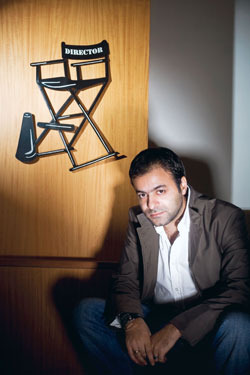
Photograph by Ritam Banerjee

After assisting with six films, and 10 years in the industry, Tarun Mansukhani debuts as a director with Dostana, releasing next month under the Dharma Productions banner. Sitanshi Talati-Parikh finds him full of steely determination, anticipation and solid allegiance to his mentor, Karan Johar

Director

The sharp, dapper man, just a shade over 30, seems more suited to the corporate world than Bollywood. With crispness of speech and meticulous attention to time, Tarun Mansukhani appears like a tightly wound elastic band – afraid to let go. It makes me ask him a number of times if he is nervous about his big release. “I haven’t thought about it, because I would’ve crumbled under that pressure. It is easier to think of it as just another film.”

Experience has made Mansukhani smarter. He quips, “I tell all my assistant directors that they can’t lie to me – I know all the tricks of the trade, I’ve played them all with Karan!” Waxing eloquent on a superb equation he shares with Karan Johar, the debut director paints a rosy picture. “Karan is the only producer in the world, who when you are hitting a deadline, tells you to relax and take your time. When you go over budget, he asks if it is justified, and if so, says, ‘No problem!’ It makes me want to ask him, ‘Are you sure?’”

Dostana, a romantic love triangle, starring Abhishek Bachchan, John Abraham and Priyanka Chopra, has been shot in Miami. During the shoot, Mansukhani recounts, Johar came to Miami for two weeks, and finally announced, ‘Look, I am really unemployed – I come, I shop and I eat. So I am going back to Mumbai to do more constructive work.’ And he left, not returning until the end of the film. The creative freedom, faith and trust provided by Johar, leaves the former singing praises of a perfect boss and perfect job. And yet, says Mansukhani, “I do not try to stay within Karan’s auteur. In fact, my deliberate decision is to combat what I have learnt – to break the school that we have developed for ourselves.”

While working on the story he has made a conscious effort to use everyday language, even if it is pedestrian language or Hinglish. While the film is youth-centric, it is not just the youth they want to appeal to. “There is an emotion that appeals to all age groups. It is not in its film-making or in its technicality or dialogues. We all have friends, our parents have had friends and our kids have friends. It may not be the dialogue that they might have spoken, or the language; but what is important is that they remember those friendships.”

Dostana is predominantly about the bond of friendship. Mansukhani, who studied in a boarding school, experienced deep friendships, giving him the idea for his first film. He brought in the premise of two men pretending to be gay to stay in an apartment, to make the story interesting. “It was a very conscious effort to not make fun of the gay community. You are not ribbing jokes about them or using them as a ploy.” A mother, who very subtly and with humour shows her acceptance of their sexual preference, adds a progressive element. So, another masala film with a social message? “We can all make art films at the end of the day, but there is a certain reach. Today this is what I would like to make. In the future, I may want to make an extremely gritty film, like Black Friday for instance.”

Talking about friendships, Johar and Mansukhani go back a long way. Johar went to school with Mansukhani’s sister, and when he was looking for an assistant for Kuch Kuch Hota Hai, he thought of him, who at the time was assisting television producer Anand Mahendroo. Mansukhani was not certain he wanted to be a part of commercial cinema – “I was just a Breach Candy boy who didn’t understand Shah Rukh and Kajol. Dilwale Dulhaniyan Le Jayenge was just another film for me.” When he took the FTII exam, confronted by questions on the direction of Swami Vivekanda Part II, he decided to work for Johar instead. The rest is history. The young director sees the future as very promising – making more films for Dharma, and eventually becoming a producer, financed by Dharma. “I don’t see myself breaking away from this family in any form. It is the only family I have known.”

Contrary to expectations, Mansukhani is not a die-hard cinema fan. Having studiously managed to avoid the classics, despite Johar’s repeated suggestions, he remarks unselfconsciously, “I stand clueless at a party when someone talks of classics like Guru Dutt and Satyajit Ray, and glibly put in my two bits, without knowing what they are talking about!” He prefers Sholay, Gadar or the more recent – admittedly candyfloss – films like Dilwale Dulhaniyan Le Jayenge and Kuch Kuch Hota Hai. Quick to laugh at himself, he confides, “The only reason I go to the cinema is because my wife wants to watch a film. While I critique every other film aloud, I am silently taking notes – though no one knows that!”

The resilient director doesn’t give himself even a moment to take a break. Starting work soon with Johar on My Name Is Khan, due for release next year, he is matter of fact about his breakneck schedule. “We are addicted to films – we are not good at anything else. This is our only world.”

And juggling that attitude with a family life? He is quick to compliment his spouse – with whom he has been in a relationship for 12 years and married for three – on being the most understanding person in the world, especially after admitting he hasn’t been to family dinners, and hasn’t met most of her family! He even missed his sister’s wedding when he was busy with a shoot. “I hope that these sacrifices made will accomplish something – at the end of the day, these opportunities may not come to me later. This is what I need to do to make life happen.”

|  Filling the gaps between words.  |

Writing By Category

  • Art, Literature & Culture
  • Brand Builidng
  • Brand Watch
  • Fashion & Style
  • Features & Trends
  • Fiction
  • Food
  • Humour
  • In The Media
  • Interviews (All)
  • Interviews: Business
  • Interviews: Cinema
  • Interviews: Cover Stories
  • Interviews: Lifestyle
  • Interviews: Luxury Brands
  • Interviews: The Arts
  • Interviews: Travel
  • Musings
  • Parenting
  • Publication: Conde Nast
  • Publication: Elle
  • Publication: Mint Lounge
  • Publication: Mother's World
  • Publication: Taj Magazine
  • Publication: The Swaddle
  • Publication: The Voice of Fashion
  • Publication: Verve Magazine
  • Social Chronicles
  • Sustainability
  • Travel Stories

Reach out:
sitanshi.t.parikh@gmail.com

© Sitanshi Talati-Parikh 2018.
All Rights Reserved.

Website Powered by WordPress.com.

  • Subscribe Subscribed
    • sitanshi talati-parikh
    • Join 51 other subscribers
    • Already have a WordPress.com account? Log in now.
    • sitanshi talati-parikh
    • Subscribe Subscribed
    • Sign up
    • Log in
    • Report this content
    • View site in Reader
    • Manage subscriptions
    • Collapse this bar