• About
  • Brand Building
  • Film & Drama
  • Writing: Arts & Lifestyle
  • Writing: Interviews
  • Writing: Luxury Brands
  • Writing: Travel

sitanshi talati-parikh

sitanshi talati-parikh

Tag Archives: Nicobar

Who Stole The Dupatta?

31 Wednesday Oct 2018

Posted by sitanshi talati-parikh in Fashion & Style, Publication: The Voice of Fashion, Sustainability

≈ Leave a comment

Tags

Crafts Revival Trust - Ritu Sethi, Dupatta, Fashion, Good Earth, Nicobar, Payal Khandwala, Sustainability, Sustainable Fashion

Published: The Voice of Fashion, October 31, 2018.

Is the dupatta today relegated to being an emblem of archaic femininity and an ornamental accessory?

The dupatta, an iconic part of the Indian fashion lexicon, has lost its original raison d’être and has seen a transformation in urban India, to become a modern fashion accessory. The soft fabric worn flowing over the shoulders may have been often picturised romantically, as billowing gently—and occasionally coyly—in the breeze, but is, in reality, an exaggerated symbol of captive femininity and more importantly, female modesty. An integral part of the fabric of Indian society, conventionally, it forms a ‘ghoonghat’ or veil as a mark of respect in front of elders and at a place of worship, or protection from the unwanted male gaze.

The Creative Destruction

Connected to traditional garments of the Indian subcontinent like the lehenga-choli and the salwar kameez, the origin of the dupatta has been traced to the Indus Valley civilization. As the garment celebrates local embroidery and craftsmanship, for someone working in the handloom industry, the evolution of the dupatta is worrisome. Ritu Sethi, chairperson of the Crafts Revival Trust, addresses the change: “I delight in the fact that the original function of covering one’s head and bosom is no longer required, yet paradoxically, as a purist, I moan its passing.” She explains, “The lighter, airier weave of a dupatta is different from the rest of the suit length—reflecting in the elegance of its fall and drape, and its border and two-sided pallus. The yarn is produced specifically for the dupatta. What are the weavers shifting to if the demand wanes? Not to mention, a textile directory is vanishing before our eyes—a classic example of creative destruction.”
Screen Shot 2018-11-13 at 4.58.59 PM

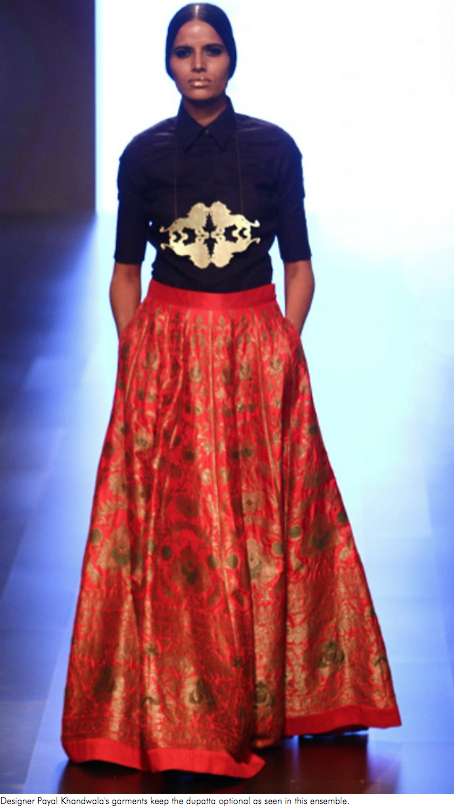
Designer Payal Khandwala may not see it as a dead end though. “With the printed dupatta in synthetic fabrics replacing its hand-woven counterpart, the weaving community was already struggling. With more attention to hand-woven textiles and slow fashion in general—whether it is for scarves, garments or even home furnishings—we can certainly compensate for this shift and the subsequent loss of revenue from the traditional dupatta.”

And yet, Deepshikha Khanna, head of apparel at Good Earth Sustain shares that the traditional dupatta forms their highest selling category. She says, “Its use has definitely not dwindled. For as long as we continue to wear our traditional clothes the existence of the dupatta will remain relevant.” Tina Tahliani-Parikh, executive director of multi-brand boutique Ensemble, finds the dupatta remains an intrinsic part of the Indian outfit. She says, “It is a very feminine element, so I don’t see it getting replaced. Younger girls may wear a lehenga choli without the dupatta, but with the older, more mature customers, there is no question of the dupatta not being there. A Mughal-style Anarkali would be incomplete without the dupatta.

The Transformation

Khandwala, whose garments keep the dupatta optional, stresses on expressing individuality versus conforming. “The difference is we have the choice now to wear the dupatta simply for the romance of it or for its drama, rather than as a symbol of modesty.” She finds that the change may have taken place for multiple reasons—including the need to push boundaries creatively, to make the fashion landscape less homogenous, attention to comfort and practicality and a need to redefine what is handed down in the name of tradition.

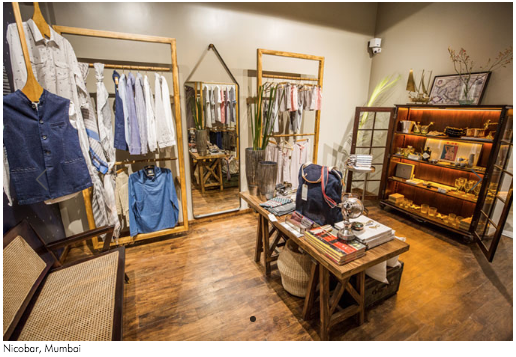
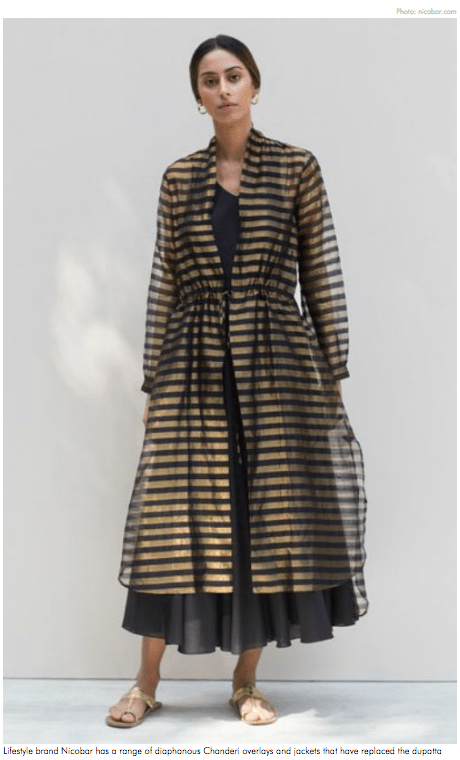
The dupatta has most definitely evolved—from two-and-a-half to two-metre variants that flow on both shoulders; to the shorter stole which falls on one shoulder only, and to an even shorter square scarf that may be worn on the neck, on the head as a bandana, or tied to a handbag as a visual accessory. Lifestyle brand Nicobar, that looks to establish a modern Indian voice, has a range of diaphanous Chanderi overlays and jackets that alternatively dress up or bring traditional texture to a Western outfit. It may not be wrong to assume that in this case, the dupatta has been entirely eliminated and replaced by an overlay.
Screen Shot 2018-11-13 at 4.59.08 PM

Khanna points out that as style evolves so does the use of clothing. “A kurta which was once conservative is now worn over a swimsuit to a beach. Similarly, a dupatta, which is very versatile, is now a scarf, a sarong or a halter top. Globally, traditional weaves like Ikat or Mughal motifs are seen on dupattas that have been adopted as scarves and have become a part of Western ensembles. It is an iteration of the dupatta seen in a different context. While its early reasons for existence needed an update as the women wearing it have evolved, one finds that Indian women continue to stay attached to their traditions but adapt them to suit a more global lifestyle.”

Clothing, in the manner of art and music, reflects socio-cultural changes—which is marked in how we choose to present ourselves with the new-found freedom to express. In that sense, the dupatta’s transformation is a sign of the times, where women are no longer required to be ‘modest’. And as for its evolution, as Khandwala puts it, “To simply repackage old ideas makes fashion stagnant and predictable. It is just as important to suggest alternatives that define the future.” And the dupatta today remains, free-flowing, open to interpretation and boundless in its versatility as it floats away from patriarchal tradition.
Fashion Retail: Does Sustainability Matter?

18 Thursday Oct 2018

Posted by sitanshi talati-parikh in Fashion & Style, Publication: The Voice of Fashion, Sustainability

≈ Leave a comment

Tags

Bungalow Eight, Ensemble, Fashion Retailers, Nicobar, Paper Boat Collective, Sustainability, Sustainable Fashion, Toile

Published: The Voice of Fashion, October 18, 2018

Is sustainable retail an oxymoron? We speak to five retailers to see how they weigh in.

Screen Shot 2018-10-19 at 6.37.03 PM
As the buzz around sustainable fashion grows, how many conversations involve that of the retailer? One of the key elements of the sustainable fashion conversation is to reduce the economy of excess and to encourage people to buy less. And therein lies the dichotomy—can a person who is necessarily driven by the bottom line, be motivated to make these choices?

Finding a Sustainable Retailer

And therefore, can there be a sustainable retailer or is it an oxymoron? Maithili Ahluwalia, founder of multi-brand fashion boutique in Mumbai, Bungalow Eight, points out that the day you are a retailer, your model is built around unsustainability because your basic premise is to sell as much as you can—whether it is season-less or handloom products. She says, “It is hard to say that you are sustainable unless you control the entire process from yarn to finished product. You could claim consciousness or partial sustainability but perhaps, ‘selling sustainable luxury’ is only valid when you have an in-built anti-consumerist ethic, control the entire supply chain and plough back resources into the ecosystem in a circular economy.”

Screen Shot 2018-10-19 at 6.36.31 PM

Bhagyashree Patwardhan, founder and creative director of slow-fashion boutique, Paper Boat Collective, Goa, which veers towards ‘natural’ over ‘sustainable’, believes that “sustainability’ and ‘organic’ are big words and as much as one tries, a hundred percent adherence to it as a retailer is difficult.”

Is there a point then to the dialogue on retail and sustainability? Simran Lal, co-founder of pan-India lifestyle brand Nicobar (and CEO of Good Earth), says, “We don’t claim to be sustainable because it is open to interpretation and there are so many parameters to it. We believe we are a conscious and mindful brand vis-a-vis a sustainable brand. We care about what, how and why we do things and are constantly reflecting on our actions.” And what about an anti-consumerist ethic? Lal says, “Although it does seem like a contradiction, at Nicobar, we have always wanted to encourage thoughtful consumption. Buy less, pay the right amount for the product so that the entire value chain is well taken care of—and thus the quality is superior, waste is less and that is, in my opinion, a conscious way of creating, retailing and consuming.”

Steps Taken

What is it that a conscious retailer can do? Pick the right kind of goods to stock, for one. Patwardhan states that Paper Boat Collective offers handmade products in natural materials, working with small designers, suppliers and manufacturers, who in turn work with smaller craftspeople or use resources that are sustainable. “This allows us a way to build a backend integrated towards sustainable and fair-trade practices.”

This slideshow requires JavaScript.

Tina Tahiliani-Parikh, executive director, multi-brand boutique, Ensemble (Mumbai and Delhi) drives initiatives that are embedded in craft—“It is very important that we keep our craft and handloom movements alive in this country. We should not go the way of Japan, where the Kimono is relegated to a ceremonial garment. Ensemble is an active supporter of the handloom sari; and we, right from the start, support a lot of young designers whose raison d’etre is sustainable fashion.”

Toile, Paper Boat Collective and Nicobar have taken it a step further into elements like decor, packaging and materials, respectively. Farheen B Rahman, co-founder of eco-fashion store, Toile (Mumbai), says they use coir for their walls and have upcycled an old Singer machine as their billing counter; while Patwardhan uses recyclable packaging materials, less paper, natural cleaning products, hardly any plastic and also aims to be zero-waste.

Screen Shot 2018-10-19 at 6.36.08 PM
At Nicobar, Lal lists initiatives like offering timeless garments in organic cotton, going plastic-bottle free, reusing packing cartons multiple times and paperless invoicing. She says, “Through our collaborative cafe, NicoCaara, we have created a menu with fresh, chemical-free produce grown at the farm of our partners, Caara, or by supporting local artisanal suppliers who in turn, believe in practising and supporting sustainable businesses.”

The Challenges

Perhaps the strongest hit a committed retailer may take is on the bottom line. Rahman admits that the turnover is very different compared to fast fashion. She says, “It is a slow process. We have refused designers who differed in ideology even though their designs were good and saleable, and those who projected themselves as sustainable but were not.”

Lal is struggling with finding sustainable packaging materials that are “affordable and consistent for delicate and fragile products to be shipped.” She says, “We are currently experimenting with different types, and are willing to take a hit on our margins to make packaging more sustainable.”

Screen Shot 2018-10-19 at 6.36.19 PM

Parikh states that there has been only a marginal increase in consumer awareness towards sustainable fashion. She says, “It is a conversation. A first-time shopper may not buy into the sustainable philosophy immediately. But once they acquire a couple of garments and experience the longevity of the garment, or they are in the ecosystem, they begin to change their minds. It is a very gradual process.”

Creativity and Effort

A little creative effort goes a long way. Celebrating season-less attire, limited production with a curated and thoughtful supply chain, use of non-toxic and biodegradable materials, elimination of waste and being conscious of the carbon footprint. Maybe an upcycling or recycling station at the retail front.

Yvon Chouinard, founder of the American apparel and outdoor gear label Patagonia, reminds his customers in New-York-based publication, The Usual: “Think twice before you buy a product from us. Do you really need it or are you just bored and want to buy something?”

As is the case with a sustainable supply chain, this requires a willingness on the part of the retailer to buy into the philosophy, the knowledge that this is critical to our future and the acceptance that there will be, at least initially, a monetary fallback. And if the consumer isn’t demanding it, perhaps the onus lies on the retailer to open up a fresh dialogue to create a conscious consumer and a responsive demand.

Where Fashion Gets Square: Instagram’s Big Impact On Fashion

22 Saturday Sep 2018

Posted by sitanshi talati-parikh in Fashion & Style, Publication: Mint Lounge

≈ Leave a comment

Tags

Border & Fall, Fashion, Fashion Nova, Instagram, Mint Lounge, Nicobar, Sabyasachi Mukherjee, Shivan & Narresh, Tommy Hilfiger

Published: Mint Lounge, September 22 edition

When jewellery designer Kaabia Grewal hosted a Grecian bachelorette trip in Mykonos in July, she posted pictures of guests wearing custom-made Shivan & Narresh ensembles on Instagram (the designers themselves were on the guest list). Perhaps actor Sonam Kapoor’s May wedding—with #sonamkishaadi grabbing 68,800 posts—filled with decadent couture designs had set the tone.

Screen Shot 2018-09-22 at 2.11.08 PMAn Instagram campaign by Shivan & Narresh for their ‘Eden Noir’ collection

Instagram, launched in 2010 and acquired by Facebook Inc. for $1 billion (around ₹7,250 crore today) in 2012, is one of the world’s most popular social media apps. During a panel discussion titled Fashion On Instagram held in Delhi in July, Sandeep Bhushan, director, Facebook (India and South Asia), said, “Fashion is the third-most followed category by young people globally on Instagram, behind music and entertainment.” With a worldwide community of over one billion users, and 25 million businesses, the photo- and video-sharing app has changed the way we live, interact and shop. What is its digital charisma and can brands get famous by just getting on the bandwagon?

A level playing field
An audience ready to scroll and shop has created unprecedented opportunities for businesses. While the internet strips shopping of the touch-and-feel experience, Instagram’s ability to create evocative stories and user-generated-and-curated reportage of runway shows, collection and campaign previews and behind-the-scenes stories, infuses the fashion industry with a new dynamism.

Today, most Indian fashion brands use the platform proactively, while Kolkata-based couturier Sabyasachi Mukherjee has been an Instagram trailblazer since 2015. His eponymous brand has seven Instagram accounts, including a core account (started in 2015 with 2.6 million followers), city-specific accounts and one dedicated to “Brides of Sabyasachi”. The designer’s Firdaus line debuted on Instagram in 2016 and his jewellery line followed suit in 2017. “A couture show is not meant to be a democratic release. But I wanted to flip the concept—do it in a way that it goes to every single household,” says the designer. “Gone are the days when you could build luxury with the concept of distance. Today, it has to be more inclusive.”

Screen Shot 2018-09-22 at 2.10.21 PMA screengrab from Sabyasachi Mukherjee’s official Instagram account

Raul Rai, co-founder of lifestyle brand Nicobar, believes their audience has been built largely on Instagram—50% of their customers discovered the brand via social media. Its reach also means that geography doesn’t restrict shopping. Shivan Bhatiya and Narresh Kukreja have tapped markets like South Africa, Singapore, Jakarta and West Asia, courtesy their eponymous brand’s Instagram account.

Indie brands too capitalize on the platform. Carol’s Shop & Tea Room, selling vintage clothing and collectibles from Nagaland, has worked purely off Instagram from the start, taking orders directly through the portal. “The interaction with the customer is more on a personal level,” says model Carol Humtsoe, who founded the e-shop in 2016 (she is now putting together a small brick-and-mortar shop in Dimapur).

Screen Shot 2018-09-22 at 2.11.24 PMAn Instagram post from Carol’s Shop & Tea Room

From grid to gallery
The 3×1 grid on Instagram (the display format on user profiles) has become a dazzling visual playground for brands. When formulating campaigns, a sizeable amount of planning is dedicated to Instagram and brands are upping their content strategy to establish a distinct voice that, they assume, will eventually lead to sales. Arjun Sawhney, managing director of communications agency TCCGGD, believes Instagram creates communities and enables a strong point of view. “Social media helps create brand awareness, in the right tone, and garner an audience, but it is not necessarily a driver of sales,” he says. “A focused, relevant audience with the economic potential to engage is critical to a brand on social media. It is not just your content game; it is the stories you are pushing.”

During the New York Fashion Week Fall/Winter 2016, the Tommy Hilfiger show witnessed the “InstaPit”, an influencer-only section with claims to maximum visibility—#TommyFall16 and #TommyHilfiger reached 137,170,550 people on Instagram (according to marketing company Pixlee).

Screen Shot 2018-09-22 at 2.07.44 PM

More recently, American fast-fashion brand, Fashion Nova, has been in the news with 13.2 million Instagram followers. The brand’s customers have generated volumes of content, including selfies with #NovaBabes, driving sales via micro-influencers and celebrity endorsements.

While worldwide influencers make or break businesses, in India, the trend remains nascent. Malika Verma Kashyap, founder of digital agency and online publication Border&Fall, says, “It is filled with many smaller players who are engaging brands, but the level of ‘influence’ is negligible whether it be a stylist, designer, blogger or other. Bollywood remains the strongest influencer, and Sonam Kapoor reigns supreme with fashion brands.”

The evolution is rapidly underway, even if it hasn’t matured. “There is a shift in focus from bloggers with maximum follower count to creators of organic and original content with a targeted and niche followership, which, in turn, has given rise to a newer generation of thought leaders,” say designers Bhatiya and Kukreja.

For many brands, the platform is weighed down by the price of influencer marketing and Instagram’s reshuffled programming. What may have started as a democratic approach is now curated by algorithms that control the reach of posts. Meanwhile, consumers are also likely to get pickier about purchase triggers, gravitating towards authenticity and quality (over quantity) of posts. Rai keeps editorial and marketing teams separate to ensure an independent voice for Nicobar; while Mukherjee says: “I like to keep the voice intimate. Instagram allows you to connect directly with your consumer without a filter. The good, the bad and the ugly—it is all out there in honest, transparent communications.”

A digital economy of excess
A Hootsuite Instagram stats-list suggests that 60% people discover products through Instagram, and 70% are likely to make a purchase on their mobiles. Earlier this year, Instagram expanded its shoppable posts’ feature to eight countries and enabled electronic payments for some companies. Now, Instagram is reportedly developing a stand-alone shopping application that may be called “IG Shopping”.

But the sense of immediacy combined with the need to own can drive impulsive purchases. Among the selfie-clicking generation, can an Instagrammer be “seen” in the same garment again?

Buyers swipe their cards on both sides of the fence: those who swear by online shopping and others who continue to prefer the traditional touch-and-feel purchases. New York-based brand strategy professional Tarana Mehta, who goes online for most of her purchases, sees Instagram as a “discovery platform”, finding new brands via influencers or ads. She has, like many others, bought into “the convenience of shifting the dressing room to the bedroom”. Kashyap, on the other hand, chooses not to shop on Instagram to avoid the “re-targeting algorithm” (an online code tracking customers to display ads relevant to their search habits).

Yet the platform’s ability to build a strong voice expands to those balancing the scales as well. Organizations like Fashion Revolution and Global Fashion Exchange are using the platform to start a global dialogue on fashion and enable consumer awareness. As consumers drive trends, a platform like Instagram, when not diluted with aggressive advertising and clickbait, can facilitate meaningful dialogues on fashion.

|  Filling the gaps between words.  |

Writing By Category

  • Art, Literature & Culture
  • Brand Builidng
  • Brand Watch
  • Fashion & Style
  • Features & Trends
  • Fiction
  • Food
  • Humour
  • In The Media
  • Interviews (All)
  • Interviews: Business
  • Interviews: Cinema
  • Interviews: Cover Stories
  • Interviews: Lifestyle
  • Interviews: Luxury Brands
  • Interviews: The Arts
  • Interviews: Travel
  • Musings
  • Parenting
  • Publication: Conde Nast
  • Publication: Elle
  • Publication: Mint Lounge
  • Publication: Mother's World
  • Publication: Taj Magazine
  • Publication: The Swaddle
  • Publication: The Voice of Fashion
  • Publication: Verve Magazine
  • Social Chronicles
  • Sustainability
  • Travel Stories

Reach out:
sitanshi.t.parikh@gmail.com

© Sitanshi Talati-Parikh 2018.
All Rights Reserved.

Website Powered by WordPress.com.

  • Subscribe Subscribed
    • sitanshi talati-parikh
    • Join 51 other subscribers
    • Already have a WordPress.com account? Log in now.
    • sitanshi talati-parikh
    • Subscribe Subscribed
    • Sign up
    • Log in
    • Report this content
    • View site in Reader
    • Manage subscriptions
    • Collapse this bar
 

Loading Comments...