• About
  • Brand Building
  • Film & Drama
  • Writing: Arts & Lifestyle
  • Writing: Interviews
  • Writing: Luxury Brands
  • Writing: Travel

sitanshi talati-parikh

sitanshi talati-parikh

Category Archives: Art, Literature & Culture

Imtiaz Ali: Happily Never After

20 Saturday Feb 2010

Posted by sitanshi talati-parikh in Art, Literature & Culture, Interviews (All), Interviews: Cinema, Publication: Verve Magazine

≈ Leave a comment

Tags

Aditya Kashyap, Deepika Padukone, Geet, imtiazali, Indian Fiction, indiancinema, jabwemet, kareenakapoor, Love Aaaj Kal, Meera, Saif Ali Khan, Scriptwriting, Shahid Kapoor, vervemagazine

Published: Verve Magazine, Verve Men, February 2010

Photograph: Colston Julian; Illustration: Bappa

Imtiaz01

Director and scriptwriter of popular romantic dramas Jab We Met and Love Aaj Kal, Imtiaz Ali, does not know whether happily-ever-after exists, “since the world is designed for relationship disasters. When people decide to get together, it is not a cerebral decision or a love formula, it’s an instinctive one. The one that got away occupies a person more, and anyone who is accessible becomes ordinary. No relationship can satisfy all the needs of a person. There is a reason why love stories end when they do”. In all his movies, the director believes that if we had the opportunity of seeing what were to happen a few years down the line to his characters, post the kiss-and-make-up; we would not be guaranteed a happy ending. So in a piece of wicked cross-scripting with Sitanshi Talati-Parikh, he plots a volatile fictional love story concocted with the unrelated characters of his two films, to see what would happen if Kareena Kapoor and Saif Ali Khan’s characters, Geet (Jab We Met) and Jai (Love Aaj Kal), actually met!

Imtiaz02The Setting

Ten years after Jab We Met (about eight years after Love Aaj Kal). Geet is married to Aditya Kashyap and they have two children. Jai and Meera are also married. There is a crisis of the “end of excitement”.

The Characters
GEET, the essential free spirit, chafes under the boring normalcy of her life. She finds that Aditya Kashyap has changed – or maybe this is who he is – an industrialist who has a lot on his plate. He can’t take off anytime he chooses; having children has also changed the equation. While they balance each other out, she is haunted by the fact that now she doesn’t have a place to reach; without a destination, there is no journey. She is deeply disillusioned by the fact that she has no train to catch, nowhere to run off to with wild abandon and therefore no major thrill that keeps her going. There is a vacuum inside her, working its way towards a silent depression. Something sparks off a renaissance….

ADITYA doesn’t like the fact that his wife, Geet, talks to everyone with unnatural friendliness. This is a part of who she is, and he can’t change that, but it bothers him. He tries to bring a semblance of order in her life, but she constantly resists it. While she needs this stability to balance her out, she tends to react violently to it. Work keeps him so preoccupied that he finds he has less time and patience to pander to her impulsive needs.

JAI always believed in the concept of a live-in relationship as opposed to marriage. His love for Meera keeps him going, but the inability to walk out at any time, to experiment, to go with the flow, or change direction if he so desires, makes him feel shackled. The pressures of life are building up and he’s just looking for an escape route.

MEERA can’t seem to understand what is bothering Jai. She keeps reminding herself that this marriage is what he wanted – he had come looking for her. The fact that he may not be happy worries her, but she doesn’t know what she can do to fix it. She decides to wait and watch for an opportunity when things can go back to normal.

The Situation
Day 1
Geet is driving, with a lot of pent-up rage, to pick up her kids from school. She is manoeuvring the Mumbai traffic, amid construction, while simultaneously on the phone trying to negotiate keeping her maid who suddenly wants to quit. She has woken up early to make aloo parathas for Aditya. Her frustration has been building up for a while but she just doesn’t have the nerve to tell Aditya, “I can’t do this anymore, this is not me!” Suddenly as she is distracted, her car slams into an island, and shudders to a stop. She fumbles, trying to start it while continuing to talk on the phone. The traffic piles up behind her; loud curses can be heard in the background, accompanied by a lot of disgusted gestures.

A car slides into position next to her, a window rolls down and a disgruntled man (Jai) looks at her, saying, “There is a reason why women shouldn’t drive. Why don’t you do something that suits you more…like look after your home, and leave driving to men?” That chauvinistic statement gets Geet completely riled up – the years of dissatisfaction and disillusionment with marriage are simmering under the surface waiting to explode. She gets out of the car to scream at him. Jai has already driven past, the window is up – with the noise of the traffic and his music in the car, he can’t hear her. She can be seen in his rear-view mirror getting smaller and smaller.

She gets back into the car, manages to start it, slams the door and drives after Jai furiously. He enters a tall office building, and the elevator door is about to close behind him, when she wedges a foot into the door. She starts yelling at him, abusing him, trying to get the pent up fury out of her system. She follows him into his office, still yelling about the woes of her life – domesticity, the children, a husband who’s forgotten how to live life. The entire office is looking at them. Suddenly, realising where she is, she flushes a deep red, turns around and leaves. Jai’s visibly shaken; he doesn’t know what hit him. He needs to make a pitch before a very important client, and he can’t perform because he’s so nervous. Stammering and suddenly not his usual confident self, he doesn’t paint a convincing picture. He loses the account…and is completely shattered.

Day 2
Driving to work the next day (at approximately the same time he’d met Geet the day before), Jai, feeling really miserable, suddenly notices her waiting in her car for her children. He immediately swerves to a stop, running over to her to give her a piece of his own mind. His problems are mounting: EMIs, a wife who’s threatening to leave him, the competition…. He ends his tirade with, “Maybe I have a wife who’s a bigger bitch than you are.”

[This is the excitement they are both missing in their lives. An escape from their own problems. Both Geet and Jai are people who would want to breathe more air, do more and say more than their partners.]

The next time they see each other, it’s like they’ve known each other for a long time…. Their vivaciousness and outgoing personalities leave no awkwardness between them. She needs to go back home to Aditya, but Jai suggests an excuse that works well on husbands, she thinks for a moment and gives into the thrill of a new experience, continuing their conversation over another cup of coffee.

Next Week
Jai has an anniversary coming up and Geet needs to shop for Aditya’s birthday. They decide it’s an excuse good enough as any to shop together. Jai confesses that his wife has hated all the gifts he’s bought her in the past, that she’s a very sensitive kind of woman. “She would be happy if she thought that I thought about the gift!” Geet thinks it would be fun to help out, while Jai can help her choose something for her “fuddy-duddy boring industrialist-type of husband”.

And then…
They continue to meet; putting in the effort to look better, in response to the passion and electricity the air. They connect at various levels – they find their childish pursuits a great diversion, which their spouses would not. They gravitate towards each other. Neither wants to commit, but they believe that they have found their soulmate in each other. They are too volatile to actually be able to have a fulfilling, stable relationship together – and they know that. They are both people who are constantly in conflict, it is difficult for them to reach resolve – but they thrive in the conflict.

The Spouses
ADITYA, when he sees the change in Geet, senses that something is not right. He begins to look back at their life and see what’s missing, what is eating away into the Geet he fell in love with. He never confronts her or makes her uncomfortable, but makes an effort to be more attentive. Geet, for her part, can tell that he knows or is aware that something has changed. She finds its oddly disconcerting that he continues to be there for her – often suggesting doing things that she loves, which makes her feel guilty and confused about her feelings. She wants to come out and talk to him about it, but something holds her back – the fear of hurting him. She wishes he would react with anger or violence – not this silent niceness. It makes her feel like a bitch. In the middle of the night, having no one else to talk to, she frequently calls up Jai.

MEERA instinctively knows when Jai is unhappy or is not being faithful, especially with the increasing calls late into the night coming from Geet. Meera’s way of dealing with it is very matter-of-fact. She invites Jai out to his favourite restaurant, dresses up in his favourite outfit; and in the middle of the wine and meal, asks him directly, “Jai, I think you’re seeing somebody…just tell me about it.” Jai looks taken-aback and then decides to come clean. He talks about Geet – a girl whom he has been hanging out with, but insists that there isn’t anything serious between them. “I didn’t tell you because you’d be upset…but I can see I’ve upset you anyway. I’m sorry. But if you say the word, I won’t see her again.” Meera looks at him for a minute and says, “If I ask you not to see her, then I’m making her your lover, so do what you want.”

The End
It appears to be a doomed love story of two people who can’t get rid of each other. Geet and Jai are the kind of people who consume each other – a relationship that scales the heights and plummets to the depths, making it a nervy ride. They make each other more insecure and it leads them to miss the stability provided by their spouses.

Jai meets Geet to tell her that they should stop seeing each other. Geet reacts explosively – talking about how much they are actually made for each other, and how they are not being unfaithful at all. They deliberate breaking up often. Eventually, in the midst of an emotional scene, Geet perks up with a suggestion – if they must end it, then why not with a bang – something that matches their personality? And she reminds him about the trip they had spoken about taking together…

Art and Conversation

27 Friday Nov 2009

Posted by sitanshi talati-parikh in Art, Literature & Culture, Interviews (All), Interviews: The Arts, Publication: Verve Magazine

≈ Leave a comment

Tags

Art and Design, Charles Saatchi, International Art, Interview, Kay Saatchi, vervemagazine

Published: Verve Magazine, Features, November 2009

Photograph: Ritam Banerjee

Former wife of advertising magnate and art collector Charles Saatchi, Kay Saatchi has been following the path to international curating. At the Art Expo in Mumbai, she talks to Sitanshi Talati-Parikh about watching Damien Hirst as a student, living with unliveable art, and being Kay Hartenstein Saatchi


Satchi

In the maze of people at Nehru Centre, it took a while for us to find each other. Once I did, it took but a moment for me to realise the lady embodies resilience and vulnerability. There has been much said and a lot more not said about Kay Hartenstein – former wife of the reclusive art collector and advertising magnate Charles Saatchi, who after their divorce in 2001, married celebrity chef Nigella Lawson.


American-born Kay had moved to London to start an art gallery of her own, but not long after ended up curating around 30 shows in eleven years at Saatchi gallery (and a dozen more after) while being Mrs. Charles Saatchi. All through she concentrated on “mothering” young artists. “I like watching them develop their career along the way. I’m not really in it for financial reasons, but you can’t help but feel clever when you buy an artist when they are terribly young and discover that you have made a good investment 20 years later.” She met the now internationally-renowned English artist Damien Hirst when he about 19, an art student going around the degree shows. “I saw his very first show…when I was married to Charles Saatchi, we gave him big shows – I’ve known him always and forever.”


How does she pick up on who will be the next big art sensation? “After all these years of going around shows, your gut instinct becomes the strongest factor. Artists have to have skill, and conviction about what they are doing. I spend a lot of time talking to them about why they want to be an artist and what they’re trying to say with their art.”


The 56-year-old Southern belle with a clipped British accent maintains her interest in art began when she was a baby. “I am quite creative as a person – I paint and draw and take photographs. Every Saturday I would wander into art galleries – it’s always been a part of my life. The process was that we (Charles and I) would go see everything. We would travel to Zurich, New York…that was the fun bit, I loved that. I have behind me 25 years of learning – meeting and talking to dealers, collectors. If I see a work of art in a degree show, I will immediately know if it connects up to something I’ve seen before. Artists tend to copy other artists – they tend to be greatly influenced by the work they admire…until they find their own voice. I can sift through that.”


She has seen all kinds of art – beautiful, outlandish and even macabre. Can she live with the things she buys? “I do! But also, I have had the incredible privilege of having a gallery with my ex, where we can exhibit things that would be of too big a scale or too demanding to have at home. I have had some wild things at our house (think Damien Hirst). It changed for me when I had a child in 1994 and I thought, ‘I don’t want this little toddler growing up and looking at rather shocking art.’”


If people are going to think twice about housing a work of art, what purpose does it serve? There is an idealistic spark in her eyes as she warms up to the topic. “It’s the creative process,” she emphasises. “Whether or not it sells! It’s good for the artist if it does, so they have the money to pay the rent and keep making more art. Some people like living with very shocking art…art is less about shocking now than it once was. Lately there is a trend towards beautiful craftsmanship and beautiful sculpting. In the English art world people wanted attention and publicity and that worked very well. There would be huge headlines about artist Tracy Emin’s ‘unmade bed’ (from the series My Bed) and that’s good up to a point. It’s not what the real meaning should be.”


As she winces at the state of her hair in the local post-monsoon humidity, she confesses that she is very partial to India. “Art is born out of the culture and this is a culture that I am very interested in. Some of the Indian artists are fantastic – I love Anju and Atul Dodiya’s work.” She pauses and as an afterthought adds, “The Indian art market has developed very quickly – it has had to slow down like the rest of the world because of the economy, and that is probably not a bad thing. A little correction and not everyone thinking they can start a gallery without doing their homework!”


“It’s okay not being a part of the Saatchi gallery anymore. At the end of the day, speaking about owning things, they are just things. I buy art all the time. I don’t want to have a gallery again – neither commercial nor private. I buy small things, emerging artists, things I can house. I try to get my other friends that are collectors to buy what I love! What I liked about doing things at the gallery was getting to know the artists, handling the shows, introducing art. When we started doing this, there wasn’t too much contemporary art being shown in London. It was just the excitement of it all and the memory of that which keeps me going. I like to look forward, not backward.”


I delicately broach the topic of the love of art bringing two people together and then suddenly realising that the love for art is all that’s left. That, and a teenage daughter (Phoebe) she talks fondly about. She seems perturbed by all the “rubbish about her past life” that has perpetuated on the Internet. While she considered going back to her maiden name after her divorce, she found that people remembered her as Kay Saatchi – “besides, it helps to get a table reservation!” she quips. On a more serious note, “I hope I am defined by my efforts in the art world and not by my name.”

TV’s Dressing Down

18 Wednesday Nov 2009

Posted by sitanshi talati-parikh in Art, Literature & Culture, Features & Trends, Publication: Verve Magazine

≈ Leave a comment

Tags

Fashion, Friends, Gossip Girl, Sex And The City, vervemagazine

Published: Verve Magazine, Nerve, October 2009

Looking at cult American television styling for inspiration may not be such a bad idea for the Indian boob tube, suggests Sitanshi Talati-Parikh

It was in 1998 that a deep sense of style began to permeate American television, with the advent of hit TV show Sex and the City. While the women were sharp, well put together and style conscious, the show only became the crucible of fashion a couple of seasons down, as it became more firmly established and daring. Not surprisingly, the show won an Emmy award for Costumes, and last year, designer Patricia Field launched a 60-piece Marks and Spencer clothes line modelled on the show’s styling.

Television04

And in that very fact lies the secret of the show’s successful outfitting: it brought about the genuine mix of high street and high-end designer fashion and made it accessible; also pointing out that the protagonists are not afraid to poke around musty vintage shops. Not just in the fact that Carrie is brave enough to wear her wardrobe experiments with élan, but also the fact that her concoctions are acceptable because of her supreme confidence. Think of the time she wore a Chanel top backwards with a handkerchief, or embellished her outfits with exaggerated accessories (corsages). Not to miss her unabashedly running through the streets of Manhattan in bright hot pants and stilettos.

One would assume all shows set in Manhattan would immediately be style and brand conscious – but that was not the case with Friends, where the styling was often atrocious (which did nothing to reduce its fan following). Gossip Girls may never achieve cult status like that of Sex and the City, but for both men and women, the show promises a feast for style-conscious eyes.

Television02

So what’s wrong with urban Indian television? Is it the fact that there are no shows set in trendy metros? Are we to remain relegated to putting up with the antiquated styling and oppressive jewellery of soap operas on the one hand and jeans and trashy urban outfits of reality shows on the other? Brinda Shah, styling consultant for television channels like Zoom explains, “We have a lot of restrictions in terms of clothes. Not just with the censor board which is difficult to say the least, but also the fact that Indian women cannot carry styles like high-cut backs. While celebs and VJs can experiment, regular people and TV actors are not as easy to work with.

The receptiveness of the audience needs to be considered – and really, it’s all about attitude.”

Undoubtedly, top TRP-endorsed Indian serials manage to put together a dazzling array of traditional finery – to the extent that it creates aspirational dressing for the audience, particularly when occasions demand such opulence. In that lies the strength and weakness of the fashion quotient that exists on television: it remains more traditional costuming where the women practically ‘sleep in their jadau’, rather than moving up the design ladder to becoming cutting-edge styling that has design houses taking notice. With top designers upping the ante in the Indian film industry (where Karisma Kapoor’s puff-sleeved frilly dresses changed into Kareena Kapoor’s chic minidresses) hopefully it is just a matter of time before they decide to foray into televsion – an untapped medium of huge impact.

Age of Lovelessness

18 Sunday Oct 2009

Posted by sitanshi talati-parikh in Art, Literature & Culture, Publication: Verve Magazine

≈ Leave a comment

Tags

Bollywood, Chalte Chalte, Dil, Hum Tum, indiancinema, Love Aaaj Kal, Saathiya, vervemagazine

Published: Verve Magazine, Nerve, September 2009

Young men and women have become cavalier about love – romance has disappeared and it is a recall to the era of practical compromise, this time, by choice. Sitanshi Talati-Parikh touches upon the pulse of relationships as portrayed by contemporary cinema

No longer is a single man (with or without fortune) in want of a wife. Men are slippery eels – the kind who don’t know their mind and remain confused bachelor boys for life, while the woman of their dreams escapes into the arms of another. Simultaneously, women these days (the strong career-driven kind) are equally adept at being dense at matters of the heart. Spending time on a long-distance relationship is not worth the trouble to either party, and hopping in and out of a relationship is easier done than said. Love Aaj Kal (2009) takes a step forward from Hum Tum (2004) and drives home the point touched upon by Kabhi Alvida Naa Kehna (2006). Hasty marriage choices – particularly made because it is the right time to do so, or due to societal pressures or even because they seem logical, tend to lead to greater unhappiness.

Qayamat Se Qayamat Tak (1988), Dil (1990) and their ilk were about breaking free from the boundaries of familial pressures and making choices purely out of love. Movies like Chalte Chalte (2003) and Saathiya (2002) moved on to explore the consequences of following the heart and the reality of making those choices. The new age of romantic cinema is that of Love Aaj Kal, where love is about practicality. Money is not necessarily the issue here – rather it is things like geographical location, the frame of mind, the inability to say ‘I do’, the desire to not get fettered by the shackles of a permanent relationship, and the importance given to the career of both individuals.

While Love… is actually pointing out the folly in choosing practical considerations over holding onto a soul mate, the fact still remains that we are currently living in a loveless age. Coming together and moving on is so easy – the options are so much more; it is easier to break up than stay together. It’s so lacking in emotion, that a break-up can be celebrated with a party thrown by the couple together. It is the era of the thinking couples’ love story – devoid of romance, emotion and yet full of unrecognised heartbreak.

Theatre: Burning Bright (Mahesh Dattani & Lilette Dubey)

26 Saturday Sep 2009

Posted by sitanshi talati-parikh in Art, Literature & Culture, Interviews (All), Interviews: The Arts, Publication: Verve Magazine

≈ Leave a comment

Tags

Interview, Lillete Dubey, Mahesh Dattani, Theatre, vervemagazine

Published: Verve Magazine, Nerve, September 2009

After a long hiatus, Mahesh Dattani returns with Brief Candle, a tragi-comedy about love, life and death, situated in a hospital for the terminally ill. Post the first opening last month, Sitanshi Talati-Parikh takes a theatrical turn with director, Lillete Dubey and the playwright

What should one expect from this Dattani play?
Mahesh Dattani (MD): I don’t know! It is a piece of drama like my other plays except it plays with theatrical conventions. [On another note] I do seem more motivated when a director is willing to commit herself to a production of my play. Lillete announced the play even before I had written it!
Lillete Dubey (LD): Mahesh’s hallmark ability to tackle difficult subjects with humanity, humour and deep insight.

You have had a very successful working relationship with each other….
MD: Lillete and I make a great team as our creative thoughts have common ground and yet we are two very different people. It is this synergy that creates an exciting creative environment at rehearsals and even in our personal interactions.
LD: Mahesh and I both enjoy stretching ourselves down a road less travelled – both in terms of theme and structure – and we try to create pieces that push people to re-examine their lives and the world around them.

What brought about this particular story?
MD: Well, the first thought came to me after a personal loss in my family. The concept of relationships that get defined only at the time of closure seemed to grow in me. While the play is not autobiographical it has sprung from personal loss. A lot of what my mother went through, although she did not suffer from cancer, found its way into characters like Shanti, a survivor of breast cancer.

Do you believe a topic like this can be handled with humour and without a deep sense of loss?
MD: There is a very fine line between comedy and tragedy. Both stem from a sense of loss but with comedy, that loss is viewed from a great distance. I have attempted to show characters who are going through a grave sense of loss but would like to distance themselves from it.
LD: That’s the challenge – to pick a subject like mortality and see how one can fashion something moving, meaningful, affirmative and even comic out of it!

Photographic Paths and Terracotta Tiffins

28 Friday Aug 2009

Posted by sitanshi talati-parikh in Art, Literature & Culture, Publication: Verve Magazine

≈ Leave a comment

Tags

Art and Design, Indian Art, Photography, vervemagazine

Published: Verve Magazine, Nerve, August 2009

It is inspiring to see young believers who go far from the madding crowd with a desire to express themselves. Sitanshi Talati-Parikh discovers the method to the madness of two such artists

Artmart11

The 21-year-old Bangalore-based artist believes it isn’t age that helps one translate thoughts on life experiences, but rather one’s sensitivity and empathetic nature. Inspired by TS Eliot’s “ability to create allusions which seemed so everlastingly contemporary to all times,” Sohini Chattopadhyay picks up on the thoughtfulness of the subject and creates metaphors on life’s situations using photography as a medium to create digital prints on archival paper. She attempts to “create the drama (or action) of images” – at the same time “generating exaggeration and levels of articulation” in her imagery, often creating a lyrical atmosphere. Perhaps cynicism hasn’t caught up with her, as she says: “The sense of striving for freedom is present in my works because I think there is a backbone of hope prevalent. And this hope is the hope of moving out, breaking paths, creating paths and striving for the goal (freedom).”

Take a peek at Sohini’s photographic imagery in her debut solo show Step In Light at Art Konsult, 23, Hauz Khas Village, New Delhi (Tel: 011-26523382) before August 15.


Artmart13

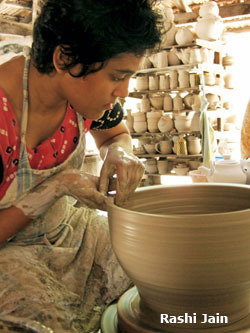
Twenty-five-year-old ‘studio potter’, Rashi Jain puts a clay foot forward

Is ‘Studio Pottery’ a fancy term for a terracotta art?
A ‘studio potter’ is an individual who experiments with different kinds of clay and does not merely produce pots repetitively but also extends the craft to an art form and furthermore; as a medium of expression. Unlike Europe, Japan and China, where the craft has evolved over centuries and been supported by royalty, ceramic art in India is still nascent and tagged as the common man’s matka for drinking water. Pottery has remained a craft form and innovative exploration has been bound by tradition.

Why utensils and crockery?
I see chai wallahs at every corner of a city, rows of dubba wallahs at Andheri station and peanut shells in paper cones lying on the road. The tin kettle, tea glasses and steel tiffin boxes are passive witnesses of lives unravelling, emotions and conversations. Recreating them in clay brings to life the moments that I spend with the objects.

Clay breaks away from the common mould…
Clay as a medium is flexible and allows one to explore the three dimensions thoroughly. It has a dual quality of being brittle as glass and timeless and hard as a fossil. Working with clay involves not only the bodily senses but all the forces of nature (earth, water, fire and wind). Working with one’s hands gives a tremendous feeling of control over one’s creation.

Literature: Suma’s Soup For The Soul

26 Wednesday Aug 2009

Posted by sitanshi talati-parikh in Art, Literature & Culture, Interviews (All), Interviews: The Arts, Publication: Verve Magazine

≈ Leave a comment

Tags

Interview, Literature, vervemagazine

Published: Verve Magazine, Nerve, August 2009

A man traumatised by his parents’ death and a broken engagement found solace while reading Suma Varughese’s article on faith. Sitanshi Talati-Parikh speaks to the former Verve columnist whose book Travelling Light is an anthology of her columns written for Life Positive

What brought about a sudden shift from magazine journalism to spiritual journalism?
I quit Society (where she was an editor for six years) because I had become aware that the values I was promoting within Society and the values I practised in real life were in contradiction to each other. I had begun to understand that the purpose of life was growth and it seemed to me that immersing oneself in material pursuits was distracting us from this purpose. I was fortunate enough to join Life Positive (in 1996) which was then on the drawing board.

At what stage did you begin asking questions that answered some of life’s biggest dilemmas?
For 16 years I had been in a kind of low-grade depression and was a confused, unhappy person. Then I suddenly had an amazing experience. I discovered within me the capacity to flip out of my ego (or the narrow framework of one’s own thoughts, feelings, reactions, needs and wants within which most of us are bound) and really experience the other without relation to self. I could do this by uttering the statement, ‘It’s their happiness that counts, not mine.’

That appears to be a difficult selfless state to be in….
It was a state of empowerment and invulnerability because I simply did not mind what people said or did. Slowly I realised that putting the happiness of others ahead of mine made me very happy. And that it was an inexhaustible source of happiness that did not depend on circumstances, only me. I did not become a realised soul, but the whole jigsaw puzzle of life fit in perfectly!

EMPOWER YOURSELF

When dark clouds gather and melancholy wreaks havoc, many people turn to what is popularly known as self-help or motivational books. They provide direction, a guiding light and inspiration to get out of a troubled spot – or sometimes become simply a Dummies Guide To Being Holier-Than-Thou! Verve recalls some iconic self-help books (excluding religious or philosophical texts!)

How To Win Friends And Influence People by Dale Carnegie
The Seven Habits of Highly Effective People by Stephen Covey
Conversations With God by Neale Donald Walsch
Who Moved My Cheese by Spencer Johnson, MD
Jonathan Livingston Seagull by Richard Bach
The Alchemist by Paulo Coelho
Chicken Soup For The Soul by Jack Canfield
Men Are From Mars, Women Are From Venus by John Gray
The Secret by Rhonda Byrne
Reader’s Digest
The Monk Who Sold His Ferrari by Robin Sharma
The Power of Now by Eckhart Tolle

Moving Shadows

15 Saturday Aug 2009

Posted by sitanshi talati-parikh in Art, Literature & Culture, Publication: Verve Magazine

≈ Leave a comment

Tags

Chinese Cinema, Shadow Puppetry, vervemagazine

Published: Verve Magazine, Nostalgia, 75th Black-and-white Issue, July 2009

Taking off from an internationally acclaimed Chinese film incorporating shadow puppetry to a peek into the prevalence of this art form in India, Sitanshi Talati-Parikh flits through the darkness and goes behind the scenes

Shadow04

It was nearly a decade ago, at a seminar on popular culture and politics in Philadelphia that I first came across the international award-winning Chinese movie To Live, directed by Zhang Yimou and based on a novel of the same name by Yu Hua. (The film was banned in Mainland China, due to its satirical portrayal of various policies and campaigns of the communist government). Dark and captivating, the movie stirred something in me, a sense of loss and belonging, and sadness at seeing life wasted and then a burgeoning of spirit, upon seeing it resuscitated. The wealthy protagonist, Xu Fugui, gambles away his fortune and family property and is forced to start a shadow puppet troupe to support his family. Against the backdrop of the Chinese Civil War and later, the Cultural Revolution, we watch events unfold with heart-breaking resonance, as a bleak story simply gets bleaker; while his classical shadowy art form becomes a means to light up his otherwise miserable life.


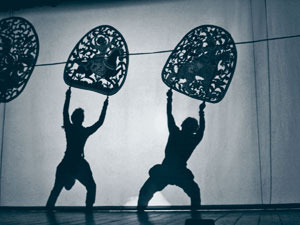
A darting shadow hovers tentatively against the backdrop, and with a resounding sense of confidence, it moves along, bobbing about with a sense of menace, joined by another; creating the illusion of moving images, and a clear sense of good and evil. Story-telling through the art of shadow play or shadow puppetry weaves a sense of drama around a story or epic saga – and can be found in many countries across the world. In India, the leather puppets – sometimes translucent and sometimes opaque, black and white or coloured – represent gods, goddesses and apsaras (celestial beings), which are held in high esteem and stored separately from the demon-puppets. Historically, the tradition of Chhaya Natak (shadow theatre) seemed to have existed in Gujarat a thousand years ago and migrated to Maharashtra; with wandering tribes, spreading their art further south.


From religious doctrine to entertainment through education on social ethics and philosophy, the puppeteers tend to pick up on the themes of Mahabharata and Ramayana, using the sculptures and friezes of the region as inspiration for the figures of the puppets. Not only are they used in the retelling of epics, puppets are also considered divine creations. Most puppet shows in India commence with prayers, and when the puppets decay, they are sent floating away on rivers after performing the worship. Shadow theatre is still popular in many parts of Asia, and besides being a source of pure entertainment, it also serves as a fabulous entry point into the darker areas of character, personality and soul, touched upon not just by the storyline, but also by the technique.


Other Puppeteering Countries


China, Taiwan, France, Indonesia, Malaysia, Thailand, Turkey, Greece, Australia

Javed Akhtar: Of Timeless Words

20 Monday Jul 2009

Posted by sitanshi talati-parikh in Art, Literature & Culture, Interviews (All), Interviews: Cinema, Publication: Verve Magazine

≈ Leave a comment

Tags

Bollywood, dialogues, IIFA, Indian Fiction, indiancinema, Interview, Javed Akhtar, lyrics, screenplay, Scriptwriting, vervemagazine

Published: Verve Magazine, 75th Black and white issue, Features, July 2009
Photograph by: Sitanshi Talati-Parikh

You cannot be entirely objective towards a person who can be considered one of India’s greatest talents. And yet, Javed Akhtar doesn’t let you down. He is approachable, relaxed and as erudite as you might expect – talking a world of sense from a lifetime of experience, with more than a pinch of humour. Of course, the writer-lyricist-poet admits in a staged whisper, “Shabana [Azmi – his wife] is much more serious than I am.” Candid and rather regretful about his shortcomings – “being not-so-disciplined and rather lazy” – the father of two rising stars of Indian cinema (Farhan and Zoya Akhtar) speaks his mind to Sitanshi Talati-Parikh

Javed01

On being down-to-earth

I have never thought about it. If someone starts thinking about why he is modest, then he isn’t a modest person. If you have certain objectivity, you will know that wherever you are, there are many people who are miles ahead of you!

On what it means to be a star
When I was young, I also admired many people – Pandit Jawaharlal Nehru, a writer called Krishna Chandra, Dilip Kumar. Ultimately, as you grow up, you realise that some people are bestowed with some exceptional talent – they have focussed, worked hard, contributed something towards art, literature and human society – but behind all those achievements there is a human being, a person. I don’t feel that kind of blind admiration anymore. A ‘star’ is actually a very vulnerable person, well aware of his/her own shortcomings and weaknesses and failures.

On nostalgia – about the industry that once was
Life offers you packages. It’s not that things were good and now they are not good. Ultimately the film industry is becoming more streamlined, with people becoming more professional and more focussed than what they once were. The film industry is coming out of the feudal era and entering the industrial mindset. The good films of the 50s, 60s and 70s had a lot of social relevance, depth and literary flavour – and a certain dignity. Think Bimal Roy, Guru Dutt, Yash Chopra or Ramesh Sippy. Today films have more variety, technical finesse and people have become smarter, less pretentious and less melodramatic. But, today cinema lacks the strong edifice. Indian films don’t have the kind of power they once had. Rhetoric is not used the way it was. There is an attempt on understatement and restraint, a great reliance on the audience’s IQ. At the same time, I don’t see the magnum opus quality in their scripts – the saga-like stories are missing today.

On bridging the gap between esotericism and entertainment
Why has the industry decided that you can either be sensible or you can be interesting? Is it a choice? Ultimately, good mainstream cinema is extremely sensible and extremely interesting. This is the desired synthesis that I look for. Films like Lagaan, Taare Zameen Par, Dil Chahta Hai, Rang De Basanti all fall in that category.

On the darkest period of Indian cinema
In the 80s (all the way to the mid-90s) somehow something had happened to our society – and the film industry is a part and parcel of our society. The reasons are multiple – somewhere our aesthetics (be it music, architecture, cinema, theatre or politics) experienced a dip in moral values. Think of the times of Sarkailo Khatiya Jada Lage (Raja Babu, 1994), Choli Ke Peeche (Khalnayak, 1993) and Babri Masjid and the Ram Janma Bhoomi dispute. Cinema of any society doesn’t exist in any kind of socio-politico-cultural void. It is connected and even commercial cinema reflects the mindset of society. It is not a coincidence that such kind of cinema was doing well – where good cinema was actually marginalised. Thankfully, by the mid-90s we started reviving and the worst is behind us.

The best grey roles you have ever written are…
Gabbar Singh’s dialogues (Sholay, 1975), Vijay in Trishul (1978), Deewar (1975); or the important minor characters like those in Arjun (1985), and Raja in Mashaal (1984).

On feeling successful
I have had my share of defeats, deprivation and humiliation; at the same time, if I go to the grand total it is in my favour. Life has ultimately dealt me good cards. I don’t know if I am flattering myself, but I genuinely believe I could have achieved more than what I have. And that I should try to do it.

Awards mean…
I am in a strange situation – when I get an award I don’t get the same kind of thrill and excitement that I once did, but when I don’t get it I still get some kind of unhappiness. It is a bad deal – you get it and you don’t feel a thrill – it’s just another confirmation; you don’t get it and you start getting very suspicious – where am I? Why has it not come to me? Is my work not good enough? It is a precarious situation to be in!

On colour evocation
Black makes me think of Black power, black panthers (or the Black Panthers), Martin Luther King, slavery in the US, civil rights.

White leaves me with mixed feelings – it has a calming effect. It is a colour of peace and tranquillity, the word that comes to mind is an Urdu word: suqoon. Ironically, I don’t think of the white race with the colour white, while the colour black evokes thoughts of the black race.

Grey equals ultimate maturity. When you can see grey, you have matured. Black is not as black and white is not as white, if you have sharp eyes.

Interpretive Art

27 Wednesday May 2009

Posted by sitanshi talati-parikh in Art, Literature & Culture, Interviews (All), Interviews: The Arts, Publication: Verve Magazine

≈ Leave a comment

Tags

Art and Design, International Art, vervemagazine

Published: Verve Magazine, Nerve, May 2009

Photograph: Nilesh Acharekar

Art theorist, educator, poet, writer and photographer, Amir Parsa has often been publicly referred to as a ‘phenomenon’. On his recent visit to Mumbai, he chats with Sitanshi Talati-Parikh about his work with art and Alzhiemer’s disease at the Museum of Modern Art, New York

Social01

Born Iranian, but culturally and educationally French, Amir Parsa has spent less than a decade of his initial years in his home country, before finding himself in the suburbs of DC, USA. A formalist, his regular attendance at French schools affected his interest in art theory and literature and he discovered himself as a literary writer at the shockingly early age of five and continued through his teenage years. This interest in art, and literature as verbal or scriptorial art simply snowballed into a profound interest in education.

Parsa, who himself is an excellent listener, considers education to be something more complex and subtle than a mere transmission of knowledge – rather, knowledge as learning, interaction and often designing society and social beings with its critical engagement. That has been his preoccupation for the last four or five years at the New York City cultural icon, Museum of Modern Art (MoMA). Curious to explore how the arts can affect the quality of life, he is currently involved in an inquiry-based learning with different audiences, ranging from kids to adults, and now particularly with patients of Alzheimer’s disease.

“It isn’t lecturing, but rather starting with a lot of questions. We look at paintings and sculptures (among other art) that invite description and interpretation. Through that process we allow people to enter into critical dialogue with the work that they are engaging with and with themselves, with their previous thoughts and life experiences,” explains the Princeton and Columbia alumnus. For instance, someone with Alzheimer’s disease might have to say something very different from what is obviously in front of them, but they are making a particular connection. The museum’s learning programme acknowledges and encourages it.

Usha Mirchandani, of Galerie Mirchandani + Steinruecke, discussed the need to bring this sort of a transformation into people’s lives in India. Parsa, who is not deeply familiar with Indian art, embraced the idea, considering it to be an exploratory phase; the chance to open up dialogue on ‘how can art matter?’ in new environs. Sharing similar concerns, Mirchandani facilitated Parsa’s educationist lecture in Mumbai recently, held to an open audience of art lovers, collectors and artists. Parsa is already planning another trip to India, this time as an individual writer-artist. An author of ten literary books, his latest publication, a book that he is working on with a team at MoMA, is due to be out this month.

← Older posts
Newer posts →

|  Filling the gaps between words.  |

Writing By Category

  • Art, Literature & Culture
  • Brand Builidng
  • Brand Watch
  • Fashion & Style
  • Features & Trends
  • Fiction
  • Food
  • Humour
  • In The Media
  • Interviews (All)
  • Interviews: Business
  • Interviews: Cinema
  • Interviews: Cover Stories
  • Interviews: Lifestyle
  • Interviews: Luxury Brands
  • Interviews: The Arts
  • Interviews: Travel
  • Musings
  • Parenting
  • Publication: Conde Nast
  • Publication: Elle
  • Publication: Mint Lounge
  • Publication: Mother's World
  • Publication: Taj Magazine
  • Publication: The Swaddle
  • Publication: The Voice of Fashion
  • Publication: Verve Magazine
  • Social Chronicles
  • Sustainability
  • Travel Stories

Reach out:
sitanshi.t.parikh@gmail.com

© Sitanshi Talati-Parikh 2018.
All Rights Reserved.

Website Powered by WordPress.com.

  • Subscribe Subscribed
    • sitanshi talati-parikh
    • Join 51 other subscribers
    • Already have a WordPress.com account? Log in now.
    • sitanshi talati-parikh
    • Subscribe Subscribed
    • Sign up
    • Log in
    • Report this content
    • View site in Reader
    • Manage subscriptions
    • Collapse this bar