The Main Course is French! (Shanghai, China)

Tags

, , ,

Published: Verve Magazine, Rambling Reporter, December 2006

A smattering of ramshackle buildings amidst the gleaming skyscrapers in Shanghai makes Sitanshi Talati-Parikh wonder how the city grew from ugly and dwarfed to tall, splendid and oh, so cosmopolitan, in just over a decade

Rambling01

As I landed in the city that is the poster child of the modern world, I held my breath until I could espy the snaking highways and the splendid buildings. I recalled seeing a row of symmetric buildings read: boring) from the plane, and a few dilapidated structures whilst being stuck in the traffic on the highway… and the tension gnawed at my insides. All along, this place, this city, is what I had been waiting for, with an innate knowledge that it would be simply outstanding. They all told me it would. I couldn’t be so sorely let down?

Secretly though, I wasn’t sure if I was happy or sorry to be unfazed by this city. It didn’t look like much – and I had given it all of 15 minutes! I refused to believe that any city held together by socialist-communism could offer a better way of life than a democratic one. My views were challenged every minute that I spent in unarguably the most modern city of the world. As I held onto my possibly jaded view, I saw the New World Order.

The city sneaked up on me. Slowly but surely it began to grow, like hunger or a snake uncoiling itself. It began to get bigger, bigger than I had ever imagined, and better, better than I had ever seen before. I tried to run away from it, afraid it would engulf me, but it towered over me at every opportunity. Even standing atop the tallest Asian TV Tower (Orient Pearl), looking down upon the city didn’t make it any less overpowering….

As my father raved about the city at every opportune moment, I would respond with a diatribe – the highways were excellent, but the traffic was still too much; the people were hardworking and intelligent, but they couldn’t piece a word of English together and the locals were a rowdy and uncultured lot. The government wants the city to grow, the country to prosper and the people to be well cared for, but it’s communist!

And suddenly it just didn’t seem so bad to me. Could all of this be so miserable? I recall the hungry eyes of the children on the streets of my hometown, and I compare it to the satisfied gleam on the faces of the youth of China. What had my so-called democracy done that was better than this? Our freedom of speech was not feeding the poor and making them happier! As the per capita income rose, the people in Shanghai grew wealthier. They were well provided and cared for.

Our hotel was plush and luxurious, and it was one amongst the many luxury hotels that vied for attention. It reeked of comfort and wealth, as did the fabulous multi-cuisine restaurants that you could choose from. From Italian wine and Mexican margaritas to Spanish tapas, Japanese sushi and French main courses, Indian dessert and Chinese tea, you could pick a cuisine from a myriad places on the globe. If the tastes were simpler and more local, you could just walk down on one of the smaller streets and pick up some dumplings or skewers.

Finishing a long drawn out meal at Giovanni’s, on the 27th floor of the Sheraton Grand, my father wistfully pointed out the glittering lights below. “Doesn’t that remind you of the Queen’s necklace?” Instinctively, I reacted with a, Yeah, right! It seemed like a role reversal. I was, in barely a few days, intensely cynical of the town that brought me up, and in awe of this city of lights.

Somehow, celebrating Diwali on the Shanghai-by-night river cruise, alive with sparkle, flavour and culture, didn’t seem out of place. This was a city totally livable – by anyone. As if to prove a point, little boats chugged by all day, on Shanghai’s Huangpu River, with enormous TV screens flashing a new lifestyle.

The city is truly cosmopolitan, in its own right. America has hit Shanghai (and China for that matter) pretty hard. Even obscure American franchises dotted the Eastern landscape; Chinese fashions were a culmination of Western haute couture with an extra zing and smaller sizes! That was very evident by the upcoming Shanghai Fashion Week that I happened to be right in time for. (Must-buy from China’s first upscale global brand, Shanghai Tang).

There is Halloween around, and the locals groove to Western pop music without understanding a word of the songs! It’s surprising to see a Starbucks inside a traditional Qing-dynasty architectural structure. Has America arrived in China, or is it the other way around? In a city where the subway system was yet to be integrated in whole, the roads were packed with cars from every country imaginable. Was I in New York or Shanghai? Subtitle the hoardings, pump up the highways, de-slant the eyes and you wouldn’t know the difference.

For a city that opened to the world after the Opium War, where foreign adventurers set up trading firms and mansions on the Bund (still the happening spot in town) from the proceeds of Opium trafficking, today, the skyscrapers in the city house the well-off middle class, while the rich live in plush villas in the suburbs, along with the poor. Whether walking on the Bund and the beautiful riverside promenade or on the streets of old Shanghai, with the Yu Gardens, Jade Buddha Temple and teahouses, one can marvel at how far this city has come.

I was incredulous as I saw the smattering of ramshackle buildings amidst the gleaming skyscrapers. I asked our tour guide – how in the world does the city go from ugly and dwarfed to tall and splendid in a span of just over a decade? The answer seemed unbelievably systematic – the government provided the residents of the buildings (that were to be razed down) with alternate housing, and replaced the old buildings with better ones! Easier said than done? Not quite! Rules and regulations were accepted, as a way of life, not something to be troubled by. The city reminded me of the brilliant Chinese acrobatic show I saw that evening – balanced gingerly on a pole of socialist-communism, but landing upright every time, not wavering even once.

Despite the cocoon of luxury, any tourist to Shanghai only wants one thing. A bargain, or many of them! The renowned Shanghai flea market is what we wanted, with a burning sense of need and urgency. The itch to bargain hit us like we’d been forewarned, like never before, not even on Mumbai’s ‘Fashion Street’. It didn’t take but a few seconds for that desire to be blown apart, when we were sorely informed that the ‘fakes’ had been taken off the roads. The flea market was eradicated in June. But we were welcome to shop at the government authorised malls. Malls? Why in the world would one go to malls in China? Malls, which were better than those in America…. Buzzing glass elevators that climbed like purring felines, shops that held one in awe, the sizes of which simply extended to the end of the earth.

To our enormous relief, Nanjing Road (the walking street, where one can take a little tourist motor train, but not any other form of vehicle) gave us local shops and boutiques… and hawkers. The hawkers that were like the plague; they ensnared us and led us into shady little alleys where following a dizzying ride up rickety stairs and hidden closets, you discovered that the fake hadn’t quite deserted Shanghai – it was just concealed from the naked eye. Polo, Abercrombie, Burberry, Gucci and the lot still flourished here, originally fake.

This made me wonder…. Maybe it was my purely democratic fantasy that refused to let me accept otherwise. Just as the fake Gucci was hidden, was the other side of life in this mystical country hidden from us too? We, the wide-eyed tourists, who came with a desire to see the People’s Republic of China in action, saw one side of the proverbial coin. Was the coin transparent or were we seeing exactly what they wanted us to see?

Literature: The World Cannot Become Uniform (Vikram Chandra)

Tags

, , , , ,

Published: Verve Magazine, Features, September-October 2006
Photograph: Gaurav Bhat

Straddling two continents, wordsmith, Vikram Chandra is deeply inspired by Indian mythology and epics. In Mumbai for the release of his latest offering, Sacred Games, the award-winning US-based author speaks about modernity and ‘Indianness’ in a tête-à-tête with SITANSHI TALATI-PARIKH

Vikram01

Muted conversations, tinkling of wine glasses, dusk setting in saw the world-wide book launch of eminent writer, Vikram Chandra’s much awaited third literary offering, Sacred Games, in Mumbai at the Hilton Towers’ Rooftop. Early the next day, at the suburban Taj Lands End, Mumbai, a conversation enfolded with the award-winning novelist who surfaces in the world of words (earlier works are Red Earth and Pouring Rain and Love and Longing in Bombay) after a long sabbatical. I had to ask – why so many years before another novel – seven in the making. He replies with alacrity, “I’m just slow, very slow. It does take some perseverance and a large degree of obsession!” This trait is remarkable in the little man with precise and fluent thoughts and a great deal of patience. As the dialogue swirls around lengths and time, Chandra states that writers have their own best lengths. “I did short stories as an experiment,” he says, “to see if they would work, but even those got really long! For me, long length is natural.”

It becomes very clear that the California-based Chandra is, as one can tell from his writing, deeply inspired by Indian mythology, the epics and other magical tales. “What forms us when we are young and growing up, stays with us,” is his strong belief.

Born and brought up in India, but having left for the States out of sheer frustration at not being able to find a good course in creative writing (when he followed poet, Nissim Ezekiel, around), Chandra did his undergraduate degree magna cum laude in English. He looks back and wonders: “Before going abroad, you live in your own parochial world and somehow think that you are universal; that you are like the person on the other side of the world. Once there, within the first couple of days, you realise that you are talking in different languages, even though everyone is supposedly speaking English!

Since then, he has been studying, working and living in America, with frequent visits to the city close to his heart, Mumbai. As a professor of creative writing at the University of California, Berkeley, he finds the cross-cultural mingling stimulating and educational for both sides. He marvels at the rapid changes in India too, “The modern urban Indian is a very different creature from the modern urban New Yorker. In a world that’s rapidly globalising and seemingly getting smaller, we are also fragmenting more and more and the polarities are growing more intense.”

What is his concept of ‘Indian’, then? What we think of as ‘Indian’ is actually the result of many, many changes all through the ages, Chandra explains. He points out that to talk of an unchanging Indianness and the nostalgia for an unchanging past and subsequent stability is itself a falsehood. Brooding about the changing nature of society, Chandra insists that “the world cannot become uniform, even if it is a smaller place”. He predicts an increase of the parochial and the local or an urban niche. “The seemingly contradictory thing,” he says, “is that even as we become more modern, we become more tribal.”

Chandra often and wistfully recalls the days when he and his friend, Anuradha Tandon started the adda in Goa Portuguesa, a restaurant in Mumbai, as a meeting ground for young thinkers and artists. He notes with some amusement that while the Mumbaiites would be dedicatedly taking part in discussions that went on into the wee hours of the morning, their American counterparts in DC, would rush off home by 9 p.m., since the next day was a working day. With barely concealed enthusiasm, he states, “It really was amazing and a lot of fun! That kind of cross-pollination and conversation is really helpful for all kinds of people – really good things came out of that.”

With the turmoil prevalent in the world around, Chandra believes that in some ways it’s a really good time to be a writer because there is so much turbulence and change. The material that is offered to you, that you come by – although it is often painful – is really rich. “In some sense, every book that I have written is a response to what is going on around me,” he says.

Coming from a family that is prolific in the arts, it is no surprise that he is also greatly influenced by the people around him. While his mother, Kamna Chandra, a playwright for All India Radio at the time, was concerned about how all her children would make a living by choosing a vocation in the arts, the entire family came together as a great support system for each other. The atmosphere in the house was always filled with literary discussions and varied artistic interests – what with sisters, Tanuja Chandra (film director) and Anupama Chopra (journalist-writer), to add to the talent pool.

One would imagine that with so many writers in one household, there would often be a difference of opinion. Chandra, on the other hand, looks unfazed and finds it productive. “It’s all in good faith. It doesn’t get to the point where you start resenting somebody else’s opinion. It’s great to be around people who understand the life of being somebody like that. You are, in a sense, strange and different.” Talking about his wife, Melanie Abrams, who is also a writer, Chandra recalls meeting her at an art festival in Los Angeles and staying in touch via email. He says, “We sometimes completely baffle each other. The universe we see is different from that of the other person.”

Chandra, himself, is a man of many talents. His proficiency with computers was discovered when he was working his way through film school in New York. A self-proclaimed computer geek, he loves to dabble in a bit of programming to relax!

After his ambiguous experience of being one of the writers for Vidhu Vinod Chopra’s Mission Kashmir, Chandra is pretty emphatic about not returning to script-writing anytime soon. “As a novelist, you have such complete control over what you do but film-making, from the ground up, is a collaborative art. It’s thrilling at times, because you pass around ideas and then directors step in and the actors make something of what you did. At other times, you want to do something and you can’t! So, then you feel really angry and frustrated.”

Funnily enough, Chandra recalls with a sheepish look, “I actually went to film school because I was scared of being a writer!” After his BA, he was lost and didn’t know how to earn his livelihood. For a year he drifted around taking up odd jobs from that of a night baker to a security guard and furniture mover in Los Angeles. Then he decided to go to film school, figuring that at least that way he would have a chance at a creative job. Ironically, it was film school that led him right back to writing books!

As the discussion revolves around the topics he chooses for his books, Chandra matter-of-factly states, “One writes something close to what one reads and gives pleasure. The Victorians, for instance. I love the diffusion of characters…!” He believes that Indians would necessarily write about the Indian experience, since that is where they are coming from. However, he warns, “One does have to be careful about getting stuck in an ethnic ghetto…for instance, the temptation to write yet another story about cultural confusion.”

For the choice of the detective genre for his latest book, Chandra believes it is a neglected and curiously pleasing form, which weaves across cultures. The detective incarnates the scientific method and the form fits with logic and reason against the chaotic. “In the end,” he says with a smile, “you love it because it comforts us and restores order.”

Has the million dollar-signing contract restored any order for Chandra? Quick to allay the thought that he is discontent, he states a little ruefully, “People presume that with that kind of number, you are set for life. After paying taxes, what you are left with isn’t enough to even buy a house! At the end of it, you are still faced with the task of making a living and feeding your dog. It’s not as if you are transported into some kind of heaven!”

A kind of heaven for Chandra, it appears, is his time distributed between his two homes. He does miss Mumbai and writes about it through the characters in his new book as well. “That is also not to say that the city is not trying and exhausting and wears on you like nothing,” he chuckles. He finds the travel and distance to be a much-needed perspective. “Getting away is a sort of purposeful dislocation – and each time I return, I can feel the city experientially again, renewed.”

While stating that there is so much territory left to explore, Chandra does show a semblance of weariness as he states that he has no plans for another book as yet. A holiday is on the official charts for him – a much required and enforced one.

Quietly contemplative, he concludes, “I realise now how lucky it is to be able to do work in the world that you actually enjoy. It’s not a privilege that everyone gets.”

Sleepless in Seattle

Tags

, , ,

Published: Verve Magazine, Travel, March-April 2006

Home to Microsoft, Boeing and those fabulous Starbucks frappuccinos, Seattle, the vivacious city on the ‘upper-west’ side of America, is a ski-jump away from Vancouver. As it always does at this stage – when flying for business takes precedence over flying for pleasure – SITANSHI TALATI-PARIKH’S rendezvous with the Emerald City began with a business seminar…

Seattle

A typical East Coast sentiment kicks off with a nasty red-eye leaving me with a whopping two hours of sleep that night. Straggled and disconcerted, I peer out at the city through heavy-lidded eyes and get accosted with a whiff of the sharp ready-to-rain-anytime air that chills and warms you at the same time. I happen to have the day free before I start spending quality time indoors at the seminar, and I quietly contemplate the best use of my precious hours of freedom. Many, many hours behind on sleep, I crave the much-advertised soft beds of my hotel. As I swing into Downtown, however, my eyes pop open and my body surges with adrenaline.

The adrenaline didn’t abate until I got on that flight back home, and even at this moment, I can still recall that heady feeling. I knew the moment my cab snaked its way into the city that this would be one memorable trip. With fatigue threatening to take charge, I could sleep in or check out the city. The choice was easy. For that one day, I shed the business suit and became the camera-clicking tourist – backpack and all.

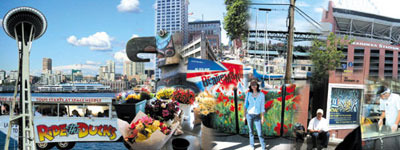
The hilly roads that can get steep without a moment’s notice all lead to the most fun place of all – Pike Place Market. A cut above the designer stores in their typical city décor, this market is just downright homely, with ‘fresh’ being the operative word. Miles and miles of the most beautiful and fresh flowers lay spread out before me, of every hue imaginable. I purchase some of the fresh farm fruits from those ever-smiling vendors, surreptitiously sample some of the homemade honey and gourmet chocolates, and join the onlookers watching cheese being churned by hand. Guiltily, I purchase a Seattle shot glass for my collection, a Chinese wall hanging and a sketch of Starbucks. The joy of strange little souvenirs. Compare the inviting little café-style restaurants with tantalising aromas and cuisines for every palate, to the airline’s ‘generous’ serving of pretzels.

My personal favorite remains the scrumptious Mediter-ranean sandwiches at the Sister’s European Café. I went there every day in lieu of the seminar lunches. They are just that good.

A local market singer strikes up a song about my T-shirt, and I realise a bit too late. As I begin to draw undue attention from the crowd, I look down aghast, at the words: ‘Guys make nice pets!’ Somehow, the Abercrombie & Fitch T-shirt didn’t seem like such a big deal when I actually bought it! A trifle nonplussed, I decide it’s about time I scram and I quickly clamber onto the nearest vehicle heading out. Turns out to be a bus going to the Seattle Space Center. Checking out the area, I also discover a Science Fiction Museum and something called the Experience Music Project. And then, my eyes catch a sign for ‘Ride the Ducks of Seattle.’ I was intrigued.

Could anything be more fun? The vehicles used are actually World War II relics and they go on land and water, giving a 90-minute tour of the city! I was in it for the ride.

We learn the duck sound and the tour guide-cum-driver is just brimming with jokes. Every age group is present and the racket we make is quite extraordinary. The people in this city are so friendly, even the harried business sorts (I’m not one of them today) actually stop by to wave and some even do the duck waggle! We do a by-land and by-water tour of the city and its skyline, check out the Art Museum (there is a Van Gogh Exhibit this week), the Seahawks Stadium, and an ancient refinery….

The most interesting part about this city is the diversity from one part to another. The Belltown District where the Space Needle is located is only alive when there are tourists around. The Space Needle (surprisingly) originated as a science project by some students and is now a famous Seattle landmark.

After a steaming cuppa’ at the Space Café, I ride to the top of the Space Needle to check out the real-time web cams. Zooming into the city, I can almost spy my husband, Sahil, sneaking furtively into a Banana Republic when he should be busy taking some business away from Microsoft!

The next stop was the Pioneer District that is actually underground. When that part of town was rebuilt, the roads ended up covering the first floor of a number of buildings.

Glowering totem poles stare watchfully at me, daring anyone to make a comment on this strange part of town. It feels like something out of Alice in Wonderland, where life exists at a subterranean level, very separate from its sunny counterpart. Taking an Underground Tour brings to light a dark sort of existence.

The Fremont is the artsy area, what with naked bicyclists, alternative and grunge music. Downtown has classy shops and restaurants, the theatre and Pike Place Market. The harbour area is always busy, and catching a ferry or a cruise to a nearby island is a piece of cake.

Taking a short ferry ride to the closest island, Bainbridge, is fun. The Island is small and cosy – I really feel it’s quite possible to walk from one end to the other! Leaning against a colourful mural in front of a little art gallery, it all looks very serene. The painting comes to life and the fields seem to extend endlessly behind me. After a quiet lunch, the ferry ride back is invigorating. The wind whips past my face, as I take in the Seattle cityscape in sharp relief against the clear blue sky. I sigh contentedly as Seattle has generously kept her ubiquitous rain clouds away from my weekend trip.

After such a memorable few hours, I can’t imagine a day spent indoors. There are lunch breaks though, I console myself, with much the same I’m-so-busy-but-oh-so-mournful look sported by the business sorts. And after 5pm, strolling down the streets of Downtown is something to look forward to. Incredibly fabulous Italian restaurants like the Palomino and Vivanda are at an appetite’s length; I noticed Fox’s Sports Bar earlier and some interesting breweries. Or I could catch a musical nearby. It’s not like there’s a lack of entertainment, just a lack of time.

The seminar paled in comparison to the mysteries of the city. I can think of a dozen more things I would have liked to do whilst there, but isn’t that the case with any new place? These are the moments when mixing business with pleasure comes to life….

No Time To Preen

Tags

, , , , , ,

Published: Verve Magazine, Features, November-December 2005
Photograph: Akash Mehta

When Falguni married Shane Peacock, together they conjured up a funky treasure trove for the tired fashion victim. Sitanshi Talati-Parikh chats with the creative couple behind the flamboyant designer label, who work 24/7 and suffer from Sunday morning blues!

Fs1

The Juhu studio is warm and snug, tastefully embellished with touches that are all Peacock. Settling myself in on an olive love seat with golf motifs, I look expectantly at Shane Peacock seated across me on an animal print settee; he appears as reticent as he is known to be. The other half of the duo – Falguni Peacock – chirpy, bubbly and innately hospitable, bustles about attending to things while talking at breakneck speed.

They could be just any newly married couple, bickering good-naturedly over minor differences, suddenly quiet, otherwise talking over each other, and completely head-over-heels in love with their three-year-old budding fashionista daughter. The conversation flows over a coffee and then some tea.

Theirs is a fairy-tale story of how a self-reliant, salwar kameez-clad Gujarati girl came upon a pig-headed, Christian boy. Ironically, Shane, who was a member of a rock band, had always fantasised about meeting a ‘propah’ traditional girl who didn’t smoke, drink, or ‘go wild’, and there she was. But Falguni wasn’t easy to woo. With a delighted chuckle, she recalls how Shane once asked her out for coffee and told her to come wearing jeans. When the usually conservative dresser obliged, he knew he had won her over.

But conventional as she seemed, Falguni was a career woman through and through. Even before she got married, she had started her own clothing label and Shane, meanwhile had also studied fashion design. It was not long after their marriage that they pooled their talents into the flamboyant and unique Peacock brand.

Their success didn’t come easy. Shane started college, studying engineering at the behest of his father, and Falguni who came from a background of chartered accountants and lawyers, was greeted with equal scepticism when she chose to become a fashion designer. In the end she settled for a Commercial Art degree to make her family happy but working in an ad agency only made her unhappy. Reminiscing, she says, “I told my father, in no uncertain terms, ‘One day I will be a really famous fashion designer’. Unfortunately, my father isn’t here to celebrate my success, but he would have been so proud.”

Shane faced similar rebuke at home when his preference for spending his days sketching outside class was discovered. Horrified at the thought of his son becoming a “ladies tailor” or even worse, being gay, his father took him to task. The rebel in Shane sprung forth and he walked out on his family. Falguni interrupts, “It is really his live wire nature that got him to where he is right now.”

Chasing those dreams, however, was easier said than done. He was forced to give up his indulgence – the rock band, he over-stayed his welcome at a friend’s house by a year and jobs were not easy to come by. It was a while before he thought about doing something on his own.

Shane drags us back to the present. “Let’s not talk about the past; it is only the present and the future which matter.” With the slightest touch of regret but no resentment, he states thoughtfully, “If I had my family’s support, I could have reached here faster. It is frustrating sometimes to think about the extra years I had to put in to get here.” Immediately distracted by his daughter, noticeably the apple of his eye, he reflects on his relationship with her, “She calls me Shane – and I like that. Calling me ‘dad’ would put that extra distance between us, which I don’t want.”

Their marriage was the turning point of their personal and professional lives. When Falguni married Shane, together they conjured up a new vision for discerning dressers. Today 90 per cent of their business comes from the international market, and the Peacocks are a global brand. Ironically, it is the Indian market that they seem unsure of. Appreciative of the attention they have been receiving nationally, they still believe that India as an organised market has a long way to go. Shane explains that selling an outwardly simple outfit for the equivalent of Rs 40,000 abroad would be no problem at all; it would be valued for the style, the cut and the label. In India on the other hand, he states matter-of-factly, “People want their money’s worth. A woman seeing a price tag of Rs 40,000 would ask for the piece to be heavily embellished so it looks like that much karigari has gone into it. Simplicity, which is really more my style, won’t work as easily here as it does abroad, at the prices we retail at.”

Falguni joins in by stating that they know their target audience, “We don’t want anyone and everyone to wear our garments. We are very selective about our clients and our stores. It is the cream of the crowd that we cater to and as long as they appreciate our work, we’re happy.” She says they would rather sell limited garments than drive volumes. It quickly becomes clear that Falguni is the hard-nosed businessperson of the two. Shane seems to read my thoughts, adding, “Falguni is the more pragmatic of the two of us, she sees the commercial viability and makes those key business decisions.” But they both agree that, “At the end of the day, you have to ensure that your work is commercial. You can’t make a masterpiece that is admired but never worn. We want it to sell, but in our style and on our terms.”

Shane strongly believes that talent alone was not the only deciding factor in their successes. Instead it is largely through smart marketing that they have been able to make themselves be seen and noticed. To promote their line, the Peacocks tried working with models, but were not happy with the results. They explain, “Models didn’t provide a value addition. You can’t identify with them, they don’t seem entirely real. Spectacular garments can’t be remembered for just that. So we decided to take on celebrities to build relevance.” That eventually turned out to be quite a marketing coup. They look at each other and smile. Falguni continues, “We set about getting the people we wanted. It was not easy convincing Manish Malhotra, himself a very successful designer, but we managed the impossible. Rita Dhody’s campaign was the most talked about. She is a flamboyant and sensual woman and epitomises glamour. Each person is very different and since we can’t change the character and personality of each, we just take their image and make it even more attractive than it is. Nawaz Singhania’s campaign was tuned into her personality; the lines were slightly more conservative, the look more accessible”.

Shane reiterates, “We want even the most ordinary looking woman to look and feel beautiful in our clothes.” As Falguni strides up to one of the racks and pulls out an outfit to demonstrate, Shane emphasises that they are known for their plunging necklines. That doesn’t mean they don’t make cover-up pieces like kaftans and such, but a large number of their designs carry their signature low necklines. “We cater largely to the kind of woman who is a lot more conscious today about fitness, health and fashion. Everyone wants to look younger and more attractive, and that’s where our necklines come in,” he laughs.

So what is their signature style? Clothes for the woman who is not afraid of going over the top. Shane deliberates and then says, “It’s all still quite new and experimental for us. Four or five years down the line we’ll know exactly what a Peacock piece is meant to look like.” They know what’s important to them, though: “Women feel slimmer and sexier in our clothes. We want a woman to show her feminine side, look like a woman, go slimmer on the waistline, let the garment flow, not be rigid. It will always be funky and distinctive.”

They’ve been echoing each other’s voices for so long, that I begin to wonder about any creative differences that they may have. “Oh, we fight a lot – on everything, but mostly work. We’re both very independent and that is what brings us at loggerheads. But our differences just seem to resolve themselves.” As Shane calls time out to talk to a friend about a trip to the Maldives, I wonder if taking time off from work helps stimulate creativity. “There are barely any holidays for us! We’re always stressed, and all of our travel is work-related. At the most we take one day off to shop (Falguni by the way, loves to shop!). We just don’t know what to do at a beach – it’s almost too stress-free. A city is the perfect place for us, like New York.” Pausing for breath, Falguni suddenly bursts into laughter and resumes, “Even on our honeymoon, in Kerala, we got bored and cut the holiday short!” Shane who finds most pleasure in spending time with his daughter Nian, adds, “Sundays bore us.”


What about giving each other space, I ask. Falguni is quick to assert, “Even if we are together 24/7, we are still doing separate things.” Shane joins in, “We handle separate factories.” As a woman though, it is difficult to manage home and work. Falguni agrees, “The baby came sooner than we had planned.” She makes a quiet mention of the fact that she owes much of her professional success to her mother, who takes care of her daughter, enabling her to keep these busy hours. They are both the creative heads of their line. “We don’t want to be dependent on assistants,” he says, and adds, “The day I feel money is more important than autonomy, I will outsource our designs to employees. That day isn’t here yet!”


So what’s in store for the future, besides more stores and new tales of success? Falguni clinches it by stating their vision, “If a person walks into a crowded room, and if what she is wearing is recognised as a Peacock from miles away, we would have achieved our dream.” Shane adds, “Some people have called us the Cavalli of the East – but we don’t want to work under anyone’s creative shadow. Our fashion house, as it will be in the future, will be sustainable enough for our daughter to carry on the tradition. We want our line to find mention among the top ten global design brands, we want to be a household name…and to live up to our unique surname, to be a Peacock is to find success in it.”