• About
  • Brand Building
  • Film & Drama
  • Writing: Arts & Lifestyle
  • Writing: Interviews
  • Writing: Luxury Brands
  • Writing: Travel

sitanshi talati-parikh

sitanshi talati-parikh

Tag Archives: Interviews: Travel

Baby’s Week Out

30 Friday Mar 2012

Posted by sitanshi talati-parikh in Parenting, Publication: Verve Magazine, Travel Stories

≈ Leave a comment

Tags

Humour, Interviews: Travel, Singapore, Verve Magazine

Published: Verve Magazine, March 2012
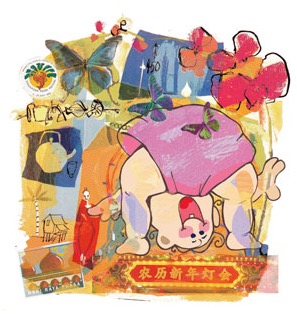
Illustration by Farzana Cooper

Singapore – the destination everyone’s been to. Repeatedly. With children in tow. Here’s a diary of an eventful trip to baby-friendly Singapore with an eight-month-old – where things turn out not quite as they were meant to be

Screen Shot 2017-07-25 at 3.18.07 PM

Day 1: Mumbai baggage
It’s a packer’s nightmare. You start by making a list. Until you realise that you could go on adding to-dos, but you may still forget something. And then you start hyperventilating. You take a really deep, shaky breath and realise – ‘Oh big deal – it’s Singapore. They have everything.’ As an intrepid traveller, I’ve battled my roots to attempt to travel light. No longer is it about, ‘What if I need this very pair of understated Anne Klein pumps over the glitzy Nine West ones?’ I am now confronted with packing for an eight-month-old infant. Her suitcase is nearly as big as I am. I’ve called ahead and asked our hotel to organise sterilisers, bottle warmers, baby cot, baby bathtub and stroller…but even so, as a friend once shrugged and said, “You want to travel with a baby, you can forget about travelling light.” And I’ve only taken one pair of shoes – the one on my feet.

Day 1: Flights and bassinet seats
The flight is uneventful, relatively speaking. My darling child dutifully falls asleep in my arms, soon after take-off, I gently put her into the bassinet in front of me. I’m just about to loosen my stiff limbs and try to settle in for a nap, when there is a slight rumble and the harried air hostess requests me firmly, ignoring my appalled expression, to remove the child from the bassinet due to anticipated air turbulence. Baby sets off a heart-wrenching wail at being disturbed from her deep sleep. I shush and rock her back to sleep over the next 45 minutes and hold her in my arms for the hours until we reach, setting off cramps in muscles I didn’t know existed. That’s the eventful part.

Day 2: Singapore and strollers
Landing in Singapore, I smile in the early morning light, dreaming of organic baby food, chic baby-friendly restaurants and malls with comfortable baby-changing stations. I already know that the city is organised around strollers – making it a piece of cake to walk around the wide pavements. Except…when your hotel accesses the main walkway through an underpass. So, I need to lug Baby and stroller down a flight of stairs, walk, and then up another flight of stairs to reach the pedestrian street. Oh no! How many times would I have to do this every day? I spy the biggest Zara on Oxford and a Starbucks right next to it. I can already see many happy hours spent between the two. Both are accessible via a flight of stairs. I’m not really into this lugging-the-stroller-up-to-shop-and-sip thing. I turn away with a sinking heart.

Day 3: The Great Singapore Sale and diapers
Of course, I have unwittingly chosen an optimum time of the year to pop into the city – at the end of the Great Shopping Festival – which means that all the malls are sickeningly busy and crowded, and waiting for the elevator to traverse floors means waiting forever. So Baby is now getting accustomed to travelling at an incline. The stroller is angled onto the escalator, with a bemused toddler strapped in.

I make a beeline for the nearest store to buy all the required baby things. From grocery store to medical store to convenience chain, each shrugs and points to the next one. I find myself amazed. My part of Orchard Street is completely sold out on Pampers’ diapers in Baby’s size. Apparently, every child in Singapore is a size medium. Good Lord, help me find diapers.

Screen Shot 2017-07-25 at 3.18.13 PM

Day 4: Jurong Bird Park and lorries
At Jurong Bird Park, Baby discovers the lorries. Startlingly awake from her afternoon nap (as we sweat up and down the park route driving the stroller and a sleeping Baby), she is thrilled to see them squawking away, flying in and perching on our hands and eating off our palms. She laughs and claps her hands at the sheer number of them, gurgles at the happy swish of colours.

Day 5: High chairs and changing stations
If there’s anything that Singapore should get full marks for, it’s the fact that any and every restaurant, even the tiniest coffee shop, will have a high chair. It makes it seem that children are wanted and are meant to be assimilated into the culture and not to be left home, like in India. While shopping for Baby on the fifth floor of Paragon, we take a break at the café nearby. It is also possibly the only one in Singapore without a high chair. A tad ironic, seeing that it is located in the children’s section of the mall!

After a run on the toy train at the play area, I walk smugly to the fancy diaper-changing station. I know this is going to be easy. What I haven’t accounted for is that Baby isn’t taking very well to being placed flat on a cold hard surface for her least favourite moment of the day. She sets off a massive howl that scares the daylights out of the ladies around. I don’t dare imagine what is running through their minds. I move away from the sophisticated station and prop myself onto a sofa and try to change her on my lap. There goes convenience. Not pleased at being huddled about, Baby doesn’t stop shrieking until she’s sitting up. I manage to pacify her with Olivia the Owl – her new best friend procured from the toy store nearby.

Day 6: Tiffany’s lullabies and the many colours of Sephora
I’ve worked out a great schedule based on where I want to shop and eat, so that Baby gets her sleep and meals bang on time. But as I cut through Takashimaya, right outside the understated bling of Tiffany’s, Baby suddenly wants to get out of her stroller and into my arms to sleep. I can’t sing lullabies to her in front of Tiffany’s with a straight face! Finding a quiet niche, I settle her in and tuck her into the stroller. As I quickly make my way to my target, Sephora, she’s up and awake dazzled by the colours and jarred by the music in the store. How will I ever shop here?

Day 6: Dancing rainbows at Clarke Quay
We set off for a quick evening meal at the lively waterside. Baby is quite well behaved, checking out the happenings. How perfect it all is! I excitedly prop open the newly acquired, organic, European baby porridge. I see to my horror that the food won’t mix, it’s coagulating and poor Baby is valiantly trying to chew with distaste. I distract her with the dancing colour water fountains in quiet desperation.

Day 6: Designer indecisions
No one goes shopping in Singapore without returning with a few prized designer goods. Some, like the Verve stylists, pre-decide what they have their eyes set on. For me, it would be impulse buys. My indecision leads me to make the walk back and forth between Prada and Miu Miu – which means Baby comes along for the ride. If only she could help me choose…but she seems content to sit back and listen to the muted music in the stores and eye the expressionless Japanese lady buying six pairs of shoes. A people-watcher, already.

Day 7: Night-time margaritas
Taking a taxi to grab dinner at Margaritas is totally worth it. Great Mexican food and ambience and enough wall paintings to keep Baby busy while I wolf down that enchilada, washing it back with the restaurant’s signature drink. From express dim sum lunches to fine-dining Thai, Baby has settled well into high-chair eating, but doesn’t quite master the patience bit, wreaking sweet havoc with the silverware and table mats. A shoe falls off, a spoon goes tinkling down, a fork spears the tiles, paper napkins find themselves arranged at floor level and a mischievous grin keeps you from tearing your hair out.

And then you take a sneak peak around – other children are equally busy self-entertaining themselves, and the only glances in our direction are indulgent ones. That’s what makes Singapore baby-friendly. Not the availability of baby food and diapers (or not), but the fact that they get it – what it means to be a parent who wants to eat a nice meal out and doesn’t want to leave Baby behind. And for those who do, most hotels in the city offer baby sitters.

The World According to Aishwarya Rai Bachchan

19 Saturday Mar 2011

Posted by sitanshi talati-parikh in Interviews (All), Interviews: Cinema, Interviews: Cover Stories, Publication: Verve Magazine

≈ Leave a comment

Tags

Aishwarya Rai Bachchan, Bollywood, Interview, Interviews: Cinema, Interviews: Travel, Verve Magazine

Published: Verve Magazine, Cover Story, March 2011
Photographs by Mike Ruiz

Aishwarya Rai Bachchan’s natural precociousness springs up at every twist in the traveller’s tale. Sitanshi Talati-Parikh watches the ex-Miss World-turned-moviestar-and-homemaker switch from child to Inca queen, Bollywood dramatist to casual honeymooner, lost tourist to Disneyworld explorer, through loud giggles, flashing smiles, dramatic enunciations and passionate inflections, exploring a few of her many memorable journeys


Ash04

A little girl sets sail for the world in an “enormous ship”. The romantic notion of travel becomes a kaleidoscopic reality, possibly even a way of life, with her “shippie” dad and family. It is the mid ’80s when Japan is “very disciplined” and China is yet to come into its own. Around a decade later, winning the Miss World pageant makes her “a cultural ambassador of India” in places unpronounceable. And through it all, Aishwarya Rai Bachchan has felt the power of being Indian, of coming from “a world within the world”.


Since then, there have been movie shoots in exotic locales: from a desert full of water bodies in Latin America to remote towns in India, brand endorsements in cobble-stoned Europe, and the world becoming a stage, literally, with performances like the Unforgettable World Tour. “I will go out and experience a place, I won’t live in an ivory tower, while gauging it and being responsible. Ever since Miss World, people have given me a lot of love – whether you call it recognition or adulation, they have always been expressive in their connectivity with me. When they saw me on the streets, it wasn’t like ‘Ay, Aishwarya!’ – women would come forward blessing and embracing me.”


Always politically correct, her carefully polished voice modulating with occasional bursts of enthusiasm, the intrepid traveller sits easy, knowing that the subject of the day is one she can be naturally passionate about. She points out that while the world advanced technologically, becoming a “smaller place”, her life mirrored the advancement: “Everything became from a 14-hour or 18-hour flight to ‘just an overnighter’, because you started doing it so often. Abhishek (Bachchan) and I love flights – we’re psychotic that way.” And, as she inevitably spends an exorbitant amount of time in transit, the covert people watcher admits “feeling a lot for elderly Indian passengers who walk around staring at monitors. Airports can be overwhelming – with the distances, pace, people and security checks; and while they have become second nature to me, I can still relate to how the experience can be for the uninitiated.”


South Africa: “I had a funny feeling inside me – looking outside the airplane window – a sense of going away.”
There are three times that Aishwarya Rai Bachchan recalls feeling this way, with a distinct sense of poignancy. It began with the flight to South Africa as she left to compete for, and win, the Miss World pageant title in 1994. “I suddenly felt that I would be away from everyone and alone for a month. And the thought of being with a whole lot of people foreign to you; but when you get there, you just fit in. I don’t know if it was a premonition or not, but I sensed that life was changing.”


London: “When you land there in winter, you barely wake up from the jetlag and feel that it is dark, like night again.”
In London, where she was to spend a year as the reigning Miss World, she had the option to have her own apartment or to live with a family in their house. “And I, being the responsible one, chose to stay in a house with a very sweet elderly couple rather than alone in an apartment, knowing my family would feel more secure. It’s a very Indian thing.” It was the first time she was living on her own: “For further studies I never went outside of Mumbai, because my father was a marine engineer, and it was just my brother, mum and I living together; I would feel for my mother and didn’t want to leave her and go away.”


Shanghai: “Suddenly Shanghai was an absolutely different city, and the world was beginning to talk about the change in China.”
It was a very different China during her repeat journey in 1994, when she went as a model with Hemant Trevedi. “Shanghai was a symbol of that change – the modernisation and globalisation, like the US on this side of the world. This was a new culture, very much in keeping with the times or ahead of the time. Very interested in India and Indian fashion and it was almost a privilege to be there with our fashion and our designers.”


China: “This time I was shooting a song on the Great Wall doing a little jig!”
In 1994, she had walked up to the fifth gate of the Great Wall, with a “more grown-up taking away, recognising the passion of generations working on building this incredible wonder that we live with on our planet”. She was back on the Great Wall as an actor, shooting the song Poovukkul, which showcased the Seven Wonders of the World, for Shankar’s Jeans. “You never know when you are going to revisit a certain part of the world. As a kid, when I was there in the ’80s, they took us to a uniquely Chinese opera, and sang some of our Hindi songs, with all the Chinese in the audience looking at us because we were the one Indian family sitting there. You’ve heard of people in China and Russia listening to our music, our film songs, and then to think, on my third visit there, I was shooting a song, with a live audience of people fascinated by our cinema and the song culture of our movies.”


Times Square and historic sites: “I am an actor – it means you have to do everything!”
Dancing atop the Great Wall – did it feel ridiculous at all? “Interestingly enough, never,” Aishwarya answers decisively. “From the beginning, I never felt odd. When shooting for Aur Pyar Ho Gaya, I remember Bobby (Deol), even though he belongs to an actor-family, feeling a bit odd when we had to do ridiculous things in public arenas, like jump on a car, or run on the street with a toothbrush in our hand and toothpaste on our face.” Or the time when she was in New York City shooting for Aa Ab Laut Chalein in Times Square wearing a fuschia pink gown with a bow, big earrings and a flower in her hair. “I had no inhibitions. You’ve grown up watching it, song and dance is so much a part of our cinema that you don’t feel silly doing it.”


Disneyland: “We both were like excited kids – free, happy and wonderfully reliving our childhood.”
A youthful exuberance springs up as she recalls memories of the past. “That family trip (’80s) that started with Japan ended with Disneyland, and Abhishek and I ended our honeymoon – after Bora Bora’s ‘drop in the ocean’ experience – in Disneyland. It wasn’t planned, but worked out beautifully into a great circle.”


Tunisia: “In my interviews, when I say ‘Every day I feel like a newcomer, or every day is like the first time’ there are those special moments when I actually feel that, very, very strongly.”
The third time she felt “the pit of the stomach feeling” was when she took off to shoot for “one of the best film experiences”, The Last Legion in Tunisia and Slovakia. “Not only did I have no one from my nationality on the crew, it was a guy flick – everybody was a dude! I was going to be a warrior, this action character. I was feeling it again: going away for a very long period, and I had to step away from very interesting work that was happening here. I had gone through that predicament too many times in my life and career: ‘Heck, all good things happening, do I have to choose?’” Without any idea of the geography of Tunisia, she was bowled over by the spectacular beauty of the country. She arrived three days before the shoot, without rehearsal. “Everyone was in panic mode, but my dancing helped me, I embraced action instantly. Beautiful Mediterranean water, very hot and warm…a bit much in the costumes, with all that armour! The places were so quaint and simple that we all became that much closer as a group.”


Slovakia: “These guys are HUGE. When you sit on these buggers, you don’t walk straight for two days after.”
Slovakia was familiar because she had been to Prague. She found the “cold (weather) and green” country replete with beautiful castles. “We were all like kids. We had so much fun working together, and such incredible discipline – whether it was Colin (Firth) or Sir Ben (Kingsley) – we were like children in a giant videogame.” And the most remarkable experience was spending time on horseback. She emits a loud, expressive laugh: “The horses in Tunisia are one size and then you get to Slovakia and you realise that the horses there are different. These guys are HUGE. When you sit on these buggers, you don’t walk straight for two days after!”


Budapest: “Ajay kept telling Sanjay (Leela Bhansali) that the two things he dreaded the most, dancing and singing, were what Sanjay made him do in the film.”
Budapest was special because Hum Dil De Chuke Sanam was shot there, for which she got her first Best Actress award. She recalls with a smile, the dance sequence with a rather nervous Ajay Devgn. “It was exceptional because it was an insight into their culture – the music and dance sequence was local to the place. So you actually experienced something unique, apart from the magnificence of being by the river and bridge. Also, we saw very few children in the country, and then we realised that they were encouraging people to have more children because of the mortality rate. Apart from the cuisines, it is always interesting to come away with an insight into the place. For me, it is not about hitting the shops; it is about getting to know a place.”


Brazil: “I was reliving my college days, being vicariously part of a gang of childhood friends.”
After Columbia during her Miss World reign, she was back in South America much later, when shooting for Dhoom 2. “The genre of the film we were working on made us relive our college days. I was privy to a close unit of kids (Abhishek, ‘Duggu’ Hrithik Roshan and Uday Chopra) who are childhood friends, and felt that I was vicariously part of the gang. Brazil offers that kind of spirit, the film gave that kind of energy.” Her eyes take on a faraway look as she recalls a surreal moment towards the end of the Dhoom 2 shooting schedule. They lay sprawled below the “magnificent” Christo, in the wee hours of the morning, before Hrithik Roshan was returning to his son being born. “We were in that woozy state of mind, because we had stayed awake the previous day and night and were watching the sun rise. It was a very quiet time, the early morning hour before the tourists arrived. We had had such a noisy schedule, all of us buzzing throughout, that it was the best silence we all shared. As we lay on the ground, we felt that Christ was looking at us from the skies. You hear terms like, ‘listening to the sound of silence’, but we experienced it then.”


Machu Picchu: “In my little bling feathered costume, I looked like one of the Inca queens.”
Shankar’s Robot took her once again to “the other side of the world”. She had taken a break from her career for the first time in her life. “I was facing the camera after an unexpected eight months all the way in Machu Picchu (Peru).” It was the longest journey they had made – counting the kind of flights, number of flights and locations. Upon reaching the place, a tiny township, after a train journey, they all walked from the railway station dragging their bags on the road. “As we trekked along, we suddenly passed a marketplace. My staff was exhausted, but I was thinking, ‘What an adventure!’ I love walking, because we don’t do that enough, and you actually get to feel the pulse of the place, get in contact with the people and culture, otherwise it could well be structure to car, car to airport, airport to plane, plane to car, car to hotel.”


Mexico City airport: “I was the pride of India and all that – and I didn’t have my passport. This was the worst moment for me.”
With her valet in tow, and running a fever, Aishwarya was connecting via Mexico City en route to Melbourne, Australia, representing India in a performance at the Commonwealth Games. Special Services, who had come to help them with the language barrier, disappeared with their passports. “It was bizarre. People there would smile a lot and look blank, because they didn’t speak the language.” She was taken to a private room that was empty save for two people who could be guards eating a home-cooked meal. “It was like the movies – being in a prison cell and these guys going at their meat sauce and bread. They would say something to each other and keep smiling at me. My valet has piercing eyes, so I would keep telling him to smile and keep his face easy. I suddenly felt I had to be protective and get us out of here. I had never felt that before. I wasn’t getting through on the phone to anyone and at one point I felt myself go a bit cold. I had wanted to visit Mexico, but this was not the adventure I was looking for!” After an encounter with a man who spoke perfectly-accented English and suddenly refused to speak any, to a bunch of “strong-looking women” who used the word “off-loaded”, Aishwarya nearly gave up. And then suddenly, in the crowd she spied the person who had disappeared with their passports and chased him down. “He was carrying our passports in his hand, and till date I have no idea why.”


Los Angeles: “With time, travel, age and experiences, you begin to like the easier, more social pace of LA.”
After boarding the flight from an eventful Mexico City, she was transiting through LA to catch her Melbourne connection, hoping to make it in time to perform. “I reached LA and suddenly life was beyond fabulous. It was the one time I cherished being who I am, in terms of the celebrity life. Suddenly, it was beyond comfort, think all superlatives. I always say that once in a while, if it gets too comfortable, God just does a little schickt (demonstrates a click with her fingers like playing carom). He’s watching his own little rom-com, thinking, ‘I want to have fun with you’. So I think, ‘Enjoy it, and turn it when you want to.’”


New Zealand: “The life that we lead, we are like gypsies, nomads, and I’m very quick to feel at home in any place in the world.”
She’s spoken a marathon, and yet looks like she can go on. I’m right; this would make a coffee-table book. “We don’t realise how quickly time flies and because a part of our life gets captured on celluloid forever, I feel as actors we live lifetimes within our lifetime.” She is off to join Abhishek in time for his birthday, in New Zealand where he is shooting, in a place she has never been before. Some people are meant to be children of the world, explorers in their own right. “And yet, when one travels so much, there will always be something unique to being home. It is your family that makes home what it is – it’s not the physical structure even if you say bed and all of that. I live a very homely life in the places that I go to. Besides, as Abhishek rightly puts it, one in six is an Indian: you can go to the farthest of places and we (Indians) will be there, saying, ‘Hello, you want home-cooked food?’ That’s the best part about Indians – they are there to feed you. You are at home anywhere in the world.”

Travel blog: The Russian Revelation

22 Thursday Apr 2010

Posted by sitanshi talati-parikh in Publication: Verve Magazine, Travel Stories

≈ Leave a comment

Tags

Interviews: Travel, Kremlin, Moscow, Pavlovsk, Peterhof, Pushkin, Red Square, Russia, St Petersburg, Verve Magazine

Published: Verve Magazine, Scapes, April 2010

Exploring the many treasures of Moscow and St. Petersburg is like balancing 17 Faberge eggs on your head, breathing fire and inhaling ice, sharing breadcrumbs with a hungry tigress and walking a tight-rope while knocking down a few vodka shots, discovers Sitanshi Talati-Parikh

Russia23

Standing at the unventilated Domodevodo airport in Moscow, bleary-eyed and tired after a long flight, all I want is the safe haven of my hotel room. Unfortunately, that is not destined in my near future. The arrival lounge at the airport, I am surprised to discover, is much worse than our own Chhatrapati Shivaji International Airport. The lines are snake-like (think anacondas) and as thick as an Amazonian rainforest. You pick a spot and hope for the best. As you get to the head of the line, you reach a sour-faced (albeit good-looking) official who has immediately made the judgement call based on your skin tone. White people move along rapidly, the tanner-skins are examined with the efficiency and distaste one reserves for a life-threatening disease. The non-English-speaking officer looks down at our passport, refers to an alarming scroll filled with digits and codes, growls out a few words in an incomprehensible manner and then points to the side, immediately dismisses us and moves onto the next lot of people. In much the same manner, there is a growing crowd of people collected next to each aisle, ‘waiting’ for whoever or whatever is to befall them. Godot, maybe? One hour in the line, half-hour at the immigration check counter, half-hour next to the immigration check counter. Doesn’t matter which time zone you’re checking.

We feel like reprimanded school children. Eventually, another gruff-looking (this one is larger and shorter, but equally sour-faced) official arrives and begins to ‘collect’ us from the aisles. ‘Come!’ is the genial order. We follow him obediently – what’s a person to do? He’s got our passports, after all; a volte face is not an option any more unless we try tackling him to the ground and running for our lives. We enter an all-metal grilled elevator – the kind that would be perfect to transport cattle or prisoners-of-war in and start a downward movement. I may have watched too many Hollywood Cold War movies, but truly, metal-heading-towards-basement has a distinct sense of foreboding. My mother, definitely the braver of the lot, finally speaks up, ‘What’s the problem, sir?’ He appears shocked by the sound of any voice not his own. ‘No problem,’ is the answering growl – as if that explains everything. Our elite hand-picked group comprises a smattering from China, Malaysia, India, Bangladesh, Africa. Think students, tourists and business-people. We’re led to a ‘holding room’ clutching nothing but the shreds of our own dignity, about to be crunched on the gravel that has probably seen much worse than late-night international tourists. This area is a hallway in front of an administrative office, as militia come and go. There’s a cracked window next to us, and no seats as we await the verdict.

An hour-and-a-half later, when we are about to simply plonk ourselves on the dusty floor, our good man officer emerges with our passports in hand and orders us with his favourite word: ‘Come!’ And we go. Follow him into the metal elevator and up the building, into the immigration hall and back to our sour-puss counter. Again, the man scrutinises our passports, murmurs something unintelligible, cross-references a set of codes as we fume inwardly, contemplating returning home right away. It would be impossible to explain that desire to the gentleman before us, though. Before our disbelieving eyes, he looks piercingly at us and then stomps (not stamps) our passport with an entry visa. We’re in. We’re in?

Russia09_1

The relief at getting to the Hotel Baltschug Kempinski (where everyone from country premiers, pop icons and royalty find themselves when visiting the city) is unimaginable. Overlooking the city’s historic district (The Red Square, The Kremlin, State Historical Museum and St. Basil’s Cathedral) leaves you with a different high – imagine a room across from the biggest symbols of Communist Russia. The President of India is also staying there, at the time of our visit, with Indian men in safari suits prowling the hallways with blueprints and security briefs. Fortunately, besides the enviable location, the hotel also teems with helpful staff that possesses a refreshingly good command over the language. Peek outside the windows and you can see the domed, gilded, lit and turreted city stretch out before you – like a snake that has convinced you that his lair is mighty cool.

The day had begun overcast, and smiling grimly after our dark experience the previous night, we were certain that the weather gods would also be in cahoots with the government officials that prey on the visitors to this city. We choose to walk across to the Red Square – considered the central point – and see what the fuss is all about. The square is buzzing with tourists from all over, and looks like Disneyland. From the moment you enter the colourful arched entrance (stopping at the central point of the city engraved into the ground), you feel like you’ve entered another world. And it’s not grim and dark and blackened stone as you would imagine – it is a riot of colours, as if fairy-tale Alice has picked her favourite colours and created a gingerbread house or a candy wonderland. We walked with the throng, and it began to thin out as people chose their favourite stop to stand and stare.

Russia04

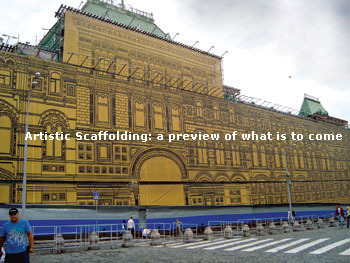
Of course, the moment we chose to park ourselves right in the middle of the square, where a full 360-degree turn would give us a multi-hued view of all the various structures, it began to pour. We had with us navy blue grandfather umbrellas, courtesy the hotel, which popped open as soon as the clouds overturned their misery onto us. We made a beeline for the first available entrance – it turned out to be GUM (pronounced ‘goom’ to rhyme with ‘doom’) mall – the official state department shopping centre of Communist times, which is now home to the top designer brands of the world. Irony hasn’t even begun to rein her wicked head; as we walked past the rather empty chi-chi stores and marvelled at the architectural wonder that is GUM, with its wired sky-lights and fountains, we found ourselves at a nice (dry-looking) café. We settled at a table on the sidewalk, well-covered and protected, and upon emerging hungrily from the rather American menu, we found ourselves staring at the simplistically designed Lenin’s mausoleum (Communist leaders were mummified), across the square. Lenin (or the alleged wax copy of his body) lies in a crystal casket and the mausoleum is faced with red granite (for Communism) and black labradorite (for mourning), essentially a pyramid composed of cubes.

Russia22

On the one end is the colourful St. Basil’s Cathedral (originally named Cathedral of the Intercession) built to commemorate Ivan the Terrible’s capture of the Mongol stronghold of Kazan. Ivan is known to have ordered architects to be blinded when a beautiful job was done, so that it could not be replicated elsewhere. The bright colour (obviously touched up and repainted recently) stands as a testimony to the tears of blood that must have run to create this lovely structure of domes, cupolas, arches, towers, and spires. We sat in silence, consuming our burgers, and tried not to think about the extremely long line that snaked across the other side of the Kremlin wall, extending a mile or more out, people milling about, waiting to get a chance to see – or pay their respects to – Lenin. I found it disconcerting to be observing this from a capitalist mall with all its trimmings housed in what was previously a communist-state driven shop: an irrational depiction (possibly unintentional) of the clashing ideologies and conflicting vision or state of the country. Were we sitting at the confluence of a truly open economy, has tourism changed all aspects of Communist philosophy, or were we a part of a bizarre Absurdist drama?

As we entered the haloed precincts of the Kremlin, there was a sense of awe that engulfed me. Unlike the Red Square that feels like a candy land, the Kremlin is more sophisticated and sprawling, with a variety of architectural forms visible. What you see from the Sophia Embankment leaves you with no clue of the self-contained city inside – palaces, armories, churches and a medieval fortress. The world-famous Kremlin is the fortress and residence of the Russian rulers. With Ivan the Great (1462-1505) at its helm, Muscovite rule extended over all of Russia, and the Kremlin became the seat of Russian power. Its stone walls were graced by the magnificent Cathedral of the Assumption, where Ivan defiantly tore up the charter binding Moscow to Mongol rule. Over the next two centuries, until Peter the Great transferred the capital of Russia to St. Petersburg, the Kremlin served as the central stage for the magnificent and occasionally horrific history of the Tsars. Secret tunnels exist below the Kremlin, whispering tales of a different time, of a time that is best left to history, conspiracy-cinema and careless whispers. The Cathedral Square however, is one of the most exquisite parts of Moscow: dotting the Square are cathedrals, towers, and palaces that together constitute almost the entire history of that period.
Russia01

You can study Russian history while walking through Moscow: the buildings are deserving of adjectives like beautiful, ugly, ridiculous and gorgeous. Moscow has grown over the years and therefore reads likes pages of a history book and marks time, unlike St. Petersburg, which is of a particular era and is elegant and poised. Our tour guide didn’t fail to point out memorials for Indira Gandhi, Mahatma Gandhi and Jawaharlal Nehru that exist to remind one of the close relations between the two countries. Besides the Kremlin and the Red Square area, the war memorials, and the Cathedral of Christ the Saviour, the most iconic architectural elements that appear as you pass through various parts of the city are the ‘Seven Sisters’ or ‘Stalin’s seven wedding cakes’: the seven towers of Moscow (including the Ministry of Foreign Affairs and the Moscow State University), designed in Stalinist style. Some apartment buildings are like those in Germany: self-contained buildings furnished for Kremlin employees, observed by the KGB. It is not a glass-and-towers city like Shanghai or Hong Kong. It is a city where the architecture and the walls speak of history, a history that is also reflected in the eyes of the people.
Russia14

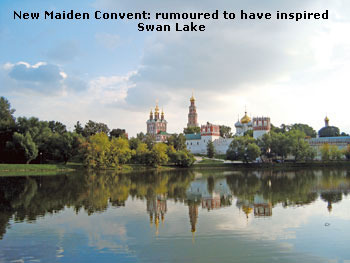
The Sparrow Hills are possibly one of the loveliest parts of Moscow: working as an observatory or viewpoint, with the entire city laid out before you – from where you can see the stadium, university, all the towers – looking lush and green, and not really a relic of the past. The view describes a city that is eminently like any other Eastern European one, well-maintained and advanced. But the most beautiful place, by far, is Moscow’s best-known cloister, the virtually intact New Maiden’s Convent (Novodevichy Convent, also known as Bogoroditse-Smolensky Monastery), proclaimed a UNESCO World Heritage Site. It is a dreamy, magical place that is lit up by night, with swans gliding along on the lake. Legend has it that here Tchaikovsky was inspired to write Swan Lake. Though, unfortunately, today, there are no swans here in sight – only ducks. Is that significant?

The metro is akin to being the underground kingdom of the Soviet. The metro runs every 90 seconds during rush hour, with nine million people using it daily. Built in the ’30s and ’40s by world-class architects, as a part of Stalin’s five-year plan, some of the beautifully designed metro stations are protected by UNESCO. It is actually quite a pleasing exercise – much in the manner of visiting and spending a day at an art gallery – to hop from one metro station to another.

Running deep into the ground – the escalators down can be intensely steep and extraordinarily long – there is an artistic treasure-trove hidden in its subterranean depths. You can find baroque-style and Kiev-inspired stations, some outstanding examples of socialist realist art and those with mosaics, framed art, sculpture, spectacular chandeliers and war memorials. During the war, some were used as bomb shelters. There is actually an entire ‘art train’ – painted from the outside with works of art hanging inside. Each station is very different from the other. The station near Revolution Square, for instance, has sculptures of dogs, where the snouts are polished regularly because students keep touching the snouts for good luck before exams. The metros form a particularly interesting rendezvous spot for couples: I noticed a tall, well-dressed woman meeting her beau who was waiting for her with a single, long-stemmed flower.

All along, as with other parts of the city, you need to watch out for thugs and pickpockets. I do indeed speak from mild experience, as we stepped out from the metro and found ourselves jostled, with a loud scream and a girl falling roughly against my husband, who looked positively startled. Turns out, the girl was in the process of getting her purse picked by a group of enterprising gypsies, and luckily for her, she felt the pick. Raising a hue and cry, a genial fist-fight ensued, accompanied by shrieks and growls, with policemen arriving on the scene double quick. The gypsies decided to show the policemen who’s the boss, and got whacked right back in return, with an ensuing chase up the metro steps. Just another day on the metro. Yawn.

It is peaceful and quiet on the weekends and overcrowded on the weekdays. Muscovites prefer to stay in summer cottages outside the city on the weekends, in the countryside. Moscow is an exorbitantly expensive city, even for the locals, and there is a huge disparity with respect to money, leading to crime and violence, even racist attacks. There are expensive malls housing top-brand shops, an exclusive high-life that glitters by night. It is a city that seems to be trying to fit into the new European capitalist scene, but it is not yet there. The women are some of the most beautiful in Europe, nay the world. Young women are overtly sexy riding on sky-high heels, skinny jeans/attention-grabbing leggings/ miniskirts, long hair and sheer shirts that scream for attention. Really, the heels and the legs are longer than the buildings. I noticed my man couldn’t take his eyes off them. Note to self: No point bothering. These women are beyond compare.

It’s not the best idea to explore town alone, unless it is a well-known bar or linked to a respectable establishment like a big hotel, particularly since no one really gets grooving until post-midnight. You will find nightclubs and dining halls made out of old bomb-shelters. When we visited, there was a happening spot called the ‘Garage’. Irony, irony everywhere, not a drop to drink. There are constant reminders of the old world in Moscow: they are either embracing change or mocking the old guard with the new life. I have yet to discover which one it is. Even a Starbucks (right around the corner from our hotel), which is generally buzzing with capitalist hope, wherever it is located, appears dark and dismal…or maybe it is just that time of the night and my imagination is playing cultural tricks on me.

IN THE CHERRY ORCHARD
extra pickings

The Russian circus: it’s like any other, but fun because of the acrobatic feats. Animals, humans and talent blend in a colourful mix of bright music, costumes and showmanship.
Spend a leisurely day checking out the Pushkin Fine Arts Museum for Impressionist and Post-Impressionist paintings.
Don’t miss one the world’s finest private collections of art at the Tretyakov Art Gallery (19th and 20th century collection of Russian avant-garde).
Alexander Pushkin is a really big deal. Check out the Pushkin café, over-rated but definitely worth a cuppa in its dark, green interiors lit by red lamps.

ST. PETERSBURG
looking forward

Russia07

Say what you like but a train often beats taking a flight hands down. And in Russia, like most of Europe, it is particularly charming to take the super fast trains between cities, because you get a chance to check out the countryside as well. And if you have time, there are cruise ships that travel between Moscow and St. Petersburg (or St. Petes as it is casually known), where you can visit small towns along the way. Formerly known as Leningrad, the city is just plain delightful with its canals and European-style buildings. And the people are super friendly. (Tell them that, and they bask in the glory – there’s a competitive streak that runs between Muscovites and Petersburgians.)

Looking at St. Petes, you immediately feel a sense of satisfaction – there is an aesthetic appeal and more often than not a sense of proportion in every street, line, building and structure. It is as if the best European minds took a policy decision to make this a city of artistic reckoning, and proceeded to do just that. The Italian designers, hailing from sunnier lands and finding themselves in duller space with the grey weather of St. Petes, took up the brush with determination, running paint in colourful hues across the buildings. In fact here, there is a sense of rightness in seeing the joy of a local wedding on the beautifully serene embankment facing the stunning, sea-green coloured, very large and very old museum of art and culture, the State Hermitage (think over 3 million works of local and international artists), as the wedding party makes merry with inebriated song. Or on the grounds of the spectacular Peterhof Palace and Park with costumed guests, amid the fountains that intentionally rival that of Versailles, with what the locals claim to be better natural water pumping and drainage technology invented in the 18th century. Or following tradition, with the groom carrying his new bride around the Bronze Horseman Statue….

It’s no wonder that after their forefathers’ experience during invasion attempts, the French and the German tourists are the ones who are particularly at ease visiting St. Petes when it is at its most beautiful in the winter, under snow with the River Neva frozen to one metre of ice that you can walk or skate on, with temperatures dipping from -10 to -30 degrees. Rivalling the winter, for people like me who prefer warm sunshine and skid-less walks, is the spectacular and tourist-happy time of ‘white nights’, when by virtue of its proximity to the North Pole, St. Petes experiences a span of continuous daylight (variably around early June through early July). Having the chance of revelling in the city’s beauty, continuously day-lit, fired many a poetic imagination: think Fyodor Dostoyevsky’s White Nights for one, which in turn, influenced international and Indian cinema (from Manmohan Desai’s Chhalia to Sanjay Leela Bhansali’s Saawariya).

The river canals really make all the difference. Slipping under low-hanging mini-bridges (and nearly getting my head slapped into one while taking a bottom-angle photo of the Church of the Saviour on Spilled Blood), moss-covered stone, large sculptural delights and past occasional official-looking Communist-style buildings (with the double-headed eagle coat of arms) holding fort with beautiful European ones, you need an English-speaking tour guide along, as hopping onto a canal tour from the Nevsky Prospect will land you with a Russian-language one (we discovered to our dismay). And at night, when there is night, the ‘Venice of the North’, which comprises 42 islands and is connected by eight waterways, opens up its drawbridges to let cruise ships and boats pass through. Lit up, it’s quite a spectacular sight.
Russia27

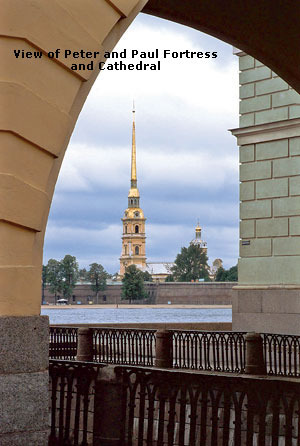
St. Petes, while magical by itself, is known worldwide for its exquisite palaces, built in baroque or neo-classical style. What I find quite amazing is that while the Communists introduced atheism (anyone going to church would have to report to the KGB office) and were severely against symbols of royal power and the excesses of the royal courts, the Communist government spent millions of dollars in restoring these royal palaces and the works of art within, which were burnt to the ground, destroyed or looted during the Revolution, world wars and invasions. The city has its fair share of synagogues, mosques, cathedrals and Buddhist temples. Two lovely examples of cathedrals are that of St. Isaac’s, the largest in the city; and that of Peter and Paul, built inside Peter and Paul Fortress, considered the first and oldest landmark in St. Petersburg.

Talking about works of art, you can spend three years in the Hermitage and not end up seeing all that it has to offer. What is particularly striking is the Raphael Loggia, rebuilt exactly (by Russian masters among others) according to the original Italian model in the Apostolic Palace in Rome frescoed by Raphael. As chambers roll into each other, each one more striking than the other, you feel lost in a space and time that is of another world or era. Ceilings that are replica of floors, floors with 16 kinds of wood…and we haven’t even got to the sheer magnificence of the royal palaces yet. While there are many to check out (each requiring half day or a full day) located in the ‘Imperial suburbs’ (not including Tsarskoye Selo) three good examples are the classical Pavlovsk Palace, baroque Catherine Palace and Park and the famous Versailles-like Peterhof.

It feels distinctly incongruous leaving the old-world charm of St. Petes by the industrial road (which has a famous porcelain factory) and taking the highway, which has plain cement buildings marring it to make our way to Catherine Palace and Park. Catherine’s Palace is a brilliant example of 18th century baroque. Built earlier than Pavlovsk, it was also restored to its current finery, with immaculate French landscaping in the gardens. We walk into the Amber room and we discover that the amber was looted from this room during the war, and later restored – so cleverly that we can barely tell where they ran short and painted stone just like it!

Peterhof is sheer magnificence. You feel that you can’t feel more wonder after having seen so many palaces and taken a long turn around the Hermitage, and then you realise that the best is always saved for the last, cutting across to a part of the grounds from where you can see the Gulf of Finland. Lying south-west of St. Petes, arriving there means being greeted by enormous, beautifully-landscaped gardens, memorials, and numerous fountains. After so many years, it is still being restored (the process that began after the Second World War) from original sketches, paintings and plans.

As we drive on the beautiful Moskovsky Prospect (‘the road which leads to Moscow’), a 10-kilometre road that ends in St. Petes’ historical centre, we pass striking examples of Stalinesque and Kruschev-style architecture. As exemplified by the Victory Park bordering the street – where 75,000 people were buried during the Second World War – scarred by many wars and many attempts at invasions (the Russians are proud of the fact that these attempts have been largely unsuccessful), you can’t miss the war memorials that stand out across the city: the old metro station built in 1957 after the Second World War, decorated with Soviet symbols; the Aurora World War II vessel which you can explore; and the Field of Mars, a graveyard for World War victims.

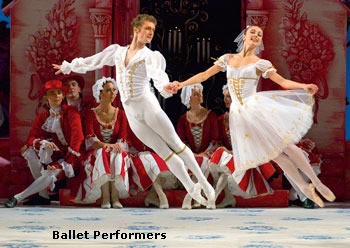
You return to the city having exhausted your eyes, nursed your emotions and wearied your legs taking in the finest art and learning about the ravaged history and have yet to experience a world-famous Russian ballet performance. Summer performances are reserved for the tourists, October being the best time for ballet when the more experienced troupes are back in town from summer break. The Fine Arts Square in the city is replete with theatres and museums (particularly the famous Russian Museum), and many a quaint shop in which to buy curios while you wait for the theatre doors to open.

A little girl stands on her toes and pirouettes, spinning faster and faster, until she appears like a blur, a speck on the stage. She stops, leans backward until her back is a perfect arch and if she moves even a fraction it will snap like an elastic band. And that, is the best way to describe the experience that is St. Petersburg – a fabulous cultural experience, breathtaking in parts, dizzying with its extraordinary beauty and somehow, always young and receptive. Words can’t do justice; you need to live the experience.

Russia08


FAR & AWAY

Getting There Aeroflot flies direct from Delhi. You can also connect via airlines like Finnair and Emirates.

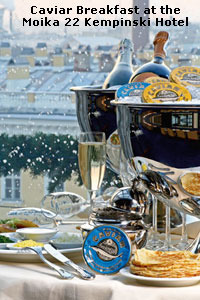
Stay While there are many good hotels, including excellent local ones, the Kempinski chain is highly reliable and perfectly catered to tourists in terms of location, cuisine, service and language; with most European tourists staying here. The Baltschug in Moscow is one of the best hotels in the city, while the Moika 22 in St. Petersburg, housed in a Petersburg Mansion on the Moika river embankment offers a spectacular view of the historic part of the city from its rooftop restaurant. Choosing a common chain for the two cities is also advisable because the consular paperwork required can be handled simultaneously.
Russia06

Eat A traditional meal is vodka with the meal including salad, soup, meat-and-potatoes style mains and dessert. Because of the weather, people prefer strong alcohol. Try the Tsar’s breakfast: orange juice, Russian champagne, red and black caviar, smoked sturgeon, marinated salmon with extras; and a version of the Russian sandwich: Bachmann salmon tartar with caviar, lettuce and chives on bread. When in St. Petersburg, check out The Other Side, a lively watering hole for expats run by a New Yorker; Podvorye (near the Pavlovsk Palace) which is designed like a traditional Russian village and has a menu offering Putin’s favourite meal; the Palkin which is considered to be the city’s best and most splurge-worthy restaurant; and Flying Dutchman which is a ship-restaurant (including a dance club and gym to burn calories) on the Neva river.

Travel Must-Knows
Don’t even consider backpacking in Russia. If you are not going as a part of a convention or an organised tour, it is recommended that you stay at a well-recognised hotel and link yourself with an accredited English-speaking tour guide. The foreign police/militia can approach anyone (particularly a tourist) and ask to see their papers. Your passport must be with you at all times.

Take Aways

Russia10

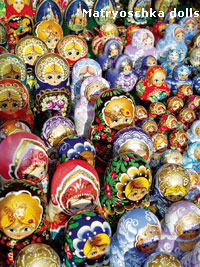
Matryoschka dolls, vodka, Russian chocolate (Krubskya which is a St. Petersburg brand), caviar (Osetra, Beluga or Sevruga), a woolly Russian hat, artistic keepsakes of the Russian masters, quirky postcards that raise an eyebrow at Communism.

Travel blog: Paradise Found (Maldives)

22 Monday Feb 2010

Posted by sitanshi talati-parikh in Publication: Verve Magazine, Travel Stories

≈ Leave a comment

Tags

Food, Interviews: Travel, Maldives, Taj Exotica, Taj Maldives, Verve Magazine, Vivanta Coral Reef

Published: Verve Magazine, February 2010

A weekend celebration can start out incredibly wrong and become magically perfect, finds Sitanshi Talati-Parikh, at a recent jaunt where she revels in the pristine beauty and gastronomic delights of the two Taj Maldivian properties


Maldives03

Turning a decade older in one year, nay overnight, is never easy on the heart. As others in my new age bracket mourned in solitude, I figured that it would be perfect to throw a rather irreverent bash and, right after, take off in fabulous style to a destination of no dispute and great repute. Finding this place was easy – the image, torn from a lifestyle magazine, was tacked up in my husband, Sahil’s, den. As he worked, he rested his eyes by looking up at the beckoning azure waters, reflecting the sunlight in a way that only a location so close to the equator could – a place where an elixir of youth could be snatched for just a little while.


When we got there, that is. Did I mention that our flight to paradise got embroiled in the sudden cyclone that hit the coast? That twisting and turning (and it just wasn’t my stomach) we got to Colombo airport, only to realise that our connecting flight to Male had already left – without us. Day one of azure waters down. Hello, rotating fan, airport odours and Sri Lankan beetroot curry.


When we arrived at Male International Airport (15 hours later), we found the Taj staff and speedboat awaiting us, with smiles and refreshments. We took off, cutting through the inky waves, with a sense of sheer relief. And then we felt it. The humungous wave that nearly knocked us off the cushioned seats and made my stomach lurch in the way that no horror movie or sexy man ever had. And another. And another even bigger one. Apparently, the cyclonic weather had turned the still-as-a-lake-waters of the Maldives into a raging dark monster that threatened to eat us alive.


This really wasn’t how it was supposed to be, I told myself. Sahil reassuringly clutched my hand, and the general manager of the Vivanta Coral Reef, Allwyn Drego, who received us, also emphasised the fact that things were normally very different. Escorted to our room, I was touched to see the remnants of balloons and streamers lining the door. A reminder of what the day was to have been – a celebration.


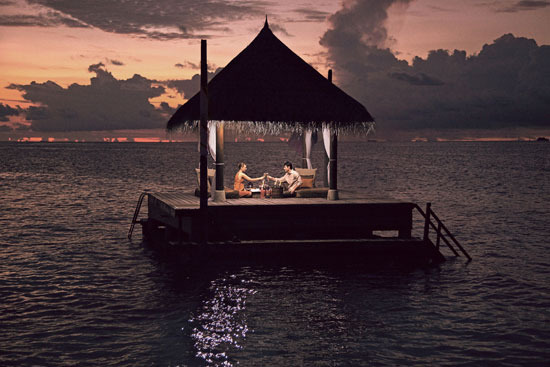
Weary, but making the effort to change for dinner, we found ourselves placed by the rouge waters, on the beach, touched by a wispy breeze that floated with the promise of better things to come. Executive chef Vikas Milhoutra aroused our senses with a perfectly proportioned four-course candle-lit tasting menu. Think green pea mash with soya and aged balsamic foam, rice-paper wraps of enokitaki, brioche crouton with tossed mushroom and goat cheese salad, grilled Maldivian snapper, polenta with ratatouille of vegetables and feta with beetroot foam, and a crème brulee taster. Sigh. I felt like the best part of my life had just begun.


I believe we brought the sunshine with us. The next day awoke spectacularly. Time began to pass us by in the haze of snorkelling and finding a magical world of stunning multi-hued coral gardens that the island was a part of, scuba-diving lessons, sea-plane island hopping, deep-sea fishing, sun bathing to dry off, and copious amounts of delectable food – excellent sushi, Australian wagyu beef and Tasmanian lobsters cooked to a tantalising finish by the devilish Teppan chef Allwin. Stargazing (it’s unbelievable how many celestial bodies are in sharp focus from this point of the world) over post-dinner liqueurs and single malts, Drego and his charming wife explained how these blissful island-hotels in the Maldives had to be self-sufficient entities. The Taj Maldivian properties import the freshest ingredients from varied international locations, while also maintaining their own waste-management and bottling plants on-location. It’s not surprising how quickly the island had begun to feel like home – like everything one needed, existed in this one microcosmic place.


As we made our way on beautiful, still waters, coasting along with the setting sun, to the other Taj property – Taj Exotica Resort & Spa – I wondered how the two properties would differ. While the Vivanta Coral Reef’s genial vivacity, with its music-filled environs and bright décor, is a perfect uplifting getaway, the Exotica is a lovely, long slim piece of pristine floating land that in the midst of overhanging trees and outstretched shrubs, fiercely protects privacy and your need for seclusion. Everything was about discovering each other: even in-room dining was a truly cherishing experience. As we sat in plush robes, in our sprawling lagoon villa, we were truly pampered by the head butler, Himanshu, who laid a table with the finest linen and cutlery, chocolate sculptures and flutes topped with heady bubbly, and enveloped us with mood lighting, piped music, fresh floral scent…always anticipating our every need.


A champagne breakfast set up on a small sand bank was located far enough from civilisation that everything else became irrelevant. We were spoilt for choice (think a dozen different kind of egg preparations) and it was the perfect way to begin a day that you wished would never end. If love makes you hungry, the options here are unlimited. Under the supervision of F&B director, Bjoern Hiller, our taste buds were tantalised: from the chi-chi progressive world cuisine restaurant The Deep End (must-have the lobster ravioli) where the genial sommelier Luigi paired the perfect wine to match mood and food, to the interactive menu prepared by renowned chef Sandeep Narang, where our palate was intricately challenged with as many courses as we could take, picking from nearly 20 cuisines. And if while exploring the island, we were to discover a perfect spot for an intimate dinner, we would find it transformed with blazing lanterns and sunken candles to light the way – our own exclusive dining experience. Conversation became irrelevant; the experience leaves me breathless at the mere reminder of it.


There remains something intrinsically Taj about these two island retreats – the open, friendly charm of the staff in perfect combination with the privacy and space afforded by them, the attention to detail – like the paved sands of the entire island that were quietly in place every single day.


Maybe it was the uncompromising beauty of the locations, or the richness of colour (that our hazy city-life makes drab and grey), or the sheer understated luxury of the environs that made one feel desperately pampered – spoiled even, as if we were the only ones that truly mattered here, or maybe it was the fact that here, no one else mattered to either of us. It completed us.

Travel blog: Fine Lace and Liquid Chocolate (Bruges, Belgium)

22 Tuesday Sep 2009

Posted by sitanshi talati-parikh in Publication: Verve Magazine, Travel Stories

≈ Leave a comment

Tags

Belgium, Bruges, Europe, Flanders, Interviews: Travel, Verve Magazine

Published: Verve Magazine, Travel, September 2009

Its charming canals lined with low-hanging trees, moss-covered stone houses with flame-coloured roofs and sleepy cobble-stoned pathways make for a great honeymoon destination, far from the madding crowd. Sitanshi Talati-Parikh pays a visit to the world’s chocolate capital, a UNESCO world heritage city, and the once-cultural capital of Europe, Bruges, in Belgium

Burges02

I found romance where I least expected it. Bruges shattered my impression that palatial beach villas are the mise en scène for a passionate interlude. Tucked away into the heart of northern Belgium, in the Flanders district, lies a egg-shaped fairy-tale town that weaves a tale of charm like it would into the fabric of its famous handmade lace. It is where the legends of knighthood and the mystery of goblins live in the gothic, baroque pieces anchored to the old world. I can imagine the peaceful spirits from Harry Potter prowling the aged alleys of Bruges. Not surprisingly, the first book in English ever printed was published in Bruges by William Caxton and much fiction and numerous movies (think In Bruges) have been inspired by the city. The gothic spires breathe out folklore that can only be confirmed by venturing into the aged great stone doorways, by standing in the centre of the courtyard and being enveloped by the sounds of the past.

Turn back the clock to the 15th century, a truly luxurious time for Bruges. The Duke of Burgundy holding court, many a fabulous soirée in the palaces rich with Flemish oil paintings (recall Jan van Eyck) and aglow with carpets spun with real silver and gold threads, glittering in the evening candlelight. It must have induced a stupor so deep that between 1600-1800 Bruges ‘fell asleep’ and it was only in 1892 that it experienced an awakening. At this time Bruges-la-Morte, a short novel by Belgian author Georges Rodenbach describes the city as dark, poor and ugly. While the locals were not thrilled, the tourists flooded the place scoping out the romance in it. Bruges’ romance lurks in the alleyways, where the past seems to want to speak to you, but the stone buildings stand quiet.

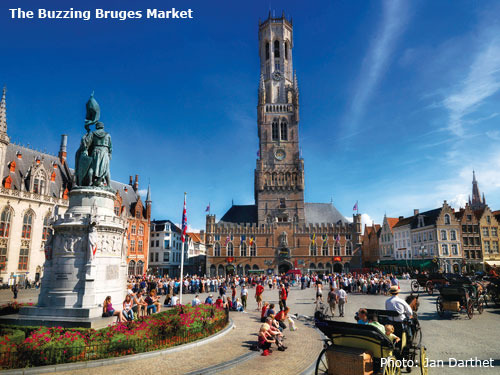
‘Belgians have a brick in their stomach,’ goes an old saying – ‘they want to build or own a great house to impress’, says our tour guide, Pol Verschuere, a wizened gentleman who speaks with a thick Flemish accent, muffling and rolling his words and missing syllables. It is a soft, fluffy language, of another world. Leaning on his umbrella, he points out to the gothic architecture, which was later changed to baroque, and to the rococo houses. Even the foundations are old world: the brick houses ‘decorated’ with natural sandstone are held together with non-corrosive bones of sheep. Three stately spires represent the Bruges skyline, one of which is the 13th century Belfry, housing a municipal carillon of 47 silver-toned bells. Climbing the steep and narrow 366 steps up the 83-metre tower (which tilts to one metre to the east) is a tourist must-do, if only for the spectacular panoramic view of the city below.

Burges06

After the climb, we took sustenance from one of the two fries’ stands below the Belfry (they have been competing since 1896). Their fame precedes them – the famous hot fries topped with cheese were overrated, and in true Belgian-style hospitality, we found ourselves shelling out extra euros for ketchup and any other accessory that may traditionally accompany the humble fry. Once revived, we moved onto the Church of Our Lady with a 122m brick spire, which houses the sculpture Madonna and Child, believed to be Michelangelo’s only sculpture to have left Italy within his lifetime. Our candle deferentially joined the others flickering in the hallowed interiors, glowing with a sense of awe at standing before the work of one of the world’s greatest artists.

Burges05

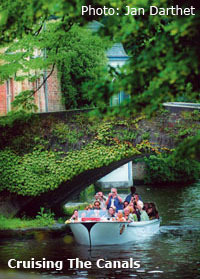
With the same sense of inner quietness, we cruised down the canals of Bruges, ‘the city’s arteries’ as tucked-away gardens, picturesque bridges and quaint – and often oddly shaped – stone homes unfolded before us. While the boatmen are not Venetian and probably not of musical inclination, the romance of the little waterways lies in the stillness around. Notwithstanding the loud warnings to duck as an impossibly low-hanging bridge would appear; and as one, the entire boat-full of tourists would bend over double as we passed under a dark, mossy alcove. Our boat slid quietly past a very important meeting of birds, past a troop of school kids who stopped to wave and turned into a little nook where a little beer bar and its nondescript customers were abruptly exposed.

Bruges is a great thirst quencher with its local beers such as the Brugse Zot and Brugse Straffe Hendrik, which are still brewed in the city itself, in the only remaining brewery, Halve Maan Brewery (1856), of which you can take a guided tour. At night, we strolled down to the Cathedraat, one of the stonewalled pubs, with outside seating, facing the courtyard. Here, my husband and I felt a sense of quiet companionship as we sipped away and watched the world go by: the late dinner seekers standing before the pubs checking out their daily specials and moving on indecisively. In sharp contrast, inside the bars, we felt like we were thrown into an American frat house or a British pub – with the heady combination of testosterone, beer and enthusiastic sports viewing.

While walking around the lively market place (central square), hunger pangs led us to make the mistake of eating at a commercial restaurant like De Carre (studiously avoided by locals and well-informed tourists alike), which left a bad taste in our mouth. The soft, fresh Belgian waffles off the street corners sweetened our palate – they were in a word, spectacular. If you like living life on the wild cocoa side, try the liquid chocolate, tobacco chocolate, chocolate lipstick or a chocolate sniff box (first ordered by the Rolling Stones) at Chocolate Line. Or the 44 kinds of hot chocolate (think banana and ginger – or not!) at Bar Choc. If that’s not enough, you can really get adventurous with their stewed meat in beer-and-chocolate sauce, with baked potatoes. I confess I didn’t!

As we spent a couple of days absorbing the lifestyle of the local taverns, intermittently sneaking out for some excellent takeout Chinese right next to the Kempinski Hotel Duke’s Palace, we were more than ready spend a sophisticated night out on our last evening in Bruges. Dressing up and calling a car to take us to the Michelin-starred De Karmeliet, we spent hours with much local wine, an extensive cheese platter and Chef Geert van Hecke’s fine dining experience of French with Flemish twists. (Interesting choice of cuisine when you recall that in the 1302 battle between the two countries, a whole regiment of French soldiers were murdered in their sleep!) While whispering such sweet nothings into each other’s ears, we found ourselves rubbing shoulders with the most exclusive patrons, all of whom engaged in muted conversations that floated like a whisper in the many alcove-like ‘dining rooms’ spilling into each other.

Bruges left us with a heightened sense of ‘other world’, where crass meets sophistication, where the old world meets the new, where charm lies in the stony street corners, where lovely boutiques are manned by surly Belgians, where exquisite tastes linger, take a hold and draw you back for more. Having been home to freedom fighters, rulers, mathematicians, engineers, theologians, poets, scholars, painters, writers and diplomats; whether it is a day or a weekend spent here, the city brings the past forward into the present.

IN BRUGES

In 1277, the first merchant fleet from Genoa appeared in the port of Bruges, making it the main link to the trade of the Mediterranean.
Diamond cutting actually originated in Bruges, before gaining a stronghold in Antwerp.
French fries are a Belgian invention. It is believed that because the Belgian commanders during World War I spoke French when they baked their fries, their allied commanders tagged them as ‘French Fries’.

It is a Museum Haven! Fries Museum (History of the Potato Fry), Diamond Museum, Lace Center, Lamp Museum (History of interior lighting, with the world’s largest lamp collection), Chocolate Museum, Groeninge Museum for the Flemish Masters and Folklore Museum…among others.

FAR AND AWAY

Getting There Bruges is connected to all major European cities by train, ferry and motorway. Flights get into Brussels airport, from where there is a transfer to Bruges by train.
Take Aways Genuine Belgian lace is rare and very expensive. The market is flooded with many cheap replicas. Belgian chocolate of all kinds is a must, especially truffles. Maybe an original Flemish oil painting or two?

Bali’s Haute Brigade

20 Wednesday May 2009

Posted by sitanshi talati-parikh in Fashion & Style, Interviews (All), Interviews: Lifestyle, Publication: Verve Magazine

≈ Leave a comment

Tags

Bali, Bali art, Bali boutiques, Bali expats, Bali fashion, Designers, Fashion, Interview, Interviews: Travel, Kuta, Lifestyle, Seminyak, Ubud, Verve Magazine

Published: Verve Magazine, Life & Travel, April 2009
Photographs provided by the designers and artists themselves. All photographs are individual copyrights. This blog post does not assume any credit for the photographs.

While others sun, tan and shade themselves, Sitanshi Talati-Parikh gets up close and personal with some chic entrepreneurs and designers in Bali who are creating a global brand for themselves.These expatriates come together to create a fabulous confluence of talent and tradition, where international eyes meet local hands

A hop, skip and splash away in a tropical microcosm of creativity, one can discover a haven for those searching for a different and better life. “A mysterious and magic place charged with tremendous powers of creation and destruction, growth and decay, harmony and struggle,” says expat Susi Johnston. It was as far back as 1920s when artists and photographers moved to Bali inspired by the unselfconscious Balinese women working the fields, and the spectacular tropical environment. It wasn’t long before Bali became the centre for creative ambition. Now, with over 15,000 expats, the island is exploding with a fountain of talent that is simply waiting to be discovered.

While international brands lie low, it is the local labels that take centre stage, run by enterprising young people who are clever enough to spot the advantages of using the unentrepreneurial local talents in a more marketable and international manner. As I speak to many of the people who have moved there, I find that they have discovered a style niche – inspired by the lush tropical environment, amiable people, easy-going life and lower standard of living, they have found opportunities on this island, or more correctly, created opportunities on this island that they may not possibly have had in their home town. The “powerful” and “energetic” island is more than home for most of these “accidental entrepreneurs”. It is also a livelihood and a lifestyle.

And the locals play an important part – every expat I met unreservedly states that the Balinese people are superlatively talented. Excellent at working with their hands, quick at moving forward with traditional techniques and themes that have been handed down through the ages, they however, lack the ability to create an international-style brand and the vision and entrepreneurial ability to take it forward. Is it a happy marriage then? Possibly, though the challenges are many. Work stops unaccountably and a sense of professionalism is lacking. Language is another huge barrier. But these are small bumps on the style highway, as many of these expats are finding fruition by getting noticed by top design houses, designing for billionaires’ homes across the world, and finding a space in a global arena. While some bring global experience to the table, all have a keen sense of creativity and style.

Through many days of exploration, in between afternoons on the beach and motorbike rides through Jalan Oberoi, Seminyak’s shopping area filled with chic boutiques; tête-à-têtes over ‘Bali coffee’ at the boutique Elysian Hotel, wanderings through Bali’s art town, Ubud, cocktails at Amandari, watching ceramic production in action and bargaining with the jewellery vendors, I came across a phenomenon of style, determination and hard work.

Janet De Neefe
Writer, entrepreneur and restaurateur
Restaurants: Casa Luna and Indus, Ubud 

Bali21


It is not difficult to imagine Janet De Neefe as the face behind the annual international Ubud Writers & Readers Festival that is now in its sixth year, and has been instrumental in putting Ubud, Bali and Indonesia back on the travel map after the Bali bombings of 2002. “The aim of the festival is to give a voice to the many talented Indonesian writers by placing them on a world stage, alongside the likes of Vikram Seth and Michael Ondaatje.” Vikram Seth proclaims that his presence at the festival was merely because of Janet’s untiring persistence. Janet’s love affair with Bali began on her first holiday with her family, and on her second visit she met her husband Ketut. She hasn’t looked back since, having spent 20 years in Bali.

Roots Melbourne, Australia

Bali Years 20 years in Ubud

Creative Space Running two restaurants and authoring a book of her personal journey in Bali, partially inspired by the local cuisine and traditions called Fragrant Rice (2003)

Personal Style An eclectic take on the local designs: “Exotic Asian and Paris chic, with a bit of Spanish thrown in. I adore Indian textiles but also love Baroque style and Chinese and Moroccan embroidery.”

Challenges “Amidst all the challenges or misunderstandings, Bali has provided me with an exceptional life that most others would only dream of. I live in a generous, supportive community who value the importance of family, neighbours and community. So many places in the West have lost this. I never feel lonely or isolated and my children are treated with respect.”

“My love affair with Bali began in 1974, with my first visit on a family holiday when I was 15. I remember landing on the shores of a garden paradise, surrounded by waves and nodding palm trees and when the plane doors were flung open, the warm heavy air, mingled with fragrant frangipani and the sweet smell of clove cigarettes, embraced me like a long lost friend.”
– Janet De Neefe, Fragrant Rice


Made de Coney
Designer and boutique owner
Label: Lily Jean, Seminyak, Kerobokan (Kuta), Nusa Dua

Screen Shot 2017-07-25 at 4.11.20 PM

Made de Coney received an inheritance of US$ 5000 from her father (who lived in Bali) at the age of 23, and without thinking twice, used it to rent a shop and create the Lily Jean label. Influenced by international fashion and inspired by the local Bali artisans, Made uses imported materials and local hand work, especially in embroidery and batik. “The same artistry they use for their religious ceremonies are applied in every artistic endeavour.”

Roots Born in Bali, she spent a decade of her childhood in Brazil and studied fashion in America.

Milestones The label is available in 12 countries, and with five shops in Indonesia, Made can look back and say, “Now I realise it is quite an achievement!”

Customers “They are women in their teens who love the playfulness of the designs; they are women in their 20s who are seeking personal statements to make with their style; women in their 30s who embrace the need for changing expressions of self; and women of every age who appreciate the delight of dressing for their own pleasure in beautiful garments that enhance their sense of self.”

Challenges “I’ve learnt to be very tolerant of religious holidays (Christian, Muslim and Hindu) and to cultivate my patience.” 

Bali24

The Lily Jean Label has soft, stylish street wear and highly glamorous cocktail dresses with important materials and local handwork.

Kirsty Ludbrook
Artist and designer
www.kirstyludbrook.com; www.ludbrookandludbrook.com

Bali22

Kirsty Ludbrook moved to Bali to set up a home for her three boys – so that they could experience a world beyond the suburbs of Sydney. “The idea was thrilling and liberating. Especially our boys living this crazy exotic life in their early years, one that is so different to that which they would have had in Australia!” While she discovered that her flair for sketches and painting could be translated into sophisticated murals using local batik techniques on cloth, her husband Richard, a fashion photographer, is building a studio in Bali to accompany the very large one he already has in Sydney. “When I first arrived here I immediately started experimenting in my art with the new materials and techniques available – particularly with the rich, lustrous colours that could be achieved in silk batik work. As a result, my art evolved, and I have been working on portraits which are created by appliquing and embroidering together individual pieces of silks.”?Her paintings get an audience at her solo show in the Biasa Artspace this year.

Roots Sydney, Australia.

Milestones Kirsty has successfully sold a design agency in Australia,?and has been named by The Bulletin Magazine as one of Australia’s top 10 creative talents in their annual Smart 100 listing.

Challenges “The hardest thing is the fact that the Balinese are such nice people. They don’t want to disappoint you or say no. More often than not, being told ‘not possible’ at the beginning would have proven a little more practical.”

Bali19

Kirsty Ludbrook’s silk ‘Art Kimonos’ are inspired from costtume design in Japanese Manga and action films, while the hooded kimonos are from Ninja characters – which sounds deceptive, as the finished product is feminine, soft and very sensual.

Michela and Marcello Massoni
Creative head and business manager
Space and Brand: Gaya Fusion, Ubud

Screen Shot 2017-07-25 at 4.11.26 PM

The first private contemporary art space in Bali was started by Stefano Grandi, an Italian entrepreneur, in collaboration with an Indonesian, Nyoman Birit. A young Italian couple, Marcello and Michela and their friend Giorgia Oronte were brought into the picture in 2003 with their background in sculpture and ceramics “to start a dream:? be able to be creative without limits and competitive and productive in an amazing environment.” With over hundred employees, Marcello manages Gaya Fusion, while Michela plays the creative head of the ceramics and sculpting division. Nostalgic about home at a time when Michela’s parents are visiting to meet the babies, they say that they “decided to move for the high quality of life, to give to our kids a natural living environment, to be creative without limits, to be inspired by the tropics and to be productive with capacities difficult to create in Italy.”

Roots Piacenza, a small town 50 km south of Milan, Italy.

Creative Space Gaya Fusion includes an art space showcasing local and international artists, a ceramic studio that exports and supplies to the top brands, including Bvlgari, Aman Resorts and Giorgio Armani Casa; private villas and spas with Italian-Balinese fusion architecture, and a restaurant offering Italian and Indonesian cuisine.

Challenges Dealing with Hindu culture, lot of ceremonies, beliefs, difficulty in finding a high level of professionalism.

Screen Shot 2017-07-25 at 4.14.00 PM

Using local products, Gaya Ceramics is always looking for new inspirations, as different clients mean different moods and designs. They make sculptures and unique pieces, while also producing nearly 5000 ceramic pieces a month.

Paola Zancanaro
Boutique owner and designer
Label: sKs or SimpleKonsepStore, Seminyak

Screen Shot 2017-07-25 at 4.11.33 PM

Paola Zancanaro hails from a long experiential fashion lineage. She studied fashion at the London College of Fashion, and began her career at Vivienne Westwood, in marketing, sales and events, then as celebrities’ dresser at Giorgio Armani, and finally at events at Prada, Milan. Ready for a change of culture, Paola considered Tokyo, but didn’t want a repeat of break-neck city life and chose Bali as her destination of choice. “I have been living on this amazing island for almost a year and half, its culture and nature are the reasons why I moved here.” She continued to work as a consultant for Prada events in Asia, while also becoming a part of a trendy boutique, sKs.

Screen Shot 2017-07-25 at 4.12.04 PM

Creative Space sKs – SimpleKonsepStore is the result of three Italian partners. All the sKs clothes are produced using antique Balinese techniques such as batik and silk screens. Paolo looks after the women’s clothes, while Mario Gierotto designs the menswear. Other accessories are from local designers and they also have exclusivity on Vivienne Westwood Jewellery.

Roots Born in Genoa and brought up in Alassio, Italy.

Challenges “Every day is a big challenge! You think you can do everything but when you get down to it, you realise is not that easy. Things do not get done quickly and as expected, but you can achieve amazing results by working with people who never stop smiling.”

sKs is a concept store where you can not just buy fashion but also find the latest gadget from Japan and real Italian design furniture such as the most iconic pieces from Kartell, Artemide, Flos and Alessi (brands that made history in the design furniture world).

Simonetta Quarti and Marco Lastrucci
Designers and boutique owners
Label: Quarzia, Seminyak

Screen Shot 2017-07-25 at 4.11.41 PM

Marco Lastrucci and Simonetta Quarti started Quarzia, a chic boutique on Jalan Oberoi, (the main shopping district in Seminyak) in 2005, when nothing besides rice fields existed in the area. Hailing from a fashion background – Simonetta was a textile designer and Marco a financial manager, they were looking for a change, and Bali seemed like the perfect option. “The freedom to express ourselves and the skill of the Balinese people” were great motivators to the couple who have spent eight years on the island. Inspired by the old traditional design, they give the fabrics an European sense of colour and design. They are not driven by “creative stress” – having to come out with new collections frequently. Instead, they believe in “eternal” clothes that are one-of-a-kind with great designs, cuts and style.

Roots Florence and Venice, Italy.

Challenges It is difficult for the local artists to be precise and manage to get the exact shade of colour required in creating clothes of international standards. “We are completely different from the local people, but we respect each other and we can learn from each other.”

Bali12

Quarzia makes one-of-a-kind clothes, where design, cut and style are very important, and where a pair of pants can be eternal.


Stephanie Robert
Designer, painter and entrepreneur
Maisonbulle Ltd. (www.mbulle.com)

Screen Shot 2017-07-25 at 4.11.48 PM

Stephanie has shifted through various creative interests and has entertained a relationship with the island since the early 90s when she came on holiday. “I loved the atmosphere and the endless possibility of creation and realisation the worker and their skills offered to one’s imaginative mind.” She returned to Indonesia to design, produce and buy a business she became a part of, for which she developed an interiors department, with the creation of a home textile and accessories line produced partially in Bali and India. Furniture took over textiles, and a sampling factory in Bali found Stephanie “enjoying experimenting, sharing knowledge and skill with a team of woodworkers, crafting beautiful pieces for single exclusive clients, architects, commercial decorators as well as large retail businesses.”

Roots France.

Design Style “Though my style would certainly reflect a great liking an admiration for the Scandinavian purist simplicity, mixed with an absolute love and fascination for the rough beauty of Asian road and country side furnishing and its practical laid-back attitude.”

Creative Space She is spearheading an online business, Maisonbulle Ltd. (www.mbulle.com) which an online catalogue of beautiful private holiday homes in Bali (and in the future globally), for which the main selective criteria is character. Specifically she recommends homes of designers, collectors, artists, philanthropists and travellers, whose homes reflect a unique character, to a similarly discerning set of travellers looking for a getaway. An editorial edition, Pulse, is soon to be launched. She also designs furniture and is a reclusive painter.

Stephanie puts her 15 years of experience travelling the world, particularly in Asia, into being a reference for “what is hot, stylish and worthy of attention”, with her online business Maisonbulle Ltd.

Susi Johnston
Art historian, designer, specialist sourcer
Store: Mican Tidur, Ubud 

Bali48


Determined to move to New Zealand, art historian Susi Johnston took a 14-year detour via Bali. She chose to ‘retire’ after a decade in marketing and public relations, “burnt out on fast-paced urban life,” and decided to spend six months in Bali doing “absolutely nothing”. She rented a little bamboo bungalow in the middle of the rice fields, near Ubud, and hasn’t looked back since. Susi speaks fluent Indonesian (actually stood in as a translator for an Indian yogi speaking to the local audience) and still hasn’t made that original relocation trip to New Zealand. “I ended up doing what I am currently doing in much the same way as so many other ‘accidental entrepreneurs’ who have found themselves in Bali,” says the ‘sleeping tiger of Bali’, who is a goldmine of information on the area and a regular blogger. She lives and works in collaboration with Bruno Piazza, her life partner, an Italian tribal art dealer and designer. They travel around Indonesia and mainland Southeast Asia together, “treasure hunting, feeding each other energy, inspiration, ideas and tastes”.

Roots Grew up in Seattle, lived in Scotland, London, New York and Hanoi.

Bali32

Creative Space Running multiple galleries with her business partners, Susi Johnston is in a space she terms “specialist sourcing”, selling genuine antiques and ancient artefacts, while also creating furniture, accessories, textiles and architectural elements in a collaborative effort.

Challenges “The education and training in Indonesia is far short of what it should be. It can be extremely difficult to put together skilled staff to fulfil the many roles that make up a modern business team.”

Susi Johnston’s companies make unique basketry objects that are more sculpture than mere baskets; work with local carvers and furniture makers who create works in stone, wood and mixed materials with traditional tools and methods. They are a part of the synergy between local and world culture.

Travel blog: The Roads Most Taken (Lonely Planet founders – Tony & Maureen Wheeler)

23 Thursday Apr 2009

Posted by sitanshi talati-parikh in Interviews (All), Interviews: Travel, Publication: Verve Magazine, Travel Stories

≈ Leave a comment

Tags

Interview, Interviews: Travel, Lonely Planet Founders, Tony and Maureen Wheeler, Verve Magazine

Published: Verve Magazine, Travel, April 2009

The founders of Lonely Planet Publications, Maureen and Tony Wheeler talk to Sitanshi Talati-Parikh about starting an empire, living like nomads, their experiences in India and often not being recognised

Tony05

Simple, down-to-earth and practically incognito, the founder couple of Lonely Planet Publications whose guidebooks have become a bible for travellers, spend most of their time on the move. I find Tony Wheeler in his casual Hawaiian shirt, reserved in an unassuming sort of way; while Maureen, with trendy gold sandals and an instinctive sense of style is warm, friendly and bubbling with opinions, despite being under the weather. Their partnership is simple – ironically, Tony, hailing from England, with an MBA is the travel writer, while Maureen, born in Belfast, with secretarial skills and a degree in social work makes for a smart business person. Soon after their marriage, in the early 70s in an eventful overland trip to Asia on a shoestring budget, they reached Australian waters with no more than 27 cents and a camera (which they soon pawned). By popular demand they turned their experiences into a makeshift book, Across Asia on the Cheap. Eighteen months later, it was repackaged as South-East Asia on a shoestring, which has sold over half a million copies worldwide and is now in its 13th edition.

Today there are over 500 Lonely Planet titles, a thriving Internet community, and in 2007 BBC Worldwide took a majority stake in the company. Now, settled in Australia with two children, Tony, whose East Timor guidebook was awarded the Pacific Asia Travel Association 2005 Gold Award for Best Travel Guidebook; and Maureen, who has received the Inspiring Woman of Australia award (1999) and been voted Business Woman of the Year (2001), continue to travel to places that they haven’t yet been to. That is surprising seeing that they have already crossed more than 120 countries. Over an evening of conversation, I find that their experiences and decades of travel have led to their extraordinary success, which they handle with surprising diffidence.

Tony11

As travel writers, you must live nomadic lives….
Maureen Wheeler (MW): We could never stay in one place for very long, because you always have to keep moving in order to keep the information current. We never spend a week on the beach just relaxing….

Is it a part of a restless spirit?
Tony Wheeler (TW): Not so much a restless spirit as much as a necessity.
MW: The restless spirit comes first, before you become a travel writer. TW: I hate going back to the same hotel again.

Do things change for you once people find out who you are?
MW: People don’t really know who we are. I’m not amazed, but other people seem to be amazed by that. We just don’t look like anybody. If we get an upgrade, it happens because there isn’t another suite or something!
TW: Some places are very aware – but we don’t realise it. Our writers do prefer to go incognito – they get a more genuine impression. You have set the standard for travel writers….
TW: Our writers today are far more professional than we were.
MW: No. They have more ways of taking notes and better ways of keeping track with technology and the Internet, but we were very conscientious – we went to every hotel, restaurant. We had to sit down at every train station and make a list, when now you can just Google it. I don’t think that makes them more professional, just makes it a little easier for them.

Tony01

How diligent are you about each place you write about?
MW: We always went everywhere. We went to places where there was nothing. We spent three days in overnight trains getting to a place in India because we had heard you get mosaics there. After getting there, searching everywhere, we met a man who took us to a run-down villa and there was nothing to see! There was nowhere to stay or eat, so we spent another two days on the train getting back. And that ends up in the book as ‘There is nothing here – don’t bother going.’ There isn’t a standard stating you had to do ten pages, but that you had tried every single road.

In India, when Lonely Planet recommended ‘Rest House Bangalore’ other hotels changed their name to ‘Rest House Bangalore’….
TW: We are aware that in some places we have a really disproportionate influence, and we need to use that influence very carefully. We tell our writers not to be too enthusiastic and to rate judiciously.
MW: Indians are very entrepreneurial. We once got a letter from a traveller saying, ‘the hotel owner said they would give me a night free if I wrote a letter to you!’

Tony12

Do you feel content?
TW: I am proud of what we’ve done. We have done a good job and we have been honest. The guidebooks should do a number of things – they should be totally practical, but they also should be educational.
MW: There is nothing worse than sitting with a bunch of people who are talking through a performance – because they are there simply because it is a tourist thing. People should understand why it is important and to show respect as well. A guidebook must inform, educate and guide, but also give you the confidence to travel. If it can’t take you a little bit further than if you had gone without the guidebook, then it hasn’t worked well at all.

Lonely Planet – what’s in the name?
TW: It originated from a song by a late 60s rock and roll band, that went ‘Once while travelling across the skies, a lonely planet caught my eye.’ And I thought that sounded nice! The reality was Joe Cocker didn’t sing ‘lonely planet’, he sang ‘lovely planet’!
MW: When we started, it was just the two of us. But when people began reviewing these books, what stuck in people’s minds was the name of the company – Lonely Planet. People don’t go in and say ‘I want a Penguin book’ even though they know about Penguin the publisher. Very few publishers’ names are bigger than the authors.

You must have great language skills….
TW: I can say ‘yes’, ‘please’, ‘thank you’ and ask for a cold beer in lots of languages.

What’s home for you?
TW: London and Melbourne. Clothes hang in the wardrobe, so you feel like you live there. What do take with you when travelling?
MW: I can’t live without my iPod.
TW: I’m a technical person – I need my laptop and camera with me. You need your passport and a credit card, some clothes and something to carry them in, and you’re set.

Favourite travel spots?
MW: I love walking in Nepal.

Maureen has written a book Travelling With Children….
MW: We took our kids at a very young age – after three years it gets much easier, yet travelling without them seemed unimaginable. By the time our kids started school, they had already travelled almost everywhere. It is a rewarding experience having them along. All the little things that you have forgotten about begin to appear new as you see it through their eyes.

When you’ve seen everything, what do you do?
TW: Go back to your favourite ones.
MW: I don’t have a burning desire to keep going back to places – I like seeing new places, to go to different parts of places I’ve been to before…. I doubt we will see everything in our lifetime.

Travel blog: Hope Floats (Andaman and Nicobar Islands)

22 Wednesday Apr 2009

Posted by sitanshi talati-parikh in Publication: Verve Magazine, Travel Stories

≈ Leave a comment

Tags

Andaman and Nicobar Islands, Car Nicobar, India, Interviews: Travel, Port Blair, Verve Magazine

Published: Verve Magazine, Travel Special, April 2009
Photographs by Geeta Parikh

Andaman05

Sweeping palms and azure waters conjure up an idyllic way of life. Tragically, a gigantic and destructive wave washed all that away faster than you could say ‘Nicobar’. Sitanshi Talati-Parikh reports on the return of the celebratory spirit of life in Car Nicobar post the ravages of the 2004 tsunami


Andaman03

The Andaman and Nicobar islands evoke mixed feelings, predominantly those of curiosity. While images of gorgeous turquoise seas and pristine beaches are imagined by the mind’s eye, there is an element of uncertainty post the 2004 tsunami that ravaged lives and life on the islands. Pooja and Ankur Pandhe (Pandhe Group), currently on the island, are involved in the task of rebuilding local infrastructure. They initially teamed up with an NGO in 2005 and now work in tandem with the Central Public Works Department. Pooja informs me that the Car Nicobar island is a restricted area where tourists are not allowed without a special permit. This is not surprising considering it is an armed force base on which special training and testing activities are carried out, and also because of its strategic location – it’s only a few miles away from India’s southern-most territory, Indira Point.

Last year saw the little island celebrate for the first time in four years. The 55th All India Co-operative Week Celebration was held with over 10 of the villages involved in the performances and celebrations, including cultural exhibits and inter-village competitions. Local colours and moves kept pace with the coconut-flavoured delicacies. Life in this little big island is slowly but surely getting back to normal. Schools have started to run. With government-aided efforts including relief funding from agencies, concrete roads, permanent shelters and most importantly, food, have been provided to the inhabitants. You can spy school-going children scampering along, men feeding their pigs, women cooking or shelling coconuts, and you realise the locals do not have a fixed daily schedule. While the islands have fertile soil, relief funding has reduced the motivation to cultivate, grow and sell. A horticulture department on the island grows a few vegetables; otherwise all supplies are imported from Port Blair and nearby islands. There is actually no vegetation on the island.

Bright young entrepreneurs Pooja and Ankur find that, “The islands will continue to remain the abode of the Nicobari tribals, always remaining somewhat secluded from the life on mainland India. The beats of their tribal drums may bring back the memories of the devastating tsunami from time to time, but thanks to efforts from?various agencies, life is better now, foreseeing a better future for the next generation.”

Andaman02

TEMPTATION ISLANDS

While Car Nicobar restricts entry, the Indian Ocean offers many spectacular islands in the Andaman and Nicobar group which are great destination spots. Think rare flora and fauna, exotic underwater marine life and corals, crystal-clear seas and mangrove-lined creeks.

Port Blair This Andamanese town is home to several museums and a major base for the Indian Navy and the Indian Coast Guard. The Cellular Jail that became a symbol of the tenacity of the Indians in their freedom struggle is also located here.

Baratang From Port Blair ferries and a restricted Jarawa tribe area bring you to this island where you can check out limestone caves and a mud volcano.

Parrot Island Take a speed boat from Baratang if you are a parrot lover.

Havelock Island Tourist-friendly (with eco-tourism), great for scuba diving and known for its rich marine life. Can be reached by government boats that run from Port Blair.

Barren Island You can find the only active volcano in India here, with a big crater of the volcano rising abruptly from the sea. Can be visited on board vessels.

Ross Island Ruins and a small museum named Smritika holds photographs and the other antiques of the Britishers, the island having once been a seat of British power.

Getting There
Port Blair is connected with Delhi, Chennai and Kolkata by air. Regular passenger ship services are available to Port Blair from Chennai, Kolkata and Vishakhapatnam and back. Charter flights or ferries to other islands are also available from Port Blair. For more information go online to www.andaman.nic.in.

Travel blog: And When Home Beckons…. (Amanresorts, Bali)

22 Wednesday Apr 2009

Posted by sitanshi talati-parikh in Publication: Verve Magazine, Travel Stories

≈ Leave a comment

Tags

Amanresorts, Bali, Interviews: Travel, Verve Magazine

Published: Verve Magazine, Travel Special, April 2009

The complete Balinese experience includes rice paddies on mountains, volcanic home of the gods and sun-kissed beaches. Amanresorts creates a lifestyle out of intimate experiences with their three exquisite properties in Bali. Sitanshi Talati-Parikh discovers that these resorts go above and beyond making you feel right at home

Aman13

They say you just have to let go of all that weighs you down in the city and find yourself floating weightlessly along in Balinese heaven. I believe it’s the simple concept of going back to nature. What some people call luxury, it is very basically finding your roots.

Seeing Bali through their eyes is about hillside villas designed like a Balinese village overlooking the best of Ubud at Amandari (peaceful spirits), sinking your toes into dark volcanic sand amid private bales poised against a backdrop of Mount Agung (a volcano revered as a home of the gods by the Balinese) at Amankila (peaceful hill), and finding yourself surrounded by the serenity of a golf course and most importantly, space, in Amanusa (peaceful isle). The typical Bali-Aman holiday drives you placidly through a time and space where you feel the world has taken a little pause, a deep breath to add some tranquility back into your life.

Aman02

Aman directly implies peace, and that is something that these worldwide resorts, from the very first one (Amanpuri, Thailand, 1988) have tried to incorporate. They successfully create a natural environment for you to feel rejuvenated. That doesn’t mean that water sports, helicopter tours, Balinese temples and spas are not on the menu. The difference lies in the little details. As I walk into the villa, I feel an overwhelming sense of grandeur that comes particularly from the large spaces, open air, thatched roofs that serenade the sky, and every object that has been meticulously drafted from local handicrafts and nature. Fresh flowers kiss woven cane and straw holders and muted earthen jars play hide-and-seek with overflowing sunshine. You feel like you are a part of nature with the open rain showers. I lie in front of the gigantic private pool and watch a play between a fat gecko and a palm frond and engross myself in the beautiful coffee-table books that lie on the traditional engraved chest.

With the high staff-to-guest ratio in these small luxury hotels, I am not surprised that the managers know each guest by name, leave handwritten notes for them and personally attend to them. I arrive at Amandari, with a host of allergies, and find the chef Morgan Lonergan and the sprightly manager Liv Gussing at my service, organising a customised meal on short notice. Within minutes, all the other resorts have been informed of my food restrictions, menus have been prepared in advance to accommodate them, and I find myself eating innovative meals that I have never enjoyed before now. Amanusa’s solicitous chef Hamish Lindsay actually prepared gluten-free cupcakes, pizzas and bread to go with the finely spiced local cuisine.

While the chefs and managers are expats who bring to the hospitality an international accent and finesse, the staff that is local and Balinese, (hailing sometimes from Java) are warm and inviting – take for instance the motherly Ibu Sariyani who has been with Amandari for 20 years. Amandari has built the resort right into the mountain, not separating it from the regular mountain paths – one such passageway cuts right through the resort and you can find the Balinese people trudging up and down on their regular beat. Faint melodies float through the air as a little dance school that is run on the premises allows the little local girls to practice and hone their skills, while the boys acclimatise themselves to local instruments.

Amid the scent of frangipani and tuberoses at Amankila, I discover that Amanresorts provides a sanctuary for people – rather than a place to see and be seen, it is a place where people who lead hectic lives, find quiet repository to detox. It is where songs of the birds and rustle of leaves come alive, over the much-needed silence of a non-existent television set. It is not surprising then, that the resorts have an extended list of famous people who choose to unwind here, often thinking, rejuvenating and maybe even writing a book or two.

Travel blog: From China, With Love (Vikram Seth)

22 Wednesday Apr 2009

Posted by sitanshi talati-parikh in Interviews (All), Interviews: The Arts, Interviews: Travel, Publication: Verve Magazine, Travel Stories

≈ Leave a comment

Tags

China, From Heaven Lake, Interview, Interviews: Travel, Lhasa, Literature, Tibet, Verve Magazine, Vikram Seth

Published: Verve Magazine, Travel Special, April 2009
Illustration: Bappa

The reclusive writer Vikram Seth goes From Heaven Lake down memory lane. While at the University of Nanjing, young Seth, armed with a rare travel card, began a hitchhiking trip through the remote parts of China all the way to Lhasa, traversing difficult climatic zones and eating glutinous broth with pork fat floating in it. Sitanshi Talati-Parikh finds the writer fondly nostalgic

Vikramseth

He is as charming as he is reticent. He faces audiences like a pro; wooing them and making them chuckle with his tongue-in-cheek humour. I watch as he quietly walks to the people he knows, greeting them in perfect English and Hindi. He mingles with the cocktail crowd, and it is hard to remember that he is indeed reclusive. As little children put up a performance in his honour, he pays them full attention, and is willing to cut his talk short to ensure that they have sufficient time. Over cocktails at Amandari, the audience reaches out to him, asking him about his irrepressible journey, referenced in his travelogue From Heaven Lake – Travels Through Sinkiang and Tibet (1983).

Extracts from the conversation with Vikram Seth:

You were in China when it was a “different era”. Did you have a sense of the scale of difficulty?
No! If I had, I would have never done it. ‘Rules are rules’ – I can’t tell you how many times I heard that in China. The only way to counter a rule was to invent an opposing rule.

You had some interesting experiences with the Chinese language.
When I first went to China, I could hardly speak Chinese, despite having studied it. So when my friends asked me how I came to China, I used the wrong intonation of speech. When I meant to say aeroplane, it actually sounded like ‘fat chicken’.

You went to the local truck station instead of taking a train or plane. Why that particular choice of transportation?
I didn’t have very much money. I was in this desolate desert town called Willow Garden – the last willow must have disappeared several hundred years ago. After two days it was like descending into a vortex of despair. I ingratiated myself with a person leaving soon in an army truck that was loaded up to the brim with live chickens and fruit, with very inefficient heating. Not very far there were huge floods across the desert where we were stuck for days on end. The one thing you don’t expect in the desert is a lot of water, but it’s always there when you don’t need it!

What drew you to Tibet?
Tibet is a mixture of two great culture zones. It was a mysterious land and with my brother gearing towards Buddhism, I felt a strong inclination to go there. The feeling lingers to date. So strongly was it fixed as an aspiration, that even when it was fulfilled, it didn’t seem plausible.

People you met along the way had been trained to be very suspicious of foreigners. What kind of response did you get?
Quite rightly, if your family’s well-being is at stake, or you might be put down as consorting with foreigners, then it is absurd to put yourself in that kind of risk. Some people were keen to use you as a punchbag for language practice, others wanted to get to know you. Eventually you realised what good friends the Chinese make – reticent, and with a subtle and slapstick sense of humour.

Why did you decide to turn your experiences into a book from journals and photos?
I arrived home and was initially mistaken for a street peddler. I was burnt black by the sun, was wearing a blue Chinese cotton coat and carrying a Hessian sack with all my belongings. Eventually, I got really impatient and bored narrating my stories, so I decided to write a few pages. And then strange people appeared at my door, apparently from the foreign ministry armed with maps of China. My father suggested writing a book about it. And that’s what I did. I had no agent – I just sent out ten letters and a map!

Tell us about Heaven Lake.
It is a beautiful snow-fed mountain lake in a small range of mountains in the middle of the desert. You’re baking in the heat, have to buy a cap for yourself, and as you go higher and higher, you visit Heaven Lake – and actually freeze.

The foreword to the book was written “in white heat” three days after the Tiananmen Square massacre.
In some sense, I am not really qualified to speak about the state of affairs. I have followed it with interest, but I haven’t been back. No one has ever said that the dreadful massacre was wrong. Even now, at a time when the government has created such a prosperous economy, there’s such a strong journalistic hand – and a brutal hand – upon people who want to exercise free speech. Any alternative power centre or centre of allegiance has been crushed with an iron hand. I don’t know where it will lead! Chinese history is perhaps more brutal, and there is a more humanist tradition that goes through it, than in any other country. Even at times when people are in despair, like during the Cultural Revolution, when they had to betray their families, they took refuge in their great poets. They see long continuity, and it helps them get through terrible times.

Do you imagine having the freedom to say ‘I will stay a few extra days’ or to have an adventure like that again?
I am trying to enter a second childhood, by refusing to do anything. I rarely accept invitations and keep, as far as possible, a blank calendar. And it is not just so much a question of saying ‘I’ll stay here’, but it’s almost as much a question of ‘I am doing Chinese calligraphy, or painting,’ without having the obligation to go somewhere, or be somewhere. My friends now invite me on very short notice – if I’m not on the 13th line of a sonnet, then I’ll say, ‘sure’ – if they invite me with six weeks notice for a sit-down dinner, the answer is: ‘Don’t depend upon me.’

It has been two decades since you have revisited China….
It was 1982 when I left China after staying there for two years. In 1989 I went back, seeing that China, like the whole communist world, was opening up. Three days after returning from my visit, I read the newspaper and the headlines – the massacre of thousands of people on the square. Of people who wanted nothing more than a more open system. Sooner or later I will want to go back to China – it is very close to me and to my heart, in terms of the culture. Places change. India has changed a lot.

← Older posts
Newer posts →

|  Filling the gaps between words.  |

Writing By Category

  • Art, Literature & Culture
  • Brand Builidng
  • Brand Watch
  • Fashion & Style
  • Features & Trends
  • Fiction
  • Food
  • Humour
  • In The Media
  • Interviews (All)
  • Interviews: Business
  • Interviews: Cinema
  • Interviews: Cover Stories
  • Interviews: Lifestyle
  • Interviews: Luxury Brands
  • Interviews: The Arts
  • Interviews: Travel
  • Musings
  • Parenting
  • Publication: Conde Nast
  • Publication: Elle
  • Publication: Mint Lounge
  • Publication: Mother's World
  • Publication: Taj Magazine
  • Publication: The Swaddle
  • Publication: The Voice of Fashion
  • Publication: Verve Magazine
  • Social Chronicles
  • Sustainability
  • Travel Stories

Reach out:
sitanshi.t.parikh@gmail.com

© Sitanshi Talati-Parikh 2018.
All Rights Reserved.

Website Powered by WordPress.com.

  • Subscribe Subscribed
    • sitanshi talati-parikh
    • Join 51 other subscribers
    • Already have a WordPress.com account? Log in now.
    • sitanshi talati-parikh
    • Subscribe Subscribed
    • Sign up
    • Log in
    • Report this content
    • View site in Reader
    • Manage subscriptions
    • Collapse this bar
 

Loading Comments...