• About
  • Brand Building
  • Film & Drama
  • Writing: Arts & Lifestyle
  • Writing: Interviews
  • Writing: Luxury Brands
  • Writing: Travel

sitanshi talati-parikh

sitanshi talati-parikh

Tag Archives: Literature

And one man we love to hate. (Hint: Five Point OMG)

14 Wednesday Dec 2011

Posted by sitanshi talati-parikh in Musings

≈ 5 Comments

Tags

Books, Chetan Bhagat, India, Literature, Love2HateU

Just watched Love2HateU with the celebrity guest being Chetan Bhagat. I feel rather bad for the hater, the poor girl stood no chance against Bhagat’s generous Gandhi-ism. He was so beatifically patronizing and condescending that I wonder she didn’t throw something at him. But that’s Chetan Bhagat – a huge icon and idol to some and a huge eyebrow raiser to others.

Bhagat’s success – and he is astonishingly successful – is because he has crawled through the cracks and found his target audience. And what a target audience that is. The non-readers. Instead of churning out a high-brow book filled with beautiful metaphors and aiming for the Booker, Bhagat does what he does best – appeal to the section of the readers that is undiscerning. But that’s not to say that his writing has no merit. It’s just unpalatable to a reader who wants something more – an enhanced literary experience, if you must.

Bhagat makes no pretensions about his literary aspirations, but he appears to consider you with pitiful glances if you question his success. He basks in his own stupendous success, often lying on a raft of self-appreciation, and what irks people is that his raft never, ever capsizes. Top models can have a bad hair day, brilliant directors can have a box office flop, the Sensex can crash, but Chetan Bhagat only goes from strength to strength.

His hater questioned the audience and their intelligence. One girl defensively answered, “Ya we read other stuff. But I don’t want to read Rushdie. I’d much rather read Bhagat.” So you have a polarized readership of Indians. The ones who read Rushdie or Amitav Ghosh and the ones who read Bhagat. Bhagat has automatically found his masses, found his safety in numbers and addressed the people who look for easy escapism in reading and not for anything challenging. Bhagat is proud of the fact that he has made people who don’t read, read. Readers are appalled by the fact that these non-readers have begun with reading his books and set their literary standard there. But each to his own, right?

And in a democratic world, readers should have that choice. Readers should have beach novels, glossy magazines, Mills & Boon and Bhagat. It isn’t annoying that Bhagat’s books are valid reading options for people. What’s annoying is how much people like them, and give him a reason to keep going. And it would be far less annoying if he didn’t think so much of himself. “I’m happy to be on this show (Love2HateU) because my new book has just released and I want to know that there are people here who don’t like what I do, not just people who enjoy my books.” Oh stuff it.

Pop-culture Candy

27 Monday Sep 2010

Posted by sitanshi talati-parikh in Art, Literature & Culture, Interviews (All), Interviews: The Arts, Publication: Verve Magazine

≈ Leave a comment

Tags

Art and Design, Graphic Novel, Literature, Popular Culture, vervemagazine

Published: Verve Magazine, Nerve, September 2010

When Pixar animator and storyboard artist, Sanjay Patel, takes a break, he sketches Hindu deities. Check out his pop-culture illustrations of traditional Hindu marriages


Art01

You see The Little Book of Hindu Deities and inevitably think kitsch, mired in the nostalgia of tradition and…cute. Flipping through it, you find yourself amused by artwork that is fresh, appealing and inoffensive; and fascinated by the information that you are, in all likelihood, quite unaware of. And of course, the illustrator’s repertoire is impressive – he is a supervising animator and storyboard artist for Pixar Animation Studios, where he has worked for the last 14 years on features that include Monsters, Inc., A Bugs Life, Toy Story 2, Ratatouille, WALL-E, The Incredibles, Toy Story 3 and CARS. He has worked on The Simpsons for Fox and also with legendary cartoonist John K. California-based Sanjay Patel sends us an illustrative self-portrait, while replying to our questions via email:


What brings about the interest in Hindu deities?
For a very long time I had zero interest in anything Indian. Growing up in LA with devout Hindu parents, I desperately just wanted to fit in. It was only until I felt comfortable being myself, did I begin to explore Hindu iconography.


Why do you illustrate deities in an irreverent pop-culture format?
To show people a contemporary view of Hindu iconography and their legends. By that I mean, a view from the perspective of someone born between two cultures – the US and India; through the lens of modernism, graphic design, and animation. And from a voice that is rooted in the pop culture of the US and is acutely aware of the relevance of Hinduism and its devotees. This is just a means of communicating with people in my age group, who are culturally disconnected, who love design and animation, who are curious about Hinduism and spirituality, and who just can’t resist something cute.


Do you feel nostalgia about tradition creeping in?
I can’t speak to the sense of nostalgia. For me, having an Indian name, background and face, and yet not ever having set foot on Indian soil, can lead to different longings: to have all the things that make me up coexist in creative space. So it’s been incredibly gratifying to finally bring together my passion for Disney animation with the roots of my parents’ traditions and to forge a new cultural symbol in the form of my books.


Is pop culture the way of life today, or is it a way to subconsciously subvert culture and tradition?
I’ve definitely used the tropes of pop culture to get a message across that culture is changing: that a person that looks Indian could be American, or that a book that looks like cartoon could actually be a visual temple. The Hindu Deities book looks like pure pop-culture candy, but will hopefully enlighten you without giving you a cavity.


What’s your verdict on India’s animation scene?
There is lots of animation work being done in India these days. Most of it is derivative and lacking in its inspiration. But as artists gain confidence, they will undoubtedly begin to create content that is unique. My hope is just as the animation master Hayao Miyazaki manages to tell stories that feel uniquely Japanese, maybe one day there will be Indian animators that will tell tales that feel uniquely rooted to their soil.

“Books don’t end fantasies – real life does!” Interview with Rupa Gulab

26 Monday Jul 2010

Posted by sitanshi talati-parikh in Art, Literature & Culture, Interviews (All), Interviews: The Arts, Publication: Verve Magazine

≈ Leave a comment

Tags

Indian Fiction, Interview, Literature, Rupa Gulab, vervemagazine

Published: Verve Magazine, Features, July 2010

Irrepressible fiction writer Rupa Gulab is back with another tale to tell, the story of 40-something Mantra who quits her job and battles everything that can possibly go wrong at that time in her life, exploring the vicissitudes of midlife crises. Sitanshi Talati Parikh in a freewheeling chat with the author

What’s fun? Writing the book or planning the book?
Planning a book is great fun. You just scribble notes while you’re lazing in bed eating chocolates and feel like you’ve accomplished a big deal! Writing a book, however, is hard work. My characters rarely act according to my plans – they’re stubborn, annoying, and insist on doing their own thing. It’s a huge struggle making them toe the line – very often, I have this overpowering urge to get them brutally murdered. Maybe I should start writing crime novels instead!

As you grow older, do your characters age with you?
That’s not strictly true. My next book after Girl Alone was for a younger target audience (Chip of the Old Blockhead) – a thirteen-year-old coming to terms with the fact that her divorced parents are falling in love with each other again – and experiencing her first crush as well. I don’t necessarily write for my own age group – I like to believe that I write for women of all ages.

Situations are not really funny when they are happening are they? But in retrospect….
Oh, I absolutely agree – everything looks better in retrospect. I always make it a point to look back with laughter. When you continue to be bitter and resentful, you need to consume gallons of antacids – and I hate, hate, hate antacids – they taste like chalk!

Do you think it really helps an average woman to read about another and find solace?
Yes it does help – particularly if you identify with the character’s problems. Why do you think chick lit always sells? Most single women enjoy reading about the trials and tribulations of other single women. You don’t feel so alone then. It’s a great comfort read. A Girl Alone fan once told me that she re-reads my book on those date-less Friday nights.

So it’s the end of fantasy for women?
Books don’t end fantasies – real life does!

Is there a greater social comment about a woman like Mantra, who feels a loss of control over her life?
I wouldn’t say that it’s a social comment. It’s just something that happens to most of us when we hit the big four-oh. That’s when you realise that almost half your life is over and the other half is not remotely attractive or promising at all: wrinkles, failing eyesight, depression and the desperate, irrational feeling that this is your very last chance to achieve what you really, really want; whether it’s your love life, career, whatever.

Mantra is placed in a higher social bracket. But a woman doesn’t become secure without basic financial trouble does she?
Money can’t buy happiness. We all learn that – sometimes the hard way.

Do you ever find the man in your stories insecure, or is it just the woman?
In my first book, Girl Alone, only the female characters were insecure. That’s because they were in their late twenties/early thirties: single, psycho and looking for love. The male characters were, as men that age usually are, rabid commitment-phobes. In The Great Depression of the 40s, all the characters are insecure about different things – including the three male characters. Vir is worried about losing his job – his stress levels are extremely high. While Karan doesn’t dissuade his wife from meeting her ex-boyfriend, he’s not exactly comfortable with it – the wily fox needs to see them interact every now and then to get a feel of the situation. And the college-going Rohan is miserable and mopey when his cool girlfriend insists on a no strings attached relationship. In the real world, everyone is insecure!

It sounds like you pretty much put into words what you are thinking….
I write exactly as I think. And the reason why I mainly do satire is because I can see through most people and situations. I have to confess that I have the most horrible, terrible nicknames for people in my head – but you can’t blame me for it because I got this from my mum. What can I say – I have lousy genes!

What do you turn, to read?
I’m a fairly eclectic reader, but I stick to fiction. Mainly humour, with a little bit of intensity every now and then. I have way too many favourite authors to list, but I must say that P.G. Wodehouse continues to be a hot favourite. He’s a great pick-me-up when I’m down. He dries tears better than Kleenex tissues.

So you’ve knocked out the 30s, 40s and the teens. What’s next?
I have two strong plots in mind – one for young adults and the other for the chick lit brigade, but I have no idea right now which one I’ll go with eventually. I just want to flake out for a bit – the characters in The Great Depression of the 40s have left me emotionally drained. I really should have killed a few of them!

THE GREAT DEPRESSION OF THE 40s
Rupa Gulab
Penguin India

Gulab’s sardonic wit hasn’t dissipated over time, in fact it has become more reined in with it’s well-crafted barbs. While you warm to the characters, and envision their lives in a midlife crisis, it helps you understand relationships and people as they change with time. The insecurities are all the same, the circumstances and decisions to deal with those insecurities vary. Gulab’s self-referencing – with her lead character attempting to write a novel and towards the end of the story reaching the idea of The Great Depression of the 40s – serves the purpose of reminding the readers that they are like one of the characters in some way, either pining for a bygone time, or harping for something out of their reach. If Gulab were to concentrate less on structured witticism, more on the depth of her characters, especially the male ones, the book would be eminently heart-warming, but would lack the punch that makes it inherently her own style. ‘Marriage ruthlessly strips away all pretences of common interests,’ is what Gulab has her protagonist thinking, and goes on to prove how fragile and yet how solid marriages can actually be. After all, as her characters prove, it is what we make of it.

Not a Word More, Not a Word Less – Jeffrey Archer

26 Saturday Jun 2010

Posted by sitanshi talati-parikh in Art, Literature & Culture, Interviews (All), Interviews: The Arts, Publication: Verve Magazine

≈ Leave a comment

Tags

International Fiction, Interview, Jeffrey Archer, Literature, vervemagazine

Published: Verve Magazine, International Edge, June 2010

British novelist, ex-politician and former jailbird, Lord Jeffrey Archer is an absorbing conversationalist. He’s confident, patient, petulant and raring with sure-fire ambition. In Mumbai for the launch of his latest collection of short stories, And Thereby Hangs a Tale, Sitanshi Talati-Parikh comes away from the tête-à-tête duly charmed

Jeffrey01

Jeffrey Archer explains the act of creation of dialogue, demonstrating how real-life conversation can’t be imitated exactly in fiction. “While talking you may say, ‘Can I have a cup of coffee, please?’ but you can’t put that in a book.” The ever-gracious Taj hospitality team appears bearing silverware and coffee, not knowing that Archer was merely demonstrating a point. “Is that my special?” he asks – having quite missed the force of his spoken word. They look confused. “Is that coffee?” They nod bewildered. “No, thank you, I have my special. I thought they told you all about it. No they didn’t? God bless them,” he mutters. A few minutes later, the somewhat-‘special’ turns up. They couldn’t garnish it with chocolate sauce, they murmur desperately. He takes a sip. “It’s not like Barista’s! They all try to make it like Barista, but they can’t. And who introduced me to Barista? ‘Raoool’ Dravid introduced me to it. I don’t like coffee. I like Barista’s. I don’t get it in England. I love it.” He gives it back, with an unhappy, “Thank you, very much.”

He is surprisingly energetic, he’s refreshingly ebullient and he holds the instinctive ability to inspire. At 70 years of age, he moves with the efficiency – and his voice carries the power of a 35-year-old. He speaks without platitudes and any hint of patronisation. And if you question his creative choices, he responds with effusive mock indignation.

Excerpts from a rollicking, sometimes serious conversation with the author:
(All exclamation marks and text repetitions are entirely based on the interviewee’s tone. Capitals denote elevated volume only.)

Why do you not have more female protagonists in your books – besides The Prodigal Daughter and False Impression?
The Prodigal Daughter is totally about the first woman president of the United States. Who wrote the first story about the first woman president of the United States? ME! Long before Hillary Clinton! You weren’t even born then! I’m married to a woman who runs the biggest, greatest hospital in Britain, Cambridge University. So, don’t you give me that protagonist stuff. In this one (points to his latest book) all the women are wicked. They’re nice in a lot of them, aren’t they? I’m not a women’s writer. I don’t write to please you, I write to please everyone!

And everyone is pleased by men?
Well, no. NO! The Prodigal Daughter is the story of a woman. False Impression, you’re quite right, is about a woman from beginning to end. You selfish thing, isn’t that enough for you? (Laughs uproariously.) God, women’s rights for India! Women to run India!

What happens if you don’t have a story to tell? Do you ever get stuck?
Never. NEVER! No writer’s block! Never. I know my next six stories. The next thing I’m writing is the biggest challenge in my life. I’m writing five books in a row, the story of which starts in 1920 and ends in 2020. They are called The Clifton Chronicles. The first book is dominated by a MAN called Harry Clifton. The second book is dominated by a woman called Emma. Yes!

Is there a sense of completion when your protagonists achieve that position of power – after all, that’s where the books end? What happens if they were to continue?
What you’ve said is going to happen in the next series. One will lead into another. They will all be separate books. I’m a believer in hard work and ambition and achievement – for men or women. (I can sense the aside.) I work for Margaret Thatcher – makes no difference to me. The achievement is in reaching the goal, not afterwards! You don’t want to think about retirement do you?

Do you believe that with great power comes great responsibility – for the storyteller and for the story itself?
No I don’t. I think that’s not realistic. I am a storyteller. I want you to enjoy the story. I want you to turn the page. I don’t want to leave you with any philosophical…well you can, but that’s not what I aim to do. I aim to entertain you.

Is that the difference between popular culture and literature?
NO! That’s insulting. (I’m just saying.) I know you are, but it’s insulting. That is to say you can’t be a great storyteller and write well. The literary failures of this world always try that line, because they are jealous. It was one of your great critics who told me, ‘Jeffrey, don’t worry with the sacred cows of India – read RK Narayan.’ I agree with her. Narayan is both – marvellous combination of great writer and great storyteller. There are very few Vikram Seths around. (He approves of Seth.)

So, your new collection of short stories….
(Answers with practised ease.) Fifteen short stories, nine of them true, the most exciting one for me is set in India, called Caste-off. It’s the story of two people I met in Mumbai three years ago (Nisha Jamvwal and Kanwar Rameshwar Singh Jamvwal). I think it will make a Bollywood film – it’s so romantic. I couldn’t believe it when I heard the story; it’s so remarkable that you can’t make it up.

Do you pull from real life or employ fiction?
It’s half and half. Human beings are giving stories all the time. Why bother to invent someone when I can just write you? It’s so easy. I look at people and I remember details very well. If I get a good story, I write one line that reminds me of it. I always keep notes. Normally everything is all up there. (Referring to his deeply lined forehead.) If you are working the whole time – and I’m always working – memory gets constantly tested. Your memory only gets lazy if you’re lazy.

What does power mean to you?
Power?! Power. (Makes it sound like ‘paar’.) It has many meanings. But sometimes, a writer has power without realising it because people will write to me and say, ‘Your book has changed my life,’ or ‘something you wrote has changed me as a person’. Which one hopes is power for good – for instance young Indians learning to believe in hard work to achieve what they want.

Your stories give people the drive to keep going, to succeed….
Nowadays, people want it tomorrow…not 20 years down the line. A girl came up to me at a restaurant and said, ‘I want to be famous.’ I asked her if she played the violin, sang a song or wrote a book…and she shook her head. She said, ‘You don’t understand me, I want to be famous.’ She didn’t want to do the work. You have to do the work. Now I’m more demanding all the time, on myself.

Does success increase the pressure to deliver?
I always had a story so I never felt pressure. The problem was making sure I worked hard enough. I’m working harder now than ever. People ask me silly questions like ‘Do you write all your books?’ But you would know straight away, wouldn’t you? You’d say, ‘Jeffrey! You didn’t write that!’ I always say to people, my readers would know – they know my tricks. Which makes it harder for me, because my fans are sitting there and saying, ‘Where’s the twist, Jeffrey? What’re you gonna do, Jeffrey? I’ve got my eye on you!’ It’s still a challenge to fool you, to get you to the last line and make you go ‘Aaeee!’ That’s the trick.

Few writers can handle short stories and sagas with equal aplomb….
The thing about short stories is that they are stories. A lot of people who write short stories are actually writing ‘looks at life’ or incidents. I tell stories. They have a beginning, middle and an end. I don’t want to write about the ‘movement in the room, made one feel luminous, as the girl walked toward me, I realised….’ Oh balls. Give me a STORY!

So you’re going strong.
Eh? FOREVER!

Love the spirit. Word.

Pixie-dust Romances

17 Wednesday Mar 2010

Posted by sitanshi talati-parikh in Art, Literature & Culture, Features & Trends, Publication: Verve Magazine, Social Chronicles

≈ Leave a comment

Tags

Avatar, Bella, comment, Edward Cullen, International Fiction, Literature, Sophie Kinsella, Stephanie Meyer, Trend, Twilight, vervemagazine

Verve Magazine, Culturescape, February 2010

The immense worldwide success of the Twilight vampire love series and James Cameron’s epic film Avatar have made fantasy a romantic prerequisite. Fangs, love bites, fairy dust and aliens pour out of the Pandora box of magic potions, brewing tales that sell imaginary love to bewitched humans. Sitanshi Talati-Parikh finds herself taking love-struck bites

As humans get more barbaric as a race, romances tend to swirl around a fictional character of an imaginary species. What is it about Pandora and the Na’vi tribe that makes them so beautiful and desired? Or about the blood-sucking undead that makes them the modern version of Byronic or Darcyian romantic heroes? Or what attracts us to a ghost, a spirit or a powerful figment of our imagination? It’s not just the fact that their being unreal or non-real, gives me the ability to superimpose the characteristics that I wish to see in the person I love. It is also the fact that by virtue of being unreal, they can be more than we are. Either as humans we are deeply ineffectual at romance; or as people we need, nay we demand more. The inability of romantic deliverance from a human race appears to send our hearts racing towards the inhuman – in true escapist fashion.

Escapism at one point of time was candyfloss romance – where the romantic hero was kind and considerate and loved you for the woman you were, not the woman he wanted you to be. It was human to be imperfect, it was human to accept these imperfections and it was human to love them. Women have always been suckers for the knight-in-shining-armour story – it is as if, we are still waiting to be rescued if not from atypical danger, then from ourselves, and our deep-rooted insecurities. The age of Feminism masked these things under the coat of smart trousers, shorter hair, and a career. Scratch the surface though, and you will find a rather unapologetic little romantic girl hidden inside every driven woman. As Vatsala Kaul Banerjee, editorial director, children and reference books for Hachette India, publishers of the Twilight, House of Night, Sookie Stackhouse, Blue Bloods, Vampire Diaries, Night World and other such series states, “Feminism is not, and should not be, exclusive to the idea of love. Not everyone who chooses to love a male or be loved by him, even if occasionally beyond all logic, is a needy little twerp. C’mon, we’ve all been there – fallen for someone so bad, it’s been hard to think of anyone or anything else, including school or friends or family. But eventually, you get real.”

What is Edward Cullen, the famous vampire hero of the Twilight saga by Stephenie Meyer, if not a paternal caregiver to the rather insipid heroine Bella Swan? His primary role is in protecting her, because he is that much stronger and more powerful than she can ever be (until she turns into a vampire, that is). As she gets embroiled repeatedly in danger, he appears miraculously to save her – because she means the world to him. When he can’t be around, it is the young werewolf Jacob Black, who, again with greater powers, remains her protector. Bella, it appears, is in love with security, and whichever good-looking, charming man who can provide that kind of security to her. It is primarily the love of a teenage girl for an older, stronger man, a benefactor, a lover, and a protector.

With the fact that there is a burgeoning cult of ‘Twilight Moms’, the notion that this is merely the infatuation of teenage girls is immediately put to question. As some of these 30-plus women grudgingly admit, there is something deeply hypnotising about this romance – which fulfils their own unrequited high-school love. The trials of high-school romances and self-doubts never change – Bella, in her rather characterless state becomes an easy avatar for the reader to identify with. As an avid reader from France in her 20s, Myriam Belkis admits, “We can empathise with Bella particularly because of her unremarkability.” The reader, hopefully a stronger Bella, can morph into a young girl, who just wants the perfect guy to love her unconditionally. And so what if the guy is a blood-sucking, cold-blooded (literally) vampire? The very fact that he finds her blood intoxicating and thirsts for it, fights a moral battle every time he is with her, struggling to control himself to be with her, kisses her and withdraws from her raw passion, is inherently sexy. It is guilt-edged, morally unsound and dangerous desire that leaves the reader panting for more.

What is bothersome is Bella’s lack of control and vapidity as a heroine – at least in the first three books. While it may be easy for girls to slip into her character because it’s an empty shell, it’s rare to find readers rooting for Team Bella. The men superimpose the woman, and despite it being her story, she remains vacuous and annoying at best, irritatingly dependent on a man to make her life credible (except for the fourth book, Breaking Dawn, where she comes into her own). ‘Even after half a year with him, I still couldn’t believe that I deserve this degree of good fortune,’ says Bella in New Moon. We can’t believe it either, because she never considered herself worthy of anyone. On a very superficial level, her crisis is that of any teenage girl’s deafening insecurity and self-doubt; on a deeper level, it is disturbing to see the protagonist in one of the most popular romances of the time behave like a suicidal sacrificial lamb at the altar of love. It makes you wonder if women have come a full circle – willing to do anything for love and for a man – and does that make it endearing or frightening?

Bella is unnaturally attracted to the supernatural, making us wonder if she is inherently other-worldly (they suggest she was born to be a vampire) or if she is battling a normal teenager’s rebellious nature with an uncanny curiosity for trouble. Isn’t it more likely for Bella’s love to be infatuation than the unflinching deep love it is proclaimed to be? As a 17-year-old she takes the kind of hazardous decisions – in the name of love – that a 27-year-old would shudder to contemplate. Belkis confesses that, “At that age you are often reckless, and personally I remember my teenage feelings as the most intense I’ve had in my life.” While its appeal to a teen audience is understandable, its appeal to an older audience is Potteresque – fantasy captures the imagination like nothing else does.

And it asserts the notion of being attracted to the bad guy, and wanting to ‘fix’ the bad guy. Edward (and later Jacob) try to make Bella believe that they are dangerous and therefore shouldn’t be anywhere near her, but that just draws her to them even more, testing their endurance. We understand why she loves them, but why, oh, why, do they love her? Is it meant to be a beacon call of hope for all the spineless women out there who want to believe that Mr Perfect is hovering somewhere, even if he is an alien?

We are constantly reminded that Edward is beautiful and perfect, Jacob is warm and attractive – and it seems to be okay, particularly from a sound feminist point of retribution, to objectify men under the pretext of unconditional love, in this three-way interspecies romance. No regular teenage boy (or man for that matter) would stand a chance against a sophisticated vampire or powerful werewolf with super powers and a burning, intense, monogamous love.

It is in much the same way that the Na’vi tribe and the female lead Neytiri are objectified in Avatar – their other-worldliness, devoid of the trappings of human failings, the beauty in their every movement and relationships with their environs is viewed with reverence, envy and admiration by the voyeur-protagonist Jake Sully. It is easy for Jake to be reborn as a freer soul, powerful in ways that a human cannot be, and in tune with a better moral and ethic fibre. He is escaping from a rotten life to a better world. Aren’t we all hoping for an avatar that can help us escape the monotony and failings of our world? There is the obvious call for humans to be better, to rethink their priorities and non-ideals, because if not, all the good men are going to be falling in love with good aliens!

The love affair in Twilight is as, another reader in her late 20s, Megha Gupta, believes, “unrealistic and teenage, even stalkerish in the real world – but oh so romantic! What attracted me initially to the first book was the fantasy element, but what kept me hooked was the star-crossed lovers theme. I wanted Edward and Bella to stay young and beautiful and in love, ‘every single day of forever’.” The romance of eternity is an obvious attraction with the love of the undead: to be frozen in time appears to be an acceptable price to pay to remain eternally bound together – even if it is at the risk of losing your soul.

In Carole Matthews’ It’s a Kind of Magic, the protagonist, Emma wishes the love of her life, Leo, could magically turn into a better boyfriend, and lo behold, he does, but with an impossibly fabulous fairy girlfriend, Isobel, in tow, whom Emma cannot possibly compete with. Love has some sort of magical element attached to it that leads you to do uncontrollable things; and yet often rights things that are wrong – because as humans we are sometimes incapable of doing so.

Lara leads a desperately boring life in Sophie Kinsella’s Twenties Girl. It takes the advent of the ghost of her great-aunt Sadie to create delicious havoc and weave a wand of romance in Lara’s life, with the touch of a nostalgic past – that of a more chivalrous time. Are we harping back to a time of better – different, more meaningful love? Is something old-fashioned genetically imprinted in us, where we wish for a time where things were simpler and more complicated all at once?

Banerjee finds that the attraction lies in “an unusual, unreal, unearthly, extraordinary romance, against all odds, enticingly impossible, potentially dangerous and possibly forbidden. Whether it’s shape-shifters, ghosts or vampires…it’s dark, action-packed and sexy. Because it’s not just ordinary men and women, the parameters of romance itself become fluid, different and challenging. The emotional and physical interfaces between two people are transformed…that’s quite thrilling, I daresay. It raises the unpredictability bar and makes for exciting unknowns to unfold.”


It is as if we, as humans, yearn for everything good that doesn’t exist in our own version of the world. Is it a deep existential quest for a better world, a better life and a better romance that we are now looking at extraterrestrial fantasy? Or is it just that a Clueless-type romance doesn’t meet our thirst for romantic fulfilment as much as the thrill of a blood-sucking or alien fantasy might? Edward has the trappings of a perfect romantic hero – he has the lineage and hails from a time of great chivalry, he is the strong-silent type, loves unconditionally and is deeply faithful, morals and ethics mean the world to him, has all the right educational qualifications, is knowledgeable and artistic, is extraordinarily rich and doesn’t ever age! It’s true – he isn’t real. It is easier to establish perfection in one that is not human – because isn’t by definition the idea of being human equal to being interestingly imperfect? And yet, Bella and Edward are a romanticised version of award-winning film, American Beauty’s (1999) Jane and Ricky – freaks to the world that doesn’t understand them.


So what are we saying? Women thoughtlessly yearn for men they can never have? The fantasies will remain largely unrequited and there will be a deep sense of dissatisfaction with their men – who will, being human, be unable to live up to these other-worldly expectations. Which human man, because he may hurt her with his brutal strength, will be willing to abscond from the pleasure of sex eternally? While Meyer’s Mormon background leads her to spell out a strict moral code of abstinence and a romance of deep fortitude, I wonder if the spellbound teens may follow suit. In a racy age when sex scandals and illicit love are the order of the day, Meyer, Kinsella and to some extent Matthew refrain from it. The sensuality is derived from restrained kissing, controlled passion and stemmed desire. It is the contemplation of the act that leaves one wanting more – it is the romance of mental and suggested foreplay. It draws one to a time where love precluded lust, where instant gratification was frowned upon.


These books are not making excuses for what they represent. There is no deep-rooted agenda, no desire to change or improve the world, but in that very sense, as popular fiction, they are making a statement about society as a whole. As Banerjee points out, “Fiction is not about being prescriptive, didactic, apologetic or redemptive…not for publishers, and not for authors. The protagonists are characters, not examples for edification. Readers may subscribe to the subtext in their personality or personal life, and that’s their choice; but for some, saying that they are what they read may be akin to saying something as simplistic as they are criminal-minded if they read crime fiction or bile-blooded freaks if they like horror. Many mothers/parents use books such as those in the Twilight series to discuss issues of love, relationships, boundaries and choices with their girls – now there’s an unexpected good thing.”


Whether you consider alien fantasies escapist fare of the worst kind or a subversive pleasure in the other world, the fascination towards romance, whether human or interspecies will remain one of the most popular forms of writing to come. As we explore galaxies, planets and the dark side of human nature, we open our minds to that which may exist outside the realm of our understanding, imagination and acceptance. It’s just heartening to know that romance isn’t dead, even if it is with the undead.
To Read or To Buy?

25 Thursday Feb 2010

Posted by sitanshi talati-parikh in Musings

≈ Leave a comment

Tags

Books, Indian Fiction, Literature, Thoughts

Today, I took a turn about the Strand Book Fair at Bajaj Hall, Nariman Point. There was a time, back during my college days, when I would count the days until the book fair and saved up pocket money for my No. 1 indulgence. There were some amazing deals back in the day – books piled upon books, some obscure titles, all at throw-away prices. It was fun rummaging through them and collecting a whole bunch of treasures. Today (and it has been the case recently) seeing that pitiful selection of books lined up on tables spine up, face down, sorted according to a rather unintelligible system, it made me feel sad. I felt a compulsion to buy – just coz I was there, I even picked a couple of titles up, but then put them down again. Ironically, I can indulge myself now, but the temptation is much lower. Either I have lost the maniacal desire to own that a literature student always has, or the fair was just plain boring. I’d rather go with the latter – a sign that kindles are winning over books. A shoe sale will have hordes of women pushing and shoving in an unlady-like fashion to get to that perfect stiletto. Even the plant and bonsai garden sale on Marine Drive garners more attention than the once-popular Strand Book Fair.
And it’s not just that the prices are not really tempting – it’s a bit of a sham. The discounts on the books are what is regularly offered by them in their store and by others for regular buyers. The ones with the mega deals are hardly visible. The hall looks dull and lifeless, like the line of titles not even bothering to vie for attention. Books have NEVER made me feel so dismal as the book fair has today.


We were recently was discussing how Danai in Bandra has a certain old
book store charm and character and how big chain stores lack that
feeling. I go to Crossowrds to grab a coffee and maybe a book. I would
go to Danai to find the book that I can’t elsewhere. Also, it is
amazing how those who run a book store have no idea where their books
are. Oxford, case in point, at Churchgate. Their staff is clueless
about the books. A big book store is just that – a shop with books. A
book shop should have real charm and character, where you can chat
with the staff knowledgebly, the owner will participate because
reading and knowledge shouldn’t be commercialised. I guess that’s what
the movie You’ve Got Mail was about. It’s happening here now, and
there’s nothing we can do to stop the art of reading becoming the
front of the salesman.

Literature: Eat Recycle Save (Tristram Stuart)

26 Saturday Sep 2009

Posted by sitanshi talati-parikh in Food, Publication: Verve Magazine

≈ Leave a comment

Tags

Environment, Interview, Literature, Tristram Stuart, vervemagazine

Published: Verve Magazine, Nerve, September 2009

The writer of The Bloodless Revolution, Tristram Stuart, is back with another sit-up-and-take-notice book, Waste, about how tackling the problem of waste is one of the simplest ways of reducing pressure on the environment and on global food supplies. The UK (Sussex)-based author tells Sitanshi Talati-Parikh what’s working and what’s not in India

Tristram02

What are we doing right?
In India the recycling tradition has always thrived – kabari-wallahs collect unwanted trash for recycling and food waste is left for animals to graze on, turning it back into meat, milk and manure. As a result, India produces meat and dairy products much more efficiently than Europe and the United States. Also Indians eat more vegetarian food and less meat than other nations, and this is a much more efficient way of feeding people than the meaty diets of the West and of China.

What should we keep in mind as we embrace a more consumerist culture?
Growing food uses land and water, so reducing food waste can help to reduce water depletion, deforestation and global warming.
Nearly one billion people are malnourished in today’s world: we can help alleviate their hunger simply by wasting less food. It means the food will stay on the market where people can buy it to feed their families, instead of the food ending up in our rubbish bins.
We have to keep an eye on food companies, who often waste thousands of tonnes of food for no good reason. When supermarkets get too powerful, they make farmers grow food that they then decide not to stock, causing harm to the land and to the farmers.
The government should help farmers keep their food fresh so it doesn’t rot before it reaches the market. Simple things like fruit crates, cool storage in markets and on farms can help a lot.
Food storage in the home is really important: keep it cool, and use up leftovers – don’t let them go to waste.
Just remember: Buy what you need and eat what you buy!

Literature: Suma’s Soup For The Soul

26 Wednesday Aug 2009

Posted by sitanshi talati-parikh in Art, Literature & Culture, Interviews (All), Interviews: The Arts, Publication: Verve Magazine

≈ Leave a comment

Tags

Interview, Literature, vervemagazine

Published: Verve Magazine, Nerve, August 2009

A man traumatised by his parents’ death and a broken engagement found solace while reading Suma Varughese’s article on faith. Sitanshi Talati-Parikh speaks to the former Verve columnist whose book Travelling Light is an anthology of her columns written for Life Positive

What brought about a sudden shift from magazine journalism to spiritual journalism?
I quit Society (where she was an editor for six years) because I had become aware that the values I was promoting within Society and the values I practised in real life were in contradiction to each other. I had begun to understand that the purpose of life was growth and it seemed to me that immersing oneself in material pursuits was distracting us from this purpose. I was fortunate enough to join Life Positive (in 1996) which was then on the drawing board.

At what stage did you begin asking questions that answered some of life’s biggest dilemmas?
For 16 years I had been in a kind of low-grade depression and was a confused, unhappy person. Then I suddenly had an amazing experience. I discovered within me the capacity to flip out of my ego (or the narrow framework of one’s own thoughts, feelings, reactions, needs and wants within which most of us are bound) and really experience the other without relation to self. I could do this by uttering the statement, ‘It’s their happiness that counts, not mine.’

That appears to be a difficult selfless state to be in….
It was a state of empowerment and invulnerability because I simply did not mind what people said or did. Slowly I realised that putting the happiness of others ahead of mine made me very happy. And that it was an inexhaustible source of happiness that did not depend on circumstances, only me. I did not become a realised soul, but the whole jigsaw puzzle of life fit in perfectly!

EMPOWER YOURSELF

When dark clouds gather and melancholy wreaks havoc, many people turn to what is popularly known as self-help or motivational books. They provide direction, a guiding light and inspiration to get out of a troubled spot – or sometimes become simply a Dummies Guide To Being Holier-Than-Thou! Verve recalls some iconic self-help books (excluding religious or philosophical texts!)

How To Win Friends And Influence People by Dale Carnegie
The Seven Habits of Highly Effective People by Stephen Covey
Conversations With God by Neale Donald Walsch
Who Moved My Cheese by Spencer Johnson, MD
Jonathan Livingston Seagull by Richard Bach
The Alchemist by Paulo Coelho
Chicken Soup For The Soul by Jack Canfield
Men Are From Mars, Women Are From Venus by John Gray
The Secret by Rhonda Byrne
Reader’s Digest
The Monk Who Sold His Ferrari by Robin Sharma
The Power of Now by Eckhart Tolle

Travel blog: From China, With Love (Vikram Seth)

22 Wednesday Apr 2009

Posted by sitanshi talati-parikh in Interviews (All), Interviews: The Arts, Interviews: Travel, Publication: Verve Magazine, Travel Stories

≈ Leave a comment

Tags

China, From Heaven Lake, Interview, Interviews: Travel, Lhasa, Literature, Tibet, Verve Magazine, Vikram Seth

Published: Verve Magazine, Travel Special, April 2009
Illustration: Bappa

The reclusive writer Vikram Seth goes From Heaven Lake down memory lane. While at the University of Nanjing, young Seth, armed with a rare travel card, began a hitchhiking trip through the remote parts of China all the way to Lhasa, traversing difficult climatic zones and eating glutinous broth with pork fat floating in it. Sitanshi Talati-Parikh finds the writer fondly nostalgic

Vikramseth

He is as charming as he is reticent. He faces audiences like a pro; wooing them and making them chuckle with his tongue-in-cheek humour. I watch as he quietly walks to the people he knows, greeting them in perfect English and Hindi. He mingles with the cocktail crowd, and it is hard to remember that he is indeed reclusive. As little children put up a performance in his honour, he pays them full attention, and is willing to cut his talk short to ensure that they have sufficient time. Over cocktails at Amandari, the audience reaches out to him, asking him about his irrepressible journey, referenced in his travelogue From Heaven Lake – Travels Through Sinkiang and Tibet (1983).

Extracts from the conversation with Vikram Seth:

You were in China when it was a “different era”. Did you have a sense of the scale of difficulty?
No! If I had, I would have never done it. ‘Rules are rules’ – I can’t tell you how many times I heard that in China. The only way to counter a rule was to invent an opposing rule.

You had some interesting experiences with the Chinese language.
When I first went to China, I could hardly speak Chinese, despite having studied it. So when my friends asked me how I came to China, I used the wrong intonation of speech. When I meant to say aeroplane, it actually sounded like ‘fat chicken’.

You went to the local truck station instead of taking a train or plane. Why that particular choice of transportation?
I didn’t have very much money. I was in this desolate desert town called Willow Garden – the last willow must have disappeared several hundred years ago. After two days it was like descending into a vortex of despair. I ingratiated myself with a person leaving soon in an army truck that was loaded up to the brim with live chickens and fruit, with very inefficient heating. Not very far there were huge floods across the desert where we were stuck for days on end. The one thing you don’t expect in the desert is a lot of water, but it’s always there when you don’t need it!

What drew you to Tibet?
Tibet is a mixture of two great culture zones. It was a mysterious land and with my brother gearing towards Buddhism, I felt a strong inclination to go there. The feeling lingers to date. So strongly was it fixed as an aspiration, that even when it was fulfilled, it didn’t seem plausible.

People you met along the way had been trained to be very suspicious of foreigners. What kind of response did you get?
Quite rightly, if your family’s well-being is at stake, or you might be put down as consorting with foreigners, then it is absurd to put yourself in that kind of risk. Some people were keen to use you as a punchbag for language practice, others wanted to get to know you. Eventually you realised what good friends the Chinese make – reticent, and with a subtle and slapstick sense of humour.

Why did you decide to turn your experiences into a book from journals and photos?
I arrived home and was initially mistaken for a street peddler. I was burnt black by the sun, was wearing a blue Chinese cotton coat and carrying a Hessian sack with all my belongings. Eventually, I got really impatient and bored narrating my stories, so I decided to write a few pages. And then strange people appeared at my door, apparently from the foreign ministry armed with maps of China. My father suggested writing a book about it. And that’s what I did. I had no agent – I just sent out ten letters and a map!

Tell us about Heaven Lake.
It is a beautiful snow-fed mountain lake in a small range of mountains in the middle of the desert. You’re baking in the heat, have to buy a cap for yourself, and as you go higher and higher, you visit Heaven Lake – and actually freeze.

The foreword to the book was written “in white heat” three days after the Tiananmen Square massacre.
In some sense, I am not really qualified to speak about the state of affairs. I have followed it with interest, but I haven’t been back. No one has ever said that the dreadful massacre was wrong. Even now, at a time when the government has created such a prosperous economy, there’s such a strong journalistic hand – and a brutal hand – upon people who want to exercise free speech. Any alternative power centre or centre of allegiance has been crushed with an iron hand. I don’t know where it will lead! Chinese history is perhaps more brutal, and there is a more humanist tradition that goes through it, than in any other country. Even at times when people are in despair, like during the Cultural Revolution, when they had to betray their families, they took refuge in their great poets. They see long continuity, and it helps them get through terrible times.

Do you imagine having the freedom to say ‘I will stay a few extra days’ or to have an adventure like that again?
I am trying to enter a second childhood, by refusing to do anything. I rarely accept invitations and keep, as far as possible, a blank calendar. And it is not just so much a question of saying ‘I’ll stay here’, but it’s almost as much a question of ‘I am doing Chinese calligraphy, or painting,’ without having the obligation to go somewhere, or be somewhere. My friends now invite me on very short notice – if I’m not on the 13th line of a sonnet, then I’ll say, ‘sure’ – if they invite me with six weeks notice for a sit-down dinner, the answer is: ‘Don’t depend upon me.’

It has been two decades since you have revisited China….
It was 1982 when I left China after staying there for two years. In 1989 I went back, seeing that China, like the whole communist world, was opening up. Three days after returning from my visit, I read the newspaper and the headlines – the massacre of thousands of people on the square. Of people who wanted nothing more than a more open system. Sooner or later I will want to go back to China – it is very close to me and to my heart, in terms of the culture. Places change. India has changed a lot.

Literature: Window to Pakistan

26 Friday Dec 2008

Posted by sitanshi talati-parikh in Publication: Verve Magazine

≈ Leave a comment

Tags

Chick Lit, Interview, Literature, Moni Mohsin, Pakistani Arts & Literature, vervemagazine

Published: Verve Magazine, Speaking Volumes, December 2008

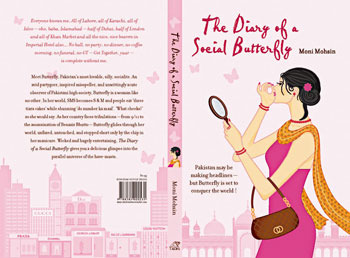
The Dairy of a Social Butterfly flits through Pakistani social life and lands smack in London. Droll and full of localised accents, the recently published book is a collection of London-based Pakistani writer Moni Mohsin’s columns over the past few years. Sitanshi Talati-Parikh catches up with the earnest writer to exchange a few words on the tenuous nature of relationships in the subcontinent, the role a writer plays and the sentimentalisation of literature

Spvol01

Dignified, self-assured and a tad bit scep-tical – I notice an imperceptible raise of the eyebrow denoting the discontentment at the way at which the talk on globalisation of language is conducted – in much the manner of a disapproving school marm. Originally from Pakistan, Moni Mohsin, lives in London with her family, and has been writing a delectably funny column for the Pakistani The Friday Times since the early 90s.

While her first book, The End of Innocence (2006) proved to be a promising debut novel, upon increasing interest in her columns, she shelved her plans for a second novel based in London, and went ahead with compiling her columns into a book. Launched particularly for the Indian sub-continent, seeing how the columns (which are also syndicated in India) drew a lot of interest during the Jaipur Kitab festival, Mohsin feels that she had found an audience for the book. Starting from 2001, the year of 9/11 and rounding up in 2007 with Benazir Bhutto’s assassination, The Dairy of a Social Butterfly is a witty and sardonic comment on the ‘social butterflies’ of Pakistan, especially the ones who find a summer home in London. With parallel events running in her book, for instance: ‘US concerned about Afghan border security, Butterfly concerned about her missing bike,’ the readers have enough to scoff at with the protagonist’s heavily accented language, lack of general unconcern and unintentional innuendos. The columns respond to events that take place in Pakistan: political and social events, big weddings et cetera. All of this is sourced through the news, Pakistani television and the social scandals discussed with Mohsin’s sister over the phone. “I go once or twice a year to Pakistan. I have children, so I am constrained by their school calendar,” says Mohsin with regret – as evidenced by the essay she has written exclusively for Verve.

Most writers of the diaspora tend to sentimentalise their country when they write about it. Mohsin reacts immediately with a very vociferous denial. Asking me, quite rhetorically if I thought Butterfly was sentimental, she races breathlessly on and lists Pakistani writers who are not in the least sentimental. Think Mohsin Hamid and The Reluctant Fundamentalist, Mohammed Hanif and A Case of Exploding Mangoes, or Nadeem Aslam. “In my novel, The End of Innocence, I talk about the honour killings in Pakistan and how horrible they are. We are not sentimentalising our country. You write about the smell of the earth after the rain, or the smell of freshly sliced fruit that fills a room because it is very particular to the subcontinent. If you live abroad, you realise that there are a lot of things you take for granted about the subcontinent. I always write about how when walking down a street in London, you know you are passing an Asian house, because of the smells that emanate – frying garlic and haldi. I don’t know if I am sentimentalising it, but it is there. Sometimes to avoid it would also be silly, because it exists. The challenge is not to romanticise it and to write about it with honesty and affection.”

Why not a novel about London where she lives, and why Pakistan, a place that she visits infrequently? “I thought I had to really know society before being able to comment on it. I have been hijacked by events, but my next book will be set in London. I am so involved with Pakistani society – so much is happening there, there is so much to be said. It is so vivid and new. The rest of the world is also interested in new societies and how they are shaping up.” Mohsin takes me back to a recent seminar in London, organised by Tehelka, in which they were trying to set up a dialogue between Pakistani writers and Indian writers and journalists and other cultural and political figures. A well-known film-maker said that there is recent interest in Muslims, ‘Muslims ka kaam karein’. “While he felt it was more of a trend, I don’t know. Generally in the subcontinent, interesting things are happening; people are producing interesting work and films. For such a long time, we in the subcontinent have been looking to the West and ignoring what is happening within ourselves and it is almost ‘declassing’ ourselves or ‘putting ourselves down’. Suddenly you feel you don’t have to. Pakistani and Indian writers and artists are making such waves abroad – you don’t have to look beyond our own backyard.”

While the interest is intense, is there openness for dialogue and understanding that extends beyond the arts? Mohsin firmly believes that Indians are less informed about Pakistan than the other way around – probably because Pakistanis have been exposed to Indian films for a long time and a greater percentage of Pakistanis travel to India. “Indians are possibly more naïve in that sense, and therefore readily believe everything they read about Pakistan. I think there is room on both sides for massive person-to-person contact; it is very important.” Mohsin, who also writes a column for a leading Indian daily describes how she is moved by the fluid dialogue between Malaysians and Indonesians. “They seemed to know each other, their works and their countries so well! Malaysians have houses in Indonesia, Indo–nesians work in Malaysia and such a free-flowing contact exists between them, that I thought what a pity that we don’t have that in the sub-continent.” I wonder why this is so, and Mohsin is quick to reply to my suggestive question, “I don’t think Pakistan is a closed society. It is very welcoming. Most people, Indians in particular when they come to Pakistan feel that hugely. What they are led to believe is so different from the actuality.”

Pakistani writers then shoulder a good deal of responsibility in setting the matter straight. “I don’t think I am playing a role in being an ambassador for my country – remember these articles were written for Pakistanis, they were not written for others, in fact, I thought they wouldn’t have a market outside. I’m just portraying what I see. And as a writer, your first duty is to tell the truth. It is not about me projecting my country abroad, it is just me commenting on my country. A writer’s job is to show a mirror to society, and I think all writers are trying to do that.”

← Older posts

|  Filling the gaps between words.  |

Writing By Category

  • Art, Literature & Culture
  • Brand Builidng
  • Brand Watch
  • Fashion & Style
  • Features & Trends
  • Fiction
  • Food
  • Humour
  • In The Media
  • Interviews (All)
  • Interviews: Business
  • Interviews: Cinema
  • Interviews: Cover Stories
  • Interviews: Lifestyle
  • Interviews: Luxury Brands
  • Interviews: The Arts
  • Interviews: Travel
  • Musings
  • Parenting
  • Publication: Conde Nast
  • Publication: Elle
  • Publication: Mint Lounge
  • Publication: Mother's World
  • Publication: Taj Magazine
  • Publication: The Swaddle
  • Publication: The Voice of Fashion
  • Publication: Verve Magazine
  • Social Chronicles
  • Sustainability
  • Travel Stories

Reach out:
sitanshi.t.parikh@gmail.com

© Sitanshi Talati-Parikh 2018.
All Rights Reserved.

Website Powered by WordPress.com.

  • Subscribe Subscribed
    • sitanshi talati-parikh
    • Join 51 other subscribers
    • Already have a WordPress.com account? Log in now.
    • sitanshi talati-parikh
    • Subscribe Subscribed
    • Sign up
    • Log in
    • Report this content
    • View site in Reader
    • Manage subscriptions
    • Collapse this bar