• About
  • Brand Building
  • Film & Drama
  • Writing: Arts & Lifestyle
  • Writing: Interviews
  • Writing: Luxury Brands
  • Writing: Travel

sitanshi talati-parikh

sitanshi talati-parikh

Tag Archives: Verve Magazine

Connoisseur of Canvases

10 Thursday Jul 2014

Posted by sitanshi talati-parikh in Art, Literature & Culture, Interviews (All), Interviews: The Arts, Publication: Verve Magazine

≈ Leave a comment

Tags

Art, Christies, Sonal Singh, The Rose Code, Verve Magazine

Published: Verve Magazine, July 2014
Photograph by Toranj Kavyon

She has established herself in the art world, has the happy ability to see the lighter side of things, is inspired by nature and is a specialist and head of Christie’s Mumbai sale

Sonal Singh Christies Verve Magazine

“I don’t really have a normal work day, as I spend a lot of my time on road.”

The 35-year-old associate director and head of sale for South Asian Modern and Contemporary Art at Christie’s Mumbai is unlikely to be chained to a desk, and probably has the most creative mix of business and pleasure. She was partial to the arts from childhood. After studying sociology at Delhi University – where she spent a good deal of her time competing for the college at music competitions – Sonal Singh created a solid foundation for herself artistically and academically in London: ceramic design at Central St. Martins College of Art and Design, modern and contemporary art at Christie’s Education and a Master’s in art business at Sotheby’s Institute of Art. After working in the field for a few years, she joined Christie’s in 2007 when the latter decided to expand its operations in India and were looking for a resident specialist.

“Every auction that you work on is exciting – to be able to handle the art at first hand is really the most thrilling experience for someone with my passions! Having said that, being a part of the Christie’s first auction in India (December 2013) was really a dream.” While she interacted with big names in the art world at the India Habitat Centre and worked with many artists at Bodhi Art Gallery, at Christie’s she is consumed by the sheer volume and quality of art that she is exposed to – some of the world’s greatest works. “Seeing the whole process through is really gratifying – first working with the collector and getting the consignment, appraising its value and importance and then seeing it go under the hammer. Negotiating for a work can be hard but getting it into an auction is extremely satisfying; similarly the actual auction can be stressful but when an artwork sets a new record or fetches a good price, it’s the most thrilling experience.”

What would someone who works with works of art like to see on her own walls? “I like the immediacy of works on paper and this is mostly what I’ve bought. I’d love to have works by Gaitonde and Amrita Sher-Gil some day and I would like to start learning more about antiquities, in particular, Gandhara sculptures.” She likes Indian textiles, treasures family jewellery and has recently rediscovered saris, while otherwise she would be likely to be seen in churidaars for formal occasions and jeans-and-shirts on a casual note.

She works as part of a team, with colleagues based in New York, London and Mumbai. They curate auctions and aim to bring together rare, important and exquisite works of art. Not surprisingly, she is often on the move, which works well for her, as she is fascinated with planes. After work, if there aren’t any overseas conference calls scheduled, she finds time for a walk, a gallery opening or catches up with friends for dinner.

“I realised a few years ago that the people in my life are my priority and I try to spend as much time as I can with them.” Sonal Singh believes in living life on her own terms and in creating her own path; and that success is nothing more or less than “making the most of what life gives you”.

A Glass Front

25 Wednesday Jun 2014

Posted by sitanshi talati-parikh in Brand Watch, Publication: Verve Magazine

≈ Leave a comment

Tags

Apple, Architecture, Art, Steve Jobs, Technology, Verve Magazine

Published: Verve Magazine July 2014

Apple Inc. changed the meaning of bricks-and-mortar with their spectacular, award-winning glass-and-steel flagship stores. We take a look at the architectural face of the brand

Apple Stores architecture

Clear glass, one crisp bitten virginal apple and a cult following to rival a pop star. Steve Jobs, the late co-founder of Apple, Inc. was a renowned stickler for design. There was no way he would retail his beautiful phones, computers and ‘haute couture’ tech gadgets in a shoddy showroom. While the majority of the showrooms exist in malls in a minimalistic steel-and-glass décor, Apple’s flagship stores have won numerous architectural awards, especially the one located on Fifth Avenue in midtown Manhattan, New York City. This particular one, open 24/7, 365 days of the year, has an iconic glass cube structure, which was completed in 2006 and revisited in 2011 to the reported cost of $7 million and $6.7 million respectively. The glass panes were replaced and fitted with larger ones to reduce the number of visible seams…because only one company in the world would care that much about judging the product by its display area.

Glass cubes, glass stairways with engineered precision, round glass elevators, glass bridges…and an inverted glass pyramid for the one at the Louvre; it is obvious that Apple loves the clarity and simplicity of glass. It’s as if Jobs wanted to provide a see-through looking glass to his products; a pedestal or shrine to the revered goods that should clearly be visible to anyone passing by. And there are many, who come to stare, openmouthed at the larger-than-life stores. The one on Fifth Avenue, for instance, is one of the most-photographed structures in the city, which is saying a lot! Despite the reverence towards steel and glass, you wouldn’t be hard-pressed to find instances where the Apple stores utilise and work around the aspects of the buildings’ original architecture – as seen when it maintained the romanticism of Paris in its Opera store.

Travelling the world with Apple: from 40,000 square feet of retail space in London; a huge, offset stainless steel frame holding the iconic glowing apple logo in Beijing; rooftop grass with a skylight visible to surrounding buildings in Boston; a big steel tunnel in Chicago; and a towering glass cylinder and spiral stairway in Shanghai, we arrive at Apple’s Grand Central Station store, which wraps around the station’s terminal from a balcony position, making it one of the largest Apple stores in the world. And while it’s not a big deal to open a store in a mall or an airport, evidently you need to be the cat’s whiskers to be given access to the Carrousel du Louvre, the underground shopping area in Paris, where the inverted glass pyramid is now as much of a talking point as Dan Brown’s imagination.

While the architectural firms Bohlin Cywinski Jackson (BCJ) and more recently, Foster + Partners have a heavy hand in the engineering and designing of the stores, Apple has  patented or filed patents for their most original designs, such as the cube and the cylinder. Steve Jobs’ name is listed first on those patents. There is even a technical patent for the engineering behind the complex glass and hardware system. Last year, in an effort to drive the success post Jobs’, the current CEO, Tim Cook, hired Angela Ahrendts, the person behind Burberry’s transformation into a symbol of global luxury. She’s been busy reshaping Apple’s physical and online retail efforts so that they both achieve a parallel cult status.

Steve Jobs masterminded the concept of retail and brand experience, hiring people specifically to drive this strategy. The high-profile retail stores, developed by Jobs, the Apple retail team, designers Eight Inc., architects Bohlin Cywinski Jackson and structural engineers Eckerlsey O’Callaghan have become among the most recognised brand expressions in retail. In fact, the one at Fifth Avenue beats Saks, Best Buy and Tiffany & Co by a mile in sales per square foot per year. With the ‘Genius Bar’ concept, customers can set-up their products or receive technical advice, while the chic stores create a sense of sharp intellectualness – a person breezing in would automatically feel part of an elite and clever gang. After all, Apple could be credited in part with making smart, cool.

Ever seen the lines in front of American booksellers before the next Harry Potter installment was due? Apple store openings have it bad. Followers and Apple-lovers (they exist in drones) line up early in the morning or even the night before to watch history being unveiled in their town. Some have more mercenary desires like the potential giveaways. The recent Apple store opening in Istanbul promised the first 4,500 entrants free T-shirts. Three thousand shoppers waited in line for the opening of Apple’s Sydney store in 2008. Alternatively, outraged Chinese Apple fans threw eggs at the Apple store in Beijing after sales of the iPhone 4S were cancelled! Wonder what is likely to happen when an Apple flagship store hits the mean streets of Mumbai?

The Business of Being

15 Sunday Jun 2014

Posted by sitanshi talati-parikh in Interviews (All), Interviews: Business, Publication: Verve Magazine

≈ Leave a comment

Tags

Bikram Saluja, Schauna Chauhan Saluja, The Rose Code, Verve Magazine

Published: Verve Magazine, June 2014
Photograph by Toranj Kavyon

She’s passionate, dedicated and full of conviction. The CEO of Parle Agro Pvt. Ltd., Schauna Chauhan Saluja, is fully immersed in running her family business and believes in a lifetime of learning

Schauna Chauhan Saluja for Verve Magazine

“Work is my priority. Which does not mean family is not as important. But at this age I have the energy, determination and the strength to handle a lot more.”

Thirty-seven-year old Schauna Chauhan Saluja started in the family business at the age of 22 and it feels like she was meant for exactly that. “I didn’t need to see a guidance counsellor in school to sit and ponder over what it is that I wanted to become or where I should work. I think it was already chosen for me and I accepted it as I grew up learning the business…it was a very natural process.”

‘After schooling in Kodaikanal International School and acquiring a Bachelor’s degree from business school in Lausanne, she was back home, learning the ropes in Parle Agro. “Being part of the business has always been so great because it is driven by so much passion and energy. And you are continuously learning. When I started, my role was to learn and understand the business, and that’s what I did – and in a lot of ways I’m still doing that. Joining young gave me a chance to grow with the company.”

The mother of a six-month-old boy, Jahaan, she has her hands full but believes that time can expand to fit all that needs to be done in. “Everyone in my family is working and is as passionate about their work so the understanding is there, if there are occasions where work takes up most of your time. When the family is together, the shared experience becomes important. And whatever free moments I have are taken up by my family first.”

Schauna, who believes in the power of teamwork, a healthy culture and set of values within the organisation, is focused on the current challenge at work – which is something she believes every other entrepreneur or business person is also facing – the challenge to keep the company growth steady in today’s economic scenario. “My life will take the direction depending on the choices I make and the decisions I take. Where I would like it to go is only higher….”

“I am what I am and I do what I do.” Her personal style is very simple, and when she accessorises, she ensures that it’s always a reflection of her personality: simple, elegant and delicate. “I believe that less is more. I don’t like it too cluttered or busy and one does not need to be fancy to look elegant.” Jackets, pearls – you would almost never see her without her pearl necklaces – and bright colours, like pink, are her staples. “One should try and dress up every day…whether it’s the business suit you wear for work or the outfit you slip into when you are going out for an occasion. And dress well to please yourself.”

She treasures a gold heart-shaped Tiffany necklace and an Ulysse Nardin watch that her husband, tennis player and actor, Bikram Saluja, gave her – the latter after he got his first independent project. To Schauna success is, “Going through varied emotions, doing what you love, dressing up in what you would enjoy wearing, learning something new every day, getting up every time you fall down, smiling through the tough times, never taking no for an answer, and always asking the question, ‘Why?’”

A High Seat

10 Tuesday Jun 2014

Posted by sitanshi talati-parikh in Art, Literature & Culture, Publication: Verve Magazine

≈ Leave a comment

Tags

Art, Mansoor Ali, Verve Magazine

Published: Vervemagazine.in June 2014

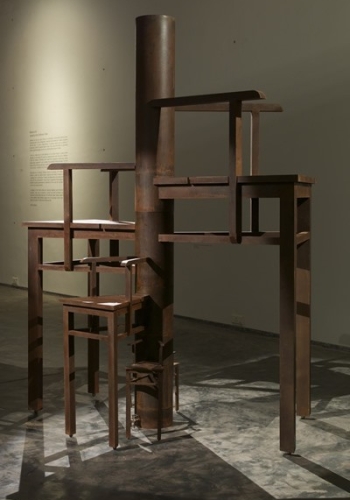
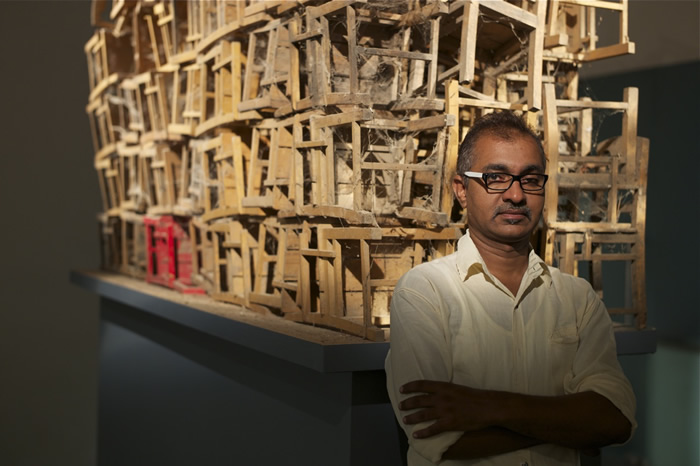
The lowly chair is also representative of the highest seat in the country. Mansoor Ali in a debut solo comments on the political system through his larger-than-life chair sculptures

Mansoor Ali Artist

t’s the Indian political system, or the lack of it, that interests Gujarat-born artist Mansoor Ali. He uses chairs as a means of political commentary, and by changing their usual configuration, proportion and context, he opens up a dialogue of interpretations.

Anatomy of an Unknown Chair is Ali’s debut solo, where in The Restless Chair, you are looking at a seat that is constantly in motion and rotates faster as you approach it; Monument to an Unknown Politician is 102-inches tall where the central column supports seven chairs of various dimensions and to reach the highest chair, you have to climb the smaller ones. The biggest chair moves in a circle, but is going nowhere. In Weight of the Political Brain, an industrial weighing scale forms the seat of an oversized chair and a miniature version of the parliament house rests on the seat. The overhead digital display reveals the weight of this political nerve center to equal that of an average human brain. It is nudging us to question the people in whom we put our faith.

Mansoor Ali lives and works in Baroda and New Delhi. His works are a part of the collections at Saatchi Art Gallery. His solo show, Anatomy of an Unknown Chair, is on at Gallery Maskara, 6/7 3rd Pasta Lane, Colaba until July 31. Timings 11am to 7pm, Tuesday to Saturday.

Mansoor Ali

5 Questions with the artist:

1. Artistic motivation: “Art comes naturally to me. It is like a story in novel or a film in one frame – just like a good poet tells it.”

2. Inspirations… “I pick up my subjects and ideas from the environment and my experiences.”

2. Artists at home: “For me it is Andy Goldsworthy…if I could ever have one!”

4. Concerns that show up in your art: “It is the quest for humanitarian concerns and to address them to my best capability.”

5. If you weren’t an artist, you would be… “An architect, ad man or an author.”

A Parisian Rhapsody

10 Tuesday Jun 2014

Posted by sitanshi talati-parikh in Art, Literature & Culture, Publication: Verve Magazine

≈ Leave a comment

Tags

Art, Maya Burman, Verve Magazine

Published: Vervemagazine.in, June 2014

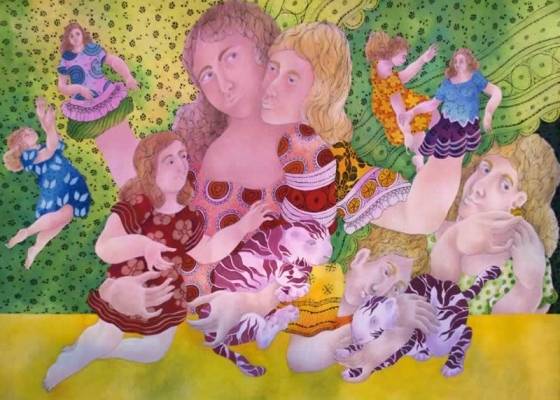
If she weren’t an artist, she would admittedly be a nightmare for her family. Parisian, Maya Burman, marries artistic traditions of France and India in her works, on show in Mumbai

Maya Burman Artist

The 43-year-old Paris-based Maya Burman creates works that have painstaking detailing for which she works in a methodical and laborious fashion: starting with a pencil sketch, moving on to a layer of watercolours and finishing with a black ink pen. Reminiscent of the French art nouveau tradition and drawing from Indian miniature painting, the artist happily merges two cultures in her evocative works.

Maya Burman’s works are can be viewed in a solo show, Rhapsody, at Art Musings gallery, Colaba, Mumbai until 20 July 2014. Monday to Friday 11am – 7pm, Saturday 11am – 5.30pm, Sundays closed. 

5 questions: Maya Burman

1. Artistic motivation “The pleasure of being alone, spending time with myself and escaping into my own world.”

2. Inspirations “Beauty, poetry and innocence in everyday small things.”

3. Art at home “I have no more space on my walls, but I will make some space for erotic drawings that I have started to collect.”

4. Concerns that show up in your art “Offences against women – present in subtle undertones in my work.”

5. If you weren’t an artist, you would be… “A nightmare for my family!”

Candid Camera: Shadows

02 Monday Jun 2014

Posted by sitanshi talati-parikh in Art, Literature & Culture, Publication: Verve Magazine

≈ 1 Comment

Tags

Candid Camera, Ishika Mohan Motwane, Photography, Verve Magazine

Published: Vervemagazine.in, June 2014

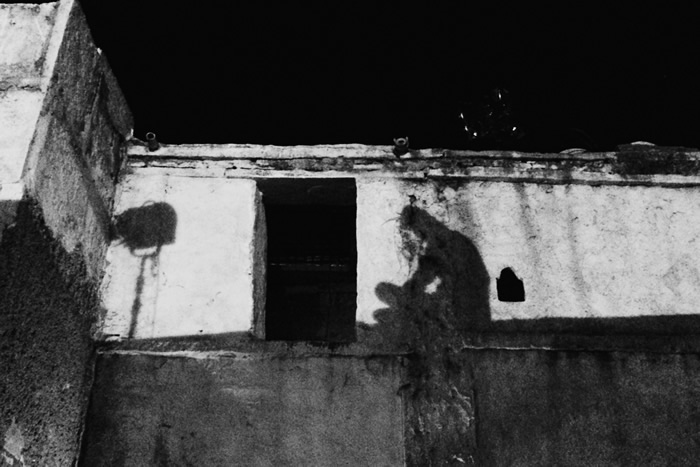
Kickstarting Verve’s online ‘Candid Camera’ series, we bring moving images that tell a story. Keep looking

Ishika Mohan Motwane Photographer

Taken While shooting stills for a film called NH10.

Where About a 100 kms from Jodhpur in a village called Kherjerla.

Mise en scene “Gruelling night shifts, small lanes, thunderstorms, sandstorms, a tired crew and everyone trying to make the day count at about 3 am. The nights were filled with silhouettes and shadows and this night it began to rain.”

Inspiration “I always feel that the light men have it hard. They’re the first to come onto set and the last to leave. Not much of rest in between unless there’s a long shot, scene or some disruption. Then maybe you can see one of them catching 40 winks up on the roof!”

Photographer Ishika Mohan Motwane, married to childhood sweetheart and Indian cinema director, Vikramadtiya Motwane, took a turn from marine biology and environmental psychology towards photography in LA, zeroing in on film still photography after being given a chance opportunity by director Sanjay Leela Bhansali. She currently works on big-ticket films in India and India-centric international films like Slumdog Millionaire.

Branding Your Bag

15 Thursday May 2014

Posted by sitanshi talati-parikh in Brand Watch, Fashion & Style, Publication: Verve Magazine

≈ Leave a comment

Tags

Bespoke Luxury, Fashion, Interviews: Luxury Brands, Louis Vuitton, Verve Magazine

Published: Vervemagazine.in May 2014

The 160-year-old brand, Louis Vuitton, allows you to customise their products in 3 different ways. Verve guides you through the process….

Louis Vuitton personalisation

I was floored when I heard that a gentleman had a custom-created Louis Vuitton case made just so that he could carry his mother’s homemade apple pie around in his travels. How does one go about customising a Louis Vuitton product? There are three distinct ways in which you can do so:

1. Special Order

WHAT This is a special creation, made specifically for people who want a custom Louis Vuitton case to carry something special like a guitar or their mother’s homemade apple pie, a baby bottle holder or a hair dresser’s trunk, or the famous Baroda tea case. With a specific concept in mind, you can sit with a brand representative (expect four-five meetings) and arrive at a sketch of the product you would like created. It is most likely based on something you have seen. You can then select the leather or canvas and choose the inside lining. Certain styles are non-negotiable. What that means is that certain styles can only be customized within boundaries, for instance, the Monogram canvas with gold fittings is linked to natural leather handles.
WHERE The order can be placed in any Louis Vuitton flagship store.
HOW One craftsman in France works on this piece from start to finish, and it can take up to six to eight months to complete.

2. Made to Order

WHAT It is a selection of products out of the Louis Vuitton permanent collection which are available for order in a selection of predefined exterior materials and interior linings. Any available product can be customized to some extent within the listed options.
WHERE The order can be placed in any Louis Vuitton store.
HOW This would take 1-3 months to complete.

3. Personalisation

(a) Hot Stamping
WHAT You can get a personalised ‘stamp’ on luggage tags, bags and wallets (depending on the style and material), at the time of purchase.
WHERE This can be done at the store level
PRICE There is no cost involved.

(b) Mon Monogram
WHAT
You can create a personalised monogram within the Louis Vuitton template. There are options designed according to the style of the bag. This can be done with initials as well. They are generally vertical stripes of varying colours, taking off from how royal families have their own colour codes.
WHERE This is done on a few predefined products before purchase. You can use the computerised simulation app at a flagship store.
HOW This takes six to eight weeks to get done and the colour won’t scrape off. The application will also give you the exact delivery date and time once you are done making your choice.
PRICE There is an additional cost for this.

(c) Hand painting
WHAT You can get your bag hand painted.
HOW This can be done at the time of, or even after purchase, though the latter depends on the condition of the canvas.
PRICE There is no cost involved.

The Mistress of Words

15 Thursday May 2014

Posted by sitanshi talati-parikh in Art, Literature & Culture, Interviews (All), Interviews: The Arts, Publication: Verve Magazine

≈ Leave a comment

Tags

Anuja Chauhan, Books, The Rose Code, Verve Magazine

Published: Verve Magazine, May 2014
Photograph by Manpreet Singh

She is as vibrant as her novels, and as sharp as her characters. Anuja Chauhan remains unaffected at the best of times

Anuja Chauhan Verve MAgazine

“I identify with every character I write, not just the girls. The heroes, the villains, the sleazy people. They’re all culled from people I know, have observed and am fond of.”

It is as if 43-year-old Anuja Chauhan has come of age early, while retaining a level of humour, innocence and vivacity about her, with her trademark witticism. Growing up, she thought being a Rajput and an army kid was the best thing in the world to be. “It was a big part of my identity and thinking. It still is, though I now realise there is a difference between being foolhardy and being brave, and that in an increasingly shrinking world, the concepts of ‘country’ and ‘nationality’ are rather overrated.”

She ended up in advertising after she read a book her husband (then boyfriend) gave her. Finding it interesting, she did the rounds of the Delhi agencies and took some copy tests. “Getting a job as a copywriter is the easiest thing in the world. Keeping
that job is another thing entirely!” She worked in the ad agency, JWT India, for over 17 years, eventually becoming vice president and executive creative director, before resigning in 2010 to pursue a full-time literary career. Over the years she worked with brands like Pepsi, Kurkure, Mountain Dew and Nokia, creating Pepsi’s Nothing official about it campaign and advertising slogans such as Pepsi’s Yeh Dil Maange More and Oye Bubbly, and Darr ke Aagey Jeet Hai for Mountain Dew. She believes that the biggest milestone for her was growing up, learning teamwork, mentoring and learning to listen.

Now she’s the best-selling author of three literary fiction novels. “Copywriting
is telling somebody else’s story. Essentially, I felt like I wanted to stretch out and write my own stories.” She started writing her first novel, The Zoya Factor, in her spare time while still working. The novel was originally optioned for a film by Red Chillies Entertainment and then resold to Pooja Shetty Deora’s Walkwater Films. The film rights to her second novel, The Battle for Bittora, are with Anil Kapoor Film Company, as she herself moves into writing screenplays for cinema. “Again, it happened very naturally. Filmmakers approached me for the movie rights
to my books – so I sold them, and then people who I couldn’t sell them to, said, ‘Write us a screenplay instead’. So I wrote. But again, it’s a collaborative process. Writing books is still the best thing. You have total control there.”

Married to television presenter and producer, Niret Alva, with three children, Anuja Chauhan has a full life. “Well, the babies are all personal milestones. Their births, the times they’ve done well, the times they’ve gotten ill. Those are the times one grows as a person, learns patience, discipline and humility and gets spiritual.” Her wish for the future is simple: “I just want my children to be healthy and happy and self-sufficient. And I want to spend quality time with my husband.”

Her style quotient consists of three things: comfort, colour and individuality. “My mum had this one jadau sone-ka-haar, which got cut up into four pieces as all her daughters wanted it. I love my bit of it.” Dressing up is wearing a sari. “Or simple clothes and big earrings and lashings of kohl and lipstick.” Inspirations are “all the
people I meet and the conversations I overhear (shamelessly!)” and success is nothing more or less than “peace of mind”.

‘Sleeping Through The Museum’

14 Wednesday May 2014

Posted by sitanshi talati-parikh in Art, Literature & Culture, Interviews (All), Interviews: The Arts, Publication: Verve Magazine

≈ Leave a comment

Tags

Art, Verve Magazine, Waswo X Waswo

Published: Vervemagazine.in, May 2014

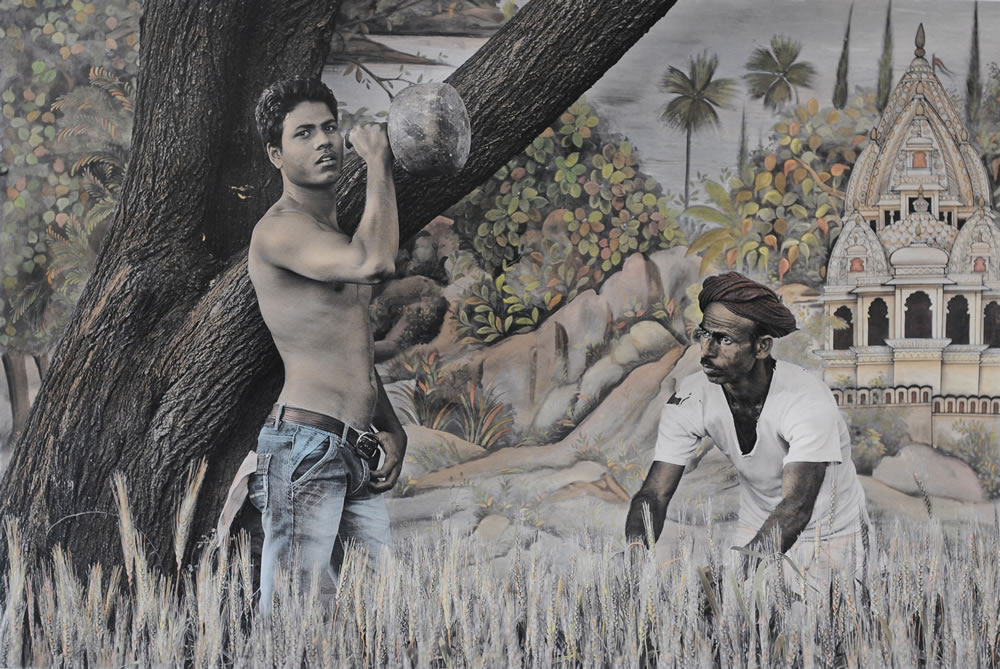
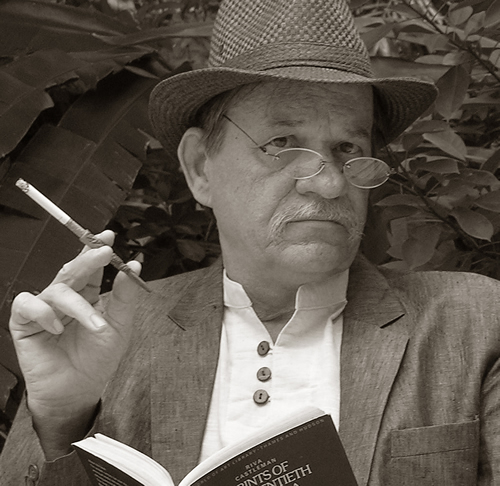
Waswo X. Waswo critiques the process of “museumification” in a show at Sakshi Art Gallery, Mumbai

Waswo X Waswo

5 Questions: Waswo X. Waswo

1. Artistic Motivation I grew up in an artistic family, so art has been part of my life since day one. It’s sort of a cliche to say art is about communication. Maybe I think about it more as a way to examine issues, and the world around me. It is in large part a way I look outward, but also self-examine.

2. Inspirations I could name a long list of artists and photographers who have inspired me, and still do. But for this particular exhibition I have to name a member of my own family, Ed Green, whose job it was to organise the painting of dioramas in the local natural history museum. This show is all about the issues that arise from that.

3. Art in your home Besides making my own art, I’ve also formed a very large collection of Indian printmaking. That collection was shown last year at the NGMA-Mumbai. So my home is filled with vintage and contemporary etchings and woodcuts by well-known Indian artists. My interest in printmaking is why I asked the young lithographer Subrat Behera Kumar to be a part of this show.

4. Concerns that show up in your art I’m concerned with how the world is being torn apart, it seems everywhere, by cultural misunderstandings. A large part of my art has been to explore these misunderstandings, and try to learn what creates them.

5. If you weren’t an artist, you would be… Believe it or not, when I was young, I also wanted to work in a museum like my cousin Ed. I dreamt about being a ‘curator’ long before that word came into common usage and fashion. If I hadn’t followed an art career, maybe that is where I would have found myself.

The show Sleeping Through the Museum previews tonight and is on until June 21, 2014 (11pm-6pm) at Sakshi Art Gallery (6/19, Grants Building, 2nd Floor, Arthur Bunder Road, Colaba, Mumbai.)

Simmering Voices

13 Tuesday May 2014

Posted by sitanshi talati-parikh in Art, Literature & Culture, Publication: Verve Magazine

≈ Leave a comment

Tags

Art, Soghra Khurasani, Verve Magazine

Published: Vervemagazine.in, May 2014

Soghra Khurasani works are layered with social and historical references and she speaks up for women. Through printmaking as well as new media work, she is able to explore and express ideas of beauty and violence, using an incredible attention to detail

Soghra Khurasani Artist

31-year-old Soghra Khurasani comes from a family that had migrated from Khorasan in Persia to Vishakhapatnam. She graduated in 2010 with a degree in printmaking from the Maharaja Sayajirao University in Baroda. Khurasani uses printmaking; sight-specific installations that use cloth and wire mesh, and using the colour red, to voice her opinion.

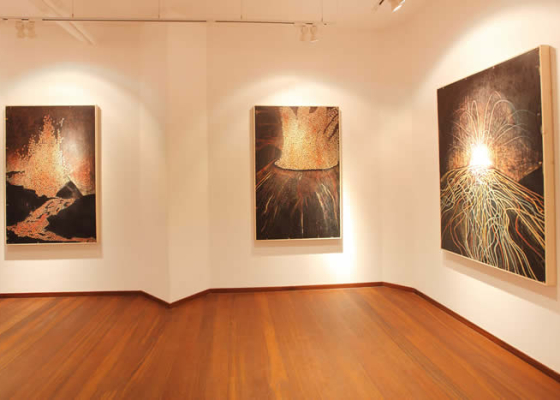
She carved a triptych woodcut of throbbing hearts calling them ‘Braveheart’, in 2009. In the aftermath of the 2012 Delhi rape, Khurasani created a series of large and small woodcuts in 2013, where her woodcuts depicted a volcano.

‘She explains them as emotional outbursts, a pent up frustration of her disappointment with people, her rejection of the years of violence she had witnessed for the last two decades, where the victims were primarily women. Khurasani’s red represents exuberance, a spout, a flow and a relentless energy, that is feminine and unrepressed,’ explains Sumesh Sharma in his introduction to her recent works.

4 Questions with the artist, Soghra Khurasani:

Artistic motivation “It’s a medium where I can explain my inner thoughts and feelings.”

An artist that finds place at your home “Zarina Hashmi.”

Your art reflects “I believe that we are losing our freedom to express ourselves, and that every human should be free. This theme finds a place in most of my works.”

If not an artist, you would be a… “Cricketer.”

One Day It Will Come Out, Solo Debut Soghra Khurasani, curated by Hena Kapadia & Sumesh Sharma, is on until June 7, 2014 at TARQ,  Dhanraj Mahal, Apollo Bunder, Colaba, Mumbai, from 11am-6pm, Monday through Saturday.

← Older posts
Newer posts →

|  Filling the gaps between words.  |

Writing By Category

  • Art, Literature & Culture
  • Brand Builidng
  • Brand Watch
  • Fashion & Style
  • Features & Trends
  • Fiction
  • Food
  • Humour
  • In The Media
  • Interviews (All)
  • Interviews: Business
  • Interviews: Cinema
  • Interviews: Cover Stories
  • Interviews: Lifestyle
  • Interviews: Luxury Brands
  • Interviews: The Arts
  • Interviews: Travel
  • Musings
  • Parenting
  • Publication: Conde Nast
  • Publication: Elle
  • Publication: Mint Lounge
  • Publication: Mother's World
  • Publication: Taj Magazine
  • Publication: The Swaddle
  • Publication: The Voice of Fashion
  • Publication: Verve Magazine
  • Social Chronicles
  • Sustainability
  • Travel Stories

Reach out:
sitanshi.t.parikh@gmail.com

© Sitanshi Talati-Parikh 2018.
All Rights Reserved.

Website Powered by WordPress.com.

  • Subscribe Subscribed
    • sitanshi talati-parikh
    • Join 51 other subscribers
    • Already have a WordPress.com account? Log in now.
    • sitanshi talati-parikh
    • Subscribe Subscribed
    • Sign up
    • Log in
    • Report this content
    • View site in Reader
    • Manage subscriptions
    • Collapse this bar
 

Loading Comments...