• About
  • Brand Building
  • Film & Drama
  • Writing: Arts & Lifestyle
  • Writing: Interviews
  • Writing: Luxury Brands
  • Writing: Travel

sitanshi talati-parikh

sitanshi talati-parikh

Category Archives: Publication: Verve Magazine

Priyanka Chopra: Unstoppable Priyanka!

20 Thursday Nov 2008

Posted by sitanshi talati-parikh in Interviews (All), Interviews: Cinema, Interviews: Cover Stories, Publication: Verve Magazine

≈ Leave a comment

Tags

Bollywood, Dostana, indiancinema, Interview, priyankachopra

Published: Verve Magazine, Cover Story, November 2008
Photograph by Atul Kasbekar

From Bareilly to Boston and Manhattan to Mumbai, the cover girl many times over, is leading a fairy-tale life. Firmly entrenched in Bollywood, Priyanka Chopra will have a record six releases this year. Dostana, where she plays an editor at Verve, releases this month and promises to be a rollicking watch. Sitanshi Talati-Parikh finds the vivacious actress full of soul, spirit and spunk

Priyanka01

It is an ordinary Thursday. What makes it extraordinary is the glitter of star power that suffuses the morning with a powerful glow. The lithe, dusky beauty saunters into the make-up van, face barely visible under her enormous shades, dressed in “comfort clothes” – leggings and a long spandex top in her favourite colour, black – after a late shoot the previous night. We look up with trepidation, as she emerges a considerable while later, our allotted time ticking ominously away. Flashing dazzling smiles at everyone, Priyanka Chopra faces the camera, barely wincing in the painfully high Dior heels, which are at least a size too big for her – by her own confession, she was “born in heels”. Ace photographer, Atul Kasbekar, coaxes fluid motion from the svelte actress. She immediately picks up the beat of the music pulsating in the tiny studio and twirls, twists at her slender waist, gracefully cuts the air with the circular motion of her lean arms, flips her hair and throws herself into the scheme of things, with ferocious enthusiasm and buoyancy. It’s a perfect first shot. As the music suddenly stops, and her personal iPod is hastily summoned, with barely noticeable displeasure, she confides, “I can’t think or function without music. My van, my room, my car are always blasting music, so the five minutes I get, become my chill out zone. And besides my family, that’s the one thing I find time for.”

With the kind of schedule she keeps – 25 films in less than five years, not a single holiday or vacation since, working literally 20 hours a day – she is playing a serious juggling act with work and family. “I really don’t find time for my family – I take it for granted that they will come and hang out with me.” Being the first-born to parents who left a flourishing medical practice to ensure that her career took off, it is evident that Priyanka has done them proud. The senior Chopras unobtrusively watch their daughter’s shoot, the mother with a slight smile as she notes the near-perfect shots being reflected on the computer screen, and the father sits back quietly and takes in the confidence of his offspring with teary-eyed pride. Rarely present while his daughter is shooting, the Verve shoot takes Dr. Ashok Chopra back in time. He recalls his 12-year-old girl flouncing in front of a full-length mirror (her only demand from her parents) singing ‘Mere khwaabon mein jo aaye…’ from Dilwale Dulhaniya Le Jayenge – Priyanka’s absolute favourite film of all time. Even now, she recalls in the blink of an eye the same sparkle, head toss and look of romantic fervour.

“Today my dad is home, living his life to the fullest – I am so grateful for that.” She went through a rough patch – possibly the only glitch in an ostensibly dream-like life – when she watched her father go through a serious illness that took him two years to recover from. She was, at the time, shooting for one of the most important movies of her career, Krrish and wrapping up Bluffmaster. “Your father is always your invincible superhero, to whom nothing can ever happen, because he is the one who protects you – and then suddenly tables turn and you have to protect him. I felt so helpless and lost. I didn’t know how to deal with it.” But deal with it, she did. She would spend nights between shoots at the hospital, thankful that this happened at a time in her career when she could provide the best possible treatment that money could buy, without compromising on her work. A year earlier, it would not have been possible.

The July-born Cancerian’s amiable personality and warmth bubble to the surface as she reminisces about the people close to her heart. Her younger brother, Siddharth, is very proud of having a ‘hot’ older sister. She admits, “I am a self-confessed bully. I used to make him do all my work and I even used to dress him up as a girl! For seven years I was the only child and my parents’ most prized possession. And then he came – I used to pinch him and make him cry. My dad would come in and I would quickly pretend that I was holding and pacifying him!” She laughs unselfconsciously. “I love him – he is my greatest weakness. I spoil him, like he is my child.”

Friendships have their own familial bonds. Hailing from an army family, spending most of her childhood on the move, from Bareilly to Jamshedpur, and Iowa, New York and Boston, Priyanka has still managed to cultivate some lasting friendships – her childhood friend, Tamanna, for instance, who flies down from Delhi to meet her on her birthday. “I’m very close to my friends. If you have even two or three ‘4 a.m. friends’ who you can depend on for your life – and you know if you were kidnapped and someone asked you who would vouch for your life, it would be those people – then you’re very lucky. Though all your colleagues are your friends, there are only a few people whom you consider family.”

That’s what Dostana is about – three friends who consider each other family – and how a relationship between great friends is formed and broken. Priyanka, who loves the outdoors, admits that the movie had the best outdoor shoot she has ever experienced. Two months on location in Miami, she found herself gleefully entertaining her “khandaan” from America. Relatives were “crawling out of every room, closet and bathroom” in her three-bedroom apartment. Priyanka dressed for the shoot every morning with people passed out on the couch. Her family was on holiday and would come and hang out on the set. The euphoria was catchy. It is easy to visualise the massive on-location party, including malls and beaches (think fabulous South Beach), with a variety of restaurants and live music bars – all pulsating with energy that Priyanka feels will translate positively on screen.

In a film about friendships, what were the off-set relationships like? “I never thought I would bond with Tarun (Mansukhani) as much as I did. Initially, I didn’t know him very well and I didn’t think I would, either. He seemed like a really serious guy – we fought like cats and dogs, and made up instantly. I keep telling his wife, Karuna, that I play his on-set wife because we are constantly fighting like a married couple! But he has so much clarity as a director.” Karan Johar popped in for a bit and Hiroo Johar was officially the “big mother hen”. Abhishek Bachchan and John Abraham, her co-stars in the film, who pretend to be a gay couple to get an apartment to live in, spent all their off-screen time together, leading Priyanka to quip that they took their roles quite seriously!

John Abraham was the self-proclaimed fitness guru on the set, training everyone – the make-up maestro Mickey Contractor, included. Every day, after the shoot, everyone would land up at the gym. Priyanka studiously followed the regime – despite the fact that she generally doesn’t work out at all – to ensure that she looked prime for her swimsuit scene in the movie. Admiring her trim body – slimmer than she has ever been – It is hard to believe that she doesn’t work out or diet, after seeing how even the ramp-size Dior outfits at the Verve shoot are too large for her. She leans forward with a conspiratorial whisper, “being overworked and underpaid is the mantra for losing weight”.

Priyanka’s character in Dostana is an editor at Verve, and is dressed in accordance to the location. “In Miami, anything’s possible. I wore shorts, high heels and a shirt to work – and I was over-dressed!” Priyanka hopes the fashion critics will find it equally appealing. “If you try to please the critics, making films trying to keep in mind what the fashion industry is going to say, then you’ll never be able to experiment.”

The actress, who has had no mentor or any formal training in acting, has found herself experimenting through her film career. High on the popularity chart, Priyanka has had her share of missable films and reigned supreme in spite of them. The laugh lines smear away and she quickly retorts, “But that’s normal, right? Nobody can get a track record of 100 per cent. It is against the law of averages.” Have the decisions been based on script alone? “It is not just the script. At every point in my career, each film I did was for a certain reason. It may not have done well, but at that point doing that film or finding that film was very important.” Andaaz and Hero gave her small, but important parts; Kismat was her first solo heroine film; Plan with Sanjay Dutt, made by Sanjay Gupta and Asambhav with Rajiv Rai, were a step up in that ladder. “I never expect anything from any film. I feel when you have expectations, somewhere you are let down.” With a sudden flash of her 100-watt smile she confides, “But I can’t help expecting from these three – Drona, Dostana and Fashion. I’ve worked really hard on each one of them and they are very special to me, whatever the fate of the film may be.”

Suddenly retrospective and a tad philosophical, Priyanka appears wiser than her 26 years. Clichés appear truisms as she applies them to her life – she speaks without any affectation, if a shade reminiscent of her articulate Miss World persona. “It is never the end that matters. It is also the journey – we may think of it as a proverb, but that’s how I have led my life, and it works for me. At this point of time, what I do is very important. What happens in the future will be part of what destiny has in store. The decisions I take now must be with courage of conviction.”

Courage of conviction has definitely got her where she is – able to pick and choose, and have more work on her hands than she has time for. “I’ve always believed that I am destiny’s favourite child.” Not even in her wildest dreams did the naturally talented actress, who was considering a career in aeronautical engineering (“making planes and going to NASA”) ever think she would be a part of show biz. “It still feels so surreal.” Neither she nor her family have had the time to retrospect. A mere 17-year-old schoolgirl when she participated in the Miss India beauty pageant – on an entry sent in as a lark by her family – she had just finished school when she became Miss World. “I had to grow up in a month!” She had to reconcile herself from a teenager in sneakers riding a bicycle to a young woman in a sari gracefully balancing a tiara on her head. “They say that the head that wears the crown rules the world. It’s not easy and it wasn’t. I still don’t remember how I did it – I only followed instructions – I was almost robotic in what I did. I only remember being myself since the last few years – since I was 22 or 23. Before that I was always so withdrawn, wary of being in this industry, not knowing anyone, wanting to protect myself and my family. Everything just happened to me. I feel somebody up there is holding onto my little finger, guiding me through life, which is why I never question what’s happening. I know if something bad is happening, this too shall pass, because there is a reason why I am here.” And what about ideals of changing the world that beauty pageants inspire? “I never had aspirations to conquer or change the world. I’m just playing my little part in the bigger picture and am happy that I am able to contribute.”

The strong girl is also incredibly soft-hearted and considerate. Very fond of children, she swings into the shoot in her gold Dior dress with her spot-boy’s son on her arm, smiles and poses for multiple pictures with their family. Later, while giving bytes to a news channel, she notes with the corner of her eye a man bent double with heavy equipment standing behind waiting for her to finish, and she immediately stops and gives way. A self-confessed “mush-pot”, she has a major weakness for romantic comedies, though she can watch creepy horror films with equal fascination. She would often get inspired and write poetry on little paper napkins – being a fan of prose, shayaris and Urdu – though she hasn’t done that in a long time. With a sudden twinkle she reveals that she would love to be serenaded – but with originality and spontaneity. “Buying red roses and sending them is so thoughtless! I prefer thoughtful gifts. A hand-written note would mean so much more to me than diamonds. Actually, a hand-written note with diamonds would mean a lot more,” she rounds up with a chuckle.

The voracious reader (biographies, chick lit, travelogues) hasn’t even had time to read a script that has been lying with her since the last twenty days. Sleeping four-five hours a day, she only manages to unwind in her white Mercedes, which she calls home. “I have worked every single day in the past few years and there isn’t one day that I regret it. I know the day I wake up in the morning feeling that I am too tired to shoot today, I will retire. Very few people are fortunate enough to love what they do. I really, truly love what I do.” That obviously keeps her steamrolling on. As I step out of her car, I watch her walk to the next shoot with a bounce in her step – despite the fact that she missed lunch entirely while talking to me.

Mumbai Unspooled

18 Tuesday Nov 2008

Posted by sitanshi talati-parikh in Art, Literature & Culture, Features & Trends, Publication: Verve Magazine

≈ Leave a comment

Tags

Bollywood, India, indiancinema, mumbai, UTV, vervemagazine

Published: Verve Magazine, Screen, November 2008

Nine Mumbai-inspired movies have been released already this year. Sitanshi Talati-Parikh explores the city’s iconography, in a retrospective look at major Mumbai films

The throbbing, pulsating city has a million stories to tell. Every minute that ticks by on the Rajabhai Tower, something new happens, and it is the numerous faces of the city that film-makers strive to capture. Its myriad voices and its many tales, the sordid truths and the fantastical goings on. The city is at once a context for relationships and events, and often a hero or even an anti-hero. It is a city of romance, aspirations, gross inequalities, fundamentalism and cosmopolitanism, strength and unity and great divisiveness. It is the city of extremes and in that sense, remarkably a city of the world – a microcosm depicting the inane possibilities that surround us. Its distinctiveness, which only a person who has spent sufficient time in the city, discovers. The cutting chai and the Iranian tea houses, the Mercedes’ and the Mumbai trains, the five star hotels and Dharavi slums, art deco Marine Drive and the Victorian Kala Ghoda area, the meandering bylanes and the heaving buses that wind through these zones, the vendors and the businessmen, the young lovers and the social climbers.

City of dreams
In this deeply aspirational city, the rags-to-riches stories can be recounted by the dozen, whether one thinks of Guru (2007) or the Munnabhai movies, as throngs of people continue to relocate to the ‘big city’ in the hope of a better life. It is their tragic and often wondrous stories that need to be told, very often by those in the Bollywood film fraternity, who may have had similar experiences. Director, Anurag Kashyap, for instance, moved to the city, struggling initially, staying at the St Xavier’s College hostel and hanging out with a band called Greek. These experiences prompted him to make Paanch (2003), an urban crime thriller involving a rock band; while Black Friday (2007), about the Mumbai riots, was inspired by a book he read.

Dark alleys and grim landscapes
The city’s black side, its alter ego, is more evocative and larger than life. It opens up its dark and mysterious corners to the exploration of themes that are a grim reality. Johnny Gaddaar (2007), a noir crime thriller shot in black, white and red, explores the sinister elements in a person’s character, in much the manner of Ek Hasina Thi (2004). Aamir (2008), a thriller about fundamentalism, where an NRI Muslim goes through a freakishly disastrous time on arrival in Mumbai and Mumbai Meri Jaan (2008) about the serial bomb blasts in Mumbai on 7/11, which depict how the blasts led to chaos and irrationality stemming from fear and loss of control in people’s lives.

Cosmopolitan angst
A city that has rivers of gold and the greatest power struggles, is also home to a good deal of metropolitan frustrated violence – when aspirations are not met. Cosmopolitan angst is an equally prominent contemporary theme, as clearly portrayed by the reality-inspired Life in a… Metro (2007), Page 3 (2005), Dus Kahaniyaan (2007), Mumbai Cutting (2008), and even the pedantic Mumbai Salsa (2007). Reminiscent of Paris, je t’aime, Mumbai Cutting is less about love and more about the grim realities of the city. Dus Kahaniyan (2007) picks up on urban themes like extramarital affairs, drugs, violence and relationships. It makes one wonder if love actually exists any more – candyfloss has disappeared from its smoggy walls. Jogger’s Park (2003) picks up a theme of a relationship between an elderly man and a young girl. Exploring relationships and the varied kind of situations life places one in, is a trend of Mumbai-based or metro-based films.

Big city tinsel town
People living in smaller towns look at the movies depicting the big city life with great interest, while those living in the city naturally identify with it. Main Madhuri Dixit Banna Chahti Hoon (2003) is a film where small town aspirations for tinsel town come to life. TV artiste and upcoming big screen actor Sid Makkar provides some finer insight. Luck By Chance, Zoya Akhtar’s upcoming film, in which he plays a part, is naturally located in Mumbai, since the movie is about the film industry. Makkar finds that the majority of movies about Mumbai are steeped in reality – and “reality is entertaining”.

Platform rendezvous and car chases
While the Golden Gate Bridge of San Francisco or the Empire State Building (in lieu of the missing World Trade Centre towers) in Manhattan are iconic structures of the city, we find the Mumbai local trains as a constant motif in movies on the city. As the train thunders along, many a story is told. Think of Mumbai Meri Jaan (2008) on the serial bomb blasts, Life in a… Metro (2007) where a clandestine meeting takes place at the local train station, Chameli (2003) takes one from Lamington Road to Kamathipura, Kundan Shah’s Hero in Mumbai Cutting is about the local train commuter as the city’s unsung hero, or even A Wednesday (2008), Saathiya (2002) and Dombivali Fast (2005). Similarly, Taxi No 9211 (2006), is a thrilling cab chase through the streets of Mumbai, loosely based on Hollywood film Changing Lanes (2002) that takes place in New York.

Waves, sand and love trysts
Many an iconic love story has been told on the streets of Mumbai – Marine Drive, Chowpatty, Worli sea face, Bandra reclamation and Juhu-Chowpatty. Bluffmaster’s (2005) glamourous love trysts, Guru’s (2007) impassioned rise to fame starting with a determined walk on Marine Drive, Hum Tum (2004) finds the star-crossed lovers coming together on Chowpatty beach in true cosmopolitan fashion (ironically, not in Paris, the city of romance). Not to forget the coming-of-age of youths in Jaane Tu… Ya Jaane Na (2008), love sparks in Lage Raho Munnabhai (2006), and the problems of urban marriage Chalte Chalte (2003).

Monsoon saris and dewdrops
Come monsoon, the city bursts into a flood of romantic fervour. The wind-splashed windscreens and swaying palm trees on Chowpatty-Marine Drive are all symbolic of a dark sensuality. Huddled under the umbrella, a generation that grew up in the city feels the homeliness in its murky puddles and blackened sky-scrapers; while those who moved here looking for something better, have a wistful sense of allegiance and belonging. Think of the romance in Chandini (1989), iconic Raj Kapoor and Nargis in Shree 420 (1955), Amitabh Bachchan and Smita Patil in Namak Halaal (1982) and even the blossoming of love amidst grim city reality in Satya (1998).

The haves and the have nots
Anyone who arrives in the city cannot miss the straggly-haired, skinny street children that wander about looking for a benefactor. At every traffic signal and outside a food place you are accosted with them. Mira Nair’s Salaam Bombay (1988) that was nominated for an Academy Award (Best Foreign Language Film) told the tale of Mumbai’s street children which now, in Traffic Signal (2007), becomes a tale of a full-fledged business. As with any big city – but particularly in a city like Mumbai that sees so much disparity between the rich and the poor – emerge tales of inequality, angst and violence. Mumbai Express (2005) describes the economic disproportion in a comic tale of Dharavi slum-dwellers plotting the kidnapping of a rich businessman’s son, while Kidnap (2008) is a movie where an orphaned youth takes revenge for a false kidnapping charge. Chandni Bar (2001) describes the tale of a young village girl, who moves to Mumbai and is forced to become a bar dancer by her uncle.

Fundamental terror
Terror camps aiming for the greatest impact by hitting the most aspirational part of a country can be found making Mumbai their target – creating a great deal of threat and insecurity. Fundamentalism, power struggles and gang wars have been the overriding theme in most of the recent films on or about Mumbai. Where a cosmopolitan love story bloomed in Mani Ratnam’s Bombay (1995), the city also took its pound of flesh in the face of fundamentalism. A decade (1985-1995) that witnessed a bloody mafia war in Mumbai, led to a barrage of films being made about the behind-the-scenes of this underworld terror, exposing the policemen-politicians-criminals nexus at a time when extortion was rife. Ram Gopal Varma’s Satya (1998) and Company (2002), an expose of the underworld gangsters that were an intrinsic part of the city at the time, before the police ran a cleansing act with a great deal of encounters, it would seem that older movies like Don (1978), were simply a tip of the iceberg that was to become Mumbai mafia. Vaastav (1999) starring Sanjay Dutt was the making of a mafia kingpin, while Ram Gopal Varma’s Sarkar (2005) and its sequel Sarkar Raj (2008), starring Bachchan senior and junior, picked up from Hollywood’s Godfather (1972), to depict the reality of a mafia family that holds the city at ransom. Shootout at Lokhandwala (2007) tells the graphic tale of the 1991 underworld encounter that made Mumbai a war zone. Black Friday (2007), Aamir (2008), Mumbai Meri Jaan (2008) and A Wednesday (2008) expose the nakedness and vulnerability of our city, and question our placid acceptance or numb nonchalance towards the problems that exist.

Absurdist desperation
A Wednesday (2008) is about a bomb scare where a citizen takes matters into his own hands to prevent the continuous outbreak of violence that has made it a dangerous city to live in. At a stage when its citizens are fearful of taking the daily train, or even walking on the street, you begin to question protection provided by the city that is your home. It is an absurdist movie taking a freakish stance about a serious problem that is being evaded or ignored by a majority of the ‘snoozing’ public.

It appears that film-makers have shifted their stance from simply portraying realities, to sounding a wake-up call to the citizens. Where the older films would explore economic disparities, love and building a life in the city, the newer films are darker in their representation. Suddenly the trouble-makers are no longer families or individuals – it is a problem that society and the country as a whole, need to address. When movies on 9/11 are made, they depict the country and the people coming together. When the serial blasts happened in India, why is it that it seemed to be more of a cry for help and a frightening portrayal of our own vulnerability than an exultation of the greatness of spirit and bond of human race?

From the people, by the people
It is easy to see why UTV CEO, Siddharth Kapur feels that, “It hasn’t been a deliberate decision to have so many movies about Mumbai (UTV has been a part of Aamir, Mumbai Meri Jaan and A Wednesday) but these are times we are living in right now. There is bound to be an influence by the age of terrorism and riots. It so happens that a lot of film-makers have been born and brought up in the city or have been greatly influenced by the experiences in the city.” But that does not limit the story’s appeal. After all, the themes are universal. Rajkumar Gupta, director of Aamir, believes that while the city’s diversity has a major role to play, the answer can be as simple as the fact that Bollywood is based in Mumbai. After all, for the film-makers working within tight budgets, it is easier to shoot in their own city.

It is undeniable though that the city is a powerful influence for film-makers. A good number of films stem out of realities that are Mumbai. If the dark reality-scapes have become the identifiable norm, it is a true barometer of the soon-to-be-absurdist life in this metro.

20 is the New 40

18 Tuesday Nov 2008

Posted by sitanshi talati-parikh in Features & Trends, Publication: Verve Magazine, Social Chronicles

≈ Leave a comment

Tags

comment, India, Quarter Life Crisis, Social Chronicle, Trend, vervemagazine

Published: Verve Magazine, Essay, November 2008
Illustration by Farzana Cooper

In a time when being young is ageless and wisdom is selective, the 20-something age group is in a different space from where it has ever been. Sitanshi Talati-Parikh ruminates on the phenomenon called the ‘quarter-life crisis’ and explores the factors that contribute to a generation on autopilot

Chronicle01

Youth has taken on a new maturity, and a new sensibility has attached itself to age. What is it that makes one feel old – age, a thought-process, experience or wisdom? And what exactly, defines a crisis – an inability to deal with circumstances and life? The mid-life crisis is quite been-there-done-that; what is now in prime focus is the quarter-life crisis (QLC) referring to a period immediately following adolescence – a decade of chaos lasting from the early twenties to the early thirties of one’s life, a phenomenon recognised by therapists and mental health professionals.

Characterised by feelings of incompetence, frustration (with relationships and work), identity crisis, insecurity, stress, confusion, boredom, opinionated and short-tempered responses, loneliness, nostalgia towards youth and a pressure-free school life, an inability to deal with situations and to face the reality of responsibilities; the ‘crisis’ seems to hit everyone in the age-group that suddenly realises that they have to grow up, fast. These emotions tend to occur pretty soon after the youths enter the post-college-make-important-decisions-about-life-stage.

Tweens are in a tearing hurry to be teens, teens are in a tremendous rush to be 20-something-mature-and-in-charge-of-their-lives, while the 20-somethings just want to stay 20-somethings. Suddenly the buck screeches to a halt there – leading to obvious maladjustments. Those who take life by the horns get burnt out, and those who ponder and plan, simply don’t move. It is a generation of extremes. ‘How will I know what I want to do so early? I need to find myself, test waters, I need space!’ Or a grimly determined, ‘I know where I want to go, and I wanna get there fast!’

At an age when, post MBA or post graduate school, the younglings would be just stepping out of the shelter of their parental lock and into the world wide web, these kids are faced with too many options, too many choices and a cheese that’s highly indecisive and constantly moving. Whilst embracing change fondly, this uncertain generation opts to hide behind the cloak of experimentation. It is difficult to step out of the comfort zone: marriage takes a backseat as jobs and partners switch with remarkable ease, towns and countries are no longer ‘long distance’, corporate ladders are meant to be parachuted up, and the age at which life ‘settles down’ is not in the near future. As a young magazine editor puts it, “We are living in an ageless world – the whole notion of age has been ‘problematised’.” After all, 30 is the new 20.

And so, 20 is the new 30. With the ‘new maturity’ – a biological fact that the age of puberty is being advanced – by the time we have reached our 20s, we are thinking like we would in our 30s; and ironically, to hold onto a desperate sense of youth, the 30-somethings are thinking, looking and behaving like they are in their 20s. As you mature faster, you also want to stay ‘younger’ longer.

And yet, it gets more complicated! Medically, 30 is the new 40. Stress, high cholesterol, high blood pressure, mental angst and all the adjoining ailments are hitting the 20-somethings in supreme irony, as the medical world finds new means to extend life. Consultant gastroenterologist, Dr Chetan Bhatt, finds the “hurry, worry, curry” syndrome has found its mark. QLC is officially a part of the psycho-babble and the 20-something age group is the cash cow of today.

Dr Ashit Sheth, consultant psychiatrist at Bombay Hospital, feels it’s the transitionary stress of the last 50 years – with a changed lifestyle, values, exposure, and disintegration of the joint-family system – transition from dependency to independency. The media hype and advertising-generated consumerism is all about “what you want being more important than what you have”. Women especially, are leading dual roles, with increasing demands. There is an excessive concern about weight leading to anorexia; the yuppie population doesn’t have time to consummate their marriages; and it eventually can lead to silent depression. The solution, according to Dr Sheth, is a five-fold answer: “Accept, follow recommendations, alter demand and expectations, enjoy what you have and learn to value basic needs.”

Expectations and needs are at the crux of this problem, agrees Dr Bhatt. It is the time of low tolerance and instant gratification – why slog and wait a few decades to enjoy things that can be had in an instant? Instant coffee, instant marriage, instant divorce, instant travel, instant loans and instant break-downs. As the older generation reminisces about the pleasures of delayed gratification, the need to work hard to reap the rewards; this generation agrees – but now years become days and delayed becomes instant. Money flows in easily – the concept of ‘working hard’ has changed to ‘maximise returns’. The youth often has their priorities straight – earn a ‘pot load’, somehow, and retire early. ‘And what exactly is a pot load?’ A 26-year-old financial analyst, casually describes a crore of rupees a year as being thoroughly acceptable – in all seriousness – “to lead a comfortable life.” High ambitions and an unreal sense of a consumerism engulf the youth, creating fantastic expectations and setting impossible goals.

As the material world threatens to swallow up the fresh recruits ripe out of school, it is the frenetic pace, which leads the 20-something in the quest of more or an existential nothingness. It is the epitome of the psychological fight-or-flight syndrome, dealt with a querulous sense of foreboding and complete confusion. As questions pile up and the answers don’t, these 20-somethings turn to mind-numbing, mind-altering and mindless states of being, hoping to alleviate their sense of frustration. It is especially worrisome, when India’s median age currently is 24.9 years – with over half its population under 25 years of age. The 20-somethings are riding a fast bike and driving a hard bargain, and it is important for someone to sit up and provide a guiding light. As Dr Bhatt concludes, “Dreams are not what you see while sleeping, dreams are what makes you restless and don’t let you sleep.”

Record Breakers

28 Tuesday Oct 2008

Posted by sitanshi talati-parikh in Interviews (All), Interviews: The Arts, Publication: Verve Magazine

≈ Leave a comment

Tags

Music, vervemagazine

Published: Verve Magazine, Nerve, October 2008

Two rocking women have something new to offer. Sona Mahapatra is singing a different tune and Anushka Manchanda is jamming with a new band when she’s not trying daredevil stunts in Fear Factor – Khatron Ke Khiladi. Sitanshi Talati-Parikh turns up the volume

Katrina

SONA MAHAPATRA

Tell us about your latest song, Diljale and album, Raat/Din. What’s exciting about it?
Diljale is a rock power ballad that celebrates the pain of loneliness, the beautiful void. The album, Raat/Din is really exciting because we believe it’s India’s first soundtrack rock album. The music is heavily influenced by the films of David Lynch and Wim Wenders. And the launching is unique: a totally digital launch worldwide, starting with Diljale, followed by subsequent songs with finally the whole album releasing by the end of the year.

Indie vs. film, what’s your take?
They’re two completely different genres today. In film music, you’re mostly interpreting other people’s ideas, while with independent music you’re expressing your own. There was a time when film songs were about ideas and expression and taking a narrative forward, but sadly today there are promotional tools and have drifted further away from meaning, the notable exception being Gulzar saab. I prefer being on stage above all else!

Anushka

ANUSHKA MANCHANDA

Do you rock just as much behind the scenes?
I quit being a VJ on TV to focus on my music and my career as a playback singer, and haven’t regretted the decision. As a performer, I get to travel the country and the world, and being on stage, I have never missed the limelight. I’m the same person on and off camera, and am comfortable both ways.

Tell us what’s exciting about your ‘electro rock n pop’ band, Shkabang?
Shkabang is here to play some good music and to have a blast doing it. We’re pretty elastic as a genre, but love bouncy grooves and bass lines. The boys are all hotties, and I’m trying to get at least one of them to play topless.

What was the most challenging part of Khatron Ke Khiladi?
I’m not a very good swimmer and I’m petrified of being underwater. I almost drowned in a pool as a child, and even though I absolutely love being in the water, I panic when it’s deep. So all the stunts involving water would have me freaking out!

Do you write your own songs?
Yes! There was a time when I only wrote about heartache and stupid boys. Now, I see things around me that make me stop and think, and I write about them.

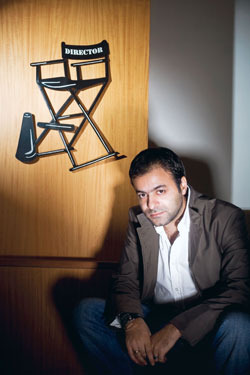
Tarun Mansukhani: Picture Perfect

20 Monday Oct 2008

Posted by sitanshi talati-parikh in Interviews (All), Interviews: Cinema, Publication: Verve Magazine

≈ Leave a comment

Tags

Bollywood, Dostana, indiancinema, Interview, Karan Johar, Tarun Mansukhani

Published: Verve Magazine, Features, October 2008
Photograph by Ritam Banerjee

After assisting with six films, and 10 years in the industry, Tarun Mansukhani debuts as a director with Dostana, releasing next month under the Dharma Productions banner. Sitanshi Talati-Parikh finds him full of steely determination, anticipation and solid allegiance to his mentor, Karan Johar

Director

The sharp, dapper man, just a shade over 30, seems more suited to the corporate world than Bollywood. With crispness of speech and meticulous attention to time, Tarun Mansukhani appears like a tightly wound elastic band – afraid to let go. It makes me ask him a number of times if he is nervous about his big release. “I haven’t thought about it, because I would’ve crumbled under that pressure. It is easier to think of it as just another film.”

Experience has made Mansukhani smarter. He quips, “I tell all my assistant directors that they can’t lie to me – I know all the tricks of the trade, I’ve played them all with Karan!” Waxing eloquent on a superb equation he shares with Karan Johar, the debut director paints a rosy picture. “Karan is the only producer in the world, who when you are hitting a deadline, tells you to relax and take your time. When you go over budget, he asks if it is justified, and if so, says, ‘No problem!’ It makes me want to ask him, ‘Are you sure?’”

Dostana, a romantic love triangle, starring Abhishek Bachchan, John Abraham and Priyanka Chopra, has been shot in Miami. During the shoot, Mansukhani recounts, Johar came to Miami for two weeks, and finally announced, ‘Look, I am really unemployed – I come, I shop and I eat. So I am going back to Mumbai to do more constructive work.’ And he left, not returning until the end of the film. The creative freedom, faith and trust provided by Johar, leaves the former singing praises of a perfect boss and perfect job. And yet, says Mansukhani, “I do not try to stay within Karan’s auteur. In fact, my deliberate decision is to combat what I have learnt – to break the school that we have developed for ourselves.”

While working on the story he has made a conscious effort to use everyday language, even if it is pedestrian language or Hinglish. While the film is youth-centric, it is not just the youth they want to appeal to. “There is an emotion that appeals to all age groups. It is not in its film-making or in its technicality or dialogues. We all have friends, our parents have had friends and our kids have friends. It may not be the dialogue that they might have spoken, or the language; but what is important is that they remember those friendships.”

Dostana is predominantly about the bond of friendship. Mansukhani, who studied in a boarding school, experienced deep friendships, giving him the idea for his first film. He brought in the premise of two men pretending to be gay to stay in an apartment, to make the story interesting. “It was a very conscious effort to not make fun of the gay community. You are not ribbing jokes about them or using them as a ploy.” A mother, who very subtly and with humour shows her acceptance of their sexual preference, adds a progressive element. So, another masala film with a social message? “We can all make art films at the end of the day, but there is a certain reach. Today this is what I would like to make. In the future, I may want to make an extremely gritty film, like Black Friday for instance.”

Talking about friendships, Johar and Mansukhani go back a long way. Johar went to school with Mansukhani’s sister, and when he was looking for an assistant for Kuch Kuch Hota Hai, he thought of him, who at the time was assisting television producer Anand Mahendroo. Mansukhani was not certain he wanted to be a part of commercial cinema – “I was just a Breach Candy boy who didn’t understand Shah Rukh and Kajol. Dilwale Dulhaniyan Le Jayenge was just another film for me.” When he took the FTII exam, confronted by questions on the direction of Swami Vivekanda Part II, he decided to work for Johar instead. The rest is history. The young director sees the future as very promising – making more films for Dharma, and eventually becoming a producer, financed by Dharma. “I don’t see myself breaking away from this family in any form. It is the only family I have known.”

Contrary to expectations, Mansukhani is not a die-hard cinema fan. Having studiously managed to avoid the classics, despite Johar’s repeated suggestions, he remarks unselfconsciously, “I stand clueless at a party when someone talks of classics like Guru Dutt and Satyajit Ray, and glibly put in my two bits, without knowing what they are talking about!” He prefers Sholay, Gadar or the more recent – admittedly candyfloss – films like Dilwale Dulhaniyan Le Jayenge and Kuch Kuch Hota Hai. Quick to laugh at himself, he confides, “The only reason I go to the cinema is because my wife wants to watch a film. While I critique every other film aloud, I am silently taking notes – though no one knows that!”

The resilient director doesn’t give himself even a moment to take a break. Starting work soon with Johar on My Name Is Khan, due for release next year, he is matter of fact about his breakneck schedule. “We are addicted to films – we are not good at anything else. This is our only world.”

And juggling that attitude with a family life? He is quick to compliment his spouse – with whom he has been in a relationship for 12 years and married for three – on being the most understanding person in the world, especially after admitting he hasn’t been to family dinners, and hasn’t met most of her family! He even missed his sister’s wedding when he was busy with a shoot. “I hope that these sacrifices made will accomplish something – at the end of the day, these opportunities may not come to me later. This is what I need to do to make life happen.”

Farhan Akhtar: Rocking Star

20 Monday Oct 2008

Posted by sitanshi talati-parikh in Interviews (All), Interviews: Cinema, Publication: Verve Magazine

≈ Leave a comment

Tags

Aamir Khan, Bollywood, Dil Chahta Hai, Don, Farhan Akhtar, indiancinema, Interview, Javed Akhtar, Lakshya, Luck By Chance, Rock On, Zoya Akhtar

Published: Verve Magazine, Verve Man, October 2008

Heady from the unprecedented success of Rock On!! Bollywood’s latest poster child of youth cinema, Farhan Akhtar talks to Sitanshi Talati-Parikh about his kind of movies, juggling family life with work and how genes make a difference

Superb actor, director, script-writer and now also a good singer (in a raspy sort of way), Farhan Akhtar steals the show with his overwhelming energy and passion on screen. Slipping into the skin of the protagonist, you feel him come alive and half expect him to jump out of the screen. How is it possible to be the master of all trades? Akhtar believes it’s just about applying yourself a 100 per cent in what you have chosen to do. Then there’s his excellent lineage. “I would agree that genetics must play a part in creating a natural leaning towards something that has been so dominant in past generations. But eventually, it cannot make you a good director or actor. That you will have to do yourself,” says the artiste, who keeps pace with a marathon schedule, and is known to never sit idle – not even for a moment.

Powered on by the desire to tell stories, Akhtar believes film-making is a collaborative art form which makes choices about script, crew and cast (among others) very crucial. He takes his time to decide on all these things before getting into a project. “I don’t know what motivates people to make the choices they do – I would hope that my work and its appreciation would serve as a catalyst for other people to do more original work and benefit from it – creatively and at the box office.”

Why, then a sequel to Don? “I found myself obsessed with the title character and the background score. I had to get it out of me. Luckily, I found many people who were as obsessed with the film as I was.” Akhtar has created a cult genre with his youth-centric films. Dil Chahta Hai became the film that revisited Bollywood norms and resonated with a huge college-going audience. That set the pace for Akhtar to continue down a road that told stories that he understood, that he wanted to tell, and which upgraded the passé films into a slicker, smoother and more identifiable medium. At the end of the day, as the film-maker puts it, “it is important to have something to say in an entertaining, engrossing manner.”

Akhtar was not consciously trying to set a social trend. He is clear in stating that, “It is not advisable to design a film keeping in mind its social impact. The design will show if that is the approach. Stay true to the story and do it because you believe in it. If the audience recognises your heart in it, everything else will follow — Rock On!! is being appreciated by an audience of 10 to 60 years of age. If the story has a universal emotional core, then it should be able to connect with all generations.”

And yet, each time it is a different story. Akhtar confesses he is a fan of all genres of movies. Lakshya didn’t do as well in the box office, but it was another story that had to be told. And then came Rock On!! – a simple story, a story you would have heard before, but one that rocked. It was the perfect blend of cinematography, acting, concept, style and above all (as with most of Akhtar’s work) dialogues that work. That are not stilted or refurbished like many of the others are.

There is actually a club of like-minded film-makers, where constructive criticism is an option, of which Farhan Akhtar, Kunal Kohli, Madhur Bhandarkar, Rakeysh (Omprakash) Mehra, Ashutosh Gowariker, Raju Hirani and Vipul Shah are a part. While Akhtar shares a great rapport with Gowariker, to the extent that they “discuss each other’s work candidly, knowing that all views are coming from a space of respect and admiration;” Akhtar’s film-making style is reminiscent of that of Aamir Khan – in that they are both gifted with supreme originality of outlook. And above all, a great sense of characterisation. Both have impeccable tastes in casting – and making an ensemble cast work is often what it takes.

Akhtar is constantly on the look out for talent – whether young or old. The website of Rock On!! actually has a talent hunt for upcoming stars. When questioned whether it was to increase the buzz on the site, he states that it is to find talent, young or old. “A good actor can be hidden inside any person of a age or gender.” That is surprising, considering that Akhtar, like Sanjay Leela Bhansali or Karan Johar, has chosen to work with established actors in his initial films. Akhtar doesn’t attribute this to stalwarts being a safer choice. He is noncommittal in his response. “I have been fortunate to have worked with some big names and talent in my films. That was the need of the script and character. Rock On!! allowed us to work with new talent as it suited the nature of the story. For me, cast is determined by character, not the other way around.”

The film-maker, who considers it a privilege to hail from a legendary family of parents — Javed Akhtar and Honey Irani, and Shabana Azmi – is very firm on the subject of credit. Where once Honey Irani had lost out on credit for her work on Dilwale Dulhaniya Le Jayenge, leading to relations being soured between the two film families, Akthar believes that, “credit is as, if not more, valuable than your fee. The money will come and go but your name will be up there forever. No one can take that away. We are very careful to make sure every single person involved on our films is given their due credit.”

A Martin Scorcese and Woody Allen fan, Akhtar admires their ability to keep reinventing themselves. It appears that he is modelling himself after them, waiting for more hidden talents to surface. Coming up soon is his sister Zoya Akhtar’s film Luck By Chance, in which he is acting. His next directorial venture is slated for 2009. Akhtar prefers not being bottled into acting or directing. “They are both a part of who I am and I hope to keep exploring and learning new things about the art and craft.”

Is his life easy? “I love doing what I do, so it’s not about easy or difficult for me. I try my best.” Married and father of two young daughters Shakya and Akira, Akhtar is constantly playing a juggling act. “I do take my children to set with me when it is possible because it is important that they know where I go and what I do. They should not feel I am disappearing for periods of time without reason.” Known to be exacting, is Akhtar an easy person to get along with? With a light chuckle, he responds, “I get along with myself just fine!”

Turquoise Ananda

28 Sunday Sep 2008

Posted by sitanshi talati-parikh in Art, Literature & Culture, Publication: Verve Magazine

≈ Leave a comment

Tags

Indian Art, vervemagazine

Published: Verve Magazine, Nerve, September 2008

Youthful, enthusiastic and effervescent, Priti Kyal’s personality flows onto her canvas and paints it in colourful hues while being rooted in a spiritual reality, finds Sitanshi Talati-Parikh

Priti Kyal’s painting style is intuitive, with a lot of motifs, design and texture, reminiscent of the saris worn by her mother. “The figures in this set of works are?small representing that we are a tiny part of the large cosmos. I have used the tree of life to reflect growth and sustenance, while the doors and windows reflect change.”

Working off traditional canvas, Mumbai-based Kyal believes that she will move towards a medium like installation, only when her thoughts need to be translated in that form.?“I unlearn everything I have already done by trying new media.” The artist, who is completely satisfied with ink at this moment, finds that despite its simplicity, it is capable of a great deal – “It’s so uncomplicated that it’s thrilling!”

Change is what motivates Kyal: “The thrill of discovery is what keeps me moving on. My work is not about the most perfect face or the most perfect picture but it is about the expression of thought.”

Talking about her buoyant and feminine choice of colours, the artist who recently had her third solo show at Jehangir Art Gallery, Mumbai, explains that her works are about herself. “The colours I use reflect my mood.?I have used soft pinks, oranges, mellow yellows and firoza (turquoise). In that sense, the works are autobiographical.”?Much of her current collection has the words ‘I Am That’ painted on, which Kyal describes as ananda?– the unity between the atman and the parmatman.?Similarly, she seeks a union between her work and herself, so that there is no duality. “I Am That, is a state where I Am My Work.”

The artist, who has a background in English literature and Indian aesthetics, dabbles in poetry, often finding herself scribbling spontaneously onto the painting. Art is simply a medium to express that which is most important, forming a montage representing small vignettes of her life.

European Rhapsody

22 Monday Sep 2008

Posted by sitanshi talati-parikh in Publication: Verve Magazine, Travel Stories

≈ Leave a comment

Tags

Cappadocia, Europe, France, Greece, Ice Hotel, Interviews: Travel, Santorini, Sweden, Turkey, Uchisar, Venice, Versailles, Verve Magazine

Published: Verve Magazine, Travel, September 2008

Sitanshi Talati-Parikh wanders far from the madding crowd in search of the most spectacular European spots for a destination wedding

Travel07

As the bridal season rolls in, everything needs to be perfect – the perfect ring, the perfect outfit, the best guest list, the most gorgeous honeymoon. But the wedding – that is the crucial, quintessential area of importance. Should we stay in or get out? Destination weddings have become the flavour of the season, more important than outfits and honeymoons – which are a given. What with a British couple getting married at 1,000 feet atop airplanes, Star Wars and fairy tale characters’-inspired wedding attire and a groom skydiving to tie the knot in Bhubaneswar; the bizarre is the flavour of the season. To find that eternal, exquisite destination, you just need to think bigger and more exclusive. Forget flowers and centrepieces, it’s the ambience and old-world charm of palaces and castles, or a simple sunset that forms the perfect backdrop to that ultimate moment which needs to be embedded in our memories forever.

It is said to be the most magnificent sunset in the world – and it may just be true. There are very few places in the world where you can stand atop a craggy piece of land and say your vows in front of the tangerine sunset straddling a dormant volcano floating on the ocean. Wedding parties fly in specially to get married in front of the Santorini sunset, and a breathless bride and groom hold hands and wait in anticipation for the exact moment when the sun sets and flashes a myriad colours across the Grecian sky, at which moment, they become man and wife. That is the starting point of a journey, where people are always looking for something special, or actually going that extra mile – literally and metaphorically, to make the event a day to remember. While Santorini appears to be the most magical spot in the world, so purely a thing of nature, consider having a beautiful ice wedding.

From volcanic sunshine to icy blue environs – with a chapel carved out of ice every year, and special custom-made ‘ice’ wedding packages, it is possible to be a real Scandinavian Ice Princess, in Jukkasjärvi, Sweden, a small village 200 km north of the Arctic Circle. No two chapels are quite the same in this unique location, as the chapel itself eventually melts away into the River Torne. Whether you choose matching ski suits, kilts or the traditional wedding attire, having a wedding at the IceHotel is an experience for all present.

If ice doesn’t do it for you, and a princess you still want to be, then simply think like the Mittals – and Versailles. The ‘fairy tale’ wedding of Lakshmi Mittal’s daughter Vanisha that was broadcast all over the world with much fanfare, or Eva Longoria’s wedding reception, were both held at the Vaux Le Vicomte Château, in Versailles, France. The historical 17th century masterpiece is replete with fountains and lush gardens, exquisite furniture, period decor and crackling fires in antique fireplaces – quite the place to warm the soul! With a host of movies shot at this fabulously grand location, it is also enough to make you feel like a movie star. Think Marie Antoinette (but of course with a ‘happily ever after’ instead)!

Talking about fairy tales, you are immediately transported to Venice – the land of entrancing (though a tad smelly) gondolas and beautiful churches. One of the most romantic cities in the world, reminiscent of Juliet being serenaded by Romeo, it is the perfect place for a classic wedding in an Italian palazzo or in the ambience of a church with famous paintings of Titian and Michelangelo as guests of honour. ‘Period Residences’ that date back to the 1500s, like Palazzo Abadessa, with frescoed ceilings, authentic antiques, and paintings from the Tintoretto school, welcome wedding parties.

Gorgeous Capri of Mediterranean blue sea, picturesque white sail boats, limestone masses and villa-lined promenades is one of the most typically beautiful spots – a spectacular alternative to the white Cycladian architecture of Greece – with the simplistic beauty of its coastline. Capri was the destination of choice for celebrity chef Wolfgang Puck and Gelila Assefa’s wedding, at the Grand Hotel Quisisana, which draws inspiration from Mediterranean art and lifestyle, whilst intrinsically remaining an Italian hotel. Getting married amidst the ruins of imperial Roman villas (think Villa Jovis) promises to be an experience.

Recalling Diane Lane in the movie Under the Tuscan Sun, where we realise it is easy to fall in love with wine country (and possibly a hot Italian), and nothing more is really required to have a rollicking country wedding. Breathtaking countryside, art, sculpture and the misty haziness of wine come together to serenade you in style. Winding down grass roads and one-horse towns, where your visitors may actually get lost or never find their way back home, with simple guitar-strumming and sultry afternoons of free wheeling time, it’s all about a sedate wedding at a villa in Tuscany.

If natural beauty is your thing, then having a wedding amidst the backdrop of the fairy chimneys, mushrooms, and unusual land forms of Cappadocia, is inimitable. Reminiscent of the bizarre backdrops in Star Wars, this Turkish phenomenon is best experienced from the painstakingly put together Museum Hotel located at the area’s highest point, Uchisar. With the grand hotel made out of the local insulated rock, many local ancient heirloom and antique pieces decorating the place and a gorgeous heated swimming pool with a breathtaking view of the Goreme Valley to boot, it is not surprising that the hotel is the favourite haunt of movie stars and celebrities, and an ideal location for an exotic wedding celebration; as the sun sets over the land forms, enveloping them in myriad hues.

This is merely the tip of the proverbial iceberg. From Bavarian mountains in Germany to the ‘sound of music’ hills of Salzburg, from the little cozy mountain chalets of Switzerland, to the Baroque architecture of Eastern Europe; going exotic is a truly memorable way to tie the knot.

Rohit Gandhi: Real Impressions

20 Saturday Sep 2008

Posted by sitanshi talati-parikh in Art, Literature & Culture, Interviews (All), Interviews: The Arts, Publication: Verve Magazine

≈ Leave a comment

Tags

Documentary, indiancinema, Interview, Rohit Gandhi

Published: Verve Magazine, Nerve, September 2008

With an impressive dossier of news stories that include live coverage of the Kashmir elections, Iraq conflict, Afghan War, the tsunami tragedy, Nepal’s royal coup, and an Emmy nomination for his recent film, Who Cares About The Girls, documentary filmmaker, Rohit Gandhi, speaks to Sitanshi Talati-Parikh about women in India and the role of journalism

Screen01

In the making of the documentary Who Cares About The Girls, which has been nominated for an Emmy award in the Outstanding Investigative Journalism – long form category, Rohit Gandhi, who is particularly interested in children – seeing that they are our future – describes how after weeks of research, a 14-year-old girl, Radha (name changed), was chosen by the NGO to be the one rescued from her abusive father and sister. He recalls with regret and anger that while the rescue took place as planned, the girl was produced in court and was released as the cops did not explain the circumstances under which the girl was rescued and, despite their best intentions, they could not help her.

The story revolves around four characters: two sisters who were sent away from home to work as child labourers, who were both sexually and verbally abused; a former sex worker-turned-activist and a rescued girl. Though it describes how children continue to be abused, Gandhi believes that there is a positive future ahead if we all get together and fight the problem. After all, “There is no magic wand to change the reality today.”

Gandhi takes his work in his stride – not wishing to become the face of any story, rather letting the story speak for itself. “It is providence to be in a position to be able to make a difference. Journalism is an opportunity to be a mirror of society, help reflect on what we are doing in our daily lives. It compresses space and time and gives a picture of our present reality.” In much the manner that his moving story on a young Iraqi boy who was severely injured by a bullet in the midst of the US-Iraq gun fire, came to the attention of the ambassador of Greece, who took the boy to Athens for treatment and brought his life back to normalcy.

The sociologist says that he knew where he was headed very early in life and that the things that need to be changed are not sitting hidden in sub-Saharan Africa, but right under our noses. “Evils of society happen right around us,” he states, moving on to describe one of his first stories – from the Tihar jail. He believes that putting criminals away in our jails makes them even more hardened criminals – and his story tried to bring about a positive change, in this “very evil system.”

The journalist who has worked with numerous national and international TV channels, and has been the recipient of many awards including an Emmy for his war coverage in Afghanistan in 2001, believes that Indian society respects its women a lot but at the same time treats them very badly. “Traditionally, we were not like this – we have lost our roots. We need to change that. Education, not just literacy, is the mantra.”

Been to the Bachelorette Party?

18 Thursday Sep 2008

Posted by sitanshi talati-parikh in Features & Trends, Humour, Publication: Verve Magazine, Social Chronicles

≈ Leave a comment

Tags

Bachelorette Party, comment, Hen Party, India, mumbai, vervemagazine

Published: Verve Magazine, Musings, September 2008
Illustration by Farzana Cooper

As women experience a dramatic liberation of the spirit, they flock together in time for the most sensational party in town – the pre-nuptial ‘bachelorette’ aka hen party. What ensues is seductive, exorbitant and completely amoral mayhem, discovers Sitanshi Talati-Parikh

Henparty

Cock-a-doodle-doo. A cackle of resounding proportions ensues, ricocheting from the walls and reverberating in my ears. As the shrieking, excited women gather together in a spacious marble tiled room of a luxury hotel, I sit back in amused anticipation. Taking the been-there-done-there stance, I hold forte as the knowing spectator of a scene that is bouncing with camaraderie, clinging with subtle desperation to a youth that may never return, and high on spirits of every kind – as if this is the last night of fun, ever.

With lurid décor to offset the expensive and borderline sensational clothes, the women in one collective burst cheer the hunky man (is it just me or do I dread the sweaty, hairy ape that may just appear?) who is to make an appearance. In a flash I recall the Friends episode where Danny DeVito appears at Phoebe’s bachelorette party, resplendent in an officer’s uniform, all of four feet tall and I believe I can never forget the look of shock and abysmal dismay on the girls’ faces. I kid you not, an Indian hen party that promises a male stripper leaves me queasy and sceptical. A bronzed Brazilian or Greek God – now that would be my kind of party!

As the inebriation skyrockets, the women get louder and brasher by the minute – and the drinking games begin to take a turn toward the scandalous. From recounting your most brazen sexual escapade, to dares that would make any sane woman shudder with disgust, the parties are simply a way to surrender to impulse and try to do what one may never have or probably never will in the future. Or maybe, it is a way to explore the secret, often subdued kinky streak, to ensure post-marital bliss. Simply by letting your imagination go completely wild.

And while one is speeding down the fast lane, taking off on destination hen parties to exotic locales is high up on the wish list. Where the women can surround themselves with everything they love most – credit cards, friends, hot men, shopping, and a vacation that promises to be embedded in their memories forever. While a fun beach trip in Spain or Koh Samui or maybe even intoxicated rounds of vineyards in Tuscany would suit my taste, there are other more sensational destinations that do the bachelorette party rounds. Take your pick from gambling, striptease and can-can in Vegas to 48-hour raves in Ibiza, from singles-only adult resorts in Mexico to life-threatening adventure sports – the world is a menu, and one just has to pick a spot.

What is it that makes this night such a big deal in a woman’s life? Is it the post-women’s lib take on the bachelor’s party? In my naïve understanding of history, women would gab a bit, have a pyjama party, gossip, paint their nails, brush each other’s hair and share secrets about love and what is soon to come. It was a means of solidifying the female bond at a time when women need it the most – as they are about to enter the big bad world of men, mothers-in-law and the kitchen. And men would sow their wild oats. Literally and metaphorically.

We then arrive at the premise that today’s women have many a wild oat to sow as well – with the liberation and all that. And so, every woman wants to bag (or bed) that last bit of scandal, before she begins the journey of a devoted and chaste life. I don’t think so! As single marriages are passé and divorces are the first resort, hen parties are just that – another party to frequent the colourful social lives of the free-spirited women of today, and one that has the golden ‘Get As Wild As You Can’ pass to make anything that happens at that party acceptable.

So what are the women really liberated from? Inhibitions – of course. Moral code – probably. A sense of decorum – definitely. And that is what makes it the night of a lifetime. Needless to say – what happens at a hen party stays at a hen party. And that is one pact that strictly cannot be broken – like that of a sorority. No photos, no emails, nothing to leave a trace of what actually took place, except a vaguely delicious memory that leaves you feeling that you’ve been bad, and enjoyed every minute of it. And the best part – there is no hangover of guilt.

← Older posts
Newer posts →

|  Filling the gaps between words.  |

Writing By Category

  • Art, Literature & Culture
  • Brand Builidng
  • Brand Watch
  • Fashion & Style
  • Features & Trends
  • Fiction
  • Food
  • Humour
  • In The Media
  • Interviews (All)
  • Interviews: Business
  • Interviews: Cinema
  • Interviews: Cover Stories
  • Interviews: Lifestyle
  • Interviews: Luxury Brands
  • Interviews: The Arts
  • Interviews: Travel
  • Musings
  • Parenting
  • Publication: Conde Nast
  • Publication: Elle
  • Publication: Mint Lounge
  • Publication: Mother's World
  • Publication: Taj Magazine
  • Publication: The Swaddle
  • Publication: The Voice of Fashion
  • Publication: Verve Magazine
  • Social Chronicles
  • Sustainability
  • Travel Stories

Reach out:
sitanshi.t.parikh@gmail.com

© Sitanshi Talati-Parikh 2018.
All Rights Reserved.

Website Powered by WordPress.com.

  • Subscribe Subscribed
    • sitanshi talati-parikh
    • Join 51 other subscribers
    • Already have a WordPress.com account? Log in now.
    • sitanshi talati-parikh
    • Subscribe Subscribed
    • Sign up
    • Log in
    • Report this content
    • View site in Reader
    • Manage subscriptions
    • Collapse this bar