• About
  • Brand Building
  • Film & Drama
  • Writing: Arts & Lifestyle
  • Writing: Interviews
  • Writing: Luxury Brands
  • Writing: Travel

sitanshi talati-parikh

sitanshi talati-parikh

Category Archives: Publication: Verve Magazine

Travel blog: Cycladic Groove

23 Wednesday Jan 2008

Posted by sitanshi talati-parikh in Publication: Verve Magazine, Travel Stories

≈ Leave a comment

Tags

Cyclades, Europe, Fira, Greece, Interviews: Travel, Mykonos, Mykonos Grand, Oia, Santorini, Verve Magazine

Published: Verve Magazine, Travel, January 2008

Jive in a raucous Mykonos bar, weep at the splendour of a sunset at Santorini and watch a myth come alive in the Mediterranean. Sitanshi Talati-Parikh traverses the legend of the fabulous Grecian islands

Travel01

A strong gust of air knocks the wind out of me. I battle against it, as if locked into a ground-up quagmire. I have barely descended from a 30-minute Aegean Airlines flight from Athens, and I am already dreading the next week that lies ahead of me in the famous party island of Europe, MYKONOS, that has been known to give Ibiza a run for its money, and a true taste of the celebratory honey. Hugging my jacket closer, I think desperately about all the fabulously skimpy clothes in my suitcase, and wonder if anyone would ever find out if I never left the hotel room, in fear of being blown away into another planet. I’d been forewarned that Mykonos is renowned for its windmills, and now being battered like a rag doll, I truly understand why. A sneak peak at my husband struggling next to me, and I am aghast at his dejected air.

I stare despondently out of the window, at miles of barren countryside, dotted with semi-constructed Cycladic buildings. It looks forlorn, remote and desolate, hardly what one would expect from a happening beach scene. It’s as if we have slipped back into time, when Aristotle Onassis brought Jackie Kennedy to this then-remote island. Winding across the road, I glimpse a flash of Mediterranean blue, looking dark, inky and bleak as the foam swirls in a vicious white, whipped like cream against the battering wind.

The car turns into our hotel, the Mykonos Grand, about four km from Mykonos town and a sense of warmth suddenly envelops me as the serene beauty of white, mosaic, patina and hard-carved marble unfold a promise of better things to come. Greeted by the dashing manager Panayiotis, the epitome of a charming (single) Greek man, I am handed over the keys to my destiny for the next week. Still buffeted by the strong winds as we wince our way to the room, hubby and I brace ourselves for a sombre vacation ahead.

But when I walk into the room, I gasp with pleasure. Pure white marble stretches from one end to another, leading from a private steam and Jacuzzi room, onto the stone patio where our personal infinity pool stretches our imagination into the depths of the Mediterranean waters. As I sip on the local masticha liqueur staring at the beach Ayios Yiannis, where the movie Shirley Valentine was filmed, I shrug, thinking – if all else fails, this wouldn’t exactly be the worst place to celebrate our anniversary….

Flash-forward a mere day later and we are basking in the hot sun, swaying to European beats on the fabulous sandy beaches of Mykonos (from smaller ones like Ornos and Psarou, to the bigger ones like Platys Gialos, Paraga, Paradise and Super Paradise), keeping our eyes peeled for the many international and Greek celebrities that have summer residences on this sophisticated and upscale island.

Screen Shot 2017-07-25 at 4.48.02 PM

True to their word, the local weather predictors were bang on mark and there is no sign of the unpredictable ‘meltemi’ that sent us into the depths of misery, which cancelled many a ferry and has been responsible for many a skirmish fought on the famous Aegean Sea. In Greek mythology, Mykonos was the location of the battle between Zeus and the Gigantes and the island was named in honour of Apollo’s grandson Mykons.

Chora (Mykonos town), set around a picturesque fishing bay, holds its own with a cosmopolitan character that is surprising in its quaint environs, where tourists jostle into fabulous little boutiques and designer stores. It is preferable to stay in a deluxe resort on the outskirts (with convenient access by bus or car) rather than in town, where a sea of small whitewashed rounded buildings nudge each other on a haphazard labyrinth of cobbled winding roads originally intended to confuse pirates.

Screen Shot 2017-07-25 at 4.48.46 PM

The town bewilders the layman and would undoubtedly leave you clutching a map and still walking in circles, trying to stick to Matogianni Street (the main shopping path). It is not surprising to find a local lounging against his shop, smoking and watching you with snickering amusement, as many a tourist has fallen prey to the deceptive streets, more often than not tumbling over Petros, the local Pelican – a Mykonian mascot for half a century. Despite that it’s hard to miss probably the most photographed church in Greece, Panagia Paraportiani – a group of chapels merged into what was once described as an ‘organic masterpiece of accidental architecture’ – standing on a once-fortified piece of land.

Paradise Beach, ranked as one of the top 10 beach party destinations of the world, lives up to its name and reputation, resonating with music that would make your pants fall off and an environment that would probably make you want to do just that! With world-famous deejays making their rounds in Mykonos in the summer (July-August), non-stop parties that race into days and pour into the ocean, with a flood of people from every part of the world picking their slice of pleasure, Mykonos rocks it up, shakes it around and splashes it down until you are left buzzing with wonderment. Designated beaches like Super Paradise encourage the gay population to come out of the closet and escape into the ‘open’ sunshine without reproach. I covertly watch two nude European women, lovingly rubbing suntan oil onto each other, as I snuggle closer to my husband.

If huge crowds and racy partying is not your cup of holistic pleasure, June or September is the perfect month for unadulterated relaxation on this seasonal haven. It is then easy to find a tranquil spot on the Chora waterfront, watching the ferries dotting the clear skyline, over platters of fresh seafood at a local café. Come evening, we find a spot in Little Venice, constructed right onto the sea’s edge with precipitous balconies peering onto foam washed pebbles, where one wrong stiletto step or an awkward bump would send one reeling into the turquoise waters. Throbbing with bars (Caprice and Mykonos Bar are to die for) and fine dining restaurants overlooking the famous quartet of Mykonian windmills it is possible to romance the night away in this Grecian Venice.

Later, as I lie back in one of the sunniest areas of the world at the Althea Spa of our hotel facing the sacred island of Delos and relaxing with a traditional Greek olive oil massage, I am told this very spot attracts the highest concentration of cosmic energy. The cosmos has definitely worked overtime to ensure that true bliss touches my fingertips and sends a flood of pleasure into my life, even if for a mere week.
screen-shot-2017-07-25-at-4-48-16-pm.jpg

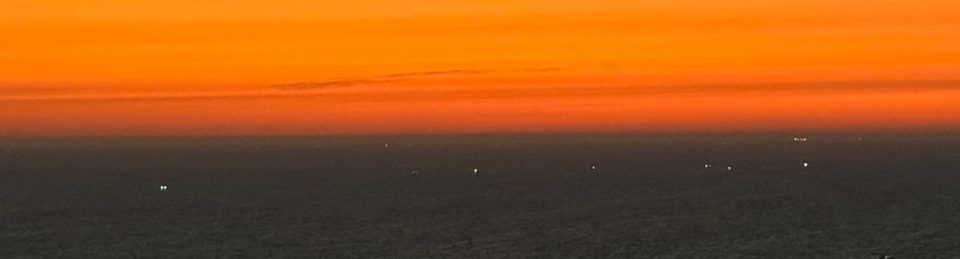
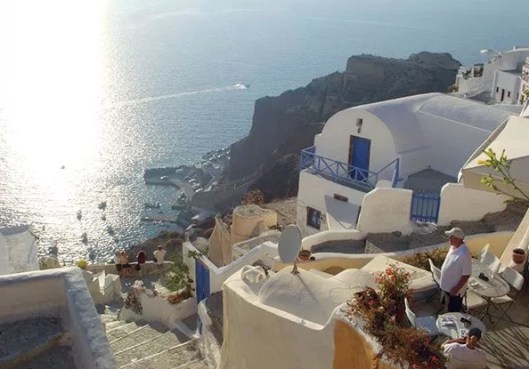
Perched on the edge of a cliff, overlooking fragments of a dormant volcano afloat in the Mediterranean waters, probably the only one in the world with its caldera in the sea, the sun performs its daily ritual. This is the famous SANTORINI sunset – which people fly out miles to watch, for which people spend a king’s ransom to get married against, in front of which writers in desperate need of inspiration stumble around. Santorini is what poetry, dreams, flights of fantasy and destination weddings are made of. As the sun’s rays sensually explore the riot of volcanic colours, naturally changing hues through the day, surrounded by the deep, blue sea, the sight brings a flood of lyrics to the tip of one’s tongue, a calm sensibility and yet an eager uneasiness to capture this eternal moment, at a place where civilisation has existed since the third millennium, BC.

From the heart of a natural catastrophe – volcanic eruptions that destroyed the island many times – has emerged spectacular beauty and tourist exploitation. As visitors throng onto the harbour in hordes, I let the pace slow me down, let the feel of the island’s majestic appeal sink into me. The cliff rises steeply into the sky and if you are one of the lucky few to have taken the high-speed catamaran ferry or a flight, then you can take the road up to the top of the cliff, where most of the towns with spectacular views are located. The others that arrive via bigger cruise ships have three remarkable options ahead of them: walk (only recommended if you are intensely fit or a masochist), ride abreast a donkey (bumpy, to say the least), or take a cable car (wait in long lines if it’s peak tourist season).
Screen Shot 2017-07-25 at 4.49.02 PM

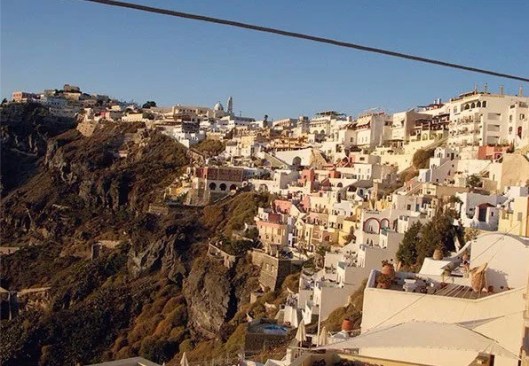
Arriving in a record 10 minutes by car into the capital town, Fira, I watch amazed as the panorama unfolds before me. In desperately steep winding, cobbled paths, that doth not inebriation or an erring footstep forgive, lies the town – twinkling, as if quietly amused by the next batch of tourists that has arrived, to match wits with its killer (and I mean that with every kind of pun intended) location. The town is built vertically up or horizontally down, whichever way you prefer to look at it. Every hotel and every room lies one below the other, accessed only by the sheer pedestrian path. With horror and growing dread, I realise the implications vis-à-vis luggage and a bout of daily extreme exercise! Fear Factor material, I believe.

Porto Fira Suites, a charming hotel located amidst a cluster of Byzantine and post-Byzantine, Cycladic architecture, welcomes us warmly with slightly raised eyebrows at our immense bags (no, it is not an Indian thing, and it definitely wasn’t too many pairs of shoes)! Having exchanged notes with other tourists on the ferry, I understand that many have chosen to stay out of the main town, in places like Imerovigli (the ‘balcony of Santorini’), Firostefani and Oia, or on the outskirts of Fira in bigger hotels, like The Majestic. Some, like us, have decided to pay the price (literally, for a room with a view is exorbitantly expensive) of being bang in the midst of all the action, where shopping, food and nightlife is but a precipitous walk away.

Strolling around Fira, we stumble upon a gold mine – literally. The path is known as ‘Gold Street’, peppered as it is with shops selling every kind of gold jewellery and antiquity. As I steer past the glitter I swerve into the bylanes of the buzzing Erithrou Stanrou street, which I chose to nickname ‘Party Street’. From an Absinthe Bar called Casablanca Soul to nightclubs like Enigma, that don’t even begin to open an eyelid before 1 am and start rocking the daylights off the volcano in the wee hours of the morning, I discover with incredulity that Fira has its share of a big party scene.


Screen Shot 2017-07-25 at 4.48.26 PM
Screen Shot 2017-07-25 at 4.48.54 PM

We choose to drive around in a racy convertible with the top down, stopping by for a bout of local wine tasting thrown in for good measure. Santorini, depicted as the island of volcanic mystery and sheer cliffs, gently merges into the water on the other side, with exceptionally colourful beaches. Kamari, on the southeastern side of the island is the most international place to lounge upon. I realise, that walking barefoot on the hot volcanic sands can be a tad scalding, so it is advisable to keep those flip-flops on! There is no better place to get a killer tan than on these beaches that simply soak up the sun.

While both of us wait for the sun to set in Oia, on the other side of the island, renowned for the world’s most beautiful sunset over the caldera, the hours simply fly by, as the sun’s rays flecked with the dark hues of the deepening volcanic earth, move slowly down our bodies and into the depths of the water, leaving behind a sense of peace, fulfillment and accomplishment. This is one sunset that is difficult to walk away from….

Saawariya: Review

19 Wednesday Dec 2007

Posted by sitanshi talati-parikh in Art, Literature & Culture, Publication: Verve Magazine

≈ Leave a comment

Tags

comment, Ranbir Kapoor, Reviews, Saawariya, Sanjay Leela Bhansali, Sonam Kapoor, vervemagazine, White Nights

Published: Verve Magazine, Screen, December 2007

Sanjay Leela Bhansali’s fantastical and surreal Saawariya is a lyrical odyssey that could have been explosive as a theatrical performance or a stage musical, opines Sitanshi Talati-Parikh

Evolving the vibrant medium of cinema a notch further has been considered the auteur of Sanjay Leela Bhansali. In his latest offering, Saawariya, he draws from Fyodor Dostoevsky’s short story, White Nights, where a vibrant youth enters a snowy, mystical hillside town only to be carried away in a fantastical love affair over four surreal nights. Despite the gaps being filled by a good soundtrack, the lyrical odyssey stretches and the story is not a perfect flow through the frames and between the songs. It would have worked better, had the songs been half the number, the scenes more tightly wound and the characters allowed to develop fully. Alternatively, this could have been explosive as a theatrical performance or stage musical.

With Saawariya, the film-maker brings a superb theatrical effect to light. Drawing from the paintings of Frederick Arthur Bridgman, Fred R Wagner and William Louis Sonntag, visualiser Ravi Chandran has made Omung Kumar’s stylised sets come alive, with the use of space lights (a first for India). Add that to excellent costumes by Reza Shariffi (Ranbir Kapoor) and Anuradha Vakil (Rani Mukerji, Sonam Kapoor), the look of Saawariya is larger than life. The movie, however, doesn’t work evocatively, even if it does enchant. His multi-hued extravaganza just misses the exacting moment, when a painting comes to life.

The beautiful canvas may just be too well crafted. As the actors appear on this canvas to enact a sequence of events, the space appears too perfectly composed, too posturised, leaving the characters distant from the audience. As Sakina (Sonam) drifts past on the waters with her arm extended, it is dramatic and unreal at the same time. Suddenly that feeling changes, when accosted with Lillianji (Zohra Sehgal) and Gulabji (Mukerji). They spring to life and the film abruptly loses its dream-like detached quality. Raj (Ranbir) splits between the gaps and opens up on screen, as an identifiable character, but one is unable to get a lasting feel of his emotions as they scatter across the canvas.

The fresh, lively faces of the newcomers light up the screen. Ranbir exceeds expectations, while Sonam Kapoor shows potential. The lack of chemistry between them, if intentional, works at a subterranean level, to hint that it is a doomed love story, but the missing chemistry – between Imaan (Salman Khan) and Sakina – has no explanation. It is easier to be moved by Lillianji’s grief, as she is left alone, than it is to sympathise with the protagonists.

Bhansali’s experimental cinema is always a welcome change from the mundane histrionics of mass cinema. Whether the audience is able to accept the shortcomings of Saawariya in light of its positive movement towards evolutionary cinema that breaks with convention, is left to be seen.

Travel blog: Romancing the Ringstrasse (Vienna)

23 Friday Nov 2007

Posted by sitanshi talati-parikh in Publication: Verve Magazine, Travel Stories

≈ Leave a comment

Tags

Austria, Europe, Interviews: Travel, Ringstrasse, Sacher Torte, Verve Magazine, Vienna, Wiener Staatsoper

Published: Verve Magazine, Travel, November 2007

It’s a modern city with a romantic soul. Vienna’s majestic royal palaces, quaint coffee houses and famed tradition of outstanding opera music evoke a bygone era of refinement and grandeur. Sitanshi Talati-Parikh walks through the heart of the bustling Austrian capital and succumbs to its elegant charm and deliciously slow rhythm

Vienna01

A ring of fortune, history and spectacular beauty drifts in with the sound of music. The tune has been heard a million times before and is unforgettable. The inner circle of Wien, the Ringstrasse, the city centre or first district, holds me spellbound. The flight attendants were not joking when they said, “We are landing in Vienna. Move your watches back a hundred years in time!”

It’s true. Despite its modern fittings and the latest technology, Vienna still maintains its old-world charm. So much so that I half expect one of the locals to raise his hat and bow in greeting. Baroque architecture jostles for space with Art Nouveau in this predominantly Catholic city overflowing with museums, cafes, opera houses, and churches.

As tourists mingle with locals at one of the Kaffeehaus (local coffee houses), I observe the age-old tradition of taking time over the brew, savouring a pastry, smoking a cigarette while reading the papers, gabbing or even composing (let’s not forget the legendary Mozart spent most of his days in cafes). This is one city that knows how to work and how to unwind. It might lack the breathless pace of a New York or London, but Vienna more than holds its own with a charm that is distinctly European.

It’s as if time has stopped – that it has raced through the city centres of the world, found its home in Vienna and is resting here. The thought makes me want to take a breather as well. Breaking my stroll through the Museum Quarter, I lie down on the crisp green grass and watch the world enfold before me.

A contemporary art exhibition at Vienna Secession, the world’s oldest independent art institution devoted to contemporary art, catches my interest. Art here, I realise, resides not only in the paintings, but also in the buildings, the music, the thinking and the pride of the people. This in itself is not without irony as many of these beautiful buildings (especially the Secession and Staatsoper) were genuinely disliked by the people when they were first built! Names roll off a local tour guide’s tongue as she rattles off names of architects, musicians and painters in a single breath. I learn that Otto Wagner, one of the most prominent Viennese architects, is among those one has to be grateful to for some of the splendid structures in the city.

Across from the Museum Quarter, the Hofburg Imperial Palace, which has hosted some of the most powerful people in Austrian history and is the residence of the President of Austria, is also a stop for the famous Fiakas (horse-driven carriages). Again, I’m back in time. For a princely sum of 40 euros, I can take a Fiaka ride around much of the Ringstrasse and relive the grandeur of the past. It is, however, the former summer palace of the Habsburg family, Schönbrunn, with its magnificent gardens, that is considered the ultimate palace experience in Vienna.

Baroque and Gothic, the imposing Stephansdom (St. Stephen’s Cathedral) is located smack in the heart of the city centre and is a beloved favourite. It’s always eventful to walk from the Wiener Staatsoper to Stephansdom through the pedestrian path paved with shops, cafes and performers. Watching the clever, talented performers, I snack on some traditional fast food — a Würstelstand or a sausage shoved into a humungous bread roll. A particularly tasty variation is the Burenwurst and Käsekrainer (sausage filled with cheese). It’s not unusual to find the stands crammed with kebab (Turkish sandwiches) and pizza offerings as well – a new addition to the fast food culture, I’m told.

Sitting in one of the cafés, I’m awestruck by the power of a middle-aged opera singer’s operatic vocals, amused by street performers vying for our attention with their jugglery, tricks and colourless jokes and quietly entertained by a pianist who rolls in her piano into the street to play to an appreciative audience.

The famed music culture of Vienna is outstanding. From street musicians to fabulous operas and ballets, Vienna throbs with exquisite sounds. I choose to attend the modern rendition of The Nutcracker, playing at the magnificent Wiener Staatsoper (Vienna State Opera). It’s a stunning performance, never mind the audience’s claims — overheard between acts over wine, chocolate and caviar – that it did not quite measure up the original.

An elegant local tradition is to enjoy a performance followed by a walk to the Sacher Hotel nearby to savour the original Sachertorte (a dessert composed of several thin layers of dry, slightly bitter chocolate cake with apricot jam in between, served with dollops of sugarless whipped cream) and rub shoulders with the best. Legend goes that the original torte was made by mistake by young apprentice Franz Sacher in 1832. Of course, it’s now world famous and Sacher Hotel’s best kept secret, even involving a long legal battle! Personally, I found the Appelstrudel and other pastries more exciting than the over-hyped Sachertorte. But the Sacher industry thrives as no tourist comes away without experiencing the original.

A great way to end the walk — drinks and dinner at the cosmopolitan DO & CO Stephansplatz with its spectacular view over the cathedral through full-length glass paved walls. I get a taste of refined Vienna as I tuck into the local weiner schnitzel (Viennese breaded veal cutlet, with various accompaniments) and watch bankers and high-profile associates in muted conversation.

I walk slowly back to the sophisticated Le Meridien, conveniently located on the Ring, across from the Staatsoper. As I enter, I witness a happening fashion party – with a showing of LISKA, one of the oldest fashion houses in Vienna. Swinging with some of Austria’s hippest, I take quick notes on the latest trends for Autumn-Winter 2007. A-line dresses, capes, clutch bags (particularly the crocodile leather sort), wide belts, patent leather boots, feathers and fringes are the latest ‘it’ sensations.

I suspect the Viennese temperament — sentimental and nostalgic — is rubbing off on me. In the wee hours of the morning, exhausted, though not world-weary, I stand by the long paned windows, staring out at the now peaceful, tree-lined Opernring Road. I pretend I live in this posh area.
This memorable walk across one of the finest cities in the world makes me want to believe this is home. I really don’t want to leave. Not yet.

Travel blog: Viennese Waltz

23 Friday Nov 2007

Posted by sitanshi talati-parikh in Publication: Verve Magazine, Travel Stories

≈ 1 Comment

Tags

Austria, Europe, Interviews: Travel, Verve Magazine, Vienna

Published: Verve Magazine, Travel, November 2007

Exult in the city’s rich delights

Suburban toast
Suburban Vienna is the place to try new Austrian wines and relax at a local Heurigen. These are the only places authorised to serve new wine, often accompanied by elaborate Viennese specialties or basic bread and cheese platters.

Deconstructed designs
Austrian fashion designer, Helmut Lang, is renowned for his minimalist, deconstructed designs. Originally from Vienna, Lang branched out to international fashion capitals like Paris and New York, with his own label.

Schrammelmusik for the soul
This Viennese folk music, popularised by the Schrammel brothers, Johann and Josef became immensely popular with the elite who were bowled over by the melodious, melancholic sound. A typical ensemble comprises two violins or fiddles, a double-necked contraguitar, a G clarinet and often, a button accordion called Schrammelharmonika. Many of Vienna’s famous composers, like Strauss, Brahms and Schönberg were Schrammelmusik enthusiasts.

Edelweiss blooming
The Edelweiss lives up to its translation of noble and white. Though found in other European nations, Austria’s national flower has shaped the world’s image of the county and the Alps. The Sound of Music’s most beloved song is dedicated to this little, big flower.

Coffee, anyone?
The Viennese are very serious about their coffee, traditionally served with a glass of chilled water. It’s sacrilege to just say you want ‘coffee’ when you’re spoilt for choice with varieties like Kleiner Schwarzer (small black coffee), Großer Brauner (large coffee with cream), Melange (coffee with milk), Kapuziner (small black coffee and a dash of cream) and Kaisermelange (coffee, milk, egg yolk and cognac). In the late 19th and early 20th century, leading writers frequently met and wrote at Viennese cafés, where much great music was also composed.

Sameera Reddy: Girl Transformed!

20 Tuesday Nov 2007

Posted by sitanshi talati-parikh in Interviews (All), Interviews: Cinema, Interviews: Cover Stories, Publication: Verve Magazine

≈ Leave a comment

Tags

Bollywood, indiancinema, Interview, Sameera Reddy

Published: Verve Magazine, Cover Story, November 2007
Photograph: Joy Datta

Bollywood siren Sameera Reddy has stepped out from the shadow of her model siblings into the sizzling world of the big screen. Recently seen schmoozing with the likes of Shakira and George Clooney at the Toronto Film Festival which showcased two of her films, the sultry star, who was also in the news for battling to save an orphanage, reveals to SITANSHI TALATI-PARIKH, that under all that glamour, she is just a simple girl with simple desires

Sameera03

“Being glamorous doesn’t turn my head, because I have been on the receiving end of never being looked at, of never getting a rose on Rose Day in college, of being alone. I am now more wary of superficiality.”

“It was a painful time when nobody even knew I existed – that there were just two Reddy sisters who were models, Sushma and Meghana.”

“We are so opinionated and headstrong, all with ideas about what’s best for the other! Now, when my sisters and I spend precious moments together, it is a riot.”

“Being sexy is just a facet, not the whole. I didn’t start out being a sex symbol, or think that I would be an actress. It was almost like an overnight change.”

“It isn’t fair to be under constant pressure of having to wake up every morning, roll out of bed and come down looking as if you have just stepped out of a Yash Chopra film! But it is a part of who we are and what we are expected to do.”

“I go with the flow, from bubble-headed bizarre roles in Telugu films, to serious acting in Bengali cinema, to masala parts in Bollywood.”

“I am meticulous about learning all the languages in which I act and I understand the meaning of every word that I speak.”

“Being an actor makes you an extrovert. It throws you into the water and forces you to learn to swim. The image is just an extension of what I am supposed to be – but it is really not who I am.”

“The adulation is fantastic – it is what makes all the baniyawalas and rikshawalas recognise me. But, one day it’s going to go away. The day most actors dread, is the day I feel I will be set free….”

“The turning point of my career was being a part of Buddhadeb Dasgupta’s film, Kalpurush. You can’t hide in Buddhadeb’s cinema, it is just you and your character and it is the true test of real acting.”

“I got a renewed sense of confidence when Buddhadeb chose to cast someone like me, when everyone else dismissed me as just a glamour doll.”

“Toronto was a crazy picnic. I went to the Festival with no expectations and ended up meeting all these international celebrities who are so unbelievably down to earth. Having dinner with them seemed like the most normal thing to do!”

“The Indian sari is the sexiest outfit in the world. Why wear Versace and Armani to International festivals?”

“I am mad about travel and I love places with history and culture, like Turkey. I like backpacking; I have spent a month in Thailand, where I learnt how to ride a bike.”

“I am a loner and an introvert. I love sitting by the poolside reading and writing in my diary – which would probably make a fantastic best-seller! I also enjoy knitting.
I shock myself. I can be unpredictable, because I am very impulsive. I follow a strict fitness and diet regime; yet one day I can wake up and decide to eat pani puri off the road, or fly to Paris, and actually do it!”

“I can say something, and then do something completely different.”

“I would never reveal my inner self to anybody.”

“My portable PlayStation is always with me. I love Need For Speed and car racing games. Sam’s Mission, a video game revolving around me, is a great kick, pun intended!
My love life suffers because guys are really intimidated by my image. At the end of the day, I am just a girl, who wants a simple guy she can come home to, not a model, actor or cricketer!”

“My role model is my mother, a part of my dad’s business, a social worker and a constant learner, whose energy even at the age of 61 makes me want to better myself.
In a world full of superficiality, taking care of orphan kids has been a reality check. The plasma TV, the diamond ring, every big thing became so redundant.”

“I emotionally blackmailed all my friends, found out what fancy new thing they were about to buy and made them put the money into the orphanage instead. I’m proud of them for coming through for me.”

“I am not a party animal. I like simplicity. My favourite thing in the world is plopping down with a big bag of popcorn and watching a movie. What really gives me pleasure is coming home to safety and comfort after a hard day’s work.”

“It is a tight slap in the face if you think that when you win the Filmfare Award you will be happy, or when you find the perfect man or lose weight you will feel good. None of that matters – happiness should begin right at this moment with no end goal in sight.”

Literature: Experimental Writer

26 Wednesday Sep 2007

Posted by sitanshi talati-parikh in Art, Literature & Culture, Interviews (All), Interviews: The Arts, Publication: Verve Magazine

≈ Leave a comment

Tags

Indian Fiction, Interview, Kalpana Swaminathan, Literature, vervemagazine

Published: Verve Magazine, Speaking Volumes, September 2007
Photograph: Ritam Banerjee

A doctor, columnist, novelist and detective fiction writer, Kalpana Swaminathan is often taken aback by the absurd situations that she has been witness to in her multi-hued career. She encapsulates the banality of everyday living in her works as is evidenced by her latest offering, The Gardener’s Song. Sitanshi Talati-Parikh exchanges notes with the diverse wordsmith who delights in dabbling in different genres

Speaking01

Holding a tête-à-tête with the talented, genteel lady, simply clad in a green sari, I sit at a corner table at Crossword, Bandra. Kalpana Swaminathan juggles at being a doctor, columnist, novelist and detective fiction writer, so our conversation sparks off with her unusual career choices. She brushes off any surprise at a paediatric surgeon taking to writing, with a decisive, “You have to be interested in people.”

Sensing that nothing more is forthcoming, I switch gears to what made her start writing. Looking less than pleased, she counters, “What kind of answers do you expect? I wish I could produce something magical.” As a child shouts behind us, Swaminathan visibly softens and warms to the topic. “I love children and I love to write.” She muses, “Medicine as a profession becomes a way of life. You use perhaps ten per cent of what you learn in practice. The other 90 per cent is not used for ‘doctoring’ – it serves a larger purpose, it changes the way you look at things, it changes the value of life.”

Just like one must have a sense for the written word, Swaminathan believes that one has to learn the child’s language and understand it. She defies the myth that children can’t talk or communicate. “It is actually the adult who has to learn how to communicate and learn to understand what the child is not telling you.” It is not surprising then, that she found her stories for children easy to write – they are all fairy tales, with magical things happening in the world.

Swaminathan found herself publishing short stories at the fantastically early age of 13, but soon after went through a lean period where for years she did not get the chance to write, until after the age of 30. She recalls those years as being “rich, harrowing and exciting,” all in one breath, a time when she was studying medicine and working intensely. “When I started writing again, the initial writing was easy – it simply scaled off me. After that, I began experimenting with different genres.”

Around 1996, after her foray into children’s writing, Swami–nathan began writing columns with her colleague and partner, Ishrat Syed. As I wonder if it is easy to write in tandem with another person, she brushes it off as child’s play, simply, “We had to arrive at a distinctive style.” It was an exploratory journey, from Animal Crackers for a daily newspaper, to columns, where they wrote about different things including art, food, “mad” science, literature and lingua franca. She recalls with pride, that in 2000, when the human genome was being mapped out, they tracked its progress, in a week-by-week review column. As if reading my thoughts, about why they haven’t written a piece of science fiction yet, she mentions that their jointly written book is due to be out soon, which is to be a futuristic view of Mumbai.

When the experimental writer wanted to have some fun, she began writing detective stories. Her detective Lalli is accompanied by her niece, the writer of the book. Lalli isn’t the action-oriented detective of the racy thrillers, but the analytical thinker of Agatha Christie’s genre. Noticing the Poirot-Hastings ensemble cast of her novel, I ask the inevitable question. Swaminathan is quick to reply, “Of course, I’ve read Agatha Christie – who hasn’t? She’s a marvellous writer, as all the others out there, but I like to think of my work as my work!” Her first detective fiction, The Page 3 Murders, is a spoof on a country house murder, relocated in Mumbai, where, as she puts it, “everyone lives in each other’s pockets.” In here we find the classic English whodunit.

Tired of men and their sidekicks, Swaminathan deliberately chose an elderly woman as her detective. After all, she points out, an Indian woman would be free to do as she pleased only when post-60 and problem free! Sharp, compassionate and efficient, Lalli, a retired police officer, is considered the man in khaki’s Last Resort (LR) on troublesome murder cases.

The Gardener’s Song, Swaminathan’s latest whodunit on the murder of the nosey Mr. Rao in a Mumbai suburb, is ultimately a Mumbai book, traversing Juhu by-lanes all the way to the dilapidated buildings of Princess Street, opening up the lives and eccentricities of suburban Mumbai households and communities. Her writing is experiential: “I used to know Bombay – not what is has become in the last two or three years, but its largeness, its middle-class suburban experience.”

The banality of everyday life comes under the writer’s microscope – taken aback by the absurd situations that she has often been witness to, it is but natural for her to include these elements in her story. In The Gardener’s Song, for instance, Swaminathan describes an incident where a man is in desperate need of a blood transfusion and the only person who matches his blood type appears on the scene, only to be nearly frightened away at the thought of an HIV test. Aghast by the impact of what a rumour like that could have on his social life and marriage prospects, the donor is vouched for by his employer and colleagues as “a good man, from good family” – as if to imply, that that in itself should be sufficient proof that the man is not HIV positive!

The Gardener’s Song is not lacking in social comment, as if attempting social change in the midst and through the medium of a detective story. This touches a sensitive area, as the impassioned writer exclaims, “I do feel very strongly about these things and cannot help voicing them!” She is angered that the Indian Penal Code has a separate section for dowry death, which is basically “soft-optioning it, not calling it murder.” Swaminathan finds that Indian crimes are crimes of despair, hypocrisy, refusal to face the truth: “We can’t say bad things about people, but we can murder them. We are a cruel, violent and dishonest lot, and those who disagree, do so as they are cushioned by illusion.”

Swaminathan takes a cynical view of women in Indian society, the kind of women who sustain an obsolete patriarchy, and the feminists who are tired of being feminists. She firmly believes that every man and woman should do his or her bit. Believing that the most powerful women in Indian culture are elderly women, she holds them responsible for the crimes committed against other women. In fact, this is one of the reasons that she profiled her detective as an elderly woman.

It is clear that this is a writer who understands her audience and her subject, in equal part. Swaminathan brings out nuances of the local language in her writing, nuances that are completely absent from her crisp spoken English. As we have a dialogue about Salman Rushdie’s theory of “chutneyfication” of the English language, she describes how the language conveys the essence of the person, the local idiom and the flavour of the conversation. A large number of writers attempt to bring their part of India in their writing, as the local dialogue is a bridge between writing in the local tongue and writing in English. It is in this manner, that the language comes alive and it is easy to move between time and place, to enter and explore a region and lives in a way that one can’t imagine. In fact, a lot of the conversations in her books are taken verbatim from real life.

Swaminathan isn’t disconcerted about the dearth of detective fiction in the country. Publishing in English, in India, she explains, is only 20 years old; she expects to see a great deal more in the next five years.

Taking a few moments for this thought to sink in, the middle-aged writer, who finds the time to write on a daily basis, whilst actively practising, notes that writing per se has less to do with the craft and more to do with the experience of being a writer. And what is it that she, as a writer looks for in her work? Sitting back, taking a sip of chilled water, Swaminathan smiles and says, “Every writer is looking for two things – the inspiration to write at least one line of truth, and the aspiration to write a book!”

Lillete Dubey: The Performer

20 Friday Jul 2007

Posted by sitanshi talati-parikh in Art, Literature & Culture, Interviews (All), Interviews: Cinema, Interviews: The Arts, Publication: Verve Magazine

≈ Leave a comment

Tags

Bollywood, indiancinema, Interview, Lillete Dubey, vervemagazine

Published: Verve Magazine, Features – Multiplex cinema, July 2007
Photograph by Kunaal Roy Kapur

She calls herself ‘an accidental film actress’. Lillete Dubey has made a mark for herself as an acclaimed character actor in films like Monsoon Wedding, My Brother Nikhil and the soon-to-be-released Bow Barracks Forever. In a freewheeling chat with Sitanshi Talati-Parikh, she describes how small-budget films have given rise to an independent, alternative voice in Indian cinema

Lillete

As I wait for the husky-voiced, charming character actor of substance, I potter around her intimate boudoir with its coffee-table tomes, old family photographs and bright silk cushions. Finally I meet the “died-in-the-wool theatre person”, who insists on calling herself an “accidental film actress,” whilst she is getting primed for the Verve shoot. Over lemonade and cheese toast, the intuitive, friendly and very “non-filmy” Lillete Dubey, jumps right into the topic at hand.

When I ask her whether alternative cinema began getting a decent showing after the mushrooming of multiplexes, she begs to differ. Dubey strongly believes it is the changing expectations of the audience that has given rise to a different kind of cinema. Multiplexes have given a platform, an alternative to mainstream, commercial cinema; but it was something that was coming – people were getting tired of having no choice. Everything, she believes, is a by-product of audience tastes.

Lighting a cigarette, Dubey explains that in her younger days, the audience did not have the choice to see anything besides Doordarshan. Today, due to the sudden advent of cable TV, media exposure and foreign films, there is a much more sophisticated audience. Their demands and expectations are different. The new discerning audience is not happy with the “seven-dances-in-Switzerland” kind of cinema. A synergy between all these elements, including the rise of multiplexes, led to the creation of what she calls, the “small-budget film”. “There isn’t ‘art’ or ‘offbeat’ cinema, simply “big-budget” and “small-budget” cinema.”

Small-budget films have given rise to an independent, alternative voice in Indian cinema, the likes of My Brother Nikhil, Bheja Fry and Monsoon Wedding. Here, the story and performances drive the film. Dubey believes this is what differentiates the two kinds of cinema and why so many movies with huge stars and hype are not hits. This is the reason why a ‘multiplex’ film, made well and within a tight budget, has very high chances of doing well, whilst the risks of a big-budget movie are commercially much higher.

Dubey rues the dearth of good character roles, especially for women, in Indian cinema, a fact that is slowly changing with the advent of smaller, independent films. The talented actress, whose upcoming ‘multiplex’ movie is the ensemble English film, Bow Barracks Forever, about Anglo-Indians in Kolkata, says thoughtfully, “Most actors (including me) would say, ‘I’ve never got the role that does me justice.’ That may sound presumptuous, but it is the remark of someone who is still striving to better than what they’ve always done. Any intelligent actor will always hanker for something richer, better, more complex, more difficult and more challenging. That’s the nature of the animal.”

Dubey agrees that a film-maker should keep trends, profiles and tastes of audiences, economics and universal appeal in mind when making a film. However, she strongly believes that if a film is made from the heart, with a good story, it will work better than a movie contrived with too much agenda. “In the end,” she smiles, “good cinema or any creative art is simply about illuminating the life we live.”

Chick Lit for the Soul

19 Saturday May 2007

Posted by sitanshi talati-parikh in Art, Literature & Culture, Features & Trends, Publication: Verve Magazine

≈ Leave a comment

Tags

Chick Lit, India, Indian Fiction, vervemagazine

Published: Verve Magazine, Features, April 2007

Single career women filling reams with the sardonic and witty prose about the angst of their lives, loves and non-loves, create a space for female readers who are tired of romances that talk about the exotically beautiful and the perfectly endowed. Increasingly, women writers are willing to pen the trials of the real woman in a real world where Mr Right may not exist. Chick lit romance is contemporary and true, with a sense of humour that stands the test of modern roles and expectations. It’s another matter that few writers can complete the final chapter without a Mr Right! Sitanshi Talati-Parikh attempts to unravel the attraction of this feel-good genre

Chicklit01

With cosmopolitan women choosing a martini over kesar-pista milk, the face of the contemporary Indian woman is changing and so is the writing to keep up with the new form of Westernised liberalisation.

Discovering an empty niche between perfectly real literature and unrealistically perfect romance, books featuring the lives and loves of young professional women, aka chick lit, comes as a form of salvation to the average woman who wants reality on the rocks, with a twist of humour. Smoothly banishing the heavy-handed depressed monotone of philosophy, and sardonically diminishing the fluffy picture-perfect description of fantasy, international chick lit queens like Helen Fielding (Bridget Jones’s Diary), Candace Bushnell (Sex and the City), Lauren Weisberger (The Devil Wears Prada) and Emma McLaughlin and Nicola Kraus (The Nanny Diaries) have set the standard for chick lit across the globe.

Seeing modern Indian women identify with these books and protagonists, Indian writers, like that of other countries across the world, have adapted this space in the local context. chick lit writer, Kavita Daswani, believes that a woman anywhere in the world is a Bridget Jones in the making, and that her angst is not much different from any working middle-class woman. Daswani points out that today’s woman anywhere in the world is probably looking for a boyfriend/husband, satisfaction in her career, good friends, enjoyment; she has money issues, she gets involved with the wrong men, and she might have conflicts within her family – all those things that any 20 or 30-something professional woman encounters on a day-to-day basis, probably anywhere in the world.

Rajashree, a Mumbai-based writer is pleased with the similarity. “I can identify with her (Bridget Jones). I was so delighted to read the portions about Bridget’s mom – even British mothers bug their daughters about getting married!” And this is how we find amusingly disgruntled, unmarried career women, filling pages with the sardonic and witty angst of their lives, loves and non-loves, create a space for the average woman, who are tired of the romances that frontline exotically beautiful and perfectly endowed women, and are willing to read about the trials of the real woman, in a real world, where Mr Right may not exist.

Women, however, being who they are, find the perfect satisfaction when Mr Right comes around and says ala Bridget Jones, “I love you just the way you are!” Every woman’s writer is selling a fantasy, it may be more real in chick lit, where the romance is contemporary and stark, with a humour that stands the test of modern roles and expectations, but no writer can complete the final chapter without a Mr Right!

This person may be an unexpected springer from the sidelines, overshadowing the ‘perfect’ man, who more often than not turns out to be the bad guy, but Mr Right inevitably appears, satisfying every reader that however unwholesome she may be, she can most certainly hope for the man of her dreams to swing by her street.

This is the actual brand of hope for those Indian women who struggle with the pressure of family expectations, arranged marriages and an optimum work life, and attempt to find a way out of the muddles of society. Swati Kaushal, author of the best-selling Piece of Cake, believes that the Indian marriage scene is not so different from dating abroad. “An arranged Indian marriage as it happens these days in India (where the girl and guy do meet a few times before they say yes),” she says, “today starts to appear as not so-very-different from arranged dates in the Western world (where a girl and guy meet a few times before they decide to go ahead). Everyone wants to have a relationship that succeeds. It’s just a question of how you get it started.”

All said and done, arranged marriages (however similar they may be to the Western dating culture) haven’t left the lives of Indian women. It seems difficult to imagine Indian chick lit bearing substance without the angst of arranged marriages in tryst with the love lives of protagonists. Rajashree agrees, believing that arranged marriages are to Indian chick lit, what dating is to Western chick lit – full of comic possibilities.

Though Swati Kaushal’s Piece of Cake upholds the same themes, where the protagonist’s mother is constantly trying to get her married to the ‘right’ man, Kaushal, herself, feels a deeper sense of worth in the novels: “I think of the bulk of my generation of middle class Indian women as torn between tradition and modernity, between what we learned from our mothers and what we learn from the Internet. Our angst derives from wanting to achieve more, to do more, to be more and quite unlike Bridget Jones, whose ambitions and preoccupations were steeped in the middle class cynicism of a mature, western economy.” Piece of Cake succeeds in bringing this out as Minal (the protagonist) comes through the pages as a character that avoids succumbing to the infinitesimal terrors of not having a mind of her own.

In Beyond Indigo, the heroine, Nina, struggles with the formula of marriage: “My mother and father made it work. Although it wasn’t the best marriage in the world they were still together and in their own way, they loved each other. Raj was a good man and that was the most important thing. He was practical, stable, kind, and he loved me and would never do anything to hurt me.” Eventually Nina has to choose between stability and risk, arranged marriage and love, tradition and loving a foreigner.

In its essence, all these novels are encouraging a coming of age of the Indian woman – whereby she cuts through the bonds of social obligation and stands up for herself. This is breaking free from the shackles of a patriarchal society, where women of a previous generation encourage the next to continue subservience to the male factor. Thus, encouragement from the written word comes at a time when women face the most insecurities and frustrations associated with an independent career-oriented life.

These novels are not feminist in the fighting sense of the word, in fact, they believe in the male significance in the woman’s life – but without sacrificing the woman’s worth and self-respect. Daswani’s Everything Happens for a Reason where a Delhi girl, Priya, is married to a California boy, and is made subservient at their wonderful California home, seems like a trite story, but the character of Priya manages to break through with a sense of subdued independence. It ends up more as an all’s-well-that-ends-well sort of story, rather than sensitive storytelling. Daswani herself agrees that the theme of arranged marriages and in-laws might have been over-touted and over done in Indian chick lit. She believes it is now time to tackle the challenge of finding unusual ways of telling those stories, or perhaps having those particular cornerstones being less important to the overall plot: “Just because an author is Indian doesn’t mean she can only tell Indian-themed stories.”

Rajashree’s Trust Me brings the theme of the big bad men, with a difference – she chooses the Indian film industry as a backdrop to the theme, drawing upon her own professional knowledge of Bollywood. In the end, one comes to realise that despite the backdrop of California, London or Bollywood – the situations and themes are not very different, and men and women are the same everywhere. It is now up to the writers to create scenarios, characters and personalities that stand out, if chick lit is to be considered seriously.

Preethi Nair’s Beyond Indigo creates such a powerful character. Nair’s storytelling is gripping and her characters tear through the pages to reach out with the power of literature and the critical depth of real story-telling. Nair’s work, like Chitra Banerjee Divakaruni (Queen of Dreams) crosses the chasm between chick lit and women’s literature. Where chick lit often remains fluffy and feel good in its writing style, women’s literature (not the chick lit sub-genre of women’s lit) is more serious and developed. As Nair, who doesn’t have much time for chick lit, puts it, “You just don’t think, ‘I’m going to write a novel now’ – you have to have something to say!” While Nair and Divakaruni’s books contain the basic elements of chick lit, it may be as tricky classifying them as chick lit, as may be Austen’s Pride and Prejudice.

Prof Dr Shefali Balsari Shah, Head of the English Department, St. Xavier’s College, Mumbai, has had entertaining discussions with her students about chick lit as a form of popular culture. Considered a part of the romance genre studies or the feminist approach to popular culture, she warns against using simplistic criteria to slot a women’s novel as chick lit. She however believes that chick lit is running out of steam and into repetitive and self-plagiarising mode. Where the wit and humour works, she wonders if the writing will be able to sustain itself.

Many of the chick lit writers are not traditionally writers by profession – they often come from varied backgrounds, and inspired by a story or incidents from their personal life, write successful chick lit novels. Since chick lit is about professional women in their mid 20s or 30s, who are juggling a career, a love life and social obligations, it is not surprising that the writers are using experiential techniques in the novelistic form.

Swati Kaushal, herself has an MBA from IIM Kolkata, and has worked with MNC’s like Nestle and Nokia for several years. Her familiarisation with the corporate culture formed her research and helped her portray Minal’s professional career accurately in Piece of Cake. Rupa Gulab, writer of the popular Girl Alone, also draws from her own experiences of living in a hostel. Similarly, Rajashree, a film writer and director, chose to try her hand at novels, placing her protagonist within the milieu of the Indian film industry.

Beyond Indigo was practically an autobiographical novel for Preethi Nair, who had experienced similar social and parental pressures to be in the ‘perfect’ job and find the ‘perfect’ man. She, like her protagonist, Nina, managed to break free from these obligations and managed to find success in what she really wanted to do – take the path less travelled.

The fact that these novels draw from personal experiences of women who are out there in the field, are writing about events that are current and relevant, make these novels all the more enjoyable and identifiable. Easy reads, simplistic themes and bright witty characters, make them the novel of choice for the average woman. The fact that they are popular is obvious from the number of books that populate bookstores and flashy covers and catchy titles that ape the genre that has found rapid popularity in the West.

Whether the quality of writing keeps up with the speed with which these novels are churned out, is questionable, where good storytelling and openhearted confession need to be seamlessly integrated. Instead, light and enjoyable becomes trashy and annoying, themes are becoming formulaic. Nisha Minha, a UK-based writer, whose books are most widely available in bookstores, is one such example. Lacking depth and character development, these novels are neither clever nor enjoyable for a discerning reader and are merely a notch higher than Mills and Boon, with a lot more regressive soap-opera-type sex and drama thrown in for good measure.

Daswani, a California-based writer, discovers interesting shades in chick lit by Indian diaspora. She explains that the most obvious difference is that authors of the Indian diaspora weave in their own cultural sensibilities, perceptions and observations into their work, telling their stories from a unique Indo-American/Indo-British/Indo-European point of view. She believes that “this clashing of cultures, even in its most subtle incarnations, can make for some very vivid storytelling”.

Chick lit, by Indian writers of the diaspora is less easily available in India, compared to chick lit by non-Indian writers! Most bookstores in Mumbai do not stock most of these writers – they are either out of stock and not reprinted or simply not available. It is also true that there are more writers of the diaspora attempting Indian chick lit, rather than local Indian writers. That could be due to the greater influence of Western culture and the growing influence of chick lit abroad, than locally. Interestingly, chick lit has its own domain and space in bookstores abroad. However, it is heartening to note that writers like Daswani and Nair are very popular amongst readers at circulating libraries like Shemaroo. As the latter puts it, the readers like something that they can read, enjoy and forget!

Kaushal, ruminating on the influence of chick lit, suggests that Indian society is changing, quite rapidly, as its economy is growing. She is cautious about the growth of chick lit: “I’m not sure there is enough writing out there to catalyse the change, one can only hope that eventually the influence of progressive books becomes more wide reaching than that of regressive serials.” Daswani on the other hand is more positive, opining that the role of chick lit is also inspirational, where many of these books serve to illuminate and enlighten, showing readers a life beyond what they know.
Whether the life that is displayed in these novels is beyond reality, or a fantasy that is clothed in reality, the books do serve to lighten the mood and temperament of professional women. Identification with the real-life heroines brings empathy through the pages, the wit and humour serves to remind us to take life not so seriously, the coming of age redefines our sense of self-worth, and more importantly the storybook endings play their part in negating cynicism and shining a beacon of hope.

Mumbai On The Rocks

19 Monday Feb 2007

Posted by sitanshi talati-parikh in Features & Trends, Humour, Publication: Verve Magazine, Social Chronicles

≈ Leave a comment

Tags

comment, Goa, India, Lifestyle, mumbai, Nightlife, Partying

Published: Verve Magazine, Musings, January 2007
Illustration by Farzana Cooper

Sitanshi Talati-Parikh meditates on Mumbai, a city where sex, drugs and alcohol race through the party circuit, Indian traditional values are discussed over sheesha and bhang and the hippest people are those that find a perfect balance between the raciness of the culture and the values that are harped on at home

Musings01

Hip, trendy and captivating. When the season to entertain is here, the tourists and diaspora start floating in with the cool Queen’s Necklace breezes, looking starry-eyed and thirsty. Coconut water or lassi isn’t their cup of tea; the quenchers are fresh sugarcane martinis and melon caipirinhas. They move to a beat that is ultimately Mumbai – trippy techno, remixed goldies and American hip-hop. Their cuisine of choice isn’t kebabs and bukharas, but French fusion and Thai curry. The melting pot of cultures that they want to experience isn’t Punjabi, Gujarati, Muslim and Christian, but a svelte girl in a miniskirt, getting ‘hammered’ on a vodka-with-wings, grooving to hip-hop and making eyes at a wannabe American frat-boy. Where sex, drugs and alcohol race through the party circuit, Indian traditional values are discussed over sheesha and bhang and the hippest people are those that find a perfect balance between the raciness of the culture and values that are harped on at home.

They flock in hordes, flooding every fashionable place in sight from Colaba to Juhu, experiencing the way of life that is Mumbai. The Gateway of India is just a landmark for the Taj Tower or Privé, the lounge bar and Elephanta, Ajanta and Ellora are mystical card patterns sold at traffic signals. From breakfast at popular bistro, Basilico, late lunches at Indigo Deli, percussion and cocktails at Henry Tham, wine at Intercontinental’s dome, sushi at Shiru, sheesha at Souk and dinner at India Jones, these tourists are here for the nouveau luxury and sophistication that is creeping into the bumpy roads that still continue to get dug up every few months, whilst fabulous new buildings and sparkling malls pop up at every intersection. The chauffer-driven Mercs and Beamers, bearing Armani and Zara, chandelier earrings, platinum credit cards and stiletto heels, accompany them to all the hot spots, where the conversation is no longer about what is going wrong, but what is going right.

As my friends start holding their designer exhibitions in happening nightspots like Red Light, instead of staid shops, homes and galleries and art is displayed and discussed over wine and hors d’oeuvres at Saltwater Grill and at evening shows at Dusk, before a nightcap at Olive, one begins to wonder whether the city’s nightlife is pervading our everyday existence. Ryan Tham, restaurant owner, believes that it is the constant need to do and try something different. I wonder: are we really so different, or are we aping a culture that we have brought home with us, after our sojourns abroad? Is this who we want to be and is this an organic social change, or one that is racing headfirst towards collision with an intrinsic culture that is no longer in line with what is considered ‘in’?

Sunday brunches are the new buzz in a city that apparently has no limits – it is no longer chic to throw a party into the wee hours of the night – rather, it is delicately suggested to drop by for a Sunday brunch at one of the happening lounges – Vie, Squeeze, Taxi, Ra. As the sophisticates stroll in by 2 p.m., the welcome drink is a shooter – tequila, kamikaze, and slammer. Inside, the liquor and rhythm are readily flowing, replicating a night-time soirée. The only noticeable difference between the partying a few hours prior and the afternoon lies in the designer pair of sunglasses that must accompany every man and woman, to be considered fittingly attired for the occasion. To be seen without one of those, is a faux pas of the biggest sort! It is mid-afternoon, after all, and what better way to hide the previous night’s hangover than with a pair of gargantuan Versace or Gucci shades that cover most of the painstakingly made-up faces? Fabulous summer dresses, skinny heels and matching totes are perfect for the occasion, where conversation gets tiresome and the music gets louder until the invitees inevitably get completely inebriated by early evening. The ‘lunch’ is of course served by 4 p.m. and eaten in most part by 6 p.m. As I wondered why these invasive, but inordinately jolly, gatherings sliced straight through my routine massage on my only free day of the week, I was perkily asked by one very tipsy girl, what better day to party than that of the Sabbath? Besides, the best way to get rid of Saturday night’s hangover is to simply roll out of bed and drink some more! The future of cosmopolitan India suddenly looked painfully bright through the skylight.

This is the much-touted ‘McDonaldisation’ of Indian culture. Our Art of Living has found a new form of materialistic meditation, where money flows like a brook, as easily in as out. I am not surprised to find friends under 30 with complaints of high blood pressure, premature balding, cholesterol and heart trouble. Stress amongst the youth is as common as a Louis Vuitton at a party and as high as the sensex. In the race to become a Manhattan, we are quickly becoming mad hatters. Life is on speed dial and a party’s calling.

For those aching for a different scene, Goa is the ultimate weekend spot right around the corner. From ramshackle beach shacks to exquisite luxury resorts, they zoom in by the hordes. Bathing, tanning and getting ‘stoned’, Goa is their escape from the reality of their lives. They’re quietly raving but not ranting; the youth has given up complaints in lieu of escapist complacence. From Manchester to Mumbai, people ironically swoop in to hide in this ecstasy-driven pleasure haven. King’s beer, Goan curry, Domino’s pizza served on the beach, entrancing music, bohemian culture and a pace of life that refuses to speak of stress or worry, ease the harried nerves and form a balm to the acid of each day.

From the palaces of the North, to the spas of the South, India has now begun selling a lifestyle that is contemporary and current, instead of the history and glory of the past. Whether this lifestyle is appropriate is no longer the question but the worldly Mumbaikar has arrived, with luxury, sophistication and ideas galore. The icing on the cake is his endless desire to party, every night, every day and on any occasion. As the visitors flicker in by the dozens, they feel more at home, away from home, where the metropolis buzzes with excitement every minute, laced with an intoxicating flavour that is truly, Indian cosmopolitan.

My American-born-desi friend looked scornful and shocked when my husband and I announced our decision to leave the Bushy ‘country of dreams’, to take the rickety and bumpy ride home. The same person, while visiting us recently, was culture-shocked by the life that was now Mumbai. After 12 event-packed days, he left, hung over, a few kilos heavier and determinedly clutching the business card of a real-estate agent in Mumbai.

From the Scandinavian girls in small-town Italy, who speak not of the Taj Mahal (monument), but of plush Indian resorts with fabulous swimming pools and massages, to the Argentinean couple touring China, who talk of the cultural differences and expensive lifestyles in cosmopolitan India, foreigners are no longer bewildered and querulous of this poor, once-rich country. They are now in awe of this rich, poor country that is climbing the lifestyle ladder faster than they can build rungs to the top. What is it that amazes them? The ability of this Asian peace-haven to break the Lakshman rekha of tradition and dance on the bar-top of fire? Or is curiosity to see how this yogic nation can successfully climb out of the quagmire that has been sold to them by a country that failed miserably in doing the same? And can we, the brainiacs of the globe, manage to come a full circle and find material peace with the fire that burns in our souls?

Q&A with Jeev Milkha Singh

26 Friday Jan 2007

Posted by sitanshi talati-parikh in Interviews (All), Interviews: The Arts, Publication: Verve Magazine

≈ Leave a comment

Tags

Golf, Interview, Jeev Milka Singh, vervemagazine

Published: Verve Magazine, Features, January 2007

His winning streak in 2006 – after a seven-year winless drought – has made Jeev Milkha Singh the first Indian ever to rank in the top 50 on the European tour. All set to make his debut appearance at the US Masters 2007, the golfer talks to Sitanshi Talati-Parikh about his myriad experiences on the international circuit

Sincere dedication and a tough fighting spirit have seen Jeev Milkha Singh emerge victorious against all odds last year. Suffering from injuries, India’s first golf superstar surmounted a testing seven-year winless drought with a one-stroke victory at the Volvo China Open in April 2006. A graduate in golf, from the Abilene Christian University in the United States of America, 35-year-old Jeev won the NCAA Divison II individual golf championship in 1993. He was the first Indian golfer to become a member of the European Tour and the US Tour. Keeping up the family tradition apparently comes easy to the sportsman – his father is the ‘Flying Sikh’ and Olympics athlete, Milkha Singh and his mother, Nirmal Kaur, is the former captain of the Indian volleyball team.

Jeev celebrated his birthday last month in a special way, playing at the Volvo Masters of Asia, on the second day at the Thai Country Club – having already won the Volvo China Open and Volvo Masters of Europe. A group of caddies sang for him, as he blew the candles on his birthday cake at the club. At the Asian Tour award function held in Bangkok, he swept three prestigious awards, including the inaugural category for ‘UBS Special Achievement’ for 2006 in addition to winning the ‘Players’ Player of the Year’ and the ‘UBS Order of Merit’.

With a career in steep ascent – his ranking jumped to 37 at the end of the year – 2006 has been an excellent year for the golfer who is currently Asia’s top ranked player. The first Indian ever to figure in the first 50 in the European tour, having recently played with the world champion, Tiger Woods, Jeev Milkha Singh talks with confidence and ease on his birthday, about his experiences and dreams.

Your father once said, ‘Let not people say you are Milkha’s son. Let them say I am Jeev’s father.’ How does he feel about your resurrection in the game?
I think I have found happiness. I am a firm believer in discipline, hard work and honesty in the sport. So far, it has worked out well. My family is pretty proud of me. Without doubt my father has achieved a lot and I feel now that I am getting closer to that pinnacle.

Both your parents are sportspeople. How did they feel about you choosing a sport that was new to the country at the time?
My family has always been very positive and supportive. They did tell me, ‘If you take the plunge, then there is no coming back!’ Whatever I chose, the aim has always been to be the best. I have been very fortunate with those who have helped me reach here. I remember the time when I had discussions with my coach in the US, talking about becoming a professional golfer – and now I have.

What change in mindset drove you to these great heights after your many trials?
It has taken a lot of mental training, hard work and I also changed my swing. Every human being is result oriented. It is all about process and routine. For me, for six years, only the result mattered. The change in my mindset has finally made a difference and it shows in my performance.

What was your experience with the peaks in your career and what have you learnt from the downs?
The game of golf is like a roller coaster. One week you are the best and the next week, you are nobody. No one can be at the top forever – unless of course, you are Tiger Woods! Even now, where I am, I know it is only temporary and the down is around the corner. One can never stop working hard and being mentally strong. It is a mind game and humility makes a big difference.

You recently played with Tiger Woods for the first time….
I was nervous playing with Tiger Woods. But he immediately put me at ease. He is really the best sportsman in the world and I felt comfortable playing with him. It is the greatest thing one golfer can do for another – make someone else relax. I learnt a lot from him, the way he conducts himself, his routine.

What do you think is the future of Indian golf? Do you believe this game can ever match cricket as a favourite sport for the Indian masses?
That is a tough question. I hope and believe that golf in India will come close to cricket in the next 10 years. With due attention being given to it by the performance of the players, enough sponsorship and more money, it may just reach its potential. If we are to do this for our country now, we need to get responsible.

Do you believe that you would have achieved what you did if you had trained in India alone?
Technically, I don’t think so. In India, there is hard work, but no places for practice. There are not enough public courses available. If the common man has to think about playing golf, where can he go? The government should be much more involved. With cricket, for instance, one can go to a park and get started, but it’s not the same for a game like golf.

Do you believe that women will find an acceptable and serious place in golf, especially in India?
I have seen young talent in our country. It can definitely happen here, just like in Japan, where the ladies’ tour is ranked higher than the men’s!

What does a man who has so many firsts want out of life?
I have been very fortunate in what I have achieved. I would like to give something back in return. I want to make this game popular, garner attention and make it seem like a possible dream to get here! One should always dream bigger and take a chance and go for it. I think with sponsorships, big tours, getting the government to open public courses and getting the private courses to give membership to young talent would be a start! In a few years I look forward to starting my own golf academy.

Being one of the busiest players in the world, how do you like living this nomadic lifestyle?
I love playing golf and it is a dream that I am following. I travel worldwide, fulfilling a dream to play well, perform well and make my country proud. Yoga is something that helps me stay relaxed and controlled. I am a huge movie buff, I’m fond of everything – Hollywood, Bollywood and even television shows. Presently, I am watching season five of 24! I love watching Harrison Ford movies and one of my favourite Indian movies is Black. I always carry a portable DVD player in my laptop bag with a 100 DVDs…!

← Older posts
Newer posts →

|  Filling the gaps between words.  |

Writing By Category

  • Art, Literature & Culture
  • Brand Builidng
  • Brand Watch
  • Fashion & Style
  • Features & Trends
  • Fiction
  • Food
  • Humour
  • In The Media
  • Interviews (All)
  • Interviews: Business
  • Interviews: Cinema
  • Interviews: Cover Stories
  • Interviews: Lifestyle
  • Interviews: Luxury Brands
  • Interviews: The Arts
  • Interviews: Travel
  • Musings
  • Parenting
  • Publication: Conde Nast
  • Publication: Elle
  • Publication: Mint Lounge
  • Publication: Mother's World
  • Publication: Taj Magazine
  • Publication: The Swaddle
  • Publication: The Voice of Fashion
  • Publication: Verve Magazine
  • Social Chronicles
  • Sustainability
  • Travel Stories

Reach out:
sitanshi.t.parikh@gmail.com

© Sitanshi Talati-Parikh 2018.
All Rights Reserved.

Website Powered by WordPress.com.

  • Subscribe Subscribed
    • sitanshi talati-parikh
    • Join 51 other subscribers
    • Already have a WordPress.com account? Log in now.
    • sitanshi talati-parikh
    • Subscribe Subscribed
    • Sign up
    • Log in
    • Report this content
    • View site in Reader
    • Manage subscriptions
    • Collapse this bar

Loading Comments...