Present Perfect

Tags

Most of us spend our time waiting for exceptional moments to find us – whether it is in the act of doing nothing and whiling time away or in the the act of doing – staying busy for most part. We don’t make an effort to actually do something memorable or exceptional, we don’t look at moments in our day as those that define us. Taking pleasure in small things, may be considered being sentimental – but isn’t that what separates man from machine, man from animal? The fact that our brain is constantly connecting dots to emote, to create a myriad different emotions and feelings which lead to experiences and new thoughts and discoveries. As the days roll by, sometimes it helps to take a step back and discover the power of the present – the only way to move forward.

Decaffienated Koffee With Karan

Tags

, , , , , ,

After a long hiatus, Johar is back with season 3 of KWK, and despite being much awaited, it fails to satisfy. It is disappointing, just like his movies: dramatic without meat, one-sided and microcosmic. Where you look for incisive questions, probing analysis and incurable wit, you realize that the show now balances on Johar’s relationship with his guests – so he treads on eggshells, pleases them, praises them and it becomes a mutual back-scratching hour. The questions are boring, dull and jaded – do we really care how some actors rate other actors? Do we want to know about only 5 actors – the Khans and Akshay Kumar? With only the bitchiness or sharp wit, straight-faced untruths and simpering (respectively) of Kareena, Saif, Ranbir and Priyanka provide some entertainment or relief, the show falls completely flat for the same reasons his movies fail to excite: they remain relevant to an older time, they assume only 5 people of either sex exist in the industry or Karan’s world, the format hasn’t got updated with anything but blatant in-show marketing of advertisers and sponsors. Tsk, I’d rather watch KBC or Masterchef than my old favourite KWK. Koffee makes me yawn.

The Elite Address

Verve Magazine, Scapes, November 2010

Quiet, clean environs and tree-lined avenues…old-world bungalows and landscaped condos…swanky wheels and round-the-clock security…. Verve stops by at the luxe locales of Mumbai, New Delhi, Chennai and Kolkata

MUMBAI
The pecking order

Old money, sky-rise penthouses, the crème de la crème of Mumbai’s business society, South Mumbai has it all….

Despite the scoffing at the incessant comparisons between the pulse of South Mumbai and Manhattan, there is something that runs as a common thread: a social hierarchy. SoBo (acronym for South Mumbai – are you snickering?) packs the crème de la crème of Mumbai’s business society (the filmi kind are found largely in the suburban elite areas). Wrapped around the country’s financial district, it is all about old money – and while SoBo represents old wealth in its bungalows, sky-rise penthouses and grossly overpriced sardine-can apartments, there is a very specific pecking order which is linked to the part of ‘town’ that you live in.

Malabar Hill is the premium territory, where flats can go for over a lakh per square foot. The original area of moneyed settlers, where the prongs spread to the classy sea-hugging stretch of Nepean Sea Road, on one foothill of the Hill, filled with a mix of wealthy Gujaratis, Marwaris and a smattering of an eclectic crowd, peppered with prestigious government bungalows (think helipads). On the other side facing the Queen’s Necklace, Walkeshwar is predominated by older settlements of traditional Gujarati business families, where the Walkeshwar Temple and Banganga Tank date to the 10th and 12th century respectively and the older dilapidated buildings are rapidly being replaced by spanking new ones. This is the area of pure vegetarian food, Italian marble in homes, diamonds on the neck, and an uneasy transition to a cosmopolitan outlook on life.

In sharp contrast are Cuffe Parade and Nariman Point, reclaimed and developed in the ‘60s. Consisting of a hugely cosmopolitan lot, there is a racy headiness associated with what is known as the ‘Cuffe crowd’. There is a mix of old and new money in this area. The youth of the Hill and Cuffe do not mix until they reach the dating stage – when it’s a grudging marriage of two important areas of geography, except among the more conservative families who can’t quite digest the categorical transition away from home ground.

Altamount Road and Carmichael Road form the other major Hill area, dominated by a quieter moneyed crowd, the sprawling bungalows and buildings interspersed with consular settlements. Possibly the only thing bringing down its stock is the lack of SoBo’s trump card – a sea view. Walking up and down this tree-lined avenue is all about getting noticed – whether you’re in a Lamborghini or outside one. Incidentally, this is where the older Ambani brother has chosen to build his towering monument of success.

While the by-lanes of Breach Candy and Pedder Road house many affluent families, you would find their own little nesting areas of the youth – like Scandal Point of yore or the Sophia College Lane. Breach Candy forms an extension of Nepean Sea Road, hugging the same stretch of sea.

Worli Sea Face doesn’t quite make it to the cream of SoBo residential areas, despite rapidly being replaced as the area of new money by the rather nouveau riche Lower Parel. Its microcosmic world of the sea face walk and spacious houses boasts a mixed crowd that is probably losing grace due to its proximity to the suburbs.

Marine Drive – facing the famed Queen’s Necklace – is all about a time of art deco and a sense of nostalgia. With airy flats lined in a grid leading off the main sea-way, Marine Drive still continues to host a majority of its original settlers. Their claim to fame is the walk/jogging community on the Drive, crowded and in view of the entire office-going traffic.

FAMOUS RESIDENTS
AVANTI AND YASH BIRLA
SHOBHAA AND DILIP DE NEERJA AND
KUMARMANGALAM BIRLA
POOJA AND MILIND DEORA
LATA MANGESHKAR
KAVITA AND VINOD KHANNA

Sometimes, tomorrow isn’t another day.

Tags

,

Somehow the wonder of a new life is deeply offset by the news of a sudden, unexpected, accidental death – of a person who has not yet lived his life in full, who has a long way of dynamism to go, who has shared his dreams, thoughts, ambitions with the world and is a book with many empty pages. I look at my newborn child next to me, with a world of dynamism lying ahead and I think about the acquaintance lost, he who had a world of dynamism still planned, unfulfilled lying ahead of him. He didn’t know the end was tomorrow – his last tweet was, ‘And tomorrow is another day…’ There is remorse in loss, there is relief that the loss is not your own, there is a hollow pang for those whose loss it is to bear, there is a fear of having to ever face such a loss, there is trepidation over how in the world his family would come to terms with this loss…. Death in it’s uncertain, unpredictable and ruthless form is a tough act to deal with – and as you walk through life, you realise that embracing life means accepting death.

Delivering on Expectations

Tags

So, I just realised that my last post, about expectancy and waiting was written on the day I went into labour. Little did I know then, what to expect. It may sound cliched, but a saying posted on route to Bandra from SoBo: “A child gives birth to a mother” is actually so true. I may have given birth to a lovely little baby girl, but she has changed me from that moment on in ways I can’t describe. Never actually being heavy on the maternal gene-thing, there is sudden shift when you hold your own child in your arms, and feel her take a breath of air, open her eyes and try to focus at the world around. It should be an experience every woman should experience once. As you watch her form actions, movements and expressions, you find yourself and your husband reflected in her – she closes her eyes like him, she sleeps like him, she looks like me…. It is like a part of you has begun existing independently – and all the rigours of mothering a newborn seem immaterial in the face of such wonder. It takes nine months to create a baby, and nine seconds to create a mother. She takes bits and pieces of you and forms a personality and persona of her own. An entire person with a full life ahead of her.


Expectations of Expectancy

Tags

, ,

Nine months later, it seems a distant memory finding out that you are pregnant – bringing in a child to this world. After all the range of emotions you go through – if you are not one of those girls-just-waiting-to-be-a-mom, you really do go through mental, physical and emotional upheavals. At no stage is it easy, but definitely there comes a time when you can actually feel a sudden shift and your mind says, admits – “it’s all worth it.” Suddenly priorities change, people around you change and your thinking changes. I’m guessing it’s a different experience for every expectant mother, but though I always believed I lacked a maternal gene, or thought I would never really get it, there came a time – surprisingly – when I did get it. I got how cool the whole deal is – building a little human, watching it grow – limbs, fingers, toes, organs, systems, spinal cord, brain, features… and to think your body is capable of doing all of that! While intellectually we know it, to actually feel it as a process is an entirely different feeling. When your baby starts moving inside, and you feel life forming, you want to hold onto that feeling. It’s surprising how quickly you get used to it all – carrying the baby, feeling the movements…it becomes something you often don’t even think about. One of nature’s most basic processes, and it is a marvel how efficiently the system works all on it’s own to get it all done. And then it all boils down to the last few weeks, days, hours, when you wait to actually meet the baby you’ve created face to face. There is impatience, there is trepidation, there is anxiety and there is a whole lot of excitement. And are there expectations? Possibly a lot – expectation that your child will be everything that you are dreaming it will, expectations of those around you. That’s a heavy load for a little tot! Possibly why I am not a fan of the term ‘expectant mom’ — it’s like you’re waiting to fulfill expectations. When you should be waiting to simply add a positive burst of energy into the world.

Whom Women Want: Imran Khan cover story

Tags

, , , , , , , ,

Published: Verve Magazine, Verve Man Supplement, Cover Story, October 2010
Photographs: Joy Datta

Img_0110

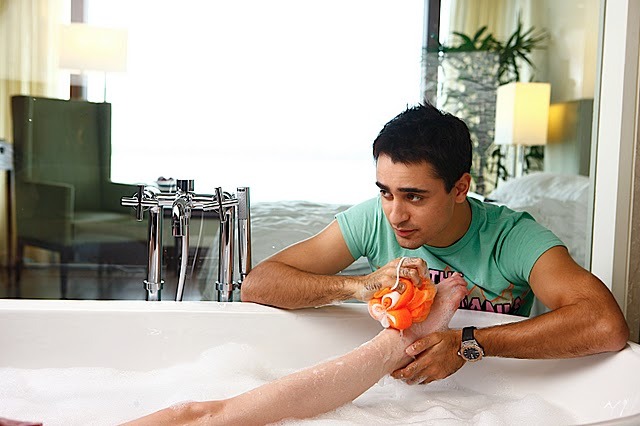
He’s the hot cake of the film industry, has a thriving gay fan following and is quite the favourite with the ladies. This is Imran Khan after he’s delivered his second big hit, I Hate Luv Storys and has a movie lined up with nearly every top actress in the industry: a big notch up from his overnight debut success. While Verve’s camera captures a day in the life of the movie star, Sitanshi Talati-Parikh looks beyond his distracting good looks to discover what makes him tick and makes him the coolest catch in town

“I’ve wanted him to be a man women would like,” is how Nuzhat Khan begins the conversation about her only child. Even the toughest detractors and hardest cynics would find it impossible to dislike 27-year-old Imran Khan, who admits to have consciously imbibed the best aspects of favourite characters from classic books, movies and comics. So, in a sense, the elusive, romantic notion of the man that women chase from fiction is actively present in Imran’s personality. Does that make him perfect? “It’s a work-in-progress,” he grins. In Nuzhat’s ideal lies a fundamental difference that sets Imran apart – while others stop at being good according to their own definition, Imran without self-deprecating, without martyring himself, goes the extra mile to be universally likeable.

Img_0111

This precocious child started speaking long, coherent sentences at a very early age – and in Nuzhat’s words, “He was a complete person even as a child, never requiring disciplining – I could talk to him like a grown-up.” It doesn’t appear to be a statement stemming from a maternal fondness, because she has always attempted to look at Imran as an unrelated person, without bias. “I would hate for him to have grown up thinking he’s special because his mother thinks so – it should be because he believes it.” And that is what makes Imran self-assured. “I don’t think I’ve ever had issues with self-doubt. What I can’t change, I don’t let it influence or affect me. Even if it may seem unnatural for a teenager to be so, I have always been a kind of calm, reasonable, logical person – prided myself on being mature. It is something I consciously hold onto, that I’ve never wanted to lose. I always wanted to be the guy who can handle a situation.” And he can do that, MacGuyver-style, in any condition, under any circumstance.

This what his fiancée, Avantika Malik, in her light, lilting voice, lists as one of the traits that makes him the man she has known to love for eight years and counting, from the age of 19. She finds that through career choices veering from wanting to remain behind-the-scenes as a director, to embracing the limelight as a hero, nothing has changed in the boy she dated and the man she is soon to be married to. “The great thing about Imran is that at his very core, he remains completely the same, grounded and real, though it’s true that he carries himself with more ease and with greater confidence now than ever before.” Avantika admits that her respect for him also stems from the vital fact that he has never given her any reason to doubt his intentions, always being honest and forthcoming about his feelings. She quotes her mother, Vandana Malik, here, who describes Imran as, ‘one of very few God’s good people.’

What makes Imran refreshingly undiabetic, though, is his well-controlled moodiness – evidenced by his need for alone time – his sharp wit, often sardonic and dry, and his toe-the-line principles. You can’t cross boundaries he’s drawn because doing so endangers the very nature of that relationship and his tolerance towards you. But if you work within these limits, you can find in him a genuine friend – warming your grey cells against his razor-sharp repartees. Sonam Kapoor, his co-star in I Hate Luv Storys, marks “his humility and hunger for knowledge, but most of all his quirky sense of humour” as appealing, and Deepika Padukone, with whom he has the upcoming romantic dramedy Break Ke Baad, finds him a fun, supportive co-star, calling him, ‘Mr-Know-It-All.’ “Imran likes to know everything about everything and if there’s ever a time that he doesn’t, he will immediately read up or Google it.” Also known as ‘Imikepdia’ among his friends, intelligence in liberal doses is something Imran prides himself in having: “My dad (Anil Pal, IT professional in Sunnyvale, California) – after all, mera baap hai – knows more about everything than I can ever know. Currently it’s uncool to know stuff, but I have always considered it to be a good thing to be knowledgeable.”

That knowledge extends to supporting causes he believes in, whether it is attempting to create a greener world – he contributed an essay on being environmentally-friendly for Verve last year – to standing up for one’s democratic rights like voting or finding a shelter for homeless animals. With his personal brand of humour and wit, he uses his columns and public forums to inspire people into action – fighting religious myopia and mediocrity, for instance. And he walks the talk: ensuring that his house is environmentally friendly, adopting stray animals and taking criticism positively to ensure achieving his own potential. It works for him, after all, women haven’t given up on idealism: Saan, co-moderator of his unofficial fan site (www.imran-khan.org) is rather taken in by his principles: “I find his honest dedication to good causes and his belief in human beings very hot.”

Img_0112

Sex-appeal? With Imran it’s never about the superficial stuff. “Good looks are not it. People are sweet and well behaved. But for my family, we lay a great deal of importance on integrity. It means different things for different people, but he doesn’t let go of that principle,” says Nuzhat. Imran accurately assesses that people gravitate towards his personality. “People like me when they meet me. I am an amiable, easy-going person. I like people and that translates well. Rakes work for younger women – say until the age of 25-26. I’ve always been the good guy, and up until a certain time I had absolutely no success with women…and suddenly everyone starts coming forward with, ‘You’re such a great guy!’ and I’m thinking, ‘Where were you 10 years ago?’” While his contemporaries play the field as cavalier Wickhams and Willoughbys, Imran remains the quintessential dependable Darcy. As Shaima, the founder of his fan site observes, “What I love about him is that he may be your typical heartthrob, but he isn’t a heart-breaker.” The fact that he has been in a committed relationship for longer than even he can remember may have something to do with it, but as Imran points out, he is quite the unlikely candidate to be “having short-lived affairs with aspiring actresses and models.”

There is a sense of vulnerability about the boy-man that is carefully concealed. I noticed it when I inadvertently came across him eating a boxful of chocolate bars, trying to calm his nerves before going in front of a live audience, over a year ago. You get barely a moment to notice it, before it flickers away. The face is always composed, the voice is always modulated and the feathers are impeccably unruffled. He is never reactionary: his sensitive personality is reined in by his logic-driven outlook. “My motivations are emotional, but my actions are rational. Both take place simultaneously. I’m not a shoulder people cry on; I am the guy who gives advice. Emotionally I am not great – I’m a fairly emotionally reserved person. People bring me things to fix, I’m a mechanic.”

Img_0113

And where reason is important, experimentation isn’t a part of who Imran is – he doesn’t choose to tread dangerous waters unless it will take him to the next step in his calculated climb to the top. Despite the fact that the prudence of his choices were questioned when he faced flak for films Kidnap and Luck, Imran makes every decision after great deliberation – he rarely, if ever, backtracks on that choice. He is quick to rectify errors, learn from the past and lay the foundation for the future, all the while maintaining a stoic demeanour about the present. For instance, his earlier bluntness – stemming from the inability to see the ramifications of brute candour – has now been prudently replaced by tactful replies, truthfulness coated with a barely perceptible paint of diplomacy. You would believe him to have a mental check-list, of the kind of movies he wishes to do, about the people he wants to work with, about the path his life should take, and find him actively fitting pieces of the puzzle to make it all fall into place.

The culmination of being inherently good, irrefutably smart, and irreverently humourous makes him a person you’d want to know despite his potential of being a big movie star. Imran is very clear about stardom: “You have to be a bankable star – to justify the money. You wear different hats. Being treated with deference can get irritating, because it can get too much; but not being treated with deference, bothers you too. I wear no hats in real life.” Twenty months ago, Imran prided himself on being the guy next door, who could roam around town ‘practically invisible’. Today, after the aggressive promos and resounding success of I Hate Luv Storys, he finds himself the reluctant star – unable to do so anymore. While he believes in positive fan interaction, he’s withdrawn from the popular social networking tool, Twitter, to ensure meaningful conversations over general mass following. Few can be actors before they are stars, few can uphold the integrity of their work over the drug of adulation and you believe he is one who can, possibly insulated by his rootedness. Nuzhat, with sudden maternal candour admits, “Yes, I worry that his goodness can suffer at the hands of the movie industry, but more so, I hope Imran never becomes content with mere success, but pushes the limits towards better and more meaningful work. And I don’t mean that for movies alone – but for it to extend to every part of his life.”

Img_0114

Post the success of his first film and the lack-lustre performance of two soon after, he wasn’t noticeably insecure, but definitely eager to prove himself once again. He took the beating in his stride, with the same equanimity with which he handled his overnight rise to fame. Today, there is a sense of retribution inflected in his tone – his choice of words denote an obviously confident person, who is merely reflecting the assurance that repeat success brings. While he doesn’t believe in destiny and can’t predict the future, he is secure: in the knowledge that he has everything that he would need to make his world go around – career back on rails, the power to pick and choose from the best of the industry lined up at his door, the girl, the family, and complete faith in himself. Al Pacino’s Tony Montana in Scarface famously said, ‘First you get the money, then you get the power, then you get the woman.’ Imran may have got it all in the wrong order, but for all the right reasons, he’s hot, he’s wanted and it looks very much like he’s here to stay.

Imran Notes
“Being the only child, I had more one-on-one time with my parents and time to introspect. I can’t deal with loud noise – like TV. I need regular periods of silence and quiet.”

“Who knows what makes you sexy? I think my personality works for me – people like me when they meet me. I am an amiable, easy-going person.

Imran owns a rare edition of his favourite comic book, batman, a Batman tie and believes that were he to have a superpower, it would be MacGyvering. He’s a Star Wars fan and considered being an archaeologist post an Indiana-Jones phase.

Img_0115

Imran Style Guide
He’s been known for his quirky tees, comfort-fit denims and one-of-a-kind sneakers. The ones he is wearing at the Verve shoot are hand-painted Beatles Nike keds sourced by Avantika from LA. Lately, inspired by old movies and the Rat Pack’s sharp “badass” attire, he has decided he wants more from the way he dresses. He’s decided to “bring back the suit by taking that style of dressing and turning it over on its head. It’s not about what you do. You wear it, don’t let it wear you.” To drive the point home, he quotes Alec Baldwin from 30 Rock, who when asked why he’s wearing a tuxedo at work, snaps back, ‘It’s after seven, what am I, a farmer?’

Socially Inept to Social King: Facebook, a result of Zuckerberg’s personality

Tags

, , , , ,

There is an interesting connection between building a revolutionary, globally popular social networking site – even making the term ‘social network’ a huge catch phrase, when you are a socially inept person. Not that you don’t have social skills – that might be an overstatement from a person who doesn’t know Mark Zuckerberg at all, but based on the possibly opinionated and one-sided movie The Social Network (and the book Accidental Billionaries) – but rather, a person who never quite fits in. What is clear, from various popular accounts, including that of friends who have met him in person, is that he’s not exactly a people person. In much the tradition of geeks (Sean Parker being an exception?), Zuckerberg prefers his own company, intelligence, a computer and the company of like-minded others rather than mingle with regular civilians.

Whatever may be his motivation, what is hugely interesting is the irony in the situation that someone who isn’t at ease in the company of others, creates a space where people can easily form social connections. Or maybe there isn’t any irony there, it is merely an organic growth. When you realize that you may need a shield to stalk people, make friends and be a social voyeur, you realize that there is a very strong space to fill – a void in the lives of many people. How many people are cool? How many people actually fit in? Barely any. But there are millions others who are looking for a platform to interact, fit in and hang out. And a platform that doesn’t even require effort – just sit in your pajamas at home and do so.

Zuckerberg was filling a gap that was hugely missing from people’s lives, which would have arrived sooner or later on the Internet – it was just his time, place and ability to jump on the idea, recognizing it’s importance. While the Winklevoss twins may have understood the implication, they were still building something exclusive and ivy league – had they even managed to get the site going their way, they would never have had the vision of a socially inept person to make Facebook what it is, because they would probably have missed the point about what’s missing in everyone’s life, which Zuckerberg would inevitably keep stumbling upon, recognizing it from his own life. For instance, if someone came up to the Winklevosses and asked them about a girl in their class, they would respond naturally with an answer about the girl in their class, getting the scoop – they wouldn’t think about it the way Zuckerberg would – as a great way to have a ‘relationship status’ update online, because Zuckerberg wouldn’t be likely to be in on the relationships of people in his class, but with Facebook he – and others like him – could.

The ‘uncool’ Zuckerberg made the coolest thing to hit the Internet, making himself the ‘coolest’ person to know in the bargain. Whether things went down in the history of Facebook the way it is portrayed in the book/ film, and whether the people are as portrayed in the book/ film is left to be seen or speculated, but what remains true is that Facebook is what it is, because Zuckerberg is who he is.

There is no “I” in Teamwork…

Tags

, , , , , , ,

It’s an observation I picked up from Twitter – that teamwork doesn’t have an “i”. And while that’s simple to understand, it means the making or breaking of a country. Sounds monumental? It is. Let’s start with what triggered this thought. Actor Imran Khan’s column in HT today (see excerpt below) on teamwork in movies and my catching Raajneeti on TV last night.

Imran Khan talks about how movies are made by teams, even if they are temporary, they are loyal:
“I wanted to talk about how we all come together for a few months, work till we fall down from exhaustion and then go our separate ways. You see, most people never realise just how much teamwork plays a part in what we do. An actor could be giving the performance of a lifetime, but if the cameraman doesn’t capture it correctly, nobody will ever see it. Each and every shot depends upon each and every person from each and every department doing exactly the right thing at exactly the right moment. It’s stressful and demanding… but it also creates a kind of bond that few other things can. For example, as I sit and write this, there is a game of cricket underway. The actors, director, ADs and light boys are all taking turns batting and bowling, and there is no hierarchy. Or, when we’ve been shooting for hours and it’s past lunch time, no one complains, because we’re all in it together. Nobody starts eating until everyone has broken for lunch.

The fate of a film can never be predicted; it may do well, it may disappear without a trace. I’ve seen both happen. But that can’t change the way we approach our work. We still have to give it everything we have, and we still have to come together and work as a team. And that’s reflected in the term for an entire cast and crew of a film; it’s called a unit.” (Full column here.)

On the other hand, there is politics, where there are teams and more teams and even more teams that spend their time bickering, playing games, manipulating and buying each other out. While some people thought Raajneeti was a bit extreme, I find it quite a relevant movie of the time – where politics today is not what the Greeks intended it to be when they coined the term.

Ref: Wikipedia: “Politics (from Greek πολιτικος, [politikós]: «citizen», «civilian»), is a process by which groups of people make collective decisions. The term is generally applied to behavior within civil governments, but politics has been observed in other group interactions, including corporate, academic, and religious institutions. It consists of ‘social relations involving authority or power’ and refers to the regulation of a political unit, and to the methods and tactics used to formulate and apply policy.”

What is the problem with our country, or many other countries today? Is it really what we learnt in civics and political science and sociology, the things we rattle off, the terms that NRIs sit back in their la-z-boys and shake their heads over while munching betel nuts? Corruption, over-population, illiteracy…these are the buzz words. Yes, these problem exist, and yes, there are important issues that need to be solved for our country to move forward. But is this the real problem at the very foundation of our issues? I think not, I think it is a genuine lack of team spirit. We don’t think like one nation, one people. Whether it is because of religion, caste, money, social structure or an age-old belief in hierarchy…or even just survival of the fittest (because we’ve had to survive to make it here – fight to get anywhere), it has made us individualistic. At the very most, we may include our family in our concerns, but that is also getting few and far between and we find ourselves largely driven by selfish concerns. Some of our wealthiest people do not contribute to charity, rather build towering monuments to denote their status. Recently, while visiting the Jai Vakeel school for the mentally challenged, I learned that the government hasn’t paid salaries there in four months. So even when something good is being done, they can’t simply cough up the change to keep it going, but they can pocket the change from CWG and other big projects. While lining one’s pockets, can’t one at the very least ensure that some good comes of some of the tax payers’ money?

Another quote popularised on Twitter, “Indians are privately smart and publicly dumb” – is exactly the same thing, we don’t believe in treating our country like our own. The streets are not ours, we can trash them. The public loos are not in our house, we can leave them filthy. The movie theatre isn’t our own, we can mess it up with food and drink. Publicly, we notoriously behave like pigs in a pigsty, and yet, we follow stringent hygiene and cleaning rules in our homes – remove your shoes before coming in, they will track germs from the outside in! Is it that we believe that someone else will take care of our mess? Is it simply because we don’t care enough about anyone else that it doesn’t matter?

The reason we admire sports so much is that as humans we crave bonding and togetherness – and there are very few places that show mutual respect and warmth for other humans than in teams that come together for a common cause. I admire the film industry – despite their bickering and issues and camps, a group of people come together and work hard to make a film – even if they never see each other again once it’s complete, they gave it their unselfish best when required. In fact, the movie Chak De is a metaphor for Indian society – we are too mentally segregated to think like one, and when we do, we can possibly reach heights we have never considered possible.

Why can’t we as social citizens do that? Why must we treat other people as “others” and not a part of our own team, own country, own race? Why can’t we think like “we” rather than “I”? If we were to, everything would be very different. A simple shift in perspective would make a huge difference in thought and a huge difference in where we are as a race or nation.

Short-sightedness – where we can’t see beyond our own noses and houses, is what makes us an ultimately selfish race. And this is the root of the trouble – global warming, social evils, unhappiness all boils down to being able to think as a bigger identity than oneself. Can we be bigger than we think we want to be?


Thai Contemporary: Review of KOH, InterContinental, Mumbai

Tags

, , , , , ,

Published in Verve Magazine, October 2010


When pregnancy cravings hit, you need something fantastic to stem the stomach-curling desire. Chef Ian Kittichai’s Koh at the InterContinental Marine Drive, seemed like a promising addition to my rather exclusive list, from the moment I heard Deepika Padukone tweeting about how great the food is and my own cousin mentioning the presence of the rather elusive massamun curry on the menu.

On a Thursday evening the Manhattan-style Asian bistro is filled with a lively crowd of familiar and international faces. Where Czar once pulsated with desi tracks, its replacement, Koh’s muted restro-lounge atmosphere is at once sophisticated and global. Propped with comfortable cushions on a table for two that’s too closely set to make it an intimate dining experience, I’m floored by the facing glass wall mural created by Thai artist Patcharapon ‘Alex’ Tangruen. The mural defines the space and cuisine – traditional roots, contemporary accents. You suspect you won’t taste the conventional here, even if the chef has drawn from the flavours of his youth: his own mother’s kitchen.

Evocative fresh fruit signature cocktails with antioxidants (Gojiberry bellinis) set the tone for the flavourful and delicately-spiced food. Steamed edamame dusted with sea salt and Thai spices for the table, followed by appetizers that make you not want to save room for the mains. ‘Chocolat’ baby back ribs (coated with dusky chocolate), an unrivalled palate-opener, juxtaposed in quick succession with stems of stout lemon grass covered with flame-grilled chicken accented with coconut and cilantro make for a delicious first offering. In fine contrast is the hand-pounded rock corn minced with spices, and the tofu…. So, I confess, I hate tofu. Even Morimoto’s tofu couldn’t convert me, but I feel unable to turn down the mild-mannered and unassuming Chef Kittichai’s suggestion of a jasmine tea-smoked tofu. Surprisingly, it lacks tofu’s usual rude texture and it is smooth as butter. The aubergine dish, though tasty enough, has a tough skin texture, leaving it difficult to manipulate while eating. After soaking in the stunning Koh golden corn gumbo – hand-pressed corn swirling in coconut broth laced with Thai basil oil; we’re all set to move to entrees.

Composed of a wide variety of freshly-imported greens and vegetables (I add crisp water chestnuts), the ‘Paneang Curry’ is perfect for my taste buds, while what the general Indian palate may scream for is the hot stone curry-spiced rice – which is akin to a Thai biryani. My husband, Sahil, takes the chef’s apt suggestion and goes with the Chilean sea bass coated with a yellow-bean glaze: a fresh offering that lives up to its promise. You are surprised how easily the hours get eaten up while you are being gastronomically appeased. In entirety, the meal leaves nothing wanting, especially when topped off with the luscious valhorna chocolate dessert accompanied by Thai coffee ice cream. Oh and did I mention the coconut cheesecake? Absolutely lovely. My only regret is being physically unable to sample all the tempting flavours on the menu – but that’s for another evening, another craving.

Koh Notes

– Chef Kittichai’s favourite ingredient that shares its home with India and Thailand is cumin.
– All the ingredients at Koh are imported: meats thrice weekly from different parts of the world, vegetables thrice weekly from Bangkok and Chiang Mai and condiments weekly from Bangkok.
– Come October, Koh plans to add a Jain version to the already extensive menu and its varied vegetarian offerings.
– When travelling you can sample Ian Kittichai’s cooking at Kittichai in Manhattan, Restaurant Murmuri in Barcelona and the gastro bar Hyde and Seek in Bangkok.