Splash of fire orchid in water @ India Jones
03 Tuesday May 2011
Posted in Musings

03 Tuesday May 2011
Posted in Musings
22 Friday Apr 2011
Tags
To save time, we chose, on the spur of the moment, to go to the local park nearby instead of our country club. By we, I mean hubby, baby and I. As we got out of our chauffeur-driven car, assembled our one-touch baby travel system in front of curious eyes and strolled into the park, I could see what a picture we made. Designer shades, sundress, chi-chi baby outfit…it felt incongruous among the many who strolled along people-watching by the sea. As I reached forward to wipe some baby drool, I looked up and met the eyes of a simple, sari-clad lower-middle-class lady, who was resting her feet on a nearby park bench. She had a baby tucked into the crook of her arm.
There would be many differences between the upbringing of that child and mine, largely material in nature – those of opportunities. And yet they looked peaceful. Flashback to a conversation with a few new mothers, who spoke in feverish agony about the sorry state of schools in the city – the horrendous situation of demand and supply, where their kids may not make it to the best schools, may have to do with second tier and even then wheedle their way in. How different is life for a person with means and one without? Both often need to snatch opportunities and push to get in – just to different places. One believes that the best is a basic right, the other hopes that somewhere along the way a better life may appear.
What is a better life? A bigger classroom, a fancy school bus, a posh car, smarter teachers? Life itself is a great teacher and sometimes, we forget the most basic of lessons. We are all born with the right to live. How we choose to live is a complex twist of fate, luck and opportunity. Motherhood can’t be that different across the board – every baby will poop, cry and laugh while learning to crawl. Possibly one will poop in the comfort of Pampers and soft linen and soundless air conditioning. But at the end of the day, each process remains the same. Their self-worth should be independent of the quality of their lives, rather should depend upon their desire to be someone.
Can the two be separated? Aren’t we constantly defining ourselves by our ability to attract wealth and power and the symbols of such derivates? I believe a society’s material image emerges from the “best” that we want to give our children. We believe that a fluffy eiderdown will make a better person or human being when maybe a hard bed is what is required. (I don’t mean that one should make a child suffer the rigours of life when there is no need to.) The fancy trappings are – if we admit it – for ourselves. To make ourselves feel better about being parents. In our desire to provide the best, we often create the worst. A society of weakening self-worth. All children need love, affection and food. The rest is – as the word states – immaterial.
08 Friday Apr 2011
Posted in Musings
Tags
Anna Hazare, Bureaucracy, Corruption, Democracy, India, Politics, Thoughts
Our democracy has given us the ability to make so many choices – a few decades ago, we chose to leave for better opportunities elsewhere, recently we choose to return because of plum prospects in India. But whenever we have to choose to be alert citizens, we choose the easy road – the road of oblivion, escapism and feigned ignorance. Even worse – something I am guilty of, too – cynicism and haplessness.
When an elderly man decides to fast, we tweet. When scams are exposed, we update our status in horror. When our status quo is breached we respond with anger, criticism even shock, but no solutions.
We, the urban intelligentsia, have found no way out, and have preferred to let the zoo animals that are our bureaucrats and politicians rule roost while we hatch eggs – shaking our intellectual manes over the evils at fine soirées.
We may #tweetforwickets in a strong show of national spirit, we may cry in emotional joy at national wins, but we make no move to change what’s wrong.
It’s true, the answers are often not with us, there needs to be a collective consciousness that decides to take no more sh*t. Everytime there is someone who inspires us, or something that appalls us, we make a stir, think about a rising, and then, in one collective motion, sit our asses right back into our plush la-z-boy recliners.
It’s unfortunate that we have the option to leave, or the money to ignore the crap that goes on in our backyard, or the cynicism to empty every full glass – because the moment we run out of our options, we may be fasting like good man Anna Hazare for our future, as our men steal every morsel from our homes.
Gandhi fasted for independence, its a shame that 60+ years hence, a man has to fast merely to get a bill noticed in parliament. Elle Woods would be charmed. Tsunamis may be hitting the Pacific, but it is the wasteland of Indian inaction that requires attention.
07 Thursday Apr 2011
Posted in Musings, Social Chronicles
Tags
Bollywood, communication, India, Realism, relationships, romance
With sexting and instant messaging, relationships have become just that – instant and ephemeral. Books and films have emulated these real-life changes with often not-so-interesting results. Has the romance in art – and relationships – died?
What defines society today is words and connections. What separates this generation from the ones before is the power of the spoken word. We think that technology is what has changed us, made us the people that move faster, think faster and behave fast. While that may be true in some part, what has empowered technology has been content – online jargon for words. Thoughts, bubbles, discussions, emoticons, replies, retorts, criticism, feedback, conversations, investigations, observations, retweets, status updates…the list goes on. This generation has increased communication by communicating less and with fewer words. It faces the task of dealing with information overload while constantly putting out more information. The oxymorons define the mindset of today – a generation that wants everything, wants everything super quick and instantly accessible and doesn’t really have the time or the patience to sift, read, ponder. That is where texts, BlackBerry messages, tweets and status updates are the de facto means of communication. It is rare for anyone to pick up the phone and have a good old-fashioned chat, in the generation that prefers to stick to a far more impersonal, but rapid form of communication. It has its own personal vocabulary: insistent abbreviations – often indecipherable to the uninitiated – and instant communication. You find people with heads bent, eyes darting and fingers moving rapidly in practiced synchronisation: rarely able to maintain eye-contact for more than a couple of minutes, rarely can a conversation run its natural old-fashioned course without interruption, as we move into an era of distracted and continuous communication and therefore, erratic and easily dismissed short-lived relationships.
Popular culture represents the dialogue and relationships of today: faster, more impatient and often meaningless. Younger filmmakers have updated their scripts to emulate real life. While underworld films picked up the nuances of the underbelly through actions and dialogue, romance in the arts has been for the longest time linked to a larger-than-life drama. Case in point: the cinema of Karan Johar or Sooraj Barjaytya. Where they update the clothes and the music, the dialogue often remains over-dramatised and pedantic. While some may argue that romance needs the dramatisation, a striking example to contest the argument is that of Saathiya – where the dialogue is rapid, off-the-street and yet, is a powerful story. There is a strong resonation with the viewer, an easy relatability, which carries the film from run-of-the-mill to sensitive and meaningful. Farhan Akhtar’s Dil Chahta Hai made the trend a popular one, taken up by film-makers like Kunal Kohli (Hum Tum) and Imtiaz Ali (Jab We Met and Love Aaj Kal).
It is the language of frankspeak or straightspeak. Where once “You complete me” was the sigh-generating dictum, now, “I need a break” is easily said, without much angst, furor or thought. Quick answers, rapid and sometimes thoughtless decisions and a sense of bubbling impatience mark the dialogues that often don’t lead anywhere special. This is the nature of relationships of today and the conversations emulate them. Easily said, easy to bed and quick to leave – all takes place faster than a thought, and what is left are non-events. How does this make and fill the artistic and aesthetic space of a film? While Kohli-directed Hum Tum talks about a meandering relationship, When-Harry-Met-Sally-style, he pumps the story with events – which hold the weight of the relationship between the protagonists that appears to be going nowhere. In an attempt to emulate real life and their easy-come-easy-go relationships, Kohli’s recent production Break Ke Baad, directed by Danish Aslam, is a slick film that lacks a meaty story, full of ‘non-happenings’. Conversations, while witty and fresh, would make a better radio play than a long commercial movie. While this may be a comment on relationships today, the art demands a certain balance between real life and cinematic license – it demands that elements, moments and events become at the very least marginally larger than life, to create entertainment, to be watchable. Ali’s Love Aaj Kal nearly crossed the line to become over-ripe with conversations, in the same quest to describe modern-day relationships. Where LAK teetered dangerously, Jab We Met remained fresh in its cinematic experience, particularly through the crispness of dialogue and emotion.
Deepika Padukone’s character, Aaliya, in Break Ke Baad is not lovable in the traditional sense – much like Sonam Kapoor’s Aisha, she is unintentionally selfish and possibly doesn’t deserve the good guy. The industry buzz has it that Zoya Akhtar’s debut film Luck By Chance missed it’s calling because the protagonist, Vikram, was not a nice guy. We don’t feel empathy for the characters and don’t wish them to reach a happy ending. And that is dangerous ground for a film to enter in the romance genre. And it is also rather disturbing seeing that these characters have been picked from real life. Is it true, then, that we prefer the traditional romantic notion of characters that may be slightly misguided, but are nice? Even if that is not real life? So as dialogues get updated, people shouldn’t?
Two recent books speak a local language, but in entirely different ways. Anuja Chauhan’s Battle For Bittora speaks real politik – the language of local and honest-to-good (sense the irony) politics, seen through the eyes of a girl of this generation. There is amusement, cynicism and wonder. While the romance remains honest to chick lit, and the dialogues are basic, matter-of-fact and emulating real life, it is the clever writing and story that lifts this novel from being mundane to a page-turner. Where Chauhan’s effortless writing excites, first-time writer, Rhea Saran’s Girl Plus One is trying too hard, as are her heroines, to become a desi Sex and the City. Saran is not wrong in suggesting, rather obviously, the fact that Indian girls today are openly emulating Manhattan’s popular TV series; however, Saran misses Candace Bushnell’s witticisms that make all the difference between real life and drama. Would a real-life Carrie really talk in continuous innuendoes? No. She simply finds a correlation between her column and her life.
However art is updated to make it believable and real, it is obvious that the artistic license must be used to lift the dullness of real life to a heightened sense of real-life drama. In creating a believable sense of inclusion in a person’s daily, often mundane life, while bringing art into our homes, drawing rooms and bedrooms, we need to maintain a certain distance that allows us to appreciate the nuances of every character, story and relationship. These elements need to interesting and memorable, and often, real life is not. That doesn’t mean we need to regress and run around trees dancing amid roses, but it does mean that we need to assess the dramatic intent of the medium: does the film justify being larger-than-life? Does the book deserve to be printed and propped up on the ‘New Arrivals’ bookshelf rather than be a basic online blog? All in all, while pointing out the casual and matter-of-fact manner of everyday relationships, are we missing the romance in the written word and the spoken dialogue? And are we losing the romance in relationships?
And that leads me to question – do we want the old-fashioned nature of romance, or does that not matter to us anymore? Does a quick sext or a couriered designer bag charm us more than an old-fashioned hand-written note with a love song? Are we so accustomed to sentimentalising love and romance that we are unable to accept it in its matter-of-fact form anymore? If the written word stands for the way we think, then are we changing so dramatically that we question and often thwart sentimentality in its old-fashioned sense? Do we love, or do we ‘like’? Or are we confused because it is ‘too complicated’?
19 Saturday Mar 2011
Tags
Aishwarya Rai Bachchan, Bollywood, Interview, Interviews: Cinema, Interviews: Travel, Verve Magazine
Published: Verve Magazine, Cover Story, March 2011
Photographs by Mike Ruiz
Aishwarya Rai Bachchan’s natural precociousness springs up at every twist in the traveller’s tale. Sitanshi Talati-Parikh watches the ex-Miss World-turned-moviestar-and-homemaker switch from child to Inca queen, Bollywood dramatist to casual honeymooner, lost tourist to Disneyworld explorer, through loud giggles, flashing smiles, dramatic enunciations and passionate inflections, exploring a few of her many memorable journeys

A little girl sets sail for the world in an “enormous ship”. The romantic notion of travel becomes a kaleidoscopic reality, possibly even a way of life, with her “shippie” dad and family. It is the mid ’80s when Japan is “very disciplined” and China is yet to come into its own. Around a decade later, winning the Miss World pageant makes her “a cultural ambassador of India” in places unpronounceable. And through it all, Aishwarya Rai Bachchan has felt the power of being Indian, of coming from “a world within the world”.
Since then, there have been movie shoots in exotic locales: from a desert full of water bodies in Latin America to remote towns in India, brand endorsements in cobble-stoned Europe, and the world becoming a stage, literally, with performances like the Unforgettable World Tour. “I will go out and experience a place, I won’t live in an ivory tower, while gauging it and being responsible. Ever since Miss World, people have given me a lot of love – whether you call it recognition or adulation, they have always been expressive in their connectivity with me. When they saw me on the streets, it wasn’t like ‘Ay, Aishwarya!’ – women would come forward blessing and embracing me.”
Always politically correct, her carefully polished voice modulating with occasional bursts of enthusiasm, the intrepid traveller sits easy, knowing that the subject of the day is one she can be naturally passionate about. She points out that while the world advanced technologically, becoming a “smaller place”, her life mirrored the advancement: “Everything became from a 14-hour or 18-hour flight to ‘just an overnighter’, because you started doing it so often. Abhishek (Bachchan) and I love flights – we’re psychotic that way.” And, as she inevitably spends an exorbitant amount of time in transit, the covert people watcher admits “feeling a lot for elderly Indian passengers who walk around staring at monitors. Airports can be overwhelming – with the distances, pace, people and security checks; and while they have become second nature to me, I can still relate to how the experience can be for the uninitiated.”
South Africa: “I had a funny feeling inside me – looking outside the airplane window – a sense of going away.”
There are three times that Aishwarya Rai Bachchan recalls feeling this way, with a distinct sense of poignancy. It began with the flight to South Africa as she left to compete for, and win, the Miss World pageant title in 1994. “I suddenly felt that I would be away from everyone and alone for a month. And the thought of being with a whole lot of people foreign to you; but when you get there, you just fit in. I don’t know if it was a premonition or not, but I sensed that life was changing.”
London: “When you land there in winter, you barely wake up from the jetlag and feel that it is dark, like night again.”
In London, where she was to spend a year as the reigning Miss World, she had the option to have her own apartment or to live with a family in their house. “And I, being the responsible one, chose to stay in a house with a very sweet elderly couple rather than alone in an apartment, knowing my family would feel more secure. It’s a very Indian thing.” It was the first time she was living on her own: “For further studies I never went outside of Mumbai, because my father was a marine engineer, and it was just my brother, mum and I living together; I would feel for my mother and didn’t want to leave her and go away.”
Shanghai: “Suddenly Shanghai was an absolutely different city, and the world was beginning to talk about the change in China.”
It was a very different China during her repeat journey in 1994, when she went as a model with Hemant Trevedi. “Shanghai was a symbol of that change – the modernisation and globalisation, like the US on this side of the world. This was a new culture, very much in keeping with the times or ahead of the time. Very interested in India and Indian fashion and it was almost a privilege to be there with our fashion and our designers.”
China: “This time I was shooting a song on the Great Wall doing a little jig!”
In 1994, she had walked up to the fifth gate of the Great Wall, with a “more grown-up taking away, recognising the passion of generations working on building this incredible wonder that we live with on our planet”. She was back on the Great Wall as an actor, shooting the song Poovukkul, which showcased the Seven Wonders of the World, for Shankar’s Jeans. “You never know when you are going to revisit a certain part of the world. As a kid, when I was there in the ’80s, they took us to a uniquely Chinese opera, and sang some of our Hindi songs, with all the Chinese in the audience looking at us because we were the one Indian family sitting there. You’ve heard of people in China and Russia listening to our music, our film songs, and then to think, on my third visit there, I was shooting a song, with a live audience of people fascinated by our cinema and the song culture of our movies.”
Times Square and historic sites: “I am an actor – it means you have to do everything!”
Dancing atop the Great Wall – did it feel ridiculous at all? “Interestingly enough, never,” Aishwarya answers decisively. “From the beginning, I never felt odd. When shooting for Aur Pyar Ho Gaya, I remember Bobby (Deol), even though he belongs to an actor-family, feeling a bit odd when we had to do ridiculous things in public arenas, like jump on a car, or run on the street with a toothbrush in our hand and toothpaste on our face.” Or the time when she was in New York City shooting for Aa Ab Laut Chalein in Times Square wearing a fuschia pink gown with a bow, big earrings and a flower in her hair. “I had no inhibitions. You’ve grown up watching it, song and dance is so much a part of our cinema that you don’t feel silly doing it.”
Disneyland: “We both were like excited kids – free, happy and wonderfully reliving our childhood.”
A youthful exuberance springs up as she recalls memories of the past. “That family trip (’80s) that started with Japan ended with Disneyland, and Abhishek and I ended our honeymoon – after Bora Bora’s ‘drop in the ocean’ experience – in Disneyland. It wasn’t planned, but worked out beautifully into a great circle.”
Tunisia: “In my interviews, when I say ‘Every day I feel like a newcomer, or every day is like the first time’ there are those special moments when I actually feel that, very, very strongly.”
The third time she felt “the pit of the stomach feeling” was when she took off to shoot for “one of the best film experiences”, The Last Legion in Tunisia and Slovakia. “Not only did I have no one from my nationality on the crew, it was a guy flick – everybody was a dude! I was going to be a warrior, this action character. I was feeling it again: going away for a very long period, and I had to step away from very interesting work that was happening here. I had gone through that predicament too many times in my life and career: ‘Heck, all good things happening, do I have to choose?’” Without any idea of the geography of Tunisia, she was bowled over by the spectacular beauty of the country. She arrived three days before the shoot, without rehearsal. “Everyone was in panic mode, but my dancing helped me, I embraced action instantly. Beautiful Mediterranean water, very hot and warm…a bit much in the costumes, with all that armour! The places were so quaint and simple that we all became that much closer as a group.”
Slovakia: “These guys are HUGE. When you sit on these buggers, you don’t walk straight for two days after.”
Slovakia was familiar because she had been to Prague. She found the “cold (weather) and green” country replete with beautiful castles. “We were all like kids. We had so much fun working together, and such incredible discipline – whether it was Colin (Firth) or Sir Ben (Kingsley) – we were like children in a giant videogame.” And the most remarkable experience was spending time on horseback. She emits a loud, expressive laugh: “The horses in Tunisia are one size and then you get to Slovakia and you realise that the horses there are different. These guys are HUGE. When you sit on these buggers, you don’t walk straight for two days after!”
Budapest: “Ajay kept telling Sanjay (Leela Bhansali) that the two things he dreaded the most, dancing and singing, were what Sanjay made him do in the film.”
Budapest was special because Hum Dil De Chuke Sanam was shot there, for which she got her first Best Actress award. She recalls with a smile, the dance sequence with a rather nervous Ajay Devgn. “It was exceptional because it was an insight into their culture – the music and dance sequence was local to the place. So you actually experienced something unique, apart from the magnificence of being by the river and bridge. Also, we saw very few children in the country, and then we realised that they were encouraging people to have more children because of the mortality rate. Apart from the cuisines, it is always interesting to come away with an insight into the place. For me, it is not about hitting the shops; it is about getting to know a place.”
Brazil: “I was reliving my college days, being vicariously part of a gang of childhood friends.”
After Columbia during her Miss World reign, she was back in South America much later, when shooting for Dhoom 2. “The genre of the film we were working on made us relive our college days. I was privy to a close unit of kids (Abhishek, ‘Duggu’ Hrithik Roshan and Uday Chopra) who are childhood friends, and felt that I was vicariously part of the gang. Brazil offers that kind of spirit, the film gave that kind of energy.” Her eyes take on a faraway look as she recalls a surreal moment towards the end of the Dhoom 2 shooting schedule. They lay sprawled below the “magnificent” Christo, in the wee hours of the morning, before Hrithik Roshan was returning to his son being born. “We were in that woozy state of mind, because we had stayed awake the previous day and night and were watching the sun rise. It was a very quiet time, the early morning hour before the tourists arrived. We had had such a noisy schedule, all of us buzzing throughout, that it was the best silence we all shared. As we lay on the ground, we felt that Christ was looking at us from the skies. You hear terms like, ‘listening to the sound of silence’, but we experienced it then.”
Machu Picchu: “In my little bling feathered costume, I looked like one of the Inca queens.”
Shankar’s Robot took her once again to “the other side of the world”. She had taken a break from her career for the first time in her life. “I was facing the camera after an unexpected eight months all the way in Machu Picchu (Peru).” It was the longest journey they had made – counting the kind of flights, number of flights and locations. Upon reaching the place, a tiny township, after a train journey, they all walked from the railway station dragging their bags on the road. “As we trekked along, we suddenly passed a marketplace. My staff was exhausted, but I was thinking, ‘What an adventure!’ I love walking, because we don’t do that enough, and you actually get to feel the pulse of the place, get in contact with the people and culture, otherwise it could well be structure to car, car to airport, airport to plane, plane to car, car to hotel.”
Mexico City airport: “I was the pride of India and all that – and I didn’t have my passport. This was the worst moment for me.”
With her valet in tow, and running a fever, Aishwarya was connecting via Mexico City en route to Melbourne, Australia, representing India in a performance at the Commonwealth Games. Special Services, who had come to help them with the language barrier, disappeared with their passports. “It was bizarre. People there would smile a lot and look blank, because they didn’t speak the language.” She was taken to a private room that was empty save for two people who could be guards eating a home-cooked meal. “It was like the movies – being in a prison cell and these guys going at their meat sauce and bread. They would say something to each other and keep smiling at me. My valet has piercing eyes, so I would keep telling him to smile and keep his face easy. I suddenly felt I had to be protective and get us out of here. I had never felt that before. I wasn’t getting through on the phone to anyone and at one point I felt myself go a bit cold. I had wanted to visit Mexico, but this was not the adventure I was looking for!” After an encounter with a man who spoke perfectly-accented English and suddenly refused to speak any, to a bunch of “strong-looking women” who used the word “off-loaded”, Aishwarya nearly gave up. And then suddenly, in the crowd she spied the person who had disappeared with their passports and chased him down. “He was carrying our passports in his hand, and till date I have no idea why.”
Los Angeles: “With time, travel, age and experiences, you begin to like the easier, more social pace of LA.”
After boarding the flight from an eventful Mexico City, she was transiting through LA to catch her Melbourne connection, hoping to make it in time to perform. “I reached LA and suddenly life was beyond fabulous. It was the one time I cherished being who I am, in terms of the celebrity life. Suddenly, it was beyond comfort, think all superlatives. I always say that once in a while, if it gets too comfortable, God just does a little schickt (demonstrates a click with her fingers like playing carom). He’s watching his own little rom-com, thinking, ‘I want to have fun with you’. So I think, ‘Enjoy it, and turn it when you want to.’”
New Zealand: “The life that we lead, we are like gypsies, nomads, and I’m very quick to feel at home in any place in the world.”
She’s spoken a marathon, and yet looks like she can go on. I’m right; this would make a coffee-table book. “We don’t realise how quickly time flies and because a part of our life gets captured on celluloid forever, I feel as actors we live lifetimes within our lifetime.” She is off to join Abhishek in time for his birthday, in New Zealand where he is shooting, in a place she has never been before. Some people are meant to be children of the world, explorers in their own right. “And yet, when one travels so much, there will always be something unique to being home. It is your family that makes home what it is – it’s not the physical structure even if you say bed and all of that. I live a very homely life in the places that I go to. Besides, as Abhishek rightly puts it, one in six is an Indian: you can go to the farthest of places and we (Indians) will be there, saying, ‘Hello, you want home-cooked food?’ That’s the best part about Indians – they are there to feed you. You are at home anywhere in the world.”
18 Friday Mar 2011
Posted in Musings
Tags
Possibly one of the more unacceptable human failings is a lack of will power. To deal with what life has to offer, one needs a strong will — and when I encounter a weak mind, I am filled with a deep sense of regret, frustration and even annoyance at a life, moment and time wasted.
The very fact that your emotions, desires and wants – even habits — overpower your better sense and mind points to a flagging spirit and not much steadiness in the soul.
What prevents us from fighting the battle to better ourselves, to control ourselves? Possibly nothing more than our own self. I believe we often lack the courage, conviction and self-belief to make us who we can be and remain stranded as who we are – floating aimlessly and limply along a mire of weakening self-worth.
We invent reasons for being such, turn a deaf ear to those who try to help us, and basically put up a wall against change. Because it means giving up whom we have got accustomed to being. We believe that staying so will give us greater joy than changing. That change implies giving pleasurable things up. What we fail to realize is that it means being proud of whom we can be — replacing the weak, irascible spirit with an infinitely positive one.
Those who wish not to – or can’t – change, are ones who appear to be listening, but never do, who have a ‘but…’ ready at every instance, whose glass is always half empty, coz they can’t stop drinking from it.
18 Friday Mar 2011
Posted in Musings

So, one of my favourite mainstream fiction writers, Jeffrey Archer (thank god he continues to live and write prolifically) is out with part one (of five parts) of what he described last year to me as the ‘Clifton Chronicles’. Is it different from his other books, particularly the sagas he is so famous for? NO. In fact, it revisits the tenets that make Archers sagas what they are: classic and true to their eternal premise that there exist connections between individuals.
1. These would most likely be men separated at birth, sharing parents, having some sort of birth mix-up – you get the point. These individuals grow up in separate conditions – mostly a strong economical divide – the fortunes of one are juxtaposed against the nurture-disadavantages of the other. While one leads a blessed life, the other has to struggle for everything.
2. Of course, the author gently nudges the reader into empathy for the more disadvantaged person – he remains Archer’s eternal hero, but, most importantly, the one with the advantage is also dealt with lovingly. He is generally a nice guy – you are unable to fault him for the fortunes of birth, and he often, wittingly or unwittingly, comes to the aid of his potential future nemesis.
3. They lead parallel lives, often mirroring actions in their own ways, both destined for success and chalking their path as they deem fit until they meet towards a dramatic finale. Archer doesn’t comment on right or wrong, rather he believes that success is paramount, along with being a good human being. His characters often set their own rules, are not always moral, but they are unable to alienate the audience in these minor misdemeanours because they remain good at heart. (Aside: Is this what Archer tries to prove about himself?)
4. Archer appears to have a strong belief in destiny – so much so that he could be Indian in his ideology. (Think astrology that believes that every individual has a path charted out, and when individuals’ paths cross, there is a greater meaning behind it.) Each of his characters is simply living out their destiny to the fullest – and incidents unfold along the way, making their lives interesting, because of the people they are. Other characters that come in to help/ aid/ or desist are mere catalysts in the greater purpose these individuals are meant to serve.
5. Archer’s hero is the quintessential hero that is living to fulfil his destiny through a greatness that lies dormant within him, that needs to be tapped, explored and unleashed. His is not the anti-hero of contemporary times; and the fact that we still like and want more of his hero, proves that we believe in the bigger hero over the popularised anti-hero.
6. His contemporary from the same country, Barbara Taylor Bradford was a master storyteller of sagas – think the one starting with Woman of Substance. The power of her story remains eternal, unfortunately, she no longer writes (I am quite certain a ghost writer writers under her name – churning out weak, insipid, badly written romance novels). I can only hope Archer doesn’t go the same route. While his story-telling skills remain as powerful, I do feel that his language has been toned down and made simpler than his older sagas. I wonder why?
7. The circumstances of his novels’ mise-en-scene remain the same: juxtaposed against the World Wars, dealing with England and no further than America or Australia, possibly areas that Archer knows well and understands best. This time around though, he takes his sagas into contemporary time: the Clifton Chronicles will span decades and enter the contemporary age – this is what will set it apart and I can’t wait to see how he deals with placing characters in a far newer age and era of technology, quite out of his usual comfort zone.
8. Even though Archer’s Clifton Chronicles, starting with Only Time Will Tell, remains Archeresque to the point where they offer nothing new, except a recycled version of his previous sagas, his stories are still knowingly and willingly consumed with as much interest because these sagas work as strong tales. The foundation that every Archer saga shares remains eternal and eminently readable. I am surprised that no movies have been made on any of his sagas. I only wish his publishers and he would not tantalise the readers with breaking the story into five parts and releasing them so far apart from each other – with no clue when the next installment is even due.
12 Saturday Mar 2011
Tags
The moment the world discovered I was expecting, the most common and oft-asked question was, “Have you got help? Have you found a maid?” Apparently, maid-less in Mumbai equals having no life.
It’s trite that on my sabbatical I would be reduced to writing about baby maids, but there is a point to the rant. Pritish Nandy’s recent column on the greed of people (A Nation of Banias) echoes what I have been thinking for the past few weeks. There is something strange happening to the world of working people – and that defines our new middle class. The best comparison is to the maid market.
At a recent evening tete a tete, a friend advised me about a maid, Suvidha, affectionately known as Su, who is magical with babies, but just needs to be given a sense of importance. “Without you, I am nothing – you are my whole and soul, you make my world go around….” These words must be in effect repeated often to the said maid, to ensure that she sticks around. Or there’s Deepali, who came from a Calcutta bureau to take care of Baby, began fighting with the entire family after a fight she had with someone one the phone (love gone bad?), slammed doors around the sleeping baby, banged Baby’s legs, shook her head when holding her, and made her wail no end. We happily bought her return ticket and couldn’t wait to see her go. Another day maid, Sushma, lied about her hours of work on the very first day – because she got a call for another night job. So, she planned to abscond early, go home take care of her kids and then run a full night duty elsewhere. So when would she sleep? Would she manage a baby on no rest? Valentina, came with references and a well-stamped passport. She had just flown down from Switzerland the night before, and after touring much of Schengen world, was looking for a job that would take her to greener pastures yonder. Another claimed to be a governess, she wouldn’t clean, she would play with the baby. So was the mother supposed to clean while the governess played? Another one called Deepa came with emotional baggage from a bad childhood and child marriage (scary stuff), but touted working at ‘big houses’, name dropped and spoke about how she would work where there were at least 3 maids handling one baby. The mother would watch or party. Not used to being responsible, she brought with her a boisterous temperament, mood swings and a dollop of immaturity an carelessness. Another young girl hopped onto a train from Calcutta, begging and pleading for a job (she had no experience) because she needed the money. And then there was Manu, dear Calcutta Manu, who spoke about perfumes, matching nail polish, gold jewellery, mobile phones and air tickets.
And all of them have one thing in common – they are interviewing you. You may well please yourself thinking you are maid shopping or looking for the right fit, but there really isn’t much in your hands – they are house-hunting (size does matter), and will take the call depending upon the wealth, material comforts and perks offered by the house. Not only have their salaries tripled, as a prerequisite, they want to be provided with additional help for themselves – watch them boss over the rest of the household-, a mobile phone, jewellery, perfume, saris, the same quality soaps and such as used by the mother, air tickets to be ferried back and forth from their home as and when they please, frequent and fancy trips (preferably abroad, but if in India then exotic places only). And only the best must be used for Baby – they even judge you on the brands of products and appliances you use. “The one from ‘foreign’ is the best didi. Don’t use ‘local’ – ask someone to bring it for you.” If you can’t provide any of the above, you are on probation. They also want to know how many people in your house, what age group, what kind of child (temperament and such) and how often the child wakes at night. As 27-year-old Deepa openly said, “I am looking to buy a house in Calcutta. I give myself five years in Mumbai – and am looking around for the perfect house to spend those five years in, before I make my move back.” She also (two days into work) yells at the household help (who’ve been around decades) to keep the noise down, buy a pressure cooker that makes no noise, and in effect ensure that she gets ‘rest’ since she’s been so baby-busy. Surprising, when she sleeps more than the mother.
At the end of the day, you need to market your house, family and child to them, to lure them into staying; and thereafter begins the rat race to keep them happy. If you suggest a method to the madness of keeping your baby clean, happy and peaceful, they take objection and feel insulted. Of course they know better what is best for your baby. Even if they have just arrived the previous day. If you think otherwise, and dare to show it, they walk.
I’m told, maids have certain predefined lines: if they have scoped the scene and don’t wish to work there, they invent an excuse of a cold (so they can’t be around Baby) and beg off time to start. They then disappear. Or, if they’ve worked with you, they speak about their child’s wedding so that they can get you to gift them stuff like gold or money.
Also, they are trying to one-up the mother. They think it is a job well done if the baby responds to them rather than the mother. Deepa proudly told me, “The baby would eat from my hand only. If the mother fed her, she would turn away and look for me. The mother begged me to stay, to not leave, for the sake of her baby; but I couldn’t handle her mother-in-law’s interference any more. It was a perfect place, otherwise. So I moved on. And yet, I love children – I’m very attached to all of them. I got so much love there.” See the irony there? From all the gossiping (read: bitching or showing off) about other houses these maids are wont to do (annoyingly in the middle of burping or putting Baby to sleep), you realize that there is a trend of women, who quit nursing, who want to get back to their own lives and who then become highly dependent on their hired help. It gives the help an unhealthy sense of importance, and the effect on the child is something for another blog post. But who’s to judge a parent’s choices?
One realizes that a woman resuming normal life after motherhood is as good as her hired help. Does that mean that we must join the race to keep the maid? At what stage do we succumb to the insanity that has become a part of the child-upbringing-world? As I shopped for maids (or so I thought) a friend remarked, getting someone to help you get a maid is worse than getting a friend to help you with a guy you’ve both fallen for. No one likes to share maid numbers, what if they need someone too? Demand exceeds supply and people tenaciously and jealously guard their maids (from poaching) and refuse to give out any information, lest they may need one in the future.
It has given rise to the Bureaus. Whether they are formalizing a system for the better or leading to a lot of issues, is yet to be seen. These are offices of great self-importance, they run a maid delivery system based on the insane demand and take commission on every placement. Some even ask for a non-refundable registration fee up front and then keep you on your toes, calling them for a maid – a few times a day, everyday. There are contracts, they interview you, they check YOUR credentials…there are even scams galore, eating into the desperation of harassed new parents. And what do you know about the women who are given access to your home and child? Who knows where they have been, what they are carrying, what issues they are harbouring? Suvarna, my local masseuse maid points it out – “You need someone you can trust, bhabhi. We know the local maids, who knows about these bureau ones? You know what the world is like, nowadays….”
A few days of the runaround, and I gave up. I believe there be a greater joy and more peace in raising your child yourself, rather than having the stress of finding the right help. So what if it leaves you knee-deep in diapers and burp cloths? Parenting is all about learning the ropes the hard way. That’s how nature intended it. Maybe that’s the way it’s meant to be. And besides, I hear it’s uber cool to be managing Baby yourself, having a maid take care of Baby is so not nuclear-21st-century-gobalista.
18 Friday Feb 2011
Posted in Humour, Publication: Verve Magazine, Social Chronicles
Tags
Published: Verve Magazine, Features, February 2009
Illustration by Bappa
Does romance leave you behind at the altar or hold you even tighter in the embrace of marriage? Sitanshi Talati-Parikh traces the transition
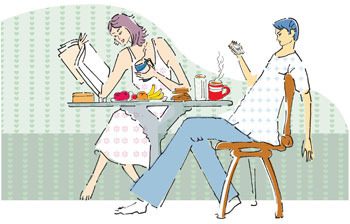
It’s astonishing how deeply romantic it is to tie the knot, slip on the sparkly on your ring finger, walk down the aisle with a swishy fountain of lace behind you, or take a turn at the wedding mandap with dramatic chants sung against the sacred leaping flames. At every moment, you are shivering with anticipation, thinking of that spectacular wedding night that awaits you on a bed of roses. From the moment you drag your weary stiletto-ridden feet home after ‘receiving’ your many guests, you’re ready to crash. Literally. In a fun, wine-laced conversation at a recent bachelorette party, we did a show of hands to see how many people actually consummated their marriage on their wedding nights. The handful who did put up their hands, I’m dead sure, were all cock and bull stories, no pun intended. I mean who in their right mind actually does it on the wedding night?! One chica claimed – ‘You must – I mean, just for the heck of it – you have to! It’s your wedding night, after all!’
And that’s exactly how marriages begin. And romance begins to lose its edge. You do things because you have to, not because it’s always fun or scintillating. So what happens to the calls late into the night when you curl your toes under the covers with glee, the little pecks of promise, the anticipation of meeting soon, the entwined fingers and the burning look of intensity in the eyes that sends your spine and neck tingling with sensation? They are replaced by the harried look of multitasking chores, the absent-minded, disoriented air, the brow furrowed with concentration, the distracted monosyllabic answers at the breakfast table over coffee, toast and wireless BlackBerry compote, the intense concentration of a person who has his ambitious head turned skywards straight at the stars. I remind him it could get lonely at the top.
As I plan another vacation, in memory of the bygone days of wooing, to give me a brief glimpse into the young lovers we once were, I placate myself with the thought of a new destination that allows one to forget the responsibilities of life and focus on the simple pleasures. Like enjoying each other’s company in the companionable silence of golden sands and crashing waves. He slides his hand into mine; we flash back in time. At that moment I sense that romance never left us; we left it because of our preoccupations. The young boy’s romance has matured into a man’s love – deeper and subtler. Instead of wallowing in a time warp, I realise the romance didn’t die. It just changed, adapted, grew. The candyfloss tinted glasses fell off. I wouldn’t want it any other way.
17 Thursday Feb 2011
Posted in Humour, Publication: Verve Magazine, Social Chronicles
Tags
Verve Magazine, Musings, February 2011
Women wearing the pants is passé, but now we find men holding onto their women’s pants with quiet desperation, afraid they will fly the coop even before the nest is made. Sitanshi Talati-Parikh muses on the metamorphoses of women in a liberated society
The Queen Bees of society are silent killers – men have for centuries been braggarts and women have found a way to get their own back. Who actually goes to a bachelor party expecting to get lucky and laid? The boys-trying-to-be-men come back with tall tales of passion galore, but the paunchy Indian men of the day (who need a compass in matters of orgasmic satisfaction) are hardly going to be the source of irresistible temptation to svelte Scandinavian women – unless a good deal of money is thrown their way. And if you need to pay for it, it doesn’t count. Indian women, who are generally in much better shape compared to their male counterparts, have an exciting, exotic appeal that makes a bit of harmless flirtation nothing more taxing to the purse than the bat of a mascara-ed eyelid. The PYTs of today can roam the cobbled streets of Europe kicking up a merry ruckus and returning quite the merrier. But we won’t go deep into the details – what happens at a destination bachelorette party, should be forgotten the moment you board the flight back home.
Women today are unselfconsciously raunchy, unafraid of their sexuality and are more than willing to take the leap in expressing it. As last year’s release, Aisha, suggests, gauche is out, and manipulative girl power is in. And of course, a foreign locale makes indiscretions completely acceptable – think Sex and the City 2 (2010) where Carrie steals a kiss with ex-boyfriend Aidan, in lieu of hubby Mr. Big being around. Or Vicky Christina Barcelona (2008), where straitlaced Vicky gets sorely tempted into an affair before marriage – even considering calling her wedding off. And while selling kisses for change at a Scottish bar at her hen night, Hannah in Made of Honour (2008) is left weak in the knees for her best friend, not her husband-to-be.
It’s not as much about infidelity and indecisiveness (that’s a thought for another day), as it is about choices. Where once women either didn’t have those choices, or didn’t give themselves the right to make those choices, now women are all for options. If men are like ice cream, women have the entire range of flavours to pick from. And choices that have to do with emotional involvement can get complicated, but we find it surprising that women can be quite the cold fish – unemotional about their liaisons and irreverent about the heartbreak they may leave in the wake of their decisions. A 20-something girl of my acquaintance was regularly chased after by men of all shapes and sizes. She flittered in and out of relationships, with unbelievable emotional ease, while trying to unravel the knots in her on-again, off-again relationship with her long-distance ex-boyfriend. Eventually, after years they decided to get married – and she seemed freaked out by the idea of ‘settling down’! She allowed herself, in that moment of cold feet, one last (we hope) indiscretion abroad. Her now-husband apparently understood her perfectly well and thought it would be most prudent to get it all out of her system. And this – acceptance of women’s wild oats that need to be sowed – is not uncommon in relationships today.
You can’t help but be slightly amazed at this development – since when did cold feet become a paddle ground for men and women, and decisions made on the call of these frozen extremities allow for getting your toes wet in alternate waters? Women today are afraid to take the plunge – in committed relationships, in marriages, towards motherhood…. It is the time when women want ‘space’ and ‘freedom’ to explore boundaries and create new ones, to feel free of the impositions that they have seen other women suffer for generations; and in that very experimental stage, often swing to the other end of the pendulum before slowly clawing back to level ground. At exactly what stage they decided to give themselves the same rights in indiscretion and fun that men have had for years, one can’t quite be sure, but the metamorphoses has firmly taken place and the butterflies are spreading their wings and flying the coop. Women do make up about 50 per cent of society – and realising this, they began to take liberties and make decisions for themselves, subservient to none but their own moral and possibly immoral code.
And this isn’t exactly bothering the men – while it may make them insecure and quite whipped, what turns men on is the winning combination of ‘girls gone wild’ – the hottest selling video in America of women crossing the line (what line?) at foam parties, Spring break, bachelorettes, sleepovers is of the same name. Women for the longest time have had silent power over men, in bed and out of it; it’s just the matter of wielding it, and wielding it right. There is something vicariously pleasing about women going wild, and something entirely irregular about men doing the same. Maybe it’s the fact that men have been having their slice of cheese on the side for years; or maybe it’s the bit where we don’t really give two hoots about a sausage fest in a bowl of hot soup? In fact, the best kind of woman is the naughty moral one: the delicious anomaly defined by the kind who isn’t afraid to kiss, but won’t tell and won’t cheat.
You can tame the man, but can the man tame his New Age, expressive woman? It’s the era of female domination – what existed in the echelons of the kitchen and household has moved to the bedroom and workplace. It’s not really about who wears the pants, rather who finds himself holding the skirt.

 sitanshi talati-parikh