• About
  • Brand Building
  • Film & Drama
  • Writing: Arts & Lifestyle
  • Writing: Interviews
  • Writing: Luxury Brands
  • Writing: Travel

sitanshi talati-parikh

sitanshi talati-parikh

Tag Archives: Payal Khandwala

Who Stole The Dupatta?

31 Wednesday Oct 2018

Posted by sitanshi talati-parikh in Fashion & Style, Publication: The Voice of Fashion, Sustainability

≈ Leave a comment

Tags

Crafts Revival Trust - Ritu Sethi, Dupatta, Fashion, Good Earth, Nicobar, Payal Khandwala, Sustainability, Sustainable Fashion

Published: The Voice of Fashion, October 31, 2018.

Is the dupatta today relegated to being an emblem of archaic femininity and an ornamental accessory?

The dupatta, an iconic part of the Indian fashion lexicon, has lost its original raison d’être and has seen a transformation in urban India, to become a modern fashion accessory. The soft fabric worn flowing over the shoulders may have been often picturised romantically, as billowing gently—and occasionally coyly—in the breeze, but is, in reality, an exaggerated symbol of captive femininity and more importantly, female modesty. An integral part of the fabric of Indian society, conventionally, it forms a ‘ghoonghat’ or veil as a mark of respect in front of elders and at a place of worship, or protection from the unwanted male gaze.

The Creative Destruction

Connected to traditional garments of the Indian subcontinent like the lehenga-choli and the salwar kameez, the origin of the dupatta has been traced to the Indus Valley civilization. As the garment celebrates local embroidery and craftsmanship, for someone working in the handloom industry, the evolution of the dupatta is worrisome. Ritu Sethi, chairperson of the Crafts Revival Trust, addresses the change: “I delight in the fact that the original function of covering one’s head and bosom is no longer required, yet paradoxically, as a purist, I moan its passing.” She explains, “The lighter, airier weave of a dupatta is different from the rest of the suit length—reflecting in the elegance of its fall and drape, and its border and two-sided pallus. The yarn is produced specifically for the dupatta. What are the weavers shifting to if the demand wanes? Not to mention, a textile directory is vanishing before our eyes—a classic example of creative destruction.”
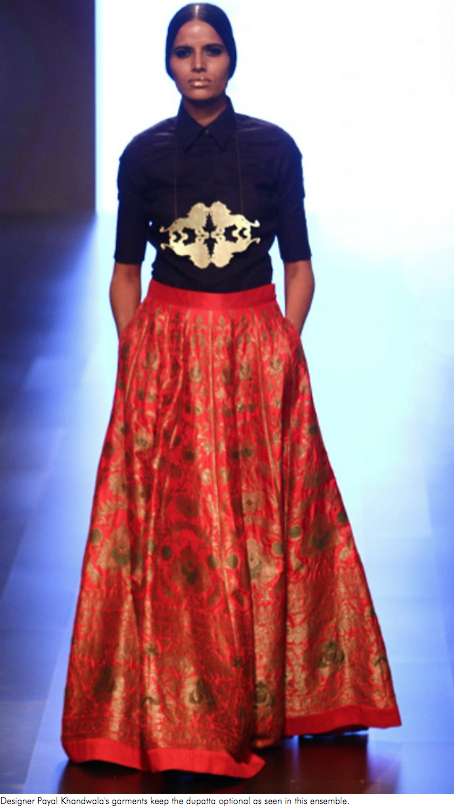
Screen Shot 2018-11-13 at 4.58.59 PM

Designer Payal Khandwala may not see it as a dead end though. “With the printed dupatta in synthetic fabrics replacing its hand-woven counterpart, the weaving community was already struggling. With more attention to hand-woven textiles and slow fashion in general—whether it is for scarves, garments or even home furnishings—we can certainly compensate for this shift and the subsequent loss of revenue from the traditional dupatta.”

And yet, Deepshikha Khanna, head of apparel at Good Earth Sustain shares that the traditional dupatta forms their highest selling category. She says, “Its use has definitely not dwindled. For as long as we continue to wear our traditional clothes the existence of the dupatta will remain relevant.” Tina Tahliani-Parikh, executive director of multi-brand boutique Ensemble, finds the dupatta remains an intrinsic part of the Indian outfit. She says, “It is a very feminine element, so I don’t see it getting replaced. Younger girls may wear a lehenga choli without the dupatta, but with the older, more mature customers, there is no question of the dupatta not being there. A Mughal-style Anarkali would be incomplete without the dupatta.

The Transformation

Khandwala, whose garments keep the dupatta optional, stresses on expressing individuality versus conforming. “The difference is we have the choice now to wear the dupatta simply for the romance of it or for its drama, rather than as a symbol of modesty.” She finds that the change may have taken place for multiple reasons—including the need to push boundaries creatively, to make the fashion landscape less homogenous, attention to comfort and practicality and a need to redefine what is handed down in the name of tradition.

The dupatta has most definitely evolved—from two-and-a-half to two-metre variants that flow on both shoulders; to the shorter stole which falls on one shoulder only, and to an even shorter square scarf that may be worn on the neck, on the head as a bandana, or tied to a handbag as a visual accessory. Lifestyle brand Nicobar, that looks to establish a modern Indian voice, has a range of diaphanous Chanderi overlays and jackets that alternatively dress up or bring traditional texture to a Western outfit. It may not be wrong to assume that in this case, the dupatta has been entirely eliminated and replaced by an overlay.
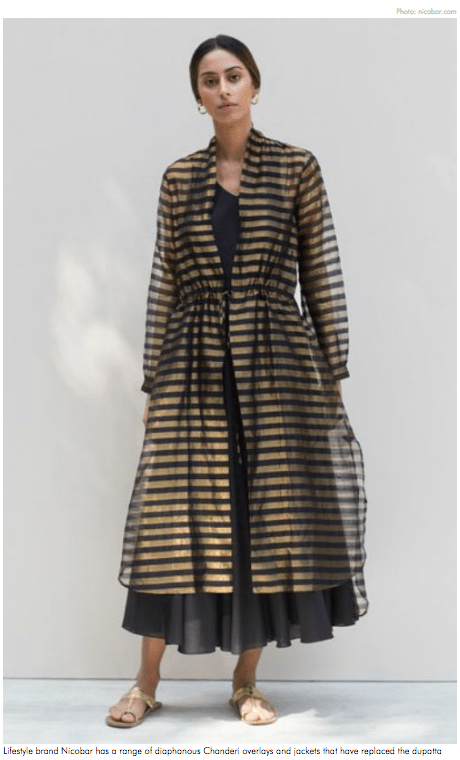
Screen Shot 2018-11-13 at 4.59.08 PM

Khanna points out that as style evolves so does the use of clothing. “A kurta which was once conservative is now worn over a swimsuit to a beach. Similarly, a dupatta, which is very versatile, is now a scarf, a sarong or a halter top. Globally, traditional weaves like Ikat or Mughal motifs are seen on dupattas that have been adopted as scarves and have become a part of Western ensembles. It is an iteration of the dupatta seen in a different context. While its early reasons for existence needed an update as the women wearing it have evolved, one finds that Indian women continue to stay attached to their traditions but adapt them to suit a more global lifestyle.”

Clothing, in the manner of art and music, reflects socio-cultural changes—which is marked in how we choose to present ourselves with the new-found freedom to express. In that sense, the dupatta’s transformation is a sign of the times, where women are no longer required to be ‘modest’. And as for its evolution, as Khandwala puts it, “To simply repackage old ideas makes fashion stagnant and predictable. It is just as important to suggest alternatives that define the future.” And the dupatta today remains, free-flowing, open to interpretation and boundless in its versatility as it floats away from patriarchal tradition.

Payal Khandwala: Out of the Closet

08 Saturday Jul 2017

Posted by sitanshi talati-parikh in Fashion & Style, Interviews (All), Interviews: Lifestyle, Publication: Mint Lounge

≈ Leave a comment

Tags

Designers, Interview, Out of the Closet, Payal Khandwala

Published in Mint Lounge July 8, 2017
(Text edited from original). Photograph by Abhijit Bhatlekar

Payal-k6vG--621x414@LiveMint

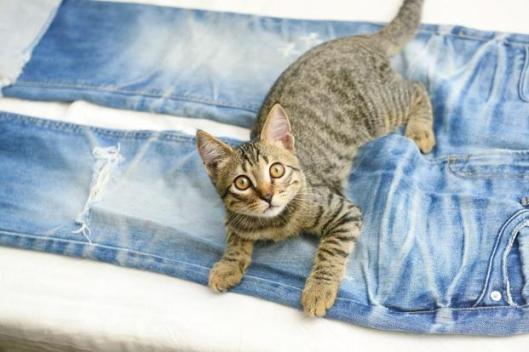
Her brand-new cat interjects his way playfully into many parts of our conversation, and artist-turned-designer Payal Khandwala deals with the situation with the same composure that she would any other area of her life. Khandwala draws from her vivacious artist’s palette for the eponymous clothing line she first showcased in March 2012, 10 years after she moved back from New York to Mumbai.

Khandwala went to New York to study fine arts at the Parsons School of Design in 1995 and then worked with menswear designer Sandy Dalal in the US.

Unable to find clothes that she liked, and sensing the potential market for a prêt line, she decided to move from canvas to fabric. The line has taken on a life of its own: She started by retailing at Good Earth and now has two stores in Mumbai, and is stocked in multiple stores in four metros.

Khandwala, 43, has repeatedly made it to best-dressed lists for her individual sense of style, which is bold-hued, sleek and non-fussy. Her eyes are always made up dramatically, her petite frame is enveloped in colourful drapes, trousers and antique silver accessories. But what she wears best is her grounded attitude to life and style. After all, she is the one who popularized lehngas with pockets for women.

payal1-k6vG--621x414@LiveMintColour-coordinated brocade saris.

The saris in her wardrobe are grouped and hung in order of colour shades and sometimes, she says, she will just “undo it to avoid becoming a slave to that kind of discipline”. Edited excerpts from an interview:

Should we be surprised that your living spaces are minimalist and muted?
I am very practical; I don’t like fuss and clutter. Not only is it the way I design, it’s also the way I live. While I like accents of colour, I want the environment to be neutral. Besides, I can’t wear and be around colour simultaneously!

How different is your look now from your New York avatar?
As a student I didn’t have any money, but New York is full of flea markets and vintage stores. I was more bohemian: pairing jeans with a top, shawl or kaftan. I became more minimalistic when I began making clothes for myself, and with age, perhaps. I don’t want too much of either sophistication or free-spiritedness.

cat-k6vG--621x414@LiveMintDistressed jeans from Hong Kong.

You’ve struggled to find lowers that worked for you, how did you figure them out?
I love jeans because they stand the test of time (she’s “obsessed” with a pale pair from a mall in Hong Kong that is loose-fitting, distressed and bootleg). I always found everything else more formal, while high-street options are largely trend-based. So now if I want to wear a particular kind of pant (she counts the palazzo as a staple), I just make it.

Anything from “back then” that makes you cringe?
You won’t see me wearing colourful patent leather wedges or fluorescent colours. I disliked the 1980s and 1990s. It was the worst time for fashion. I did it then and it was a disaster. I have learnt my lesson.

Didn’t you have a love affair with saris?
I took two Abraham & Thakore cotton saris with me to New York, but it became a lot easier when I moved back to Mumbai, because of the weather. Being a part of the art circle, or maybe as a reaction to having been away so long, I began wearing saris more frequently, pairing them with tank tops or jackets that I procured from Vietnam, Cambodia or Istanbul. I easily have more than 80 saris (none of which are from my mother), including 50- to 70-year-old vintage brocade saris, and lehngas woven with pure gold thread, and an early Sabyasachi.

silver-k6vG--414x621@LiveMint

Silver necklace from Istanbul.

Tell us about your eclectic jewellery collection.
I have a lot of silver jewellery: I wore it with saris for my wedding. I’ve not bought anything in ages, because there is very little of the genuine kind in circulation—they just make pieces that look antique. I’ve picked up stuff from Rajasthan (Jaipur and Udaipur), Istanbul and, earlier, from Amrapali. I am also fond of necklaces that are like thin discs made out of coconut or vinyl put together and tribal, Maasai-style pieces. I’m currently in love with flower-shaped leather rings that I picked out in multiple shades from a little Spanish store, Tierra (now shut down), in New York.

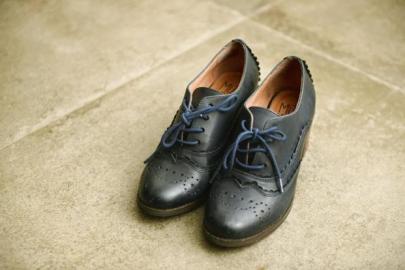
shoes-k6vG--621x414@LiveMintA pair of indigo brogues from Miz Mooz, New York

Do you believe in a “look”?
If you have a distinct sense of style, it will automatically come with a “look”. Any decision you make—if it comes from a place that is not external or trend-driven—is based on your personality. For instance, I’m an informal person. I will go to a restaurant and cross my legs and sit; so you will very rarely see me wearing anything that is short and tight.

Which is more important, fashion or style?
Style, of course! And that makes you question the male gaze. In much the way that Coco Chanel was trying to do by questioning the need for women to wear corsets—because there were men designing for women, with their idea of what a girl should look like. I feel now there is finally some conversation about this.

purple-k6vg-414x621livemint.jpgReversible handwoven jacket from Payal Khandwala.

What do you believe is key to making, wearing and choosing clothes?
It is simply a matter of taste that will connect all three. And while I know colour is what everyone responds to, the bedrock of a good outfit (for anybody of any size and shape) is proportion. It’s like assuming that a long skinny rectangle can be equal to a square. As you “cover up” with clothes, you are cheating: Perhaps three people in the world have a body that looks perfectly proportionate. The rest of us are stuck with bits and bobs and the lines we’ve earned and stretch marks we have fought for.

Payal’s colour wheel
Khandwala gives us her markers for special occasions

Brunch: Think beyond white. It works, but it’s predictable. I recommend citrine or coral.

Cocktail: Don’t feel compelled to pick black, go with a deeper bold colour. I’m partial to jewel colours, so sapphire blue, emerald green, perhaps with a hint of metallic.

Romantic date: Pick a colour that is an extension of your personality. This is probably the best time to be at your most comfortable. If you’re bold, I would recommend crimson; free spirits can try chartreuse; if you lean towards shyness, then powder blue, silver, or blush rose.

When in doubt: Neutrals like charcoal, black, navy, indigo and white work in most situations, so when unsure, turn to one of these shades. Whichever colour you pick, the key is to wear it with confidence.

Skirting The Issue: Is the future of fashion ungendered?

17 Wednesday May 2017

Posted by sitanshi talati-parikh in Brand Watch, Fashion & Style, Features & Trends, Publication: Mint Lounge

≈ Leave a comment

Tags

Anaam, Androgyny, Antar Agni, Burberry, Chanel, Design, Designers, Fashion, Genderless, Genderless Kei, Gucci, Kallol Datta, Korean Beauty, Louis Vuitton, Maithili Ahluwalia, Mint Lounge, Payal Khandwala, Rajesh Pratap Singh, Ungendered, Writing, Yves Saint Laurent

Published in Mint Lounge, Saturday May 13, 2017 (Future of Design special edition).
(Additional images added below for this blog post)

We have had women in tuxedos and men in skirts. But the new ‘genderless’ direction in the global fashion world might further dissolve the idea of binary identities

designskirt-k2mC--621x414@LiveMintAn image from ‘Vogue India’s’ May issue, guest-edited by Mario Testino. The editorial, titled ‘Role Play’, attempts to ‘challenge gender with fashion’. Photo: Courtesy Mario Testino for Vogue India/May 2017
Earlier this week, Emma Watson received the first gender-neutral award for Best Actor (Beauty And The Beast) at the MTV Movie & TV Awards. “It says something about how we perceive the human experience,” she said. The award was presented by Asia Kate Dillon, who plays TV’s first gender non-binary character (Taylor, on Billions).

Like other recent events, this added to the ongoing conversation on gender-fluidity.

For a culture like ours, with its thrust on uber masculinity and coy femininity, reconciling to this phenomenon may be shocking, but not impossible. While one knows androgyny to be the combination of masculine and feminine characteristics, ambiguity in gender could be a lifestyle, sexual or style choice.

Louis Vuitton_Jaden Smith - high res

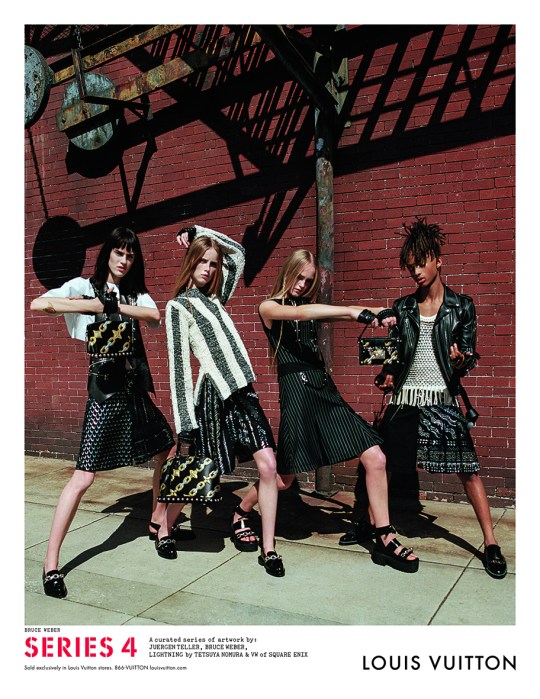
Celebrities such as Miley Cyrus have identified themselves as pansexual, but perhaps it is young actor-rapper Jaden Smith’s bold outlook that has fired up the imagination. Will Smith’s son is seen wearing a skirt as part of Louis Vuitton’s Series 4 (Spring/Summer 2016) campaign about a heroine and the multiple facets to her personality. The brand’s creative director, Nicolas Ghesquière, believes Smith “represents a generation that has assimilated the codes of true freedom, one that is free of manifestos and questions about gender. Wearing a skirt comes as naturally to him as it would to a woman who, long ago, granted herself permission to wear a man’s trench or a tuxedo”.

Androgynous roots

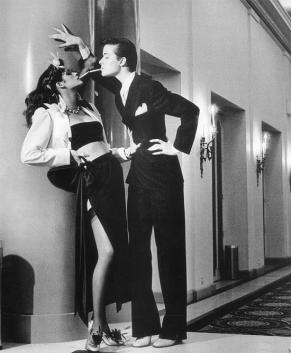
le-smoking-3Le Smoking, Yves Saint Laurent by Helmut Newton

Worldwide, sartorial acceptance tipped when the founders of two path-breaking French haute couture houses, Coco Chanel and Yves Saint Laurent, gave women trousers and tuxedos in the early and mid- 20th century, respectively. Many male music legends have flirted with everything from make-up and heels to ruffles and florals, but it was David Bowie (in his sexually ambiguous Ziggy Stardust persona) and Prince (in his flamboyant Purple Rain-era) who cut the sartorial cord with their seminal style statements. More recently, American hip hop artiste Young Thug wore a dress for his album cover, while British footballer David Beckham has been spotted in nail paint and a sarong.

Historically, pre-colonial India saw no issue in dressing up its men, particularly royalty; the traditional male outfits of Gujarat and Rajasthan are adorned with colours, mirrors and gathers, while drapes like shawls, anarkalis, lungis, kurtas, salwars and churidars have been a long-standing part of India’s unisex fashion grammar. Even as the idea trickles down—Tridha, a school in Mumbai, has genderless uniforms (a short kurta students can wear with lowers of their choice)—in a country that lends exaggerated importance to binary sexuality, fashion is setting a new pace for a forward-thinking society.

Beyond binaries

Rajesh Pratap Singh - low res option 2A model wearing Rajesh Pratap Singh.

Designer Rajesh Pratap Singh, who has an affinity towards androgyny, finds the audience for unisex clothing limited. “As women found independence and emancipation once again in India, wearing men’s clothing is considered stylish in most urban areas, but it doesn’t hold true for most parts of the country,” he points out.

What is true though is that modern silhouettes for the local landscape increasingly tend to be sleeker, deconstructed or fluid, shaped according to will, body type and occasion. From anarkalis to dhoti pants, from cholis to shirt-blouses, we have made a shift in styles, and increased the functional element of formal wear. But are women able to take the leap to wearing perhaps a tuxedo to an Indian wedding? Mumbai-based designer Payal Khandwala, whose lines for women are largely anti-fit, says: “It (gender-fluid dressing) will be a parallel movement. The bright side is that it makes us question the male gaze we have taken for granted and re-examine our preoccupation with ‘pretty’ and ‘hyper-sexualized’ clothing for women.”

Unisex clothing creates ambiguity towards age, shape and size, naturally defying the restrictions imposed, stereotypes perpetuated and social comment invited by accentuating and fitted garments. While many designers locally have nailed the anti-fit trend, there have been attempts, such as the “Ungendered” clothing line released online last year by Zara, that faced flak for its unimaginative designs. Unisex outfits shouldn’t be drab, shapeless or colourless—rather, they should be a celebration of clothing that is chic while being free of conservative parameters.

38_RoryA model wearing Gucci.

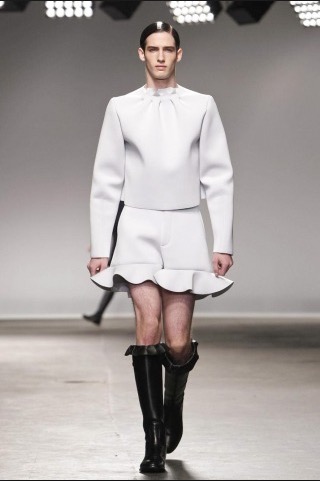
Women in menswear may be de rigueur, but men in women’s clothing is certainly up for exploration. A key designer of genderless fashion, J.W. Anderson’s Fall 2013 collection sent a male model on the runway in ruffled shorts and knee-high boots, showing off muscular, hairy legs. Singer Pharrell Williams, who likes Chanel necklaces, has starred in the couture house’s Gabrielle bag campaign this year. International luxury brands like Gucci (whose fluid vision under creative director Alessandro Michele has been touted as inspired and sound) have “genderless” models—those without an associated gender—on the runway, also unifying men’s and women’s fashion weeks. Michele stated last year, “It’s the way I see the world today.”

It was a “fluid-packed” fall 2016, with Burberry harking back to Bowie-esque ruffled shirts for men and military-style jackets (also seen in Givenchy’s campaign) for women, along with gender-neutral trench coats.

Screen Shot 2017-05-18 at 2.34.33 PMA model wearing J.W. Anderson.

Bungalow 8 founder Maithili Ahluwalia is unimpressed by men in skirts. “It is not a natural evolution, it is fashion. A man’s body is structured differently and it is a bit limiting to think that what works for one may work for the other. It should be a mindset over a sartorial choice, not a surface-level relationship with fashion. Would a man wear gender-fluid clothing to work, particularly if he works in a bank?” she asks. Possibly, if he is anything like actor Ranveer Singh, who has turned red-carpet dressing on its head with his penchant for aggressive experimentation—of course, creative professions do allow for more sartorial freedom.

Delhi designer Ujjawal Dubey, founder of label Antar-Agni, whose styles are “androgynous and flattering to both the sexes, avoiding stark lines and labels between genders”, believes India is primed for change. So does Sumiran Kabir Sharma, whose new label Anaam is said to “dissolve all stereotypes”. Sharma works as “a silhouette generation artist, not focusing on the physical and the biological part of the human body that defines gender”. According to him, going genderless is not a passing phase—“it is definitely the future of fashion”.

SKIRT4-kG9C--621x414@LiveMint

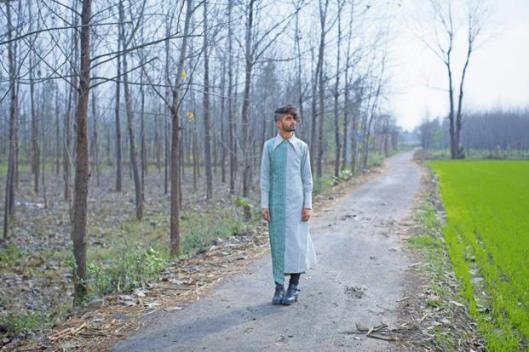
A model in an Anaam piece.

Kolkata-based designer Kallol Datta, who started out making (and wearing) gender-neutral clothing, is now moving towards “sexless clothing, where there is no acknowledgement of gender”. “I’ve favoured all-enveloping shapes and certain proportions when layering pieces of clothing…there is a blurring of lines with these shapes.”

Going genderless

If the male gaze changes, so may the female gaze. In Tokyo, following the explosive trend of “genderless kei” (kei means style), “genderless boys” have appeared on the scene since 2015. The popular Japanese idols tend to be slim-bodied, with dyed hair, make-up and nail polish, coloured contact lenses, and attention-grabbing outfits. They are not necessarily gay or trying to be like women, they are rejecting gender norms and establishing a new yardstick of style. It’s likely inspired by the Korean term ulzzang (“best face”), a common beauty standard for both men and women derived from the “flawless” K-Pop idols.

In America, Marilyn Manson’s genderless Mechanical Animals cover set the tone years ago but today, gender-neutral models like Rain Dove have gained supermodel status. Dove’s Instagram page says: “I’m not a Boy. I’m not a Girl either. I am I.” And further, “Sometimes I like lace panties. Sometimes I like briefs. It’s my body…. And I’ll cover it however I damn please.”

Today, numerous designers worldwide offer unisex lines of clothing, and stores like Selfridges in London stock an “Agender Fashion Without Definition” collection across three storeys, suggesting that the trend is more than that—it’s a new way of life.

Fashion should cater seamlessly to one’s individuality, without leaning towards homogeneity. Khandwala agrees: “At its core, what one wears must be a democratic decision that comes from a place of honesty and self-evaluation. The impetus cannot be external and certainly not because it is a fashion movement.”

Is the potential dissolution of gender a fantasy of the future or a reality of today? As predefined roles get blurry, so does the way we dress. And we should find our voice in that freedom. Worldwide, as socio-politico-religious mindsets get narrower, perhaps it is fashion’s lot to expressively push back as the non-conformist and heterogenous “genderless uniform” of a truly inclusive and free-spirited society where it is, literally, best face forward.

****

How we got here

A brief sartorial history of the blurring of gender lines

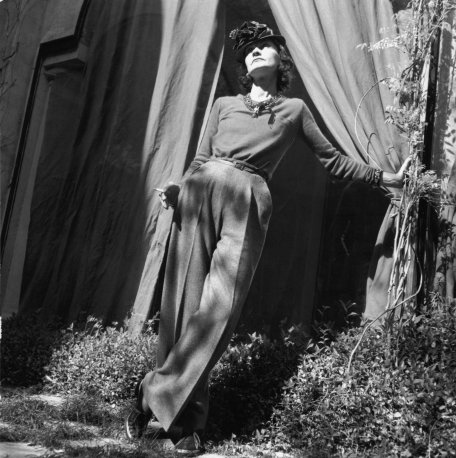
1938 Photo Schall at La PausaCoco Chanel

1910s: Gabrielle “Coco” Chanel changed women’s relationships with their bodies and ways of life by introducing them to trousers and jersey sportswear.

skirt2-kG9C--414x621@LiveMint

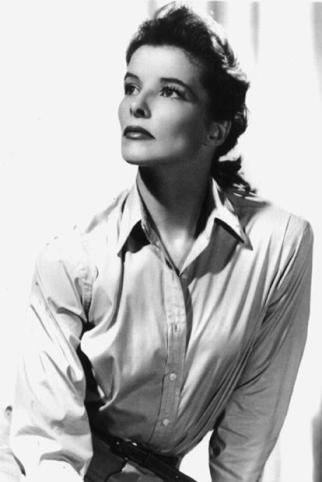
Katharine Hepburn

1930s: Katharine Hepburn’s path-breaking attachment to men’s shirts bought secretly from the back of New York’s Brooks Brothers store and Marlene Dietrich’s seminal moment kissing a woman on screen while wearing a bow tie and top hat.

1960s: Yves Saint Laurent’s (muse Violeta Sanchez) “Le Smoking” tuxedo suit for women pioneered the modern-day power suit; Mick Jagger performed in Hyde Park in a white “man’s dress” designed by Mr Fish.

YVES-k2mC--414x621@LiveMint

David Bowie

1970s: Patti Smith’s obvious androgyny, Jane Fonda’s bold red-carpet moments and David Bowie’s sexually ambiguous Ziggy Stardust persona triggered cultural shifts.

Grace-k2mC--621x414@LiveMint

Grace Jones

1980s: Feminine Prince and masculine Grace Jones set the tone for blurry gender lines. Japanese designers Yohji Yamamoto and Rei Kawakubo’s ambiguous collections set the tone for the future.

marilyn-k2mC--414x621@LiveMint

Marilyn Manson ‘Mechanical Animals’ cover

2000s: Marilyn Manson appeared genderless on the ‘Mechanical Animals’ cover.

|  Filling the gaps between words.  |

Writing By Category

  • Art, Literature & Culture
  • Brand Builidng
  • Brand Watch
  • Fashion & Style
  • Features & Trends
  • Fiction
  • Food
  • Humour
  • In The Media
  • Interviews (All)
  • Interviews: Business
  • Interviews: Cinema
  • Interviews: Cover Stories
  • Interviews: Lifestyle
  • Interviews: Luxury Brands
  • Interviews: The Arts
  • Interviews: Travel
  • Musings
  • Parenting
  • Publication: Conde Nast
  • Publication: Elle
  • Publication: Mint Lounge
  • Publication: Mother's World
  • Publication: Taj Magazine
  • Publication: The Swaddle
  • Publication: The Voice of Fashion
  • Publication: Verve Magazine
  • Social Chronicles
  • Sustainability
  • Travel Stories

Reach out:
sitanshi.t.parikh@gmail.com

© Sitanshi Talati-Parikh 2018.
All Rights Reserved.

Website Powered by WordPress.com.

  • Subscribe Subscribed
    • sitanshi talati-parikh
    • Join 51 other subscribers
    • Already have a WordPress.com account? Log in now.
    • sitanshi talati-parikh
    • Subscribe Subscribed
    • Sign up
    • Log in
    • Report this content
    • View site in Reader
    • Manage subscriptions
    • Collapse this bar
 

Loading Comments...