• About
  • Brand Building
  • Film & Drama
  • Writing: Arts & Lifestyle
  • Writing: Interviews
  • Writing: Luxury Brands
  • Writing: Travel

sitanshi talati-parikh

sitanshi talati-parikh

Tag Archives: Reviews

Discovering 25 cities with Louis Vuitton’s City Guide App

15 Tuesday Dec 2015

Posted by sitanshi talati-parikh in Brand Watch, Publication: Verve Magazine

≈ Leave a comment

Tags

City Guide Books, Interviews: Luxury Brands, Interviews: Travel, Louis Vuitton, Reviews, Verve Magazine

Published Vervemagazine.in, December 2015

Screen Shot 2017-07-25 at 12.36.02 PM

‘I travel not to go anywhere, but to go. I travel for travel’s sake. The great affair is to move.’ Robert Louis Stevenson

Screen Shot 2017-07-25 at 12.36.11 PM

We’re sold on the beautiful travel images that capture monochrome moments from the cities. The ones above are from their newest cities, Chicago, Prague and Rome. Having been familiar with the beautifully produced hard-bound editions of Louis Vuitton’s colour-coded city guides (available in box sets as well), the just-launched app is a traveller’s dream come true. Lavish photos (taken by imaginative photography creative Tendance Floue) with an expansive lens-eye, an attractive and friendly user interface, the little category bubbles open up a world of painstakingly-collected information. But they already had us at the opening quotes, which change each time you access the app, like the one by Stevenson.

Screen Shot 2017-07-25 at 12.36.20 PM

Cafes that tell tales of day dreaming artists and authors, museums that paint a picture of a different time, streets that exude a ‘haute’ aura that has nothing to do with the ability to buy or sell. It speaks of a state of mind – the desire to experience the city through the eyes of the like-minded locals.

Screen Shot 2017-07-25 at 12.35.51 PM

A team of 50 experts, including those from the cities being covered, contribute content making it a comprehensive guide to 25 of the world’s most popular cities: fashion capitals, centres for contemporary art, beach towns and business hubs. The best part? The Parisian guide is available for free until the end of this month (the others cost €9.99 or US$9.99 in the App Store).

Screen Shot 2017-07-25 at 12.37.43 PM

Here’s what you can do:

Screen Shot 2017-07-25 at 12.37.49 PM

1. LOCATION, LOCATION It’s a snap to find any address on these easy-to-read maps, available offline. In location-aware mode, you can see all nearby businesses and points of interest, zoom in and refine your results by topic. With the search engine, you can switch to list mode.

2. LITTLE BLACK BOOK Create and view your address book of favourites at any time.

Screen Shot 2017-07-25 at 12.37.55 PM

3. POSTCARD FROM PARIS Send your loved ones a photo from your camera or from the guide’s gallery of pictures. Personalise your postcard and share your travel memories by using the filter in the colour of each city.

What’s more…

1. CONTRIBUTORS OF CALIBRE Each Louis Vuitton City Guide includes the participation of special guest contributors, who speak from personal experience of their home cities. Local celebrities or insiders open their personal address books and divulge several secret preferred haunts. For example, Prince M.L. Poomchai Chumbala suggests some of the elegant highlights to discover in Bangkok, while the film director Ivan Zachariáš takes the reader for a stroll around his favourite parts of central Prague.

2. LANGUAGE OF WORTH The guide is available in English and French options.

3. COLLABORATORS UNITE Louis Vuitton reaches out to journalists, writers, major figures in the world of arts and letters, many of whom divide their time between two cities; several authors often collaborate on one city, and each guide reflects the personalities of its contributors.

Screen Shot 2017-07-25 at 12.38.01 PM

4. (UN)COVERED If you plan to go the whole hog they also have a small leather case with the Monogram pattern, for the iPad and iPhone (6 and 6 Plus); they come in four extra colors inspired by the city collection: blue for Paris, yellow for Rome, red for Beijing and pink for Tokyo.

Did you know?

Screen Shot 2017-07-25 at 12.38.09 PM

Louis Vuitton has operated its own publishing house for some fifteen years and today offers a catalogue of more than 80 titles, including two collections focused on travel: its City Guides and Travel Books. Gaston-Louis Vuitton (1883–1970), grandson of the founder, was an avid collector and keen bibliophile, whose tastes ranged from literature to art books; he founded three bibliophile societies. When the Louis Vuitton store on the Champs-Elysées opened its doors in 1914, it already featured a comfortable reading and letter-writing room for its customers. This tradition continues into the present day at the Louis Vuitton bookstores.
A Noisy Trend: Coffitivity

03 Monday Mar 2014

Posted by sitanshi talati-parikh in Art, Literature & Culture, Publication: Verve Magazine

≈ Leave a comment

Tags

Reviews, Technology, Verve Magazine

Published: Verve Magazine, February 2014, Technology

There’s a new app on the market that accurately replicates coffee-shop murmurs while you work to help your creative juices to flow

Some like to work in silence, but apparently it’s an anathema for those who like feeling the heady buzz of sound. In an increasingly connected world, it seems that people are feeling more disconnected and alone. From quiet cubicles to work-from-home dens people don’t like to work in isolation. So to circumvent this, young professionals have taken to Coffitivity (coffitivity.com) like an only child takes to company. The online app provides three kinds of background noise. ‘Morning Murmur’ (a gentle hum to get the day started), ‘Lunchtime Lounge’ (bustling chatter of the lunchtime rush) and ‘University Undertones’ (the scholarly sounds of a campus café).

The noise that would be strange and annoying to someone who is passing by your workstation is actually strangely comforting while you work. While you would expect it to destroy your ability to concentrate, it actually soothes you and helps you focus better. Its tagline actually says, ‘Enough noise to work’! Their positioning relies upon research that states that ‘it’s pretty hard to be creative in a quiet space’, while a ‘loud workspace can be frustrating and distracting’, so they provide a perfect mix of ‘calm and commotion’ to replicate the environment in a coffee house. The sounds include those of clinking cups, cash registers and murmurs of conversation floating around you. It’s kept soft and muted in the background, is never invasive and a perfect sensory accompaniment to the steaming cup of your favourite brew.

With the strong coffee house culture flowing into India from Europe and America, many business meetings and discussions are held over a cuppa at a coffee shop. There is a pervasive ‘social’ feeling that allows for a discussion that isn’t held within a bubble. You don’t feel cut off from the world, you feel that you are a part of the world. There is a relaxed and casual attitude to a work discussion that you don’t get in a closed-door conference room.

While it forms a clever replacement to music that some people prefer while working, and it grows on you as you have it on, all I can say is that for someone who can be the most creative in silence, I felt a sense of relief and a lightness in my head when it was switched off. And really, nothing can replace the soft chirping of a real bird in the background….

Artistic Brainwaves

11 Wednesday Sep 2013

Posted by sitanshi talati-parikh in Art, Literature & Culture, Publication: Verve Magazine

≈ Leave a comment

Tags

Art, Reviews, Verve Magazine

Published: Verve Magazine, Nerve, Art Pick, September 2013

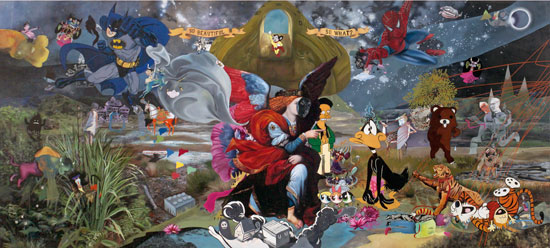
Former newspaper cartoonist, Raghava KK, uses art and technology as a means of storytelling – often dramatic and radical

Image

He’s one of CNN’s 10 most remarkable people (2010), a four-time TED speaker, a lecturer at top American schools and his iPad book, Pop-it, won several awards, including a Kirkus Book Award (2011). New York and Bengaluru-based artist, Raghava KK quit school at 18 to start his career as a newspaper cartoonist. Now, the successful young artist is also actively involved in a radical education initiative, NuVu Studios, an offshoot of Harvard and MIT, to redefine creativity in education. He combines art and technology to bring multiple perspectives into the deployment of knowledge. His new show That’s All Folks! has come about through “the emotional mapping of the three disparate worlds: The Cartoon, The Historical, The Memetic”. Verve catches the artist, who believes in “non-linear, dispersive, collaborative storytelling” for a few questions.

Raghava KK’s solo show, That’s All Folks!, will be on at Art Musings, Colaba, Mumbai, from September 4 to October 25, 2013.

RAGHAVA SPEAK

How does your iPad art book Pop-it bring perspectives to children?
I created the book when my first child was born. Pop-it is about the things children do with their parents. It shakes up the concept of the ideal family and is meant to expose children to multiple perspectives at the earliest stage. The book starts out with a gay couple raising a child. If you shake the iPad, you get a lesbian couple. Shake it again, and you get a heterosexual couple. I can’t promise to bring my children up without biases, but I can promise to expose them to as many biases as possible.

Where do memes in art take us – are they a bridge between the graphic form of visual storytelling and the print form?
Contrary to what it may appear, memes serve exactly the opposite purpose. The meme breaks the bridge, giving the graphic a life and context of its own, disconnected from its original intent. (A meme, like a gene, contains certain properties, including the ability to self-replicate. But unlike a gene, a meme can move laterally and hierarchically from host to host, much like a parasite would. Memes create emergent phenomena when they reach critical mass and have a life of their own, separate from the life of their creators and replicators.)

Your interactive artwork brings together science, technology and art….
My brainwave art pieces use the viewers’ thoughts and mental state (read by an EEG headset) to dynamically bias and change the artwork. I am currently developing works using other biochemical sensors, kinect hacks, and a new touch-screen frame technology. These works are changing the role of the viewer from that of just a spectator to an active, biasing participant in the artwork.

Do you see the extinction of the traditional canvas?
Each medium, whether paint, digital, iPad, or performance, lends a unique perspective to the visual experience. I don’t see the future as doing away with any one of these unique forms of expression. Instead, I see a more inclusive pool, where there will be unique combinations and re-combinations of these mediums arising in new exploratory visual experiences.

The ‘John Grishams’ of Banking

05 Monday Aug 2013

Posted by sitanshi talati-parikh in Art, Literature & Culture, Publication: Verve Magazine

≈ Leave a comment

Tags

Books, Indian Fiction, Reviews, Trend, Verve Magazine

Published: Nerve Books-Trend, Verve Magazine, August 2013

While John Grisham turned from criminal lawyer to legal thriller novelist, our local boys are also finding dramatic success in writing. What makes the finance geeks and diplomats turn into vivid storytellers?

Image

A banker friend looks enviously at my job description and makes a comment about how much fun it all seems to be. There’s some talk about doing something because you love doing it, not because of the money. Ahem. Who needs money, today, right? With inflation, it’s so easy to live on air, water and ink. And then an email pops into my inbox, informing me that the ‘John Grisham of Banking’ is out with a new book. Ravi Subramanian, winner of the Economist-Crossword award for The Incredible Banker is going to be jumping headlong into financial scams, university intrigue and politics, all of which will lead to murder. Subramanian is an alumus of IIM-Bangalore and a banker by profession. Sounds familiar? The often impudently positioned Chetan Bhagat comes to mind. He brought the IIM-havens into our homes, making us feel one with his world particularly through his clever non-language. Bhagat, for those unfamiliar with India’s educator-of-the-masses, is an investment banker hailing from IIM-Ahmedabad. He quit his career to become a full-time bestseller writer. In 2010, Time magazine named him one of the most influential people in the world.

And there’s the case of Shiva taking on the avatar of Lakshmi! The brainchild of an alumnus of IIM-Calcutta, Amish Tripathi’s The Shiva Trilogy has broken records in terms of book sales, becoming the fastest selling book series in the history of Indian publishing, with 1.7 million copies in print and over Rs 40 crores in sales. His books have been known to displace Bhagat’s on bookshelves. It’s surprising there hasn’t been any mass uprising against that. Forbes India has ranked him #85 in the 2012 Celebrity 100 list, while Dharma Productions has optioned the movie rights to his book, The Immortals of Meluha.

Vikas Swarup, from the Indian Foreign Services (IFS), and currently Consul General of India in Osaka-Kobe, Japan, has found an alternative career in writing to go with his day job. For those unfamiliar with Swarup’s name, he’s the mastermind behind Slumdog Millionaire – in its original novel form of Q&A.

They’ve made literature sexy – because of their success stories, but does the fact that they have come from management backgrounds and position their pen against the end goal of a fat bottom-line enable them to write themselves into money? If Tripathi is to be believed, the right kind of marketing can be the key to success, after all, his marketing and finance background have hugely helped him in the process. He approached bookstores to distribute free copies of the first chapter of his debut novel. He created video trailers and screened them at multiplexes for his sequel. For the last in the trilogy, he released a music album – all of these being marketing firsts for books. Bhagat is a player in the field of self-marketing, whether direct or through his opinion pieces and articles.

Finance and marketing geeks work hard and tend to get burnt out. They make a pot load of money and then ship out to a more reasonable version of their current profession. But is it that simple? With the way the banking and finance world runs and the state of the world economy, is it just timely and brilliant that these smart mavericks have found a way to quit a strenuous job and make a mark in the world of the Arts? Can it be a happy marriage? Tripathi’s read up on how to write (Stephen King’s On Writing), he’s made Excel sheets with date plans and character sketches in Word documents. Eventually, he learned to go with the flow. Not to forget his first attempt got rejected 20 times. But then a merger and acquisition deal or a marketing pitch can take months of hard work before falling through. Does that give you the patience and inner strength to deal with rejection and wait for success?

These men would have us believe that it’s possible to write a good story and have the readers flocking to you. Each of them has found a hook – even if they often get critiqued for poor writing and editing. Bhagat is proud of the fact that he has got those who never read to start reading. But they are selling a story – and it’s a good one and largely, ‘in the language of the common man.’ While writers write, and wait for a good peg, these young men have stories to tell – the writing is incidental to the tale. It’s like a business proposition – you think of a good business idea and kick-start it; making it happen is merely execution. So you lose the beauty of language and the metaphors of thought; you don’t get literature, you get entertainment. Popular culture provides your money’s worth, something worth writing home about, and these are the kings of pop culture.

And the applause comes from everywhere. Their books get sold for movie rights: Vikas Swarup’s Q&A, became Slumdog Millionaire catapulting him to more fame than he would have envisioned. Bhagat, already hugely successful in his own right, reached new peaks with movies like 3 Idiots and Kai Po Che being made from his books. We’ll have to see where Dharma’s version of Tripathi’s story takes him.

But more importantly, it seems they may have set the benchmarks higher. A woman today may no longer stand back and say, ‘I wish to have a man who can serenade me with wit – or money.’ Instead, she is more likely to say, ‘I wish to lie with a man spinning tales of sweet fortune.’ Can any ordinary man ever measure up? And while we are at it, can there ever be an Excel spreadsheet that outlines how one can become a successful writer, mathematical formulae et al?

That Chauhan Girl Again #Review: Those Pricey Thakur Girls

20 Wednesday Mar 2013

Posted by sitanshi talati-parikh in Art, Literature & Culture, Publication: Verve Magazine

≈ Leave a comment

Tags

Anuja Chauhan, Books, Reviews, Verve Magazine

Published: Verve Magazine, March 2013, Nerve/Reviews

As her previous two books roll on the floors as films, ad and screenplay writer, Anuja Chauhan is out with a third novel, which also promises a sequel

Image

For any chick-lit fan, Anuja Chauhan is a breath of fresh air. She set the stage with The Zoya Factor, ensuring that we get her milieu of razor-sharp wit, desi mise en scene, irreverent metaphors and vivid character sketches. She took it a notch further by moving away from the city grime into rural dust with Battle for Bittora, her second novel. Those Pricey Thakur Girls arrive in small-town Delhi, with middle-class morality and the desire to be strong independent women. But here she places the story in the 80s, where at every stage you are familiarising yourself with a time that seems far removed from today. It’s the time of Doordarshan, tweaked to be Desh Darpan, a time when the Emergency is still fresh in everyone’s mind, when free speech is something to be treasured and fought for. Her protagonists are a newsreader and an investigative journalist, which makes them snooty about their respective jobs as well as their differing personalities. In the midst of revolutionary thoughts, careers and salary slips, a budding romance blossoms where Debjani Thakur, the feisty but incredibly shy newsreader falls prey to Dylan Singh Shekhawat’s charms.

Chauhan treats the light-hearted women’s fiction genre with remarkable personality. There is no rallying to western chick lit; there isn’t a desperate desiness, she has made it her own with a mix of gentility and local rootedness, which she claims is nothing but “the space we all live in! This is life in India aaj kal. I’m just writing down what I see around me, every day.” After all, Chauhan grew up in a house full of girls and has two of her own. It’s not hard to see that she leans towards the darkly determined men, who are at the heart of the matter, decent. Chauhan’s wickedly humourous romances are always marked with a foray into something new while being strangely, and comfortingly, familiar. Until the sequel, then.

Q & A – ANUJA CHAUHAN

Fame – either accidental or unsolicited – accompanies the stories of your protagonists.
I just enjoy a big fat public declaration of love. When it finally happens, everybody should see, everybody should know. And so Zoya (in The Zoya Factor) dates the cricket captain, Jinni (in Battle For Bittora) embraces her political rival and makes the front pages and Debjani does… um, what she does. Maybe that’s very cheesy of me – but I think a little cheese is required in our daily diet. I like putting my protagonists in peculiar predicaments and seeing which way they’ll jump.

Why is the book set in the 80s?
Nostalgia I think. I found I was spending a lot of time telling my kids (11, 14 and 17) how life was ‘back then’ when I was growing up. No Pepsi, no pizza delivery, only DD on TV. Besides, something about this book, about five sisters growing up in a big old house with a walled garden, just felt right in the 80s. Also, maybe this was just a reaction to the kind of snappy, sassy, glossy books that are flooding the bookstores, full of ‘bold’ girls and ‘jerk’ guys, I felt like I wanted to write old-fashioned romance – no texts, only letters, no sex, only kisses.

And the darkly determined young men going after your girls…?
I do admit to the darkly determined. I don’t like fair men – I can’t write them. And I detest ditherers, so that’s out too.

Matru Ki Bijlee Ka Mandola – Review

15 Tuesday Jan 2013

Posted by sitanshi talati-parikh in Musings

≈ Leave a comment

Tags

Bollywood, imrankhan, indiancinema, Reviews

Matru Ki Bijlee Ka Mandola – a review

305308xcitefun-matru-ki-bijlee-ka-mandola

From the moment the promos hit the air, it promised to be a strange movie. But you hoped it was a good strange, or interesting strange. It suggested dark comedy, satire, farcical elements with a popular star cast and a winning director.

But when the time came to deliver, it could have been so much more. While one must admire Vishal Bharadwaj for making a film like this, which stemmed from his love for dharti mata, the hinterlands and Shakesperean tradition all combined, he stumbled in areas that he normally shouldn’t have. With Omkara (his Othello), Maqbool (his Macbeth) etc., he had clear direction. He took an Elizabethan setting and converted it to the darkness of a village in rural India. A milieu he understands well, a tradition he can well expand. With Matru…, he took the technique of social satire and farce and moved it to his familiar rural India. Without a strong Shakesperean story to fall back on, he flounders with a premise. Is he merely picking at the problems of rural farmers and their rich zamindars who are out to looto them? He deals with the topic with unwarranted superficiality. If one chooses not to be serious about a serious problem, then one must at the very least attempt to show some depth while plotting around it.

A good student of Shakespeare always has powerful characters and can sketch them well. Bharadwaj hasn’t failed before and doesn’t falter here either. All the characters come alive, are stand out performances and are believable, even if occasionally caricaturized on the premise of satire. Pankaj Kapur as the Jekyll-and-Hyde Mandola is brilliant, if a little too easy to manipulate towards a happy film ending. Bijlee is a free spirit and plays her role faultlessly. Matru is what the actor, Imran Khan, has described as a desi Che Guevara. Matru’s sophistication is obvious, but then we write it off as a Delhi-education that has softened the expected rough edges. Shabana Azmi’s politician and her witless son played by Arya Babbar appear the most caricaturized, but in the space of the film and it’s intentions, the OTT treatment is forgiven, in fact even acceptable.

For someone who should be a stickler for details, Bharadwaj seems to have ignored quite a few things. Why must Bijlee run amok shouting for Matru, when we are later shown Matru wielding a cell phone? How does Matru conveniently manage to pull a favour, get a check of money for his village, and then never have to worry about making the delivery 5 days later of the crop which is ruined? There was a chance to create pressure — those 5 days one would think would have been mentioned for a reason — but it never comes up, as time stands still and the village gets busy with Bijlee’s sudden wedding. Mandola has a remarkable change of heart, we don’t really understand why…and that’s a shame because everything seemed to be building up to him and his idiosyncrasies. It’s all very convenient, but it’s not sharp.

The dialogue on the other hand, is sharp. It’s witty and layered and the delivery is pretty good from all the characters, who show wonderful comic timing all the way. For once, the onus of comedy isn’t on the comic relief but is on all the characters, which is great thing for Indian cinema, especially when it comes to satire. However, the failing was language. With farce and dark humour, one would need one clear, easily decipherable language. Bharadwaj has used three: Hindi, English and Haryanvi, of which one is entirely alien to the multiplex audience and another alien to a single-screen audience. While Kapur is playing his character perfectly, slurring the words like a drunk, he is inadvertently making it harder for the audience to grasp all of what he’s saying, often having the viewer miss key points of humour. The director should have caught that. On the flip side, Khan with his crisp diction is actually easily understood even in his learned Haryanvi, making the experience lighter and easier for the multiplex audience.

All in all, a clever attempt but a near miss. It will go down in the books as something to be dissected, analysed and categorized. It is a film of no small significance, it’s just unfortunate how close it came to being a serious contender for something special. Not to mention, slash 20 min off the run time, it would have read as well and tightly as Delhi Belly, another mad caper film. And Matru… could have retained it’s rather good music.


Thai Contemporary: Review of KOH, InterContinental, Mumbai

23 Saturday Oct 2010

Posted by sitanshi talati-parikh in Food, Publication: Verve Magazine

≈ Leave a comment

Tags

Chef Ian Kittichai, Food, InterContinental, KOH, mumbai, Reviews, Thai

Published in Verve Magazine, October 2010


When pregnancy cravings hit, you need something fantastic to stem the stomach-curling desire. Chef Ian Kittichai’s Koh at the InterContinental Marine Drive, seemed like a promising addition to my rather exclusive list, from the moment I heard Deepika Padukone tweeting about how great the food is and my own cousin mentioning the presence of the rather elusive massamun curry on the menu.

On a Thursday evening the Manhattan-style Asian bistro is filled with a lively crowd of familiar and international faces. Where Czar once pulsated with desi tracks, its replacement, Koh’s muted restro-lounge atmosphere is at once sophisticated and global. Propped with comfortable cushions on a table for two that’s too closely set to make it an intimate dining experience, I’m floored by the facing glass wall mural created by Thai artist Patcharapon ‘Alex’ Tangruen. The mural defines the space and cuisine – traditional roots, contemporary accents. You suspect you won’t taste the conventional here, even if the chef has drawn from the flavours of his youth: his own mother’s kitchen.

Evocative fresh fruit signature cocktails with antioxidants (Gojiberry bellinis) set the tone for the flavourful and delicately-spiced food. Steamed edamame dusted with sea salt and Thai spices for the table, followed by appetizers that make you not want to save room for the mains. ‘Chocolat’ baby back ribs (coated with dusky chocolate), an unrivalled palate-opener, juxtaposed in quick succession with stems of stout lemon grass covered with flame-grilled chicken accented with coconut and cilantro make for a delicious first offering. In fine contrast is the hand-pounded rock corn minced with spices, and the tofu…. So, I confess, I hate tofu. Even Morimoto’s tofu couldn’t convert me, but I feel unable to turn down the mild-mannered and unassuming Chef Kittichai’s suggestion of a jasmine tea-smoked tofu. Surprisingly, it lacks tofu’s usual rude texture and it is smooth as butter. The aubergine dish, though tasty enough, has a tough skin texture, leaving it difficult to manipulate while eating. After soaking in the stunning Koh golden corn gumbo – hand-pressed corn swirling in coconut broth laced with Thai basil oil; we’re all set to move to entrees.

Composed of a wide variety of freshly-imported greens and vegetables (I add crisp water chestnuts), the ‘Paneang Curry’ is perfect for my taste buds, while what the general Indian palate may scream for is the hot stone curry-spiced rice – which is akin to a Thai biryani. My husband, Sahil, takes the chef’s apt suggestion and goes with the Chilean sea bass coated with a yellow-bean glaze: a fresh offering that lives up to its promise. You are surprised how easily the hours get eaten up while you are being gastronomically appeased. In entirety, the meal leaves nothing wanting, especially when topped off with the luscious valhorna chocolate dessert accompanied by Thai coffee ice cream. Oh and did I mention the coconut cheesecake? Absolutely lovely. My only regret is being physically unable to sample all the tempting flavours on the menu – but that’s for another evening, another craving.

Koh Notes

– Chef Kittichai’s favourite ingredient that shares its home with India and Thailand is cumin.
– All the ingredients at Koh are imported: meats thrice weekly from different parts of the world, vegetables thrice weekly from Bangkok and Chiang Mai and condiments weekly from Bangkok.
– Come October, Koh plans to add a Jain version to the already extensive menu and its varied vegetarian offerings.
– When travelling you can sample Ian Kittichai’s cooking at Kittichai in Manhattan, Restaurant Murmuri in Barcelona and the gastro bar Hyde and Seek in Bangkok.


What’s Wrong With Anjaana Anjaani?

21 Thursday Oct 2010

Posted by sitanshi talati-parikh in Musings

≈ Leave a comment

Tags

Abbas Tyrewala, Anjaana Anjaani, Bollywood, indiancinema, Jaane Tu Ya Jaane Na, priyankachopra, Ranbir Kapoor, Reviews, Thoughts

I had great expectations from Anjaana Anjaani – based on the phenomenal music and energy during the promos and videos. With the reviews sounding disappointing, I still went to watch it out of sheer curiosity and I came back wondering what it is that Indian film audiences want in a movie. Agreed, the premise of the movie was about suicide, but there are hardly any dark elements in the film, except for when PC actually tries to kill herself, and is nearly successful. The film technically is slick – good camera work, nice styling and locales, power-packed performance from Priyanka Chopra (PC) and a very credible performance from Ranbir Kapoor, who one has to admit, can definitely act. He lived the role, though possibly with less zest than PC simply because of the nature of their onscreen characters. The dialogues are good for most part, some even quite crisp, and the story at least has a different premise, which is more than what we can say for the other generic love stories being made lately. In fact, it’s grim premise has genuine resonance with a contemporary youth – they tend to go into depths over love or money, and finding meaning in their lives becomes a lost cause. And finding that meaning when living out what they believe are their last days, with the person they least expect to, is existential in it’s execution. Were this to have been a Hollywood film, the same multiplex audience would have probably accepted it as a different kind of chick-flick and watched it. In Indian cinema, it is rejected in concept. There were parts that were slow and dragged, but that can be expected from any film. Overall though, I thought it worked – more than many of the big-banner love stories of this year – and yet it fared under expectations. I’m truly at a loss to figure out what it is that people found lacking in the film, especially when people go to watch movies like Housefull and Golmaal etc. I believe the Indian audiences demand sheer drama in romance, or mindless humour. Actually, it still remains a mystery to see why certain films work and others don’t. I’m curious to see the fate of Jhootha Hi Sahi – Abbas Tyrewala’s next, after Jaane Tu…Ya Jaane Na, which I felt was a small big film. A simple premise, filled with so much promise and character. Easily a film watchable multiple times, particularly because of the freshness of the casting and the sharp editing. Does Abbas manage it again, without Aamir?

Of Age and Time

27 Friday Aug 2010

Posted by sitanshi talati-parikh in Art, Literature & Culture, Publication: Verve Magazine

≈ Leave a comment

Tags

Alyque Padamsee, Reviews, Sabira Merchant, Theatre, vervemagazine

Published: Verve Magazine, Nerve, August 2010

It evolved from a Caucasian play to Parsi characterisation – making it appealingly familiar in the Indian context. Sitanshi Talati-Parikh goes behind the scenes, previewing The Game, an endearing two-person tragicomedy


Theatre01

Alyque Padamsee, Sabira Merchant, Bachi Karkaria, Raell Padamsee, Sam Kerawala. Stalwarts all, come together in The Game – Bachi’s adaptation of DL Colburn’s The Gin Game and her own earlier adaptation The Rummy Game – which brings Shireen Bamboat and Fali Pastakia, two elderly inhabitants of Pallonjee Nursing Home, together for the odd game of rummy, cracking through the carefully-maintained facades of each other’s lives.

There is humour tinged with despondency, pulling you irrevocably into their lives with a sincerity that can stem merely from a convincing performance. Alyque gets reluctantly back into acting after a hiatus of 15 years, last seen in a major role playing Mohammad Ali Jinnah in Gandhi, and accepts that while “film acting is a bore, stage gives me a huge high”. When daughter Raell chose to revive The Rummy Game in the memory of the late Hosi Vasunia, he accepted the chance to play Fali, an irascible, lonely man who masks his soft nature under a cloak of crabbiness. Sabira, who along with Hosi was a part of the earlier adaptation, is a natural as the prim and petulant Shireen. Watching the preview in Alyque’s charming living room, against the backdrop of a library of books, I find their interactions unaffected and instinctive despite being in early rehearsal mode, both adept at getting into the skin of their characters.

Sabira fell in love with the award-winning DL Colburn original theatrical almost a decade ago on Broadway. “It’s so hard to find a role for an older person. There’s nothing meaty and hands-on. This is a play you can play forever. You can age with it.” That is exactly what the play’s theme is about, a very simple conversation about aging: how children grow further from their parents and how the latter deals with that change. Fali is the prime example of transferred aggression – the physical pain of growing old and the emotional angst of being alone gets transferred into his testy temperament. In between scene breaks, over bhajjias and tea, Alyque, admits that it was an easily identifiable role, “I can feel the pain in my back, I notice myself getting more short-tempered as I go along. Patience is not about the other person, it is about you. As soon as you are physically disabled, the first thing you have to overcome is impatience.” He pauses, and with an indulgent smile continues, “And for the other point, Raell, for instance, is a busy girl – I need to take an appointment to meet her.”

Sabira chimes in with feeling, “Everything that children have to do – life in general – absorbs them so much that to meet them you have to plan in advance! It’s a fact of life.” And this very issue remains her character, Shireen’s, main concern. She is a more complex character – she isn’t quite as transparent as Fali, and as the layers of her personality peel away, you realise how vulnerably human she is. And in the metaphorical interactions and altercations between Shireen and Fali, we find a hugely touching and irrevocably moving play that remains timeless and universal in its appeal.

The Game goes on stage at St. Andrews Auditorium, Bandra, Mumbai on August 21 at 7:30 pm and at NCPA, Nariman Point, Mumbai on August 22 at 6:30 pm.

Quick Bites on Theatre

Alyque: “Theatre acting is really stimulating – you get a chance to rehearse, which you don’t in films; and once you are on stage, you have a live audience – there is a kind of an electric current passing back and forth. In a comedy you can hear the laughter, but even in a serious play, you can feel the audience intensely.”

Sabira: “We weep on stage because we feel the power in the belly – not because of movie-style glycerine. There is no lying. The adrenalin is pumping and you’re not yourself – you are playing somebody else, you’re under somebody else’s skin. It’s a wonderful catharsis – I am never exhausted after a play. For me it’s like a holiday. And there’s no baggage.”

Mindless in the Desert: SATC-2 is actually just a spoof of itself!

15 Tuesday Jun 2010

Posted by sitanshi talati-parikh in Musings

≈ Leave a comment

Tags

Hollywood, movies, Reviews, Sex And The City, Thoughts

How is it possible that Hollywood cannot see how stupid it makes Americans look when it creates movies like Sex and the City-2? I mean you start out with four relatively intelligent, well-read and well-travelled (we hope) women: a writer, a lawyer, a PR person and an art curator. How can these women who’ve spent years in their respective professions behave like such complete imbeciles? Well actually, Miranda and Charlotte do behave themselves, but the queen bees of the foursome, Carrie and Samantha act like absolute idiots.

I get that Samantha is Samantha – deliciously irreverent when it comes to sex and society. But I also get that while she flirts outrageously, and takes home a lot of goody bags, she generally doesn’t act like a moron in her home city. It seems that lack of hormones and hot flashes makes her go a little insane. She flagrantly flaunts social codes (which are a religious and legal issue in the middle east), while being the business guest of the sheikh who has kindly flown her friends and her first class in complete luxury to his home country, so that she can think about representing him in a PR capacity. It appears that Samantha could do with some PR of her own – and some re-training in the way to behave in public; not like a hormonal teenager on heat. And you can argue that that’s just Samantha – but is it? Did she become a top PR executive by showing hordes of conservative men her middle finger, breasts and her latest lay’s boner? I’m not really sure. It just seems that she’s finally becoming senile. Where even her Samantha-ness is no longer acceptable.

Do Americans really know so little of other cultures and behave this silly when they travel? What they do in New York is not really acceptable in Abu Dhabi! And flaunting social norms is not funny, it’s just stupid. Why does Hollywood not understand that when they make movies like this, they are not ridiculing the closed cultures of the world while heralding the joys of the librated ones, they are only proving that Americans can be really socially inept, culturally dumb and truly lacking in common sense, basic decency and courtesy and in any amount of general knowledge? And Americans are not really like this – the ones I’ve met are genuinely interested in other cultures and politely respectful of them. So who are these Americans that Michael Patrick King is idolising on big screen? What happened to the girls who regaled us with their smart repartees, chic appearance and layered conversations? The girls who may have used the metaphor of sex, but were making important observations about society, life, men and people. These are not the women we see now – the women now are haggard, bitchy, unable to learn from their lives’ many lessons and choose to regularly regress to inept teenage-world.

Miranda and Charlotte’s troubles are actually real and funny – they deserved more room to mature and grow, but instead the story got sucked into the vortex of Carrie’s stupidity and Samantha’s ridiculous faux pas. Carrie is just being plain ridiculous – she is tired of the relationship in its current form, she takes time off from their house, but when Big tries to intervene and asks for some time off too, she freaks out and goes and makes out with an ex-boyfriend. I mean really? Do these girls never grow up? What Carrie did when she was 20 and 30 is not really still acceptable at 45+! Does she never learn from her mistakes? Or is the writer so unimaginative that he can’t move or think beyond the usual troubles of the 4 girls? Where is the Carrie who only believed in the love of her life, and went through men trying to find happiness but unable to do so, because she truly loved another? Her affair with Big (when she was dating Aidan) was allowed, because he was the man she loved. Why would she cheat on the man she loves with Aidan? Just because he was too tired to go out to party with her after a long day at work and bought her a plasma TV instead of jewellery? Is she really that shallow?

And the clothes! The styling! What an eyesore! What the show had been known for, renowned for, were the supremely stylish clothes and looks. What have they done here? They’ve taken the brightest, gaudiest fabrics possible, stuck on extremely shiny, often pointy things, added the most garish of accessories that made them look like Christmas trees at best, and called them clothes. I can possibly accept that 4 of the 750 clothes actually looked reasonable, and the only good thing to come out of this is that Miranda got a makeover. The plain Jane of the series and the tubby-mommy of the first movie looked the best of the lot here. Carrie should have thought about mummifying her look from the series and staying cryogenically frozen. She has not aged well, and well, botox doesn’t work for everyone.

The movie would have truly worked as a spoof of the show and the series – outlandish clothes, haggard-looking women, absolutely no story, weak dialogues, stupid characters, social faux pas galore, trivialisation of social rules and a caricature of American intelligence (or the lack of).

I thought the first movie did injustice to the supremely brilliant shows, but in retrospect that movie was Oscar-material compared to this hunk of junk that fans of the show were forced to sit through for 146 minutes! Maybe King needs to think about handing the writing over to Darren Star – who put together 94 episodes of the show that won 8 golden globes. This movie, I’d be happy if it won a Razzie. Two funny lines and four decent outfits do not a movie make. I may just have to burn the box set of the Sex and the City after the incredibly bad taste this movie left in my mind and soul, ruining the iconic characters forever. I hope King gets the message and lets everything and everybody rest in peace, without a third piece of torture barraging our mind and the cities.

← Older posts

|  Filling the gaps between words.  |

Writing By Category

  • Art, Literature & Culture
  • Brand Builidng
  • Brand Watch
  • Fashion & Style
  • Features & Trends
  • Fiction
  • Food
  • Humour
  • In The Media
  • Interviews (All)
  • Interviews: Business
  • Interviews: Cinema
  • Interviews: Cover Stories
  • Interviews: Lifestyle
  • Interviews: Luxury Brands
  • Interviews: The Arts
  • Interviews: Travel
  • Musings
  • Parenting
  • Publication: Conde Nast
  • Publication: Elle
  • Publication: Mint Lounge
  • Publication: Mother's World
  • Publication: Taj Magazine
  • Publication: The Swaddle
  • Publication: The Voice of Fashion
  • Publication: Verve Magazine
  • Social Chronicles
  • Sustainability
  • Travel Stories

Reach out:
sitanshi.t.parikh@gmail.com

© Sitanshi Talati-Parikh 2018.
All Rights Reserved.

Website Powered by WordPress.com.

  • Subscribe Subscribed
    • sitanshi talati-parikh
    • Join 51 other subscribers
    • Already have a WordPress.com account? Log in now.
    • sitanshi talati-parikh
    • Subscribe Subscribed
    • Sign up
    • Log in
    • Report this content
    • View site in Reader
    • Manage subscriptions
    • Collapse this bar
 

Loading Comments...