• About
  • Brand Building
  • Film & Drama
  • Writing: Arts & Lifestyle
  • Writing: Interviews
  • Writing: Luxury Brands
  • Writing: Travel

sitanshi talati-parikh

sitanshi talati-parikh

Tag Archives: Social Chronicle

Why Are School Uniforms Still Gendered?

15 Tuesday May 2018

Posted by sitanshi talati-parikh in Features & Trends, Parenting, Publication: The Swaddle

≈ Leave a comment

Tags

Gender Inequality India, Parenting, School Uniforms, Social Chronicle, Ungendered

Published on The Swaddle: May 14, 2018

Screen Shot 2018-05-15 at 11.27.37 AM

Recently, the Children’s Academy — which runs three private schools in Mumbai — determined through a student poll that its new uniforms will be gender neutral. While an overwhelming majority of students chose T-shirts, 58% of the 1100 girls who participated opted for trousers over skirts, citing comfort as a big factor. The new uniforms will be implemented at Children’s Academy schools in the upcoming academic year.

This decision towards gender neutrality comes as one of many, as schools across the globe adapt to increasingly inclusive attitudes. Last September, The Daily Mail reported that 150 schools in the UK would be introducing gender-neutral uniforms, where children of any gender were allowed to wear either a skirt or trousers. Last month, Fiordland College in Te Anau, New Zealand agreed to gender-neutral uniforms, where the girls will be allowed to wear pants and the boys will be allowed to wear dresses, as per their choice.

Such changes are the result of a growing resistance to gender stereotypes from both students and parents. At a basic level, schools are paying attention to the need to provide young children with the comfort of moving around safely, and without restriction. Although widespread gender neutral uniforms are a step in the right direction, ultimately, India needs to move towards the global trend of letting students choose whether they want to wear skirts, dresses, or trousers.

“As a girl in Indian society, I have grown up in an environment that has often restricted my clothing choices in terms of ‘what to wear’ or ‘when to wear,’” says 17-year-old Tamanna Sheth, who attends BD Somani International School (BDSIS). “I strongly believe in gender-neutral uniforms as I support the idea of comfort over appearance. Besides, they may also make one feel more confident.”

While urban Indian parents may be less resistant to change these days, radically different points of view exist among them. For many parents, gender-neutral uniforms are not on their radar. If they are, they may weigh in but not be a deal breaker when parents are picking a school.

Esha Pandya Choksi, mother of a two-year-old girl, strongly believes that differentiating between clothing from an early age adds to the pool of social factors that foster gender inequality. “At an age when children form ideas, clothing sets the stage about what girls and boys can or cannot do,” she says. “While clothing is not a direct counter to society’s stereotypes, it is a small step towards making a statement.”

Akanksha Shah, mother of two girls, aged seven and four, the older of whom attends Mumbai’s Cathedral and John Connon School, prefers dress to be an obvious differentiator. “They (skirts) are feminine and graceful; they complement the body structure of girls better,” she says.

Mumbai-based fashion designer and mother of a girl and a boy aged five and seven respectively, Anjali Patel-Mehta, is strongly in favour of gender-neutral uniforms. She suggests that a traditional Indian form of dress may actually make for a progressive uniform. “The kurta is universal, entirely gender neutral and authentic to India, while tunic and pants still lean towards a gender,” she says. However, she’s cautious of the implementation challenges — for example, resistance from the girls themselves, like those who struggle with body issues. She believes letting kids choose what to wear for themselves might be the best solution. “Going androgynous or unisex isn’t ideal: eventually, it should be a social choice, rather than attempting to force fit someone into a gender-neutral role,” says Patel-Mehta.

While giving children a choice in what to wear might have its own challenges — a child making a non-traditional choice may face peer pressure and ridicule — it will create a foundation for long-term societal acceptance.

The Mumbai-based Waldorf schools like Tridha, Inodai and The Golden Spiral, with the Rudolf Steiner education system, offer simple colourful cotton kurta tops paired with bottoms of their choice. “Our uniforms are practical and frugal — designed more to be comfortable in our climatic conditions and allowing freedom of movement during play,” says Tasneem Quettawala, co-founder and pre-primary coordinator of The Golden Spiral School.

South Mumbai-based IB schools like Bombay International School (BIS) and BDSIS have gender-neutral uniforms, save for their formal uniforms — worn once a week at BIS and worn optionally at BDSIS. These are in the form of a “skort” for girls, which is a pair of shorts with a front flap, giving the impression of a skirt. Anjali Karpe, deputy head of BIS, says the gender-neutral sports (PE) uniform, which comprises shorts and a tee for all children, is worn on most days and has been around for 25 years, even when it wasn’t the norm for all schools. “It is high time we went for gender-neutral uniforms — there is a distinct change in the perception of what is considered ‘feminine,’” Karpe says. “It is an archaic notion of dressing girls in skirts.”

And yet, while BIS derives comfort from the neutrality of their most commonly worn PE uniforms, Karpe reflects on the challenges of making a school-wide change, as the uniform is an important part of a school’s branding. “It needs to be an informed choice at a student-body level,” says Karpe. “Personal opinion cannot drive school leadership, and it would involve multiple stakeholders.”

The Children’s Academy method of polling its students is a good example of how to drive such change in a fair and egalitarian manner. Their schools will make the new uniforms optional within the first year of the change, taking into consideration parents who have already invested in the old uniforms; the new uniforms will become mandatory from the subsequent academic year.

At schools with less progressive ethoses, the student body may not lean towards gender-neutral uniforms with the same kind of majority. Government schools in India, however, have shown that they’re not resistant to change if it benefits their students. Last year, the Uttar Pradesh government announced that it would be changing the color of its public school uniforms from khaki to bright red and brown, in an effort to ensure that students wouldn’t feel like they were in any way inferior to their counterparts in private institutions. It’s not inconceivable that, down the line, they, too, will feel the need to adopt gender-neutral uniforms, if more private schools begin to do so, and seeing that the gender-neutral kurta already exists as a part of the social fabric.

Schools have been clinging to their uniforms for decades at a stretch, in the name of tradition and school identity. Uniforms have often been designed before the current management can recall, and have not come under review or updated since. They’re unlikely to be high on the list of priorities for most schools. But some schools have begun to lay the groundwork by listening closely to their students. It will be a slow process — stumbling blocks include tradition, deep conditioning, and stigma — but as institutions begin to pay more attention to what is best for their students, positive change will follow.
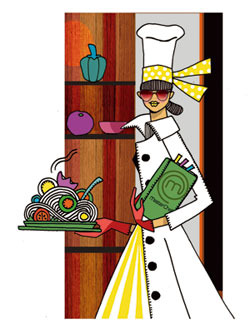
MasterChef On My Plate

17 Saturday Dec 2011

Posted by sitanshi talati-parikh in Humour, Publication: Verve Magazine, Social Chronicles

≈ Leave a comment

Tags

comment, Designer Children's Parties, Designers, Food, India, MasterChef, Social Chronicle, Trend, vervemagazine

Published: Verve Magazine, Social Chronicle, December 2011
(Illustration by Farzana Cooper)

If you are the latest in the line if PYTs to send your hubby a tiffin that contains pan-seared foi gras with a champagne berry jus, then you know you’ve arrived onto a culinary scene that’s flush with promise and ready to launch. Sitanshi Talati-Parikh describes the necessity of taking a kitchen rendezvous to the next step


Verve-masterchef


‘Do you cook?’ She whispered. ‘Of course not!’ I retorted scornfully.  Great parties are never about knowing what to cook; they are all about finding the right caterer. Gloved hands, butler coats, flitting in and out: the spanking German-designed modular kitchen is meant to be seen, not used. Must you fret whether pesto has pine nuts or pistachios? I’m quite certain it’s the latter, logically, isn’t pesto the green one?


Lately though, newbie home-makers carry recipes in their Ferragamo totes, and while sneezing up a bomb at the local Nature’s Basket, can easily tell one nut from another. Blame it on the latest reality TV craze: MasterChef Australia – far superior to its Indian franchise. As the country watches with bated breath which one of the accented Australians go down under and which ones make it to the top, the ladies are picking up a few tricks along the way, and the men are finding a new itch to scratch: the kind which involves a cutting board and a chef’s hat. After all, those men in chef whites skim over the fine line to count as men in uniform – and the way into a woman’s boudoir may well be through her stomach. Many a young man has now leaned over the bar and whispered suggestively into his lady love’s ear, ‘Your kitchen or mine?’


Now, you can’t visit a friendly home without getting a sprig of parsley in your Brie, or a dose of balsamic vinaigrette in your chilled watermelon balls. Recipes are snitched from one of the mushrooming gourmet restaurants in the city – the toasted pine nut, goat cheese and watermelon salad is The Tasting Room, I believe – and every meal is judged on the outlandishly clever gourmet competency of the home-maker-turned-chef. Does your beetroot come laced with chevre? Has it been garnished just so? If not, it’s not good enough to be plated up?


Play dates (for the uninitiated: the time like-minded infants spend getting to know each other) are also a fine chance to show off those pa(i)ring skills: preparing the finest meal for your child’s little friend – what could be a better sign of love? Ten-month-olds are developing a spectacular taste for the healthy good life – in the form of broccoli-and-spinach risotto garnished with fresh basil, a traditional (low-spice of course) massuman curry and zucchini-and-parmesan ravioli, washed down with a tall bottle of elaichi-flavoured formula milk.


And it’s not just the chic young men and women flaunting their culinary skills, it’s about ensuring that you have a system in place to replicate this sensational food – anytime and with the least bother. And to that end, my Bihari cook is now struggling with understanding my desire to replace a Bombay grilled chutney sandwich on Britannia bread with a Mediterranean sandwich on multigrain herb focaccia.  And not even adding his own home-made paneer? Instead, layering the green meat of a tasteless fruit that he imagines to be Bengali baingan together with hefty hunks of feta, grilled zucchini and eggplant licked with a killer harrissa paste! He grudgingly grasps that the need of the hour – and the possibility of survival – means his knowing his parmigiana from his au gratin.


Chefs are now finding themselves akin to moviestars: in a recent MasterChef India (Season 2) show, one of the contestants cried because she got to meet her idol Michelin-starred, New York-based, Indian chef Vikas Khanna, whom she then proceeded to serenade. With Indians and Sri Lankans making their token presence felt on international cooking shows stirring up a curry-and-flatbread once in a way, and with Michelin-starred chef Vineet Bhatia attempting to challenge the desi taste buds, it appears innovation is the call of the day. You can’t serve up chana-bhatura any more, but what you can do is throw in chickpea couscous, broccoli khichdi and bhatura-flavoured sorbet. Now that would be a meal worth writing home about.


No longer is it about spices – it is about tempering taste buds with the appropriate levels of flavour so that they (your taste buds) can regain their virginity – and discard the massacre of years of generous masalas and chilli powder. And it isn’t really about eating – or stomaching to satisfy – as it is about teasing and cajoling the culinary senses into a pleased stupor. Hunger is for the middle-class. Palate-teasers are what fine dining is all about. It is no wonder that young chefs returning from Manhattan, dipping their fingers into genteel party catering, serve up hors d’oeuvres the size of peanuts. So smoked mozzarella flatbreads are actually coin pizzas, the size of, well, the shiny new 10-rupee coin. Tapas are in, or haven’t you heard? A meal in one of Mumbai’s trendy restaurants can consist of merely ordering 17 tapas and needing a hefty bottle of wine to wash all that tiny, tasty food down to feel deliciously full. 


Wine pairing can’t be missed of course. No self-respecting 30-something will serve anything less than the perfect limited-edition international sipper that goes best with the course being served. All along, the conversation tinkles with very profound discussions on Chinese politics, Rushdie’s literary smackdowns, and whether the Riesling would work better with the coconut soufflé or the champagne tart. My ultimate brain wave is to serve up a passion-fruit-and-lemongrass Sangria. It’s the easy way out of pretentious course-drinking – and is somehow that crass, bohemian sort of thing one can do, to remain cool after all that soul-searching food.


Talking about soul-searching food, the gourmands believe in cooking from your heart, and with a dollop of love. How much can you cook from your heart, when your stomach is empty and how much love can emanate from that drop of extra virgin olive oil that you mayn’t get from your grandmother’s hand-churned ghee?


The thrill lies in the pleasure-seeker and the social climber. After all, can you really be eating khana-khazana-type makhani food in your Jimmy Choos and Herve Leger? It is worth sharing Gouda and Roma tomato notes, if merely to prove that the world is your personal oyster and you have an international, exclusive and very uber chic stew cooking in your state-of-the-art kitchen. And after that dinner party full of whispered conversation, clinking flutes and a sense of social accomplishment, where the senses have been thrilled with that one lactose-free beetroot foam tortellini, you are more than likely to find yourself kicking back furtively with a hearty macaroni baked dish, folded with about 250 grams of Amul cheese, and a little kiss of ketchup.

20 is the New 40

18 Tuesday Nov 2008

Posted by sitanshi talati-parikh in Features & Trends, Publication: Verve Magazine, Social Chronicles

≈ Leave a comment

Tags

comment, India, Quarter Life Crisis, Social Chronicle, Trend, vervemagazine

Published: Verve Magazine, Essay, November 2008
Illustration by Farzana Cooper

In a time when being young is ageless and wisdom is selective, the 20-something age group is in a different space from where it has ever been. Sitanshi Talati-Parikh ruminates on the phenomenon called the ‘quarter-life crisis’ and explores the factors that contribute to a generation on autopilot

Chronicle01

Youth has taken on a new maturity, and a new sensibility has attached itself to age. What is it that makes one feel old – age, a thought-process, experience or wisdom? And what exactly, defines a crisis – an inability to deal with circumstances and life? The mid-life crisis is quite been-there-done-that; what is now in prime focus is the quarter-life crisis (QLC) referring to a period immediately following adolescence – a decade of chaos lasting from the early twenties to the early thirties of one’s life, a phenomenon recognised by therapists and mental health professionals.

Characterised by feelings of incompetence, frustration (with relationships and work), identity crisis, insecurity, stress, confusion, boredom, opinionated and short-tempered responses, loneliness, nostalgia towards youth and a pressure-free school life, an inability to deal with situations and to face the reality of responsibilities; the ‘crisis’ seems to hit everyone in the age-group that suddenly realises that they have to grow up, fast. These emotions tend to occur pretty soon after the youths enter the post-college-make-important-decisions-about-life-stage.

Tweens are in a tearing hurry to be teens, teens are in a tremendous rush to be 20-something-mature-and-in-charge-of-their-lives, while the 20-somethings just want to stay 20-somethings. Suddenly the buck screeches to a halt there – leading to obvious maladjustments. Those who take life by the horns get burnt out, and those who ponder and plan, simply don’t move. It is a generation of extremes. ‘How will I know what I want to do so early? I need to find myself, test waters, I need space!’ Or a grimly determined, ‘I know where I want to go, and I wanna get there fast!’

At an age when, post MBA or post graduate school, the younglings would be just stepping out of the shelter of their parental lock and into the world wide web, these kids are faced with too many options, too many choices and a cheese that’s highly indecisive and constantly moving. Whilst embracing change fondly, this uncertain generation opts to hide behind the cloak of experimentation. It is difficult to step out of the comfort zone: marriage takes a backseat as jobs and partners switch with remarkable ease, towns and countries are no longer ‘long distance’, corporate ladders are meant to be parachuted up, and the age at which life ‘settles down’ is not in the near future. As a young magazine editor puts it, “We are living in an ageless world – the whole notion of age has been ‘problematised’.” After all, 30 is the new 20.

And so, 20 is the new 30. With the ‘new maturity’ – a biological fact that the age of puberty is being advanced – by the time we have reached our 20s, we are thinking like we would in our 30s; and ironically, to hold onto a desperate sense of youth, the 30-somethings are thinking, looking and behaving like they are in their 20s. As you mature faster, you also want to stay ‘younger’ longer.

And yet, it gets more complicated! Medically, 30 is the new 40. Stress, high cholesterol, high blood pressure, mental angst and all the adjoining ailments are hitting the 20-somethings in supreme irony, as the medical world finds new means to extend life. Consultant gastroenterologist, Dr Chetan Bhatt, finds the “hurry, worry, curry” syndrome has found its mark. QLC is officially a part of the psycho-babble and the 20-something age group is the cash cow of today.

Dr Ashit Sheth, consultant psychiatrist at Bombay Hospital, feels it’s the transitionary stress of the last 50 years – with a changed lifestyle, values, exposure, and disintegration of the joint-family system – transition from dependency to independency. The media hype and advertising-generated consumerism is all about “what you want being more important than what you have”. Women especially, are leading dual roles, with increasing demands. There is an excessive concern about weight leading to anorexia; the yuppie population doesn’t have time to consummate their marriages; and it eventually can lead to silent depression. The solution, according to Dr Sheth, is a five-fold answer: “Accept, follow recommendations, alter demand and expectations, enjoy what you have and learn to value basic needs.”

Expectations and needs are at the crux of this problem, agrees Dr Bhatt. It is the time of low tolerance and instant gratification – why slog and wait a few decades to enjoy things that can be had in an instant? Instant coffee, instant marriage, instant divorce, instant travel, instant loans and instant break-downs. As the older generation reminisces about the pleasures of delayed gratification, the need to work hard to reap the rewards; this generation agrees – but now years become days and delayed becomes instant. Money flows in easily – the concept of ‘working hard’ has changed to ‘maximise returns’. The youth often has their priorities straight – earn a ‘pot load’, somehow, and retire early. ‘And what exactly is a pot load?’ A 26-year-old financial analyst, casually describes a crore of rupees a year as being thoroughly acceptable – in all seriousness – “to lead a comfortable life.” High ambitions and an unreal sense of a consumerism engulf the youth, creating fantastic expectations and setting impossible goals.

As the material world threatens to swallow up the fresh recruits ripe out of school, it is the frenetic pace, which leads the 20-something in the quest of more or an existential nothingness. It is the epitome of the psychological fight-or-flight syndrome, dealt with a querulous sense of foreboding and complete confusion. As questions pile up and the answers don’t, these 20-somethings turn to mind-numbing, mind-altering and mindless states of being, hoping to alleviate their sense of frustration. It is especially worrisome, when India’s median age currently is 24.9 years – with over half its population under 25 years of age. The 20-somethings are riding a fast bike and driving a hard bargain, and it is important for someone to sit up and provide a guiding light. As Dr Bhatt concludes, “Dreams are not what you see while sleeping, dreams are what makes you restless and don’t let you sleep.”

|  Filling the gaps between words.  |

Writing By Category

  • Art, Literature & Culture
  • Brand Builidng
  • Brand Watch
  • Fashion & Style
  • Features & Trends
  • Fiction
  • Food
  • Humour
  • In The Media
  • Interviews (All)
  • Interviews: Business
  • Interviews: Cinema
  • Interviews: Cover Stories
  • Interviews: Lifestyle
  • Interviews: Luxury Brands
  • Interviews: The Arts
  • Interviews: Travel
  • Musings
  • Parenting
  • Publication: Conde Nast
  • Publication: Elle
  • Publication: Mint Lounge
  • Publication: Mother's World
  • Publication: Taj Magazine
  • Publication: The Swaddle
  • Publication: The Voice of Fashion
  • Publication: Verve Magazine
  • Social Chronicles
  • Sustainability
  • Travel Stories

Reach out:
sitanshi.t.parikh@gmail.com

© Sitanshi Talati-Parikh 2018.
All Rights Reserved.

Website Powered by WordPress.com.

  • Subscribe Subscribed
    • sitanshi talati-parikh
    • Join 51 other subscribers
    • Already have a WordPress.com account? Log in now.
    • sitanshi talati-parikh
    • Subscribe Subscribed
    • Sign up
    • Log in
    • Report this content
    • View site in Reader
    • Manage subscriptions
    • Collapse this bar
 

Loading Comments...