• About
  • Brand Building
  • Film & Drama
  • Writing: Arts & Lifestyle
  • Writing: Interviews
  • Writing: Luxury Brands
  • Writing: Travel

sitanshi talati-parikh

sitanshi talati-parikh

Category Archives: Art, Literature & Culture

Of Age and Time

27 Friday Aug 2010

Posted by sitanshi talati-parikh in Art, Literature & Culture, Publication: Verve Magazine

≈ Leave a comment

Tags

Alyque Padamsee, Reviews, Sabira Merchant, Theatre, vervemagazine

Published: Verve Magazine, Nerve, August 2010

It evolved from a Caucasian play to Parsi characterisation – making it appealingly familiar in the Indian context. Sitanshi Talati-Parikh goes behind the scenes, previewing The Game, an endearing two-person tragicomedy


Theatre01

Alyque Padamsee, Sabira Merchant, Bachi Karkaria, Raell Padamsee, Sam Kerawala. Stalwarts all, come together in The Game – Bachi’s adaptation of DL Colburn’s The Gin Game and her own earlier adaptation The Rummy Game – which brings Shireen Bamboat and Fali Pastakia, two elderly inhabitants of Pallonjee Nursing Home, together for the odd game of rummy, cracking through the carefully-maintained facades of each other’s lives.

There is humour tinged with despondency, pulling you irrevocably into their lives with a sincerity that can stem merely from a convincing performance. Alyque gets reluctantly back into acting after a hiatus of 15 years, last seen in a major role playing Mohammad Ali Jinnah in Gandhi, and accepts that while “film acting is a bore, stage gives me a huge high”. When daughter Raell chose to revive The Rummy Game in the memory of the late Hosi Vasunia, he accepted the chance to play Fali, an irascible, lonely man who masks his soft nature under a cloak of crabbiness. Sabira, who along with Hosi was a part of the earlier adaptation, is a natural as the prim and petulant Shireen. Watching the preview in Alyque’s charming living room, against the backdrop of a library of books, I find their interactions unaffected and instinctive despite being in early rehearsal mode, both adept at getting into the skin of their characters.

Sabira fell in love with the award-winning DL Colburn original theatrical almost a decade ago on Broadway. “It’s so hard to find a role for an older person. There’s nothing meaty and hands-on. This is a play you can play forever. You can age with it.” That is exactly what the play’s theme is about, a very simple conversation about aging: how children grow further from their parents and how the latter deals with that change. Fali is the prime example of transferred aggression – the physical pain of growing old and the emotional angst of being alone gets transferred into his testy temperament. In between scene breaks, over bhajjias and tea, Alyque, admits that it was an easily identifiable role, “I can feel the pain in my back, I notice myself getting more short-tempered as I go along. Patience is not about the other person, it is about you. As soon as you are physically disabled, the first thing you have to overcome is impatience.” He pauses, and with an indulgent smile continues, “And for the other point, Raell, for instance, is a busy girl – I need to take an appointment to meet her.”

Sabira chimes in with feeling, “Everything that children have to do – life in general – absorbs them so much that to meet them you have to plan in advance! It’s a fact of life.” And this very issue remains her character, Shireen’s, main concern. She is a more complex character – she isn’t quite as transparent as Fali, and as the layers of her personality peel away, you realise how vulnerably human she is. And in the metaphorical interactions and altercations between Shireen and Fali, we find a hugely touching and irrevocably moving play that remains timeless and universal in its appeal.

The Game goes on stage at St. Andrews Auditorium, Bandra, Mumbai on August 21 at 7:30 pm and at NCPA, Nariman Point, Mumbai on August 22 at 6:30 pm.

Quick Bites on Theatre

Alyque: “Theatre acting is really stimulating – you get a chance to rehearse, which you don’t in films; and once you are on stage, you have a live audience – there is a kind of an electric current passing back and forth. In a comedy you can hear the laughter, but even in a serious play, you can feel the audience intensely.”

Sabira: “We weep on stage because we feel the power in the belly – not because of movie-style glycerine. There is no lying. The adrenalin is pumping and you’re not yourself – you are playing somebody else, you’re under somebody else’s skin. It’s a wonderful catharsis – I am never exhausted after a play. For me it’s like a holiday. And there’s no baggage.”

Sculpted Vision – Bharti Kher

27 Friday Aug 2010

Posted by sitanshi talati-parikh in Art, Literature & Culture, Interviews (All), Interviews: The Arts, Publication: Verve Magazine

≈ Leave a comment

Tags

Art and Design, Bharti Kher, Indian Art, Interview, vervemagazine

Published: Verve Magazine, Nerve, August 2010

Bharti Kher is now considered ‘India’s top woman artist’. We catch up with the 3-time Verve Power Lister post the astounding sale of her sculpture at a recent Sotheby’s auction


Art01

Her elephant sculpture, The Skin Speaks a Language Not Its Own, reportedly sold for a hefty $1.5 million, giving UK-born, India-residing Bharti Kher a permanent residence in the top echelons of artistic stardom. In a quick Q&A:


Artists stray from using traditional symbols of India, but you are popularising them (elephants, bindi etc) as elements with great depth.
It’s not particular to India as such, what I’m interested in is the ready-made and its transformation, and then the cliché and how it sits in our consciousness. When you use something so obvious there has to be subversion.


Every artist strives to have their voice heard and influence public opinion. Do you believe you’ve managed to do that?
I don’t think artists have very powerful voices, we whisper for a long time, perhaps! Maybe people will look at Indian art more, but they have been looking for a long time: this generation has had a lot of exposure already.


Does it bother you that Indians are not the ones purchasing the works; it is a foreign gallery/ foreign collectors?
Yes it would if it was true. Indians do buy my work but less than those from abroad…some major works left when they could have stayed.


Where do you believe Indian artists fall short in terms of gaining international recognition and acceptance?
Indian artists don’t fall short at all, it’s just that the world is a bit slow and needs time to catch up to them!


How does it feel to be one part of a successful couple in the same profession – being married to Subodh Gupta?
We are both working hard right now…we talk, we fight, nothing is easy and we are still sailing.


What attracts you to life-size sculpture?
It creates a relationship with the self. Scale is something I enjoy – whether I want the works to envelope you or seem fragile, so that you (the viewer) feel like a giant or an elf.


Since you work on each piece for a long duration – a few months at a time – do you ever feel that the idea stops mattering to you or changes?
I usually work on many works simultaneously, so none of them ever reach the same level of completion at the same time – therefore the energy is always different at each stage of a work. I have to keep my sanity!


Hypothetically, what do you think your career graph would look like had you remained in the UK and established yourself as an artist from there?
I can’t talk about the things that never were. Maybe I would have been a writer or a mental patient! It’s fun to think about the ‘what ifs’ and go on strange journeys with yourself.

Off With The Shirt!

17 Tuesday Aug 2010

Posted by sitanshi talati-parikh in Art, Literature & Culture, Publication: Verve Magazine

≈ 1 Comment

Tags

Ayananka Bose, Bollywood, cinematography, hrithikroshan, I Hate Luv Storys, imrankhan, indiancinema, Kites, vervemagazine

Verve Magazine, Nerve, July 2010

The camera is taking a different turn – it’s moving towards the male body as an object of adulation, aspiration and desire

They are splashing half-naked men all over to tantalise the homely Indian woman.

If it wasn’t enough that Hrithik Roshan was brutally declothed and exposed to a rather heavily-breathing female audience in his latest debacle Kites, what was far more revealing was the way the camera panned his body – from the tightly-packed muscled abs and the pumping veins in his neck, to the finely chiselled face and the flaring nostrils, to the slight tensing in the taut abdomen right above where his well-fitting Calvin Klein briefs began and imagination slid downward. The camera stayed put. Our minds didn’t. It’s fun, you admit, until it becomes adulatory. Men are lovely, especially lovely men, but in all the right doses. Cameras making love to men’s bodies and the bodies responding in kind is soft porn in the making, when actually you just want a healthy dose of flashing progesterone. Sometimes, less is tantalisingly more.

Then the shy young gentleman, who we politely thought would make for interesting eye candy were he to shed his cute tees, gamely went ahead and did just that. Workouts, unpalatable food and some dedication later…catch any of the promos for his new rom-com I Hate Luv Storys? We couldn’t – we were too busy checking out gleeful aunties, pushing the prince-nez further up their haughty noses running amock, delighted with this new potential cradle-snatch, and tweens and teens knocking themselves out in a frenzy. Imran Khan, who is seen lying wantonly on a black leather sofa in nothing but slithery track pants, may have just ranked himself from ‘chocolate boy’ to ‘sexy young thing’. So despite having the very good-looking Sonam Kapoor and the sultry Bruna Abdullah in the movie, producer Karan Johar chooses to flash the body of the male factor in the promos!

Shahid Kapoor, meanwhile, tried very hard to garner some attention in Badmaash Company, as he appears more self-obsessed, but he couldn’t quite steal the attention from pretty Anushka Sharma’s new barely-clothed avatar. Women still rule the roost, but the men are out to give them some thrust for their bodies aplenty. We, the audience, just sit back and enjoy the competitive foreplay.

CARESSED BY THE CAMERA

Cinematographer Ayananka Bose, 30, director of photography (DoP) for the recently-released Kites and the upcoming I Hate Luv Storys, says:
“Male actors have never been this image conscious but then again physical appearances have never been this important in establishing a brand. Their bodies are their brand ambassadors. It not only portrays the actor with greater sex appeal but it also inspires the audience to think of their personal physique and fitness, establishing a deeper connection with the audience…often leading to adulation.

The camera is an integral extension of the DoP’s vision that is guided by the director’s requirement. You strive to make the visual look stylish, beautiful and most importantly flow within the theme of the story. This rule applies across the entire spectrum from animate and inanimate to things male and female!

If there is a perfect understanding between the director and the DoP we most often end up with an edited version that is good for both – seeing that we always shoot more than what might be needed. In my opinion, the union of a director and a DoP is much like the union of a husband and a wife.”

Laughter Club

17 Tuesday Aug 2010

Posted by sitanshi talati-parikh in Art, Literature & Culture, Interviews (All), Interviews: The Arts, Publication: Verve Magazine

≈ Leave a comment

Tags

Stand-up Comedy, The Comedy Store, vervemagazine, Vir Das

Verve Magazine, Nerve, July 2010

Stand-up comedians are coming of age in a country that loves stage tamasha (real and reel), with international comedians trying their brand of humour here as well

I think I’d never really, really laughed, like laughed-until-I-nearly-peed-in-my-pants until I laughed at a hole-in-the-wall, I-look-ghetto-but-I’m-really-cool place in Greenwich Village, Manhattan. The Comedy Cellar had three hilarious men (why is it mainly men who have the balls to say horribly rude things? Is that an obvious answer, anatomically speaking?) who got away with saying incredibly offensive things to some very decent people. And some other very decent people had a major, side-splitting laugh at those other decent people. And not to forget nervous laughter, wondering if you’d be the next target.

There’s something absolutely liberating about going to watch a stand-up comic. It’s also particularly pleasing because here’s a person who’s really putting himself out there. Any other performance artiste may get polite claps, but a stand-up comic rarely ever benefits from anything polite. In the split second after he’s said his line, the laughter should come rolling in, and if it doesn’t, it’s not even a pregnant pause, it’s deeply embarrassing. To then keep going, have the courage to move right onto the next joke, to often poke fun at oneself, is something that makes the comic endearing; and if he’s one of those witty, vicious, mean ones who are just out to tear you apart (for all the times they’ve never been laughed at) it makes him someone to be feared.

Stand-up comics in India in the English language are few, but growing more every day as we discover actual comedy clubs that offer a permanent podium for the travelling comics, international comics and local ones. It is no longer about renting a space at a hotel, holding stage in an auditorium; it’s about having an identity of your own. After touring India last year, The Comedy Store has arrived at Palladium, Phoenix Mills, Mumbai, where Jo Caulfied, a female comic is performing this month, from July 8 to 11.

STAND-UP TONIC

31-year-old Vir Das has been on the comedy circuit for five years, done about 2000 acts, written his own, hosted TV shows, acted in Hindi cinema (most recently seen in Badmaash Company), started India’s first comedy rock band, Alien Chutney, and his company Wierdass Comedy has started India’s first ever open mic for amateur comedians. Early next year he will be seen in Aamir Khan Productions’ Delhi Belly.

So facing the people of the West and India…
I think the Indian audience requires a little more homework. You have to work a little harder to warm them up in the first five minutes, but once you do, they are a louder and better audience than any.

It takes a lot of courage to put yourself out there….
I am nervous before each show. You never really know how it’s going to go. My jokes are like throwing darts at a board, some of them stick and some of them end up biting you in the ass.

The three things you find really funny:
Women, women and women!

How much is improv?
Performing comedy is like cooking live. It’s hard to tell where it’s going to go; you are constantly adjusting to audiences’ laughter levels and room energies. There is a heavy amount of improvisation in my shows.

What’s the scene with international comedians coming to India?
Indians are a very seasoned comedy audience. I also think they know that every foreign comedian is not a good comedian. Therefore, when you claim to be an English comedian in India, given that everyone has mainly seen a Seinfeld, Cosby, Carlin or Murphy, the bar is bloody high.

And you wanted to be a comedian because?
Circumstance. There is a certain humour that comes with having nothing to lose. The toughest situations in my life have been the funniest. All I did was write them down.

“Books don’t end fantasies – real life does!” Interview with Rupa Gulab

26 Monday Jul 2010

Posted by sitanshi talati-parikh in Art, Literature & Culture, Interviews (All), Interviews: The Arts, Publication: Verve Magazine

≈ Leave a comment

Tags

Indian Fiction, Interview, Literature, Rupa Gulab, vervemagazine

Published: Verve Magazine, Features, July 2010

Irrepressible fiction writer Rupa Gulab is back with another tale to tell, the story of 40-something Mantra who quits her job and battles everything that can possibly go wrong at that time in her life, exploring the vicissitudes of midlife crises. Sitanshi Talati Parikh in a freewheeling chat with the author

What’s fun? Writing the book or planning the book?
Planning a book is great fun. You just scribble notes while you’re lazing in bed eating chocolates and feel like you’ve accomplished a big deal! Writing a book, however, is hard work. My characters rarely act according to my plans – they’re stubborn, annoying, and insist on doing their own thing. It’s a huge struggle making them toe the line – very often, I have this overpowering urge to get them brutally murdered. Maybe I should start writing crime novels instead!

As you grow older, do your characters age with you?
That’s not strictly true. My next book after Girl Alone was for a younger target audience (Chip of the Old Blockhead) – a thirteen-year-old coming to terms with the fact that her divorced parents are falling in love with each other again – and experiencing her first crush as well. I don’t necessarily write for my own age group – I like to believe that I write for women of all ages.

Situations are not really funny when they are happening are they? But in retrospect….
Oh, I absolutely agree – everything looks better in retrospect. I always make it a point to look back with laughter. When you continue to be bitter and resentful, you need to consume gallons of antacids – and I hate, hate, hate antacids – they taste like chalk!

Do you think it really helps an average woman to read about another and find solace?
Yes it does help – particularly if you identify with the character’s problems. Why do you think chick lit always sells? Most single women enjoy reading about the trials and tribulations of other single women. You don’t feel so alone then. It’s a great comfort read. A Girl Alone fan once told me that she re-reads my book on those date-less Friday nights.

So it’s the end of fantasy for women?
Books don’t end fantasies – real life does!

Is there a greater social comment about a woman like Mantra, who feels a loss of control over her life?
I wouldn’t say that it’s a social comment. It’s just something that happens to most of us when we hit the big four-oh. That’s when you realise that almost half your life is over and the other half is not remotely attractive or promising at all: wrinkles, failing eyesight, depression and the desperate, irrational feeling that this is your very last chance to achieve what you really, really want; whether it’s your love life, career, whatever.

Mantra is placed in a higher social bracket. But a woman doesn’t become secure without basic financial trouble does she?
Money can’t buy happiness. We all learn that – sometimes the hard way.

Do you ever find the man in your stories insecure, or is it just the woman?
In my first book, Girl Alone, only the female characters were insecure. That’s because they were in their late twenties/early thirties: single, psycho and looking for love. The male characters were, as men that age usually are, rabid commitment-phobes. In The Great Depression of the 40s, all the characters are insecure about different things – including the three male characters. Vir is worried about losing his job – his stress levels are extremely high. While Karan doesn’t dissuade his wife from meeting her ex-boyfriend, he’s not exactly comfortable with it – the wily fox needs to see them interact every now and then to get a feel of the situation. And the college-going Rohan is miserable and mopey when his cool girlfriend insists on a no strings attached relationship. In the real world, everyone is insecure!

It sounds like you pretty much put into words what you are thinking….
I write exactly as I think. And the reason why I mainly do satire is because I can see through most people and situations. I have to confess that I have the most horrible, terrible nicknames for people in my head – but you can’t blame me for it because I got this from my mum. What can I say – I have lousy genes!

What do you turn, to read?
I’m a fairly eclectic reader, but I stick to fiction. Mainly humour, with a little bit of intensity every now and then. I have way too many favourite authors to list, but I must say that P.G. Wodehouse continues to be a hot favourite. He’s a great pick-me-up when I’m down. He dries tears better than Kleenex tissues.

So you’ve knocked out the 30s, 40s and the teens. What’s next?
I have two strong plots in mind – one for young adults and the other for the chick lit brigade, but I have no idea right now which one I’ll go with eventually. I just want to flake out for a bit – the characters in The Great Depression of the 40s have left me emotionally drained. I really should have killed a few of them!

THE GREAT DEPRESSION OF THE 40s
Rupa Gulab
Penguin India

Gulab’s sardonic wit hasn’t dissipated over time, in fact it has become more reined in with it’s well-crafted barbs. While you warm to the characters, and envision their lives in a midlife crisis, it helps you understand relationships and people as they change with time. The insecurities are all the same, the circumstances and decisions to deal with those insecurities vary. Gulab’s self-referencing – with her lead character attempting to write a novel and towards the end of the story reaching the idea of The Great Depression of the 40s – serves the purpose of reminding the readers that they are like one of the characters in some way, either pining for a bygone time, or harping for something out of their reach. If Gulab were to concentrate less on structured witticism, more on the depth of her characters, especially the male ones, the book would be eminently heart-warming, but would lack the punch that makes it inherently her own style. ‘Marriage ruthlessly strips away all pretences of common interests,’ is what Gulab has her protagonist thinking, and goes on to prove how fragile and yet how solid marriages can actually be. After all, as her characters prove, it is what we make of it.

The Present Past

27 Sunday Jun 2010

Posted by sitanshi talati-parikh in Art, Literature & Culture, Interviews (All), Interviews: The Arts, Publication: Verve Magazine

≈ Leave a comment

Tags

Art and Design, Pakistani Arts & Literature, vervemagazine

Published: Verve Magazine, Nerve, June 2010

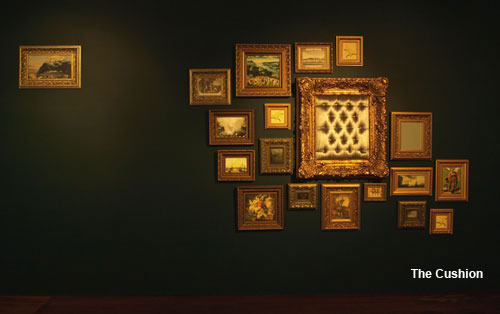
Risham Syed is an artist who understands the influence of history in contemporary life, and expresses it through her often ironic and provoking tableaux. Sitanshi Talati-Parikh explores her intent and thought

Art02
Art03
Art01
See the full gallery on Posterous

Lahore-based Risham Syed stages provocative set pieces by juxtaposing the power of the past with symbols of contemporary Pakistani society. She paints art, historical images or even photographic images in acrylic, which is essentially plastic. Paintings are turned into objects and ‘conceptual pieces’. There is a very strong influence of power play in the mise-en-scene of installation art and the placement of objects. Domestic objects are used to talk about her experience of living in a society “which imposes certain roles on (men and) women who in turn assume these roles most of the time without challenging/questioning them. This is a take on that, but then these objects engage in a dialogue with the larger social/political picture.” She chooses objects that carry a particular historical/cultural context. For example, the white marble mantelpiece is very Victorian with Indian elements. Along with representing the family unit or the institution of it, it represents a certain class. The wall lamp pretends to be ‘Victorian’ but is a very cheap Chinese version of it. The vestiges of cultural inheritance are observed to suggest an origin and it’s very perceived authenticity.


Art04

In conversation with the artist:

What inspires your works?
I collect photographs from newspapers, magazines, life around in general on a daily basis. I also collect old photographs that inherently carry a particular context with them. I am interested in history and how it connects itself with the present moment.

What draws you towards historical power play?
I connect history with the present. It is also a way of looking within and outside and I like this recurring dialogue. The way I construct this connection, I feel it remains open and every time a new narrative can appear, depending on the sequence of the connection.

Are you using space as a metaphor?
The most apparent thing is a domestic space that comes through from these constructions. It’s a metaphor for roles, personas, pretences, power play, control, etc. Domesticity is a tool that I use to connect various issues with the larger picture. You see a quiet wall lamp with a small painting under it but on close inspection the painting is of disturbance or violence. In this way within the quiet, apparently pretty domestic spaces, there is another space within the painted surface which again is a metaphor for the space outside of us which is alien yet it’s the space within us.

What does power mean to you?
The idea of power or ego is within us and it manifests itself in various dislocated channels resulting in destruction. There is power play from within the basic family unit structure of the society to the larger global picture. It’s the base of the economic structure and that becomes the driving force. It is connected with identities, images, personas, relationships and attitudes.

Influencing artists Zahoor-ul Akhlaq, Salima Hashmi, Quddus Mirza (her teachers at National College of Arts, Lahore). Indian artists like Amrita Sher Gill, Arpita Singh, Bhupen Khakar, the Warhli tribes.

Love looking at: Rembrandt, Leonardo, Vermeer, Gauguin, Van Gough, Magaritte, Joseph Cornell, Frida Kahlo, Chagall, Rothko, Rauschenburg, Richter, Peter Blake, Hockney, O’Keefe, Cartier Bresson….

Not a Word More, Not a Word Less – Jeffrey Archer

26 Saturday Jun 2010

Posted by sitanshi talati-parikh in Art, Literature & Culture, Interviews (All), Interviews: The Arts, Publication: Verve Magazine

≈ Leave a comment

Tags

International Fiction, Interview, Jeffrey Archer, Literature, vervemagazine

Published: Verve Magazine, International Edge, June 2010

British novelist, ex-politician and former jailbird, Lord Jeffrey Archer is an absorbing conversationalist. He’s confident, patient, petulant and raring with sure-fire ambition. In Mumbai for the launch of his latest collection of short stories, And Thereby Hangs a Tale, Sitanshi Talati-Parikh comes away from the tête-à-tête duly charmed

Jeffrey01

Jeffrey Archer explains the act of creation of dialogue, demonstrating how real-life conversation can’t be imitated exactly in fiction. “While talking you may say, ‘Can I have a cup of coffee, please?’ but you can’t put that in a book.” The ever-gracious Taj hospitality team appears bearing silverware and coffee, not knowing that Archer was merely demonstrating a point. “Is that my special?” he asks – having quite missed the force of his spoken word. They look confused. “Is that coffee?” They nod bewildered. “No, thank you, I have my special. I thought they told you all about it. No they didn’t? God bless them,” he mutters. A few minutes later, the somewhat-‘special’ turns up. They couldn’t garnish it with chocolate sauce, they murmur desperately. He takes a sip. “It’s not like Barista’s! They all try to make it like Barista, but they can’t. And who introduced me to Barista? ‘Raoool’ Dravid introduced me to it. I don’t like coffee. I like Barista’s. I don’t get it in England. I love it.” He gives it back, with an unhappy, “Thank you, very much.”

He is surprisingly energetic, he’s refreshingly ebullient and he holds the instinctive ability to inspire. At 70 years of age, he moves with the efficiency – and his voice carries the power of a 35-year-old. He speaks without platitudes and any hint of patronisation. And if you question his creative choices, he responds with effusive mock indignation.

Excerpts from a rollicking, sometimes serious conversation with the author:
(All exclamation marks and text repetitions are entirely based on the interviewee’s tone. Capitals denote elevated volume only.)

Why do you not have more female protagonists in your books – besides The Prodigal Daughter and False Impression?
The Prodigal Daughter is totally about the first woman president of the United States. Who wrote the first story about the first woman president of the United States? ME! Long before Hillary Clinton! You weren’t even born then! I’m married to a woman who runs the biggest, greatest hospital in Britain, Cambridge University. So, don’t you give me that protagonist stuff. In this one (points to his latest book) all the women are wicked. They’re nice in a lot of them, aren’t they? I’m not a women’s writer. I don’t write to please you, I write to please everyone!

And everyone is pleased by men?
Well, no. NO! The Prodigal Daughter is the story of a woman. False Impression, you’re quite right, is about a woman from beginning to end. You selfish thing, isn’t that enough for you? (Laughs uproariously.) God, women’s rights for India! Women to run India!

What happens if you don’t have a story to tell? Do you ever get stuck?
Never. NEVER! No writer’s block! Never. I know my next six stories. The next thing I’m writing is the biggest challenge in my life. I’m writing five books in a row, the story of which starts in 1920 and ends in 2020. They are called The Clifton Chronicles. The first book is dominated by a MAN called Harry Clifton. The second book is dominated by a woman called Emma. Yes!

Is there a sense of completion when your protagonists achieve that position of power – after all, that’s where the books end? What happens if they were to continue?
What you’ve said is going to happen in the next series. One will lead into another. They will all be separate books. I’m a believer in hard work and ambition and achievement – for men or women. (I can sense the aside.) I work for Margaret Thatcher – makes no difference to me. The achievement is in reaching the goal, not afterwards! You don’t want to think about retirement do you?

Do you believe that with great power comes great responsibility – for the storyteller and for the story itself?
No I don’t. I think that’s not realistic. I am a storyteller. I want you to enjoy the story. I want you to turn the page. I don’t want to leave you with any philosophical…well you can, but that’s not what I aim to do. I aim to entertain you.

Is that the difference between popular culture and literature?
NO! That’s insulting. (I’m just saying.) I know you are, but it’s insulting. That is to say you can’t be a great storyteller and write well. The literary failures of this world always try that line, because they are jealous. It was one of your great critics who told me, ‘Jeffrey, don’t worry with the sacred cows of India – read RK Narayan.’ I agree with her. Narayan is both – marvellous combination of great writer and great storyteller. There are very few Vikram Seths around. (He approves of Seth.)

So, your new collection of short stories….
(Answers with practised ease.) Fifteen short stories, nine of them true, the most exciting one for me is set in India, called Caste-off. It’s the story of two people I met in Mumbai three years ago (Nisha Jamvwal and Kanwar Rameshwar Singh Jamvwal). I think it will make a Bollywood film – it’s so romantic. I couldn’t believe it when I heard the story; it’s so remarkable that you can’t make it up.

Do you pull from real life or employ fiction?
It’s half and half. Human beings are giving stories all the time. Why bother to invent someone when I can just write you? It’s so easy. I look at people and I remember details very well. If I get a good story, I write one line that reminds me of it. I always keep notes. Normally everything is all up there. (Referring to his deeply lined forehead.) If you are working the whole time – and I’m always working – memory gets constantly tested. Your memory only gets lazy if you’re lazy.

What does power mean to you?
Power?! Power. (Makes it sound like ‘paar’.) It has many meanings. But sometimes, a writer has power without realising it because people will write to me and say, ‘Your book has changed my life,’ or ‘something you wrote has changed me as a person’. Which one hopes is power for good – for instance young Indians learning to believe in hard work to achieve what they want.

Your stories give people the drive to keep going, to succeed….
Nowadays, people want it tomorrow…not 20 years down the line. A girl came up to me at a restaurant and said, ‘I want to be famous.’ I asked her if she played the violin, sang a song or wrote a book…and she shook her head. She said, ‘You don’t understand me, I want to be famous.’ She didn’t want to do the work. You have to do the work. Now I’m more demanding all the time, on myself.

Does success increase the pressure to deliver?
I always had a story so I never felt pressure. The problem was making sure I worked hard enough. I’m working harder now than ever. People ask me silly questions like ‘Do you write all your books?’ But you would know straight away, wouldn’t you? You’d say, ‘Jeffrey! You didn’t write that!’ I always say to people, my readers would know – they know my tricks. Which makes it harder for me, because my fans are sitting there and saying, ‘Where’s the twist, Jeffrey? What’re you gonna do, Jeffrey? I’ve got my eye on you!’ It’s still a challenge to fool you, to get you to the last line and make you go ‘Aaeee!’ That’s the trick.

Few writers can handle short stories and sagas with equal aplomb….
The thing about short stories is that they are stories. A lot of people who write short stories are actually writing ‘looks at life’ or incidents. I tell stories. They have a beginning, middle and an end. I don’t want to write about the ‘movement in the room, made one feel luminous, as the girl walked toward me, I realised….’ Oh balls. Give me a STORY!

So you’re going strong.
Eh? FOREVER!

Love the spirit. Word.

Moving Images

27 Saturday Mar 2010

Posted by sitanshi talati-parikh in Art, Literature & Culture, Publication: Verve Magazine

≈ Leave a comment

Tags

Art and Design, International Art, Photography, vervemagazine

Published: Verve Magazine, Nerve, March 2010

Two Australians set off on a bike ride through Rajasthan clicking photographs along the way, which were later auctioned for charity. Verve brings an exclusive showcase of four of the shots taken by veteran director Baz Luhrmann and People’s Choice Award-winning artist Vincent Fantauzzo

A Snappy Portrait

Moving05

He’s the hot young artist with a wife of Indian (think Goa) origin and a three-month-old baby. Preferable medium of choice, oil on canvas – with a cinematic approach. Vincent Fantauzzo likes using photography and film to create a narrative that the viewer can relate to. “It’s all real art. I do a lot of photography, filming, sculptures and abstract painting. I’m completely open to all forms, letting it evolve naturally. Photography and film inspires my painting.” Not surprising then, that he’s in talks with director Baz Luhrmann (also inspired by visual arts) to blur the line between painting and film with animation.

The 33-year-old UK-born-Australian-resident exhibited his works (besides painting a mural with Luhrmann) at the Le Sutra art concept hotel, Mumbai. He’s exhibited in India three years ago, but this journey was a little bit different. Luhrmann and Fantauzzo set off on a bike ride through Rajasthan to take pictures of anything interesting that came their way, the shots then being auctioned for charity – a positive gesture through a creative act.

Going back to his stunning paintings of the late Heath Ledger and the child actor Brandon Walters from Luhrmann’s Australia that earned him the People’s Choice Award, the soft-spoken Fantauzzo says, “I’m interested in a story behind the person. Sometimes that is a space with the person in it – close-up crop section of the person. A picture speaks a thousand words and a face can do the same thing. A single image can tell a whole story leaving room for interpretation, where multiple stories can evolve. It is about not complicating art. I don’t want a person to have to be an academic or an art historian to connect with my work. It’s for everyone.”

A lens-worthy construction

27 Saturday Mar 2010

Posted by sitanshi talati-parikh in Art, Literature & Culture, Publication: Verve Magazine

≈ Leave a comment

Tags

Art and Design, Indian Art, Photography, vervemagazine

Published: Verve Magazine, Nerve, March 2010

Verve takes a look at artist Yamini Nayar’s photographs, created for the lens and destroyed right after

Art03
Art04
Art07

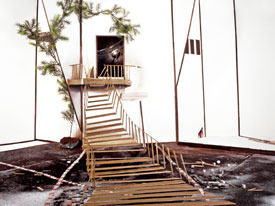
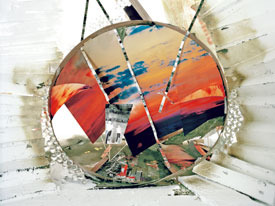
BROOKLYN-BASED AND DETROIT-BORN YAMINI NAYAR HAS found recognition in the top international magazines. Drawing inspiration from industrial and post-industrial towns, she combines sculpture, installation and photography in her images of imagined spaces. Using raw, industrial and discarded materials, her table-top to room-size installations are built for the lens: the scenes are photographed with a large-format camera and are destroyed once the photograph is generated.

The 34-year-old artist says, “The digital studies are created parallel to the constructed images, in which they conceive of spatial systems within images of found settings, including sites of decaying industrial towns and manufacturing sites.” She goes on to elaborate, “Space is where design and everyday life intersect. It is layered; public and private grow and overlap in the traces and material culture of inhabitants – habits, histories, desires, neuroses. In addition, I’m drawn to a kind of makeshift construction and architectonics, a repurposing of materials, mirroring what you see in developing global cities where there is an inventiveness with materials, realising what is possible with what is at hand.”

Pixie-dust Romances

17 Wednesday Mar 2010

Posted by sitanshi talati-parikh in Art, Literature & Culture, Features & Trends, Publication: Verve Magazine, Social Chronicles

≈ Leave a comment

Tags

Avatar, Bella, comment, Edward Cullen, International Fiction, Literature, Sophie Kinsella, Stephanie Meyer, Trend, Twilight, vervemagazine

Verve Magazine, Culturescape, February 2010

The immense worldwide success of the Twilight vampire love series and James Cameron’s epic film Avatar have made fantasy a romantic prerequisite. Fangs, love bites, fairy dust and aliens pour out of the Pandora box of magic potions, brewing tales that sell imaginary love to bewitched humans. Sitanshi Talati-Parikh finds herself taking love-struck bites

As humans get more barbaric as a race, romances tend to swirl around a fictional character of an imaginary species. What is it about Pandora and the Na’vi tribe that makes them so beautiful and desired? Or about the blood-sucking undead that makes them the modern version of Byronic or Darcyian romantic heroes? Or what attracts us to a ghost, a spirit or a powerful figment of our imagination? It’s not just the fact that their being unreal or non-real, gives me the ability to superimpose the characteristics that I wish to see in the person I love. It is also the fact that by virtue of being unreal, they can be more than we are. Either as humans we are deeply ineffectual at romance; or as people we need, nay we demand more. The inability of romantic deliverance from a human race appears to send our hearts racing towards the inhuman – in true escapist fashion.

Escapism at one point of time was candyfloss romance – where the romantic hero was kind and considerate and loved you for the woman you were, not the woman he wanted you to be. It was human to be imperfect, it was human to accept these imperfections and it was human to love them. Women have always been suckers for the knight-in-shining-armour story – it is as if, we are still waiting to be rescued if not from atypical danger, then from ourselves, and our deep-rooted insecurities. The age of Feminism masked these things under the coat of smart trousers, shorter hair, and a career. Scratch the surface though, and you will find a rather unapologetic little romantic girl hidden inside every driven woman. As Vatsala Kaul Banerjee, editorial director, children and reference books for Hachette India, publishers of the Twilight, House of Night, Sookie Stackhouse, Blue Bloods, Vampire Diaries, Night World and other such series states, “Feminism is not, and should not be, exclusive to the idea of love. Not everyone who chooses to love a male or be loved by him, even if occasionally beyond all logic, is a needy little twerp. C’mon, we’ve all been there – fallen for someone so bad, it’s been hard to think of anyone or anything else, including school or friends or family. But eventually, you get real.”

What is Edward Cullen, the famous vampire hero of the Twilight saga by Stephenie Meyer, if not a paternal caregiver to the rather insipid heroine Bella Swan? His primary role is in protecting her, because he is that much stronger and more powerful than she can ever be (until she turns into a vampire, that is). As she gets embroiled repeatedly in danger, he appears miraculously to save her – because she means the world to him. When he can’t be around, it is the young werewolf Jacob Black, who, again with greater powers, remains her protector. Bella, it appears, is in love with security, and whichever good-looking, charming man who can provide that kind of security to her. It is primarily the love of a teenage girl for an older, stronger man, a benefactor, a lover, and a protector.

With the fact that there is a burgeoning cult of ‘Twilight Moms’, the notion that this is merely the infatuation of teenage girls is immediately put to question. As some of these 30-plus women grudgingly admit, there is something deeply hypnotising about this romance – which fulfils their own unrequited high-school love. The trials of high-school romances and self-doubts never change – Bella, in her rather characterless state becomes an easy avatar for the reader to identify with. As an avid reader from France in her 20s, Myriam Belkis admits, “We can empathise with Bella particularly because of her unremarkability.” The reader, hopefully a stronger Bella, can morph into a young girl, who just wants the perfect guy to love her unconditionally. And so what if the guy is a blood-sucking, cold-blooded (literally) vampire? The very fact that he finds her blood intoxicating and thirsts for it, fights a moral battle every time he is with her, struggling to control himself to be with her, kisses her and withdraws from her raw passion, is inherently sexy. It is guilt-edged, morally unsound and dangerous desire that leaves the reader panting for more.

What is bothersome is Bella’s lack of control and vapidity as a heroine – at least in the first three books. While it may be easy for girls to slip into her character because it’s an empty shell, it’s rare to find readers rooting for Team Bella. The men superimpose the woman, and despite it being her story, she remains vacuous and annoying at best, irritatingly dependent on a man to make her life credible (except for the fourth book, Breaking Dawn, where she comes into her own). ‘Even after half a year with him, I still couldn’t believe that I deserve this degree of good fortune,’ says Bella in New Moon. We can’t believe it either, because she never considered herself worthy of anyone. On a very superficial level, her crisis is that of any teenage girl’s deafening insecurity and self-doubt; on a deeper level, it is disturbing to see the protagonist in one of the most popular romances of the time behave like a suicidal sacrificial lamb at the altar of love. It makes you wonder if women have come a full circle – willing to do anything for love and for a man – and does that make it endearing or frightening?

Bella is unnaturally attracted to the supernatural, making us wonder if she is inherently other-worldly (they suggest she was born to be a vampire) or if she is battling a normal teenager’s rebellious nature with an uncanny curiosity for trouble. Isn’t it more likely for Bella’s love to be infatuation than the unflinching deep love it is proclaimed to be? As a 17-year-old she takes the kind of hazardous decisions – in the name of love – that a 27-year-old would shudder to contemplate. Belkis confesses that, “At that age you are often reckless, and personally I remember my teenage feelings as the most intense I’ve had in my life.” While its appeal to a teen audience is understandable, its appeal to an older audience is Potteresque – fantasy captures the imagination like nothing else does.

And it asserts the notion of being attracted to the bad guy, and wanting to ‘fix’ the bad guy. Edward (and later Jacob) try to make Bella believe that they are dangerous and therefore shouldn’t be anywhere near her, but that just draws her to them even more, testing their endurance. We understand why she loves them, but why, oh, why, do they love her? Is it meant to be a beacon call of hope for all the spineless women out there who want to believe that Mr Perfect is hovering somewhere, even if he is an alien?

We are constantly reminded that Edward is beautiful and perfect, Jacob is warm and attractive – and it seems to be okay, particularly from a sound feminist point of retribution, to objectify men under the pretext of unconditional love, in this three-way interspecies romance. No regular teenage boy (or man for that matter) would stand a chance against a sophisticated vampire or powerful werewolf with super powers and a burning, intense, monogamous love.

It is in much the same way that the Na’vi tribe and the female lead Neytiri are objectified in Avatar – their other-worldliness, devoid of the trappings of human failings, the beauty in their every movement and relationships with their environs is viewed with reverence, envy and admiration by the voyeur-protagonist Jake Sully. It is easy for Jake to be reborn as a freer soul, powerful in ways that a human cannot be, and in tune with a better moral and ethic fibre. He is escaping from a rotten life to a better world. Aren’t we all hoping for an avatar that can help us escape the monotony and failings of our world? There is the obvious call for humans to be better, to rethink their priorities and non-ideals, because if not, all the good men are going to be falling in love with good aliens!

The love affair in Twilight is as, another reader in her late 20s, Megha Gupta, believes, “unrealistic and teenage, even stalkerish in the real world – but oh so romantic! What attracted me initially to the first book was the fantasy element, but what kept me hooked was the star-crossed lovers theme. I wanted Edward and Bella to stay young and beautiful and in love, ‘every single day of forever’.” The romance of eternity is an obvious attraction with the love of the undead: to be frozen in time appears to be an acceptable price to pay to remain eternally bound together – even if it is at the risk of losing your soul.

In Carole Matthews’ It’s a Kind of Magic, the protagonist, Emma wishes the love of her life, Leo, could magically turn into a better boyfriend, and lo behold, he does, but with an impossibly fabulous fairy girlfriend, Isobel, in tow, whom Emma cannot possibly compete with. Love has some sort of magical element attached to it that leads you to do uncontrollable things; and yet often rights things that are wrong – because as humans we are sometimes incapable of doing so.

Lara leads a desperately boring life in Sophie Kinsella’s Twenties Girl. It takes the advent of the ghost of her great-aunt Sadie to create delicious havoc and weave a wand of romance in Lara’s life, with the touch of a nostalgic past – that of a more chivalrous time. Are we harping back to a time of better – different, more meaningful love? Is something old-fashioned genetically imprinted in us, where we wish for a time where things were simpler and more complicated all at once?

Banerjee finds that the attraction lies in “an unusual, unreal, unearthly, extraordinary romance, against all odds, enticingly impossible, potentially dangerous and possibly forbidden. Whether it’s shape-shifters, ghosts or vampires…it’s dark, action-packed and sexy. Because it’s not just ordinary men and women, the parameters of romance itself become fluid, different and challenging. The emotional and physical interfaces between two people are transformed…that’s quite thrilling, I daresay. It raises the unpredictability bar and makes for exciting unknowns to unfold.”


It is as if we, as humans, yearn for everything good that doesn’t exist in our own version of the world. Is it a deep existential quest for a better world, a better life and a better romance that we are now looking at extraterrestrial fantasy? Or is it just that a Clueless-type romance doesn’t meet our thirst for romantic fulfilment as much as the thrill of a blood-sucking or alien fantasy might? Edward has the trappings of a perfect romantic hero – he has the lineage and hails from a time of great chivalry, he is the strong-silent type, loves unconditionally and is deeply faithful, morals and ethics mean the world to him, has all the right educational qualifications, is knowledgeable and artistic, is extraordinarily rich and doesn’t ever age! It’s true – he isn’t real. It is easier to establish perfection in one that is not human – because isn’t by definition the idea of being human equal to being interestingly imperfect? And yet, Bella and Edward are a romanticised version of award-winning film, American Beauty’s (1999) Jane and Ricky – freaks to the world that doesn’t understand them.


So what are we saying? Women thoughtlessly yearn for men they can never have? The fantasies will remain largely unrequited and there will be a deep sense of dissatisfaction with their men – who will, being human, be unable to live up to these other-worldly expectations. Which human man, because he may hurt her with his brutal strength, will be willing to abscond from the pleasure of sex eternally? While Meyer’s Mormon background leads her to spell out a strict moral code of abstinence and a romance of deep fortitude, I wonder if the spellbound teens may follow suit. In a racy age when sex scandals and illicit love are the order of the day, Meyer, Kinsella and to some extent Matthew refrain from it. The sensuality is derived from restrained kissing, controlled passion and stemmed desire. It is the contemplation of the act that leaves one wanting more – it is the romance of mental and suggested foreplay. It draws one to a time where love precluded lust, where instant gratification was frowned upon.


These books are not making excuses for what they represent. There is no deep-rooted agenda, no desire to change or improve the world, but in that very sense, as popular fiction, they are making a statement about society as a whole. As Banerjee points out, “Fiction is not about being prescriptive, didactic, apologetic or redemptive…not for publishers, and not for authors. The protagonists are characters, not examples for edification. Readers may subscribe to the subtext in their personality or personal life, and that’s their choice; but for some, saying that they are what they read may be akin to saying something as simplistic as they are criminal-minded if they read crime fiction or bile-blooded freaks if they like horror. Many mothers/parents use books such as those in the Twilight series to discuss issues of love, relationships, boundaries and choices with their girls – now there’s an unexpected good thing.”


Whether you consider alien fantasies escapist fare of the worst kind or a subversive pleasure in the other world, the fascination towards romance, whether human or interspecies will remain one of the most popular forms of writing to come. As we explore galaxies, planets and the dark side of human nature, we open our minds to that which may exist outside the realm of our understanding, imagination and acceptance. It’s just heartening to know that romance isn’t dead, even if it is with the undead.

← Older posts
Newer posts →

|  Filling the gaps between words.  |

Writing By Category

  • Art, Literature & Culture
  • Brand Builidng
  • Brand Watch
  • Fashion & Style
  • Features & Trends
  • Fiction
  • Food
  • Humour
  • In The Media
  • Interviews (All)
  • Interviews: Business
  • Interviews: Cinema
  • Interviews: Cover Stories
  • Interviews: Lifestyle
  • Interviews: Luxury Brands
  • Interviews: The Arts
  • Interviews: Travel
  • Musings
  • Parenting
  • Publication: Conde Nast
  • Publication: Elle
  • Publication: Mint Lounge
  • Publication: Mother's World
  • Publication: Taj Magazine
  • Publication: The Swaddle
  • Publication: The Voice of Fashion
  • Publication: Verve Magazine
  • Social Chronicles
  • Sustainability
  • Travel Stories

Reach out:
sitanshi.t.parikh@gmail.com

© Sitanshi Talati-Parikh 2018.
All Rights Reserved.

Website Powered by WordPress.com.

  • Subscribe Subscribed
    • sitanshi talati-parikh
    • Join 51 other subscribers
    • Already have a WordPress.com account? Log in now.
    • sitanshi talati-parikh
    • Subscribe Subscribed
    • Sign up
    • Log in
    • Report this content
    • View site in Reader
    • Manage subscriptions
    • Collapse this bar