Tags
Angela Roi, Cruelty-free fashion, Fashion, Gunas, Matt & Nat, Modavanti, Rheson, ShopEthica, Stella McCartney, Sustainability, Sustainable Fashion, Vegan, Vogue India
Published: Vogue India, Jan 2018


02 Tuesday Jan 2018
Posted in Fashion & Style, Publication: Conde Nast, Sustainability
Tags
Angela Roi, Cruelty-free fashion, Fashion, Gunas, Matt & Nat, Modavanti, Rheson, ShopEthica, Stella McCartney, Sustainability, Sustainable Fashion, Vegan, Vogue India
Published: Vogue India, Jan 2018
23 Saturday Dec 2017
Posted in Fashion & Style, Publication: Mint Lounge
Tags
Published: Mint Lounge, December 23 Edition
Additional images added to this post.
Post the sneaker craze, the trending ‘sock boot’ takes athleisure a step higher
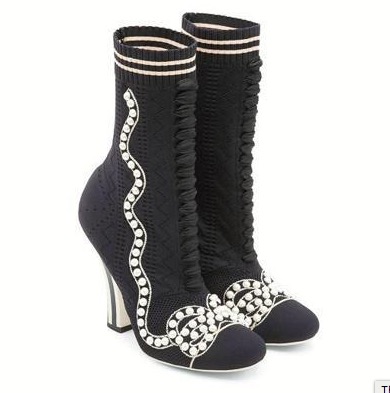
Exactly when you start debating how Sarah Jessica Parker struts around town in knee-high hot pink socks tucked inside sky-high stilettos (and wonder if she buys the shoes a size bigger to make room for the socks), the world hands you the sock boot. Punk heel aside, the sock boot has a retro swing, reminiscent of the 1980s.
So it’s not a sock for your boot (which is technically termed a “boot sock”). It’s a boot, generally ankle or calf length, which merges the sock element in the design and is likely to have a pointy toe and a kitten or block heel. With colours ranging from neutral to pop, they are stretch-jersey booties, occasionally with added textures like velvet and embroidery. Sock line or potential scrunchy gathers aside, this hybrid acknowledges that athleisure is not a passing trend.

The sock boot is a natural progression from the thigh-high satin boots popularized by Karl Lagerfeld for Chanel in 1990, when the boots became an alternative to leggings. Kylie Jenner made waves in purple Balenciaga Spandex boots, which, offered in a range of colours, are an obvious replacement for leggings. In 2014, Nike and Adidas introduced the all-in-one knitted football sock shoes. More recently, Vetements and Balenciaga designer Demna Gvasalia redefined the boot with the second-skin Balenciaga “knife bootie” in black knitted sock or pop-coloured crepe, which, in turn, is an elevated take on the Vetements lighter-heel knitted sock boots. And Valentino’s and Prada’s sock-stilettos may not be boots, but they do bear a strong resemblance, naturally creating a sock-stiletto-boot hybrid.

Sock boots hug the ankles and create a slimming effect, which is a big hit on the street. And it’s a trend that suggests longevity, simply because of its ease of use. They feel lighter than the original kind and are easier to carry around when you are hopping between kickers and heels. They also turn up the volume on the preferred silhouettes of the moment, anti-fit above and body-con below. High-fashion sportswear has become a wardrobe staple, and it is but natural that boots should follow suit.
These boots make perfect accompaniments to mid-calf or knee-length flirty skirts, floral dresses and minis. They also provide opportunities for layering: Beyoncé paired her Vetements mid-calf bootie of sparkly green athletic socks and a unicorn-printed column heel with cut-off shorts and a camouflage jacket.
Our favourite among what’s out there? It’s got to be Fendi’s toast-to-vintage and ready-to-rock sock boots that give the sportiness a feminine kiss with pearls and lace.
Where to find it:


Balenciaga, Fendi, Vetements, Valentino, Malone Souliers, Uterque, Giuseppe Zanotti, Zara, Mango, Forever 21, TopShop.
28 Saturday Oct 2017
Published in Mint Lounge, October 28 Edition
Photographs by Abhijit Bhatlekar
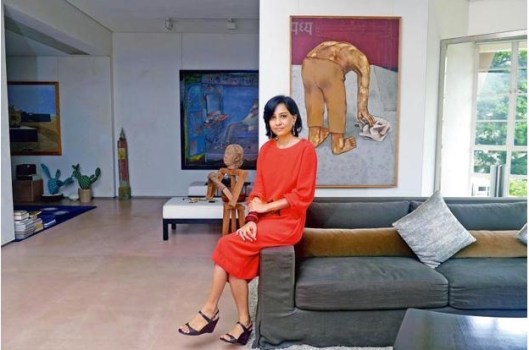
The passion for art began at home. Gallerist Priya Jhaveri’s parents were “obsessive collectors” of beautiful things, including modern art and antiquities, textiles, jewellery and ornaments. “They travelled widely, always including us in their visits to artist studios and galleries, and encouraged a study of the humanities,” says Jhaveri.
Since 2010, an apartment on Walkeshwar Road in South Mumbai, designed by Bijoy Jain, has been converted into Jhaveri Contemporary, a gallery showing artists across generations. Priya’s older sister, the London-based Amrita Jhaveri, manages the relationships with the estates they represent as a gallery. In Mumbai, Priya works closely with the gallery’s international artists, producing, promoting, managing exhibitions and negotiating sales, while overseeing daily operations.
The 41-year-old modern history and Spanish major from Oberlin College, US, has worked with an environmental law firm in San Francisco, collaborated with writer and filmmaker Bishakha Datta’s non-profit organization Point of View (POV) in India, co-authored a book,Unzipped: Women And Men In Prostitution Speak Out and worked as editor and project manager on books on Indian art and architecture at India Book House, before joining the art consultancy set up by her sister that evolved into the gallery.
The gallery showcases a wide range of artists, both veteran and avant-garde—currently on show is experimental film-maker Shambhavi Kaul’s work—and it forms a reference for Jhaveri’s individualistic sensibility and aesthetic values.
Priya gravitates towards understated elegance with a touch of quirk. She is dressed in Western attire for the most part. “I adore saris but I can’t tie my own sari!” she says. She has a practical approach to dressing: You are likely to find her in flats and sporting a white Swatch Skin watch. She avoids “high-maintenance clothes” for her work life, and opts for functional ready-to-wear for travel abroad, accounting for the local climate and long days at fairs. But there is always an accessory, like the chunky ivory wedding chudis she wears to add a touch of colour, or jewellery from sister Nandita Jhaveri’s eponymous line.
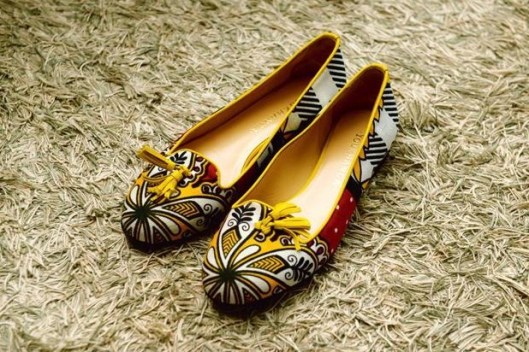 Shoes by You Khanga.
You might struggle to recognize the brands she wears, for she shops at local boutiques abroad for anything that catches her eye, like the You Khanga closed-toe flats (an Italian brand that works with African prints). A classic blue Acne Studios shirt is a staple and a Stella Jean dress a fun favourite, with basics from Uniqlo and Zara. In India, she tends to pick up items from Bodice, Amba, Vraj:bhoomi (for brogues) and close friend Maithili Ahluwalia’s Bungalow 8. It’s all so subtle, you wouldn’t even realize she is wearing a Chloé dress. You believe her when she quips about her personal style, “I’ve not given it much thought, so perhaps it’s effortless.”
Lounge caught up with her for an interview. Edited excerpts:
How would you describe your personal style?
I do know that style eclipses the best of wardrobes, presupposing a certain authenticity: Find comfort in your own skin, and the rest will follow. I tend to veer towards a more classic look. I’m not hugely adventurous and, depending on my mood, I can pick things that are elegant, androgynous, lazy even: I’d love to leave home in a pretty kaftan and chappals with a silver necklace thrown on.
Are you attracted to a specific palette or cuts?
I gravitate towards classic cuts set apart by irregular detailing. I enjoy striking colours—orange, turquoise, sky blue, emerald—and, on occasion, patterns and prints that are graphic, playful or more delicate. I appreciate clothing made using natural dyes and fabrics and the use of traditional weaves reinvented in contemporary design.
Do you believe that a sense of style is important?
Not as much as a sense of self. But if we’re thinking of style more broadly, in terms of attitude and comportment, then yes it is.
Is there any weight to the saying: style/dressing is an art form?
It can be, absolutely, just like the best of television can, or a piece of writing, music, architecture or dance.
Describe your preferred outfits for work, evening and a casual setting.
Lots of dresses with silver jewellery (also jewellery made with materials like coral, stone, glass) and sandals for work. If I’m working at an art fair, I add skirts and jumpsuits, with heels on the first three days and flat shoes on the last two when comfort trumps vanity. In a casual setting, I adore roomy trousers in Khadi by Runaway Bicycle.
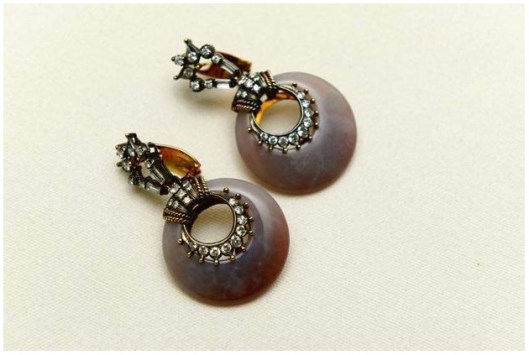 Vintage agate and diamond earrings designed by her father Dinesh Jhaveri in the 1970s.
Describe your three best style acquisitions.
A Patola sari for its flawless double-Ikat weave. Brilliantly handcrafted, it resembles a Nintendo game with its graphic pattern sporting animals and hybrid creatures. Earrings designed by my father, Dinesh Jhaveri, in the 1970s, for their inventive use of materials like wood and crystal alongside diamonds and gold. And a classic Boucheron watch with interchangeable leather straps in multiple colours for its timeless design.
When it comes to art and fashion, do you believe in acquiring timeless pieces or the flavour of the moment?
The challenge is knowing whether the “flavour of the moment” will be timeless or, equally, whether you need it to be timeless. In collecting art, my judgement sits somewhere between instinct and knowledge. It is important to make informed decisions. Supporting an artist can often be reward enough, as can an impulsive bout of retail therapy.
How important is sensibility and can you define it? Can it be acquired or is it inherent?
Sadly, I can’t define it. Its importance, however, is hard to over-exaggerate. Given that sensibility covers everything that not only makes sense but also makes beauty out of the daily rough and tumble of our lives. In a different mode: I don’t think sensibility is a value that is central to art or style anymore. Most artists today respond to literary or political values. Prelapsarian aesthetic pleasures have given way to more theoretical approaches.
When it comes to style, who or what inspires you?
Artist Amrita Sher-Gil, irreverence, The Sopranos, the novels of Philip Roth, the people I love and the laughter of old friends.
25 Monday Sep 2017
Published in Verve Magazine, September 2017 (Bridal Issue)
Photographs by Rishabh Malik
Designer, Rajesh Pratap Singh, on undertaking ‘super couture projects’ for unconventional brides.

He won’t design a wedding outfit. But, if you are lucky, he will create something, as a ‘super couture project’, for you, if approached with the right sensibility. All he asks is that you be: “intelligent, experimental, unconventional, and not bound by tradition”.
Seminal androgynous fashion has come out of Rajesh Pratap Singh’s atelier. Based in New Delhi, he hails from Rajasthan, and considers the poshakh the perfect bridal garment. Post NIFT Delhi, he worked in fashion in India and Italy before introducing his own line of men’s and women’s clothing in 1997. Pratap Singh, who has showcased his collections at Paris Fashion Week, draws from his roots to craft artisanal garments that stand out for their impeccably clean lines, careful detailing and subtle international silhouettes.
Pratap Singh, who is Woolmark’s first wool ambassador of India (2013), has his creations (made with Bhutanese fabrics) permanently housed in Bhutan’s Royal Textile Museum, while his ajrak prints on linen as well as handloom weaves in ikat are housed in the permanent textile and apparel archives of the Victoria and Albert Museum, London. However, his textile repertoire extends beyond experimenting with ikat weaves, handloom indigos, Chanderis and Benarasi weaves. His fondness for the sari, which he describes as “a directory of Indian textiles”, is evident by the animation in his voice and generosity of adjectives used while on the topic. “It is the purest and most perfect Indian garment: versatile, beautiful and sexy.” He has developed a range of saris; his looms, whenever free, go into creative production to make these.
His voice is crisp, but his demeanour is non-confrontational. He doesn’t want to disrupt, he just wants to be true to his point of view. Perhaps that is what is missing from the Indian bridal milieu — sophisticated, cultivated points of view that offer a bouquet of options to the bride-to-be. Not one that remains limited to what Pratap Singh, at the risk of being politically incorrect, suggests is “a crazy obsession with an idea of ‘Indian royalty’ which manifests itself in a whole different avatar when it comes to wedding attire”.
The designer, who — literally, as we speak — is setting up one of his looms to weave a garment for a close friend’s daughter, has, in the past, designed a classic Benarasi lehnga woven with engineered motifs for his colleague Devika Multani and created a veiled brocade jacket with dhoti pants for Border and Fall’s Malika Verma Kashyap, for their wedding days. Pratap Singh holds strong to the fact that “people should be able to wear whatever they want to, on supposedly one of the most important days in their life. It should be an extension of their personality and whatever they are comfortable with. There must be no expectations, nor should their wardrobe selection be dictated by norms”. Verma Kashyap speaks about her choice of designer for her wedding outfit: “Reaching out to Rajesh was a simple decision, as was the process of creating it with him. I’ve always loved his clothing and the spirit in which he approaches design: it’s thoughtful and cuts through the noise.”
In essence, it boils down to sensibility. And realising that if you like his work, he’ll work with you to create something exclusive. A garment that would be simply the combination of his technique and your personality. Both irrefutably unique.
Excerpts from a conversation with the designer….
Tell us about your problem with Indian women dressed like ‘royalty’ on their wedding day.
There is a confused ‘royal hangover’. What a lot of designers think royalty ought to be, or ‘nouveau royalty’. We already have a traditional wedding outfit (typical to different parts of the country). I believe you shouldn’t touch a garment that is perfect, unless you have something serious to say. I see bad reproductions of some things that existed or that which are thought to have existed: such as a cancan-gown-inspired lehnga. It is neither here nor there.
Do you believe you could create a relevant voice in nontraditional bridal wear?
The categories we work with, so far, have not included bridal wear. Jackets were what we started off with and that is where we progressed. Our job is to solve problems, and we didn’t look at the bridal market as having a problem. There are enough people in this sphere, with some doing a really decent job of it.
What does style mean?
Style is distinctive, definitive and comes from being within your comfort zone, in an effortlessly natural and honest way.
Do you believe that bridal wear, by nature, allows women to be comfortable?
Each to her own. While I don’t want to judge, I can’t understand women wearing something so heavy, where the internal construction has suspenders to carry the weight of the embroidery on the lehnga. I would not make something like that! Weddings in India are a long affair, so wear what you feel comfortable in. If you want to make a statement, make sure it’s one you believe in — the designer is the last person who should be the decision maker.
Today in India, can there be an androgynous bride….or an androgynous groom?
Today in India, you should be whoever you want to be and wear whatever you want to wear. That is the true essence and spirit of freedom. If a girl wants to wear a tuxedo for her wedding, go ahead. I’ll make it for you!
How would you design a lehnga?
With engineered motifs, and definitely woven. I can’t say that the alternative is a pin-tuck lehnga, which people ask for. The geometry of the pin-tuck lehnga won’t give the right finish to the garment; it’s not meant for that.
Basically, it is the personality of the individual that pushes a garment, rather than me trying to say, ‘I’ve made a lehnga, I’ve put 10,000 crystals on it, it costs you a bomb and you have to wear it.’ It may be great for business, but I am not in that business.
What would it take for a bride to convince you to make an outfit for her?
She just needs to ask. And if she’s interesting and intelligent, why not? If I know the person, I would do it out of love. If a random person throws money at me, I won’t do it.
There has to be a certain vibe and understanding. It’s difficult for me to do a faceless, nameless design of this nature. For that, I have tons of friends doing wonderful work and I’m happy to direct you there!
23 Saturday Sep 2017
Tags
Published: Mint Lounge, September 23 edition
Additional images and content (end box) used in this post.
Swedish philosopher and feminist Ellen Key described in her essay, Beauty For All (1899), a life that consisted of fewer but finer things—those that are functional and beautiful all at once. By the 1950s, Scandinavia (colloquially including the five countries of Finland, Norway, Sweden, Iceland and Denmark) witnessed a design movement characterized by simplicity, minimalism and functionality. It’s a design sensibility influenced in part by the stark beauty of the Nordic landscape, the harsh northern climate and a lifestyle that is driven less by excess and more by fulfilment. The long winters and reduced sunlight, for instance, have designers creating bright, light and practical interiors. It is visible in art as well: late-19th century Swedish artist Carl Larsson was known for his brightly coloured paintings, while innovative, futuristic shapes dominated the works of the late Verner Panton, one of Denmark’s most influential 20th century furniture-and-interior designers. Contemporary interior brands like HAY and Ikea are Swedish exports to the world.
 Lifestyle scape by Hay.
With fashion, the focus is on functional—and often multifunctional wear—rather than occasional glamour. Importance is given to longevity, and there is a drive towards go-to staples that you can experiment with, add your own personality to and build your look around. Over the decades, from the bold prints of the 1960s and 1970s to the boho chic of the 1990s, the fashion sensibility of Norway, Sweden, Denmark and their neighbours has emerged as a distinctive “Scandi style”.
Today, you can’t make a trip to any of the European fashion capital cities without walking into a boutique devoted solely to Scandinavian fashion brands, not to mention its deep impact on wardrobes via high-street or upmarket streetwear, like H&M. It’s what the chic Parisians and Londoners are buying, and what global celebrities are headlining.
We bring you a lexicon of the fashion brigade from Scandinavia.


ACNE Studios
Ambition to Create Novel Expressions (ACNE) is a 21-year-old brand that has bridged the gap between high fashion, ready-to-wear and streetwear, with its headquarters in Stockholm and outlets in major fashion capitals of the world.
 Fjällräven
Backpacks as utilitarian cool
Chasing functionality entwined with a “cool geek” sensibility are brands like Fjällräven and Sandqvist. Fjällräven uses G-1000, its own hardwearing and versatile fabric born from founder Åke Nordin’s experiments with building mountaineering jackets out of tent fabric, while Sandqvist is inspired by the untrammelled rawness of the Nordic landscape.
 Ganni
Ganni
Copenhagen Girls
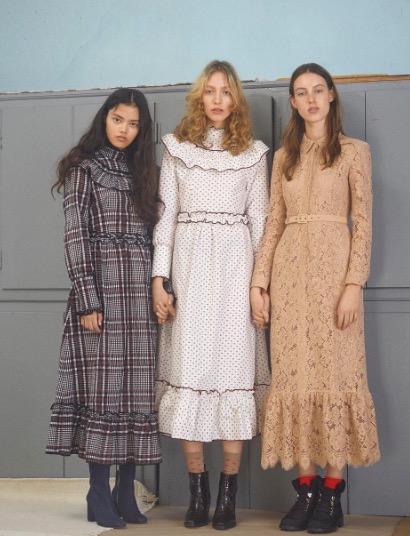
Danish brand Ganni is an Instagram fashion wonder. In 2015, Danish model and photographer Helena Christensen took a selfie with her friend, actor Kate Bosworth, for Instagram (both wearing Ganni) and captioned it “#GanniGirls”. It went viral, via digital influencers like Danish models who post images of the latest styles while on their summer break. What began as a niche cashmere line has taken the quintessential “Copenhagen girl” global, with celebrities like Jessica Alba and Kendall Jenner buying into the brand and concept.


Expressive knitwear
Family-owned, heritage knitwear companies like the Swedish House of Dagmar (named after the founders’ late grandmother, a tailor) and Danish brand SNS Herning (specializing in knitwear geared for Nordic fishermen) focus on the basics. Dagmar has defined the term “expressive knitwear”, where inspiration is taken from architecture, contemporary art and culture, focusing on textures and cuts.
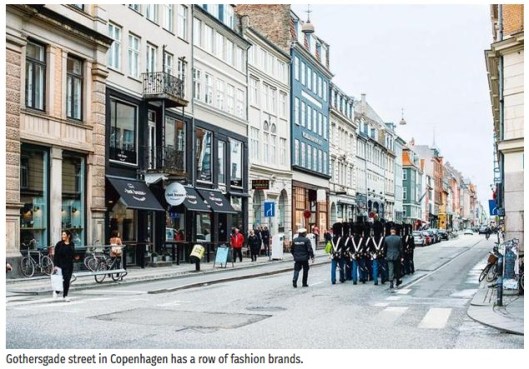
Gothersgade
The major street in the city centre of Copenhagen, Denmark, offers a wide range of shops and smaller boutiques.

Scandi Kids
Nordic children’s brands emphasize on comfort, colour and print: from Swedish brand Mini Rodini started by an illustrator, Indikidual’s unisex pieces and Danish brand Bangbang Copenhagen’s circus play to Gardner and the Gang’s cartoon-embellished organic cotton and Soft Gallery’s poetic prints and embroidery.
More than H&M
In 2014, the Swedish multinational H&M Group was valued at €13 billion (around Rs99,300 crore), the highest-valued fashion brand in Europe. H&M also owns Cheap Monday (known for their hip skinny black jeans in the 1990s), the trendy & Other Stories, the younger-apparel brand Monki, and COS (Collection of Style), the unobtrusive brand which takes high-street wear into a chic new realm.

New Nordic Movement
The award-winning, Copenhagen-based Henrik Vibskov is known for his avant-garde and forward-thinking designs in clothing (particularly men’s fashion), furniture, art and music. He is often associated with the “New Nordic Movement”, especially due to his serious runway fashion credentials.
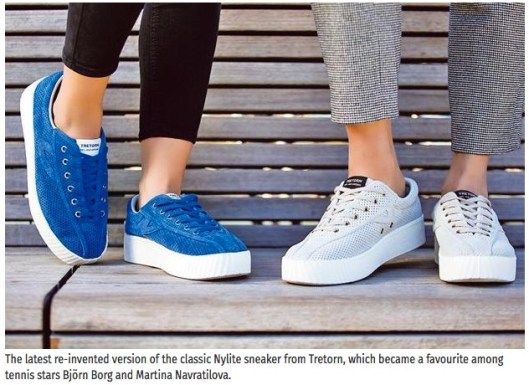
Performance footwear
Swedish brand Tretorn has expanded from weather-ready rubber boots to casual and performance footwear, with canvas shoes like Nylite and Racket. The brand that was born in 1891 holds a warrant of appointment to the Swedish royal family, making it an exclusive supplier to the court.
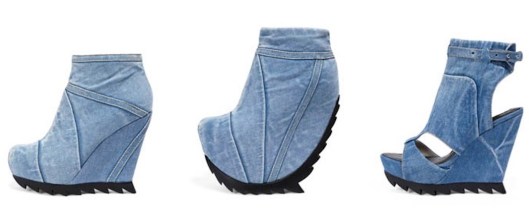
Camilla Skovgaard
Toffel clogs
Sweden’s famous “toffel” clog has found its way into contemporary times with a modern look and vintage twist. Available in 22 countries, Swedish Hasbeens toffels (expanded from platform sandals to loafers, heels and clumpy boots), bags and belts are based on the original 1970s models, and are handmade with ecologically prepared natural grain leather. Meanwhile, award-winning footwear designer Camilla Skovgaard’s edgy spike heels and moulded platforms, which count patrons in actors Halle Berry and Kristen Stewart, and singer Rihanna, are available in 33 countries.
 RAINS
RAINS
Weather-proof textiles
Denmark’s wet climate has led to a surge in brands that factor in the weather. RAINS works contemporary cuts with weather-ready textiles, including classic rain anoraks and other waterproof apparel and accessories. Elka has rubbery, heavy gear, while Stutterheim applies the rubber fabric to handmade raincoats and SWIMS has a wide range of accessories made from 100% waterproof material.
OTHER KEY SCANDI BRANDS
By Malene Birger is worn by the Crown Princess of Denmark as well as the Duchess of Cambridge.
Bruuns Bazaar is the first Danish company to show in Paris in 1999.
FILLIPA K is a Swedish men’s and womenswear retailer believing in minimalist, pure, clean lines with high-quality fabrics and flattering cuts.
Wood Wood is a smart Danish athleisure brand with an attitude; with over 50 collaborations with brands from Nike to Disney and Fred Perry.
Gestuz Has a pared-down sophisticated sensibility for whom they describe to be a “Gestuz Girl”.
Astrid Andersen counts fans in Rihanna and Drake, and has taken forward the sport-luxe genre by adding materials like lace and fur to classic tracksuits.
Cecile Copenhagen Took two printed scarves and turned them into a shirt and a pair of shorts, which now count as signature pieces.
Norse Projects Copenhagen brand that blends streetwear and workwear towards a higher aesthetic.
Très-Bien The Swedish menswear store has an in-house label that speaks of minimalism and timeless silhouettes.
Sophie Bille Brahe Delicate and contemporary jewellery, counting Madonna as a fan.
Georg Jensen Classic Scandi jewellery that also collaborates with upcoming designers.
16 Wednesday Aug 2017
Posted in Fashion & Style, Publication: Mint Lounge
Published in Mint Lounge
As the Lakme Fashion Week takes off in Mumbai today, here are five designers to look out for and the causes they express through their collections
Eco warrior: Chola by Sohaya Mishra
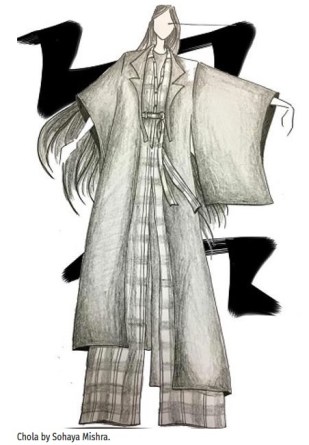
Mumbai-based Mishra has worked with a monochrome palette, which she feels “leaves space for thoughtful interpretation and encourages conversations on the beauty of contrast”. “Black and white, two opposing forces yet complementary, work together to bring balance, inherent to the concept of sustainability,” she says in an email interview. This dualism is woven into her dialogue on sustainability. For the collection, Mishra is working with Recca, a recycled cotton fabric sourced from Tamil Nadu’s Anandi Enterprises, an organization that supplies organic cotton. The collection consists of recycled twills in herringbone and check weaves. The recycled cotton is soft and is different in texture from the light weight organic cotton she has used previously. The movement is forged by a social media initiative, run with the hashtag ‘#RestartFashion’, intended to educate consumers about the consequences of fast fashion and benefits of using post-consumer waste.
Master of the weave: Sanjay Garg, Raw Mango

Delhi-based Garg’s latest collection, “Angels” or “Cloud People”, opens Lakmé Fashion Week (LFW) this season, with an off-site showcase at the Royal Opera House in Mumbai. It highlights the softness of white with delicate chikankari on Bengal mul, zardozi and handwoven brocade. “The angel motif adds a new vocabulary to chikankari, which traditionally features florals and paisley motifs. In this case, it was about questioning the use of chikankari, as almost everything seen today is a diluted derivative. The chikan work in this collection is incredibly fine and delicate.” Garg recommends viewing the garments closely to examine the insides and details. What you’re likely to discover is soft feathers and clouds of angels in flight.
Bender of Norms: Anaam by Sumiran Kabir Sharma
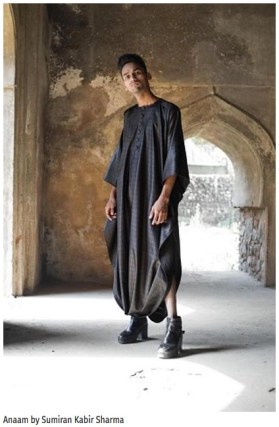
Delhi-based Sumiran Kabir Sharma’s collection is inspired by Sonagachi, the red light district in Kolkata. “Our collection, ‘Sonagachi’, represents an unstoppable, unbeatable army of warriors from the infamous district, those who march headfirst in flowy uniforms. Fierce, nameless, ageless, genderless silhouettes representing the collective strength and a call for identity, respect and recognition,” says Sharma. He goes for a representative colour palette with grey, black and earthy browns. The material used is suiting fabric, which is conventionally menswear fabric used for uniforms or corporate clothing. Drapes and patterns co-exist to form unique silhouettes, dotted with epaulettes and stitch detailing. He asks that you “come prepared to view it with equality and acceptance”.
Nostalgia artist: Eká by Rina Singh

Inspired by old, discarded sketchbooks and undone artworks, Delhi-based designer Rina Singh’s theme embraces unfinished techniques. She creates a patchwork of artisanal, aged textiles, in a subtle aesthetic of Gandhian India. “I like to use the feeling of familiarity as opposed to sharp, untouched starched clothes. I like to present the clothes with a feeling of being washed and touched by hand, almost like it has been a part of your wardrobe already,” says Singh in an email interview. She looked to late artist Amrita Sher-Gil for inspiration, and also reached out to activist-author Arundhati Roy and artist Mithu Sen, to ask them questions about their choices and mementos in clothing.
In this collection, you will find monotones of nude with washed-down teal, indigo and blush pink. Faded shades of cement, iron and charcoal “lend a sepia-tinted veneer”. Visualize unfinished floral motifs on jamdani silk wool, block-printed textiles in art mosaic, and embroidery in unspun wool, silk and cotton yarns.
Upcycling advocate: Doodlage by Kriti Tula
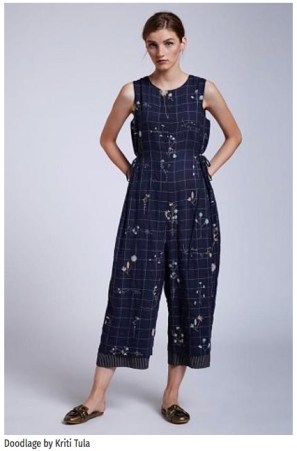
Delhi-based Doodlage started with the idea of being able to use scraps from the garment industry and to work around fabric defects to create limited-edition collections. Tula has collaborated with Conserve India, a Delhi-based organization that re-purposes used polybags, discarded seat belts and tyre tubes. They will present together on the second day of the five-day event of LFW; the day is dedicated to themes of sustainability. “Upcycling industrial waste is the central idea of our brand. Each garment is created using industrial scraps, defected fabric and end-of-the-line fabrics which are all a part of pre-consumer waste that often end up in massive quantities of landfill,” says Tula. The collection for LFW, “Dreams and Dystopia”, addresses the chaos and distress in current political and social situations. “What we need is a call to action. To find the strength to push for change and to go beyond likes and shares on social media,” she says.
Deep tones of navy, maroon, sap green are combined with light under-tones of pastel blue and steel grey. “A layer of patchwork and prints representing complex city grids is superimposed with whimsical floral details,” says the designer. Doodlage employs slogans as part of its fashion vocabulary. “Clothing is a means of self-expression and slogans allow you to be more vocal and expressive,” says Tula, of the typographic design employed in her fashion line.
08 Saturday Jul 2017
Published in Mint Lounge July 8, 2017
(Text edited from original). Photograph by Abhijit Bhatlekar

Her brand-new cat interjects his way playfully into many parts of our conversation, and artist-turned-designer Payal Khandwala deals with the situation with the same composure that she would any other area of her life. Khandwala draws from her vivacious artist’s palette for the eponymous clothing line she first showcased in March 2012, 10 years after she moved back from New York to Mumbai.
Khandwala went to New York to study fine arts at the Parsons School of Design in 1995 and then worked with menswear designer Sandy Dalal in the US.
Unable to find clothes that she liked, and sensing the potential market for a prêt line, she decided to move from canvas to fabric. The line has taken on a life of its own: She started by retailing at Good Earth and now has two stores in Mumbai, and is stocked in multiple stores in four metros.
Khandwala, 43, has repeatedly made it to best-dressed lists for her individual sense of style, which is bold-hued, sleek and non-fussy. Her eyes are always made up dramatically, her petite frame is enveloped in colourful drapes, trousers and antique silver accessories. But what she wears best is her grounded attitude to life and style. After all, she is the one who popularized lehngas with pockets for women.
 Colour-coordinated brocade saris.
The saris in her wardrobe are grouped and hung in order of colour shades and sometimes, she says, she will just “undo it to avoid becoming a slave to that kind of discipline”. Edited excerpts from an interview:
Should we be surprised that your living spaces are minimalist and muted?
I am very practical; I don’t like fuss and clutter. Not only is it the way I design, it’s also the way I live. While I like accents of colour, I want the environment to be neutral. Besides, I can’t wear and be around colour simultaneously!
How different is your look now from your New York avatar?
As a student I didn’t have any money, but New York is full of flea markets and vintage stores. I was more bohemian: pairing jeans with a top, shawl or kaftan. I became more minimalistic when I began making clothes for myself, and with age, perhaps. I don’t want too much of either sophistication or free-spiritedness.
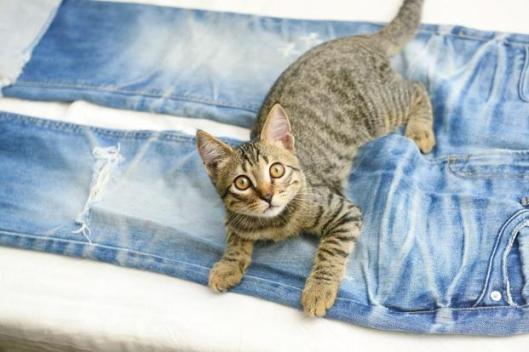 Distressed jeans from Hong Kong.
You’ve struggled to find lowers that worked for you, how did you figure them out?
I love jeans because they stand the test of time (she’s “obsessed” with a pale pair from a mall in Hong Kong that is loose-fitting, distressed and bootleg). I always found everything else more formal, while high-street options are largely trend-based. So now if I want to wear a particular kind of pant (she counts the palazzo as a staple), I just make it.
Anything from “back then” that makes you cringe?
You won’t see me wearing colourful patent leather wedges or fluorescent colours. I disliked the 1980s and 1990s. It was the worst time for fashion. I did it then and it was a disaster. I have learnt my lesson.
Didn’t you have a love affair with saris?
I took two Abraham & Thakore cotton saris with me to New York, but it became a lot easier when I moved back to Mumbai, because of the weather. Being a part of the art circle, or maybe as a reaction to having been away so long, I began wearing saris more frequently, pairing them with tank tops or jackets that I procured from Vietnam, Cambodia or Istanbul. I easily have more than 80 saris (none of which are from my mother), including 50- to 70-year-old vintage brocade saris, and lehngas woven with pure gold thread, and an early Sabyasachi.

Silver necklace from Istanbul.
Tell us about your eclectic jewellery collection.
I have a lot of silver jewellery: I wore it with saris for my wedding. I’ve not bought anything in ages, because there is very little of the genuine kind in circulation—they just make pieces that look antique. I’ve picked up stuff from Rajasthan (Jaipur and Udaipur), Istanbul and, earlier, from Amrapali. I am also fond of necklaces that are like thin discs made out of coconut or vinyl put together and tribal, Maasai-style pieces. I’m currently in love with flower-shaped leather rings that I picked out in multiple shades from a little Spanish store, Tierra (now shut down), in New York.
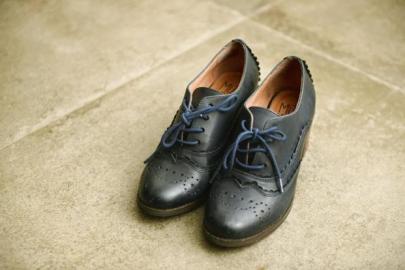 A pair of indigo brogues from Miz Mooz, New York
Do you believe in a “look”?
If you have a distinct sense of style, it will automatically come with a “look”. Any decision you make—if it comes from a place that is not external or trend-driven—is based on your personality. For instance, I’m an informal person. I will go to a restaurant and cross my legs and sit; so you will very rarely see me wearing anything that is short and tight.
Which is more important, fashion or style?
Style, of course! And that makes you question the male gaze. In much the way that Coco Chanel was trying to do by questioning the need for women to wear corsets—because there were men designing for women, with their idea of what a girl should look like. I feel now there is finally some conversation about this.
 Reversible handwoven jacket from Payal Khandwala.
What do you believe is key to making, wearing and choosing clothes?
It is simply a matter of taste that will connect all three. And while I know colour is what everyone responds to, the bedrock of a good outfit (for anybody of any size and shape) is proportion. It’s like assuming that a long skinny rectangle can be equal to a square. As you “cover up” with clothes, you are cheating: Perhaps three people in the world have a body that looks perfectly proportionate. The rest of us are stuck with bits and bobs and the lines we’ve earned and stretch marks we have fought for.
Payal’s colour wheel
Khandwala gives us her markers for special occasions
Brunch: Think beyond white. It works, but it’s predictable. I recommend citrine or coral.
Cocktail: Don’t feel compelled to pick black, go with a deeper bold colour. I’m partial to jewel colours, so sapphire blue, emerald green, perhaps with a hint of metallic.
Romantic date: Pick a colour that is an extension of your personality. This is probably the best time to be at your most comfortable. If you’re bold, I would recommend crimson; free spirits can try chartreuse; if you lean towards shyness, then powder blue, silver, or blush rose.
When in doubt: Neutrals like charcoal, black, navy, indigo and white work in most situations, so when unsure, turn to one of these shades. Whichever colour you pick, the key is to wear it with confidence.
27 Saturday May 2017
Posted in Fashion & Style, Publication: Mint Lounge, Sustainability
Tags
Ahimsa, Bags, Ethical Fashion, Fashion, Gunas, Matt & Nat, Mint Lounge, Stella McCartney, Style, Sustainability, Sustainable Fashion, Vegan
Published in Mint Lounge, Saturday May 27, 2017
(Additional images and content used for this post)
If you eat meat, stop reading now. If you are often accused of being a grass-eater, carry on. The eureka moment, when you realize that if you don’t eat it, you shouldn’t wear it, is accompanied by a sense of sartorial discomfort. In India, while designers flirt with the idea of cruelty-free fashion, it’s not all-encompassing. Satin clutches and beaded pouches aside, where do you find the sophisticated bag, the kind with fashion lineage and net worth, the bag that speaks a million dollars with a slight flash of its label? Where do you find a bag that isn’t nouveau riche and one which shows that you care? It may sound noble, but saying no to leather isn’t glamorous when your options are polyurethane.
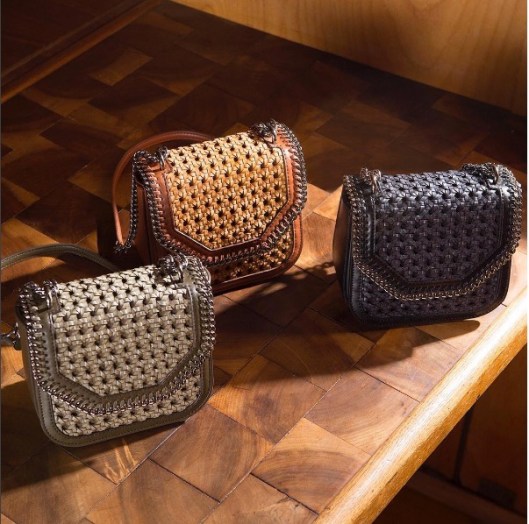
Stella McCartney’s #FalabellaBox in wicker.
In 2001, Stella McCartney, a life-long vegetarian and a supporter of the People for the Ethical Treatment of Animals, took her lifestyle choice and made it a sustainable business. The British designer doesn’t use leather or fur in any of her high-end fashion products. They are cool, edgy and modern and keep the good politics alive, one animal at a time. It actually mimics leather so beautifully that you wouldn’t know the difference, unless your eye picks out the giveaway trademark metal edging (and really, with that price tag, it will keep society from judging you on the basis of your bag).
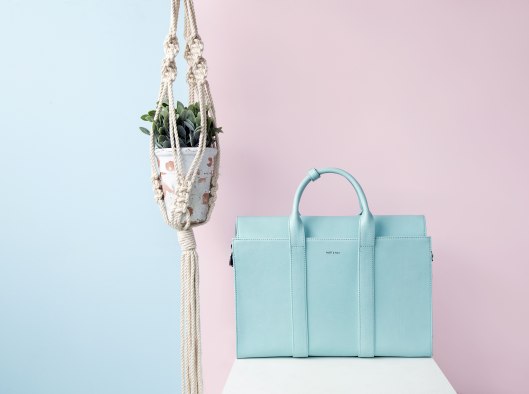
Matt & Nat’s ‘Parallel’ Handbag, worn as a briefcase or cross-body bag.
While McCartney’s classic Falabella handbag (distinguished by a braided chain detail) packs a punch, the Canadian company, Matt & Nat (Materials and Nature), came as a complete eye-opener. When it arrived in the mail (after the whole customs shindig), the vegan bag itself was sleek and functional, but what the “live-beautifully” product said was that the lining was made with 100% recycled plastic bottles (clocked at approximately 21 bottles per bag). The label is made from recycled cork, the price tag moonlights as a bookmark. They have introduced recycled bicycle tyres in their collection and on Earth day, their Instagram post noted that they have recycled over three million plastic bottles to create the linings of their bags. Unlike cheaper man-made materials, this bag lasts until you tire of it, without any difference in texture or appearance.
While their site does not publicize it, the founders are of Indian origin: Inder Bedi launched the company in 1995 after moving to Montreal to go to university and attempted to go vegan. He found his options limited, so he set out to become a game changer. Five years later, Manny Kohli, another passionate vegan, joined him, and is currently president and chief executive officer. Their office lives by the philosophy, including having monthly vegan potluck meals.


Gunas bag and wallet.
Take another instance of vegetarian-turned-vegan Sugandh Agrawal, who grew up in India and now lives in New York. Her experience with raw hide, while interning at a local handbag design firm that specialized in exotic skin handbags and shoes, led her to start her own line of vegan fashion wear, Gunas.
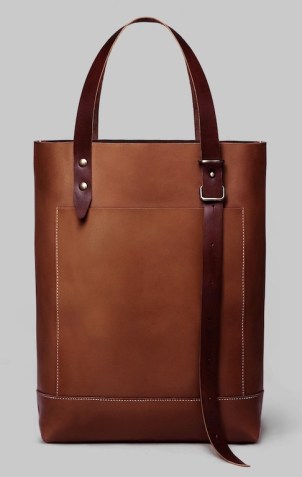
Grain’s stirrup tote bag.
Unlike man-made leather, ahimsa leather, which has become a topic of serious discussion in India over the last few years, is made from the hide of dead animals. Grain, started by Avinash Bhalerao in 2014, offers unisex bags. While no certification is provided, they work with 30-year-old tanneries that recycle the skin of dead animals into leather, which is the closest you can get to the real thing, without actually harming the animal.
Brands like Guess are dipping into the man-made leather initiatives—but it wouldn’t be amiss to begin thinking about sustainability, and going all the way while you are at it. It is a process of transition, as model Renee Peters explains on Ethica, an ethical fashion blog: “The hardest thing about going completely green has been doing it while being a member of the fashion industry and wanting to express my personal style. I have to work harder at curating my own look….” Go ahead, make a difference, one bag at a time. There is #NoRheson to say no.


Stella McCartney’s Falabella wallets and bags made from eco alter-nappa and the oversized Stella Popper.
Where To Find It:
Stella McCartney
Matt and Nat
Angela Roi
Gunas
Freedom of Animals
Ethica
Modavanti
Rheson
17 Wednesday May 2017
Tags
Anaam, Androgyny, Antar Agni, Burberry, Chanel, Design, Designers, Fashion, Genderless, Genderless Kei, Gucci, Kallol Datta, Korean Beauty, Louis Vuitton, Maithili Ahluwalia, Mint Lounge, Payal Khandwala, Rajesh Pratap Singh, Ungendered, Writing, Yves Saint Laurent
Published in Mint Lounge, Saturday May 13, 2017 (Future of Design special edition).
(Additional images added below for this blog post)
We have had women in tuxedos and men in skirts. But the new ‘genderless’ direction in the global fashion world might further dissolve the idea of binary identities
 An image from ‘Vogue India’s’ May issue, guest-edited by Mario Testino. The editorial, titled ‘Role Play’, attempts to ‘challenge gender with fashion’. Photo: Courtesy Mario Testino for Vogue India/May 2017
Earlier this week, Emma Watson received the first gender-neutral award for Best Actor (Beauty And The Beast) at the MTV Movie & TV Awards. “It says something about how we perceive the human experience,” she said. The award was presented by Asia Kate Dillon, who plays TV’s first gender non-binary character (Taylor, on Billions).
Like other recent events, this added to the ongoing conversation on gender-fluidity.
For a culture like ours, with its thrust on uber masculinity and coy femininity, reconciling to this phenomenon may be shocking, but not impossible. While one knows androgyny to be the combination of masculine and feminine characteristics, ambiguity in gender could be a lifestyle, sexual or style choice.
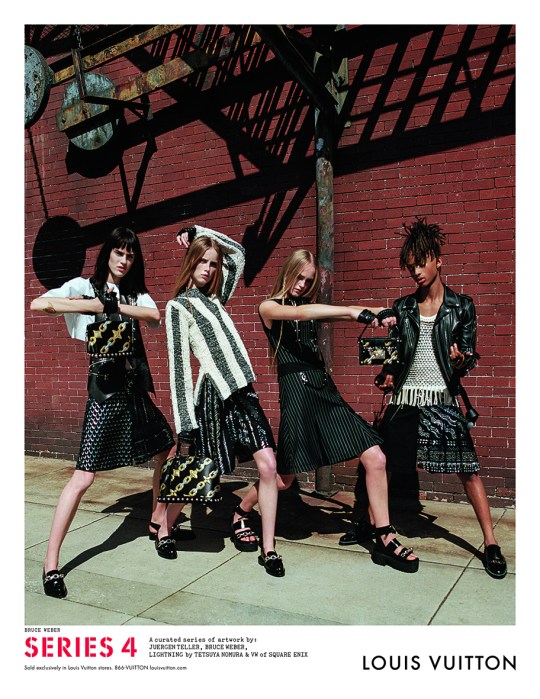
Celebrities such as Miley Cyrus have identified themselves as pansexual, but perhaps it is young actor-rapper Jaden Smith’s bold outlook that has fired up the imagination. Will Smith’s son is seen wearing a skirt as part of Louis Vuitton’s Series 4 (Spring/Summer 2016) campaign about a heroine and the multiple facets to her personality. The brand’s creative director, Nicolas Ghesquière, believes Smith “represents a generation that has assimilated the codes of true freedom, one that is free of manifestos and questions about gender. Wearing a skirt comes as naturally to him as it would to a woman who, long ago, granted herself permission to wear a man’s trench or a tuxedo”.
Androgynous roots
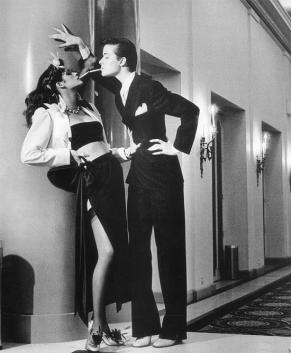 Le Smoking, Yves Saint Laurent by Helmut Newton
Worldwide, sartorial acceptance tipped when the founders of two path-breaking French haute couture houses, Coco Chanel and Yves Saint Laurent, gave women trousers and tuxedos in the early and mid- 20th century, respectively. Many male music legends have flirted with everything from make-up and heels to ruffles and florals, but it was David Bowie (in his sexually ambiguous Ziggy Stardust persona) and Prince (in his flamboyant Purple Rain-era) who cut the sartorial cord with their seminal style statements. More recently, American hip hop artiste Young Thug wore a dress for his album cover, while British footballer David Beckham has been spotted in nail paint and a sarong.
Historically, pre-colonial India saw no issue in dressing up its men, particularly royalty; the traditional male outfits of Gujarat and Rajasthan are adorned with colours, mirrors and gathers, while drapes like shawls, anarkalis, lungis, kurtas, salwars and churidars have been a long-standing part of India’s unisex fashion grammar. Even as the idea trickles down—Tridha, a school in Mumbai, has genderless uniforms (a short kurta students can wear with lowers of their choice)—in a country that lends exaggerated importance to binary sexuality, fashion is setting a new pace for a forward-thinking society.
Beyond binaries
 A model wearing Rajesh Pratap Singh.
Designer Rajesh Pratap Singh, who has an affinity towards androgyny, finds the audience for unisex clothing limited. “As women found independence and emancipation once again in India, wearing men’s clothing is considered stylish in most urban areas, but it doesn’t hold true for most parts of the country,” he points out.
What is true though is that modern silhouettes for the local landscape increasingly tend to be sleeker, deconstructed or fluid, shaped according to will, body type and occasion. From anarkalis to dhoti pants, from cholis to shirt-blouses, we have made a shift in styles, and increased the functional element of formal wear. But are women able to take the leap to wearing perhaps a tuxedo to an Indian wedding? Mumbai-based designer Payal Khandwala, whose lines for women are largely anti-fit, says: “It (gender-fluid dressing) will be a parallel movement. The bright side is that it makes us question the male gaze we have taken for granted and re-examine our preoccupation with ‘pretty’ and ‘hyper-sexualized’ clothing for women.”
Unisex clothing creates ambiguity towards age, shape and size, naturally defying the restrictions imposed, stereotypes perpetuated and social comment invited by accentuating and fitted garments. While many designers locally have nailed the anti-fit trend, there have been attempts, such as the “Ungendered” clothing line released online last year by Zara, that faced flak for its unimaginative designs. Unisex outfits shouldn’t be drab, shapeless or colourless—rather, they should be a celebration of clothing that is chic while being free of conservative parameters.
 A model wearing Gucci.
Women in menswear may be de rigueur, but men in women’s clothing is certainly up for exploration. A key designer of genderless fashion, J.W. Anderson’s Fall 2013 collection sent a male model on the runway in ruffled shorts and knee-high boots, showing off muscular, hairy legs. Singer Pharrell Williams, who likes Chanel necklaces, has starred in the couture house’s Gabrielle bag campaign this year. International luxury brands like Gucci (whose fluid vision under creative director Alessandro Michele has been touted as inspired and sound) have “genderless” models—those without an associated gender—on the runway, also unifying men’s and women’s fashion weeks. Michele stated last year, “It’s the way I see the world today.”
It was a “fluid-packed” fall 2016, with Burberry harking back to Bowie-esque ruffled shirts for men and military-style jackets (also seen in Givenchy’s campaign) for women, along with gender-neutral trench coats.
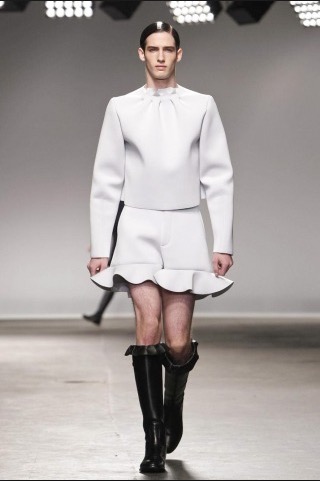 A model wearing J.W. Anderson.
Bungalow 8 founder Maithili Ahluwalia is unimpressed by men in skirts. “It is not a natural evolution, it is fashion. A man’s body is structured differently and it is a bit limiting to think that what works for one may work for the other. It should be a mindset over a sartorial choice, not a surface-level relationship with fashion. Would a man wear gender-fluid clothing to work, particularly if he works in a bank?” she asks. Possibly, if he is anything like actor Ranveer Singh, who has turned red-carpet dressing on its head with his penchant for aggressive experimentation—of course, creative professions do allow for more sartorial freedom.
Delhi designer Ujjawal Dubey, founder of label Antar-Agni, whose styles are “androgynous and flattering to both the sexes, avoiding stark lines and labels between genders”, believes India is primed for change. So does Sumiran Kabir Sharma, whose new label Anaam is said to “dissolve all stereotypes”. Sharma works as “a silhouette generation artist, not focusing on the physical and the biological part of the human body that defines gender”. According to him, going genderless is not a passing phase—“it is definitely the future of fashion”.
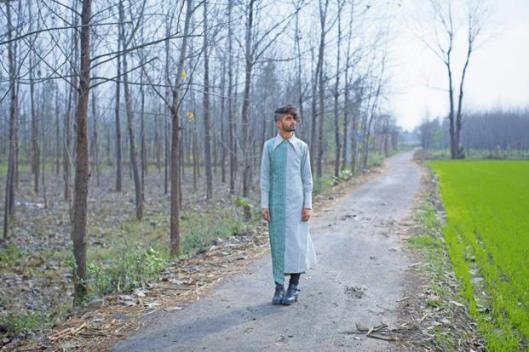
A model in an Anaam piece.
Kolkata-based designer Kallol Datta, who started out making (and wearing) gender-neutral clothing, is now moving towards “sexless clothing, where there is no acknowledgement of gender”. “I’ve favoured all-enveloping shapes and certain proportions when layering pieces of clothing…there is a blurring of lines with these shapes.”
Going genderless
If the male gaze changes, so may the female gaze. In Tokyo, following the explosive trend of “genderless kei” (kei means style), “genderless boys” have appeared on the scene since 2015. The popular Japanese idols tend to be slim-bodied, with dyed hair, make-up and nail polish, coloured contact lenses, and attention-grabbing outfits. They are not necessarily gay or trying to be like women, they are rejecting gender norms and establishing a new yardstick of style. It’s likely inspired by the Korean term ulzzang (“best face”), a common beauty standard for both men and women derived from the “flawless” K-Pop idols.
In America, Marilyn Manson’s genderless Mechanical Animals cover set the tone years ago but today, gender-neutral models like Rain Dove have gained supermodel status. Dove’s Instagram page says: “I’m not a Boy. I’m not a Girl either. I am I.” And further, “Sometimes I like lace panties. Sometimes I like briefs. It’s my body…. And I’ll cover it however I damn please.”
Today, numerous designers worldwide offer unisex lines of clothing, and stores like Selfridges in London stock an “Agender Fashion Without Definition” collection across three storeys, suggesting that the trend is more than that—it’s a new way of life.
Fashion should cater seamlessly to one’s individuality, without leaning towards homogeneity. Khandwala agrees: “At its core, what one wears must be a democratic decision that comes from a place of honesty and self-evaluation. The impetus cannot be external and certainly not because it is a fashion movement.”
Is the potential dissolution of gender a fantasy of the future or a reality of today? As predefined roles get blurry, so does the way we dress. And we should find our voice in that freedom. Worldwide, as socio-politico-religious mindsets get narrower, perhaps it is fashion’s lot to expressively push back as the non-conformist and heterogenous “genderless uniform” of a truly inclusive and free-spirited society where it is, literally, best face forward.
****
How we got here
A brief sartorial history of the blurring of gender lines
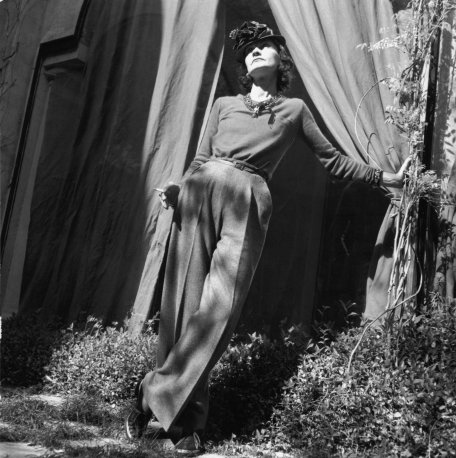 Coco Chanel
1910s: Gabrielle “Coco” Chanel changed women’s relationships with their bodies and ways of life by introducing them to trousers and jersey sportswear.

Katharine Hepburn
1930s: Katharine Hepburn’s path-breaking attachment to men’s shirts bought secretly from the back of New York’s Brooks Brothers store and Marlene Dietrich’s seminal moment kissing a woman on screen while wearing a bow tie and top hat.
1960s: Yves Saint Laurent’s (muse Violeta Sanchez) “Le Smoking” tuxedo suit for women pioneered the modern-day power suit; Mick Jagger performed in Hyde Park in a white “man’s dress” designed by Mr Fish.

David Bowie
1970s: Patti Smith’s obvious androgyny, Jane Fonda’s bold red-carpet moments and David Bowie’s sexually ambiguous Ziggy Stardust persona triggered cultural shifts.

Grace Jones
1980s: Feminine Prince and masculine Grace Jones set the tone for blurry gender lines. Japanese designers Yohji Yamamoto and Rei Kawakubo’s ambiguous collections set the tone for the future.

Marilyn Manson ‘Mechanical Animals’ cover
2000s: Marilyn Manson appeared genderless on the ‘Mechanical Animals’ cover.
12 Wednesday Apr 2017
Published: Verve Magazine, April 2017
Image Credit (Suhani Pittie): Nishat Fatima
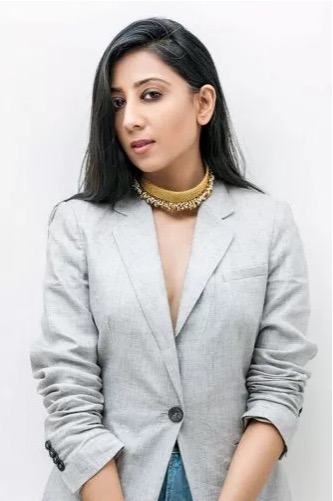
“To be a pioneer means to champion the authority of your own thoughts…your own creative imagination. To bring every genius idea forward. To be precise, but to also allow spontaneity.” Suhani Pittie’s words describe work that may — and should — lead to diverse opinions; for something to be fresh and path-breaking, it must create discomfort. Hyderabad-based Pittie’s jewellery does just that. She describes it as “luxurious but melancholic” and when you hold one of her designs in your hand, you understand exactly what she means. It’s delicate but strong, fine but chunky; it’s bold and yet has elements of the traditional, all the while being “respectful of India, its craft and heritage”.
The label that began formally in 2005 can be considered a trailblazer for its welding of the modern and the conventional but, more importantly, for growing into a self-sufficient business catering to Indians the world over. There is a flagship store in Hyderabad, an online shopping portal on suhanipittie.com (besides being available in offline retail outlets like Ensemble and Aza across the country, and abroad, commissioned by the Museum of Arts and Design) and a new line ‘Dooi by SP’ on Myntra, while also undertaking corporate and festive gifting, wedding lines (which include jewellery for the bride, gifts and decor) and bespoke pieces. And if that isn’t enough, Pittie has also partnered with a technology company which works on a CSR model in the renewable energy space in rural India, called socialsolar.in.

Kolkata-born Pittie’s career choice can be traced back to a rudimentary moment — when she punctured a piece of old silver and bent it; a relative wore it around their neck and someone said, “That’s magic!” Pittie recalls, “When I started, it was an open ground. With my love for India stemmed this deep desire to show new, innovative possibilities of age-old craft and, via that, to explore my own talent. I had never intended to get into this field. Today, it’s no more about me. I want to build a remarkable company, generate more employment, expand skill sets amongst rural women, and raise the standard of living of all our employees, to ensure that they can afford to send their children to school. I’m reaching out to a bigger universe — en route to building something unique…a company with a great product and a warm heart….” What’s striking is what she counts as her greatest achievement. Her first karigar is still working with her today.
Pittie began, as many creative souls do, on a whim, not armed with knowledge or market analysis. “I was new to Hyderabad. I hired one worker. I made 12 pieces with very little capital. And everything got sold. How do you work with metal, when you don’t know how to do it yourself?” As she struggled to find a foothold in a competitive industry, she read every book on the tools and manufacturing of silver. Even today, when 20 to 25 unique pieces are sampled daily, Pittie believes the brand is exactly what it started out as. “Unapologetically individualistic. There is heart in every piece. Non-conforming, yet adhering to values. Destabilising yet disciplined. Beautiful yet rebellious. Paradoxical, really.” And she continues to put a lot of herself in her work: “My jewellery is very reflective of my personal journey at that moment of time. The silence of metal surfaces in tandem with the rebelliousness of design.”

Despite having a corporate structure with departments and managers, projections and targets, Pittie takes a distinctive and free-spirited approach to design. “I execute everything in this department. It’s very emotive — what I’m feeling at the moment, what’s moved me. It could be turbulent. It could be romantic.” Once the thoughts and initial sketches are in, she begins collaborating with her production manager to work out their feasibility. “I was expecting alarm — the day I told him that we are going to make our own metal because I want ‘greyish silver’. But he looked at me and said, ‘That’s what we always do. We invent, no, ma’am?’” She works with a vast range of materials: copper, silver, steel, brass, thermocol (styrofoam), Bakelite and acrylic, to name a few. “I’m not schooled in this field. So it has become my playground…. It was not frivolous when it started and it isn’t frivolous now. The aim has always been to be brave and soar.”
Pittie is the youngest of three artistically-inclined sisters — Kolkata-based fashion designer Anamika Khanna, known to have modernised traditional Indian garments, and Mumbai-based Suruchi Choksi, an abstract artist. “The age gap is tremendous (ten and seven respectively). We didn’t get much time together. I spent all my time outside the house — I was head girl at my school and into extracurricular activities: elocution, debate, quiz, dance, football….” Pittie, who’s been vegan for 20 years, is a graduate in Indian classical music, and was once in a band. Despite her petite frame, she describes herself as “tough” and finds comfort in a “personal, unpretentious” home that has “a lot of books, monster trucks and only beanbags to sit on”.
By those who know her, 36-year-old Pittie, who works in tandem with her husband Stouvant Pittie (a director with the company), has been described as childlike in her irrepressible affinity for a fairy-tale world that soaks up imagination and spits out creativity. You can tell, because she fangirls over Harry Potter — “J.K. Rowling made me believe it was possible even when it seemed impossible. I’m definitely a Gryffindor, but I want to be like Luna Lovegood — so pure and wise.” And then, the woman who believes in magic has a reading list that is steeped in reality. She hasn’t missed a single edition of Time magazine for 14 years, and pours through The Economic Times daily, is interested in public leaders, economics and administration, is currently on Music of the Spinning Wheel: Mahatma Gandhi’s Manifesto for the Internet Age, and watches American entrepreneurial reality show Shark Tank. Pittie, despite the success, admits that she “can’t slow down”. She thrives on “razor-sharp focus” (undiluted by social media), enjoys her own company and of those whom she describes as progressive. “People with unique ideas and clarity. Who debate and challenge. And I’m blessed to have some in my life. It keeps the machine going.”

Suhani Speak
“The current non-precious jewellery market in India is seeing something incredible and unprecedented. It’s also a circle really. Customers need more options, hence are more accepting. That encourages more individuals to take the risk and get into the field. Jewellery, which held ‘locker sentiment’, is now being seen more for composition value and its voice. It’s a great time to be in the industry: challenging but so much more welcoming! More products, more experiments and diverse raw material have been entering the market. Non-precious jewellery could be such a strong dialogue of now, for now.”
“My buyer is aged from 17 to 72. They are women, from every part of the country, who are not afraid to wear their values like a badge.”
“I have never been a victim of trends, and I don’t desire for my clients to ever be. I want to give them memories, stories, beauty and vulnerability. I don’t want to give them ‘objects’ of today. I want my pieces to be purveyors of pure design and at the same time a narrative of the times we live in.”
“You are emphasising your own expression, your own ideals and inspirations and you are designing the future. Your humble attempts can change the landscape of an industry. To be propelled by love and beauty and instances and events around the world and to physically craft them into tangibility…that is extreme responsibility.”
“Kolkata and Hyderabad both inspire me. They have such strong cultural influences and heritage. Kolkata inculcates in you discipline. It encourages you to debate at 5.30 a.m. next to the chai-wallah. Hyderabad is such a beautiful cosmos of old and new. There is so much tehzeeb in the culture, language. It teaches you to respect. So much of what I am is because of these two cities.”
“I have a brooch which is a miniature grandfather’s clock that I really treasure. It’s all minakari work, complete with a cuckoo bird that pops out when wound. Besides the design, it’s also technically superb. It boggles your mind that without machines such marvels could be made. There are some brooches I have which are made of the tiniest mosaic pieces (0.5 mm by 0.5 mm). The patience the artist must have had!”
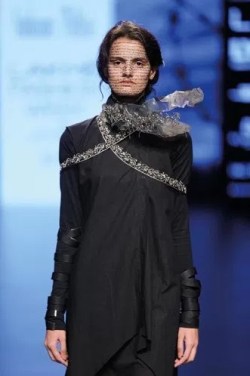
“Our show, Nowhere People (LFW 2016, focused on the plight of refugees), broke me and pulled me together on many levels. To take a painful topic and show jewellery that was distressed and broken, yet wearable and beautiful…. To have connected to the vulnerability of this paradox in a parallel world, with the audience, where they hugged me and cried…. To take a poem by Kenyan poet Warsan Shire Home, and translate each syllable of it into metal, that was, I would say humbly, my greatest moment.”
 sitanshi talati-parikh