A Pop-Up Star

Tags

, , , ,

Published Verve Magazine, November 2014
Photograph by Ryan Martis.

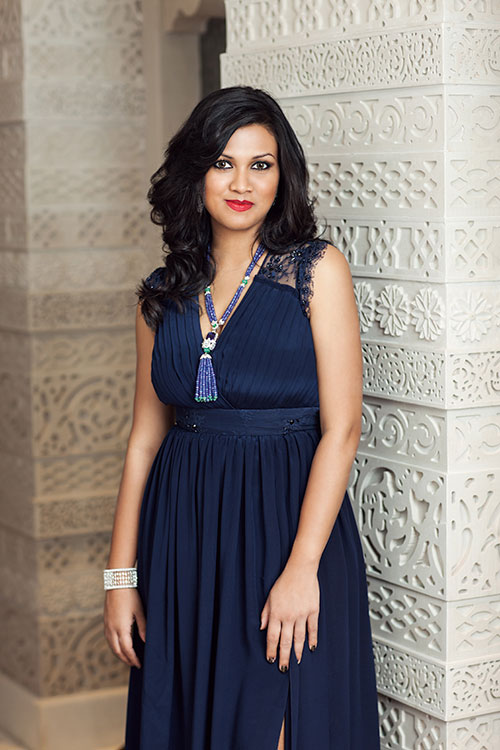
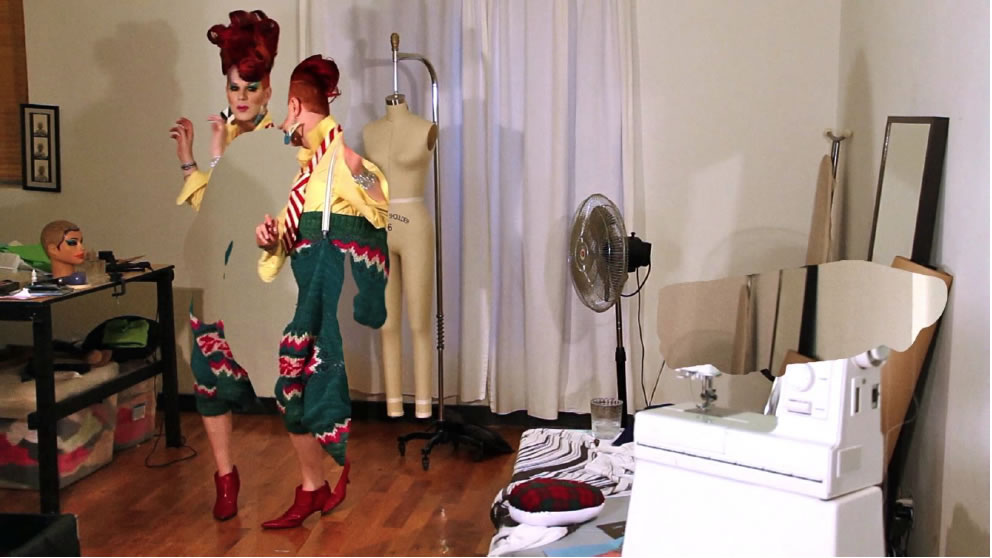
She is assertive and doesn’t believe in wasting time. Founder and owner of perniaspopupshop.com, top stylist, Pernia Qureshi, who has made it to the cover of Verve’s best dressed list, sits pretty on The Rose Code list of achievers

Pernia-Qureshi

“My online store is my baby and means a lot to me. I have never worked as hard as I did to put this store together. It was a huge challenge but worth it!”

She majored in criminal justice and English literature, and minored in dance from George Washington University, USA. She had ambitions to become a lawyer while growing up, but Pernia Qureshi ended up being a top stylist and fashion entrepreneur. Working in the fashion industry as a stylist in New York, she found her footing and brought that back to India. “New York was a great learning experience for me. It laid the base on which I built my career.” Upon returning to Delhi though, it wasn’t easy at first. “I found it hard to relate to disorganisation, unpunctuality, and unprofessionalism in some cases.”

Pernia worked independently with top Indian designers on their campaigns, look books and fashion shows. She also began styling for Indian cinema with movies like Aisha (2010) and Thank You (2011). Simultaneously, she poured her energies into building possibly India’s first curated fashion shopping portal, perniaspopupshop.com (PPUS), which has been a resounding success. While she works for her online store 24/7, she remains interested in styling for cinema, awaiting the kind of projects that would spark her interest.

Evidently, having worked on every aspect of her business, she is connected to it in a way that is different from her independent projects. “It is hard to pinpoint one aspect as the most challenging or enjoyable. I am involved in everything and I get a sense of overall satisfaction and pride from my work.” She has a busy day, but manages to involve her love for dancing in it. “These days my schedule is off. Normally I wake up, have breakfast, move on to spending two hours in my Kuchipudi class with Raja and Radha Reddy and Kaushalya Reddy, get home, shower, lunch, head to work at PPUS, and reach back home for an early dinner.”

Whether at work or at an event, she knows how to work the styling charm, while being appropriate to the occasion and respecting the dress code. “My personal style is classic, feminine and sometimes sexy.” Her most treasured piece of jewellery remains her grandmother’s earrings that the latter wore at her wedding.

She’s looking ahead, but her thoughts are simple. “I don’t feel like I have reached any milestone professionally yet. Personally I have managed to have a family and a few friends that love me and dote on me. For me, that’s a milestone enough.” As for the future – “I don’t plan so far ahead. I just hope to be financially independent and creatively satisfied. I am inspired by so many things all the time. All my senses are constantly engaged. And success to me is measured in happiness.”
Sacha’s Way

Tags

, ,

Vervemagazine.in December 2014
Photograph by Shovan Gandhi

Sacha-Mendes-Shovan-Gandhi

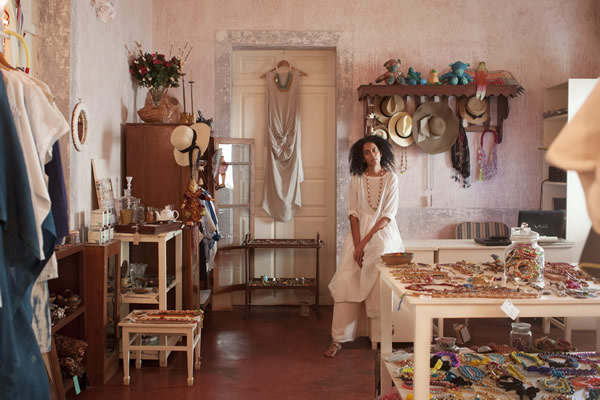
From being a writer and fashion stylist for fashion publications to curating a resortwear shop in Goa, Sacha Mendes’ journey has been interesting, to say the least. As she puts it, it started with a small shop of cushion covers by her mother, two racks of clothes by her friends (SavioJon and Anuj Sharma), and a few jars of orange-peel cookies made by a friendly neighbour, all in the comfort of her father’s ancestral home. “It was never meant to be a store, just a cabinet of curiosities to amuse us.” Today, Sacha’s Shop in Panjim, Goa is an eclectic collection of style goodies that a local can rely upon and a traveller makes it a point to always check out. You would be likely to find deconstructed trousers made into a dress, leather puppets, paper birds, and cross-stitch towels.

Sacha’s Shop appears as a pop-up in Mumbai at The Vintage Garden (Patkar Bungalow, Turner Road, Bandra), December 12-14 (11am-7pm) with resortwear for men and women, furniture, jewellery, table linen, art and design books, home décor, floral arrangements and a range of collectibles.

A quick chat with Sacha Mendes:

Designers in store (Goa) SavioJon, Tilla, Small Shop, 11:11, Maku, Design By Example, Paromita Banerjee, Aish Naushad Ali, Runaway Bicycle, Aavaran, Hot Pink Cool Blue, Ninoshka, Not Like You, Ritika Sachdeva, Pretty Stoned, Lisa Jackal, Labrador

Greatest inspiration “Mostly it’s people I meet, dear friends, people whose work I look up to, people I learn from, people I fall in love with, and family.”

The idea “As I always say, it wasn’t a conscious decision. It was an experiment of filling a space with pieces that I love.”

The greatest challenge that comes with a start-up “There is no great challenge. There is just a journey, an adventure.”

The best part about being an entrepreneur “You can express yourself through your work.”

Your dream “Is to live on a farm and self educate my children!”

A change post Sacha’s Shop “My relationship with time.”

Harshest criticism “I don’t think I’ve ever received any harsh criticism. My friends and family are great for getting me on track, and keeping it real, but they always do it with love.”

Favourite fashion trend “Oversized clothes.”

A personal style quotient you swear by “To each their own. I don’t believe in dictating style tips to anyone, and I expect the same.”

Looking forward to in 2015… “New adventures.”

A Drop In The City

Tags

,

Vervemagazine.in November 2014

Concerned with water, a deep desire to investigate, immerse and experiment, Atul Bhalla’s show in Delhi is stark and moving

Atul-Bhalla-Chair-in-the-landscape-36-x-53.5-in-Archival-Pigment-Paper-2013

1964-born, Delhi and USA educated, Atul Bhalla is deeply interested in the environment particularly the eco-politics of water. His conceptual art creates an engagement with urban and metropolitan spaces, particularly those in his home city of New Delhi. He is also known as an environmental activist on the basis of his preoccupation with the distribution, regulation, commoditisation and pollution of water – and yet he stays on the right side of social concern. Bhalla describes his practice as an attempt to understand water, the way he perceives it, feels it, drinks it, swims in it and sinks in it. Possibly, with the world losing sight of the water crises, with the immense wastage of natural resources in movements like the Ice Bucket Challenge, it is prudent to have a speaker for the precious resource.

5 Questions with the artist, Atul Bhalla
1. Artistic Motivations “It’s the deep desire to investigate, experiment, immerse, push boundaries and communicate…to say it my way.”

2. Inspirations “Jeff Wall, Francis Alys, Andrei Tarkovsky, Isaac Bashevis Singer, Wislawa Szymborska, Fyodor Dostoevsky.”

3. On the wall at home “Francis Bacon, Giacometti, Gerard Richter, Tacita Dean, Jeff Wall, Francis Alys.”

4. Concerns that find place in your art “Water!”

5. If you weren’t an artist, you would be…“Still an artist!”

Ya Ki Kuchh Aur runs until January 2, 2015 at Vadehra Art Gallery, D-53 Defence Colony, New Delhi.

Does Mass Culture Have Meaning?

Tags

,

Vervemagazine.in November 2014

2

From an organic site-specific installation by architect-turned-artist, Asim Waqif to an exploration of structure and space through Aditya Pandey’s abstract paintings, Rajorshi Ghosh’s photo montages and video, and Vishal K Dar’s robotic lighting ensembles (crafted out of automotive parts sourced from the grey market), The Science of Speed explores the ‘immersive environment of pictures, objects, lights, colours and sounds.’ The title of the exhibition draws upon French philosopher Paul Virilo’s concept of ‘dromology’, describing how society is referenced by and revolves around mass media, which the philosopher considers to be a form of modern warfare.

Much like their observation of the movement of images in mass media and culture, the artists in the exhibition acquire and recycle images and objects without a reference to the original context or function. Check it out for the ability to step away from a burgeoning digital culture and question the endless consumption of information that after a point becomes seemingly meaningless.

The Science of Speed by Nature Morte is on view at Famous Studios, Mumbai from November 6 to 16, 2014.

Artist Profiles

Asim Waqif Hyderabad-born and New Delhi-based architect-turned-artist, who has had four solo shows in Paris, Delhi and Mumbai. He recently showed at the Marrakech Biennial. He has been associated with many research and development programs in Badrinath, Rajasthan and Himachal Pradesh.

Aditya Pande Lucknow-born and New Delhi-based artist has a degree in graphic design from NID-Ahmedabad and has had five solo shows in Mumbai, Gurgaon, London and New Delhi.

Rajorshi Ghosh Calcutta born Ghosh now lives in New Delhi and Ohio, where he teaches at the School of Art at Ohio University. Also an NID-Ahmedabad graduate (Visual Art) he also did his MFA from the University of California-Los Angeles. He’s exhibited internationally, and in received the Jury’s Recommendation Award at the 11th Japan Media Art Festival in Tokyo.

Vishal K Dar New Delhi-born and based artist studied architecture in Gugaon and later did an MFA from the University of California-Los Angeles. He’s exhibited internationally and was awarded the ‘Promising New Artist’ award by the India Habitat Centre (2006).

Ranbir Kapoor: Fatal Attraction

Tags

, , , ,

Published Verve Magazine, Verve Man supplement, cover story, October 2014
Photographs by Dabboo Ratnani

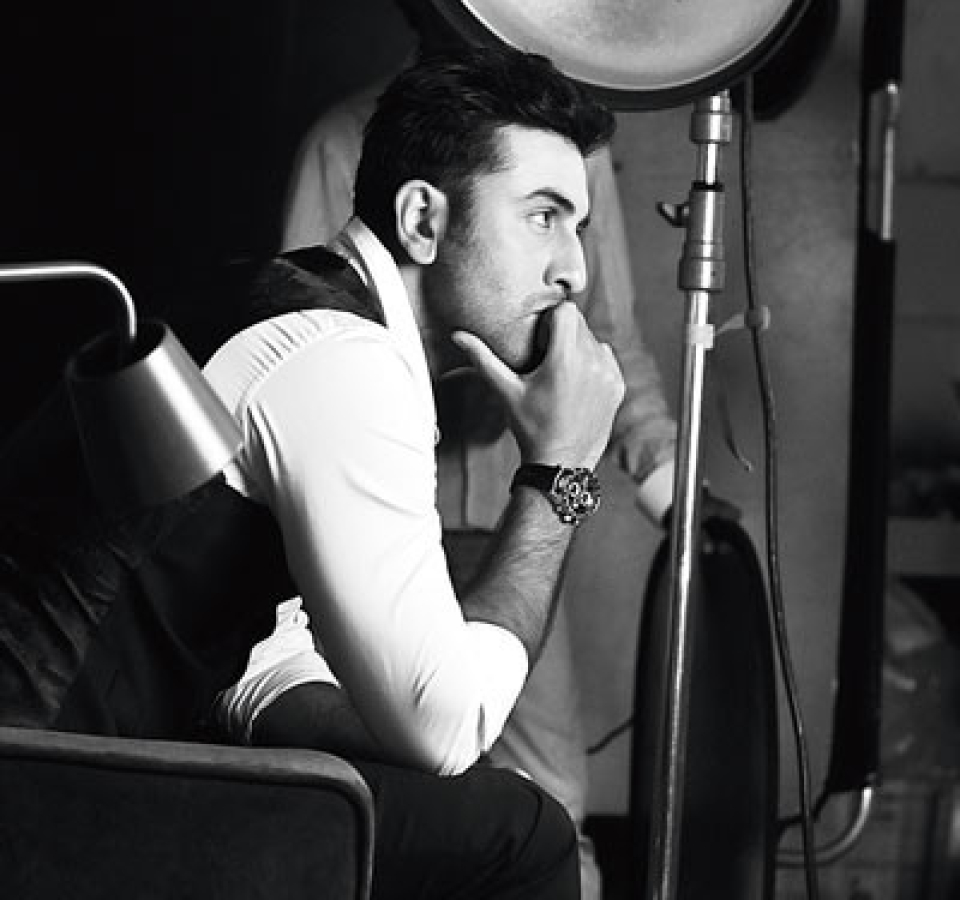
Ranbir Kapoor for TAG Heuer and Verve, shot by Dabboo Ratnani Ranbir-Kapoor-5-960x900_c

In 2007, with Saawariya, a fresh-faced actor emerged, with the promise of cinematic style. He was eminently watchable and easy on the eyes. The very fact that he could drop his towel without any inhibitions in his first film showed that he had no awkward reservations and could go the distance. Through the films after, he proved himself to be a commercially viable Bollywood star, dancing like a pro and displayed clever histrionics that can only come from a place that has nothing to do with training, observation, knowledge or practice. It’s inherent, it’s intrinsic and it’s something that makes him the poster child for royal DNA.

Suave and personable, there is a boyish charm that makes it easy for people to get drawn to him. I met him socially, just before the release of Saawariya, and when he discovered that I was involved in the film in a small way, he immediately asked my opinion of the film with tremulous anticipation. It was the launch pad to his dream career, after all. Even then, his soft-spoken voice and sincere doe-eyes made you want to believe.

Rockstar director, Imtiaz Ali, is all praise for the Kapoor: “As an actor, Ranbir keeps his craft craftless. He manages not to impose his personality on the character. That is almost impossible to achieve. He is truly deeply madly passionate about cinema. Anyone would be lucky to work with him.” And his repertoire of varied roles underlines this fact. Rocket Singh (2009) proved that Ranbir Kapoor could take a staid role devoid of glamour and turn it into one of his most memorable performances. Rockstar (2011) displayed the zeal, the aesthetic heights that he could be driven to for a role. Barfi! (2012) established that Ranbir could be given any role, with any disability and he could rip the screen with the sheer power of his performance. It’s that easy for him. It’s that exciting for us as viewers. It is without a shred of doubt that the elusive superstar that people await for decades, even generations, has been delivered in the form of Raj Kapoor’s grandson.

But somewhere along the lines, cracks began to appear on the chiselled persona. He’s the rock star of our dreams and the Hyde of our nightmares. He’s the debonair rakish Willoughby that every ‘good’ girl gets her knickers in a twist for, in a futile attempt to tame. He’s young, at the prime of his game and he must sow his wild oats. Do his personal choices make a difference to his onscreen abilities? Only when he chooses to play the field onscreen, you want to save the haseenas from his grasp.

Fortunately for him, the chinks that appear in the amour are only personal ones, never professional. And after a tumultuous break-up he can continue to woo his ex-girlfriend on screen with as much finesse as he would his latest lady love, as is evident by the massive success of last year’s rom-com entirely lacking in nuances,Yeh Jawaani Hai Deewani.

But, his ability to sustain lasting relationships with the same ease he brings to the screen is the question. Is it possible, or fair to expect him to have it all? He promised us a screen hero and never fails to deliver. Must he also give us a persona that we can look up to and admire in real life? It is so rare to find a combination of a brilliant actor and a movie star – one that the masses and critics applaud with equal spirit. May that be enough for us, and may we only hope that the women in his life find peace in being a part of something greater than a person – being witness to Talent.

Ranbir Speak

“My own search for who I am and to make my parents proud, is what drives me. I am very passionate about Indian cinema, acting, directing and producing films. I get to do what I love…it becomes the biggest driving force in life.”

“I don’t think I have ever felt pressure. I felt a responsibility – my family has been contributing to Indian cinema for 80 years and now I have to take that legacy forward, in my own individual way with my own notions, thoughts and choices. Pressure is always used in a negative way; it has positive attributes. So for me it was a responsibility and I had to prove myself within my family.”

“I don’t take tags like ‘desirable’, ‘good-looking’ or ‘bad looking’ too seriously. I always believe that handsome is what handsome really does. If your work is good, everything seems good. I hope to continue doing good work, work with interesting people and constantly surprise myself.”

“You go to work, you come back home, and you switch off and spend time with family, your wife, your girlfriend and your siblings. Family and close friends are really important, that’s what grounds you. The film industry transports you to a place that is not real, so it is really important to get back to your bearings.”

The Handy Dandy Square

Tags

, ,

Published Verve Magazine, Verve Man Supplement, October 2011

The handkerchief – once a permanent resident of a gentleman’s pocket – is hardly to be seen, but this accessory still has its uses….

There’s something about a well-dressed man that has me waxing eloquent on more than one occasion. While most men today are considerate towards our eyes and have upped their grooming quotient remarkably, it does send the heart in a tizzy when you spy that devilish, impertinent, cheeky little square punching a direct access to our emotions right out of the pocket. Tissues replaced handkerchiefs with ease – really does no one care about trees anymore? And we can never have the mid-century British moment of a flutter-and-swoon with the gentleman’s hanky popping out promptly to the rescue. With the disappearance of the hanky, came the appearance of the less-than-perfect man, whatever Raymond may claim. But the gregarious pocket square may save the day: in its beautiful sateen avatar, it promises a lifetime of care.

12 fortuitous ways in which the pocket square may come to the rescue:

  1. When there is a snivelling bride. And you are the solicitous groom with pleasant manners.
  2. When you are the best man at your buddy’s wedding and the delectable bridesmaid is having an emotional moment. The pocket square ensures that you will have a lucky night.
  3. Offering it to patch up the teensy-weensy sari blouse the girl next to you on the dance floor has managed to rip with an enthusiastic move.
  4. Serenading the woman of your dreams by dashing off poetry at a moment’s notice on your pale pink square and handing it to her by going down on one knee.
  5. After points #2 – #4 have worked, using it for some impromptu S&M.
  6. Knowing that you both scored a 100 per cent compatibility ratio in point #5, leaving your square with your number written on it with her lipstick to plan the next date.
  7. Using it innovatively to gain miles for your mile high club membership.
  8. Blindfolding your date before throwing her off a plane as you surprise her with a skydiving-and-dinner plan.
  9. Using it as loincloth, when she takes her revenge and runs away with your pants after leaving you in the Jacuzzi.
  10. Wowing your betrothed with vows scrawled in a flourish on the initialled-square and handed to her with her favourite piece of jewellery.
  11. When the elderly auntie right next to you is looking with quiet desperation for a tissue to quickly spit her tobacco…or paan before
    she has to make a lengthy speech about an enjoyable and hitherto utterly uneventful 75 years of marriage.
  12. You can use it as a gag for the auntie who makes it a point to nudge you repeatedly to ask you if you are next, while you play best man at your buddy’s wedding.

Tech Tycoon

Tags

, ,

Vervemagazine.in October 2014
Photograph by Toranj Kavyon

The CEO and design head of Vu Technologies, Devita Saraf, is a trained Odissi dancer, member of the international high-IQ Mensa society and has been ranked in the top 25 most powerful women in India (2006) by leading national media. Young, smart and talented, there’s no question about Devita Saraf’s place in The Rose Code

devita-saraf

“I believe in thinking ahead. I get very uncomfortable if things seem too unchanged.”

The 32-year-old daughter of Rajkumar Saraf (chairman and CEO of Zenith Computers) started training at the age of 16, and made sure her academic career followed suit. Post management of technology at University of California, Berkeley, business degrees from the University of Southern California and London School of Economics, Devita Saraf joined her family business at 21 becoming the director of marketing. At 24 she started Vu Technologies, and at age 29, co-founded the Pittsburgh-based Vu Telepresence Inc. “While at Zenith Computers, working closely with industry behemoths such as Intel and Microsoft, we realised the burgeoning demand for high-end technology in the emerging Indian market. I mixed my love for luxury with our background of technology and the innovation capabilities of these large companies, and started Vu Technologies.”

She looks at the entire business, “even boring bits such as accounts, logistics and operations”, while her heart remains in marketing. She exemplifies the spirit of entrepreneurship: “It begins with imagining something that doesn’t exist and making it real. Entrepreneurship is a personality trait more than a job. Like the friend in the group who always makes plans, as opposed to the ones that just go along for the ride.”

Success is sweet, as Saraf has discovered. “I was never a topper in school and barely got any certificates for academic excellence, so I guess I compensated to my parents by winning some major business awards. They make my mother proud, and that is always satisfying.” It’s not surprising then that she counts as her personal milestone being invited to her school (Queen Mary School, Mumbai) as a chief guest a few years ago. “The same teachers who punished me for being a mischievous child, were now being hospitable. But they were also very proud of me and moments like these motivate me to work hard.”

While her workday is generally a mix of meetings, emails and face-to-face interactions with team members, she leads a “normal South Mumbai life, taking long walks at Marine Drive or meeting friends at the Willingdon Club. I’m not married yet, so it gives me enough time to pursue my interests such as dance or actively participate in EO and other forums.” Saraf also has certifications in Ikebana and jewellery design. She designed her name in diamonds as a necklace for her 10th birthday and wore it for every birthday thereafter. “Honestly, it surprises me that my parents let me design with diamonds at age nine!”

The global jetsetter’s personal style can be described as “feminine sophisticate” as she favours body-con dresses, red, pink, floral prints, lace, trench coats, hats and jewellery. “Even though I am in business, my style is far from androgynous.” She is inspired by “powerful princesses” and is all about creating new milestones and reaching them. “I do aspire to have political and policy-making leadership in this country. It’s the least we can do for the future of our country.”

The Leaning Effect

Tags

, ,

Vervemagazine.in October 2014
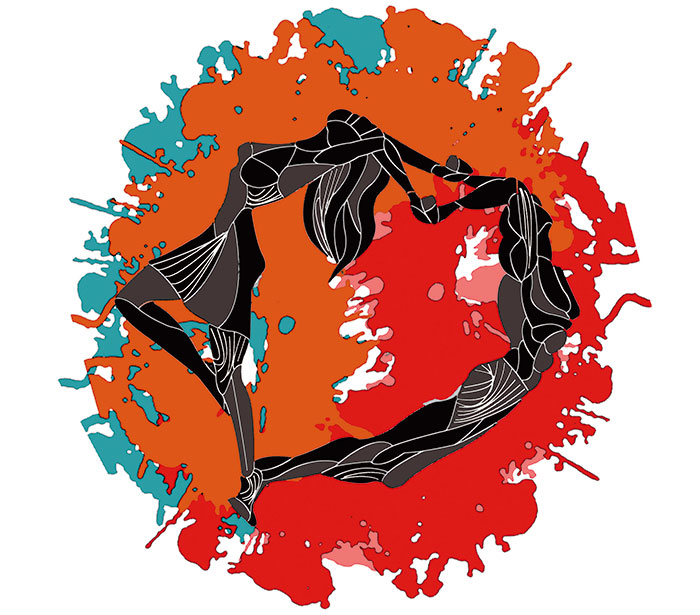
Illustration by Wyanet Vaz

Women are choosing to take their time before tying the knot, thinking fiercely about a potential loss of freedom, the pressure to start a family and career compromises in an increasingly driven world, wondering who will be on top….

Final

Setting metaphoric innuendos aside, enough has been said about a woman having it all and playing a juggling act with everything including her own sanity. With home being the woman’s domain and the workplace being the man’s, guidelines are crisply divided – the lakshman rekha is sindoor red. What happens when those boundaries are crossed? Everything becomes grey and the girl doesn’t want any sindoor red. The man feels emaciated and the woman feels burdened with judgement.

Even when it became socially acceptable for a woman after marriage to ‘stay busy’ so that she basically wouldn’t spend the family wealth shopping, it was understood that she would do so in socially acceptable places, with timings and choices and clothes that kept her family maryada in mind at all times. Mostly, she either ran her own home business or she worked out of her father’s or husband’s office. It was considered taboo for a woman of means to work outside the family limits. It’s not like she needed the money after all!

And what about wanting to do something that is more than being the household accountant and ironing out domestic problems? An educated woman, who has worked before marriage, is likely to have a desire to build a healthy career of her own – one that may not be convenient, or secure or easy. But how does a man and his family knuckle down to it?

And then the ‘supportive family’ arrived. In an age of inflation and an era of success stories, there is a greater desire for families to accept their daughters-in-law’s careers and achievements. But that didn’t mean that a woman would stop doing what she was traditionally expected to – she still ran the house and ordered groceries and tallied salaries and cooked and managed and juggled her career alongside it all. This led to people beginning to question whether women could have it all….

So, it’s not surprising that women are pushing marriage to later in life, because while it is possible for a woman to metaphorically be on top, is it possible for her to be on top of everything without spreading herself too thin? There may be a solution, as Facebook’s CEO, Sheryl Sandberg pointed out in her book, Lean In. It talks about making your partner a real partner, moving forward to accept shared responsibility of building a life and family together. In our celebrated patriarchal society where women are relegated as dependent on men, it is empowering to think that there can be a chance for ambition and salvation in the same sentence.

Ground Space

Tags

,

Vervemagazine.in October 2014

15 artists showing for over three months at Lado Sarai’s new gallery. There’s no way you can miss Zameen, curated by Ranjit Hoskote

Ranbir-Kaleka.A-panoramic-spectrum

Last year, ArtDistrictXIII opened it’s doors in Lado Sarai, and now they have a group show curated by Ranjit Hoskote with some heavy names in order. Gigi Scaria, who gave Verve ‘frame-able’ art (July 2013) is also present among names like Atul Dodiya, Gargi Raina, Baiju Parthan, Ranbir Kaleka and Jagannath Panda. Titled Zameen, Hoskote admits to the initial reference point of Husain’s Zameen and moves on to establish the various ranges of thought leading to a collection of 15 artists in Lado Sarai: starting from “the processes of gentrification and urban expansion” to “the aura of exile and diaspora.”

The artists have articulated their explorations of zameen through diverse media, ranging from woodcut, paintings, digital prints and installations to finding expression in domains like the blog or graphic novel or “the additive memoir into which a sequence of Facebook posts can develop”. “Taken together, I regard these outcomes – whether manifest or latent, exhibitionary or discursive – as travelling territories of thought,” writes Hoskote in his curatorial essay.

What may we expect?
In the curators words (excerpts):

1. Atul Dodiya and Baiju Parthan engage with the ideological and aesthetic resources of the contemporary Indian subjectivity, the varied pasts from which we in the present may derive critical inspiration rather than inflated pride.

2. Jagannath Panda and Gigi Scaria phrase hymns to despoiled environments and their endangered denizens and silenced mythologies; their paintings gesture towards the syndromes of war and expansionism.

3. Lost homelands preoccupy Veer Munshi and Zarina Hashmi; both artists explore mnemonic forms, Munshi through portraiture and Hashmi through cartography and the symbolic image.

4. Ravi Agarwal shares, with Hashmi, a concern with memories of space once inhabited by family, structured by rituals of kinship and inherited ways of being and making, now disrupted by economic and political shifts. Agarwal also shares, withArunkumar H G, a commitment to critiquing and resisting the toxic industrial threat to agriculture and the environment.

5. Land, in Ranbir Kaleka’s account, is the cumulus of the fantasies, stories, dreams and aspirations of those who inhabit or occupy it. Fantasies of belonging also animate Gargi Raina’s work: she explores sensory memories that modulate our sense of self, working beneath the levels of waking consciousness.

6. Elliptical family memoirs also define Ram Rahman’s work, which is charged with his intense experience of the neighbourhoods he has inhabited in New Delhi and New York. In Ashim Purkayastha’s work, the family portrait encodes the circumstances of oppression and terror that have constrained private life and compromised civil liberties in zones such as North-east India, where the mandate of militarisation often overrides democratic guarantees.

7. Praneet Soi’s work, like Ram Rahman’s, articulates the modes by which a transcultural subjectivity anchors itself in multiple locations.

8. Both Vishwajyoti Ghosh and Ryan Lobo record forms of community emerging within a hyperreal present dominated by metropolitan aspirations: their artistic projects capture the thrum of travelling subcultures, the momentum of societies in fast motion.

Zameen is on show until January 31, 2015 at ArtDIstrictXIII (F-213C, Lado Sarai, New Delhi).

Open Minds

Tags

,

Vervemagazine.in October 2014

What do mind maps and vacuums have in common? Find out in the artistic dialogue between an Indian and American artist in Delhi

Pieter-Schoolwerth

This week in Delhi, a visual dialogue opens between two artists, Avinash Veeraraghavan (Indian) and Pieter Schoolwerth (American), about mapping minds and vacuums respectively.  It’s a bit of a brain twister pushing boundaries of the imagination into mental black holes and mapping the psyche through the collective unconscious and free association. In We do not see things the way they are, we see things the way we are, Veeraraghavan’s fictional maps are conceived as metaphors of the places his mind has seen; while Schoolwerth’s first exhibition in India, My Vacuum Suucks, brings to the table the vacuum of reality.

Through the materiality and liberated signification of We do not see things the way they are, we see things the way we are, Veeraraghavan expresses “delight in the coming together of difference.” Meanwhile, moving images, six paintings and a series of collages depict the “trials and tribulations of presence versus absence in the vacuum space of the world” for New York city based Schoolwerth.

The exhibition is on until December 17, 2014 at GallerySKE (1st Floor Shivam House, F 14 Middle Circle, Connaught Place, New Delhi).