Tarun Mansukhani: Picture Perfect

Tags

, , , , ,

Published: Verve Magazine, Features, October 2008
Photograph by Ritam Banerjee

After assisting with six films, and 10 years in the industry, Tarun Mansukhani debuts as a director with Dostana, releasing next month under the Dharma Productions banner. Sitanshi Talati-Parikh finds him full of steely determination, anticipation and solid allegiance to his mentor, Karan Johar
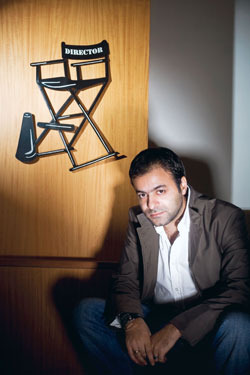
Director

The sharp, dapper man, just a shade over 30, seems more suited to the corporate world than Bollywood. With crispness of speech and meticulous attention to time, Tarun Mansukhani appears like a tightly wound elastic band – afraid to let go. It makes me ask him a number of times if he is nervous about his big release. “I haven’t thought about it, because I would’ve crumbled under that pressure. It is easier to think of it as just another film.”

Experience has made Mansukhani smarter. He quips, “I tell all my assistant directors that they can’t lie to me – I know all the tricks of the trade, I’ve played them all with Karan!” Waxing eloquent on a superb equation he shares with Karan Johar, the debut director paints a rosy picture. “Karan is the only producer in the world, who when you are hitting a deadline, tells you to relax and take your time. When you go over budget, he asks if it is justified, and if so, says, ‘No problem!’ It makes me want to ask him, ‘Are you sure?’”

Dostana, a romantic love triangle, starring Abhishek Bachchan, John Abraham and Priyanka Chopra, has been shot in Miami. During the shoot, Mansukhani recounts, Johar came to Miami for two weeks, and finally announced, ‘Look, I am really unemployed – I come, I shop and I eat. So I am going back to Mumbai to do more constructive work.’ And he left, not returning until the end of the film. The creative freedom, faith and trust provided by Johar, leaves the former singing praises of a perfect boss and perfect job. And yet, says Mansukhani, “I do not try to stay within Karan’s auteur. In fact, my deliberate decision is to combat what I have learnt – to break the school that we have developed for ourselves.”

While working on the story he has made a conscious effort to use everyday language, even if it is pedestrian language or Hinglish. While the film is youth-centric, it is not just the youth they want to appeal to. “There is an emotion that appeals to all age groups. It is not in its film-making or in its technicality or dialogues. We all have friends, our parents have had friends and our kids have friends. It may not be the dialogue that they might have spoken, or the language; but what is important is that they remember those friendships.”

Dostana is predominantly about the bond of friendship. Mansukhani, who studied in a boarding school, experienced deep friendships, giving him the idea for his first film. He brought in the premise of two men pretending to be gay to stay in an apartment, to make the story interesting. “It was a very conscious effort to not make fun of the gay community. You are not ribbing jokes about them or using them as a ploy.” A mother, who very subtly and with humour shows her acceptance of their sexual preference, adds a progressive element. So, another masala film with a social message? “We can all make art films at the end of the day, but there is a certain reach. Today this is what I would like to make. In the future, I may want to make an extremely gritty film, like Black Friday for instance.”

Talking about friendships, Johar and Mansukhani go back a long way. Johar went to school with Mansukhani’s sister, and when he was looking for an assistant for Kuch Kuch Hota Hai, he thought of him, who at the time was assisting television producer Anand Mahendroo. Mansukhani was not certain he wanted to be a part of commercial cinema – “I was just a Breach Candy boy who didn’t understand Shah Rukh and Kajol. Dilwale Dulhaniyan Le Jayenge was just another film for me.” When he took the FTII exam, confronted by questions on the direction of Swami Vivekanda Part II, he decided to work for Johar instead. The rest is history. The young director sees the future as very promising – making more films for Dharma, and eventually becoming a producer, financed by Dharma. “I don’t see myself breaking away from this family in any form. It is the only family I have known.”

Contrary to expectations, Mansukhani is not a die-hard cinema fan. Having studiously managed to avoid the classics, despite Johar’s repeated suggestions, he remarks unselfconsciously, “I stand clueless at a party when someone talks of classics like Guru Dutt and Satyajit Ray, and glibly put in my two bits, without knowing what they are talking about!” He prefers Sholay, Gadar or the more recent – admittedly candyfloss – films like Dilwale Dulhaniyan Le Jayenge and Kuch Kuch Hota Hai. Quick to laugh at himself, he confides, “The only reason I go to the cinema is because my wife wants to watch a film. While I critique every other film aloud, I am silently taking notes – though no one knows that!”

The resilient director doesn’t give himself even a moment to take a break. Starting work soon with Johar on My Name Is Khan, due for release next year, he is matter of fact about his breakneck schedule. “We are addicted to films – we are not good at anything else. This is our only world.”

And juggling that attitude with a family life? He is quick to compliment his spouse – with whom he has been in a relationship for 12 years and married for three – on being the most understanding person in the world, especially after admitting he hasn’t been to family dinners, and hasn’t met most of her family! He even missed his sister’s wedding when he was busy with a shoot. “I hope that these sacrifices made will accomplish something – at the end of the day, these opportunities may not come to me later. This is what I need to do to make life happen.”

Farhan Akhtar: Rocking Star

Tags

, , , , , , , , , , ,

Published: Verve Magazine, Verve Man, October 2008

Heady from the unprecedented success of Rock On!! Bollywood’s latest poster child of youth cinema, Farhan Akhtar talks to Sitanshi Talati-Parikh about his kind of movies, juggling family life with work and how genes make a difference

Superb actor, director, script-writer and now also a good singer (in a raspy sort of way), Farhan Akhtar steals the show with his overwhelming energy and passion on screen. Slipping into the skin of the protagonist, you feel him come alive and half expect him to jump out of the screen. How is it possible to be the master of all trades? Akhtar believes it’s just about applying yourself a 100 per cent in what you have chosen to do. Then there’s his excellent lineage. “I would agree that genetics must play a part in creating a natural leaning towards something that has been so dominant in past generations. But eventually, it cannot make you a good director or actor. That you will have to do yourself,” says the artiste, who keeps pace with a marathon schedule, and is known to never sit idle – not even for a moment.

Powered on by the desire to tell stories, Akhtar believes film-making is a collaborative art form which makes choices about script, crew and cast (among others) very crucial. He takes his time to decide on all these things before getting into a project. “I don’t know what motivates people to make the choices they do – I would hope that my work and its appreciation would serve as a catalyst for other people to do more original work and benefit from it – creatively and at the box office.”

Why, then a sequel to Don? “I found myself obsessed with the title character and the background score. I had to get it out of me. Luckily, I found many people who were as obsessed with the film as I was.” Akhtar has created a cult genre with his youth-centric films. Dil Chahta Hai became the film that revisited Bollywood norms and resonated with a huge college-going audience. That set the pace for Akhtar to continue down a road that told stories that he understood, that he wanted to tell, and which upgraded the passé films into a slicker, smoother and more identifiable medium. At the end of the day, as the film-maker puts it, “it is important to have something to say in an entertaining, engrossing manner.”

Akhtar was not consciously trying to set a social trend. He is clear in stating that, “It is not advisable to design a film keeping in mind its social impact. The design will show if that is the approach. Stay true to the story and do it because you believe in it. If the audience recognises your heart in it, everything else will follow — Rock On!! is being appreciated by an audience of 10 to 60 years of age. If the story has a universal emotional core, then it should be able to connect with all generations.”

And yet, each time it is a different story. Akhtar confesses he is a fan of all genres of movies. Lakshya didn’t do as well in the box office, but it was another story that had to be told. And then came Rock On!! – a simple story, a story you would have heard before, but one that rocked. It was the perfect blend of cinematography, acting, concept, style and above all (as with most of Akhtar’s work) dialogues that work. That are not stilted or refurbished like many of the others are.

There is actually a club of like-minded film-makers, where constructive criticism is an option, of which Farhan Akhtar, Kunal Kohli, Madhur Bhandarkar, Rakeysh (Omprakash) Mehra, Ashutosh Gowariker, Raju Hirani and Vipul Shah are a part. While Akhtar shares a great rapport with Gowariker, to the extent that they “discuss each other’s work candidly, knowing that all views are coming from a space of respect and admiration;” Akhtar’s film-making style is reminiscent of that of Aamir Khan – in that they are both gifted with supreme originality of outlook. And above all, a great sense of characterisation. Both have impeccable tastes in casting – and making an ensemble cast work is often what it takes.

Akhtar is constantly on the look out for talent – whether young or old. The website of Rock On!! actually has a talent hunt for upcoming stars. When questioned whether it was to increase the buzz on the site, he states that it is to find talent, young or old. “A good actor can be hidden inside any person of a age or gender.” That is surprising, considering that Akhtar, like Sanjay Leela Bhansali or Karan Johar, has chosen to work with established actors in his initial films. Akhtar doesn’t attribute this to stalwarts being a safer choice. He is noncommittal in his response. “I have been fortunate to have worked with some big names and talent in my films. That was the need of the script and character. Rock On!! allowed us to work with new talent as it suited the nature of the story. For me, cast is determined by character, not the other way around.”

The film-maker, who considers it a privilege to hail from a legendary family of parents — Javed Akhtar and Honey Irani, and Shabana Azmi – is very firm on the subject of credit. Where once Honey Irani had lost out on credit for her work on Dilwale Dulhaniya Le Jayenge, leading to relations being soured between the two film families, Akthar believes that, “credit is as, if not more, valuable than your fee. The money will come and go but your name will be up there forever. No one can take that away. We are very careful to make sure every single person involved on our films is given their due credit.”

A Martin Scorcese and Woody Allen fan, Akhtar admires their ability to keep reinventing themselves. It appears that he is modelling himself after them, waiting for more hidden talents to surface. Coming up soon is his sister Zoya Akhtar’s film Luck By Chance, in which he is acting. His next directorial venture is slated for 2009. Akhtar prefers not being bottled into acting or directing. “They are both a part of who I am and I hope to keep exploring and learning new things about the art and craft.”

Is his life easy? “I love doing what I do, so it’s not about easy or difficult for me. I try my best.” Married and father of two young daughters Shakya and Akira, Akhtar is constantly playing a juggling act. “I do take my children to set with me when it is possible because it is important that they know where I go and what I do. They should not feel I am disappearing for periods of time without reason.” Known to be exacting, is Akhtar an easy person to get along with? With a light chuckle, he responds, “I get along with myself just fine!”

Turquoise Ananda

Tags

,

Published: Verve Magazine, Nerve, September 2008

Youthful, enthusiastic and effervescent, Priti Kyal’s personality flows onto her canvas and paints it in colourful hues while being rooted in a spiritual reality, finds Sitanshi Talati-Parikh

Priti Kyal’s painting style is intuitive, with a lot of motifs, design and texture, reminiscent of the saris worn by her mother. “The figures in this set of works are?small representing that we are a tiny part of the large cosmos. I have used the tree of life to reflect growth and sustenance, while the doors and windows reflect change.”

Working off traditional canvas, Mumbai-based Kyal believes that she will move towards a medium like installation, only when her thoughts need to be translated in that form.?“I unlearn everything I have already done by trying new media.” The artist, who is completely satisfied with ink at this moment, finds that despite its simplicity, it is capable of a great deal – “It’s so uncomplicated that it’s thrilling!”

Change is what motivates Kyal: “The thrill of discovery is what keeps me moving on. My work is not about the most perfect face or the most perfect picture but it is about the expression of thought.”

Talking about her buoyant and feminine choice of colours, the artist who recently had her third solo show at Jehangir Art Gallery, Mumbai, explains that her works are about herself. “The colours I use reflect my mood.?I have used soft pinks, oranges, mellow yellows and firoza (turquoise). In that sense, the works are autobiographical.”?Much of her current collection has the words ‘I Am That’ painted on, which Kyal describes as ananda?– the unity between the atman and the parmatman.?Similarly, she seeks a union between her work and herself, so that there is no duality. “I Am That, is a state where I Am My Work.”

The artist, who has a background in English literature and Indian aesthetics, dabbles in poetry, often finding herself scribbling spontaneously onto the painting. Art is simply a medium to express that which is most important, forming a montage representing small vignettes of her life.

European Rhapsody

Tags

, , , , , , , , , , , ,

Published: Verve Magazine, Travel, September 2008

Sitanshi Talati-Parikh wanders far from the madding crowd in search of the most spectacular European spots for a destination wedding

Travel07

As the bridal season rolls in, everything needs to be perfect – the perfect ring, the perfect outfit, the best guest list, the most gorgeous honeymoon. But the wedding – that is the crucial, quintessential area of importance. Should we stay in or get out? Destination weddings have become the flavour of the season, more important than outfits and honeymoons – which are a given. What with a British couple getting married at 1,000 feet atop airplanes, Star Wars and fairy tale characters’-inspired wedding attire and a groom skydiving to tie the knot in Bhubaneswar; the bizarre is the flavour of the season. To find that eternal, exquisite destination, you just need to think bigger and more exclusive. Forget flowers and centrepieces, it’s the ambience and old-world charm of palaces and castles, or a simple sunset that forms the perfect backdrop to that ultimate moment which needs to be embedded in our memories forever.

It is said to be the most magnificent sunset in the world – and it may just be true. There are very few places in the world where you can stand atop a craggy piece of land and say your vows in front of the tangerine sunset straddling a dormant volcano floating on the ocean. Wedding parties fly in specially to get married in front of the Santorini sunset, and a breathless bride and groom hold hands and wait in anticipation for the exact moment when the sun sets and flashes a myriad colours across the Grecian sky, at which moment, they become man and wife. That is the starting point of a journey, where people are always looking for something special, or actually going that extra mile – literally and metaphorically, to make the event a day to remember. While Santorini appears to be the most magical spot in the world, so purely a thing of nature, consider having a beautiful ice wedding.

From volcanic sunshine to icy blue environs – with a chapel carved out of ice every year, and special custom-made ‘ice’ wedding packages, it is possible to be a real Scandinavian Ice Princess, in Jukkasjärvi, Sweden, a small village 200 km north of the Arctic Circle. No two chapels are quite the same in this unique location, as the chapel itself eventually melts away into the River Torne. Whether you choose matching ski suits, kilts or the traditional wedding attire, having a wedding at the IceHotel is an experience for all present.

If ice doesn’t do it for you, and a princess you still want to be, then simply think like the Mittals – and Versailles. The ‘fairy tale’ wedding of Lakshmi Mittal’s daughter Vanisha that was broadcast all over the world with much fanfare, or Eva Longoria’s wedding reception, were both held at the Vaux Le Vicomte Château, in Versailles, France. The historical 17th century masterpiece is replete with fountains and lush gardens, exquisite furniture, period decor and crackling fires in antique fireplaces – quite the place to warm the soul! With a host of movies shot at this fabulously grand location, it is also enough to make you feel like a movie star. Think Marie Antoinette (but of course with a ‘happily ever after’ instead)!

Talking about fairy tales, you are immediately transported to Venice – the land of entrancing (though a tad smelly) gondolas and beautiful churches. One of the most romantic cities in the world, reminiscent of Juliet being serenaded by Romeo, it is the perfect place for a classic wedding in an Italian palazzo or in the ambience of a church with famous paintings of Titian and Michelangelo as guests of honour. ‘Period Residences’ that date back to the 1500s, like Palazzo Abadessa, with frescoed ceilings, authentic antiques, and paintings from the Tintoretto school, welcome wedding parties.

Gorgeous Capri of Mediterranean blue sea, picturesque white sail boats, limestone masses and villa-lined promenades is one of the most typically beautiful spots – a spectacular alternative to the white Cycladian architecture of Greece – with the simplistic beauty of its coastline. Capri was the destination of choice for celebrity chef Wolfgang Puck and Gelila Assefa’s wedding, at the Grand Hotel Quisisana, which draws inspiration from Mediterranean art and lifestyle, whilst intrinsically remaining an Italian hotel. Getting married amidst the ruins of imperial Roman villas (think Villa Jovis) promises to be an experience.

Recalling Diane Lane in the movie Under the Tuscan Sun, where we realise it is easy to fall in love with wine country (and possibly a hot Italian), and nothing more is really required to have a rollicking country wedding. Breathtaking countryside, art, sculpture and the misty haziness of wine come together to serenade you in style. Winding down grass roads and one-horse towns, where your visitors may actually get lost or never find their way back home, with simple guitar-strumming and sultry afternoons of free wheeling time, it’s all about a sedate wedding at a villa in Tuscany.

If natural beauty is your thing, then having a wedding amidst the backdrop of the fairy chimneys, mushrooms, and unusual land forms of Cappadocia, is inimitable. Reminiscent of the bizarre backdrops in Star Wars, this Turkish phenomenon is best experienced from the painstakingly put together Museum Hotel located at the area’s highest point, Uchisar. With the grand hotel made out of the local insulated rock, many local ancient heirloom and antique pieces decorating the place and a gorgeous heated swimming pool with a breathtaking view of the Goreme Valley to boot, it is not surprising that the hotel is the favourite haunt of movie stars and celebrities, and an ideal location for an exotic wedding celebration; as the sun sets over the land forms, enveloping them in myriad hues.

This is merely the tip of the proverbial iceberg. From Bavarian mountains in Germany to the ‘sound of music’ hills of Salzburg, from the little cozy mountain chalets of Switzerland, to the Baroque architecture of Eastern Europe; going exotic is a truly memorable way to tie the knot.

Rohit Gandhi: Real Impressions

Tags

, , ,

Published: Verve Magazine, Nerve, September 2008

With an impressive dossier of news stories that include live coverage of the Kashmir elections, Iraq conflict, Afghan War, the tsunami tragedy, Nepal’s royal coup, and an Emmy nomination for his recent film, Who Cares About The Girls, documentary filmmaker, Rohit Gandhi, speaks to Sitanshi Talati-Parikh about women in India and the role of journalism

Screen01

In the making of the documentary Who Cares About The Girls, which has been nominated for an Emmy award in the Outstanding Investigative Journalism – long form category, Rohit Gandhi, who is particularly interested in children – seeing that they are our future – describes how after weeks of research, a 14-year-old girl, Radha (name changed), was chosen by the NGO to be the one rescued from her abusive father and sister. He recalls with regret and anger that while the rescue took place as planned, the girl was produced in court and was released as the cops did not explain the circumstances under which the girl was rescued and, despite their best intentions, they could not help her.

The story revolves around four characters: two sisters who were sent away from home to work as child labourers, who were both sexually and verbally abused; a former sex worker-turned-activist and a rescued girl. Though it describes how children continue to be abused, Gandhi believes that there is a positive future ahead if we all get together and fight the problem. After all, “There is no magic wand to change the reality today.”

Gandhi takes his work in his stride – not wishing to become the face of any story, rather letting the story speak for itself. “It is providence to be in a position to be able to make a difference. Journalism is an opportunity to be a mirror of society, help reflect on what we are doing in our daily lives. It compresses space and time and gives a picture of our present reality.” In much the manner that his moving story on a young Iraqi boy who was severely injured by a bullet in the midst of the US-Iraq gun fire, came to the attention of the ambassador of Greece, who took the boy to Athens for treatment and brought his life back to normalcy.

The sociologist says that he knew where he was headed very early in life and that the things that need to be changed are not sitting hidden in sub-Saharan Africa, but right under our noses. “Evils of society happen right around us,” he states, moving on to describe one of his first stories – from the Tihar jail. He believes that putting criminals away in our jails makes them even more hardened criminals – and his story tried to bring about a positive change, in this “very evil system.”

The journalist who has worked with numerous national and international TV channels, and has been the recipient of many awards including an Emmy for his war coverage in Afghanistan in 2001, believes that Indian society respects its women a lot but at the same time treats them very badly. “Traditionally, we were not like this – we have lost our roots. We need to change that. Education, not just literacy, is the mantra.”

Been to the Bachelorette Party?

Tags

, , , , ,

Published: Verve Magazine, Musings, September 2008
Illustration by Farzana Cooper

As women experience a dramatic liberation of the spirit, they flock together in time for the most sensational party in town – the pre-nuptial ‘bachelorette’ aka hen party. What ensues is seductive, exorbitant and completely amoral mayhem, discovers Sitanshi Talati-Parikh

Henparty

Cock-a-doodle-doo. A cackle of resounding proportions ensues, ricocheting from the walls and reverberating in my ears. As the shrieking, excited women gather together in a spacious marble tiled room of a luxury hotel, I sit back in amused anticipation. Taking the been-there-done-there stance, I hold forte as the knowing spectator of a scene that is bouncing with camaraderie, clinging with subtle desperation to a youth that may never return, and high on spirits of every kind – as if this is the last night of fun, ever.

With lurid décor to offset the expensive and borderline sensational clothes, the women in one collective burst cheer the hunky man (is it just me or do I dread the sweaty, hairy ape that may just appear?) who is to make an appearance. In a flash I recall the Friends episode where Danny DeVito appears at Phoebe’s bachelorette party, resplendent in an officer’s uniform, all of four feet tall and I believe I can never forget the look of shock and abysmal dismay on the girls’ faces. I kid you not, an Indian hen party that promises a male stripper leaves me queasy and sceptical. A bronzed Brazilian or Greek God – now that would be my kind of party!

As the inebriation skyrockets, the women get louder and brasher by the minute – and the drinking games begin to take a turn toward the scandalous. From recounting your most brazen sexual escapade, to dares that would make any sane woman shudder with disgust, the parties are simply a way to surrender to impulse and try to do what one may never have or probably never will in the future. Or maybe, it is a way to explore the secret, often subdued kinky streak, to ensure post-marital bliss. Simply by letting your imagination go completely wild.

And while one is speeding down the fast lane, taking off on destination hen parties to exotic locales is high up on the wish list. Where the women can surround themselves with everything they love most – credit cards, friends, hot men, shopping, and a vacation that promises to be embedded in their memories forever. While a fun beach trip in Spain or Koh Samui or maybe even intoxicated rounds of vineyards in Tuscany would suit my taste, there are other more sensational destinations that do the bachelorette party rounds. Take your pick from gambling, striptease and can-can in Vegas to 48-hour raves in Ibiza, from singles-only adult resorts in Mexico to life-threatening adventure sports – the world is a menu, and one just has to pick a spot.

What is it that makes this night such a big deal in a woman’s life? Is it the post-women’s lib take on the bachelor’s party? In my naïve understanding of history, women would gab a bit, have a pyjama party, gossip, paint their nails, brush each other’s hair and share secrets about love and what is soon to come. It was a means of solidifying the female bond at a time when women need it the most – as they are about to enter the big bad world of men, mothers-in-law and the kitchen. And men would sow their wild oats. Literally and metaphorically.

We then arrive at the premise that today’s women have many a wild oat to sow as well – with the liberation and all that. And so, every woman wants to bag (or bed) that last bit of scandal, before she begins the journey of a devoted and chaste life. I don’t think so! As single marriages are passé and divorces are the first resort, hen parties are just that – another party to frequent the colourful social lives of the free-spirited women of today, and one that has the golden ‘Get As Wild As You Can’ pass to make anything that happens at that party acceptable.

So what are the women really liberated from? Inhibitions – of course. Moral code – probably. A sense of decorum – definitely. And that is what makes it the night of a lifetime. Needless to say – what happens at a hen party stays at a hen party. And that is one pact that strictly cannot be broken – like that of a sorority. No photos, no emails, nothing to leave a trace of what actually took place, except a vaguely delicious memory that leaves you feeling that you’ve been bad, and enjoyed every minute of it. And the best part – there is no hangover of guilt.

Fair Ground

Tags

, ,

Published: Verve Magazine, Features, August 2008

Over 100 artists, 34 art galleries, critics, curators, collectors, delegates and speakers from across the world will come together in the very first art fair of its kind and biggest art exhibition to date in India this month. Sitanshi Talati-Parikh constructs a discussion between some of the top attendees, in an exclusive Verve sneak preview

For all the people out there who get intimidated by art galleries and their mysterious interiors that presently abound with pots, pans and acrylic that sell at stupendous prices, and for all those who don’t, comes the leveller of all levellers – an art fair in Pragati Maidan, New Delhi. Reminiscent of melas and tousled gatherings of intellengisia on hot dusty evenings, the ‘fair’ is somewhat a more accessible term. And accessibility is the aim of the Indian Art Summit 2008, put together by Hanmer MS & L.

Going Public
Dr Robert Storr, Dean, Yale University School of Art, USA, who is one of the people flying in specially for the occasion, is interested in the “opportunity it affords to make crucial distinctions between commercial formats for showing art and exhibitions and formats such as museums, alternative spaces, biennials and the like.” He elaborates, “I have nothing against dealers and galleries, but they primarily reach an already engaged segment of the public – collectors especially – whereas large exhibitions and small ones in venues more readily accessible to the non-art world public represent the long-term hope for Indian contemporary artists – or for contemporary artists anywhere – of making a lasting mark on their country, their culture and their time.”

Why Now?
What makes it the right time, keeping aside the fact that art is the new mantra and one of the biggest money-spinners? Renu Modi, of Gallery Espace admits that about a decade ago, she had tried to bring about such a fair at Pragati Maidan and it fell through then. She believes it is the right atmosphere for an art market – it is happening elsewhere in the world, why not here?

The Outcome
Renu Modi feels that such a summit that brings together like-minded people discussing issues and ideas will automatically see things and trends materialising. That is not to say that there haven’t been seminars and symposiums in Delhi, where not much has come out of the discussions – it is important to implement these ideas in the long-term, stresses the gallery owner. Echoing her thought, Dr Storr believes that “just getting a group of active, committed people in any field into one room – artists, art professionals in this case – can throw sparks and have a profound catalytic effect on the scene if everyone comes prepared to listen as well as to speak.”

Philip Hoffman, chief executive, The Fine Art Fund Group, considers the Indian art market to still be in its emerging phase. He specifies that the size of the market has grown from $2 million to approximately $400 million in seven years alone. “An art fair could really help boost the growth rate by directly involving galleries and artists alike, getting collectors and investors on site and by generating general interest.”

Going Global
Dr Hugo Weihe, international director, Asian Art, Christies, sees Indian art as becoming increasingly global, India and all things Indian occupying a new pride of place, while Peter Nagy, Nature Morte, feels that the best of Indian art is already truly global, but also thinks that Indian culture, as a whole, is becoming more relevant and important to the entire world. Nagy deliberates that while this also has to do with economic and political influence, interest in contemporary Indian art is also a natural extension of the increased globalisation of the art world.

Philip Hoffman, who agrees with Nagy in the sense that the Indian art scene is already global, believes that modern and contemporary Indian art has long been undervalued as compared to other areas of the art market, and with the boom of the financial markets, real estate and all other asset classes in India, many new art collectors are establishing themselves and purchasing works from artists of similar heritage. “We believe there is a high level of creativity and talent in India, which is going to make this market move even further, and with continued global exposure in 2008, we think that this is the right time to invest in Indian art.” He continues, “Prices are continually rising and are much higher than they were, say, five years ago. However, when compared to the Western contemporary art market there is clearly potential for an increase in prices.”

International Recognition
Dr Storr, who has an unmatched résumé in art as critic, curator, artist, academic and writer, chronicles the need for international recognition to validate art. “This has been true throughout the history of the modern era – which is a history of great powers and empires. Once upon a time, artists from my country went to Paris or London to get recognition. Now they stay home and the world comes to them. This will happen in India too – indeed it is has started to happen in measurable ways. The point is that the institutions in India must do the right things for artists so that when the world comes they see the best under the best circumstances, and that includes not just contemporary classics or hot new market stars but those artists who challenge art, art institutions and the public in the liveliest, most inventive and the most pertinent ways. Once that process starts – and Indian artists, critics and curators have started it already – there is no standing pat, and above all, no going back.” On the other hand, Peter Nagy, who made the move from New York to New Delhi in 1997, finds that, “the powers-that-be within India are still too timid and insecure about contemporary art to take many of the risks necessary to properly champion the avant-garde.”

ANJOLIE ELA MENON
ARTIST
“I think it is a great idea, and have backed it from the beginning. Galleries couldn’t get their act together to do this, so it is better to have a neutral agency taking the initiative. Like Hanmer’s Khushi art auctions earlier, one hopes that this will be managed to those same high standards. It is a young, enthusiastic team, which brings together good presentation, an interesting mix of people from abroad and India. Many of the top people in the art world have accepted the invitation to attend the summit. It is clever on the part of the organisers to have galleries taking stalls as opposed to individual artists. This event also brings together diverse publications on art under one roof for the first time.

The triumvirate of artists, gallerists and critics coming together is unique. Increasingly critics and curators add a theoretical dimension to the understanding of art, both interpreting and endorsing various trends. Gallerists represent the market. But let’s not lose sight of the fact that it is upon the creative genius of artists that the whole edifice actually rests.

One hopes that the venue (Pragati Maidan) will bring art to a wider public in a forum that is not intimidating, for those who are habitually drawn only to food, fashion and films! The summit will be an important milestone as young new artists will get a chance to be showcased along with the veterans.

Indian art has been around for a long time, it is only now that it is being accepted internationally. Today there are Indian galleries abroad dedicated specifically to Indian art. It is INDIA TIME now. India is IN and Indian art rides on the crest of this wave.

Indians do not buy international art in significant numbers. But it is equally difficult for our artists to enter the global market. It is largely expats abroad who buy their country’s art. The Indian art boom is fuelled by investors and NRIs and not so much by foreign buyers. More importantly, for the first time Indian art is finally being acquired by foreign museums. I was fortunate in being given a six months solo at the Asian Art Museum, San Francisco last year and several artists have followed in various venues. It is a shame that the government has stopped sending artists to the Biennales and art fairs. Before the Venice Biennale last year, I went to see the Indian Government with the then director of the Venice Biennale, Dr Robert Storr. I just got a bureaucratic excuse, and no entry was sent officially. A wonderful opportunity for India was lost. It is the private players who have put Indian art on the map and this event will prove this beyond a doubt.”

ART CRITIC AND CURATOR
“The summit is important in the sense that it shifts the focus from normal areas of art activity like the gallery circuit into a more public space. The place at which it is being organised (Pragati Maidan) is where industrial or government organised fairs are generally held and attracts hundreds of thousands of footfalls. It is the first time a summit of this kind is being held – it changes the level of exchange, where there is a social and public address rather than merely a controlled group of people. The summit will hopefully grow and become more structured, gaining authority over a period of time. It is also a way by which pressure can be brought upon government art and culture circuits to be more active in the field. I am very optimistic about the venture.

An event like this should be a public event, and that also depends on the marketing of such an event. Art shouldn’t be a traded commodity – or evaluated in terms of asset to the portfolio. It should be a means to enrich the public consciousness. Before this, there was no single event that rallied together critics, gallerists, artists, media and promoters. In that sense it is a step forward, a call to the world to come and take a look.

The current growth is a long overdue recognition due to the Indian art scene. It has to solidify, look at including better art education, institutions and also a professional gallery structure. There is no reason why the world shouldn’t be interested in Indian art, an art which draws from and is an amalgam of varied sources: literary, political, the social polity. Intellectually and artistically it will grow, but much more radical investment in institutional support is required. The place of art at the level that is societal and civilisational, must be better recognised.”

Travel blog: California Dreamin’ – Napa Notes

Tags

, , , , , , ,

Published: Verve Magazine, Travel, August 2008

Jazz evenings, vines dripping fruit, cheese on a platter. Verve goes on two languorous road trips

Travel01

As sleepy as a cat curled up on a furry rug by a crackling fire, as mobile as fresh wine that slowly slithers down a crystal glass, Santa Rosa is a town that is just barely half-awake. Eating an authentic Mexican meal at a local restaurant, the town reminds me of something out of an old Western film. We had just arrived here, driving up from the foggy centre of San Francisco into the hazy dustiness of Santa Rosa, which is the perfect spot from which to navigate wine country, the sprawling wilderness that is absolutely enchanting and completely at one with nature. We start off on the drive with my friend’s Ecuadorian fiancé, our designated driver.

My mind drifting away, I recall Mr. Big from Sex and the City, who randomly buys a vineyard in Napa and leaves NYC to set up shop in sunny California. Or maybe I am thinking of Sideways, the Alexander Payne movie about two middle-aged men who take off on a trip through wine country – drinking a lot of wine and trying to get lucky with the ladies. Wine country has a dramatically different meaning for anyone who has been there, or wants to go there – it stands for a mystical sense of escapism – an alternative to beaches and hills. Expansive flatland stretching longer than the eyes can see, winding roads through vines dripping with fruit that lead to a manufacturing unit for eternal intoxication.

I wonder if it is the lazy meandering or the breathless anticipation for that new flavourful taste that attacks your palate, or the simple desire to unwind in a lengthy road trip that gives wine country a charm that raises eyebrows and nods of approval. Exploring wine country however, takes more than one sunny afternoon. It is possible to consider days, even weeks of enchantment, drifting languorously from one vineyard to another, from one valley to another, polishing off the best cheeses and dining at some of the finest restaurants. Think Napa, Sonoma and Mendocino counties.

With sultry sounds of Simon and Garfunkel to take us back to an era beyond the electronica of today, the car rolls smoothly on, zipping past the dusty vineyards, as we sit armed with a map, chocolate-covered pretzels and excited gossip galore. Turning into our first stop we pour out like excited teenagers, dying to get a first look at a real-life winery. Where entertaining visitors and tourists is as much a business as is producing the famous wines.

Our introduction to the art of tasting starts with the Robert Mondavi winery. Opening a ‘fresh’ bottle of Reserve wine, we let the wine breathe to absorb the natural flavours from its first breath of fresh air. As we watch the ruby red liquid slide down the wide-bottom glass, the server, with an artful twist of his wrist, explains the clarity and quality of the wine. Observing it is like knowing the difference between a crystal and diamond – the different grades and the uniqueness of the one with crystal-clear clarity. With a degree of reverence, the glass is held before us, with its splash of precious nectar and we are encouraged to take in its flavours. Is it woody or musky? Cherry or Meaty? Do we sense a dash of burgundy? As our inexperienced noses start to give up and get confused, the knowing demonstrator quickly picks up a petri dish of fresh coffee beans and swishes it before our twitching nostrils. That will break the sense of smell and once we go back to smelling the wine, the aromas start to become sharp and more distinct.

Barely have we reached the starting phase of sensing aromas and mentally tuning into flavours that would hit our senses, is it time to take that first sip. Tentatively, we stand queued up ready for the hit. Holding the first sip while swirling it about with our tongues and breathing in the aromas, we close our eyes to experience the multitude of flavours that flood our palate. It is then that we can actually realise how numb our taste buds are with the daily overdose of packaged foods, condiments and spices that we have forgotten to really appreciate basic tastes.

Back in the car, heady with the rush of excitement with a new sense of awakening, we plot our journey. While the other wineries along the way are more of jolly experiences and a great way to experiment with the crash course on wine tasting, it is the rustic beauty of Rubicon Estate that really takes our breath away. On the way to Rubicon, we encounter the cozy groves of Ravenswood in Sonoma County, where we are encouraged to be bolder – not surprising given their motto of ‘No wimpy wines!’ We come face-to-face with Zinfandels, surrendering to a rich, full-bodied and intense experience, that I don’t think we are ready for, yet!

Ready for the lunch break though, we stop at the family-owned V. Sattui winery, known for their gourmet deli and cheese platters. Refuelling, we decide to take a turn through the gift shop and museum (I succumb to buying a wine country poster) and the chilly barrel aging cellars, getting a taste of the actual process. Italian winemaker Vittorio Sattui arrived in San Francisco in 1882 with his new bride, Kattarina, to begin their life in America. A trade baker, making wine in his spare time, Vittorio’s reputation grew until Prohibition. Daryl Sattui took his great-grandfather’s passion to fruition, and in the late 1900s V. Sattui Winery became a beautiful stone structure amid the venerable 250 year-old oaks, reminiscent of the late 19th century wineries in Italy and France. The walk back in time filled me with a sense of warmth that no amount of wine could.

From the Italian rustic story, we reached that glamourous Italian connection – the Coppola family. Francis Ford Coppola has spent nearly as much time making wines at his Niebaum-Coppola Estate Winery (now called the Rubicon Estate) in the Napa Valley as he has making movies. As we walk into the grand estate with creepers and moss-covered stone, we are overwhelmed with a sense of something larger-than-life. Just dropping the name Coppola, leads one to feel in the presence of power, something very different from the quaint homeliness of V. Sattui. As if it is not enough to feel this power, we are thrown amidst a deeper significance of this estate – something that makes this less about wine and more about a marking of history and experiences – a part of a greater sociological significance – about two immigrant families (Gustave Niebaum and the Coppolas) who came together to ‘establish a wine estate rivalling those in France’. As the Godfather of filmmaking put it, he was a part of the two great art forms key to the development of California. The hoity-toity demeanour of the estate’s caretakers make us want to scurry back out into bright sunshine and the reality of everyday life – where crystal chandeliers and grand staircases are left to the reel life rather than real life.

As the hours and the wineries roll by in hazy delirium, we decide that it is about time to turn back to the foggy bay area, where strolling down Fisherman’s Wharf, watching the sun set, we could sit back at a little Italian bistro, replay the day’s escapades over a glass to wine that we have just learnt to appreciate. After all, I think, as the Golden Gate Bridge appears in the horizon, the experience does make one thirsty for more.

Travel blog: Turkish Rites

Tags

, , , , , , , ,

Published: Verve Magazine, July 2008

Stepping away from the modern spa techniques, Sitanshi Talati-Parikh sets off to explore the ancient baths and ritualistic cleansing therapies in two very exclusive Turkish locations – the Kempinksi Hotel at the Mediterranean beachside Bodrum, and the Ritz Carlton in Istanbul

Spa04

I knew a little bit about Turkish baths – the fact that they have been a source of inspiration especially for the Victorian Era, (think Titanic); and have been a confluence of Roman, Byzantine tradition merged with the influence of the Turks of Anatolia. I decided to keep an open mind in the five-star version of the local baths as I was duly escorted into the impressive facilities of the Six Senses Spa at the Kempinski Bodrum.

Stately and expansive, the rooms spilled into one another, with a spectacular view over the Aegean Sea from the angled glass windows. With a sense of trepidation, I wound the pestemal (a simple woven cotton fabric) around my waist – and clonked over the hammam carpet into the first chamber in the nalin (special wooden shoes embellished with mother-of-pearl). I had been forewarned by the spa director, Lisa, that the hammam could be a little rough – it has been known to leave a jarring sense of loss of skin! Feeling particularly protective towards my own supple skin, I nearly had second thoughts about going through this experience, but faced the first room with the courage of one entering a torture chamber.

Clear white marble from floor to ceiling greeted me, in the vast octagonal room, with an octagonal raised piece of marble directly in the centre. Having sat in the steam room for fifteen minutes prior, I was already feeling misty and breathless. As I lay down on one side of the central piece, I shot up straight when a hot stone nearly scalded my back. Quietly amused, the bikini-clad masseuse, also with a pestemal wrapped around her waist, motioned me to lie back down and relax, as she poured cool water all over me from one of the myriad stone wash basins, with a metal bowl. Alternating warm and cool water, she was opening and closing the pores of my skin, before beginning the lengthy exfoliation.

Wrapping a kese (a rough mitt) around her hand, the masseuse began to vigorously scrub my skin, leaving a brisk, burning sensation. As I frantically motioned her to keep the scrubbing down to a minimum, she smiled enigmatically, leaving me with a sense of a lost cause. Gritting my teeth through the exfoliation, I finally found myself drenched with the soothing water once again. Getting a moment to catch my breath and wince, I could smell a fragrance wafting towards me and saw the masseuse from the corner of my eye swaying and blowing into a big bag. Curiosity piqued, I sat up and craned my neck to take in the surreal scene.

She was filling a large soft bag (specially woven out of hair or plant fibres) with soapy water, blowing into it and shaking it until it began to overflow with soap bubbles which she then emptied all over me! I was lying in a cloudy haze, covered in soap bubbles, as she then slid the soft bubble bag in a light rub all over my body. It was the most wonderful sensation after being roughly scrubbed from head to toe! Drifting away, I caught myself imagining this room filled with laughing, gossiping local women of yore, bathing together and socialising with a strong sense of familiarity that is possible only in a community bath. After all, they gathered here for all cultural occasions – ritual cleansing, wedding ceremonies, a new born baby’s fortieth day, hospitality bathing, circumcision… uh, need I say more?

While the community bathing concept has reached all parts of the world, I believe it is the exquisite engraving and mosaic, carved marble and gold embellishments of the Ottoman Empire that has made Turkish baths really famous. It is easy to feel like royalty, being bathed on marble and gilded patina. Brought pleasantly back to the present, with the advent of a soft massage with silk moisturisers, I realised that though this was a complete pampering experience, a true hamam needs the company of friends or acquaintances to make it an authentic one. I wasn’t complaining though – lying back and getting bathed is generally restricted to when you are a baby!

As the 45-minute bath drew to a close, she helped me up, dried my hair and body, wrapped me up like a little child and took me into the last chamber, filled with lanterns, lounges and muted music – in which you could relax and cool off. Sip a little tea, lie down and even take a nap after the massage or marvel at the baby-like softness of your rejuvenated skin, smelling fragrantly of the traditional attar of rose.

As I arrived in Istanbul, the land of harems and their pampered traditions, I was ready for a deeper experience. Little did I know what was in store, at the ultra-luxurious Laveda Spa at the Ritz Carlton. I found myself getting ready for a 50-minute traditional Turkish massage by one of their most experienced masseuses, Sema. As I lay back scrubbed and dried, I wondered why they have a massage after a bath – apparently, a massage is the best way to relax your body and skin after the exfoliating hammam. Starting with a slender wrist movement, Sema loosened the stiff muscles of my body before she embarked on a stronger kneading and arm roll technique. Like the Indian Ayurvedic massage, the Turkish one also tends to use a generous amount of pressure and ancient therapeutic techniques as it is a invigorating and stimulating massage rather than a relaxing one.

As Sema quietly worked away, I found myself finally getting the knots out of my wound-up body. Suddenly, I found a strange hot sensation run through my back, a growing circular heat and I stirred and asked her what was wrong. With a self-assured demeanour, she explained that noticing some stress-related pain in my back, she had reverted to a bio-energy massage, which was excellent at drawing negative energy out and flowing positive energy into the body, creating the heat waves. This was the first I had ever heard of a bio-energy massage – I asked her to tell me more. Not proficient in English, like most of the people of the country, she tried to communicate her response in broken English. Endowed with highly intuitive fingers and a heightened sense of touch, Sema, apparently could sense the ailments in her clients’ bodies and could also sense blocked chakras and energy fields. I found her telling me things that only my doctor would know and I was bowled over by her insight. And then, she made predictions that only a soothsayer could. From the certain present to the relatively ambiguous future, we were now treading ground that left many questions unanswered – that only time would prove accurate. As the massage drew to a close, I sat up feeling lighter and emotionally moved. It was as if her energy fields had managed to channelise positive fuel into my body….

From ritualistic cleansing to a therapeutic Turkish massage, the experience, even if not exactly in the populated ambience of the bygone era, was by itself truly spectacular. There really wasn’t much else to say, except, maybe, Masha Allah!

Larger Than Life

Tags

, ,

Published: Verve Magazine, Nerve, June 2008

Inspired by ‘life’, 30-year-old installation artist Ranjani Shettar has created a buzz among the art circles, particularly in the US. She draws inspiration from deep-rooted Indian culture and traditions and finds a spiritual cognizance with the wispy installations that she has unwittingly made her signature style, incorporating simple materials like coconut fibres, resin, terracotta, wax, twine and metal in her work. Sitanshi Talati-Parikh talks to the artist from Bangalore who refuses to keep track of the marketability and rates of her works

Artmart04

Entitled Sun-sneezers blow light bubbles, Ranjani Shettar’s first solo show in a US museum is currently on at the Institute of Contemporary Art, Boston, Massachusetts, where suspended sculpture made with steel, tamarind powder and muslin is fashioned into organic shapes reminiscent of soap bubbles, containers of light or multiplying cells, creating a dreamy ambience. The artist, also concurrently showcasing at the prestigious 55th Carnegie International, Pennsylvania, isn’t sure of who has influenced her works through time. “The answer keeps changing every time someone asks me that question!” she remarks. Currently, she holds weight by William Kentridge, Martin Puryear, Eve Hesse and Tim Hawkinson.

Shettar prefers to use simple materials like thread and wax to car bodies and silicone rubber. “Ranjani Shettar’s use of materials both organic and man-made suggests the complex cultural associations of India and the collision of tradition and modernity,” opines Jill Medvedow, Director of the Institute of Contemporary Art.

She was very clear about her choice of installations over paintings. “My visualisation is in three dimensions and so it is much more natural for me to sculpt than paint.” She finds it more comfortable to work in space rather than on a flat surface, where she enjoys the act of involving herself physically and completely in the making of the work.

Originally trained as a sculptor, she started off in a classical way, with figurative sculptures in clay, wood, plaster and stone, where she learned to use the materials and her hands. It was a slow and gradual transition from the figurative to the abstraction. “Somewhere along the way,” she realised, “I needed to expand my choice of materials to be able to express myself better and that’s when I started using materials from my own surroundings.”

Shettar’s works straddle urban and organic forces. This is not surprising as she believes that, “each one of us is a reflection of our own surroundings, upbringing and our own mind. I have grown up being close to nature in a rural set up with my essentially urban family.”