The Born Again Opera

Tags

, , , ,

Published: Verve Magazine, Features, May 2008

Sanjay Leela Bhansali’s Padmavati has brought operas in the Indian context into the forefront of every coffee-table discussion. Sitanshi Talati-Parikh examines the relevance of operas and their place in society, and discovers that India has a long-standing operatic tradition

Opera01

Opera is music drama,’ said Richard Wagner, the famous German composer, conductor, music theorist and essayist. Suddenly, the world of sung-drama or musicals falls wide open into the purview of what is commonly considered ‘opera’. Musicals are not to be confused with operas – the former are closer to plays interspersed with singing, and the latter a dramatic art form wherein singers and musicians combine text with a musical score.

India has a distinctive sung-drama tradition, from the sentimental lyrical tales, Sufi poetry and the Ramlila of the north, to Chakyar Koothu and Ottamthullal of the south, even if the classical operas in the European style are a far cry from our own operatic form. In India, Dip Chand introduced the importance of voice-culture and voice-modulation and an emphasis on emotion in music, incorporating music, dance, verse, ballad recital and pantomime. From plays drawn from legends to current themes like women empowerment and AIDS awareness, this form of theatre serves a social purpose as well.

Luciano Berio, experimental Italian composer, spoke about the birth of the opera in the 16th century: ‘Opera once was an important social instrument, especially in Italy. With Rossini and Verdi, people were listening to opera together and having the same catharsis with the same story, the same moral dilemmas. They were holding hands in the darkness. That has gone. Now perhaps they are holding hands watching television.’

It leads one to question whether television has made performances into a commodity and if live acts have lost their artistic place in society. When at one time, in lieu of TV, people would gather together in a community to watch live performances; now it is a delicacy left for the elite or the tamasha of the poor.

‘Opera is an 18th and 19th century art that must find a 20th century audience.’ The late Goeran Gentele, Swedish empressario and director of the Metropolitan Opera in New York, pondered on the challenges of modern opera. The same question applies to us. Will this century witness a resurgence of this art form in the cosmopolitan theatres of India, or will it be marginalised as local tradition, simply splurged upon when visiting the Continent?

Opera03

Omung Kumar and Rajesh Pratap Singh, who have worked on Sanjay Leela Bhansali’s flamboyant production, Padmavati, on the sets and costumes res–pectively, both agree that to bring larger-than-life performance in the shape of a grand opera to India is a challenge and not necessarily commercially viable. With exorbitant sums required in funding, they wonder if anyone would touch an opera. Also, it serves to satisfy the aesthetic palette of only a minute slice of the theatre-going audience. It is not surprising, seeing that Padmavati, at the Theatre du Chatelet, had an excellent infrastructure – a pit in the stage that went down 25 feet – the budget and ability to throw in a few live animals (elephant, horse and tiger, no less) and a flying Ganesha, to top it all.

Indian films that follow the song-and-dance routine come closer to musicals than operas, but serve to remind us that given a chance, our audience may not balk from a truly operatic experience. Recently, Puccini’s opera Madama Butterfly was recreated by the National Centre of the Performing Arts (NCPA) in Mumbai where The Symphony Orchestra of India worked in tandem with an international troupe. This sparing visit left the theatre-going audience craving for more. As Padmavati moves to Italy and may plan to visit India at some point of time, it leads us to hope that sophisticated operas on an international scale may find a place in our weekends. Sitting through an opera is like taking a bite of caviar and relishing it. With elitist appeal and an expensive price tag, can this art form become a trend in India or remain a luxurious delicacy?

India Abroad
Padmavati – Albert Roussel, sailor and composer, after a trip to South Asia in 1909, wrote this opera, which was well received in Paris in 1923. It was recorded twice after – in 1969 by Jean Martinon and in 1982 by Michel Plasson. The latest version is by Sanjay Leela Bhansali, in 2008.

Les Indes Galantes – The Orient has served to fascinate French composers since the 18th century, the greatest period for the opera-ballet. Jean-Philippe Rameau’s Les Indes Galantes is an example, depicting the love life of ‘noble savages’.

The Sorcerer – This 2006 Gilbert and Sullivan light opera was advertised with the tagline ‘Opera Meets Bollywood’ and performed in Stanford University’s Dinkelspiel Auditorium. The story is set in Victorian India, where the protagonist, Alexis Iyangar, follows love to countermand worldly unhappiness. Bright silks and Bollywood choreography are set to Gilbert and Sullivan’s original score.

The Fakir of Benares – The opening show in April 1922 at the Mandador Theatre in Paris, became the talk of Europe. Priya Wacziarg, soprano and daughter of French author and historian Francis Wacziarg resurrected this opera nearly 80 years later, under the direction of Muzaffar Ali. The opera incorporates Bharat Natyam and Kalairipattu, along with Indian musical instruments. This was the first time an opera was screened in India with the help of Indian and French artistes, before taking it abroad.

Raj Kapoor’s first introduction to opera was Fiddler on the Roof, performed by Topol, famous Israeli theatrical and film producer. At this time, Topol was said to have announced to the audience: ‘Ladies and gentlemen, there is a misconception that I am Israel’s most popular actor. That’s wrong. I am the second most popular man, the first being Raj Kapoor of India, who is present here with us today.’

Operatic Genres
Operetta – Considered the precursor of the modern musical comedy.

Comic Opera – English-language operetta, reached its peak under the hands of Gilbert and Sullivan during the Victorian era.

Rock Opera – Singers sing a story while acting it out.

Metal and Rap Opera – The latter also called hip-hopera; is a strain of Rock Operas.

International reactions to Padmavati (2008)
‘If the Theatre du Chatelet was hoping for a spectacle on a scale seldom seen these days, this work – staged only once since its Paris premiere in 1923 – offered endless potential. Bollywood director, Sanjay Leela Bhansali, making his first foray into opera, obliged with a flamboyant production attentive to authentic detail.’
Lynne Walker for The Independent

‘Some of its dark colours are undeniably attractive, and the vocal writing is elegant. But something more is needed in a 100-minute stage work, and the thinness of the action, combined with the lack of detail in any of the characters, even Padmavati, is only emphasised by the long stretches of ballet music in which nothing happens.’ Andrew Clements for The Guardian

‘The result looks like a Bollywood movie – colourful, endearingly naive, picturesque…. Don’t expect thrilling arias or dramatic climaxes. Padmavati is essentially a decorative work. You watch it like an exotic painting or a religious ceremony.’
Jorg von Uthmann for Bloomberg News

Opera in Bollywood
Hum Dil De Chuke Sanam Salman Khan and Aishwarya Rai Bachchan’s parting scene in a grand opera house.

Dil Chahta Hai – Preity Zinta takes Aamir Khan to an opera in Sydney.

Aaja Nachle – An operatic picturisation of the Laila-Majnu story.

Devdas (2002) – Lawrence Foster, Opera Music Director, Padmavati, considers it ‘opera ballet;’ while David Chute, writes in the LA Weekly, ‘There were sequences in his 2002 Devdas that played like long-lost snippets of Verdi.’

Saawariya – In the same article, Saawariya (Beloved), is described as ‘a lavish road-show revamp of La Bohème.’ Shree 420, Awara, Mera Naam Joker – Raj Kapoor is known to have visualised films in operatic style, with pathos and melodrama. Shree 420, an iconic film is actually considered to be more performance than film – a ‘brilliant melodrama’ where everyone sings and everyone dances, including the homeless and the wealthy!

Homespun sung-drama
Origin – 3rd century BC with the Rigveda and the Natya Shastra of Bharata Muni, where plays were written in verse form, commonly under royal patronisation.

North India – Swang is a popular folk dance drama consisting of theatrical mimicry (nakal) accompanied by song and dialogue, in kirtan or nautanki style.

Punjab – Heer Ranjha is performed as an opera-ballet and Mirza Sahiba is sung in long pensive notes.

Kerala – The satirical Ottamthullal finds a single actor reciting dance songs, acting and dancing; while the humorous Chakyar Koothu mixes prose and poetry.

Fashionista Baby

Tags

, , , ,

Published: Verve Magazine, Fashion, April 2008

Fresh out of a designer baby soirée, Sitanshi Talati-Parikh contemplates the exclusivity of a generation soon to be born, who will probably never feel the warmth of a granny-crafted bootie or bib

Baby01

I gasped the very instant I got a formal, evite to a baby shower. The little brats were crawling into my inbox now? The cutesy, ballooney, floral evite exploding with colour was reminding me that the clock was ticking – my grandmother-in-law’s reproving face hovered before my eyes, and I sighed, replete with the knowledge of the irrefutable truth that the pressure would mount and until I either became one of those aunties-that-never-had-kids-but-kept-attending-baby-showers, or even worse, one of the radiant, peachy-pink mothers that had cutsey baby showers thrown by a bunch of excited girlfriends. Ick. This was what life was reduced to. Shopping for babies and attending haute couture baby parties.

Mustering up courage, and looking like this was just another day, I spent my only free day of the week shopping for the tiny tot. As I entered the shop that held promise and words of encouragement for the little-somethings soon to bless your life, with absolutely adorable Anne Geddes’ baby pictures floating enticingly on the walls (wreaking havoc with your sanity if your baby dared to look any less cute), I was accosted by long counters that stretched before me and I suddenly felt a strange discomfort. Sliding down the nearest aisle, my jaw dropped as I looked at a myriad range of baby products that seemed to leap at me from the shelves. Juniper bath wash and serendipity powder, fluorescent rattles and luminous baby oil; help!

Flash forward into a chic SoBo home, where a baby shower is being organised – with larger than life helium balloons in every kiddie shape, little soap bubbles floating around, and guests floating around in bandana bibs sipping passion fruit champagne from Vera Wang crystal flutes. The celebration is under way! As I sit down, I am accosted with large 24-carat gold-tipped diaper pins, and told to get in the groove with all the baby games that have been cleverly concocted by the discerning would-be mama’s coterie. I can only think of the fact that as the baby enters this world – she is certain to be a part of the imported Russian-performer-and-celebrity-lion-birthday parties and potentially even worse, salon-and-spa bashes for the precocious five-year-old.

Nudged into sipping some sugary concoction out of baby bottles and match-ing baby names against celebrity mamas, in a test-your-celeb-prowess-contest, I quietly conceal my ignorance by downing one more flute of the bubbly and practising recently acquired knowledge of a yoga relaxation technique. My creative friend concocted a time capsule for the baby – all the invitees arrive with something of a landmark nature and surrender this to a little capsule that will keep time stagnant – until the baby is old enough to figure out what shattered the earth in the Year Of Her Birth. Bless the child that discovers that just as she was about to step into the world, daffodil yellow rocked Spring-Summer catwalks and Tamil Nadu gave way to the third sex, ForceIndia came into being and SRK got his own IPL. Whoo-hoo!

Literature: Second Comings

Tags

, , ,

Published: Verve Magazine, Features, Travel, March 2008

With 27 novels and 14 books of criticism and non-fiction under his belt, Paul Theroux, American travel writer, who has spent extensive time in Asia and Africa, is ready to release his latest travel chronicle later this year. On his recent visit to the city, the writer of the best-selling The Great Railway Bazaar, and the winner of many an award, regales fans in Mumbai

Travel01

I wonder what a prolific travel writer would be like – well read and engaging? Paul Theroux is all of that and more, poetic at heart, and likely to espouse on his literary influences rather than his own work. Able to look at himself with humour and reticence, he remarks after being warmly introduced to the audience at a panel discussion, “Now, I begin to believe in myself.” Visiting Mumbai by chance when the Calcutta Book Fair got cancelled at the last minute, Theroux decided to tour the country for three weeks as a guest of the State Government.

Dreams of India began in the early 19th century, in the neighbourhood where Theroux grew up and are alive to this day. Ralph Waldo Emerson circulated copies of the Bhagwad Gita amongst his friends. Henry Thoreau and Mark Twain were both inspired by India. Twain’s Following the Equator, in turn, was a great source of inspiration for Theroux. Richard Henry Dana served as his role model, the perfect travel writer – bold, brave, uncomplaining, with an ability to survive discomfort. “When I thought of my first travel book, I thought of going to India and in the most interesting and unforgettable way – by train instead of plane.” Wanting to connect it to where he lived earlier–London–Theroux, studying a map, figured it was as simple as joining the dots. The journey turned out to be memorable enough to make for a fascinating travel book.

Paul Theroux’s recent visit to India is all about second comings. As he often notes, there are exceedingly few travel writers who have been able to return to a destination after having made a journey there once. In fact, all the great ones haven’t been able to do so. “When you get older, the world changes – in ways you cannot guess – it is possible to make predictions, but one cannot see into the future.” He remarks, tongue-in-cheek, that he had a choice – to take his own trip again, or leave it up to some 20-year-old in search of a book, who would write it, probably, not as well!

Theroux points out, ironically, in the age of globalisation and in a flat world, what was possible the first time around is often, impossible in the next journey. This was particularly the case with India, where it was no longer possible for him to take the Great Train Journey, like he did many a year ago, with the problems in Pakistan and Afghanistan.

He jokes about a time in Chennai when everyone there could tell him how to get to New York, but not a soul knew whether the ferry to Colombo was running! Taking a realistic perspective he notes, “The world isn’t a village you can go to, and not everyone are brothers and sisters! Over time, some countries close up and others open up.” While Vietnam and Burma may still have oppression, Laos is booming, and Singapore is heralding the brave new world. Taking a ‘prison tour’ in the ‘free world’, however, was enlightening – Theroux chose to see a Stalinist Labour Camp from the ’30s instead of Swan Lake or churches.

Travelling overland, one can really see how people are living, how they are displaced – and it’s many hours (over the quicker air route) well spent. China is unrecognisable – there are ‘ancient charming towns in a big fat city’. According to him, China is the difference between cultural revolution and money, where history hasn’t been kind: ‘Get out of the way, or we’ll run you over – a road is coming up over the pagoda!’

Theroux feels that India is not in the same boat. Attached to its past, there is a certain ‘changelessness’ about India – like the three-legged dog that will eternally roam the streets of the country. “It is like a hall of mirrors, looking down to see if it is continuous.” And the change is positive – the traveller determined to see the new India is certain to visit a call centre to meet Tarun aka Tony from Vikhroli.

As any traveller realises, their perspective of a place they visit is entirely different from that of the locals, or people who live there for long stretches of time. Vociferous about the subjective role of travel writers, Theroux agrees that the experiences could have been very different for any of the travel writers (including himself). Quoting Henry James, “The house of fiction has many windows,” Theroux insists that he is not an objective traveller. “I leap to conclusions and make wild generalisations for a living!” Travel writing isn’t a geographical survey – it is a ‘strange beast’ – its very false and speculative nature is what makes it amazing, autobiographical, and in a sense akin to life.

Words flow easily, as Theroux remarks on his role as a travel chronicler, “I wander aimlessly like a dog, but the writing has to be truthful. A travel book isn’t a love letter – it is the truth as I see it – reconstructed ‘above all to make you see’.’’

Travel blog: The Greek Dozen

Tags

, , , ,

Published: Verve Magazine, Travel, March 2008

On her wanderings in the Greek capital, Sitanshi Talati-Parikh zeroes in onto 12 hotspots in Athens

Greek02

1. Sunbathe in Plaka
How does one describe the ultimate tourist spot in Athens? Commercial, crowded, pricey, but a lot of fun! In the warm sunny weather, there is nothing like sitting back in one of the courtyard cafés that dot the area, watching the crowds go by, gawping at the local architecture (with some ancient Greek and Roman ruins and several Byzantine churches scattered around), dawdling over lunch or sipping a cappuccino fréddo (Greek iced coffee) and feeling the tourist buzz settle somewhere within you.

2. Party at Psiri
Psiri is the village to Plaka’s Manhattan, though in a microcosmic scale. Psiri is a small bohemian area just off Plaka, where boutique hotels happily co-exist with graffiti-ridden walls, bands play at night and ouzeries (local taverns), especially those at Platia Iroon, spring to life with the onset of the locals. As music throbs through the narrow streets, I am taken aback as the hardware and supply stores from the day convert into makeshift taverns by night, where you’re likely to spot the bloke from the block lounging, smoking or grilling an octopus.

3. Sing a song at Syntagma
Syntagma sings a completely different tune, with the change of guard – who stand under the Tomb of the Unknown Soldier. As the sun’s rays mark time, the stiff-lipped guards unflinchingly swing into their hourly change. Try as I did to stand uncomfortably close while taking a picture, I couldn’t for the life of me, sense even the bat of an eyelid.

4. Taste Adrianou
One of the exits from the famed Acropolis winds its way into the lively Adrianou Street, where street lamps play peekaboo with the tea lights flickering on the myriad tables that line this street. Chairs practically touch each other at some of the most charming outdoor family dining restaurants in the city (names that are truly Greek to me), replete with charismatic musicians. Hang around long enough to witness wedding merriment in one of the delightful restaurants.

5. Get high
The Acropolis literally means ‘high city’. Packed into the admission price of the Acropolis of Athens, you can visit the Parthenon (a symbol of Greek democracy and one of the world’s most famous cultural monuments), the Temple of Olympian Zeus, Theatre of Dionysious, Hadrian’s Library and the Ancient Agora, amongst others. The steep walk up leaves you breathless, but reliving history and checking out the magnificent view simply takes your breath away.

6. Scale new heights
Standing atop the Acropolis, facing the city, I stare at the green mountain rising from the midst of a sea of buildings, I wonder if it is worth my while to climb it after a truly long day. Later, as I reach atop Mt. Lycabettus (aboard a funny little train), I feel no regret, as a spectacular view unfolds before me, and I feel awash with a sense of depth. A nice café and amphitheatre (great shows held in the summer) make for a good break from the regular city spots.

7. Unravel history
Not surprisingly, Athens has over 130 museums, so either one has to make a judicious choice or move there permanently to explore them all! The first private museum, Benaki (housing the vast collection of Antonis Benakis), the Byzantine and Christian Museum, the National Archaeological Museum and the National Art Gallery are my picks.

8. Knock on Heaven’s door
The 12th century Church of Agios Eleftherios in Plaka is one of the most remarkable examples of Byzantine architecture. Also in Plaka is Agios Nikolaos Rangavas (part of the palace of the Rangavas family). The little 11th century Church of Kapnikarea bang in the middle of Ermou’s shopping street and the Church of Agii Theodori in Syntagma are worth checking out, for their lovely friezes and distinctive architecture.

9. To market, to market…
The famous flea market of Athens in Monastiraki Square is where a decidedly odd selection of items turns up on display. There isn’t much that can’t be found here (especially during the Sunday sales) – vintage vinyl and rare CDs, funky t-shirts, cheap jewellery, wrought iron items and Africans bootlegging DVDs.

10. Rock in style
The annual Hellenic festival runs from May through October, with an action-packed line-up of international music, dance and theatre, generally in one of the three places: the Athens festival at Odeon of Herodes Atticus by the floodlit Acropolis, a Greek drama festival at the Ancient Theatre of Epidavros, and the Musical July at the 4th century BC Little Theatre of Ancient Epidavros. From the international Rockwave Festival, to the August Moon Festival, from Jazz to Electronica, Athens is buzzing with live activity in the midst of history. In the summer, outdoor cinemas located in gardens and on rooftops, with modern sound systems, throw open their doors; bringing to the audience a movie by the moonlight with a glass of wine and a view of the Acropolis to boot. A movie date doesn’t get more romantic than that.

11. Splurge at Ermou
August-September is great sale time; it’s when the post-summer tourists have left and the bargains kick in. This is the perfect time to land up at Ermou Street to catch a neat deal with some excellent Italian leather and soft Greek cotton. Here, fake goods line the pavements in front of designer stores. For curios, walk the bylanes of Adrianou, that offer everything from memorabilia and paintings to make-your-own beaded jewellery. A little tram conveniently shuttles between Adrianou and Ermou via the market.

12. Ride the coast
It’s easy to forget that Athens is actually a coastal hub, with easy access to some great and well-organised beaches. Sparkling new resorts and spas (including those reminiscent of an ancient Roman Bath) have sprung up in the Athenian Riviera to cater to the well-heeled Athenians ready to take a break from city life. Or, about an hour away from the city, you could spend the afternoon by the busy port of Piraeus, buzzing with activity, dotted with gusty white sails and enormous steamers. Inhabited since 26th century BC, the name Piraeus roughly translates as ‘the place over the passage’, and is known to have been home to some famous local sportsmen, artistes and politicians. And what better high than to jump onto a ferry and zip off to a remote Greek island. Just on a lark!

Travel blog: Ouzo and Meze (Greece)

Tags

, , , , , , , , ,

Published: Verve Magazine, Travel, March 2008

Basking in the Mediterranean warmth, Sitanshi Talati-Parikh, in a local tasting sojourn, cruises through culinary lairs in Greece

Food04

Virginity represents the epitome of purity. And a dash of extra virginity is purity magnified. Something so basic has been turned into the lifeblood of a country, into an industry and into a staple. Olive oil, spectacularly virgin, blessedly enhanced with features that are the true test of nature, denuded from the bountiful olive’s original sourness, marinated in herbs like fennel and finally spiked to culinary satisfaction. Olive oil is to Greece, what wine is to France. Drench a traditional Greek salad with it, observe it slide down the hefty chunk of feta cheese, creating rivulets around the oregano seasoning and watch it play a merry hide-and-seek with the folds of crisp lettuce, mountains of cucumber, mounds of olives and soft hills of ripe tomatoes until it arrives peacefully at the bottom of the bowl, waiting to be swished back up with flecks of freshly ground pepper. Ah!

Tourists come and tourists go, and they always leave with a distinct sense of Greece, emblazoned in her cuisine, and the pride with which the locals present their food to the hungry-eyed. With some grudging leeway made for Continental preparations (Greek with a French twist, dashed off with a healthy serving of Italian), it is tough to find truly international cuisine in Greece. Rightly so, for, would one wish to eat paneer tikka or sushi whilst basking in the Mediterranean?

Strolling down Athens’ Adrianou Street, a merry pedestrian path, in the vicinity of Plaka, I am spoilt for options. A host of family-run restaurants and street cafés vie for attention, as lissome Greek men prowl around attempting to charm a wayward tourist into their culinary lair. Uncles, brothers and nephews are all out in full force, with wickedly greasy smiles pasted on for the unsuspecting visitor who hovers expectantly at the entrance, flipping pages of their laminated menus, and once the walk has been made towards the table, they flit quickly to the next victim; I can only assume that the omnipresent mothers, wives, aunts and nieces are all back in the kitchen cooking up something truly divine!

Choosing the restaurant with the cosiest ambience and flickering candles, we slide into one of the crammed tables, and order ouzo – local anise-flavoured alcohol. Likened to the absinth or local fenny, ouzo is so strong (80-proof) that even the local Greeks chase it with water and always eat some meze to lighten the impact. Nothing fancy – something simple like bread doused in olive oil accompanied with a homemade dip, or feta and olives, works. (Beware the tricky ‘cover’ charge, that every table is inadvertently slapped with – for water and bread – whether ordered or not!)

If alcohol isn’t your cup of tea, then try the local Greek coffee, a chilled foam-topped drink popularly known as frappé or fréddo. For those who believe that Starbucks invented frappés, think again! Discovered by an employee of Nestlé way back in 1957 in Thessaloniki, the Greek frappé has its own variations in the iced espresso or cappuccino fréddo. In Greece, the local iced coffees are so popular that the trademark tall, slim glass, brimming with dark brown liquid swirled with pale froth is the drink of choice on sunny beaches, in lieu of fancy cocktails.

Food is a strange thing – even months, or years after having eaten something delectable, it is possible to conjure up, in the mind’s eye, the very taste, the flavour and aroma… In how many places though, is it possible to savour the changing hands of the season? The Greeks are purely seasonal eaters – the horiatiki salata (Greek salad), popular in summer, gets replaced by some version of lachano-marouli salata (cabbage-lettuce salad) at any other time of the year. The healthiest food in winter is the horta or wild greens, steamed or blanched and deftly made into a salad, with a dash of lemon juice and olive oil, eaten as a light meal with potatoes (in lieu of fish or meat). Watching the locals spend hours bantering or watching a community TV over the appetisers and salad, we begin to feel right at home.

As the moon lights up the Acropolis, our main course is served in steaming platters. From a freshly baked spanakopita (spinach and feta stuffed filo pie) to moussaka (a minced lamb and eggplant casserole), stuffed peppers, and pastitsio (a baked meat dish with béchamel sauce) there is much to choose from. Meat is in abundance in Greece – grilled lamb chops, pork and meatballs, and not forgetting game stew and grilled octopus. We look for kat which identifies frozen items on the menu, as the Greeks, by law, must make mention of anything that is not fresh. These baked dishes are great on the mainland, but the islands have their own specialties, though olive oil remains an ubiquitous ingredient across the country.

Food01

On the Cycladic islands, a few days later, as I watch the multi-toned hues of the Santorini sunset reflect onto the burgundy wine, throwing shadows onto mashed fava (split pea) puree drizzled with olive oil and roasted onions, I automatically reach for the blood red tomato balls, as if colour must match colour, in order to synchronise with nature. The melting carafe of local Santorini wine, springing from the volcanic temperament of the soil and microclimate, is as unique as the local produce, giving us waterless yet succulent cherry tomatoes, sweet and sturdy white aubergines (both owing their origins in Suez), piquant green capers and cheese cultivated at home and served fresh, daily.

Hobnobbing with the locals gets us an inside peek into some interesting tastes that grab our palette – louloudakia or stuffed zucchini flowers (a dish found in Lesvos) which can be deep fried with cheese or boiled and stuffed with rice and herbs. And a local appetizer popularised in the Mykonos taverns, louza, a deep ruby-coloured ham flavoured with spices, left to dry and sliced particularly thin.

It is simply sinful to leave Greece without having experienced the popular Greek fast food of gyro (pita sandwich with rotisseried meat, accompaniments and tzatziki sauce) and souvlaki (cubes of meat on skewers). We steadfastly maintain that neither dish tasted remotely close to the original, hole-in-the-wall version, when attempted at a fancy restaurant. It is not difficult to find a little joint in the island towns or on street corners in Athens. A corn-on-the-cob and roasted pistachios from the little street vendors work as great accompaniments.

The generous physical proportions of the Greeks is not surprising, what with a daily dose of lovingly syruped layers of delicacies – from Turkish baklava and melitinia (small cream cheese pies) to the Mykonos specialty of roasted marzipan. For a lighter dash of sweetness, there is always the local seasonal fruit (giant juicy figs, melons and pears) or my personal favourite – yoghurt doused with fresh fruit, honey and groundnuts – the famous local concoction, particularly delicious, creamy and thick.

As I sit back, sipping on the local digestive liqueur masticha, swirling the flavour of anise around my tongue, after twelve days of food tasting in the land of myth and history, I feel like I am a part of another world, a world rich in food and culture, and yet simple to the core. Maybe it is the lack of popularisation of Greek cuisine abroad, or the fact that when in Greece, get fed like the Greeks do, that I feel content. Or maybe it is all those chunks of feta swirling in extra virgin olive oil…

Verve’s Bollywood Style Awards 2008

Tags

, , , , , ,

Published: Verve Magazine, Features, February 2008
Photographs by Manmeet Bhatti

After a long era of homegrown costumiers dressing movie stars of yore, fashion designers styling glam queens has become de rigueur in today’s Bollywood. From unique kitsch to contemporary chic, Verve awards three veteran couturiers for their distinctive Indo-retro costumes that set the screen ablaze in 2007 and recreates these trendsetting looks with model Amrit Maghera

Bollywood01

Fantasy Mode – Saawariya
Anuradha Vakil for Sonam Kapoor
In the romantic, lyrical tale described over four fateful nights, the screen comes alive with intricate attention to detail in the ambience of Saawariya. Fantasy woven into the fabric of traditional designs enhances Sakina’s (Sonam Kapoor) mystical quality, as she flits in between the surrealistic frames. Designing with the outlook of ‘poetry in motion,’ Anuradha Vakil, known for her work in fashion design that is deeply rooted in Indian crafts, completes director Sanjay Leela Bhansali’s vision. Understated designs, which shadow the intricate background sets, are actually realistic and wearable. Empire waistlines and floating anarkalis in classic colours (primarily black and white) have become the rage. Drawing from kathak and the Islamic arts and culture, there is a predominance of antique fabrics, appliqué and ikat weaves and kalabottan embroidery. Vakil shed her initial skepticism at designing for a commercial film, when she discovered the artistic vision of the film.


Bollywood02

Authentic Recreation – Khoya Khoya Chand
Niharika Khan for Soha Ali Khan
In a film that takes the audience back to the 1950s, to the era of black and white cinema, Khoya Khoya Chand, a story of on-set romance, subtly plays with the mood of the time. Niharika Khan (along with Ashima Belapurkar) tracked back to film magazines, old movies, footage, and survivors from that decade, meticulously developing the evolution of the 50s’ silks and baggy pants to the chiffons and drainpipes of the 60s; indemnifying the teased hairdos, and svelte sari-draped divas. Khan tapped into real life sources, like those of her mother-in-law, Begum Para, her mother’s friend, Waheeda Rehman, and ’60s glamour doll, Saira Banu, making diligent use of valuable resources like old pictures (especially those of Madhubala) and her mother’s saris. It is not surprising then, that the styling is reminiscent of divas from that era – Nadira, Nargis and Meena Kumari. The movement in time is also symbolised by the colour palette: the earlier half of the film restricts itself to muted hues and black and white, while the latter half erupts with a burst of colour, as the cinema transitions to Technicolour.

Ethnic Fusion – Jab We Met
Manish Malhotra for Kareena Kapoor
As the small-town girl, with spirit and a refreshingly optimistic outlook on life, completely unaware of street corner whispers and conventional norms, Kareena Kapoor carried off this eccentric look with aplomb in Jab We Met. Manish Malhotra, exercising the artistic freedom given to him by the director, Imitiaz Ali, boldly dressed Kareena in patiala pants in a fusion concept with a mismatched T-shirt and traditional hoop earrings, which have gone on to become a cult statement. As he describes it, “The blue singlet was peeking through her shirt, and her character, Geet, is someone who would shed the shirt and jeans for a patiala and ganjee – the transition is easy, not requiring any deviation.” The outfit was designed keeping Kareena in mind – her slim figure, height and darkened hair complemented the ensemble. In the latter half of the film, when the character is in Shimla, though Kareena would have preferred dresses, both the director and designer were in agreement that a simple salwar-kameez would work best, staying true to her small-town roots.
And work well it did….


Bollywood04

Retro Rendering – Om Shanti Om
Manish Malhotra for Deepika Padukone
Celebrating the ’70s in multicoloured tones, bling and outlandish evocations, Manish Malhotra had fun going vintage with bright colours, skintight churidar-kurtas and bouffant or long straight hair to boot. Being brought up on an intense dose of ’70s films, Malhotra got the opportunity to recreate this vision in Om Shanti Om. Farah Khan, who shares his passion for the era, didn’t think twice before selecting him as the costume designer. Khan wanted to be exact, and even modelled the looks on actresses like Hema Malini, Rekha, Mumtaz, Leena Chandavarkar and Helen, before opting for the final designs. Malhotra loved dressing up Deepika Padukone, whom he describes as, “a beautiful young actress, with a great figure. We could mould her into the look we wanted.” He is thrilled to have recreated history, particularly in the multi-starrer song, which was an exciting challenge in itself. The retro style is now so popular that a commercial line celebrating this look is soon to be launched!

Travel blog: Cycladic Groove

Tags

, , , , , , , , ,

Published: Verve Magazine, Travel, January 2008

Jive in a raucous Mykonos bar, weep at the splendour of a sunset at Santorini and watch a myth come alive in the Mediterranean. Sitanshi Talati-Parikh traverses the legend of the fabulous Grecian islands

Travel01

A strong gust of air knocks the wind out of me. I battle against it, as if locked into a ground-up quagmire. I have barely descended from a 30-minute Aegean Airlines flight from Athens, and I am already dreading the next week that lies ahead of me in the famous party island of Europe, MYKONOS, that has been known to give Ibiza a run for its money, and a true taste of the celebratory honey. Hugging my jacket closer, I think desperately about all the fabulously skimpy clothes in my suitcase, and wonder if anyone would ever find out if I never left the hotel room, in fear of being blown away into another planet. I’d been forewarned that Mykonos is renowned for its windmills, and now being battered like a rag doll, I truly understand why. A sneak peak at my husband struggling next to me, and I am aghast at his dejected air.

I stare despondently out of the window, at miles of barren countryside, dotted with semi-constructed Cycladic buildings. It looks forlorn, remote and desolate, hardly what one would expect from a happening beach scene. It’s as if we have slipped back into time, when Aristotle Onassis brought Jackie Kennedy to this then-remote island. Winding across the road, I glimpse a flash of Mediterranean blue, looking dark, inky and bleak as the foam swirls in a vicious white, whipped like cream against the battering wind.

The car turns into our hotel, the Mykonos Grand, about four km from Mykonos town and a sense of warmth suddenly envelops me as the serene beauty of white, mosaic, patina and hard-carved marble unfold a promise of better things to come. Greeted by the dashing manager Panayiotis, the epitome of a charming (single) Greek man, I am handed over the keys to my destiny for the next week. Still buffeted by the strong winds as we wince our way to the room, hubby and I brace ourselves for a sombre vacation ahead.

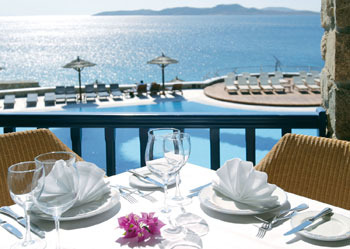
But when I walk into the room, I gasp with pleasure. Pure white marble stretches from one end to another, leading from a private steam and Jacuzzi room, onto the stone patio where our personal infinity pool stretches our imagination into the depths of the Mediterranean waters. As I sip on the local masticha liqueur staring at the beach Ayios Yiannis, where the movie Shirley Valentine was filmed, I shrug, thinking – if all else fails, this wouldn’t exactly be the worst place to celebrate our anniversary….

Flash-forward a mere day later and we are basking in the hot sun, swaying to European beats on the fabulous sandy beaches of Mykonos (from smaller ones like Ornos and Psarou, to the bigger ones like Platys Gialos, Paraga, Paradise and Super Paradise), keeping our eyes peeled for the many international and Greek celebrities that have summer residences on this sophisticated and upscale island.

Screen Shot 2017-07-25 at 4.48.02 PM

True to their word, the local weather predictors were bang on mark and there is no sign of the unpredictable ‘meltemi’ that sent us into the depths of misery, which cancelled many a ferry and has been responsible for many a skirmish fought on the famous Aegean Sea. In Greek mythology, Mykonos was the location of the battle between Zeus and the Gigantes and the island was named in honour of Apollo’s grandson Mykons.

Chora (Mykonos town), set around a picturesque fishing bay, holds its own with a cosmopolitan character that is surprising in its quaint environs, where tourists jostle into fabulous little boutiques and designer stores. It is preferable to stay in a deluxe resort on the outskirts (with convenient access by bus or car) rather than in town, where a sea of small whitewashed rounded buildings nudge each other on a haphazard labyrinth of cobbled winding roads originally intended to confuse pirates.

Screen Shot 2017-07-25 at 4.48.46 PM

The town bewilders the layman and would undoubtedly leave you clutching a map and still walking in circles, trying to stick to Matogianni Street (the main shopping path). It is not surprising to find a local lounging against his shop, smoking and watching you with snickering amusement, as many a tourist has fallen prey to the deceptive streets, more often than not tumbling over Petros, the local Pelican – a Mykonian mascot for half a century. Despite that it’s hard to miss probably the most photographed church in Greece, Panagia Paraportiani – a group of chapels merged into what was once described as an ‘organic masterpiece of accidental architecture’ – standing on a once-fortified piece of land.

Paradise Beach, ranked as one of the top 10 beach party destinations of the world, lives up to its name and reputation, resonating with music that would make your pants fall off and an environment that would probably make you want to do just that! With world-famous deejays making their rounds in Mykonos in the summer (July-August), non-stop parties that race into days and pour into the ocean, with a flood of people from every part of the world picking their slice of pleasure, Mykonos rocks it up, shakes it around and splashes it down until you are left buzzing with wonderment. Designated beaches like Super Paradise encourage the gay population to come out of the closet and escape into the ‘open’ sunshine without reproach. I covertly watch two nude European women, lovingly rubbing suntan oil onto each other, as I snuggle closer to my husband.

If huge crowds and racy partying is not your cup of holistic pleasure, June or September is the perfect month for unadulterated relaxation on this seasonal haven. It is then easy to find a tranquil spot on the Chora waterfront, watching the ferries dotting the clear skyline, over platters of fresh seafood at a local café. Come evening, we find a spot in Little Venice, constructed right onto the sea’s edge with precipitous balconies peering onto foam washed pebbles, where one wrong stiletto step or an awkward bump would send one reeling into the turquoise waters. Throbbing with bars (Caprice and Mykonos Bar are to die for) and fine dining restaurants overlooking the famous quartet of Mykonian windmills it is possible to romance the night away in this Grecian Venice.

Later, as I lie back in one of the sunniest areas of the world at the Althea Spa of our hotel facing the sacred island of Delos and relaxing with a traditional Greek olive oil massage, I am told this very spot attracts the highest concentration of cosmic energy. The cosmos has definitely worked overtime to ensure that true bliss touches my fingertips and sends a flood of pleasure into my life, even if for a mere week.

screen-shot-2017-07-25-at-4-48-16-pm.jpg

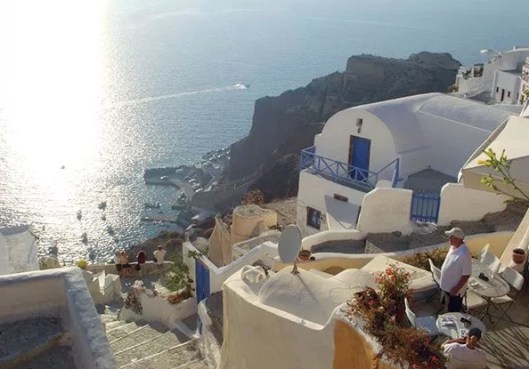
Perched on the edge of a cliff, overlooking fragments of a dormant volcano afloat in the Mediterranean waters, probably the only one in the world with its caldera in the sea, the sun performs its daily ritual. This is the famous SANTORINI sunset – which people fly out miles to watch, for which people spend a king’s ransom to get married against, in front of which writers in desperate need of inspiration stumble around. Santorini is what poetry, dreams, flights of fantasy and destination weddings are made of. As the sun’s rays sensually explore the riot of volcanic colours, naturally changing hues through the day, surrounded by the deep, blue sea, the sight brings a flood of lyrics to the tip of one’s tongue, a calm sensibility and yet an eager uneasiness to capture this eternal moment, at a place where civilisation has existed since the third millennium, BC.

From the heart of a natural catastrophe – volcanic eruptions that destroyed the island many times – has emerged spectacular beauty and tourist exploitation. As visitors throng onto the harbour in hordes, I let the pace slow me down, let the feel of the island’s majestic appeal sink into me. The cliff rises steeply into the sky and if you are one of the lucky few to have taken the high-speed catamaran ferry or a flight, then you can take the road up to the top of the cliff, where most of the towns with spectacular views are located. The others that arrive via bigger cruise ships have three remarkable options ahead of them: walk (only recommended if you are intensely fit or a masochist), ride abreast a donkey (bumpy, to say the least), or take a cable car (wait in long lines if it’s peak tourist season).

Screen Shot 2017-07-25 at 4.49.02 PM

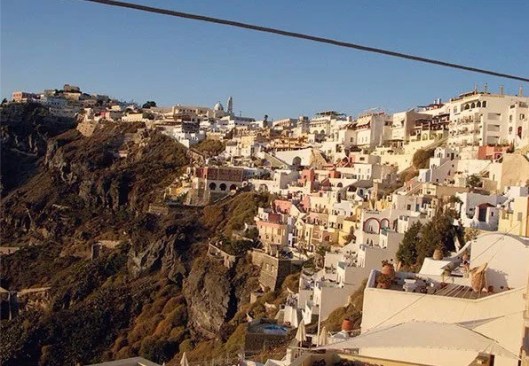
Arriving in a record 10 minutes by car into the capital town, Fira, I watch amazed as the panorama unfolds before me. In desperately steep winding, cobbled paths, that doth not inebriation or an erring footstep forgive, lies the town – twinkling, as if quietly amused by the next batch of tourists that has arrived, to match wits with its killer (and I mean that with every kind of pun intended) location. The town is built vertically up or horizontally down, whichever way you prefer to look at it. Every hotel and every room lies one below the other, accessed only by the sheer pedestrian path. With horror and growing dread, I realise the implications vis-à-vis luggage and a bout of daily extreme exercise! Fear Factor material, I believe.

Porto Fira Suites, a charming hotel located amidst a cluster of Byzantine and post-Byzantine, Cycladic architecture, welcomes us warmly with slightly raised eyebrows at our immense bags (no, it is not an Indian thing, and it definitely wasn’t too many pairs of shoes)! Having exchanged notes with other tourists on the ferry, I understand that many have chosen to stay out of the main town, in places like Imerovigli (the ‘balcony of Santorini’), Firostefani and Oia, or on the outskirts of Fira in bigger hotels, like The Majestic. Some, like us, have decided to pay the price (literally, for a room with a view is exorbitantly expensive) of being bang in the midst of all the action, where shopping, food and nightlife is but a precipitous walk away.

Strolling around Fira, we stumble upon a gold mine – literally. The path is known as ‘Gold Street’, peppered as it is with shops selling every kind of gold jewellery and antiquity. As I steer past the glitter I swerve into the bylanes of the buzzing Erithrou Stanrou street, which I chose to nickname ‘Party Street’. From an Absinthe Bar called Casablanca Soul to nightclubs like Enigma, that don’t even begin to open an eyelid before 1 am and start rocking the daylights off the volcano in the wee hours of the morning, I discover with incredulity that Fira has its share of a big party scene.


We choose to drive around in a racy convertible with the top down, stopping by for a bout of local wine tasting thrown in for good measure. Santorini, depicted as the island of volcanic mystery and sheer cliffs, gently merges into the water on the other side, with exceptionally colourful beaches. Kamari, on the southeastern side of the island is the most international place to lounge upon. I realise, that walking barefoot on the hot volcanic sands can be a tad scalding, so it is advisable to keep those flip-flops on! There is no better place to get a killer tan than on these beaches that simply soak up the sun.

While both of us wait for the sun to set in Oia, on the other side of the island, renowned for the world’s most beautiful sunset over the caldera, the hours simply fly by, as the sun’s rays flecked with the dark hues of the deepening volcanic earth, move slowly down our bodies and into the depths of the water, leaving behind a sense of peace, fulfillment and accomplishment. This is one sunset that is difficult to walk away from….

Saawariya: Review

Tags

, , , , , , ,

Published: Verve Magazine, Screen, December 2007

Sanjay Leela Bhansali’s fantastical and surreal Saawariya is a lyrical odyssey that could have been explosive as a theatrical performance or a stage musical, opines Sitanshi Talati-Parikh

Evolving the vibrant medium of cinema a notch further has been considered the auteur of Sanjay Leela Bhansali. In his latest offering, Saawariya, he draws from Fyodor Dostoevsky’s short story, White Nights, where a vibrant youth enters a snowy, mystical hillside town only to be carried away in a fantastical love affair over four surreal nights. Despite the gaps being filled by a good soundtrack, the lyrical odyssey stretches and the story is not a perfect flow through the frames and between the songs. It would have worked better, had the songs been half the number, the scenes more tightly wound and the characters allowed to develop fully. Alternatively, this could have been explosive as a theatrical performance or stage musical.

With Saawariya, the film-maker brings a superb theatrical effect to light. Drawing from the paintings of Frederick Arthur Bridgman, Fred R Wagner and William Louis Sonntag, visualiser Ravi Chandran has made Omung Kumar’s stylised sets come alive, with the use of space lights (a first for India). Add that to excellent costumes by Reza Shariffi (Ranbir Kapoor) and Anuradha Vakil (Rani Mukerji, Sonam Kapoor), the look of Saawariya is larger than life. The movie, however, doesn’t work evocatively, even if it does enchant. His multi-hued extravaganza just misses the exacting moment, when a painting comes to life.

The beautiful canvas may just be too well crafted. As the actors appear on this canvas to enact a sequence of events, the space appears too perfectly composed, too posturised, leaving the characters distant from the audience. As Sakina (Sonam) drifts past on the waters with her arm extended, it is dramatic and unreal at the same time. Suddenly that feeling changes, when accosted with Lillianji (Zohra Sehgal) and Gulabji (Mukerji). They spring to life and the film abruptly loses its dream-like detached quality. Raj (Ranbir) splits between the gaps and opens up on screen, as an identifiable character, but one is unable to get a lasting feel of his emotions as they scatter across the canvas.

The fresh, lively faces of the newcomers light up the screen. Ranbir exceeds expectations, while Sonam Kapoor shows potential. The lack of chemistry between them, if intentional, works at a subterranean level, to hint that it is a doomed love story, but the missing chemistry – between Imaan (Salman Khan) and Sakina – has no explanation. It is easier to be moved by Lillianji’s grief, as she is left alone, than it is to sympathise with the protagonists.

Bhansali’s experimental cinema is always a welcome change from the mundane histrionics of mass cinema. Whether the audience is able to accept the shortcomings of Saawariya in light of its positive movement towards evolutionary cinema that breaks with convention, is left to be seen.

Travel blog: Romancing the Ringstrasse (Vienna)

Tags

, , , , , , ,

Published: Verve Magazine, Travel, November 2007

It’s a modern city with a romantic soul. Vienna’s majestic royal palaces, quaint coffee houses and famed tradition of outstanding opera music evoke a bygone era of refinement and grandeur. Sitanshi Talati-Parikh walks through the heart of the bustling Austrian capital and succumbs to its elegant charm and deliciously slow rhythm

Vienna01

A ring of fortune, history and spectacular beauty drifts in with the sound of music. The tune has been heard a million times before and is unforgettable. The inner circle of Wien, the Ringstrasse, the city centre or first district, holds me spellbound. The flight attendants were not joking when they said, “We are landing in Vienna. Move your watches back a hundred years in time!”

It’s true. Despite its modern fittings and the latest technology, Vienna still maintains its old-world charm. So much so that I half expect one of the locals to raise his hat and bow in greeting. Baroque architecture jostles for space with Art Nouveau in this predominantly Catholic city overflowing with museums, cafes, opera houses, and churches.

As tourists mingle with locals at one of the Kaffeehaus (local coffee houses), I observe the age-old tradition of taking time over the brew, savouring a pastry, smoking a cigarette while reading the papers, gabbing or even composing (let’s not forget the legendary Mozart spent most of his days in cafes). This is one city that knows how to work and how to unwind. It might lack the breathless pace of a New York or London, but Vienna more than holds its own with a charm that is distinctly European.

It’s as if time has stopped – that it has raced through the city centres of the world, found its home in Vienna and is resting here. The thought makes me want to take a breather as well. Breaking my stroll through the Museum Quarter, I lie down on the crisp green grass and watch the world enfold before me.

A contemporary art exhibition at Vienna Secession, the world’s oldest independent art institution devoted to contemporary art, catches my interest. Art here, I realise, resides not only in the paintings, but also in the buildings, the music, the thinking and the pride of the people. This in itself is not without irony as many of these beautiful buildings (especially the Secession and Staatsoper) were genuinely disliked by the people when they were first built! Names roll off a local tour guide’s tongue as she rattles off names of architects, musicians and painters in a single breath. I learn that Otto Wagner, one of the most prominent Viennese architects, is among those one has to be grateful to for some of the splendid structures in the city.

Across from the Museum Quarter, the Hofburg Imperial Palace, which has hosted some of the most powerful people in Austrian history and is the residence of the President of Austria, is also a stop for the famous Fiakas (horse-driven carriages). Again, I’m back in time. For a princely sum of 40 euros, I can take a Fiaka ride around much of the Ringstrasse and relive the grandeur of the past. It is, however, the former summer palace of the Habsburg family, Schönbrunn, with its magnificent gardens, that is considered the ultimate palace experience in Vienna.

Baroque and Gothic, the imposing Stephansdom (St. Stephen’s Cathedral) is located smack in the heart of the city centre and is a beloved favourite. It’s always eventful to walk from the Wiener Staatsoper to Stephansdom through the pedestrian path paved with shops, cafes and performers. Watching the clever, talented performers, I snack on some traditional fast food — a Würstelstand or a sausage shoved into a humungous bread roll. A particularly tasty variation is the Burenwurst and Käsekrainer (sausage filled with cheese). It’s not unusual to find the stands crammed with kebab (Turkish sandwiches) and pizza offerings as well – a new addition to the fast food culture, I’m told.

Sitting in one of the cafés, I’m awestruck by the power of a middle-aged opera singer’s operatic vocals, amused by street performers vying for our attention with their jugglery, tricks and colourless jokes and quietly entertained by a pianist who rolls in her piano into the street to play to an appreciative audience.

The famed music culture of Vienna is outstanding. From street musicians to fabulous operas and ballets, Vienna throbs with exquisite sounds. I choose to attend the modern rendition of The Nutcracker, playing at the magnificent Wiener Staatsoper (Vienna State Opera). It’s a stunning performance, never mind the audience’s claims — overheard between acts over wine, chocolate and caviar – that it did not quite measure up the original.

An elegant local tradition is to enjoy a performance followed by a walk to the Sacher Hotel nearby to savour the original Sachertorte (a dessert composed of several thin layers of dry, slightly bitter chocolate cake with apricot jam in between, served with dollops of sugarless whipped cream) and rub shoulders with the best. Legend goes that the original torte was made by mistake by young apprentice Franz Sacher in 1832. Of course, it’s now world famous and Sacher Hotel’s best kept secret, even involving a long legal battle! Personally, I found the Appelstrudel and other pastries more exciting than the over-hyped Sachertorte. But the Sacher industry thrives as no tourist comes away without experiencing the original.

A great way to end the walk — drinks and dinner at the cosmopolitan DO & CO Stephansplatz with its spectacular view over the cathedral through full-length glass paved walls. I get a taste of refined Vienna as I tuck into the local weiner schnitzel (Viennese breaded veal cutlet, with various accompaniments) and watch bankers and high-profile associates in muted conversation.

I walk slowly back to the sophisticated Le Meridien, conveniently located on the Ring, across from the Staatsoper. As I enter, I witness a happening fashion party – with a showing of LISKA, one of the oldest fashion houses in Vienna. Swinging with some of Austria’s hippest, I take quick notes on the latest trends for Autumn-Winter 2007. A-line dresses, capes, clutch bags (particularly the crocodile leather sort), wide belts, patent leather boots, feathers and fringes are the latest ‘it’ sensations.

I suspect the Viennese temperament — sentimental and nostalgic — is rubbing off on me. In the wee hours of the morning, exhausted, though not world-weary, I stand by the long paned windows, staring out at the now peaceful, tree-lined Opernring Road. I pretend I live in this posh area.
This memorable walk across one of the finest cities in the world makes me want to believe this is home. I really don’t want to leave. Not yet.

Travel blog: Viennese Waltz

Tags

, , , ,

Published: Verve Magazine, Travel, November 2007

Exult in the city’s rich delights

Suburban toast
Suburban Vienna is the place to try new Austrian wines and relax at a local Heurigen. These are the only places authorised to serve new wine, often accompanied by elaborate Viennese specialties or basic bread and cheese platters.

Deconstructed designs
Austrian fashion designer, Helmut Lang, is renowned for his minimalist, deconstructed designs. Originally from Vienna, Lang branched out to international fashion capitals like Paris and New York, with his own label.

Schrammelmusik for the soul
This Viennese folk music, popularised by the Schrammel brothers, Johann and Josef became immensely popular with the elite who were bowled over by the melodious, melancholic sound. A typical ensemble comprises two violins or fiddles, a double-necked contraguitar, a G clarinet and often, a button accordion called Schrammelharmonika. Many of Vienna’s famous composers, like Strauss, Brahms and Schönberg were Schrammelmusik enthusiasts.

Edelweiss blooming
The Edelweiss lives up to its translation of noble and white. Though found in other European nations, Austria’s national flower has shaped the world’s image of the county and the Alps. The Sound of Music’s most beloved song is dedicated to this little, big flower.

Coffee, anyone?
The Viennese are very serious about their coffee, traditionally served with a glass of chilled water. It’s sacrilege to just say you want ‘coffee’ when you’re spoilt for choice with varieties like Kleiner Schwarzer (small black coffee), Großer Brauner (large coffee with cream), Melange (coffee with milk), Kapuziner (small black coffee and a dash of cream) and Kaisermelange (coffee, milk, egg yolk and cognac). In the late 19th and early 20th century, leading writers frequently met and wrote at Viennese cafés, where much great music was also composed.