• About
  • Brand Building
  • Film & Drama
  • Writing: Arts & Lifestyle
  • Writing: Interviews
  • Writing: Luxury Brands
  • Writing: Travel

sitanshi talati-parikh

sitanshi talati-parikh

Category Archives: Interviews: The Arts

Record Breakers

28 Tuesday Oct 2008

Posted by sitanshi talati-parikh in Interviews (All), Interviews: The Arts, Publication: Verve Magazine

≈ Leave a comment

Tags

Music, vervemagazine

Published: Verve Magazine, Nerve, October 2008

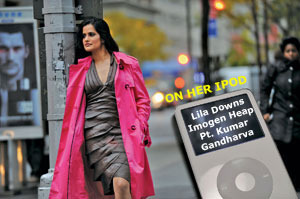
Two rocking women have something new to offer. Sona Mahapatra is singing a different tune and Anushka Manchanda is jamming with a new band when she’s not trying daredevil stunts in Fear Factor – Khatron Ke Khiladi. Sitanshi Talati-Parikh turns up the volume

Katrina

SONA MAHAPATRA

Tell us about your latest song, Diljale and album, Raat/Din. What’s exciting about it?
Diljale is a rock power ballad that celebrates the pain of loneliness, the beautiful void. The album, Raat/Din is really exciting because we believe it’s India’s first soundtrack rock album. The music is heavily influenced by the films of David Lynch and Wim Wenders. And the launching is unique: a totally digital launch worldwide, starting with Diljale, followed by subsequent songs with finally the whole album releasing by the end of the year.

Indie vs. film, what’s your take?
They’re two completely different genres today. In film music, you’re mostly interpreting other people’s ideas, while with independent music you’re expressing your own. There was a time when film songs were about ideas and expression and taking a narrative forward, but sadly today there are promotional tools and have drifted further away from meaning, the notable exception being Gulzar saab. I prefer being on stage above all else!

Anushka

ANUSHKA MANCHANDA

Do you rock just as much behind the scenes?
I quit being a VJ on TV to focus on my music and my career as a playback singer, and haven’t regretted the decision. As a performer, I get to travel the country and the world, and being on stage, I have never missed the limelight. I’m the same person on and off camera, and am comfortable both ways.

Tell us what’s exciting about your ‘electro rock n pop’ band, Shkabang?
Shkabang is here to play some good music and to have a blast doing it. We’re pretty elastic as a genre, but love bouncy grooves and bass lines. The boys are all hotties, and I’m trying to get at least one of them to play topless.

What was the most challenging part of Khatron Ke Khiladi?
I’m not a very good swimmer and I’m petrified of being underwater. I almost drowned in a pool as a child, and even though I absolutely love being in the water, I panic when it’s deep. So all the stunts involving water would have me freaking out!

Do you write your own songs?
Yes! There was a time when I only wrote about heartache and stupid boys. Now, I see things around me that make me stop and think, and I write about them.

Rohit Gandhi: Real Impressions

20 Saturday Sep 2008

Posted by sitanshi talati-parikh in Art, Literature & Culture, Interviews (All), Interviews: The Arts, Publication: Verve Magazine

≈ Leave a comment

Tags

Documentary, indiancinema, Interview, Rohit Gandhi

Published: Verve Magazine, Nerve, September 2008

With an impressive dossier of news stories that include live coverage of the Kashmir elections, Iraq conflict, Afghan War, the tsunami tragedy, Nepal’s royal coup, and an Emmy nomination for his recent film, Who Cares About The Girls, documentary filmmaker, Rohit Gandhi, speaks to Sitanshi Talati-Parikh about women in India and the role of journalism

Screen01

In the making of the documentary Who Cares About The Girls, which has been nominated for an Emmy award in the Outstanding Investigative Journalism – long form category, Rohit Gandhi, who is particularly interested in children – seeing that they are our future – describes how after weeks of research, a 14-year-old girl, Radha (name changed), was chosen by the NGO to be the one rescued from her abusive father and sister. He recalls with regret and anger that while the rescue took place as planned, the girl was produced in court and was released as the cops did not explain the circumstances under which the girl was rescued and, despite their best intentions, they could not help her.

The story revolves around four characters: two sisters who were sent away from home to work as child labourers, who were both sexually and verbally abused; a former sex worker-turned-activist and a rescued girl. Though it describes how children continue to be abused, Gandhi believes that there is a positive future ahead if we all get together and fight the problem. After all, “There is no magic wand to change the reality today.”

Gandhi takes his work in his stride – not wishing to become the face of any story, rather letting the story speak for itself. “It is providence to be in a position to be able to make a difference. Journalism is an opportunity to be a mirror of society, help reflect on what we are doing in our daily lives. It compresses space and time and gives a picture of our present reality.” In much the manner that his moving story on a young Iraqi boy who was severely injured by a bullet in the midst of the US-Iraq gun fire, came to the attention of the ambassador of Greece, who took the boy to Athens for treatment and brought his life back to normalcy.

The sociologist says that he knew where he was headed very early in life and that the things that need to be changed are not sitting hidden in sub-Saharan Africa, but right under our noses. “Evils of society happen right around us,” he states, moving on to describe one of his first stories – from the Tihar jail. He believes that putting criminals away in our jails makes them even more hardened criminals – and his story tried to bring about a positive change, in this “very evil system.”

The journalist who has worked with numerous national and international TV channels, and has been the recipient of many awards including an Emmy for his war coverage in Afghanistan in 2001, believes that Indian society respects its women a lot but at the same time treats them very badly. “Traditionally, we were not like this – we have lost our roots. We need to change that. Education, not just literacy, is the mantra.”

Larger Than Life

27 Friday Jun 2008

Posted by sitanshi talati-parikh in Art, Literature & Culture, Interviews (All), Interviews: The Arts, Publication: Verve Magazine

≈ Leave a comment

Tags

Art and Design, Indian Art, vervemagazine

Published: Verve Magazine, Nerve, June 2008

Inspired by ‘life’, 30-year-old installation artist Ranjani Shettar has created a buzz among the art circles, particularly in the US. She draws inspiration from deep-rooted Indian culture and traditions and finds a spiritual cognizance with the wispy installations that she has unwittingly made her signature style, incorporating simple materials like coconut fibres, resin, terracotta, wax, twine and metal in her work. Sitanshi Talati-Parikh talks to the artist from Bangalore who refuses to keep track of the marketability and rates of her works

Artmart04

Entitled Sun-sneezers blow light bubbles, Ranjani Shettar’s first solo show in a US museum is currently on at the Institute of Contemporary Art, Boston, Massachusetts, where suspended sculpture made with steel, tamarind powder and muslin is fashioned into organic shapes reminiscent of soap bubbles, containers of light or multiplying cells, creating a dreamy ambience. The artist, also concurrently showcasing at the prestigious 55th Carnegie International, Pennsylvania, isn’t sure of who has influenced her works through time. “The answer keeps changing every time someone asks me that question!” she remarks. Currently, she holds weight by William Kentridge, Martin Puryear, Eve Hesse and Tim Hawkinson.

Shettar prefers to use simple materials like thread and wax to car bodies and silicone rubber. “Ranjani Shettar’s use of materials both organic and man-made suggests the complex cultural associations of India and the collision of tradition and modernity,” opines Jill Medvedow, Director of the Institute of Contemporary Art.

She was very clear about her choice of installations over paintings. “My visualisation is in three dimensions and so it is much more natural for me to sculpt than paint.” She finds it more comfortable to work in space rather than on a flat surface, where she enjoys the act of involving herself physically and completely in the making of the work.

Originally trained as a sculptor, she started off in a classical way, with figurative sculptures in clay, wood, plaster and stone, where she learned to use the materials and her hands. It was a slow and gradual transition from the figurative to the abstraction. “Somewhere along the way,” she realised, “I needed to expand my choice of materials to be able to express myself better and that’s when I started using materials from my own surroundings.”

Shettar’s works straddle urban and organic forces. This is not surprising as she believes that, “each one of us is a reflection of our own surroundings, upbringing and our own mind. I have grown up being close to nature in a rural set up with my essentially urban family.”

Literature: Second Comings

26 Wednesday Mar 2008

Posted by sitanshi talati-parikh in Art, Literature & Culture, Interviews (All), Interviews: The Arts, Publication: Verve Magazine

≈ Leave a comment

Tags

Interview, Interviews: Travel, Literature, vervemagazine

Published: Verve Magazine, Features, Travel, March 2008

With 27 novels and 14 books of criticism and non-fiction under his belt, Paul Theroux, American travel writer, who has spent extensive time in Asia and Africa, is ready to release his latest travel chronicle later this year. On his recent visit to the city, the writer of the best-selling The Great Railway Bazaar, and the winner of many an award, regales fans in Mumbai

Travel01

I wonder what a prolific travel writer would be like – well read and engaging? Paul Theroux is all of that and more, poetic at heart, and likely to espouse on his literary influences rather than his own work. Able to look at himself with humour and reticence, he remarks after being warmly introduced to the audience at a panel discussion, “Now, I begin to believe in myself.” Visiting Mumbai by chance when the Calcutta Book Fair got cancelled at the last minute, Theroux decided to tour the country for three weeks as a guest of the State Government.

Dreams of India began in the early 19th century, in the neighbourhood where Theroux grew up and are alive to this day. Ralph Waldo Emerson circulated copies of the Bhagwad Gita amongst his friends. Henry Thoreau and Mark Twain were both inspired by India. Twain’s Following the Equator, in turn, was a great source of inspiration for Theroux. Richard Henry Dana served as his role model, the perfect travel writer – bold, brave, uncomplaining, with an ability to survive discomfort. “When I thought of my first travel book, I thought of going to India and in the most interesting and unforgettable way – by train instead of plane.” Wanting to connect it to where he lived earlier–London–Theroux, studying a map, figured it was as simple as joining the dots. The journey turned out to be memorable enough to make for a fascinating travel book.

Paul Theroux’s recent visit to India is all about second comings. As he often notes, there are exceedingly few travel writers who have been able to return to a destination after having made a journey there once. In fact, all the great ones haven’t been able to do so. “When you get older, the world changes – in ways you cannot guess – it is possible to make predictions, but one cannot see into the future.” He remarks, tongue-in-cheek, that he had a choice – to take his own trip again, or leave it up to some 20-year-old in search of a book, who would write it, probably, not as well!

Theroux points out, ironically, in the age of globalisation and in a flat world, what was possible the first time around is often, impossible in the next journey. This was particularly the case with India, where it was no longer possible for him to take the Great Train Journey, like he did many a year ago, with the problems in Pakistan and Afghanistan.

He jokes about a time in Chennai when everyone there could tell him how to get to New York, but not a soul knew whether the ferry to Colombo was running! Taking a realistic perspective he notes, “The world isn’t a village you can go to, and not everyone are brothers and sisters! Over time, some countries close up and others open up.” While Vietnam and Burma may still have oppression, Laos is booming, and Singapore is heralding the brave new world. Taking a ‘prison tour’ in the ‘free world’, however, was enlightening – Theroux chose to see a Stalinist Labour Camp from the ’30s instead of Swan Lake or churches.

Travelling overland, one can really see how people are living, how they are displaced – and it’s many hours (over the quicker air route) well spent. China is unrecognisable – there are ‘ancient charming towns in a big fat city’. According to him, China is the difference between cultural revolution and money, where history hasn’t been kind: ‘Get out of the way, or we’ll run you over – a road is coming up over the pagoda!’

Theroux feels that India is not in the same boat. Attached to its past, there is a certain ‘changelessness’ about India – like the three-legged dog that will eternally roam the streets of the country. “It is like a hall of mirrors, looking down to see if it is continuous.” And the change is positive – the traveller determined to see the new India is certain to visit a call centre to meet Tarun aka Tony from Vikhroli.

As any traveller realises, their perspective of a place they visit is entirely different from that of the locals, or people who live there for long stretches of time. Vociferous about the subjective role of travel writers, Theroux agrees that the experiences could have been very different for any of the travel writers (including himself). Quoting Henry James, “The house of fiction has many windows,” Theroux insists that he is not an objective traveller. “I leap to conclusions and make wild generalisations for a living!” Travel writing isn’t a geographical survey – it is a ‘strange beast’ – its very false and speculative nature is what makes it amazing, autobiographical, and in a sense akin to life.

Words flow easily, as Theroux remarks on his role as a travel chronicler, “I wander aimlessly like a dog, but the writing has to be truthful. A travel book isn’t a love letter – it is the truth as I see it – reconstructed ‘above all to make you see’.’’

Literature: Experimental Writer

26 Wednesday Sep 2007

Posted by sitanshi talati-parikh in Art, Literature & Culture, Interviews (All), Interviews: The Arts, Publication: Verve Magazine

≈ Leave a comment

Tags

Indian Fiction, Interview, Kalpana Swaminathan, Literature, vervemagazine

Published: Verve Magazine, Speaking Volumes, September 2007
Photograph: Ritam Banerjee

A doctor, columnist, novelist and detective fiction writer, Kalpana Swaminathan is often taken aback by the absurd situations that she has been witness to in her multi-hued career. She encapsulates the banality of everyday living in her works as is evidenced by her latest offering, The Gardener’s Song. Sitanshi Talati-Parikh exchanges notes with the diverse wordsmith who delights in dabbling in different genres

Speaking01

Holding a tête-à-tête with the talented, genteel lady, simply clad in a green sari, I sit at a corner table at Crossword, Bandra. Kalpana Swaminathan juggles at being a doctor, columnist, novelist and detective fiction writer, so our conversation sparks off with her unusual career choices. She brushes off any surprise at a paediatric surgeon taking to writing, with a decisive, “You have to be interested in people.”

Sensing that nothing more is forthcoming, I switch gears to what made her start writing. Looking less than pleased, she counters, “What kind of answers do you expect? I wish I could produce something magical.” As a child shouts behind us, Swaminathan visibly softens and warms to the topic. “I love children and I love to write.” She muses, “Medicine as a profession becomes a way of life. You use perhaps ten per cent of what you learn in practice. The other 90 per cent is not used for ‘doctoring’ – it serves a larger purpose, it changes the way you look at things, it changes the value of life.”

Just like one must have a sense for the written word, Swaminathan believes that one has to learn the child’s language and understand it. She defies the myth that children can’t talk or communicate. “It is actually the adult who has to learn how to communicate and learn to understand what the child is not telling you.” It is not surprising then, that she found her stories for children easy to write – they are all fairy tales, with magical things happening in the world.

Swaminathan found herself publishing short stories at the fantastically early age of 13, but soon after went through a lean period where for years she did not get the chance to write, until after the age of 30. She recalls those years as being “rich, harrowing and exciting,” all in one breath, a time when she was studying medicine and working intensely. “When I started writing again, the initial writing was easy – it simply scaled off me. After that, I began experimenting with different genres.”

Around 1996, after her foray into children’s writing, Swami–nathan began writing columns with her colleague and partner, Ishrat Syed. As I wonder if it is easy to write in tandem with another person, she brushes it off as child’s play, simply, “We had to arrive at a distinctive style.” It was an exploratory journey, from Animal Crackers for a daily newspaper, to columns, where they wrote about different things including art, food, “mad” science, literature and lingua franca. She recalls with pride, that in 2000, when the human genome was being mapped out, they tracked its progress, in a week-by-week review column. As if reading my thoughts, about why they haven’t written a piece of science fiction yet, she mentions that their jointly written book is due to be out soon, which is to be a futuristic view of Mumbai.

When the experimental writer wanted to have some fun, she began writing detective stories. Her detective Lalli is accompanied by her niece, the writer of the book. Lalli isn’t the action-oriented detective of the racy thrillers, but the analytical thinker of Agatha Christie’s genre. Noticing the Poirot-Hastings ensemble cast of her novel, I ask the inevitable question. Swaminathan is quick to reply, “Of course, I’ve read Agatha Christie – who hasn’t? She’s a marvellous writer, as all the others out there, but I like to think of my work as my work!” Her first detective fiction, The Page 3 Murders, is a spoof on a country house murder, relocated in Mumbai, where, as she puts it, “everyone lives in each other’s pockets.” In here we find the classic English whodunit.

Tired of men and their sidekicks, Swaminathan deliberately chose an elderly woman as her detective. After all, she points out, an Indian woman would be free to do as she pleased only when post-60 and problem free! Sharp, compassionate and efficient, Lalli, a retired police officer, is considered the man in khaki’s Last Resort (LR) on troublesome murder cases.

The Gardener’s Song, Swaminathan’s latest whodunit on the murder of the nosey Mr. Rao in a Mumbai suburb, is ultimately a Mumbai book, traversing Juhu by-lanes all the way to the dilapidated buildings of Princess Street, opening up the lives and eccentricities of suburban Mumbai households and communities. Her writing is experiential: “I used to know Bombay – not what is has become in the last two or three years, but its largeness, its middle-class suburban experience.”

The banality of everyday life comes under the writer’s microscope – taken aback by the absurd situations that she has often been witness to, it is but natural for her to include these elements in her story. In The Gardener’s Song, for instance, Swaminathan describes an incident where a man is in desperate need of a blood transfusion and the only person who matches his blood type appears on the scene, only to be nearly frightened away at the thought of an HIV test. Aghast by the impact of what a rumour like that could have on his social life and marriage prospects, the donor is vouched for by his employer and colleagues as “a good man, from good family” – as if to imply, that that in itself should be sufficient proof that the man is not HIV positive!

The Gardener’s Song is not lacking in social comment, as if attempting social change in the midst and through the medium of a detective story. This touches a sensitive area, as the impassioned writer exclaims, “I do feel very strongly about these things and cannot help voicing them!” She is angered that the Indian Penal Code has a separate section for dowry death, which is basically “soft-optioning it, not calling it murder.” Swaminathan finds that Indian crimes are crimes of despair, hypocrisy, refusal to face the truth: “We can’t say bad things about people, but we can murder them. We are a cruel, violent and dishonest lot, and those who disagree, do so as they are cushioned by illusion.”

Swaminathan takes a cynical view of women in Indian society, the kind of women who sustain an obsolete patriarchy, and the feminists who are tired of being feminists. She firmly believes that every man and woman should do his or her bit. Believing that the most powerful women in Indian culture are elderly women, she holds them responsible for the crimes committed against other women. In fact, this is one of the reasons that she profiled her detective as an elderly woman.

It is clear that this is a writer who understands her audience and her subject, in equal part. Swaminathan brings out nuances of the local language in her writing, nuances that are completely absent from her crisp spoken English. As we have a dialogue about Salman Rushdie’s theory of “chutneyfication” of the English language, she describes how the language conveys the essence of the person, the local idiom and the flavour of the conversation. A large number of writers attempt to bring their part of India in their writing, as the local dialogue is a bridge between writing in the local tongue and writing in English. It is in this manner, that the language comes alive and it is easy to move between time and place, to enter and explore a region and lives in a way that one can’t imagine. In fact, a lot of the conversations in her books are taken verbatim from real life.

Swaminathan isn’t disconcerted about the dearth of detective fiction in the country. Publishing in English, in India, she explains, is only 20 years old; she expects to see a great deal more in the next five years.

Taking a few moments for this thought to sink in, the middle-aged writer, who finds the time to write on a daily basis, whilst actively practising, notes that writing per se has less to do with the craft and more to do with the experience of being a writer. And what is it that she, as a writer looks for in her work? Sitting back, taking a sip of chilled water, Swaminathan smiles and says, “Every writer is looking for two things – the inspiration to write at least one line of truth, and the aspiration to write a book!”

Lillete Dubey: The Performer

20 Friday Jul 2007

Posted by sitanshi talati-parikh in Art, Literature & Culture, Interviews (All), Interviews: Cinema, Interviews: The Arts, Publication: Verve Magazine

≈ Leave a comment

Tags

Bollywood, indiancinema, Interview, Lillete Dubey, vervemagazine

Published: Verve Magazine, Features – Multiplex cinema, July 2007
Photograph by Kunaal Roy Kapur

She calls herself ‘an accidental film actress’. Lillete Dubey has made a mark for herself as an acclaimed character actor in films like Monsoon Wedding, My Brother Nikhil and the soon-to-be-released Bow Barracks Forever. In a freewheeling chat with Sitanshi Talati-Parikh, she describes how small-budget films have given rise to an independent, alternative voice in Indian cinema

Lillete

As I wait for the husky-voiced, charming character actor of substance, I potter around her intimate boudoir with its coffee-table tomes, old family photographs and bright silk cushions. Finally I meet the “died-in-the-wool theatre person”, who insists on calling herself an “accidental film actress,” whilst she is getting primed for the Verve shoot. Over lemonade and cheese toast, the intuitive, friendly and very “non-filmy” Lillete Dubey, jumps right into the topic at hand.

When I ask her whether alternative cinema began getting a decent showing after the mushrooming of multiplexes, she begs to differ. Dubey strongly believes it is the changing expectations of the audience that has given rise to a different kind of cinema. Multiplexes have given a platform, an alternative to mainstream, commercial cinema; but it was something that was coming – people were getting tired of having no choice. Everything, she believes, is a by-product of audience tastes.

Lighting a cigarette, Dubey explains that in her younger days, the audience did not have the choice to see anything besides Doordarshan. Today, due to the sudden advent of cable TV, media exposure and foreign films, there is a much more sophisticated audience. Their demands and expectations are different. The new discerning audience is not happy with the “seven-dances-in-Switzerland” kind of cinema. A synergy between all these elements, including the rise of multiplexes, led to the creation of what she calls, the “small-budget film”. “There isn’t ‘art’ or ‘offbeat’ cinema, simply “big-budget” and “small-budget” cinema.”

Small-budget films have given rise to an independent, alternative voice in Indian cinema, the likes of My Brother Nikhil, Bheja Fry and Monsoon Wedding. Here, the story and performances drive the film. Dubey believes this is what differentiates the two kinds of cinema and why so many movies with huge stars and hype are not hits. This is the reason why a ‘multiplex’ film, made well and within a tight budget, has very high chances of doing well, whilst the risks of a big-budget movie are commercially much higher.

Dubey rues the dearth of good character roles, especially for women, in Indian cinema, a fact that is slowly changing with the advent of smaller, independent films. The talented actress, whose upcoming ‘multiplex’ movie is the ensemble English film, Bow Barracks Forever, about Anglo-Indians in Kolkata, says thoughtfully, “Most actors (including me) would say, ‘I’ve never got the role that does me justice.’ That may sound presumptuous, but it is the remark of someone who is still striving to better than what they’ve always done. Any intelligent actor will always hanker for something richer, better, more complex, more difficult and more challenging. That’s the nature of the animal.”

Dubey agrees that a film-maker should keep trends, profiles and tastes of audiences, economics and universal appeal in mind when making a film. However, she strongly believes that if a film is made from the heart, with a good story, it will work better than a movie contrived with too much agenda. “In the end,” she smiles, “good cinema or any creative art is simply about illuminating the life we live.”

Q&A with Jeev Milkha Singh

26 Friday Jan 2007

Posted by sitanshi talati-parikh in Interviews (All), Interviews: The Arts, Publication: Verve Magazine

≈ Leave a comment

Tags

Golf, Interview, Jeev Milka Singh, vervemagazine

Published: Verve Magazine, Features, January 2007

His winning streak in 2006 – after a seven-year winless drought – has made Jeev Milkha Singh the first Indian ever to rank in the top 50 on the European tour. All set to make his debut appearance at the US Masters 2007, the golfer talks to Sitanshi Talati-Parikh about his myriad experiences on the international circuit

Sincere dedication and a tough fighting spirit have seen Jeev Milkha Singh emerge victorious against all odds last year. Suffering from injuries, India’s first golf superstar surmounted a testing seven-year winless drought with a one-stroke victory at the Volvo China Open in April 2006. A graduate in golf, from the Abilene Christian University in the United States of America, 35-year-old Jeev won the NCAA Divison II individual golf championship in 1993. He was the first Indian golfer to become a member of the European Tour and the US Tour. Keeping up the family tradition apparently comes easy to the sportsman – his father is the ‘Flying Sikh’ and Olympics athlete, Milkha Singh and his mother, Nirmal Kaur, is the former captain of the Indian volleyball team.

Jeev celebrated his birthday last month in a special way, playing at the Volvo Masters of Asia, on the second day at the Thai Country Club – having already won the Volvo China Open and Volvo Masters of Europe. A group of caddies sang for him, as he blew the candles on his birthday cake at the club. At the Asian Tour award function held in Bangkok, he swept three prestigious awards, including the inaugural category for ‘UBS Special Achievement’ for 2006 in addition to winning the ‘Players’ Player of the Year’ and the ‘UBS Order of Merit’.

With a career in steep ascent – his ranking jumped to 37 at the end of the year – 2006 has been an excellent year for the golfer who is currently Asia’s top ranked player. The first Indian ever to figure in the first 50 in the European tour, having recently played with the world champion, Tiger Woods, Jeev Milkha Singh talks with confidence and ease on his birthday, about his experiences and dreams.

Your father once said, ‘Let not people say you are Milkha’s son. Let them say I am Jeev’s father.’ How does he feel about your resurrection in the game?
I think I have found happiness. I am a firm believer in discipline, hard work and honesty in the sport. So far, it has worked out well. My family is pretty proud of me. Without doubt my father has achieved a lot and I feel now that I am getting closer to that pinnacle.

Both your parents are sportspeople. How did they feel about you choosing a sport that was new to the country at the time?
My family has always been very positive and supportive. They did tell me, ‘If you take the plunge, then there is no coming back!’ Whatever I chose, the aim has always been to be the best. I have been very fortunate with those who have helped me reach here. I remember the time when I had discussions with my coach in the US, talking about becoming a professional golfer – and now I have.

What change in mindset drove you to these great heights after your many trials?
It has taken a lot of mental training, hard work and I also changed my swing. Every human being is result oriented. It is all about process and routine. For me, for six years, only the result mattered. The change in my mindset has finally made a difference and it shows in my performance.

What was your experience with the peaks in your career and what have you learnt from the downs?
The game of golf is like a roller coaster. One week you are the best and the next week, you are nobody. No one can be at the top forever – unless of course, you are Tiger Woods! Even now, where I am, I know it is only temporary and the down is around the corner. One can never stop working hard and being mentally strong. It is a mind game and humility makes a big difference.

You recently played with Tiger Woods for the first time….
I was nervous playing with Tiger Woods. But he immediately put me at ease. He is really the best sportsman in the world and I felt comfortable playing with him. It is the greatest thing one golfer can do for another – make someone else relax. I learnt a lot from him, the way he conducts himself, his routine.

What do you think is the future of Indian golf? Do you believe this game can ever match cricket as a favourite sport for the Indian masses?
That is a tough question. I hope and believe that golf in India will come close to cricket in the next 10 years. With due attention being given to it by the performance of the players, enough sponsorship and more money, it may just reach its potential. If we are to do this for our country now, we need to get responsible.

Do you believe that you would have achieved what you did if you had trained in India alone?
Technically, I don’t think so. In India, there is hard work, but no places for practice. There are not enough public courses available. If the common man has to think about playing golf, where can he go? The government should be much more involved. With cricket, for instance, one can go to a park and get started, but it’s not the same for a game like golf.

Do you believe that women will find an acceptable and serious place in golf, especially in India?
I have seen young talent in our country. It can definitely happen here, just like in Japan, where the ladies’ tour is ranked higher than the men’s!

What does a man who has so many firsts want out of life?
I have been very fortunate in what I have achieved. I would like to give something back in return. I want to make this game popular, garner attention and make it seem like a possible dream to get here! One should always dream bigger and take a chance and go for it. I think with sponsorships, big tours, getting the government to open public courses and getting the private courses to give membership to young talent would be a start! In a few years I look forward to starting my own golf academy.

Being one of the busiest players in the world, how do you like living this nomadic lifestyle?
I love playing golf and it is a dream that I am following. I travel worldwide, fulfilling a dream to play well, perform well and make my country proud. Yoga is something that helps me stay relaxed and controlled. I am a huge movie buff, I’m fond of everything – Hollywood, Bollywood and even television shows. Presently, I am watching season five of 24! I love watching Harrison Ford movies and one of my favourite Indian movies is Black. I always carry a portable DVD player in my laptop bag with a 100 DVDs…!

Literature: The Passionate Scotsman

26 Friday Jan 2007

Posted by sitanshi talati-parikh in Art, Literature & Culture, Interviews (All), Interviews: The Arts, Publication: Verve Magazine

≈ Leave a comment

Tags

Interview, Literature, vervemagazine, William Dalrymple

Published: Verve Magazine, Speaking Volumes, January 2007
Photograph: Dia Mehta

He seamlessly translates his obsession with history into words. At the launch of his latest tome – The Last Moghul – in Mumbai, William Dalrymple zooms in on the contemporary literary diaspora and its impact on the West. Sitanshi Talati-Parikh gets upfront and personal with the veteran novelist

Volumes01

I read through some parts of a 500-page historic tome and then stop to wonder what the writer, William Dalrymple, himself would be like. A hearty, jovial Scotsman was definitely not in the reckoning, but there he was, merrily sipping wine and chuckling away at every opportune moment.

“‘Why India and why Delhi’, is a question that always intrigues me,” muses William Dalrymple. “It implies that India and Delhi are not places where one would naturally prefer to live. One doesn’t think that way about New York or London. It implies as if India is second best!” He laughs heartily at the fact that English journalists never ask him this question. But scribes from Delhi and Mumbai often have this query and seek answers from him.

The Last Moghul, on the sepoy mutiny during the British Raj, was drawn from a collection of 20,000 Urdu and Persian documents stored in the National Archives in Delhi. Dalrymple collaborated with two other scholars who helped him unravel the material written in these languages and scripts. “The physical writing is mine, but the actual work, thoughts and ideas that we thrashed out over many cups of National Archives’ chai and Kareem’s kebabs was equally Mahmood’s [Farooqui] as it was mine,” he states unequivocally.

As we discuss the nature of religion affecting the uprising, Dalrymple suggests that every historian writes history imprisoned in his own time. Like he himself discovered that, in the aftermath of 9/11 and Ayodhya where one sees religious matters animating people to resistance and violence, the Delhi documents were overwhelmingly one of religious causes. To his surprise, he also found a latent jihadi element: the Delhi uprising didn’t talk about the angrez, as much as it discussed the Christians and the kafirs (infidels).

Though Dalrymple disagrees that this book serves to talk about the present or the future, he does believe that history repeats itself. There are clear lessons, and while sitting in the library researching this, the story had been played out every day in the newspapers. “At the basic level,” he says, “if in the West, you mess around with the East, invade it, the chickens will come home to roost!” He is bemused by the Americans’ surprise: it is not shocking if one country takes over people of another nation, impinges on the freedom of people, dominates their economies and their lives, it is bound to have repercussions. “So,” he emphasises, “you find a completely erroneous depiction of history of unbridgeable divides of civilisation, of eternal clashes between a free, democratic, liberal, Judeo-Christian West and the imperial, aggressive, irrational East.”

It took a Scotsman passionate about Indian history to notice the wealth of information lost to people in the dusty archives. Dalrymple is shocked that 75 per cent of material that they uncovered from the department had never been requisitioned before. He exclaims, “This is the National Archives in the Indian capital, with documents on practically the biggest event in 19th century history where the anti-colonial vote was the largest in this city than anywhere in the world, and there was no interest in exploring it. That to me is utterly, utterly extraordinary!”

Dalrymple believes that one of the reasons that a major piece of world history was more-or-less his to unfold and write about, was the lack of familiarity with Urdu or Persian by scholars and historians of today. “It is a great privilege to be in this position. But it is not as it should be. It shouldn’t be a white Englishman unravelling a major piece of Indian history.”

The writer who has lived in Delhi for 20 years, and claims modestly to know Hindi “thodi, thodi,” suddenly jumps up excitedly and asks me about Kiran Desai. Reading aloud from The Inheritance of Loss, he speaks with pleasure of the desis in New York, the taxi and delivery boys. On a serious note, he says, “The diaspora are mediating India for the West.” Kiran Desai, according to him, is a New Yorker. The last book, written by an Indian, in India, which really made it in the West, was The God of Small Things. He believes that one does not need to be validated by the recognition of the West to be an artist. Accepting that writing in a regional language may be superior to one of these Indian novels in English, he feels that Indians are no longer producing artistic work that creates an impact on the West. Thereafter follows the discussion over whether one should privilege ethnicity over experience: Shantaram is considered to be a far more realistic portrait of Mumbai than Suketu Mehta’s Maximum City.

The historian, whose first travel out of Scotland was to the subcontinent, is optimistic, but believes that the jury’s out on India. Whilst there are “extraordinary cities rising out of the deserts,” there are still some major unresolved issues like the “criminality of politics, caste issues and cranky infrastructure.” Dalrymple is surprised that Pakistan has much better infrastructure than India. He describes the big difference between the two countries is that every year India’s literacy rate creeps up: this is the factor that will determine the subcontinent’s future prosperity and Pakistan’s uncertainty.

The controversial writer is proud of how easily his family has adjusted to India. His wife, Olivia, an artist, speaks better Hindi than he does, and his three children go to school in Delhi, hang out at the Red Fort, watch Dhoom:2, spend Christmas at the Tiracol Fort in Goa, weekends in Jaipur and summers in the UK. “I like walking. The frustration about living in a place like Delhi is that for most part of the year, the climate over here is not conducive for walking. There are moments in May when I am at a loss, wondering why I live in this country!” he laughs. Dalrymple considers Delhi home and Mumbai a place where he comes for fun, with a meal at Trishna, walk on the beach in Juhu and friends to visit.

Exhausted after producing “two big fatties” in five years, William Dalrymple looks forward to taking a year off, doing bits of journalism and attending literary festivals in beach resorts. He eloquently anticipates a reading at the moonlit Diwan-e-Khas in January. Already next on the list are a collection of Indo-centric religious journals, with sections on countries like Pakistan and Palestine; and a book on Akbar soon to follow. Quietly pleased with the appreciation of his work, this Scotsman, who has discovered a passion for the history of the Indian subcontinent, is determined to uncover more stones left unturned.

Literature: The World Cannot Become Uniform (Vikram Chandra)

26 Thursday Oct 2006

Posted by sitanshi talati-parikh in Art, Literature & Culture, Interviews (All), Interviews: The Arts, Publication: Verve Magazine

≈ Leave a comment

Tags

Indian Fiction, Interview, Literature, Sacred Games, vervemagazine, Vikram Chandra

Published: Verve Magazine, Features, September-October 2006
Photograph: Gaurav Bhat

Straddling two continents, wordsmith, Vikram Chandra is deeply inspired by Indian mythology and epics. In Mumbai for the release of his latest offering, Sacred Games, the award-winning US-based author speaks about modernity and ‘Indianness’ in a tête-à-tête with SITANSHI TALATI-PARIKH

Vikram01

Muted conversations, tinkling of wine glasses, dusk setting in saw the world-wide book launch of eminent writer, Vikram Chandra’s much awaited third literary offering, Sacred Games, in Mumbai at the Hilton Towers’ Rooftop. Early the next day, at the suburban Taj Lands End, Mumbai, a conversation enfolded with the award-winning novelist who surfaces in the world of words (earlier works are Red Earth and Pouring Rain and Love and Longing in Bombay) after a long sabbatical. I had to ask – why so many years before another novel – seven in the making. He replies with alacrity, “I’m just slow, very slow. It does take some perseverance and a large degree of obsession!” This trait is remarkable in the little man with precise and fluent thoughts and a great deal of patience. As the dialogue swirls around lengths and time, Chandra states that writers have their own best lengths. “I did short stories as an experiment,” he says, “to see if they would work, but even those got really long! For me, long length is natural.”

It becomes very clear that the California-based Chandra is, as one can tell from his writing, deeply inspired by Indian mythology, the epics and other magical tales. “What forms us when we are young and growing up, stays with us,” is his strong belief.

Born and brought up in India, but having left for the States out of sheer frustration at not being able to find a good course in creative writing (when he followed poet, Nissim Ezekiel, around), Chandra did his undergraduate degree magna cum laude in English. He looks back and wonders: “Before going abroad, you live in your own parochial world and somehow think that you are universal; that you are like the person on the other side of the world. Once there, within the first couple of days, you realise that you are talking in different languages, even though everyone is supposedly speaking English!

Since then, he has been studying, working and living in America, with frequent visits to the city close to his heart, Mumbai. As a professor of creative writing at the University of California, Berkeley, he finds the cross-cultural mingling stimulating and educational for both sides. He marvels at the rapid changes in India too, “The modern urban Indian is a very different creature from the modern urban New Yorker. In a world that’s rapidly globalising and seemingly getting smaller, we are also fragmenting more and more and the polarities are growing more intense.”

What is his concept of ‘Indian’, then? What we think of as ‘Indian’ is actually the result of many, many changes all through the ages, Chandra explains. He points out that to talk of an unchanging Indianness and the nostalgia for an unchanging past and subsequent stability is itself a falsehood. Brooding about the changing nature of society, Chandra insists that “the world cannot become uniform, even if it is a smaller place”. He predicts an increase of the parochial and the local or an urban niche. “The seemingly contradictory thing,” he says, “is that even as we become more modern, we become more tribal.”

Chandra often and wistfully recalls the days when he and his friend, Anuradha Tandon started the adda in Goa Portuguesa, a restaurant in Mumbai, as a meeting ground for young thinkers and artists. He notes with some amusement that while the Mumbaiites would be dedicatedly taking part in discussions that went on into the wee hours of the morning, their American counterparts in DC, would rush off home by 9 p.m., since the next day was a working day. With barely concealed enthusiasm, he states, “It really was amazing and a lot of fun! That kind of cross-pollination and conversation is really helpful for all kinds of people – really good things came out of that.”

With the turmoil prevalent in the world around, Chandra believes that in some ways it’s a really good time to be a writer because there is so much turbulence and change. The material that is offered to you, that you come by – although it is often painful – is really rich. “In some sense, every book that I have written is a response to what is going on around me,” he says.

Coming from a family that is prolific in the arts, it is no surprise that he is also greatly influenced by the people around him. While his mother, Kamna Chandra, a playwright for All India Radio at the time, was concerned about how all her children would make a living by choosing a vocation in the arts, the entire family came together as a great support system for each other. The atmosphere in the house was always filled with literary discussions and varied artistic interests – what with sisters, Tanuja Chandra (film director) and Anupama Chopra (journalist-writer), to add to the talent pool.

One would imagine that with so many writers in one household, there would often be a difference of opinion. Chandra, on the other hand, looks unfazed and finds it productive. “It’s all in good faith. It doesn’t get to the point where you start resenting somebody else’s opinion. It’s great to be around people who understand the life of being somebody like that. You are, in a sense, strange and different.” Talking about his wife, Melanie Abrams, who is also a writer, Chandra recalls meeting her at an art festival in Los Angeles and staying in touch via email. He says, “We sometimes completely baffle each other. The universe we see is different from that of the other person.”

Chandra, himself, is a man of many talents. His proficiency with computers was discovered when he was working his way through film school in New York. A self-proclaimed computer geek, he loves to dabble in a bit of programming to relax!

After his ambiguous experience of being one of the writers for Vidhu Vinod Chopra’s Mission Kashmir, Chandra is pretty emphatic about not returning to script-writing anytime soon. “As a novelist, you have such complete control over what you do but film-making, from the ground up, is a collaborative art. It’s thrilling at times, because you pass around ideas and then directors step in and the actors make something of what you did. At other times, you want to do something and you can’t! So, then you feel really angry and frustrated.”

Funnily enough, Chandra recalls with a sheepish look, “I actually went to film school because I was scared of being a writer!” After his BA, he was lost and didn’t know how to earn his livelihood. For a year he drifted around taking up odd jobs from that of a night baker to a security guard and furniture mover in Los Angeles. Then he decided to go to film school, figuring that at least that way he would have a chance at a creative job. Ironically, it was film school that led him right back to writing books!

As the discussion revolves around the topics he chooses for his books, Chandra matter-of-factly states, “One writes something close to what one reads and gives pleasure. The Victorians, for instance. I love the diffusion of characters…!” He believes that Indians would necessarily write about the Indian experience, since that is where they are coming from. However, he warns, “One does have to be careful about getting stuck in an ethnic ghetto…for instance, the temptation to write yet another story about cultural confusion.”

For the choice of the detective genre for his latest book, Chandra believes it is a neglected and curiously pleasing form, which weaves across cultures. The detective incarnates the scientific method and the form fits with logic and reason against the chaotic. “In the end,” he says with a smile, “you love it because it comforts us and restores order.”

Has the million dollar-signing contract restored any order for Chandra? Quick to allay the thought that he is discontent, he states a little ruefully, “People presume that with that kind of number, you are set for life. After paying taxes, what you are left with isn’t enough to even buy a house! At the end of it, you are still faced with the task of making a living and feeding your dog. It’s not as if you are transported into some kind of heaven!”

A kind of heaven for Chandra, it appears, is his time distributed between his two homes. He does miss Mumbai and writes about it through the characters in his new book as well. “That is also not to say that the city is not trying and exhausting and wears on you like nothing,” he chuckles. He finds the travel and distance to be a much-needed perspective. “Getting away is a sort of purposeful dislocation – and each time I return, I can feel the city experientially again, renewed.”

While stating that there is so much territory left to explore, Chandra does show a semblance of weariness as he states that he has no plans for another book as yet. A holiday is on the official charts for him – a much required and enforced one.

Quietly contemplative, he concludes, “I realise now how lucky it is to be able to do work in the world that you actually enjoy. It’s not a privilege that everyone gets.”

Newer posts →

|  Filling the gaps between words.  |

Writing By Category

  • Art, Literature & Culture
  • Brand Builidng
  • Brand Watch
  • Fashion & Style
  • Features & Trends
  • Fiction
  • Food
  • Humour
  • In The Media
  • Interviews (All)
  • Interviews: Business
  • Interviews: Cinema
  • Interviews: Cover Stories
  • Interviews: Lifestyle
  • Interviews: Luxury Brands
  • Interviews: The Arts
  • Interviews: Travel
  • Musings
  • Parenting
  • Publication: Conde Nast
  • Publication: Elle
  • Publication: Mint Lounge
  • Publication: Mother's World
  • Publication: Taj Magazine
  • Publication: The Swaddle
  • Publication: The Voice of Fashion
  • Publication: Verve Magazine
  • Social Chronicles
  • Sustainability
  • Travel Stories

Reach out:
sitanshi.t.parikh@gmail.com

© Sitanshi Talati-Parikh 2018.
All Rights Reserved.

Website Powered by WordPress.com.

  • Subscribe Subscribed
    • sitanshi talati-parikh
    • Join 51 other subscribers
    • Already have a WordPress.com account? Log in now.
    • sitanshi talati-parikh
    • Subscribe Subscribed
    • Sign up
    • Log in
    • Report this content
    • View site in Reader
    • Manage subscriptions
    • Collapse this bar