chipped nails and life

Tags

Life is like a chipped nail – one that is actually chipped from the edge deep near the skin, with a sharp edge that snags everything it touches. You just gotta wait for it to grow out and blunt.

What are opportunities? Things that you hanker after hoping to get the chance to fulfil; things that you think you will do at some point of time (like a good deed) and when a chance comes your way, you think – ah, well not this time; or things you never expected to do, but just popped before you waiting to be accomplished; or finally things that you never got to do because someone got there first? Or a situation that you converted into something great. Or is an opportunity just accepting what comes your way, even a broken nail that snags?

Is it just waking up every day and doing what needs to be done, doing things right and just making the best of that day? Taking a positive approach to life…

Is an opportunity simply realising that every choice is an opportunity?

A broken nail is a choice simply in the way you deal with it.  to be honest, i stamp my foot, whishk in aggravation and file the damn thing. doesn’t bode too well, does it?

yummilicious, delicious, and so real

Tags

,

i hear they have special food tasters to make the food as yummy as it is – in their pretty wrappings and fabulous boxes. all microwave-able and ready to eat. also i believe that preservatives, colour, additives, flavouring substances, chemicals, pesticides, hormones and such add to the flavour and taste. french fries and processed cheese are like plastic – so non-biodegradable that even bugs won’t come to them. apparently, you gotta go scout out without a hope in hell to actually eat organic. don’t believe me? watch supersize me.

Travel blog: The Roads Most Taken (Lonely Planet founders – Tony & Maureen Wheeler)

Tags

, , , ,

Published: Verve Magazine, Travel, April 2009

The founders of Lonely Planet Publications, Maureen and Tony Wheeler talk to Sitanshi Talati-Parikh about starting an empire, living like nomads, their experiences in India and often not being recognised

Tony05

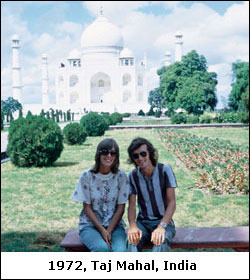
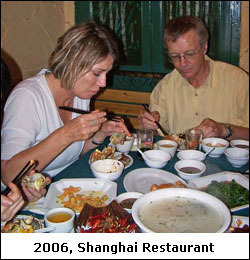
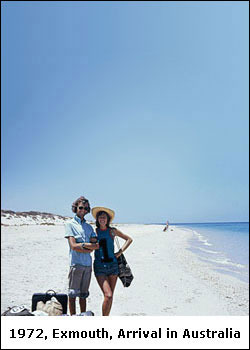
Simple, down-to-earth and practically incognito, the founder couple of Lonely Planet Publications whose guidebooks have become a bible for travellers, spend most of their time on the move. I find Tony Wheeler in his casual Hawaiian shirt, reserved in an unassuming sort of way; while Maureen, with trendy gold sandals and an instinctive sense of style is warm, friendly and bubbling with opinions, despite being under the weather. Their partnership is simple – ironically, Tony, hailing from England, with an MBA is the travel writer, while Maureen, born in Belfast, with secretarial skills and a degree in social work makes for a smart business person. Soon after their marriage, in the early 70s in an eventful overland trip to Asia on a shoestring budget, they reached Australian waters with no more than 27 cents and a camera (which they soon pawned). By popular demand they turned their experiences into a makeshift book, Across Asia on the Cheap. Eighteen months later, it was repackaged as South-East Asia on a shoestring, which has sold over half a million copies worldwide and is now in its 13th edition.

Today there are over 500 Lonely Planet titles, a thriving Internet community, and in 2007 BBC Worldwide took a majority stake in the company. Now, settled in Australia with two children, Tony, whose East Timor guidebook was awarded the Pacific Asia Travel Association 2005 Gold Award for Best Travel Guidebook; and Maureen, who has received the Inspiring Woman of Australia award (1999) and been voted Business Woman of the Year (2001), continue to travel to places that they haven’t yet been to. That is surprising seeing that they have already crossed more than 120 countries. Over an evening of conversation, I find that their experiences and decades of travel have led to their extraordinary success, which they handle with surprising diffidence.

Tony11

As travel writers, you must live nomadic lives….
Maureen Wheeler (MW): We could never stay in one place for very long, because you always have to keep moving in order to keep the information current. We never spend a week on the beach just relaxing….

Is it a part of a restless spirit?
Tony Wheeler (TW): Not so much a restless spirit as much as a necessity.
MW: The restless spirit comes first, before you become a travel writer. TW: I hate going back to the same hotel again.

Do things change for you once people find out who you are?
MW: People don’t really know who we are. I’m not amazed, but other people seem to be amazed by that. We just don’t look like anybody. If we get an upgrade, it happens because there isn’t another suite or something!
TW: Some places are very aware – but we don’t realise it. Our writers do prefer to go incognito – they get a more genuine impression. You have set the standard for travel writers….
TW: Our writers today are far more professional than we were.
MW: No. They have more ways of taking notes and better ways of keeping track with technology and the Internet, but we were very conscientious – we went to every hotel, restaurant. We had to sit down at every train station and make a list, when now you can just Google it. I don’t think that makes them more professional, just makes it a little easier for them.

Tony01

How diligent are you about each place you write about?
MW: We always went everywhere. We went to places where there was nothing. We spent three days in overnight trains getting to a place in India because we had heard you get mosaics there. After getting there, searching everywhere, we met a man who took us to a run-down villa and there was nothing to see! There was nowhere to stay or eat, so we spent another two days on the train getting back. And that ends up in the book as ‘There is nothing here – don’t bother going.’ There isn’t a standard stating you had to do ten pages, but that you had tried every single road.

In India, when Lonely Planet recommended ‘Rest House Bangalore’ other hotels changed their name to ‘Rest House Bangalore’….
TW: We are aware that in some places we have a really disproportionate influence, and we need to use that influence very carefully. We tell our writers not to be too enthusiastic and to rate judiciously.
MW: Indians are very entrepreneurial. We once got a letter from a traveller saying, ‘the hotel owner said they would give me a night free if I wrote a letter to you!’

Tony12

Do you feel content?
TW: I am proud of what we’ve done. We have done a good job and we have been honest. The guidebooks should do a number of things – they should be totally practical, but they also should be educational.
MW: There is nothing worse than sitting with a bunch of people who are talking through a performance – because they are there simply because it is a tourist thing. People should understand why it is important and to show respect as well. A guidebook must inform, educate and guide, but also give you the confidence to travel. If it can’t take you a little bit further than if you had gone without the guidebook, then it hasn’t worked well at all.

Lonely Planet – what’s in the name?
TW: It originated from a song by a late 60s rock and roll band, that went ‘Once while travelling across the skies, a lonely planet caught my eye.’ And I thought that sounded nice! The reality was Joe Cocker didn’t sing ‘lonely planet’, he sang ‘lovely planet’!
MW: When we started, it was just the two of us. But when people began reviewing these books, what stuck in people’s minds was the name of the company – Lonely Planet. People don’t go in and say ‘I want a Penguin book’ even though they know about Penguin the publisher. Very few publishers’ names are bigger than the authors.

You must have great language skills….
TW: I can say ‘yes’, ‘please’, ‘thank you’ and ask for a cold beer in lots of languages.

What’s home for you?
TW: London and Melbourne. Clothes hang in the wardrobe, so you feel like you live there. What do take with you when travelling?
MW: I can’t live without my iPod.
TW: I’m a technical person – I need my laptop and camera with me. You need your passport and a credit card, some clothes and something to carry them in, and you’re set.

Favourite travel spots?
MW: I love walking in Nepal.

Maureen has written a book Travelling With Children….
MW: We took our kids at a very young age – after three years it gets much easier, yet travelling without them seemed unimaginable. By the time our kids started school, they had already travelled almost everywhere. It is a rewarding experience having them along. All the little things that you have forgotten about begin to appear new as you see it through their eyes.

When you’ve seen everything, what do you do?
TW: Go back to your favourite ones.
MW: I don’t have a burning desire to keep going back to places – I like seeing new places, to go to different parts of places I’ve been to before…. I doubt we will see everything in our lifetime.

for those allergic to the internet

Tags

,

My husband never fails to remind me that I am severely allergic to the Internet. The world wide web has ensnared me and trapped me in its webby talons, and then made me ineffectual. Okay nothing that dramatic has happened. My husband, the tech-trigger-happy person, however, insists that I emanate some electro-magnetic power that repels anything electronic. So gadgets simply fail to work around me – those smart brilliant gadgets that would perform those dooper cool processes, simply die around me. And the super hot Internet that has changed everyones (incl. my own) life, simply fails to work, or really really slows down when I happen to surf by. It’s like I’m the equivalent of the plague for anything electronic. Of course, when this techie husband of mine picks up the laptop in an attempt to quiet the wails that emanate from my soul at failed technology, he merely needs to tap and pat and stroke the damn machine and it responds just fine. It’s not like I don’t love it like he does, but damn it, isn’t it just a friggin’ machine? I guess that last statement just damned me into technology hell, or the equivalent – which is no Internet, ever. You may never read any more blogs written by me. If they are written, it’s gotta be an imposter….

when does editing stop and writing begin (or vice versa)?

Tags

,

what’s in an apostrophe i say? i mean does it really matter at the end of the day if it is its or it’s? It really is an indelible itch to fix these apostrophes, coz they simply seem like such a small big thing! they change the meaning from personable to impersonable, and it seems like the error is glaring at you when you read it – doesn’t everyone notice it?

at that stage you really wonder at what stage you stop being a writer (allowed to make such incongruous mistakes) and become an editor (shrivelling up with the anxiety of a missing ‘strophe). and does being a better editor make you an equally better writer? OR doesn’t being a better writer, make you a better editor?

Unfortunately, I believe none of the above have anything to do with the other. An editor is probably waiting for a story to tell – and after having read so much crap stuff and good stuff by others, is simply too jaded and self-critical to actually write… and a writer is simply so ponderously self-obssessed with a story or the finer nuances, that the judicious clarity to edit – to step away from the work, and actually see it as it is, is quite matter-of-factly, lost. I mean, of course that it s a huge generalisation but that is how it seems to fit just right. Writers write and editors edit. Writers suffer editor’s block and editors suffer writer’s block.

They say a book or film is as good as its editor. An editor works quietly (or not so quietly – I suppose they must be given to temperamental fits) behind the scenes to make the final product what it is – to make it or break it. I guess that’s why so many writers thank their editors in the acknowledgements, and so many directors simply forget to thank their editors in their trophy acceptance speeches! Since there are awards for ‘best editing’ in movies – why isn’t there an award for best book editor? Not that I want one of course, I’m waiting to write that book.

Travel blog: Hope Floats (Andaman and Nicobar Islands)

Tags

, , , , ,

Published: Verve Magazine, Travel Special, April 2009
Photographs by Geeta Parikh

Andaman05

Sweeping palms and azure waters conjure up an idyllic way of life. Tragically, a gigantic and destructive wave washed all that away faster than you could say ‘Nicobar’. Sitanshi Talati-Parikh reports on the return of the celebratory spirit of life in Car Nicobar post the ravages of the 2004 tsunami


Andaman03

The Andaman and Nicobar islands evoke mixed feelings, predominantly those of curiosity. While images of gorgeous turquoise seas and pristine beaches are imagined by the mind’s eye, there is an element of uncertainty post the 2004 tsunami that ravaged lives and life on the islands. Pooja and Ankur Pandhe (Pandhe Group), currently on the island, are involved in the task of rebuilding local infrastructure. They initially teamed up with an NGO in 2005 and now work in tandem with the Central Public Works Department. Pooja informs me that the Car Nicobar island is a restricted area where tourists are not allowed without a special permit. This is not surprising considering it is an armed force base on which special training and testing activities are carried out, and also because of its strategic location – it’s only a few miles away from India’s southern-most territory, Indira Point.

Last year saw the little island celebrate for the first time in four years. The 55th All India Co-operative Week Celebration was held with over 10 of the villages involved in the performances and celebrations, including cultural exhibits and inter-village competitions. Local colours and moves kept pace with the coconut-flavoured delicacies. Life in this little big island is slowly but surely getting back to normal. Schools have started to run. With government-aided efforts including relief funding from agencies, concrete roads, permanent shelters and most importantly, food, have been provided to the inhabitants. You can spy school-going children scampering along, men feeding their pigs, women cooking or shelling coconuts, and you realise the locals do not have a fixed daily schedule. While the islands have fertile soil, relief funding has reduced the motivation to cultivate, grow and sell. A horticulture department on the island grows a few vegetables; otherwise all supplies are imported from Port Blair and nearby islands. There is actually no vegetation on the island.

Bright young entrepreneurs Pooja and Ankur find that, “The islands will continue to remain the abode of the Nicobari tribals, always remaining somewhat secluded from the life on mainland India. The beats of their tribal drums may bring back the memories of the devastating tsunami from time to time, but thanks to efforts from?various agencies, life is better now, foreseeing a better future for the next generation.”

Andaman02

TEMPTATION ISLANDS

While Car Nicobar restricts entry, the Indian Ocean offers many spectacular islands in the Andaman and Nicobar group which are great destination spots. Think rare flora and fauna, exotic underwater marine life and corals, crystal-clear seas and mangrove-lined creeks.

Port Blair This Andamanese town is home to several museums and a major base for the Indian Navy and the Indian Coast Guard. The Cellular Jail that became a symbol of the tenacity of the Indians in their freedom struggle is also located here.

Baratang From Port Blair ferries and a restricted Jarawa tribe area bring you to this island where you can check out limestone caves and a mud volcano.

Parrot Island Take a speed boat from Baratang if you are a parrot lover.

Havelock Island Tourist-friendly (with eco-tourism), great for scuba diving and known for its rich marine life. Can be reached by government boats that run from Port Blair.

Barren Island You can find the only active volcano in India here, with a big crater of the volcano rising abruptly from the sea. Can be visited on board vessels.

Ross Island Ruins and a small museum named Smritika holds photographs and the other antiques of the Britishers, the island having once been a seat of British power.

Getting There
Port Blair is connected with Delhi, Chennai and Kolkata by air. Regular passenger ship services are available to Port Blair from Chennai, Kolkata and Vishakhapatnam and back. Charter flights or ferries to other islands are also available from Port Blair. For more information go online to www.andaman.nic.in.

Travel blog: And When Home Beckons…. (Amanresorts, Bali)

Tags

, , ,

Published: Verve Magazine, Travel Special, April 2009

The complete Balinese experience includes rice paddies on mountains, volcanic home of the gods and sun-kissed beaches. Amanresorts creates a lifestyle out of intimate experiences with their three exquisite properties in Bali. Sitanshi Talati-Parikh discovers that these resorts go above and beyond making you feel right at home

They say you just have to let go of all that weighs you down in the city and find yourself floating weightlessly along in Balinese heaven. I believe it’s the simple concept of going back to nature. What some people call luxury, it is very basically finding your roots.

Seeing Bali through their eyes is about hillside villas designed like a Balinese village overlooking the best of Ubud at Amandari (peaceful spirits), sinking your toes into dark volcanic sand amid private bales poised against a backdrop of Mount Agung (a volcano revered as a home of the gods by the Balinese) at Amankila (peaceful hill), and finding yourself surrounded by the serenity of a golf course and most importantly, space, in Amanusa (peaceful isle). The typical Bali-Aman holiday drives you placidly through a time and space where you feel the world has taken a little pause, a deep breath to add some tranquility back into your life.

Aman02

Aman directly implies peace, and that is something that these worldwide resorts, from the very first one (Amanpuri, Thailand, 1988) have tried to incorporate. They successfully create a natural environment for you to feel rejuvenated. That doesn’t mean that water sports, helicopter tours, Balinese temples and spas are not on the menu. The difference lies in the little details. As I walk into the villa, I feel an overwhelming sense of grandeur that comes particularly from the large spaces, open air, thatched roofs that serenade the sky, and every object that has been meticulously drafted from local handicrafts and nature. Fresh flowers kiss woven cane and straw holders and muted earthen jars play hide-and-seek with overflowing sunshine. You feel like you are a part of nature with the open rain showers. I lie in front of the gigantic private pool and watch a play between a fat gecko and a palm frond and engross myself in the beautiful coffee-table books that lie on the traditional engraved chest.

With the high staff-to-guest ratio in these small luxury hotels, I am not surprised that the managers know each guest by name, leave handwritten notes for them and personally attend to them. I arrive at Amandari, with a host of allergies, and find the chef Morgan Lonergan and the sprightly manager Liv Gussing at my service, organising a customised meal on short notice. Within minutes, all the other resorts have been informed of my food restrictions, menus have been prepared in advance to accommodate them, and I find myself eating innovative meals that I have never enjoyed before now. Amanusa’s solicitous chef Hamish Lindsay actually prepared gluten-free cupcakes, pizzas and bread to go with the finely spiced local cuisine.

While the chefs and managers are expats who bring to the hospitality an international accent and finesse, the staff that is local and Balinese, (hailing sometimes from Java) are warm and inviting – take for instance the motherly Ibu Sariyani who has been with Amandari for 20 years. Amandari has built the resort right into the mountain, not separating it from the regular mountain paths – one such passageway cuts right through the resort and you can find the Balinese people trudging up and down on their regular beat. Faint melodies float through the air as a little dance school that is run on the premises allows the little local girls to practice and hone their skills, while the boys acclimatise themselves to local instruments.

Amid the scent of frangipani and tuberoses at Amankila, I discover that Amanresorts provides a sanctuary for people – rather than a place to see and be seen, it is a place where people who lead hectic lives, find quiet repository to detox. It is where songs of the birds and rustle of leaves come alive, over the much-needed silence of a non-existent television set. It is not surprising then, that the resorts have an extended list of famous people who choose to unwind here, often thinking, rejuvenating and maybe even writing a book or two.

Travel blog: From China, With Love (Vikram Seth)

Tags

, , , , , , , ,

Published: Verve Magazine, Travel Special, April 2009
Illustration: Bappa

The reclusive writer Vikram Seth goes From Heaven Lake down memory lane. While at the University of Nanjing, young Seth, armed with a rare travel card, began a hitchhiking trip through the remote parts of China all the way to Lhasa, traversing difficult climatic zones and eating glutinous broth with pork fat floating in it. Sitanshi Talati-Parikh finds the writer fondly nostalgic

Vikramseth

He is as charming as he is reticent. He faces audiences like a pro; wooing them and making them chuckle with his tongue-in-cheek humour. I watch as he quietly walks to the people he knows, greeting them in perfect English and Hindi. He mingles with the cocktail crowd, and it is hard to remember that he is indeed reclusive. As little children put up a performance in his honour, he pays them full attention, and is willing to cut his talk short to ensure that they have sufficient time. Over cocktails at Amandari, the audience reaches out to him, asking him about his irrepressible journey, referenced in his travelogue From Heaven Lake – Travels Through Sinkiang and Tibet (1983).

Extracts from the conversation with Vikram Seth:

You were in China when it was a “different era”. Did you have a sense of the scale of difficulty?
No! If I had, I would have never done it. ‘Rules are rules’ – I can’t tell you how many times I heard that in China. The only way to counter a rule was to invent an opposing rule.

You had some interesting experiences with the Chinese language.
When I first went to China, I could hardly speak Chinese, despite having studied it. So when my friends asked me how I came to China, I used the wrong intonation of speech. When I meant to say aeroplane, it actually sounded like ‘fat chicken’.

You went to the local truck station instead of taking a train or plane. Why that particular choice of transportation?
I didn’t have very much money. I was in this desolate desert town called Willow Garden – the last willow must have disappeared several hundred years ago. After two days it was like descending into a vortex of despair. I ingratiated myself with a person leaving soon in an army truck that was loaded up to the brim with live chickens and fruit, with very inefficient heating. Not very far there were huge floods across the desert where we were stuck for days on end. The one thing you don’t expect in the desert is a lot of water, but it’s always there when you don’t need it!

What drew you to Tibet?
Tibet is a mixture of two great culture zones. It was a mysterious land and with my brother gearing towards Buddhism, I felt a strong inclination to go there. The feeling lingers to date. So strongly was it fixed as an aspiration, that even when it was fulfilled, it didn’t seem plausible.

People you met along the way had been trained to be very suspicious of foreigners. What kind of response did you get?
Quite rightly, if your family’s well-being is at stake, or you might be put down as consorting with foreigners, then it is absurd to put yourself in that kind of risk. Some people were keen to use you as a punchbag for language practice, others wanted to get to know you. Eventually you realised what good friends the Chinese make – reticent, and with a subtle and slapstick sense of humour.

Why did you decide to turn your experiences into a book from journals and photos?
I arrived home and was initially mistaken for a street peddler. I was burnt black by the sun, was wearing a blue Chinese cotton coat and carrying a Hessian sack with all my belongings. Eventually, I got really impatient and bored narrating my stories, so I decided to write a few pages. And then strange people appeared at my door, apparently from the foreign ministry armed with maps of China. My father suggested writing a book about it. And that’s what I did. I had no agent – I just sent out ten letters and a map!

Tell us about Heaven Lake.
It is a beautiful snow-fed mountain lake in a small range of mountains in the middle of the desert. You’re baking in the heat, have to buy a cap for yourself, and as you go higher and higher, you visit Heaven Lake – and actually freeze.

The foreword to the book was written “in white heat” three days after the Tiananmen Square massacre.
In some sense, I am not really qualified to speak about the state of affairs. I have followed it with interest, but I haven’t been back. No one has ever said that the dreadful massacre was wrong. Even now, at a time when the government has created such a prosperous economy, there’s such a strong journalistic hand – and a brutal hand – upon people who want to exercise free speech. Any alternative power centre or centre of allegiance has been crushed with an iron hand. I don’t know where it will lead! Chinese history is perhaps more brutal, and there is a more humanist tradition that goes through it, than in any other country. Even at times when people are in despair, like during the Cultural Revolution, when they had to betray their families, they took refuge in their great poets. They see long continuity, and it helps them get through terrible times.

Do you imagine having the freedom to say ‘I will stay a few extra days’ or to have an adventure like that again?
I am trying to enter a second childhood, by refusing to do anything. I rarely accept invitations and keep, as far as possible, a blank calendar. And it is not just so much a question of saying ‘I’ll stay here’, but it’s almost as much a question of ‘I am doing Chinese calligraphy, or painting,’ without having the obligation to go somewhere, or be somewhere. My friends now invite me on very short notice – if I’m not on the 13th line of a sonnet, then I’ll say, ‘sure’ – if they invite me with six weeks notice for a sit-down dinner, the answer is: ‘Don’t depend upon me.’

It has been two decades since you have revisited China….
It was 1982 when I left China after staying there for two years. In 1989 I went back, seeing that China, like the whole communist world, was opening up. Three days after returning from my visit, I read the newspaper and the headlines – the massacre of thousands of people on the square. Of people who wanted nothing more than a more open system. Sooner or later I will want to go back to China – it is very close to me and to my heart, in terms of the culture. Places change. India has changed a lot.

Imran Khan: An Actor and a Gentleman

Tags

, , , , , , , , , ,

Published: Verve Magazine, Verve Man, Features, April 2009
Photograph by Colston Julian

Affable yet reticent, blunt yet polite, serious yet funny, unemotional yet moody, Bollywood’s latest poster boy seems to be a contradiction of sorts. Aamir Khan’s nephew and Nasir Husain’s grandson, 26-year-old Imran Khan is two films down with two new releases, Delhi Belly and Luck coming up this year. Sitanshi Talati-Parikh draws the suave and restrained actor out, even if just for a little bit

Imran02

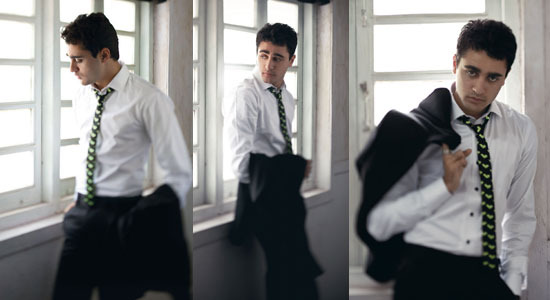
The brows are furrowed in intense concentration. The facial expression is blank. The eyes are reflective. The humour is deadpan. No smirk, no smile, not even a laugh line. And yet we all titter. What is it about this new kid on the block that sends hearts fluttering and makes you yearn to know more? As I watch Imran Khan step self-consciously in front of the camera, taking shot after shot effortlessly, I can’t help but notice his face has character. Whether it emanates from the well-crafted jawline or the intensely expressive eyes, it’s unmistakable. After every shot, Imran lithely hops over for a critical assessment. He is his own worst (or best) critic. As he discusses camera angles with photographer Colston Julian, I learn that he is a self-taught actor (or more accurately, natural), while he has been formally trained in writing, cinematography and direction at New York Film Academy, Los Angeles.

In a crisp white shirt and black trousers with a funky Batman tie (he is a huge fan), Imran sits cross-legged before me on a chair with an expectant look on his face. Why would someone who looks as good as him not attempt to give acting a shot and head straight for direction? As a child he picked up the camera, playing with genres like sci-fi (on the lines of Alien), Agatha Christiesque murder mysteries and spoofs. Post-school, he stumbled from market research into advertising (including ad films). At this point he realised films are what he understands best. After all, the mere smell of celluloid gives him butterflies in his stomach.

Acting was never his intention. A sequence of events – or fate – combined with Abbas Tyrewala’s faith in him led to Imran being cast as the lead in Jaane Tu…Ya Jaane Na (2008), the film that made him an overnight star. Despite having played a young Aamir Khan in Qayamat Se Qayamat Tak (1988) and Jo Jeeta Wohi Sikandar (1992), he says matter-of-factly, “I never thought of myself as being a very good looking guy and figured there was no place for me in the Hindi film industry. Hrithik Roshan set the bar. He is a complete package. I’m not built like him, I can’t dance even a quarter as well as he can – that’s something I aspire to.”

Noticing my imperceptible shiver with the blast from the air conditioner, he solicitously jumps to his sock-covered feet and props himself up on his toes to tone down the room temperature. Then in a flash he is back in interrogation mode. Born in Wisconsin, America, to Nuzhat Khan (director Mansoor Khan’s sister) and Anil Pal, he moved to Mumbai with his mother after his parents’ divorce. He was a year and a half at the time. In all the schools he went to – including Bombay Scottish (Mumbai), two schools in Ooty, a nature-based gurukul in the Nilgiris, Bangalore and Fremont high school in Sunnyvale, California, he was always the new kid in school. “It was really tough. I didn’t grow up being considered cool or dating a lot of girls. I was into science and books and not into sports. I was always the odd one out at parties, sitting in the corner, knowing barely two or three people.”

Imran admits that constantly moving from school to school made him more independent but also a bit of a loner. “I don’t socialise a lot and like silence. I can’t be on all the time – I need occasions when I am with absolutely no one so I can reset, recharge, rejuvenate and then come back out.” He has only just started to make friends in the industry – think Ranbir Kapoor – since he grew up not knowing anyone. Though fond of listening to music, he can’t abide television. He actually doesn’t own a TV or a cable connection. Surprising, considering that he is an obsessive movie buff and watches three to five movies a day (on his computer) and is happiest when at a movie theatre.

As we get to the much-publicised fact that girls are extremely “well-behaved” around him – “very calm and composed – no crazy stuff,” I discover he is also the guy who likes to be in the background and tries not to get noticed. “I roam around town (getting a roll at Candies, Bandra) practically invisible. It’s like an internal switch I can turn on and off. I can walk into a room and make everyone turn around and notice me, or I can walk across a room and no one will ever realise that I am there.”

Imran04

He can be brutally blunt without any perceptible intention of causing discord. “I can’t make stuff up or say anything that isn’t exactly as it is. I live my life by fact and follow reason and logic. I find emotion and irrationality hard to deal with.” Does that make relationships complicated? He swiftly attributes his personal growth to his relationship with girlfriend Avantika Malik, whom he has been seeing for over six years. “I have learned a lot about myself and become a more balanced person. I was 19 when I started seeing Avantika, at a point where I couldn’t express my thoughts and feelings. I’m still not very good at that but have become more comfortable with my own emotions.” The young actor doesn’t see any danger in tagging himself as ‘unavailable’ – “People trust you more if you are open about your relationships.”

Post film school in LA, he could have tried his hand at Hollywood movies. He attributes his return to India to finding it offensive that elite Indians can be so disdainful of Hindi films. “I understand that these movies have shortcomings, but I want to make it better!” He explains earnestly, “I have never lacked anything in life. Everything that I have today comes from the film industry. My grandfather started with nothing – his family threw him out when they found out that he wanted to work in the film industry. He has built it all up, and for me to run away from that is impossible.” I can quite believe him when he says his strongest point is his integrity. “If it is not right or not honourable, I won’t do it – like taking money for things I don’t believe in. It may be an old-fashioned concept, but it counts for something, right?”

Right. And victory follows the honourable? According to the Capricornian, “Success is having the freedom to choose to do only what you really want to do.” By his own definition, Imran is very successful. While scripts are lined up at home, he can’t seem to find one that excites him. “I feel bored and stagnated if I am doing the same thing over and over – that’s part of the reason I am not a banker!” It explains why he jumped from playing a romantic hero to a villain. Ironically, while serious roles are easier for him than light, fun, “torturous” scenes, Imran suffered a lot emotionally, playing the negative role in Kidnap (2008). He couldn’t sleep, would suddenly start crying, and even threw up, dealing with the violence of the character. I ask him if it is worth it. Pensively he says, “I have come out of that stronger as an actor. It’s like scar tissue – when it heals, it heals back tougher.”

In his upcoming comic caper Delhi Belly, directed by Abhinay Deo and from the Aamir Khan Productions banner, Imran sports a new look. He loses the beefed-up frame of Luck, a forthcoming action-thriller directed by Soham Shah and turns into a long-haired, scrawny guy. “Everyone knows how much your physical appearance affects you personally. Women think that way about being fat while guys worry about being skinny.” He straightens his body and puffs his shoulders to demonstrate. “Physicality means a lot – for better or for worse. That’s how we are!”

He is precise and involved about his look to the extent of admitted eccentricity. The idiosyncrasy is tinged with moodiness – he shuffles simultaneously through multiple books and movies entirely dependent on his frame of mind. Imran, who coined, “I like humanity in principle but not in practice,” doesn’t wear his heart on his sleeve. “The people who matter know and understand me. I don’t feel everyone needs to like me beyond a superficial level.” And yet this intensely private person is also incredibly sentimental. The quirky tie collector fondly treasures his grandfather’s blue tie; and the green-and-yellow striped tie worn by Aamir in Jo Jeeta Wohi Sikandar is sported by the nephew in the publicity stills of Jaane Tu…. I inadvertently stumble upon a pair of bright-hued Converse shoes (another fetish) gifted to him by a friend on his birthday, that he doggedly wears despite their being a size too small.

He puts the shoes down and looks up expectantly. My first and last memory of him is his intense concentration. He doesn’t get distracted easily as people move, doors open, phones ring, bugs fly; he remains completely tuned into the task at hand. For about an hour the deep brown eyes are trained onto me and the very second, the conversation (as he prefers to term it) is over, the eyes have clicked out and the focus has shifted to the next task at hand. The bright young Khan – who refuses to tint his car or wear sunglasses because they hide the eyes and mask the face – has withdrawn into his shell, the inscrutable mask back in place.

Curly Fries, Crunchy Crabs and a Patisserie Called Tart

Tags

, , ,

Published: Verve Magazine, Features, March 2009
Photographs by Nilesh Acharekar

As the young flood Mumbai post international living, education and exposure, Sitanshi Talati-Parikh finds that the city is quickly adapting to their exacting demands and needs, giving rise to a dynamic, fast, racy and global trend. The bagels are lathered with cream cheese, the burgers are juicy and there is authentic dim sum and then some. Warmth and attentive service are their mantra. The choicest of downtown Mumbai’s happening youth-run establishments open their doors to share their unique experiences and tantalising recipes

Henry Tham
Ryan and Keenan Tham

Walking into the Asian bistro you feel enveloped by a sense of serenity. Dim lighting, tall ceilings and Buddhas galore make this little restaurant and bar appear spacious and inviting. In 2005, post a degree in hotel management from Griffith University, Australia, the young Tham brothers, who are suave and affable in their part, brought to Mumbai the trendy upmarket concept, which at the time was relatively new in the area. Post their successful partnership in Olive, and seeing that no other Asian resto-bar existed at the time, they decided to create a place where people would like to come to celebrate special occasions, while also finding it equally comfortable kicking back with a fresh juice martini in the evening. The new-age food and promising seafood has taken the third generation family establishment a step further, wooing the hip young ones and couples. With an ambitious future expansion plan in mind, Ryan (26) and Keenan (24) felt confident enough to create a brand with their father, Henry’s name, riding on the goodwill and knowledge that he has built over the years. The bar reflects the brothers’ personality and is known for funky cocktails pulsating to the sounds of house, jazz and blues.

Rest12

Mandarin Crab
Ingredients: Medium-size live crab, 1 no, 800 gms; Chopped ginger, 2 tbsp; Chopped garlic, 3 tbsp; Chopped onion, 1 no; Chopped green chilli, half tbsp; Chopped spring onion (green stem), 3 nos; Dark soya sauce, 1 tbsp; Light soya sauce, 1 tbsp; Chopped coriander, 1 tbsp; White pepper, half tsp; Salt, pinch; Sugar, 1 tsp; Chicken stock soup, 200 ml; Cornflour mixed in 60 ml water, 1 tbsp; Groundnut oil for the sauce, 3 tbsp; Cooking oil (for deep frying the crab), 400ml.
Method: Freeze the live crab for two hours till it is asleep and in a coma. Rip off the top shell and clean the crab of its grey gills. Chop the crab into six pieces. Pour 400 ml of cooking oil in a wok and deep-fry the crab for about 3 minutes till it is red in colour. Remove crab from oil. In a fresh wok pour three table spoons of oil and add the ginger, garlic, onion, chilli and stir-fry on medium flame till garlic is golden brown. Add light and dark soya sauce and some white pepper, sugar and salt to taste. Add the stock soup. Increase the flame to high. When it comes to a boil, add the crab and toss for four minutes. Add the cornflour mix to thicken the sauce. Add spring onions. Sprinkle the coriander on top and the crab is ready to be served.

Vong Wong and Dragonfly
Aashiyana Shroff

Café culture has really found a place in the echelons of Mumbai city. While chains and independent coffee shops have worked, you would be rue to find a gourmet café that is not overpriced in the Nariman Point area. Originally started as a lounge and bar, Dragonfly has now recreated itself into a spacious café and brunch spot through the day, wooing partygoers on weekend nights. Aashiyana Shroff, 26, who moved to Mumbai from London four years ago, teemed up with her father Deepak Shroff and turned her passion for food into their first venture Vong Wong – a Chinese and Thai cuisine restaurant. Dragonfly, located in the same space, though accessible from a different entrance, rivals the former with voluminous space overlooking the ocean. Aashiyana’s reinvented Dragonfly opened its doors last month, with “value for money; good, comfort food” like pizza, pasta, salad and burgers. Not wanting to take themselves too seriously, the place now has a more approachable and less pretentious feel. Also introducing a patisserie called Tart with a cupcake speciality, this is an avatar worth checking out.

Rest02

Greek Salad
Ingredients: Cucumber, 30 gms; Red pepper, 20 gms; Green pepper, 20 gms; Tomato wedges, 20 gms; Feta cheese, 60 gms; Onion ring, 10 gms; Kalamata olives, 10 gms; Romaine lettuce, small bunch; Vinaigrette dressing, 60 ml; Oregano, 1 tsp.
Method: Cut the cucumber, red pepper, green pepper into cubes. Cut tomato into wedges and olives into half. Mix all the ingredients. Arrange in a salad bowl. Sprinkle chopped oregano on top.

OBA
Rishi Acharya

Thirty-year-old Rishi Acharya has found himself splat in the middle of the hospitality industry despite being from a completely different educational background. While his family business has been distribution and retail of alcohol, he did his Bachelor’s of Commerce from H.R. College, Mumbai. He got involved with Athena, after which his ventures (along with his partners) Lush and Ra (named after his initials) became hugely successful. After an unsuccessful stint in food retail, Rishi decided to join hands with Raja Dhody to start OBA, a New York-style resto-lounge, which encourages an evolving party experience with lighting and ambience that transforms according to the hour and concept – from bright dinner and ambient lounge to a glowing red ceiling light for the night. Rishi speaks from experience when he says that opening a large upmarket space and then changing the clientele demographics from exclusive guest-list only to all and sundry, is not what he has in mind for OBA. He is firm about wanting a sophisticated crowd (ideal age group 28 and up) in his 2300 square foot place, without it getting too crowded. He anticipates a select society, where you come confident with the knowledge of bumping into friends.
Rest14

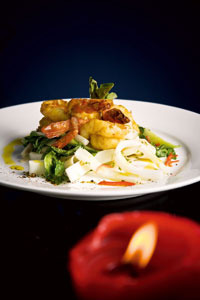
Pan-tossed prawns with onions, mint, and pak choi served with herb fettuccine and curry oil
Ingredients: Prawns b grade, 5 nos; Curry powder, 10 gms; Butter unsalted, 10 gms; Olive oil, 30 ml; Salt to taste; Fresh red chilli, 1 no; Pak choi sliced, 20 gms; White onion sliced, 10 gms; Shredded mint, few sprigs; Parsley, few sprigs; Lemon, 1 no; Garlic chopped, 5 gms; Extra virgin olive oil, 50 ml; Fettuccine (boiled), 80 gms.
Method: Heat the extra virgin olive oil with half curry powder, garlic, half onion. Let the oil cool and blend. Strain through a fine sieve to clear. Marinate the prawns with curry powder, salt, pepper and parsley. Heat olive and butter in a pan, add the prawns and cook till done. Blanch the vegetables. Toss the pasta with olive oil, red chilli, vegetables, onions and season with mint. Put the pasta in the centre of the plate. Top it up with vegetables. Arrange the prawns on top of the vegetables. Dress the dish with curry oil. Garnish with few mint sprigs and a lemon wedge.


Wich Latte
Abedin Sham

Twenty-six-year-old Abedin Sham, returned from Cornell University, USA with a specific idea in mind. An all-day eatery that catered not only to the myriad tourists walking down Colaba Causeway, but also to the people who have spent time abroad and crave the basic café food that is so easily available in the West. With an affordable price tag and imported items that appeal to a younger age group, Abedin conceived a kitchen that put together freshly baked multigrain breads, curly fries and imported cheeses. Known for their soup-in-a-bowl, gourmet sandwiches, bagels and salads, Wich Latte appears to be modelled closely on America’s café chain, Panera Bread. With plans to create express outlets with a centralised kitchen using economies of scale and the franchise model, Abedin is ready to take up the challenges post the success of his first venture.

Rest06

American Veg Gumbo
Ingredients: Tomato puree, 100 ml; Broccoli, 25 gms; Baby corn, 25 gms; Carrot, 25 gms; American corn, 20 gms; Potato, 20 gms; Okra, 50 gms; Chopped garlic, 15 gms; Onion, 10 gms; Celery, 10 gms; Chopped basil; Salt and pepper, to taste; Vegetable Stock, 40 ml.
For Vegetable Stock: Water, 500 ml; Onion, 1 no; Celery leaf, 30 gms; Bay leaf, 1 no; Pepper corn, 2-4 nos; Carrot, 1 no; Leek, 20 gms.
Method: Heat the oil. Sauté garlic, celery, leeks, Add the tomato puree. Sauté along with the tomato puree for two-three minutes. Add the stock. Blanch the vegetables separately. Sauté them in butter. Add to the stock. Boil till tender make sure not to over cook the vegetables. Add 15 gms of roux for thickness. Add shredded basil for finish. Serve hot.

Pub Culture

Twenty-six-year-old executive, Aditya Parikh, decided to set up a ‘Thursday Drinkathon’ with a few friends, where young people get together post-work at a common location (generally in the Mumbai downtown area) to grab a few cold ones. It is networking, unwinding and partying all rolled into one. A peek into two of the many London-esque pubs that have sprouted in Colaba

Woodside Inn

Three young boys, Sumitraj Gambhir (27), Pankil Shah (27) and Abhishek Honawar (25), partners of a company called Neighbourhood Hospitality Management Services, decided to innovate with Woodside Inn, December 2007. They saw potential in the place nestled within a 120-year-old heritage building that has evolved many times, but has been largely successful on this particular instance. The concept is a warm neighbourhood bistro, reminiscent of the London pubs, where one can easily kick back, post work and catch up with colleagues or friends. Images of Mumbai line the walls, where wood, food and beer find a happy marriage in what they call an “urban experiment”. Frequented by artists during the day and professionals in the evening, the place has recall value for its character.

Bootleggers

Thirty-year-old Sushant Kamath, with a wide range of experience in the hospitality industry in Mumbai, Pune and Goa and 32-year-old Kumar Patel, with experience in healthcare in New York, opened the doors of Bootleggers in April 2008 to create a “non-territorial, non-class conscious place” to hang out. It is an “attitude-free space” that is full of interactive games, such as chess and scrabble, with pub quizzes once a month testing the general knowledge of the guests. It is frequented by groups of women who feel comfortable in the space, besides that fact that Tuesdays offer them cosmopolitans on the house. Very receptive to feedback, they have recently expanded their food menu, insisting that the take-away is “warmth”.